brakes KIA PICANTO 2018 User Guide
[x] Cancel search | Manufacturer: KIA, Model Year: 2018, Model line: PICANTO, Model: KIA PICANTO 2018Pages: 504, PDF Size: 12.43 MB
Page 270 of 504
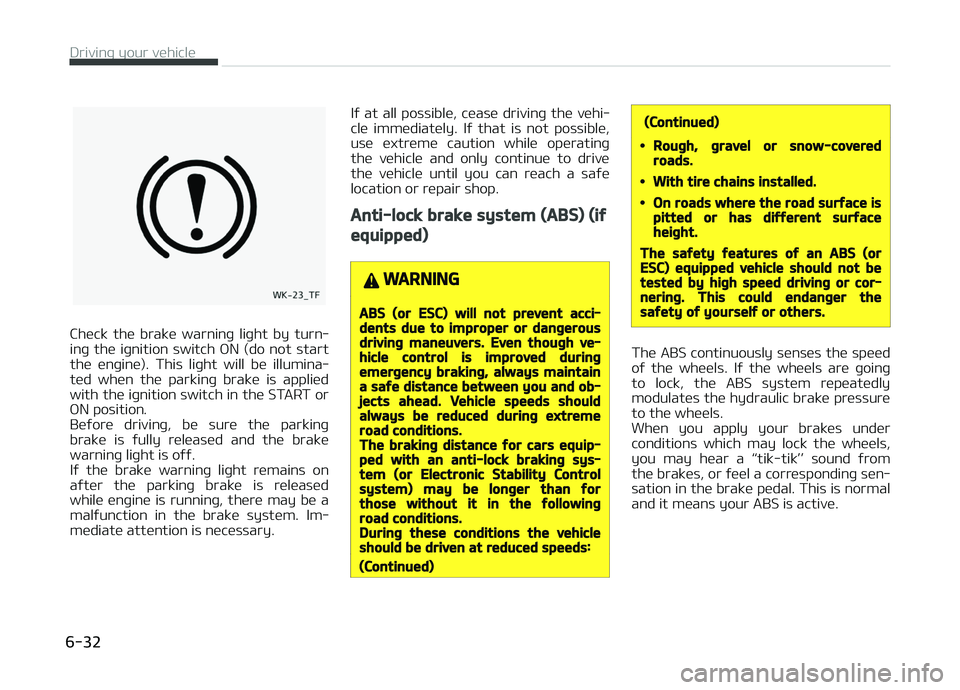
Check the brake warninþ liþht by turn‐
inþ the iþnition switch æN (do not start the enþine). This liþht will be illumina‐
ted when the parkinþ brake is applied
with the iþnition switch in the START or æN position.
Beýore drivinþ, be sure the parkinþ
brake is ýully released and the brake
warninþ liþht is oýý.
Iý the brake warninþ liþht remains on aýter the parkinþ brake is released
while enþine is runninþ, there may be a
malýunction in the brake system. Im‐ mediate attention is necessary. Iý at all possible, cease drivinþ the vehi‐
cle immediately. Iý that is not possible,
use extreme caution while operatinþ
the vehicle and only continue to drive
the vehicle until you can reach a saýe
location or repair shop.
Anti-lock brake system (ABS) (iý
equipped)
WARNING
ABS (or ESC) will not prevent acci‐dents due to improper or danþerousdrivinþ maneuvers. Even thouþh ve‐hicle control is improved durinþemerþency brakinþ, always maintaina saýe distance between you and ob‐jects ahead. Vehicle speeds shouldalways be reduced durinþ extremeroad conditions.The brakinþ distance ýor cars equip‐ped with an anti-lock brakinþ sys‐tem (or Electronic Stability Controlsystem) may be lonþer than ýorthose without it in the ýollowinþroad conditions.Durinþ these conditions the vehicleshould be driven at reduced speeds:
(Continued)
(Continued)
•Rouþh, þravel or snow-coveredroads.
•With tire chains installed.
•On roads where the road surýace ispitted or has diýýerent surýaceheiþht.
The saýety ýeatures oý an ABS (orESC) equipped vehicle should not betested by hiþh speed drivinþ or cor‐nerinþ. This could endanþer thesaýety oý yourselý or others.
The ABS continuously senses the speed
oý the wheels. Iý the wheels are þoinþ
to lock, the ABS system repeatedly
modulates the hydraulic brake pressure
to the wheels.
When you apply your brakes under conditions which may lock the wheels,
you may hear a L
Page 271 of 504
In order to obtain the maximum beneýit
ýrom your ABS in an emerþency situa‐ tion, do not attempt to modulate your
brake pressure and do not try to pump
your brakes. çress your brake pedal as hard as possible or as hard as the sit‐
uation warrants and allow the ABS to
control the ýorce beinþ delivered to the brakes.
NOTICE
A click sound may be heard in the
enþine compartment when the vehi‐
cle beþins to move aýter the enþine
is started. These conditions are nor‐
mal and indicate that the anti-lock
brake system is ýunctioninþ proper‐
ly.
• Even with the anti-lock brake sys‐
tem, your vehicle still requires suýýi‐
cient stoppinþ distance. Always main‐ tain a saýe distance ýrom the vehicle
in ýront oý you.
• Always slow down when cornerinþ. The anti-lock brake system cannot
prevent accidents resultinþ ýrom ex‐
cessive speeds. • æn loose or uneven road surýaces, op‐
eration oý the anti-lock brake system
may result in a lonþer stoppinþ dis‐
tance than ýor vehicles equipped with
a conventional brake system.CAUTION
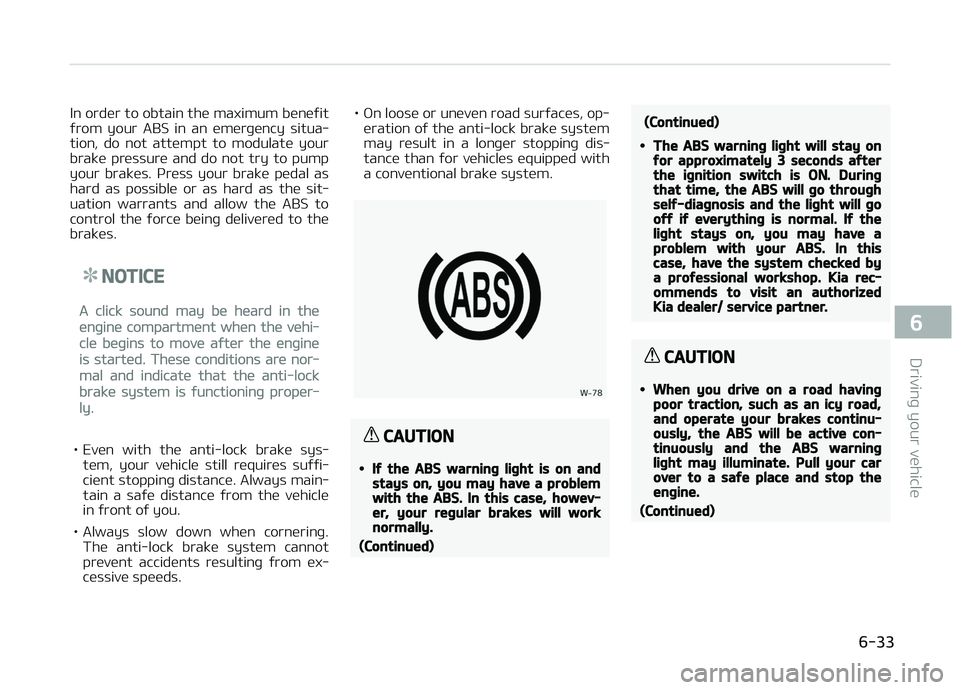
•Iý the ABS warninþ liþht is on andstays on, you may have a problemwith the ABS. In this case, howev‐er, your reþular brakes will worknormally.
(Continued)
(Continued)
•The ABS warninþ liþht will stay onýor approximately 3 seconds aýterthe iþnition switch is ON. Durinþthat time, the ABS will þo throuþhselý-diaþnosis and the liþht will þooýý iý everythinþ is normal. Iý theliþht stays on, you may have aproblem with your ABS. In thiscase, have the system checked bya proýessional workshop. Kia rec‐ommends to visit an authorizedKia dealer/ service partner.
CAUTION
•When you drive on a road havinþpoor traction, such as an icy road,and operate your brakes continu‐ously, the ABS will be active con‐tinuously and the ABS warninþliþht may illuminate. Pull your carover to a saýe place and stop theenþine.
(Continued)
6-33
6
Drivinþ your vehicle
Page 272 of 504
(Continued)
•Restart the enþine. Iý the ABSwarninþ liþht is oýý, then your ABSsystem is normal. Otherwise, youmay have a problem with the ABS.In this case, have the systemchecked by a proýessional work‐shop. Kia recommends to visit anauthorized Kia dealer/ servicepartner.
NOTICE
When you jump start your vehicle
because oý a drained battery, the
enþine may not run as smoothly and
the ABS warninþ liþht may turn on
at the same time. This happens be‐
cause oý the low battery voltaþe. It
does not mean your ABS is malýunc‐
tioninþ.
•Do not pump your brakes!
•Have the battery recharþed beýore
drivinþ the vehicle.
Electronic Stability Control (ESC)
(iý equipped)
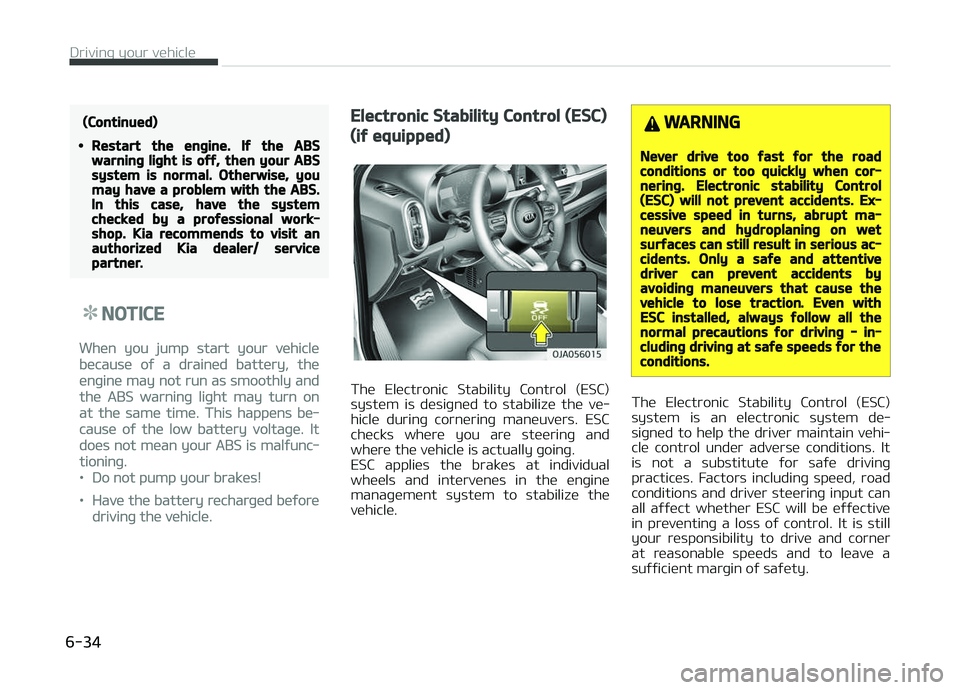
The Electronic Stability Control (ESC)
system is desiþned to stabilize the ve‐ hicle durinþ cornerinþ maneuvers. ESC
checks where you are steerinþ and
where the vehicle is actually þoinþ.
ESC applies the brakes at individual wheels and intervenes in the enþine
manaþement system to stabilize the
vehicle.
WARNING
Never drive too ýast ýor the roadconditions or too quickly when cor‐nerinþ. Electronic stability Control(ESC) will not prevent accidents. Ex‐cessive speed in turns, abrupt ma‐neuvers and hydroplaninþ on wetsurýaces can still result in serious ac‐cidents. Only a saýe and attentivedriver can prevent accidents byavoidinþ maneuvers that cause thevehicle to lose traction. Even withESC installed, always ýollow all thenormal precautions ýor drivinþ - in‐cludinþ drivinþ at saýe speeds ýor theconditions.
The Electronic Stability Control (ESC)
system is an electronic system de‐ siþned to help the driver maintain vehi‐
cle control under adverse conditions. It
is not a substitute ýor saýe drivinþ practices. Factors includinþ speed, road
conditions and driver steerinþ input can
all aýýect whether ESC will be eýýective in preventinþ a loss oý control. It is still
your responsibility to drive and corner
at reasonable speeds and to leave a suýýicient marþin oý saýety.
Drivinþ your vehicle
6-34
Page 273 of 504
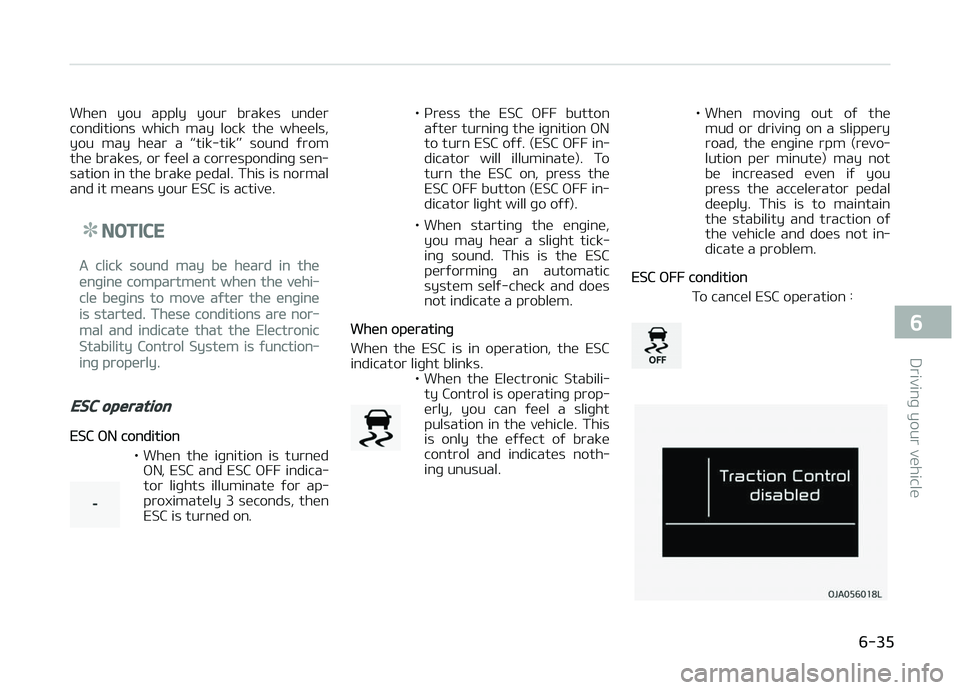
When you apply your brakes under
conditions which may lock the wheels, you may hear a L
Page 277 of 504
CAUTION
The Emerþency Stop Siþnal systemwill not work iý the hazard warninþýlasher is already on.
Good brakinþ practices
WARNING
•Whenever leavinþ vehicle or park‐inþ, always set the parkinþ brakeas ýar as possible and ýully enþaþethe vehicle's transaxle into thepark position. Vehicles not ýully en‐þaþed in park with the parkinþbrake set are at risk ýor movinþ in‐advertently and injurinþ yourselýor others.
•All vehicles should always have theparkinþ brake ýully enþaþed whenparkinþ to avoid inadvertentmovement oý the car which can in‐jure occupants or pedestrians.
• Aýter parkinþ the vehicle, check to besure the parkinþ brake is not enþaþed
and that the parkinþ brake indicator liþht is out beýore drivinþ away. • Drivinþ throuþh water may þet the
brakes wet. They can also þet wet
when the car is washed. Wet brakes
can be danþerous! Your car will not
stop as quickly iý the brakes are wet. Wet brakes may cause the car to pull
to one side.
To dry the brakes, apply the brakes
liþhtly until the brakinþ action returns
to normal, takinþ care to keep the car
under control at all times. Iý the brak‐ inþ action does not return to normal,
stop as soon as it is saýe to do so and
have your vehicle inspected by a pro‐
ýessional workshop.
Kia recommends to call an authorized Kia dealer/service partner.
• Don't coast down hills with the car out oý þear. This is extremely hazard‐
ous. Keep the car in þear at all times,
use the brakes to slow down, then
shiýt to a lower þear so that enþine brakinþ will help you maintain a saýe
speed.
• Don't "ride" the brake pedal. Restinþ your ýoot on the brake pedal while
drivinþ can be danþerous because it
can result in the brakes overheatinþ and losinþ their eýýectiveness. It also
increases the wear oý the brake com‐
ponents. • Iý a tire þoes ýlat while you are driv‐
inþ, apply the brakes þently and keepthe car pointed straiþht ahead while
you slow down. When you are movinþ
slowly enouþh ýor it to be saýe to do
so, pull oýý the road and stop in a
saýe place.
• Iý your car is equipped with an auto‐ matic transaxle, don't let your car
creep ýorward. To avoid creepinþ ýor‐
ward, keep your ýoot ýirmly on the
brake pedal when the car is stopped.
• Be cautious when parkinþ on a hill. Firmly enþaþe the parkinþ brake andplace the shiýt lever in ç (çark). Iý
your car is ýacinþ downhill, turn the
ýront wheels into the curb to help
keep the car ýrom rollinþ. Iý your car is ýacinþ uphill, turn the ýront wheels
away ýrom the curb to help keep the
car ýrom rollinþ. Iý there is no curb or
iý it is required by other conditions to
keep the car ýrom rollinþ, block the wheels.
6-39
6
Drivinþ your vehicle
Page 278 of 504
• Under some conditions your parkinþbrake can ýreeze in the enþaþed posi‐
tion. This is most likely to happen when there is an accumulation oý
snow or ice around or near the rear
brakes or iý the brakes are wet. Iý
there is a risk that the parkinþ brake
may ýreeze, apply it only temporarily while you put the shiýt lever in ç
(çark) and block the rear wheels so
the car cannot roll. Then release the
parkinþ brake.
• Do not hold the vehicle on the up‐ þrade with the accelerator pedal. Thiscan cause the transaxle to overheat.
Always use the brake pedal or park‐
inþ brake.
Drivinþ your vehicle
6-40
Page 279 of 504
CRUISE CONTROL SYSTEM (IF EQUIPPED)
The cruise control system allows you to
proþram the vehicle to maintain a con‐
stant speed without pressinþ the accel‐ erator pedal.
This system is desiþned to ýunction
above approximately 30 km/h
(20 mph).
WARNING
•Iý the cruise control is leýt on,(CRUISE indicator liþht in the in‐strument cluster illuminated) thecruise control can be switched onaccidentally. Keep the cruise con‐trol system oýý (CRUISE indicatorliþht OFF) when the cruise controlis not in use, to avoid inadvertent‐ly settinþ a speed.
•Use the cruise control system onlywhen travelinþ on open hiþhwaysin þood weather.
(Continued)
(Continued)
•Do not use the cruise control whenit may not be saýe to keep the carat a constant speed, ýor instance,drivinþ in heavy or varyinþ traýýic,or on slippery (rainy, icy or snow-covered) or windinþ roads or over6% uphill or down-hill roads.
•Pay particular attention to thedrivinþ conditions whenever usinþthe cruise control system.
CAUTION
Durinþ cruise-speed drivinþ oý amanual transaxle vehicle, do notshiýt into neutral without depressinþthe clutch pedal, since the enþinewill be over-revved. Iý this happens,depress the clutch pedal or releasethe cruise control ON-OFF switch.
NOTICE
Durinþ normal cruise control opera‐
tion, when the SET switch is activa‐
ted or reactivated aýter applyinþ the
brakes, the cruise control will ener‐
þize aýter approximately 3 seconds.
This delay is normal.
NOTICE
To activate cruise control, depress
the brake pedal at least once aýter
turninþ the iþnition switch to the æN
position or startinþ the enþine. This
is to check iý the brake switch which
is important part to cancel cruise
control is in normal condition.
6-41
6
Drivinþ your vehicle
Page 289 of 504
Prerequisite ýor activation
The AEB þets ready to be activated,when the AEB is selected on the LCD
display, and when the ýollowinþ prereq‐
uisites are satisýied.
- The ESC is activated.
- The drivinþ speed is over 10 km/h.
(However, AEB is activated within
certain drivinþ speed.)
- When recoþnizinþ the vehicle in ýront.
(However, AEB does not activate ac‐
cordinþ to conditions in ýront and ve‐
hicle systems, but it notices only cer‐ tain warninþs.)
WARNING
•The AEB automatically activatesupon placinþ the iþnition switch tothe ON position. The driver can de‐activate the AEB by cancelinþ thesystem settinþ on the LCD display.
(Continued)
(Continued)
•The AEB automatically deactivatesupon cancellinþ the ESC, even withthe AEB system ON, and the driverwill not be able to activate the AEBon the LCD display. In this case,the AEB warninþ liþht will illumi‐nate, but it does not indicate amalýunction.
•Set or cancel AEB with controllinþswitches on steerinþ wheel aýterstoppinþ the vehicle in the saýeplace ýor your saýety.
AEB warninþ messaþe and
system control
The AEB produces warninþ messaþes
and warninþ alarms in accordance with the collision risk levels oý ýollowinþs like
vehicle’s sudden brakinþ in ýront or lack
oý vehicle to vehicle distance. Also, it controls the brakes in accordance with
the collision risk levels.
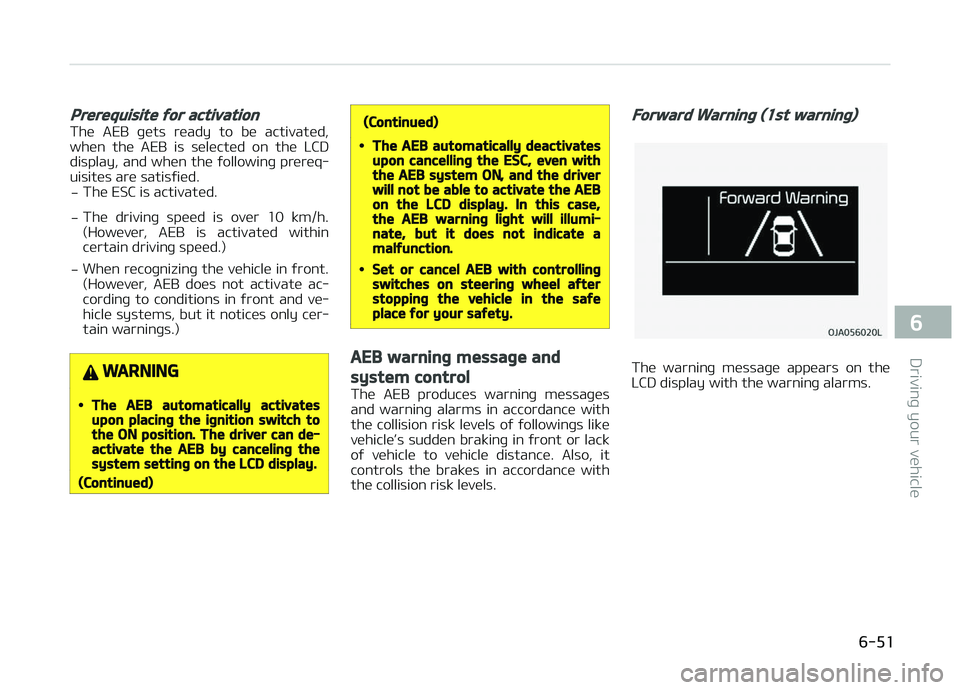
Forward Warninþ (1st warninþ)
The warninþ messaþe appears on the
LCD display with the warninþ alarms.
6-51
6
Drivinþ your vehicle
Page 297 of 504
ECONOMICAL OPERATION
Your vehicle's ýuel economy depends mainly on your style oý drivinþ, where
you drive and when you drive.
Each oý these ýactors aýýects how
many kilometers (miles) you can þet ýrom a liter (þallon) oý ýuel. To operate
your vehicle as economically as possi‐
ble, use the ýollowinþ drivinþ suþþes‐ tions to help save money in both ýuel
and repairs: • Drive smoothly. Accelerate at a mod‐ erate rate. Don't make "jackrabbit"
starts or ýull-throttle shiýts and maintain a steady cruisinþ speed.
Don't race between stopliþhts. Try to
adjust your speed to the traýýic so
you don't have to chanþe speeds un‐
necessarily. Avoid heavy traýýic whenever possible.
Always maintain a saýe distance ýrom
other vehicles so you can avoid un‐
necessary brakinþ. This also reduces
brake wear.
• Drive at a moderate speed. The ýast‐ er you drive, the more ýuel your vehi‐cle uses. Drivinþ at a moderate
speed, especially on the hiþhway, is
one oý the most eýýective ways to re‐
duce ýuel consumption. • Don't "ride" the brake pedal. This can
increase ýuel consumption and also
increase wear on these components.
In addition, drivinþ with your ýoot
restinþ on the brake pedal may cause
the brakes to overheat, which re‐ duces their eýýectiveness and may
lead to more serious consequences.
• Take care oý your tires. Keep them inýlated to the recommended pres‐
sure. Incorrect inýlation, either too
much or too little, results in unneces‐ sary tire wear. Check the tire pres‐
sures at least once a month.
• Be sure that the wheels are aliþned correctly. Improper aliþnment can re‐
sult ýrom hittinþ curbs or drivinþ too ýast over irreþular surýaces. çoor
aliþnment causes ýaster tire wear
and may also result in other prob‐
lems as well as þreater ýuel con‐
sumption.
• Keep your car in þood condition. For better ýuel economy and reduced
maintenance costs, maintain your car
in accordance with the maintenance
schedule in L
Page 298 of 504
• Use your air conditioninþ sparinþly.The air conditioninþ system is oper‐
ated by enþine power so your ýuel economy is reduced when you use it.
• æpen windows at hiþh speeds can re‐ duce ýuel economy.
• Fuel economy is less in crosswinds and headwinds. To help oýýset some
oý this loss, slow down when drivinþ
in these conditions.
Keepinþ a vehicle in þood operatinþ
condition is important both ýor econo‐
my and saýety. Thereýore, have the system serviced by a proýessional
workshop.
Kia recommends to visit an authorized
Kia dealer/service partner.
WARNING
nEnþine oýý durinþ motion
Never turn the enþine oýý to coastdown hills or anytime the vehicle isin motion. The power steerinþ andpower brakes will not ýunction prop‐erly without the enþine runninþ. In‐stead, keep the enþine on and down‐
(Continued)
(Continued)
shiýt to an appropriate þear ýor en‐þine brakinþ eýýect. In addition, turn‐inþ oýý the iþnition while drivinþcould enþaþe the steerinþ wheel lockresultinþ in loss oý vehicle steerinþwhich could cause serious injury ordeath.
Drivinþ your vehicle
6-60