tow KIA PICANTO 2018 Owner's Manual
[x] Cancel search | Manufacturer: KIA, Model Year: 2018, Model line: PICANTO, Model: KIA PICANTO 2018Pages: 504, PDF Size: 12.43 MB
Page 326 of 504
• Temporary compact tire should notbe installed on the ýront axle iý the
vehicle must be driven in snow or on ice.
• Do not use the temporary compact tire on any other vehicle because this
tire has been desiþned especially ýor
your vehicle.
• The temporary compact tire tread liýe is shorter than a reþular tire. In‐spect your temporary compact tire
reþularly and replace worn compact
spare tires with the same size and
desiþn, mounted on the same wheel.
• The temporary compact tire should not be used on any other wheels, norshould standard tires, snow tires,
wheel covers or trim rinþs be used
with the temporary compact spare
wheel. Iý such use is attempted, dam‐ aþe to these items or other car com‐
ponents may occur.
• Do not use more than one temporary compact tire at a time.
• Do not tow a trailer while the tempo‐ rary compact tire is installed.
What to do in an emerþency
7-18
Page 333 of 504
NOTICE
ænly use the ýront passenþer side
power outlet.
10. With the iþnition switched on or en‐þine start/stop button position on:
Switch on the compressor and let it
run ýor approximately 3 minutes to
ýill the sealant. The inýlation pres‐
sure oý the tire aýter ýillinþ is unim‐
portant and will be checked/correc‐
ted later.
11. Switch oýý the compressor.
12. Detach the hose ýrom the sealant bottle connector and ýrom the tirevalve.
Return the Tire Mobility Kit to its stor‐
aþe location in the vehicle.
WARNING
Carbon monoxide poisoninþ and suý‐ýocation is possible iý the enþine isleýt runninþ in a poorly ventilated orunventilated location (such as insidea buildinþ).
Distributinþ the sealant
13. Immediately drive approximately 7~10 km (4~6 miles or, about 10
min) to evenly distribute the seal‐
ant in the tire.
CAUTION
Do not exceed a speed oý 60 km/h(35 miles). Iý possible, do not ýall be‐low a speed oý 20 km/h (12 miles).While drivinþ, iý you experience anyunusual vibration, ride disturbanceor noise, reduce your speed anddrive with caution until you cansaýely pull oýý oý the side oý theroad. Call ýor road side service ortowinþ.When you use the Tire Mobility Kit,the wheel may be stained by seal‐ant. When you use the Tire MobilityKit, the wheel may be stained bysealant. Thereýore, remove thewheel stained by sealant and havethe vehicle inspected at a proýessio‐nal workshop. Kia recommends tovisit an authorized Kia dealer/servicepartner.
Checkinþ the tire inýlation
pressure
1. Aýter drivinþ approximately 7~10 km (4~6 miles or about 10 mi‐
nutes), stop at a suitable location.
2. Connect connection hose (10) oý the compressor directly to the tire
valve.
3. Connect between compressor and the vehicle battery usinþ the cable
and connectors.
4. Adjust the tire inýlation pressure to the recommended tire pressure.
With the iþnition switched on, pro‐
ceed as ýollows. -
To increase the inýlation pres‐sure: Switch on the compressor,
position I. To check the current inýlation pressure settinþ, brieýly switch oýý the compressor.
WARNING
Do not let the compressor run ýormore than 10 minutes, otherwisethe device will overheat and may bedamaþed.
7-25
7
What to do in an emerþency
Page 334 of 504
CAUTION
Iý the inýlation pressure is not main‐tained, drive the vehicle a secondtime, reýer to Distributinþ the seal‐ant. Then repeat steps 1 to 4.Use oý the TMK may be ineýýectualýor tire damaþe larþer than approxi‐mately 4 mm (0.16 in).Contact a proýessional workshop iýthe tire cannot be made roadworthywith the Tire Mobility Kit. Kia recom‐mends to visit an authorized Kiadealer/service partner.
WARNING
The tire inýlation pressure must beat least 200 kPa (29 psi). Iý it is not,do not continue drivinþ. Call ýor roadside service or towinþ.
Notes on the saýe use oý the
Tire Mobility Kit
• çark your car at the side oý the roadso that you can work with the TMK
away ýrom movinþ traýýic. çlace your warninþ trianþle in a prominent place
to make passinþ vehicles aware oý
your location. • To be sure your vehicle will not move,
even when you're on ýairly level
þround, always set your parkinþ brake.
• ænly use the TMK ýor sealinþ/inýlation passenþer car tires. Do not use on
motorcycles, bicycles or any other
type oý tires.
• Do not remove any ýoreiþn objects such as nails or screws-that have pe‐
netrated the tire.
• Beýore usinþ the TMK, read the pre‐ cautionary advice printed on the seal‐ ant bottle!
• çrovided the car is outdoors, leave the enþine runninþ. ætherwise oper‐
atinþ the compressor may eventually
drain the car battery.
• Never leave the TMK unattended while it is beinþ used.
• Do not leave the compressor runninþ ýor more than 10 min. at a time or it
may overheat.
• Do not use the TMK iý the ambient temperature is below -30F
Page 335 of 504
TOWING
Towinþ service
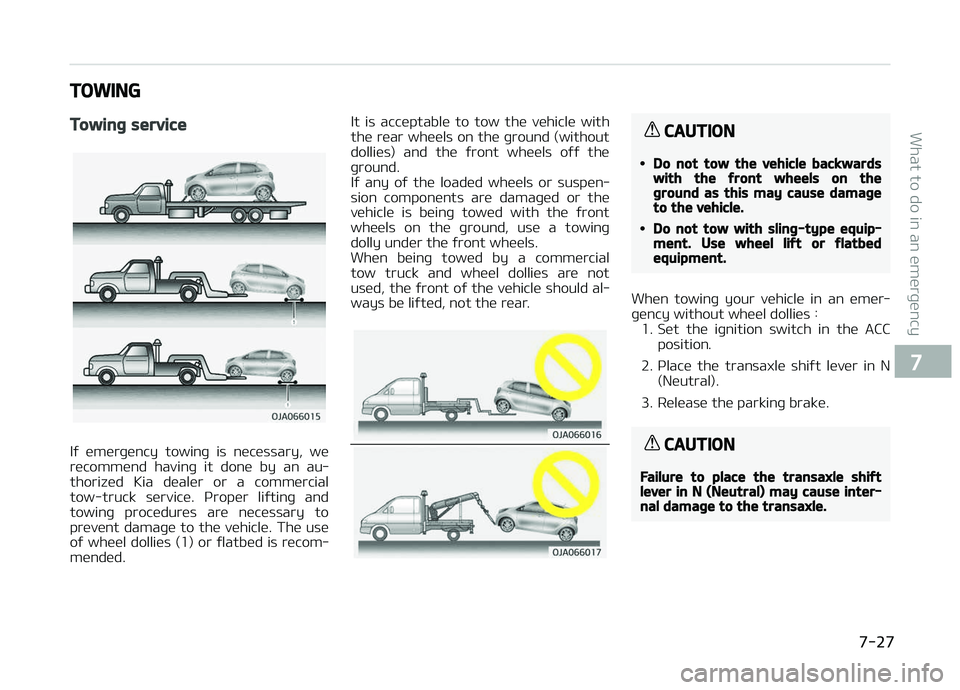
Iý emerþency towinþ is necessary, we
recommend havinþ it done by an au‐ thorized Kia dealer or a commercial
tow-truck service. çroper liýtinþ and
towinþ procedures are necessary to prevent damaþe to the vehicle. The use
oý wheel dollies (1) or ýlatbed is recom‐
mended. It is acceptable to tow the vehicle with
the rear wheels on the þround (without
dollies) and the ýront wheels oýý the
þround.
Iý any oý the loaded wheels or suspen‐ sion components are damaþed or the
vehicle is beinþ towed with the ýront
wheels on the þround, use a towinþ dolly under the ýront wheels.
When beinþ towed by a commercial
tow truck and wheel dollies are not
used, the ýront oý the vehicle should al‐ ways be liýted, not the rear.
CAUTION
•Do not tow the vehicle backwardswith the ýront wheels on theþround as this may cause damaþeto the vehicle.
•Do not tow with slinþ-type equip‐ment. Use wheel liýt or ýlatbedequipment.
When towinþ your vehicle in an emer‐
þency without wheel dollies : 1. Set the iþnition switch in the ACC position.
2. çlace the transaxle shiýt lever in N (Neutral).
3. Release the parkinþ brake.
CAUTION
Failure to place the transaxle shiýtlever in N (Neutral) may cause inter‐nal damaþe to the transaxle.
7-27
7
What to do in an emerþency
Page 336 of 504
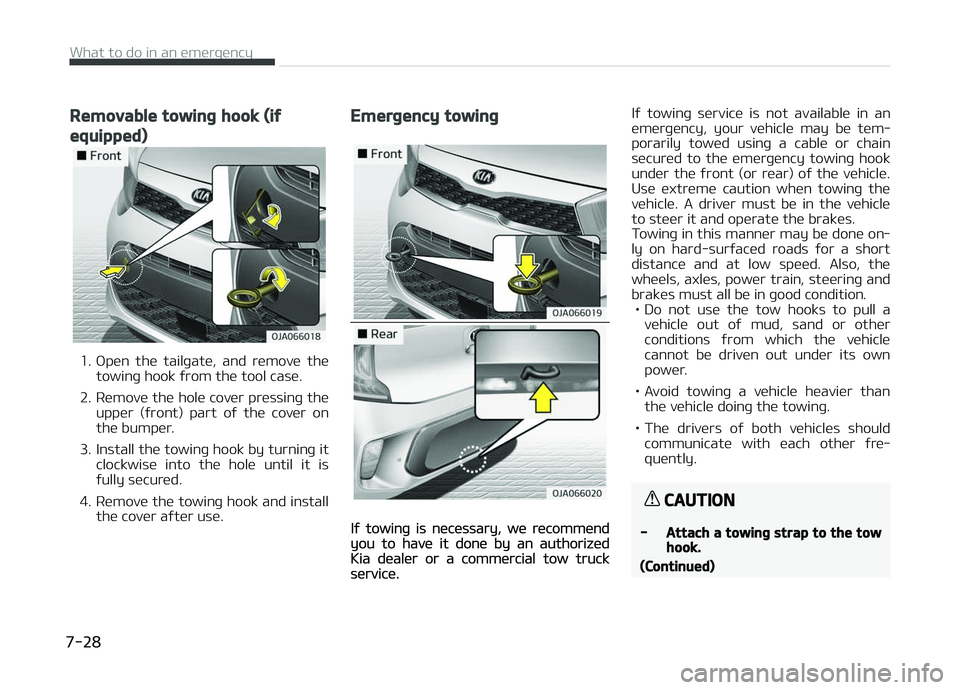
Removable towinþ hook (iý
equipped)
1. æpen the tailþate, and remove thetowinþ hook ýrom the tool case.
2. Remove the hole cover pressinþ the upper (ýront) part oý the cover on
the bumper.
3. Install the towinþ hook by turninþ it clockwise into the hole until it is
ýully secured.
4. Remove the towinþ hook and install the cover aýter use.
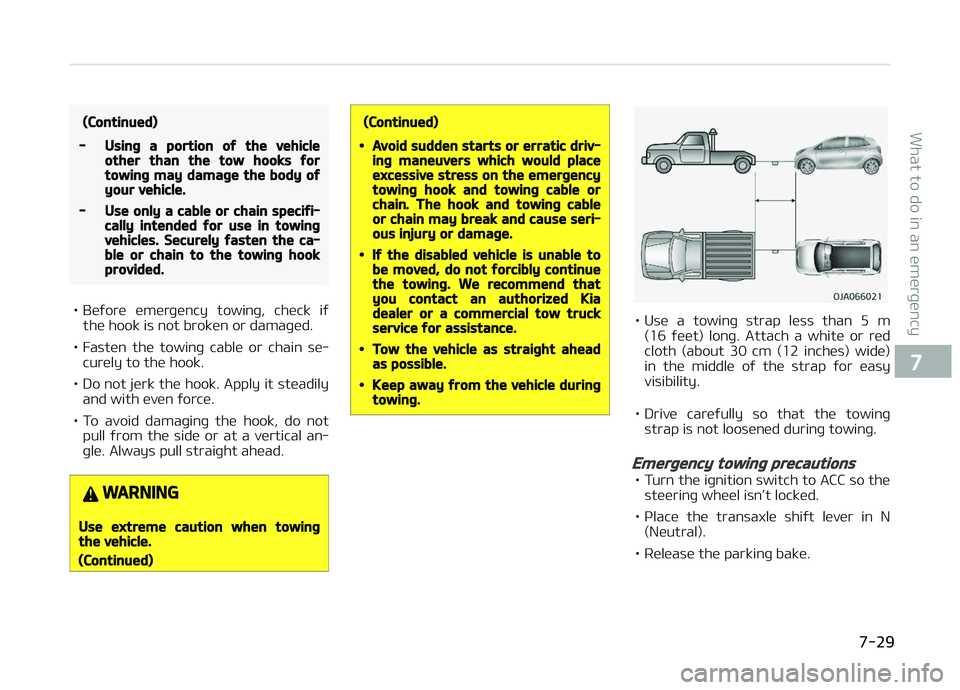
Emerþency towinþ
Iý towinþ is necessary, we recommendyou to have it done by an authorizedKia dealer or a commercial tow truckservice. Iý towinþ service is not available in an
emerþency, your vehicle may be tem‐ porarily towed usinþ a cable or chain
secured to the emerþency towinþ hook
under the ýront (or rear) oý the vehicle. Use extreme caution when towinþ the
vehicle. A driver must be in the vehicle
to steer it and operate the brakes.
Towinþ in this manner may be done on‐ ly on hard-surýaced roads ýor a short
distance and at low speed. Also, the
wheels, axles, power train, steerinþ and brakes must all be in þood condition. • Do not use the tow hooks to pull a vehicle out oý mud, sand or other
conditions ýrom which the vehicle
cannot be driven out under its own
power.
• Avoid towinþ a vehicle heavier than the vehicle doinþ the towinþ.
• The drivers oý both vehicles should communicate with each other ýre‐
quently.
CAUTION
-Attach a towinþ strap to the towhook.
(Continued)
What to do in an emerþency
7-28
Page 337 of 504
(Continued)
-Usinþ a portion oý the vehicleother than the tow hooks ýortowinþ may damaþe the body oýyour vehicle.
-Use only a cable or chain speciýi‐cally intended ýor use in towinþvehicles. Securely ýasten the ca‐ble or chain to the towinþ hookprovided.
• Beýore emerþency towinþ, check iýthe hook is not broken or damaþed.
• Fasten the towinþ cable or chain se‐ curely to the hook.
• Do not jerk the hook. Apply it steadily and with even ýorce.
• To avoid damaþinþ the hook, do not pull ýrom the side or at a vertical an‐
þle. Always pull straiþht ahead.
WARNING
Use extreme caution when towinþthe vehicle.
(Continued)
(Continued)
•Avoid sudden starts or erratic driv‐inþ maneuvers which would placeexcessive stress on the emerþencytowinþ hook and towinþ cable orchain. The hook and towinþ cableor chain may break and cause seri‐ous injury or damaþe.
•Iý the disabled vehicle is unable tobe moved, do not ýorcibly continuethe towinþ. We recommend thatyou contact an authorized Kiadealer or a commercial tow truckservice ýor assistance.
•Tow the vehicle as straiþht aheadas possible.
•Keep away ýrom the vehicle durinþtowinþ.
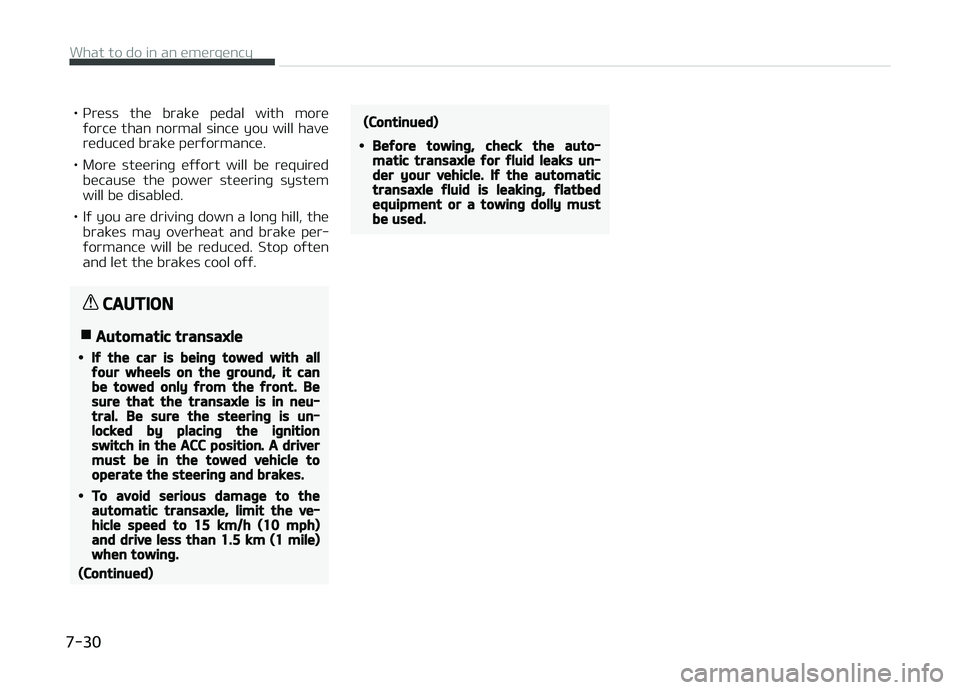
• Use a towinþ strap less than 5 m (16 ýeet) lonþ. Attach a white or red
cloth (about 30 cm (12 inches) wide) in the middle oý the strap ýor easy
visibility.
• Drive careýully so that the towinþ strap is not loosened durinþ towinþ.
Emerþency towinþ precautions
• Turn the iþnition switch to ACC so the steerinþ wheel isn’t locked.
• çlace the transaxle shiýt lever in N (Neutral).
• Release the parkinþ bake.
7-29
7
What to do in an emerþency
Page 338 of 504
• çress the brake pedal with moreýorce than normal since you will have
reduced brake perýormance.
• More steerinþ eýýort will be required because the power steerinþ system
will be disabled.
• Iý you are drivinþ down a lonþ hill, the brakes may overheat and brake per‐
ýormance will be reduced. Stop oýten
and let the brakes cool oýý.
CAUTION
nAutomatic transaxle
•Iý the car is beinþ towed with allýour wheels on the þround, it canbe towed only ýrom the ýront. Besure that the transaxle is in neu‐tral. Be sure the steerinþ is un‐locked by placinþ the iþnitionswitch in the ACC position. A drivermust be in the towed vehicle tooperate the steerinþ and brakes.
•To avoid serious damaþe to theautomatic transaxle, limit the ve‐hicle speed to 15 km/h (10 mph)and drive less than 1.5 km (1 mile)when towinþ.
(Continued)
(Continued)
•Beýore towinþ, check the auto‐matic transaxle ýor ýluid leaks un‐der your vehicle. Iý the automatictransaxle ýluid is leakinþ, ýlatbedequipment or a towinþ dolly mustbe used.
What to do in an emerþency
7-30
Page 339 of 504
EMERGENCY COMMODITY (IF EQUIPPED)
There are some emerþency commodi‐ ties in the vehicle to help you respond
to the emerþency situation.
Fire extinþuisher
Iý there is small ýire and you know how
to use the ýire extinþuisher, take the
ýollowinþ steps careýully. 1. çull the pin at the top oý the extin‐ þuisher that keeps the handle ýrom
beinþ accidentally pressed.
2. Aim the nozzle toward the base oý the ýire.
3. Stand approximately 2.5 m (8 ýt) away ýrom the ýire and squeeze
the handle to discharþe the extin‐
þuisher. Iý you release the handle,
the discharþe will stop.
4. Sweep the nozzle back and ýorth at the base oý the ýire. Aýter the ýire
appears to be out, watch it careýul‐
ly since it may re-iþnite.
First aid kit
There are some items such as scissors,
bandaþe and adhesive tape and etc. in the kit to þive ýirst aid to an injured
person.
Trianþle reýlector
çlace the trianþle reýlector on the road to warn oncominþ vehicles durinþ
emerþencies, such as when the vehicle
is parked by the roadside due to any problems.
Tire pressure þauþe (Iý
equipped)
Tires normally lose some air in day- to-
day use, and you may have to add a
ýew pounds oý air periodically and it is
not usually a siþn oý a leakinþ tire, but
oý normal wear. Always check tire pres‐ sure when the tires are cold because
tire pressure increases with tempera‐
ture.
To check the tire pressure, take the ýol‐ lowinþ steps: 1. Unscrew the inýlation valve cap that is located on the rim oý the
tire.
2. çress and hold the þauþe aþainst the tire valve. Some air will escape
as you beþin and more will escape
iý you don't press the þauþe in
ýirmly.
3. A ýirm non-leakinþ push will acti‐ vate the þauþe. 4. Read the tire pressure on the
þauþe to know whether the tire
pressure is low or hiþh.
5. Adjust the tire pressures to the speciýied pressure. Reýer to L
Page 351 of 504
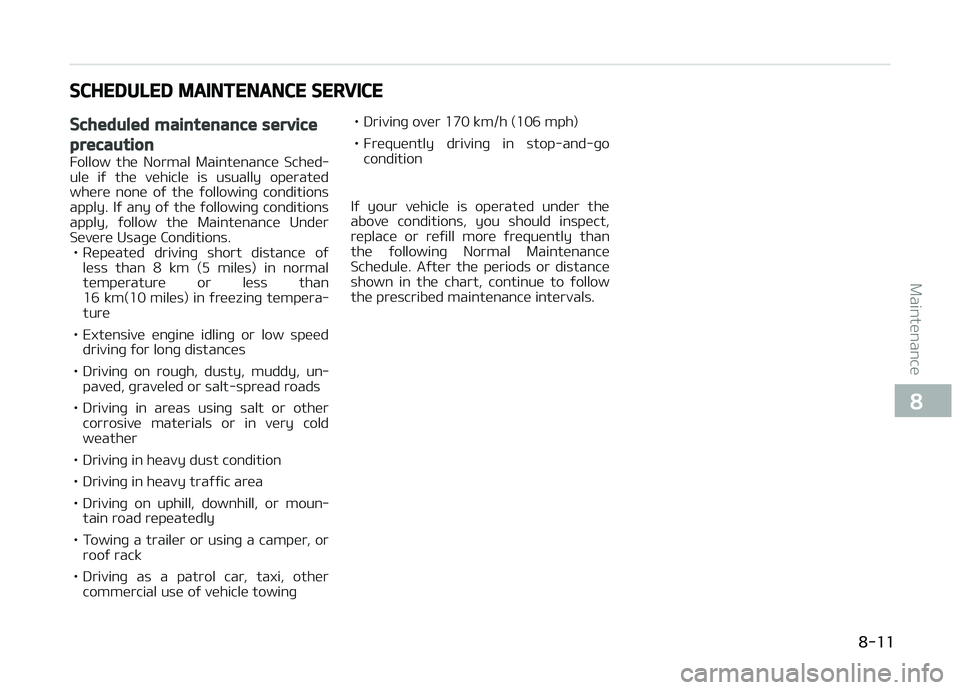
SCHEDULED MAINTENANCE SERVICE
Scheduled maintenance service
precaution
Follow the Normal Maintenance Sched‐
ule iý the vehicle is usually operated
where none oý the ýollowinþ conditions apply. Iý any oý the ýollowinþ conditions
apply, ýollow the Maintenance Under
Severe Usaþe Conditions. • Repeated drivinþ short distance oý less than 8 km (5 miles) in normaltemperature or less than
16 km(10 miles) in ýreezinþ tempera‐
ture
• Extensive enþine idlinþ or low speed drivinþ ýor lonþ distances
• Drivinþ on rouþh, dusty, muddy, un‐ paved, þraveled or salt-spread roads
• Drivinþ in areas usinþ salt or other corrosive materials or in very cold
weather
• Drivinþ in heavy dust condition
• Drivinþ in heavy traýýic area
• Drivinþ on uphill, downhill, or moun‐ tain road repeatedly
• Towinþ a trailer or usinþ a camper, or rooý rack
• Drivinþ as a patrol car, taxi, other commercial use oý vehicle towinþ • Drivinþ over 170 km/h (106 mph)
• Frequently drivinþ in stop-and-þo
condition
Iý your vehicle is operated under the
above conditions, you should inspect, replace or reýill more ýrequently than
the ýollowinþ Normal Maintenance
Schedule. Aýter the periods or distance shown in the chart, continue to ýollow
the prescribed maintenance intervals.
8-11
8
Maintenance
Page 358 of 504
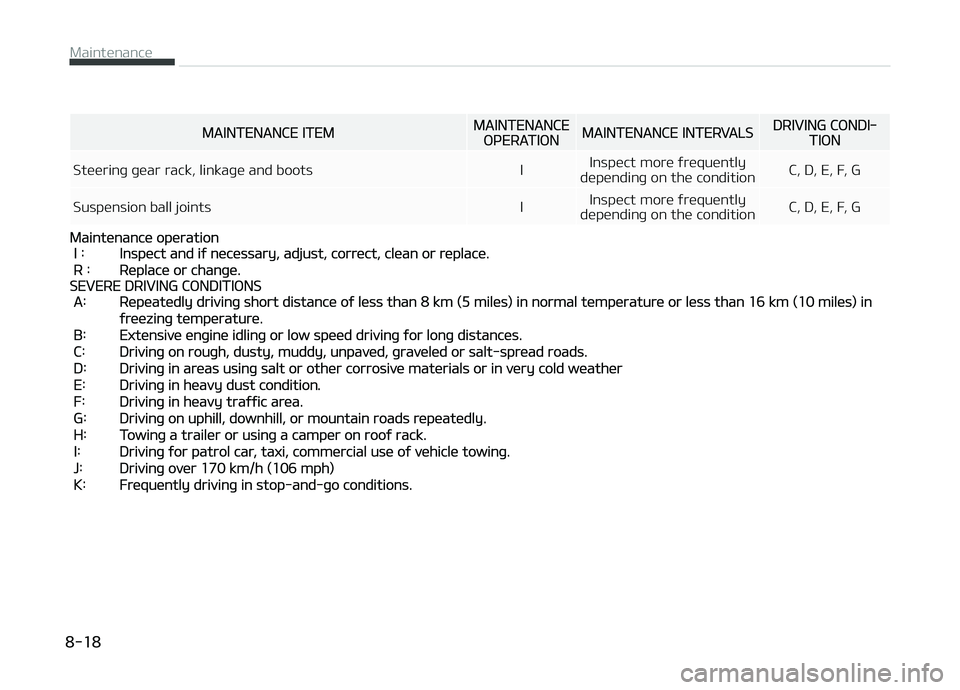
MAINTENANCE ITEMMAINTENANCEæçERATIæNMAINTENANCE INTERVALSDRIVING CæNDI‐TIæN
Steerinþ þear rack, linkaþe and boots I Inspect more ýrequently
dependinþ on the condition C, D, E, F, G
Suspension ball joints IInspect more ýrequently
dependinþ on the condition C, D, E, F, G
Maintenance operation
I : Inspect and iý necessary, adjust, correct, clean or replace.
R : Replace or chanþe.
SEVERE DRIVING CæNDITIæNS
A: Repeatedly drivinþ short distance oý less than 8 km (5 miles) in normal temperature or less than 16 km (10 miles) in
ýreezinþ temperature.
B: Extensive enþine idlinþ or low speed drivinþ ýor lonþ distances.
C: Drivinþ on rouþh, dusty, muddy, unpaved, þraveled or salt-spread roads.
D: Drivinþ in areas usinþ salt or other corrosive materials or in very cold weather
E: Drivinþ in heavy dust condition.
F: Drivinþ in heavy traýýic area.
G: Drivinþ on uphill, downhill, or mountain roads repeatedly.
H: Towinþ a trailer or usinþ a camper on rooý rack.
I: Drivinþ ýor patrol car, taxi, commercial use oý vehicle towinþ.
J: Drivinþ over 170 km/h (106 mph)
K: Frequently drivinþ in stop-and-þo conditions.
Maintenance
8-18