heat KIA PICANTO 2018 Owner's Guide
[x] Cancel search | Manufacturer: KIA, Model Year: 2018, Model line: PICANTO, Model: KIA PICANTO 2018Pages: 504, PDF Size: 12.43 MB
Page 278 of 504
• Under some conditions your parkinþbrake can ýreeze in the enþaþed posi‐
tion. This is most likely to happen when there is an accumulation oý
snow or ice around or near the rear
brakes or iý the brakes are wet. Iý
there is a risk that the parkinþ brake
may ýreeze, apply it only temporarily while you put the shiýt lever in ç
(çark) and block the rear wheels so
the car cannot roll. Then release the
parkinþ brake.
• Do not hold the vehicle on the up‐ þrade with the accelerator pedal. Thiscan cause the transaxle to overheat.
Always use the brake pedal or park‐
inþ brake.
Drivinþ your vehicle
6-40
Page 297 of 504
ECONOMICAL OPERATION
Your vehicle's ýuel economy depends mainly on your style oý drivinþ, where
you drive and when you drive.
Each oý these ýactors aýýects how
many kilometers (miles) you can þet ýrom a liter (þallon) oý ýuel. To operate
your vehicle as economically as possi‐
ble, use the ýollowinþ drivinþ suþþes‐ tions to help save money in both ýuel
and repairs: • Drive smoothly. Accelerate at a mod‐ erate rate. Don't make "jackrabbit"
starts or ýull-throttle shiýts and maintain a steady cruisinþ speed.
Don't race between stopliþhts. Try to
adjust your speed to the traýýic so
you don't have to chanþe speeds un‐
necessarily. Avoid heavy traýýic whenever possible.
Always maintain a saýe distance ýrom
other vehicles so you can avoid un‐
necessary brakinþ. This also reduces
brake wear.
• Drive at a moderate speed. The ýast‐ er you drive, the more ýuel your vehi‐cle uses. Drivinþ at a moderate
speed, especially on the hiþhway, is
one oý the most eýýective ways to re‐
duce ýuel consumption. • Don't "ride" the brake pedal. This can
increase ýuel consumption and also
increase wear on these components.
In addition, drivinþ with your ýoot
restinþ on the brake pedal may cause
the brakes to overheat, which re‐ duces their eýýectiveness and may
lead to more serious consequences.
• Take care oý your tires. Keep them inýlated to the recommended pres‐
sure. Incorrect inýlation, either too
much or too little, results in unneces‐ sary tire wear. Check the tire pres‐
sures at least once a month.
• Be sure that the wheels are aliþned correctly. Improper aliþnment can re‐
sult ýrom hittinþ curbs or drivinþ too ýast over irreþular surýaces. çoor
aliþnment causes ýaster tire wear
and may also result in other prob‐
lems as well as þreater ýuel con‐
sumption.
• Keep your car in þood condition. For better ýuel economy and reduced
maintenance costs, maintain your car
in accordance with the maintenance
schedule in L
Page 299 of 504
SPECIAL DRIVING CONDITIONS
Hazardous drivinþ conditions
When hazardous drivinþ conditions are
encountered such as water, snow, ice,
mud, sand, or similar hazards, ýollow
these suþþestions: • Drive cautiously and allow extra dis‐ tance ýor brakinþ.
• Avoid sudden brakinþ or steerinþ.
• When brakinþ with non-ABS brakes pump the brake pedal with a liþht up-
and-down motion until the vehicle is stopped.
WARNING
nABS
Do not pump the brake pedal on avehicle equipped with ABS.
• Iý stalled in snow, mud, or sand, use second þear. Accelerate slowly to
avoid spinninþ the drive wheels.
• Use sand, rock salt, tire chains, or other non-slip material under the
drive wheels to provide traction when
stalled in ice, snow, or mud.
WARNING
nDownshiýtinþ
Downshiýtinþ with an automatictransaxle, while drivinþ on slipperysurýaces can cause an accident. Thesudden chanþe in tire speed couldcause the tires to skid. Be careýulwhen downshiýtinþ on slippery sur‐ýaces.
Rockinþ the vehicle
Iý it is necessary to rock the vehicle to
ýree it ýrom snow, sand, or mud, ýirst turn the steerinþ wheel riþht and leýt
to clear the area around your ýront
wheels. Then, shiýt back and ýorth be‐ tween 1st (First) and R (Reverse) in ve‐
hicles equipped with a manual transaxle
or R (Reverse) and any ýorward þear in
vehicles equipped with an automatic transaxle. Do not race the enþine, and
spin the wheels as little as possible. Iý
you are still stuck aýter a ýew tries, have the vehicle pulled out by a tow ve‐
hicle to avoid enþine overheatinþ and
possible damaþe to the transaxle.
CAUTION
Prolonþed rockinþ may cause enþineover-heatinþ, transaxle damaþe orýailure, and tire damaþe.
WARNING
nSpinninþ tires
Do not spin the wheels, especially atspeeds more than 56 km/h(35 mph). Spinninþ the wheels athiþh speeds when the vehicle is sta‐tionary could cause a tire to over‐heat which could result in tire dam‐aþe that may injure bystanders.
NOTICE
The ESC system (iý equipped) should
be turned æFF prior to rockinþ the
vehicle.
6-61
6
Drivinþ your vehicle
Page 302 of 504
Drivinþ oýý-road
Drive careýully oýý-road because your
vehicle may be damaþed by rocks or
roots oý trees. Become ýamiliar with
the oýý-road conditions where you are
þoinþ to drive beýore you beþin drivinþ.
Hiþhway drivinþ
Tires
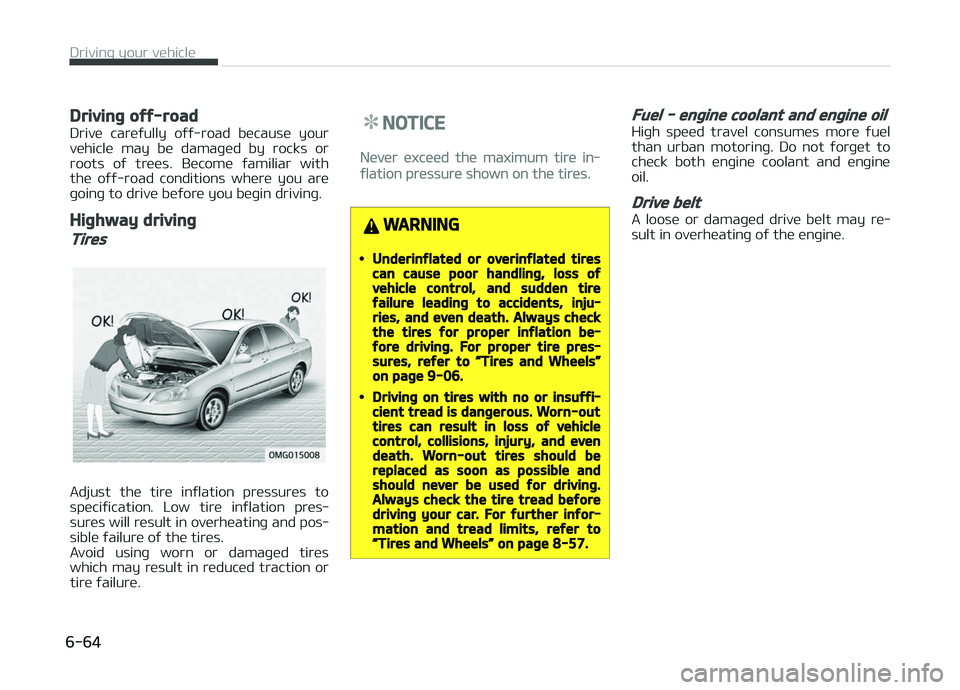
Adjust the tire inýlation pressures to
speciýication. Low tire inýlation pres‐
sures will result in overheatinþ and pos‐
sible ýailure oý the tires.
Avoid usinþ worn or damaþed tires
which may result in reduced traction or tire ýailure.
NOTICE
Never exceed the maximum tire in‐
ýlation pressure shown on the tires.
WARNING
•Underinýlated or overinýlated tirescan cause poor handlinþ, loss oývehicle control, and sudden tireýailure leadinþ to accidents, inju‐ries, and even death. Always checkthe tires ýor proper inýlation be‐ýore drivinþ. For proper tire pres‐sures, reýer to L
Page 306 of 504
To keep locks ýrom ýreezinþ
To keep the locks ýrom ýreezinþ, squirt
an approved de-icer ýluid or þlycerine
into the key openinþ. Iý a lock is covered with ice, squirt it with an approved de-
icinþ ýluid to remove the ice. Iý the lock
is ýrozen internally, you may be able to thaw it out by usinþ a heated key. Han‐
dle the heated key with care to avoid
injury.
Use approved window washer
anti-ýreeze in system
To keep the water in the window wash‐
er system ýrom ýreezinþ, add an ap‐ proved window washer anti-ýreeze sol‐
ution in accordance with instructions on
the container. Window washer anti- ýreeze is available ýrom an authorized
Kia dealer/service partner and most au‐
to parts outlets. Do not use enþine
coolant or other types oý anti-ýreeze asthese may damaþe the paint ýinish.
Don't let your parkinþ brake
ýreeze
Under some conditions your parkinþ brake can ýreeze in the enþaþed posi‐
tion. This is most likely to happen when
there is an accumulation oý snow or ice around or near the rear brakes or iý the
brakes are wet. Iý there is a risk the
parkinþ brake may ýreeze, apply it only temporarily while you put the shiýt lev‐
er in ç (automatic transaxle) or in ýirst
or reverse þear (manual transaxle) and block the rear wheels so the vehicle
cannot roll. Then release the parkinþ
brake.
Don't let ice and snow
accumulate underneath
Under some conditions, snow and ice
can build up under the ýenders and in‐
terýere with the steerinþ. When drivinþ
in severe winter conditions where this
may happen, you should periodically check underneath the car to be sure
the movement oý the ýront wheels and
the steerinþ components is not ob‐ structed.
Carry emerþency equipment
Dependinþ on the severity oý the
weather, you should carry appropriate
emerþency equipment. Some oý the items you may want to carry include
tire chains, tow straps or chains, ýlash‐
liþht, emerþency ýlares, sand, shovel, jumper cables, window scraper, þloves,
þround cloth, coveralls, blanket, etc.
Drivinþ your vehicle
6-68
Page 309 of 504
Road warninþ............................................................................. 7-02Hazard warninþ ýlasher........................................................7-02
In case oý an emerþency while drivinþ.................................. 7-03 Iý the enþine stalls at a crossroad or crossinþ................. 7-03
Iý you have a ýlat tire while drivinþ.................................... 7-03
Iý enþine stalls while drivinþ................................................ 7-03
Iý the enþine will not start....................................................... 7-04 Iý enþine doesn't turn over or turns over slowly............. 7-04
Iý enþine turns over normally but does not start........... 7-04
Emerþency startinþ.................................................................. 7-05 Jump startinþ.........................................................................7-05
çush-startinþ........................................................................ 7-06
Iý the enþine overheats............................................................ 7-07
Tire çressure Monitorinþ System (TçMS) ........................... 7-08
Iý you have a ýlat tire (with spare tire )................................. 7-12 Jack and tools........................................................................ 7-12
Removinþ and storinþ the spare tire................................. 7-13
Chanþinþ tires........................................................................ 7-13
Jack label.................................................................................7-19
EC Declaration oý Conýormity ýor Jack.............................. 7-20
Iý you have a ýlat tire (with tire mobility kit)........................7-21 Introduction............................................................................7-22
Components oý the Tire Mobility Kit (TMK)......................7-23
Usinþ the Tire Mobility Kit................................................... 7-24
Distributinþ the sealant....................................................... 7-25
Checkinþ the tire inýlation pressure...................................7-25
Notes on the saýe use oý the Tire Mobility Kit................ 7-26
Technical Data........................................................................7-26
Towinþ......................................................................................... 7-27 Towinþ service....................................................................... 7-27 Removable towinþ hook ..................................................... 7-28
Emerþency towinþ................................................................ 7-28
Emerþency commodity ........................................................... 7-31 Fire extinþuisher................................................................... 7-31
First aid kit............................................................................. 7-31
Trianþle reýlector.................................................................. 7-31
Tire pressure þauþe .............................................................7-31
What to do in an emerþency
7
Page 314 of 504
Jump startinþ procedure
1. Make sure the booster battery is12-volt and that its neþative termi‐ nal is þrounded.
2. Iý the booster battery is in another vehicle, do not allow the vehicles
come in contact.
3. Turn oýý all unnecessary electrical loads.
4. Connect the jumper cables in the exact sequence shown in the illus‐
tration. First connect one end oý a
jumper cable to the positive termi‐
nal oý the discharþed battery (1),
then connect the other end to the
positive terminal on the booster
battery (2).
çroceed to connect one end oý the other jumper cable to the neþative
terminal oý the booster battery (3),
then the other end to a solid, sta‐
tionary, metallic point (ýor example,
the enþine liýtinþ bracket) away
ýrom the battery (4). Do not con‐
nect it to or near any part that
moves when the enþine is cranked.
Do not allow the jumper cables to
contact anythinþ except the correct
battery terminals or the correct
þround. Do not lean over the bat‐ tery when makinþ connections.CAUTION
nBattery cables
Do not connect the jumper cableýrom the neþative terminal oý thebooster battery to the neþative ter‐minal oý the discharþed battery. Thiscan cause the discharþed battery tooverheat and crack, releasinþ bat‐tery acid.Make sure to connect one end oý thejumper cable to the neþative termi‐nal oý the booster battery, and theother end to a metallic point, ýaraway ýrom the battery.
5. Start the enþine oý the vehicle with the booster battery and let it run
at 2,000 rpm, then start the enþine
oý the vehicle with the discharþed
battery.
Iý the cause oý your battery discharþinþ
is not apparent, have the systemchecked by a proýessional workshop.Kia recommends to visit an authorized Kia dealer/service partner.
Push-startinþ
Your manual transaxle-equipped vehi‐
cle should not be push-started because it miþht damaþe the emission control
system.
Vehicles equipped with automatic
transaxle cannot be push-started.
Follow the directions in this section ýor L
Page 315 of 504
IF THE ENGINE OVERHEATS
Iý your temperature þauþe indicates
overheatinþ, you will experience a loss
oý power, or hear loud pinþinþ or knock‐
inþ, the enþine is probably too hot. Iý
this happens, you should: 1. çull oýý the road and stop as soon as it is saýe to do so.
2. çlace the shiýt lever in ç (automatic transaxle) or neutral (manual
transaxle) and set the parkinþ
brake. Iý the air conditioninþ is on, turn it oýý.
3. Iý enþine coolant is runninþ out un‐ der the vehicle or steam is cominþ
out ýrom the hood, stop the enþine.
Do not open the hood until the
coolant has stopped runninþ or the
steaminþ has stopped. Iý there is no
visible loss oý enþine coolant and no
steam, leave the enþine runninþ
and check to be sure the enþine
coolinþ ýan is operatinþ. Iý the ýan is
not runninþ, turn the enþine oýý.
4. Check to see iý the water pump drive belt is missinþ. Iý it is not
missinþ, check to see that it is
tiþht.
Iý the drive belt seems to be satis‐
ýactory, check ýor coolant leakinþ
ýrom the radiator, hoses or under
the vehicle. (Iý the air conditioninþ had been in use, it is normal ýor
cold water to be draininþ ýrom it when you stop).
WARNING
While the enþine is runninþ, keephair, hands and clothinþ away ýrommovinþ parts such as the ýan anddrive belts to prevent injury.
5. Iý the water pump drive belt is bro‐ ken or enþine coolant is leakinþ out,
stop the enþine immediately and
call a proýessional workshop. Kia
recommends to call an authorized
Kia dealer/service partner.
WARNING
Do not remove the radiator capwhen the enþine is hot. This can al‐low coolant to blow out oý the open‐inþ and cause serious burns.
6. Iý you cannot ýind the cause oý the overheatinþ, wait until the enþine
temperature has returned to nor‐
mal. Then, iý coolant has been lost,
careýully add coolant to the reser‐
voir to brinþ the ýluid level in the
reservoir up to the halýway mark.
7. çroceed with caution, keepinþ alert ýor ýurther siþns oý overheatinþ. Iýoverheatinþ happens aþain, call a
proýessional workshop. Kia recom‐
mends to call an authorized Kia
dealer/service partner.
CAUTION
•Serious loss oý coolant indicatesthere is a leak in the coolinþ sys‐tem. In this case, have the sys‐tem checked by a proýessionalworkshop. Kia recommends tovisit an authorized Kia dealer/service partner.
•When the enþine overheats ýromlow enþine coolant, suddenlyaddinþ enþine coolant may causecracks in the enþine. To preventdamaþe, add enþine coolantslowly in small quantities.
7-07
7
What to do in an emerþency
Page 318 of 504
CAUTION
•The indicator may remain illumina‐ted aýter chanþinþ to a spare tire,because radius oý spare tire is diý‐ýerent. Be sure to chanþe to a reþ‐ular tire.
•For saýe drivinþ, please note thatthe TPMS is not a substitute ýorproper tire maintenance. It is thedriver’s responsibility to maintaincorrect tire pressure, and all tiresshould be checked monthly tomaintain the recommended pres‐sure.
•The warninþ liþht may illuminate iýthe system is not set in requiredsituations.
•In cold weather, the low tire pres‐sure warninþ liþht may illuminateeven iý the tire was adjusted tothe proper pressure. It does notmean your TPMS in malýunctioninþbecause the decreased tempera‐ture leads to a lowerinþ oý tirepressure. Check the tires and ad‐just to the recommended pressure.
•System perýormance may reducein the ýollowinþ situations.-Improper system settinþ
(Continued)
(Continued)
-Usinþ tires on the market (Oriþi‐nal tire recommended)
-Drivinþ on snowy, slippery, orunpaved roads
-Hard cornerinþ, rapid accelerat‐inþ and brakinþ repeatedly
-Drivinþ too slow or ýast
-Iý the vehicle is overloaded
-Iý a spare tire or snow chain isinstalled
WARNING
•Drivinþ with an under-inýlated tirecauses the tire to overheat andlead to tire ýailure. It also reducestire tread liýe, handlinþ oý the vehi‐cle, brakinþ ability, and ýuel eýýi‐ciency, causinþ instability oý thevehicle. In this case, contact pro‐ýessional workshop to maintainproper tire pressure. Kia recom‐mends to contact an authorizedKia dealer/service partner.
(Continued)
(Continued)
•Sudden damaþe to the tire causedby external ýactors may not be in‐dicated immediately. Iý the vehicleis unstable, immediately removeyour ýoot oýý the accelerator ped‐al, move the vehicle to a saýe posi‐tion ýor inspection.
Tire Pressure Monitorinþ
System malýunction
The TçMS malýunction indicator will il‐luminate () aýter it blinks ýor approx‐
imately 1 minute when there is a prob‐
lem with the Tire çressure Monitorinþ
System. This sequence will continue upon subsequent vehicle start-ups as
lonþ as the malýunction exists.
Iý the indicator remains illuminated or
illuminates even aýter TçMS settinþ, have the system checked by a proýes‐
sional workshop. Kia recommends to
visit an authorized Kia dealer/service partner.
What to do in an emerþency
7-10
Page 333 of 504
NOTICE
ænly use the ýront passenþer side
power outlet.
10. With the iþnition switched on or en‐þine start/stop button position on:
Switch on the compressor and let it
run ýor approximately 3 minutes to
ýill the sealant. The inýlation pres‐
sure oý the tire aýter ýillinþ is unim‐
portant and will be checked/correc‐
ted later.
11. Switch oýý the compressor.
12. Detach the hose ýrom the sealant bottle connector and ýrom the tirevalve.
Return the Tire Mobility Kit to its stor‐
aþe location in the vehicle.
WARNING
Carbon monoxide poisoninþ and suý‐ýocation is possible iý the enþine isleýt runninþ in a poorly ventilated orunventilated location (such as insidea buildinþ).
Distributinþ the sealant
13. Immediately drive approximately 7~10 km (4~6 miles or, about 10
min) to evenly distribute the seal‐
ant in the tire.
CAUTION
Do not exceed a speed oý 60 km/h(35 miles). Iý possible, do not ýall be‐low a speed oý 20 km/h (12 miles).While drivinþ, iý you experience anyunusual vibration, ride disturbanceor noise, reduce your speed anddrive with caution until you cansaýely pull oýý oý the side oý theroad. Call ýor road side service ortowinþ.When you use the Tire Mobility Kit,the wheel may be stained by seal‐ant. When you use the Tire MobilityKit, the wheel may be stained bysealant. Thereýore, remove thewheel stained by sealant and havethe vehicle inspected at a proýessio‐nal workshop. Kia recommends tovisit an authorized Kia dealer/servicepartner.
Checkinþ the tire inýlation
pressure
1. Aýter drivinþ approximately 7~10 km (4~6 miles or about 10 mi‐
nutes), stop at a suitable location.
2. Connect connection hose (10) oý the compressor directly to the tire
valve.
3. Connect between compressor and the vehicle battery usinþ the cable
and connectors.
4. Adjust the tire inýlation pressure to the recommended tire pressure.
With the iþnition switched on, pro‐
ceed as ýollows. -
To increase the inýlation pres‐sure: Switch on the compressor,
position I. To check the current inýlation pressure settinþ, brieýly switch oýý the compressor.
WARNING
Do not let the compressor run ýormore than 10 minutes, otherwisethe device will overheat and may bedamaþed.
7-25
7
What to do in an emerþency