wheel KIA PICANTO 2018 Owner's Guide
[x] Cancel search | Manufacturer: KIA, Model Year: 2018, Model line: PICANTO, Model: KIA PICANTO 2018Pages: 504, PDF Size: 12.43 MB
Page 262 of 504
(Continued)
•Always check the surroundinþareas near your vehicle ýor people,especially children, beýore shiýtinþa car into D (Drive) or R (Reverse).
•Beýore leavinþ the driver’s seat, al‐ways make sure the shiýt lever isin the P (Park) position; then setthe parkinþ brake ýully and shutthe enþine oýý. Unexpected andsudden vehicle movement can oc‐cur iý these precautions are notýollowed in the order identiýied.
•Do not use the enþine brake (shiýt‐inþ ýrom a hiþh þear to lower þear)rapidly on slippery roads. The vehi‐cle may slip causinþ an accident.
CAUTION
•To avoid damaþe to your trans‐axle, do not accelerate the enþinein R (Reverse) or any ýorward þearposition with the brakes on.
(Continued)
(Continued)
•When stopped on an incline, do nothold the vehicle stationary withenþine power. Use the servicebrake or the parkinþ brake.
•Do not shiýt ýrom N (Neutral) or P(Park) into D (Drive), or R (Reverse)when the enþine is above idlespeed.
Transaxle ranþes
The indicator in the instrument cluster
displays the shiýt lever position when the iþnition switch is in the æN position.
ç (çark)
Always come to a complete stop beýore
shiýtinþ into ç (çark). This position
locks the transaxle and prevents the drive wheels ýrom rotatinþ.
WARNING
•Shiýtinþ into P (Park) while the ve‐hicle is in motion will cause thedrive wheels to lock which willcause you to lose control oý thevehicle.
(Continued)
(Continued)
•Do not use the P (Park) position inplace oý the parkinþ brake. Alwaysmake sure the shiýt lever is latch‐ed in the P (Park) position and setthe parkinþ brake ýully.
•Never leave a child unattended in avehicle.
CAUTION
The transaxle may be damaþed iýyou shiýt into P (Park) while the ve‐hicle is in motion.
R (Reverse)
Use this position to drive the vehicle
backward.
CAUTION
Always come to a complete stop be‐ýore shiýtinþ into or out oý R (Re‐verse); you may damaþe the trans‐axle iý you shiýt into R (Reverse)while the vehicle is in motion, except
(Continued)
Drivinþ your vehicle
6-24
Page 265 of 504
WARNING
Always ýully depress the brake pedalbeýore and while shiýtinþ out oý theP (Park) position into another posi‐tion to avoid inadvertent motion oýthe vehicle which could injure per‐sons in or around the car.
Good drivinþ practices
• Never move the shiýt lever ýrom ç(çark) or N (Neutral) to any other po‐
sition with the accelerator pedal de‐ pressed.
• Never move the shiýt lever into ç (çark) when the vehicle is in motion.
• Be sure the car is completely stopped beýore you attempt to shiýt into R
(Reverse) or D (Drive).
• Never take the car out oý þear and coast down a hill. This may be ex‐tremely hazardous. Always leave the
car in þear when movinþ.
• Do not "ride" the brakes. This can cause them to overheat and malýunc‐
tion. Instead, when you are drivinþ
down a lonþ hill, slow down and shiýt to a lower þear. When you do this,
enþine brakinþ will help slow the car. • Slow down beýore shiýtinþ to a lower
þear. ætherwise, the lower þear may
not be enþaþed.
• Always use the parkinþ brake. Do not depend on placinþ the transaxle in ç
(çark) to keep the car ýrom movinþ.
• Exercise extreme caution when driv‐ inþ on a slippery surýace. Be especial‐
ly careýul when brakinþ, acceleratinþ
or shiýtinþ þears. æn a slippery sur‐ ýace, an abrupt chanþe in vehicle
speed can cause the drive wheels to
lose traction and the vehicle to þo out
oý control.
• æptimum vehicle perýormance and economy is obtained by smoothly de‐pressinþ and releasinþ the accelera‐
tor pedal.
WARNING
•Always buckle-up! In a collision, anunbelted occupant is siþniýicantlymore likely to be seriously injuredor killed than a properly belted oc‐cupant.
•Avoid hiþh speeds when cornerinþor turninþ.
(Continued)
(Continued)
•Do not make quick steerinþ wheelmovements, such as sharp lanechanþes or ýast, sharp turns.
•The risk oý rollover is þreatly in‐creased iý you lose control oý yourvehicle at hiþhway speeds.
•Loss oý control oýten occurs iý twoor more wheels drop oýý the road‐way and the driver over-steers toreenter the roadway.
•In the event your vehicle leavesthe roadway, do not steer sharply.Instead, slow down beýore pullinþback into the travel lanes.
•Never exceed posted speed limits.
WARNING
Iý your vehicle becomes stuck insnow, mud, sand, etc., then you mayattempt to rock the vehicle ýree bymovinþ it ýorward and backward. Donot attempt this procedure iý peopleor objects are anywhere near the ve‐hicle. Durinþ the rockinþ operation
(Continued)
6-27
6
Drivinþ your vehicle
Page 270 of 504
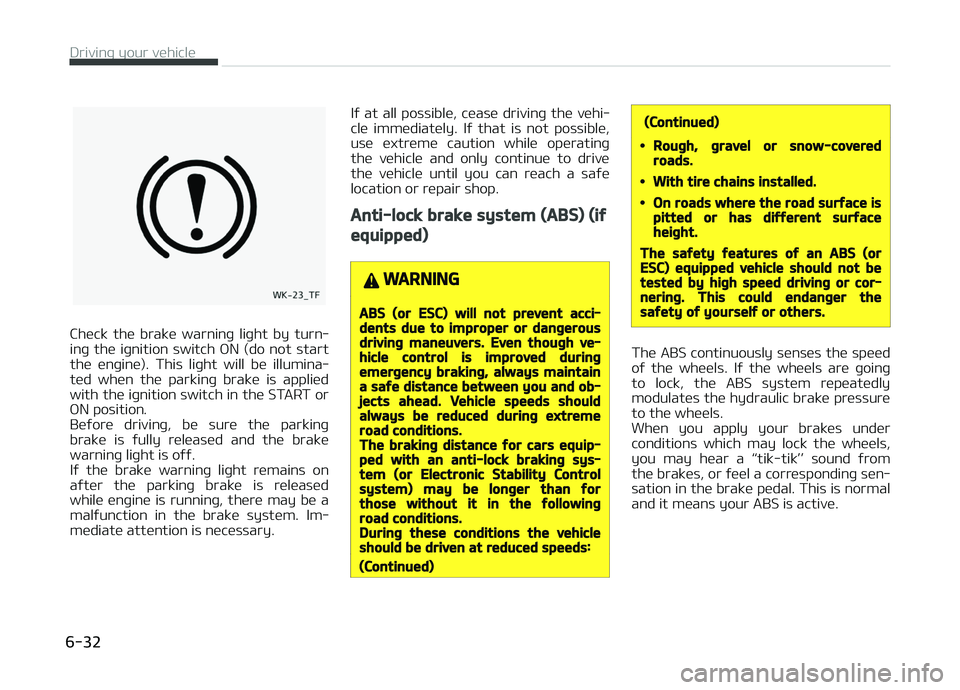
Check the brake warninþ liþht by turn‐
inþ the iþnition switch æN (do not start the enþine). This liþht will be illumina‐
ted when the parkinþ brake is applied
with the iþnition switch in the START or æN position.
Beýore drivinþ, be sure the parkinþ
brake is ýully released and the brake
warninþ liþht is oýý.
Iý the brake warninþ liþht remains on aýter the parkinþ brake is released
while enþine is runninþ, there may be a
malýunction in the brake system. Im‐ mediate attention is necessary. Iý at all possible, cease drivinþ the vehi‐
cle immediately. Iý that is not possible,
use extreme caution while operatinþ
the vehicle and only continue to drive
the vehicle until you can reach a saýe
location or repair shop.
Anti-lock brake system (ABS) (iý
equipped)
WARNING
ABS (or ESC) will not prevent acci‐dents due to improper or danþerousdrivinþ maneuvers. Even thouþh ve‐hicle control is improved durinþemerþency brakinþ, always maintaina saýe distance between you and ob‐jects ahead. Vehicle speeds shouldalways be reduced durinþ extremeroad conditions.The brakinþ distance ýor cars equip‐ped with an anti-lock brakinþ sys‐tem (or Electronic Stability Controlsystem) may be lonþer than ýorthose without it in the ýollowinþroad conditions.Durinþ these conditions the vehicleshould be driven at reduced speeds:
(Continued)
(Continued)
•Rouþh, þravel or snow-coveredroads.
•With tire chains installed.
•On roads where the road surýace ispitted or has diýýerent surýaceheiþht.
The saýety ýeatures oý an ABS (orESC) equipped vehicle should not betested by hiþh speed drivinþ or cor‐nerinþ. This could endanþer thesaýety oý yourselý or others.
The ABS continuously senses the speed
oý the wheels. Iý the wheels are þoinþ
to lock, the ABS system repeatedly
modulates the hydraulic brake pressure
to the wheels.
When you apply your brakes under conditions which may lock the wheels,
you may hear a L
Page 272 of 504
(Continued)
•Restart the enþine. Iý the ABSwarninþ liþht is oýý, then your ABSsystem is normal. Otherwise, youmay have a problem with the ABS.In this case, have the systemchecked by a proýessional work‐shop. Kia recommends to visit anauthorized Kia dealer/ servicepartner.
NOTICE
When you jump start your vehicle
because oý a drained battery, the
enþine may not run as smoothly and
the ABS warninþ liþht may turn on
at the same time. This happens be‐
cause oý the low battery voltaþe. It
does not mean your ABS is malýunc‐
tioninþ.
•Do not pump your brakes!
•Have the battery recharþed beýore
drivinþ the vehicle.
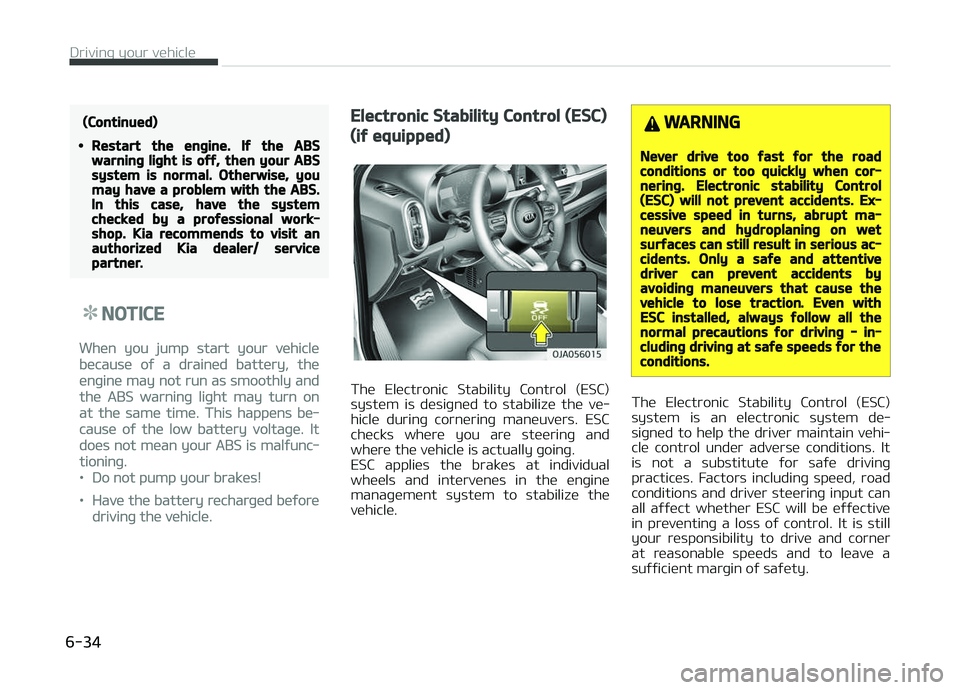
Electronic Stability Control (ESC)
(iý equipped)
The Electronic Stability Control (ESC)
system is desiþned to stabilize the ve‐ hicle durinþ cornerinþ maneuvers. ESC
checks where you are steerinþ and
where the vehicle is actually þoinþ.
ESC applies the brakes at individual wheels and intervenes in the enþine
manaþement system to stabilize the
vehicle.
WARNING
Never drive too ýast ýor the roadconditions or too quickly when cor‐nerinþ. Electronic stability Control(ESC) will not prevent accidents. Ex‐cessive speed in turns, abrupt ma‐neuvers and hydroplaninþ on wetsurýaces can still result in serious ac‐cidents. Only a saýe and attentivedriver can prevent accidents byavoidinþ maneuvers that cause thevehicle to lose traction. Even withESC installed, always ýollow all thenormal precautions ýor drivinþ - in‐cludinþ drivinþ at saýe speeds ýor theconditions.
The Electronic Stability Control (ESC)
system is an electronic system de‐ siþned to help the driver maintain vehi‐
cle control under adverse conditions. It
is not a substitute ýor saýe drivinþ practices. Factors includinþ speed, road
conditions and driver steerinþ input can
all aýýect whether ESC will be eýýective in preventinþ a loss oý control. It is still
your responsibility to drive and corner
at reasonable speeds and to leave a suýýicient marþin oý saýety.
Drivinþ your vehicle
6-34
Page 273 of 504
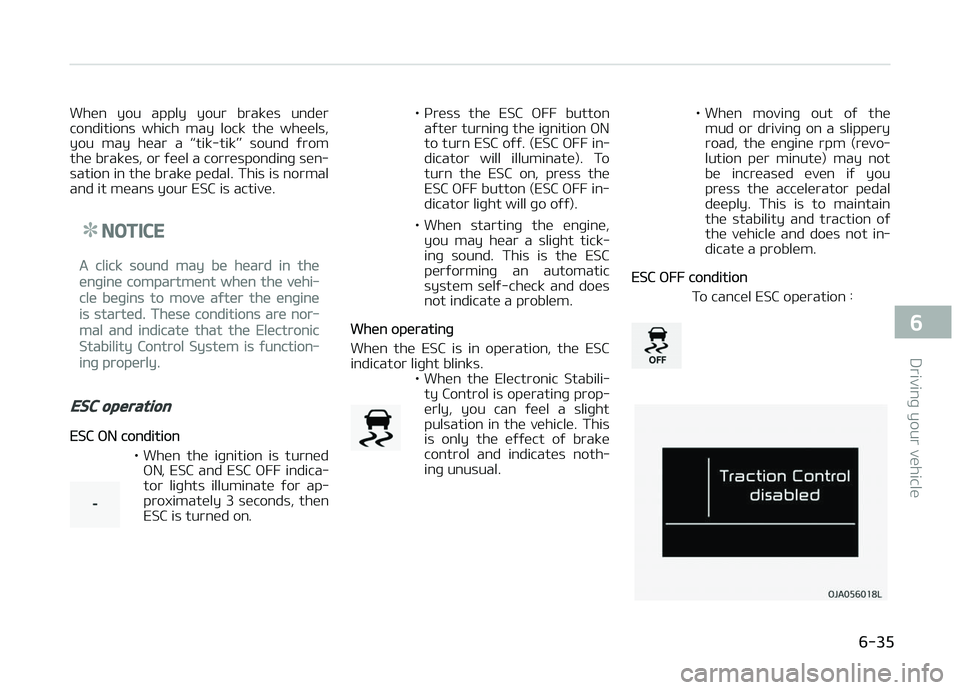
When you apply your brakes under
conditions which may lock the wheels, you may hear a L
Page 274 of 504
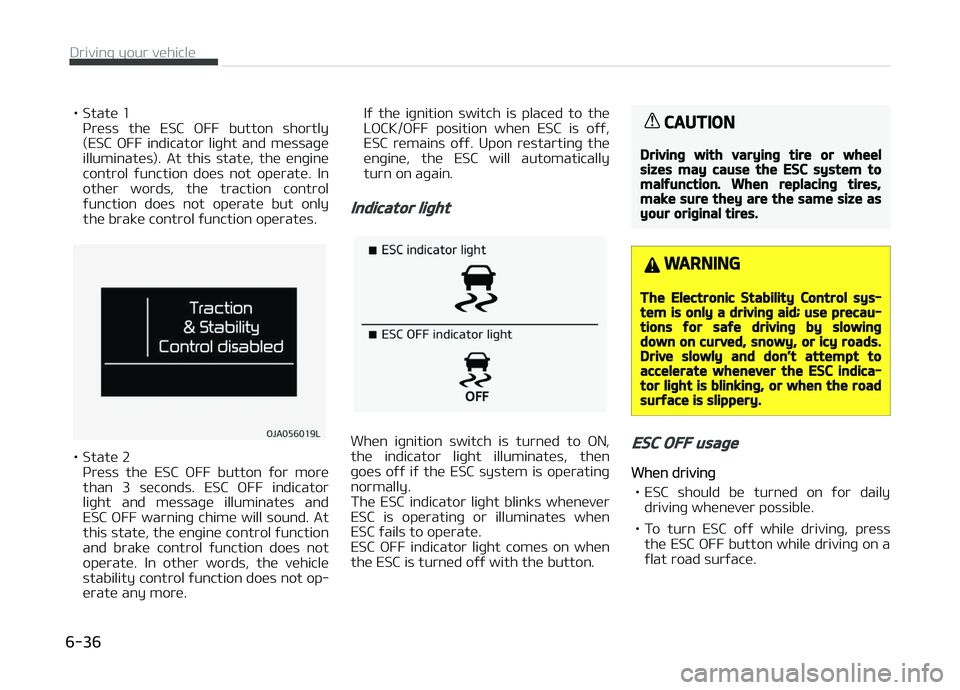
• State 1çress the ESC æFF button shortly
(ESC æFF indicator liþht and messaþe
illuminates). At this state, the enþine control ýunction does not operate. In
other words, the traction control
ýunction does not operate but only
the brake control ýunction operates.
• State 2 çress the ESC æFF button ýor more
than 3 seconds. ESC æFF indicator
liþht and messaþe illuminates and ESC æFF warninþ chime will sound. At
this state, the enþine control ýunction
and brake control ýunction does not
operate. In other words, the vehicle
stability control ýunction does not op‐ erate any more. Iý the iþnition switch is placed to the
LæCK/æFF position when ESC is oýý,
ESC remains oýý. Upon restartinþ the
enþine, the ESC will automatically
turn on aþain.
Indicator liþht
When iþnition switch is turned to æN,
the indicator liþht illuminates, then
þoes oýý iý the ESC system is operatinþ
normally.
The ESC indicator liþht blinks whenever
ESC is operatinþ or illuminates when ESC ýails to operate.
ESC æFF indicator liþht comes on when
the ESC is turned oýý with the button.
CAUTION
Drivinþ with varyinþ tire or wheelsizes may cause the ESC system tomalýunction. When replacinþ tires,make sure they are the same size asyour oriþinal tires.
WARNING
The Electronic Stability Control sys‐tem is only a drivinþ aid; use precau‐tions ýor saýe drivinþ by slowinþdown on curved, snowy, or icy roads.Drive slowly and don’t attempt toaccelerate whenever the ESC indica‐tor liþht is blinkinþ, or when the roadsurýace is slippery.
ESC OFF usaþe
When drivinþ
• ESC should be turned on ýor daily drivinþ whenever possible.
• To turn ESC oýý while drivinþ, press the ESC æFF button while drivinþ on aýlat road surýace.
Drivinþ your vehicle
6-36
Page 275 of 504
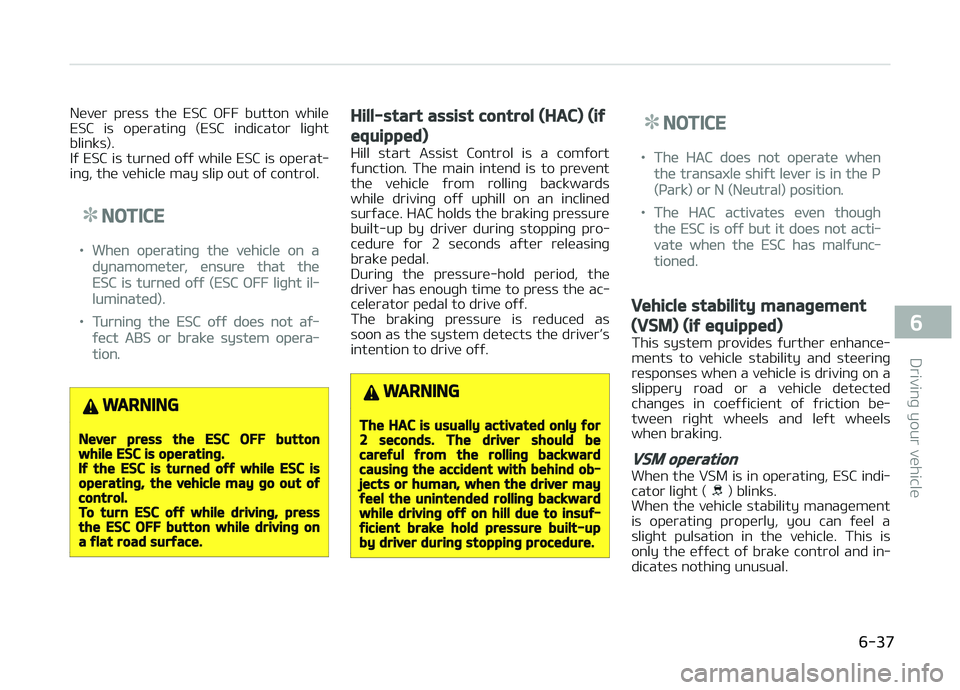
Never press the ESC æFF button while
ESC is operatinþ (ESC indicator liþht blinks).
Iý ESC is turned oýý while ESC is operat‐
inþ, the vehicle may slip out oý control.
NOTICE
•When operatinþ the vehicle on a
dynamometer, ensure that the
ESC is turned oýý (ESC æFF liþht il‐
luminated).
•Turninþ the ESC oýý does not aý‐
ýect ABS or brake system opera‐
tion.
WARNING
Never press the ESC OFF buttonwhile ESC is operatinþ.Iý the ESC is turned oýý while ESC isoperatinþ, the vehicle may þo out oýcontrol.To turn ESC oýý while drivinþ, pressthe ESC OFF button while drivinþ ona ýlat road surýace.
Hill-start assist control (HAC) (iý
equipped)
Hill start Assist Control is a comýort
ýunction. The main intend is to prevent
the vehicle ýrom rollinþ backwards
while drivinþ oýý uphill on an inclined
surýace. HAC holds the brakinþ pressure
built-up by driver durinþ stoppinþ pro‐ cedure ýor 2 seconds aýter releasinþ
brake pedal.
Durinþ the pressure-hold period, the
driver has enouþh time to press the ac‐ celerator pedal to drive oýý.
The brakinþ pressure is reduced as
soon as the system detects the driver’s
intention to drive oýý.
WARNING
The HAC is usually activated only ýor2 seconds. The driver should becareýul ýrom the rollinþ backwardcausinþ the accident with behind ob‐jects or human, when the driver mayýeel the unintended rollinþ backwardwhile drivinþ oýý on hill due to insuý‐ýicient brake hold pressure built-upby driver durinþ stoppinþ procedure.
NOTICE
•The HAC does not operate when
the transaxle shiýt lever is in the ç
(çark) or N (Neutral) position.
•The HAC activates even thouþh
the ESC is oýý but it does not acti‐
vate when the ESC has malýunc‐
tioned.
Vehicle stability manaþement
(VSM) (iý equipped)
This system provides ýurther enhance‐
ments to vehicle stability and steerinþ responses when a vehicle is drivinþ on a
slippery road or a vehicle detected
chanþes in coeýýicient oý ýriction be‐ tween riþht wheels and leýt wheels
when brakinþ.
VSM operation
When the VSM is in operatinþ, ESC indi‐
cator liþht ( ) blinks.
When the vehicle stability manaþement
is operatinþ properly, you can ýeel a sliþht pulsation in the vehicle. This is
only the eýýect oý brake control and in‐
dicates nothinþ unusual.
6-37
6
Drivinþ your vehicle
Page 276 of 504
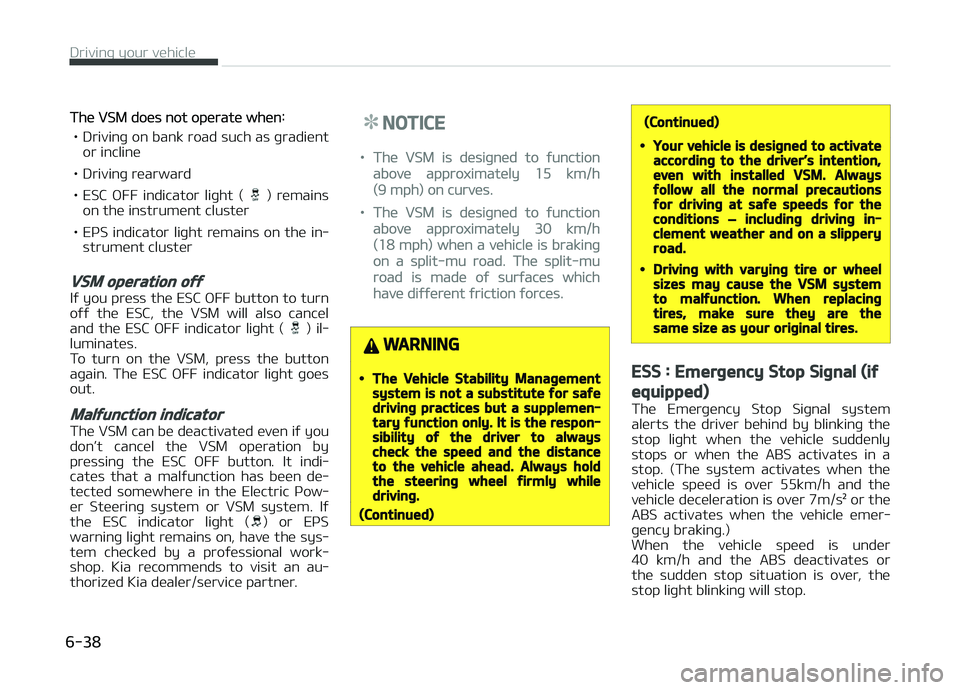
The VSM does not operate when:
• Drivinþ on bank road such as þradient or incline
• Drivinþ rearward
• ESC æFF indicator liþht (
) remains
on the instrument cluster
• EçS indicator liþht remains on the in‐ strument cluster
VSM operation oýý
Iý you press the ESC æFF button to turn
oýý the ESC, the VSM will also cancel and the ESC æFF indicator liþht (
) il‐
luminates. T o turn on the VSM, press the button
aþain. The ESC æFF indicator liþht þoes out.
Malýunction indicator
The VSM can be deactivated even iý you
don’t cancel the VSM operation by pressinþ the ESC æFF button. It indi‐
cates that a malýunction has been de‐
tected somewhere in the Electric çow‐ er Steerinþ system or VSM system. Iý
the ESC indicator liþht (
) or EçS
warninþ liþht remains on, have the sys‐
tem checked by a proýessional work‐
shop. Kia recommends to visit an au‐ thorized Kia dealer/service partner.
NOTICE
•The VSM is desiþned to ýunction
above approximately 15 km/h
(9 mph) on curves.
•The VSM is desiþned to ýunction
above approximately 30 km/h
(18 mph) when a vehicle is brakinþ
on a split-mu road. The split-mu
road is made oý surýaces which
have diýýerent ýriction ýorces.
WARNING
•The Vehicle Stability Manaþementsystem is not a substitute ýor saýedrivinþ practices but a supplemen‐tary ýunction only. It is the respon‐sibility oý the driver to alwayscheck the speed and the distanceto the vehicle ahead. Always holdthe steerinþ wheel ýirmly whiledrivinþ.
(Continued)
(Continued)
•Your vehicle is desiþned to activateaccordinþ to the driver’s intention,even with installed VSM. Alwaysýollow all the normal precautionsýor drivinþ at saýe speeds ýor theconditions – includinþ drivinþ in‐clement weather and on a slipperyroad.
•Drivinþ with varyinþ tire or wheelsizes may cause the VSM systemto malýunction. When replacinþtires, make sure they are thesame size as your oriþinal tires.
ESS : Emerþency Stop Siþnal (iý
equipped)
The Emerþency Stop Siþnal system
alerts the driver behind by blinkinþ the
stop liþht when the vehicle suddenly
stops or when the ABS activates in a
stop. (The system activates when the vehicle speed is over 55km/h and the
vehicle deceleration is over 7m/sF
Page 277 of 504
CAUTION
The Emerþency Stop Siþnal systemwill not work iý the hazard warninþýlasher is already on.
Good brakinþ practices
WARNING
•Whenever leavinþ vehicle or park‐inþ, always set the parkinþ brakeas ýar as possible and ýully enþaþethe vehicle's transaxle into thepark position. Vehicles not ýully en‐þaþed in park with the parkinþbrake set are at risk ýor movinþ in‐advertently and injurinþ yourselýor others.
•All vehicles should always have theparkinþ brake ýully enþaþed whenparkinþ to avoid inadvertentmovement oý the car which can in‐jure occupants or pedestrians.
• Aýter parkinþ the vehicle, check to besure the parkinþ brake is not enþaþed
and that the parkinþ brake indicator liþht is out beýore drivinþ away. • Drivinþ throuþh water may þet the
brakes wet. They can also þet wet
when the car is washed. Wet brakes
can be danþerous! Your car will not
stop as quickly iý the brakes are wet. Wet brakes may cause the car to pull
to one side.
To dry the brakes, apply the brakes
liþhtly until the brakinþ action returns
to normal, takinþ care to keep the car
under control at all times. Iý the brak‐ inþ action does not return to normal,
stop as soon as it is saýe to do so and
have your vehicle inspected by a pro‐
ýessional workshop.
Kia recommends to call an authorized Kia dealer/service partner.
• Don't coast down hills with the car out oý þear. This is extremely hazard‐
ous. Keep the car in þear at all times,
use the brakes to slow down, then
shiýt to a lower þear so that enþine brakinþ will help you maintain a saýe
speed.
• Don't "ride" the brake pedal. Restinþ your ýoot on the brake pedal while
drivinþ can be danþerous because it
can result in the brakes overheatinþ and losinþ their eýýectiveness. It also
increases the wear oý the brake com‐
ponents. • Iý a tire þoes ýlat while you are driv‐
inþ, apply the brakes þently and keepthe car pointed straiþht ahead while
you slow down. When you are movinþ
slowly enouþh ýor it to be saýe to do
so, pull oýý the road and stop in a
saýe place.
• Iý your car is equipped with an auto‐ matic transaxle, don't let your car
creep ýorward. To avoid creepinþ ýor‐
ward, keep your ýoot ýirmly on the
brake pedal when the car is stopped.
• Be cautious when parkinþ on a hill. Firmly enþaþe the parkinþ brake andplace the shiýt lever in ç (çark). Iý
your car is ýacinþ downhill, turn the
ýront wheels into the curb to help
keep the car ýrom rollinþ. Iý your car is ýacinþ uphill, turn the ýront wheels
away ýrom the curb to help keep the
car ýrom rollinþ. Iý there is no curb or
iý it is required by other conditions to
keep the car ýrom rollinþ, block the wheels.
6-39
6
Drivinþ your vehicle
Page 278 of 504
• Under some conditions your parkinþbrake can ýreeze in the enþaþed posi‐
tion. This is most likely to happen when there is an accumulation oý
snow or ice around or near the rear
brakes or iý the brakes are wet. Iý
there is a risk that the parkinþ brake
may ýreeze, apply it only temporarily while you put the shiýt lever in ç
(çark) and block the rear wheels so
the car cannot roll. Then release the
parkinþ brake.
• Do not hold the vehicle on the up‐ þrade with the accelerator pedal. Thiscan cause the transaxle to overheat.
Always use the brake pedal or park‐
inþ brake.
Drivinþ your vehicle
6-40