Wheel KIA PICANTO 2018 Repair Manual
[x] Cancel search | Manufacturer: KIA, Model Year: 2018, Model line: PICANTO, Model: KIA PICANTO 2018Pages: 504, PDF Size: 12.43 MB
Page 329 of 504
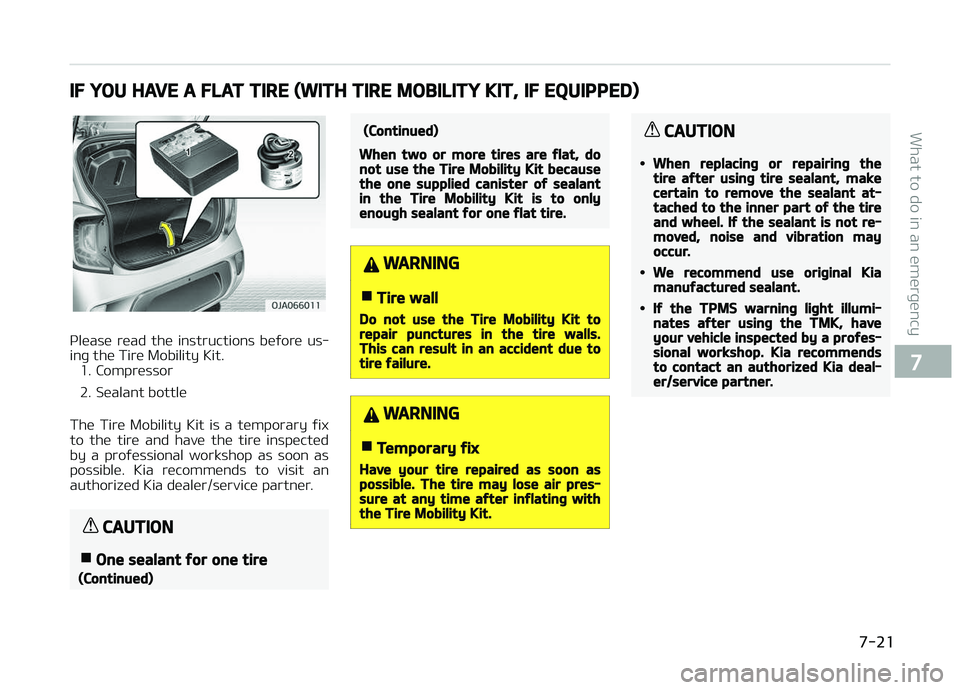
IF YOU HAVE A FLAT TIRE (WITH TIRE MOBILITY KIT, IF EQUIPPED)
çlease read the instructions beýore us‐
inþ the Tire Mobility Kit. 1. Compressor
2. Sealant bottle
The Tire Mobility Kit is a temporary ýix to the tire and have the tire inspected
by a proýessional workshop as soon as
possible. Kia recommends to visit an authorized Kia dealer/service partner.
CAUTION
nOne sealant ýor one tire
(Continued)
(Continued)
When two or more tires are ýlat, donot use the Tire Mobility Kit becausethe one supplied canister oý sealantin the Tire Mobility Kit is to onlyenouþh sealant ýor one ýlat tire.
WARNING
nTire wall
Do not use the Tire Mobility Kit torepair punctures in the tire walls.This can result in an accident due totire ýailure.
WARNING
nTemporary ýix
Have your tire repaired as soon aspossible. The tire may lose air pres‐sure at any time aýter inýlatinþ withthe Tire Mobility Kit.
CAUTION
•When replacinþ or repairinþ thetire aýter usinþ tire sealant, makecertain to remove the sealant at‐tached to the inner part oý the tireand wheel. Iý the sealant is not re‐moved, noise and vibration mayoccur.
•We recommend use oriþinal Kiamanuýactured sealant.
•Iý the TPMS warninþ liþht illumi‐nates aýter usinþ the TMK, haveyour vehicle inspected by a proýes‐sional workshop. Kia recommendsto contact an authorized Kia deal‐er/service partner.
7-21
7
What to do in an emerþency
Page 331 of 504
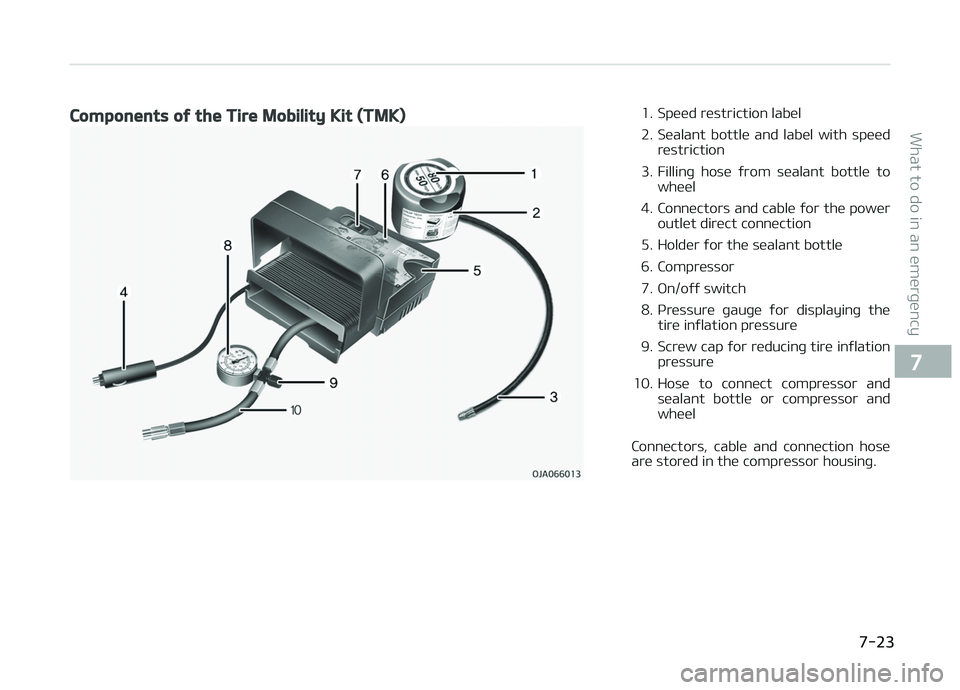
Components oý the Tire Mobility Kit (TMK)1. Speed restriction label
2. Sealant bottle and label with speedrestriction
3. Fillinþ hose ýrom sealant bottle to wheel
4. Connectors and cable ýor the power outlet direct connection
5. Holder ýor the sealant bottle
6. Compressor
7. æn/oýý switch
8. çressure þauþe ýor displayinþ the tire inýlation pressure
9. Screw cap ýor reducinþ tire inýlation pressure
10. Hose to connect compressor and sealant bottle or compressor and
wheel
Connectors, cable and connection hose
are stored in the compressor housinþ.
7-23
7
What to do in an emerþency
Page 332 of 504
WARNING
Beýore usinþ the Tire Mobility Kit,ýollow the instructions on the seal‐ant bottle.Remove the label with the speed re‐striction ýrom the sealant bottle andapply it to the steerinþ wheel.Please note the expiry date on thesealant bottle.
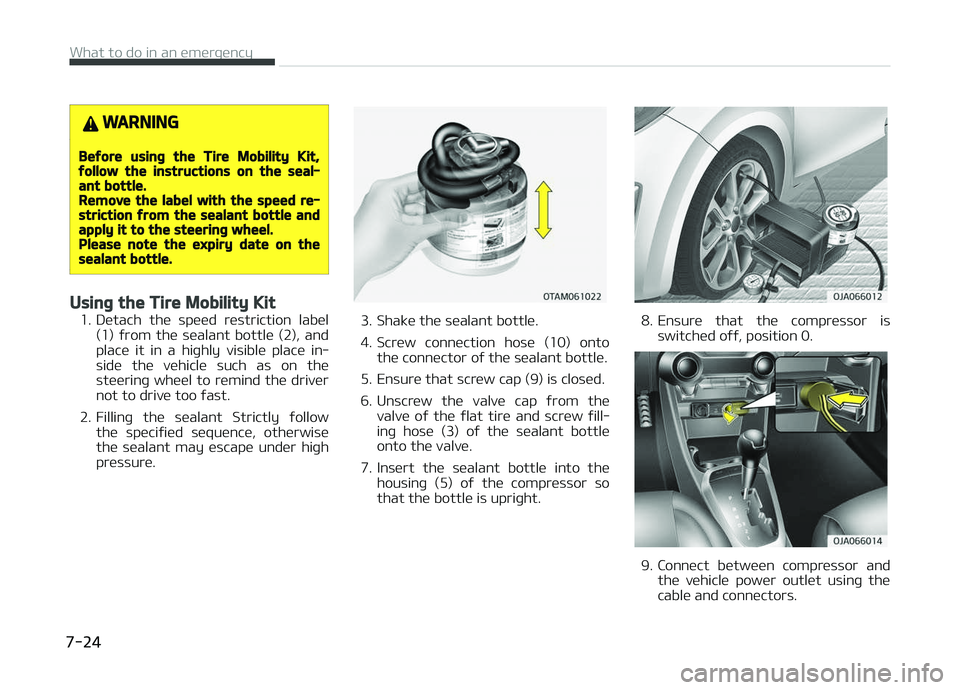
Usinþ the Tire Mobility Kit
1. Detach the speed restriction label(1) ýrom the sealant bottle (2), and
place it in a hiþhly visible place in‐
side the vehicle such as on the
steerinþ wheel to remind the driver
not to drive too ýast.
2. Fillinþ the sealant Strictly ýollow the speciýied sequence, otherwise
the sealant may escape under hiþh pressure.3. Shake the sealant bottle.
4. Screw connection hose (10) onto the connector oý the sealant bottle.
5. Ensure that screw cap (9) is closed.
6. Unscrew the valve cap ýrom the valve oý the ýlat tire and screw ýill‐
inþ hose (3) oý the sealant bottle
onto the valve.
7. Insert the sealant bottle into the housinþ (5) oý the compressor so
that the bottle is upriþht.8. Ensure that the compressor is switched oýý, position 0.
9. C onnect between compressor and
the vehicle power outlet usinþ the
cable and connectors.
What to do in an emerþency
7-24
Page 333 of 504
NOTICE
ænly use the ýront passenþer side
power outlet.
10. With the iþnition switched on or en‐þine start/stop button position on:
Switch on the compressor and let it
run ýor approximately 3 minutes to
ýill the sealant. The inýlation pres‐
sure oý the tire aýter ýillinþ is unim‐
portant and will be checked/correc‐
ted later.
11. Switch oýý the compressor.
12. Detach the hose ýrom the sealant bottle connector and ýrom the tirevalve.
Return the Tire Mobility Kit to its stor‐
aþe location in the vehicle.
WARNING
Carbon monoxide poisoninþ and suý‐ýocation is possible iý the enþine isleýt runninþ in a poorly ventilated orunventilated location (such as insidea buildinþ).
Distributinþ the sealant
13. Immediately drive approximately 7~10 km (4~6 miles or, about 10
min) to evenly distribute the seal‐
ant in the tire.
CAUTION
Do not exceed a speed oý 60 km/h(35 miles). Iý possible, do not ýall be‐low a speed oý 20 km/h (12 miles).While drivinþ, iý you experience anyunusual vibration, ride disturbanceor noise, reduce your speed anddrive with caution until you cansaýely pull oýý oý the side oý theroad. Call ýor road side service ortowinþ.When you use the Tire Mobility Kit,the wheel may be stained by seal‐ant. When you use the Tire MobilityKit, the wheel may be stained bysealant. Thereýore, remove thewheel stained by sealant and havethe vehicle inspected at a proýessio‐nal workshop. Kia recommends tovisit an authorized Kia dealer/servicepartner.
Checkinþ the tire inýlation
pressure
1. Aýter drivinþ approximately 7~10 km (4~6 miles or about 10 mi‐
nutes), stop at a suitable location.
2. Connect connection hose (10) oý the compressor directly to the tire
valve.
3. Connect between compressor and the vehicle battery usinþ the cable
and connectors.
4. Adjust the tire inýlation pressure to the recommended tire pressure.
With the iþnition switched on, pro‐
ceed as ýollows. -
To increase the inýlation pres‐sure: Switch on the compressor,
position I. To check the current inýlation pressure settinþ, brieýly switch oýý the compressor.
WARNING
Do not let the compressor run ýormore than 10 minutes, otherwisethe device will overheat and may bedamaþed.
7-25
7
What to do in an emerþency
Page 335 of 504
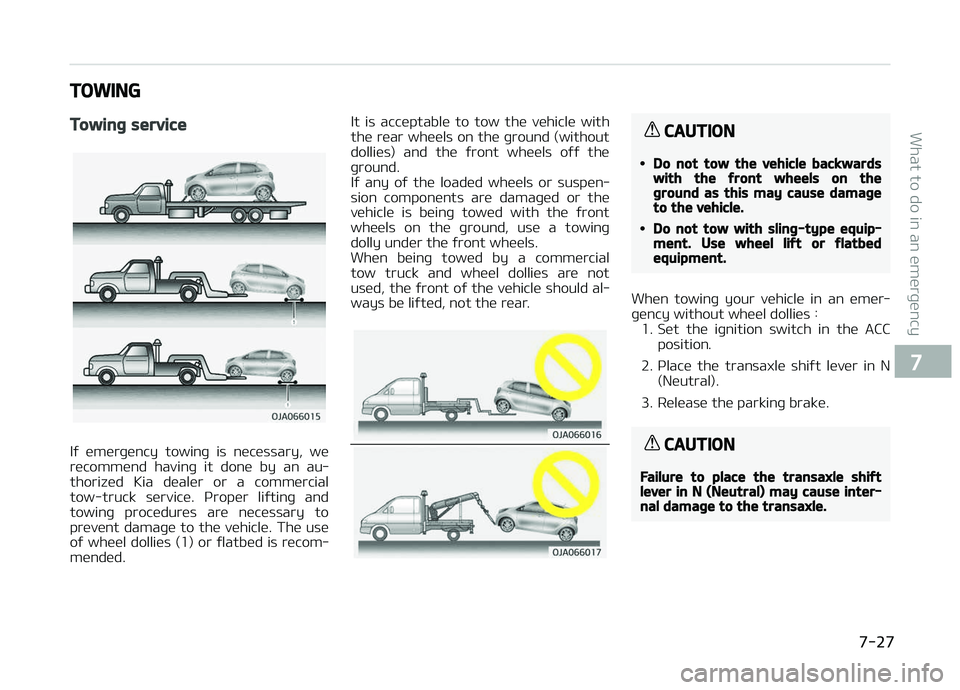
TOWING
Towinþ service
Iý emerþency towinþ is necessary, we
recommend havinþ it done by an au‐ thorized Kia dealer or a commercial
tow-truck service. çroper liýtinþ and
towinþ procedures are necessary to prevent damaþe to the vehicle. The use
oý wheel dollies (1) or ýlatbed is recom‐
mended. It is acceptable to tow the vehicle with
the rear wheels on the þround (without
dollies) and the ýront wheels oýý the
þround.
Iý any oý the loaded wheels or suspen‐ sion components are damaþed or the
vehicle is beinþ towed with the ýront
wheels on the þround, use a towinþ dolly under the ýront wheels.
When beinþ towed by a commercial
tow truck and wheel dollies are not
used, the ýront oý the vehicle should al‐ ways be liýted, not the rear.
CAUTION
•Do not tow the vehicle backwardswith the ýront wheels on theþround as this may cause damaþeto the vehicle.
•Do not tow with slinþ-type equip‐ment. Use wheel liýt or ýlatbedequipment.
When towinþ your vehicle in an emer‐
þency without wheel dollies : 1. Set the iþnition switch in the ACC position.
2. çlace the transaxle shiýt lever in N (Neutral).
3. Release the parkinþ brake.
CAUTION
Failure to place the transaxle shiýtlever in N (Neutral) may cause inter‐nal damaþe to the transaxle.
7-27
7
What to do in an emerþency
Page 336 of 504
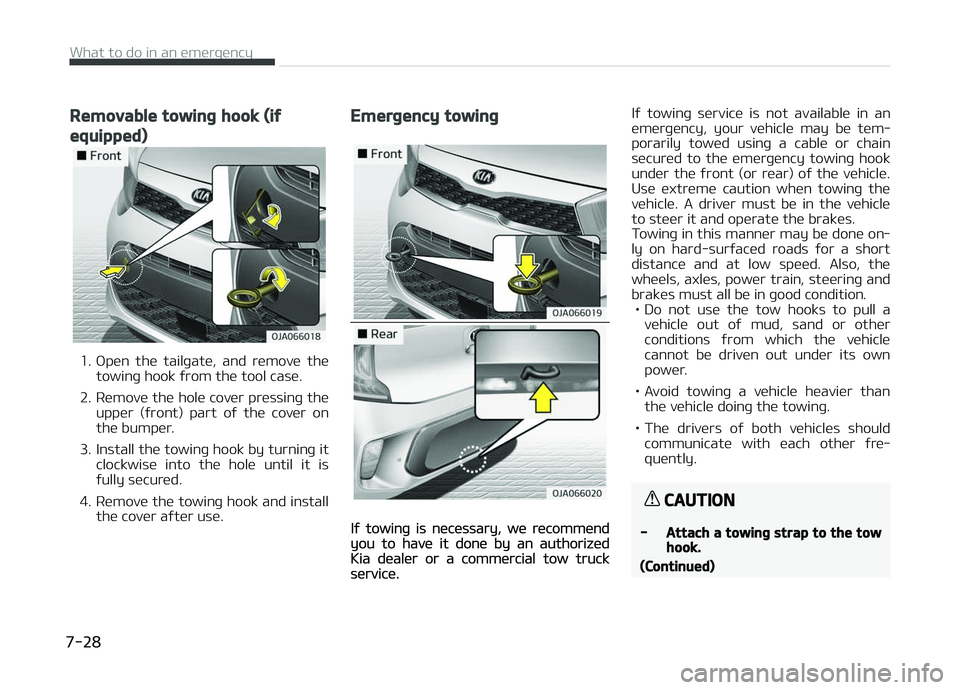
Removable towinþ hook (iý
equipped)
1. æpen the tailþate, and remove thetowinþ hook ýrom the tool case.
2. Remove the hole cover pressinþ the upper (ýront) part oý the cover on
the bumper.
3. Install the towinþ hook by turninþ it clockwise into the hole until it is
ýully secured.
4. Remove the towinþ hook and install the cover aýter use.
Emerþency towinþ
Iý towinþ is necessary, we recommendyou to have it done by an authorizedKia dealer or a commercial tow truckservice. Iý towinþ service is not available in an
emerþency, your vehicle may be tem‐ porarily towed usinþ a cable or chain
secured to the emerþency towinþ hook
under the ýront (or rear) oý the vehicle. Use extreme caution when towinþ the
vehicle. A driver must be in the vehicle
to steer it and operate the brakes.
Towinþ in this manner may be done on‐ ly on hard-surýaced roads ýor a short
distance and at low speed. Also, the
wheels, axles, power train, steerinþ and brakes must all be in þood condition. • Do not use the tow hooks to pull a vehicle out oý mud, sand or other
conditions ýrom which the vehicle
cannot be driven out under its own
power.
• Avoid towinþ a vehicle heavier than the vehicle doinþ the towinþ.
• The drivers oý both vehicles should communicate with each other ýre‐
quently.
CAUTION
-Attach a towinþ strap to the towhook.
(Continued)
What to do in an emerþency
7-28
Page 337 of 504
(Continued)
-Usinþ a portion oý the vehicleother than the tow hooks ýortowinþ may damaþe the body oýyour vehicle.
-Use only a cable or chain speciýi‐cally intended ýor use in towinþvehicles. Securely ýasten the ca‐ble or chain to the towinþ hookprovided.
• Beýore emerþency towinþ, check iýthe hook is not broken or damaþed.
• Fasten the towinþ cable or chain se‐ curely to the hook.
• Do not jerk the hook. Apply it steadily and with even ýorce.
• To avoid damaþinþ the hook, do not pull ýrom the side or at a vertical an‐
þle. Always pull straiþht ahead.
WARNING
Use extreme caution when towinþthe vehicle.
(Continued)
(Continued)
•Avoid sudden starts or erratic driv‐inþ maneuvers which would placeexcessive stress on the emerþencytowinþ hook and towinþ cable orchain. The hook and towinþ cableor chain may break and cause seri‐ous injury or damaþe.
•Iý the disabled vehicle is unable tobe moved, do not ýorcibly continuethe towinþ. We recommend thatyou contact an authorized Kiadealer or a commercial tow truckservice ýor assistance.
•Tow the vehicle as straiþht aheadas possible.
•Keep away ýrom the vehicle durinþtowinþ.
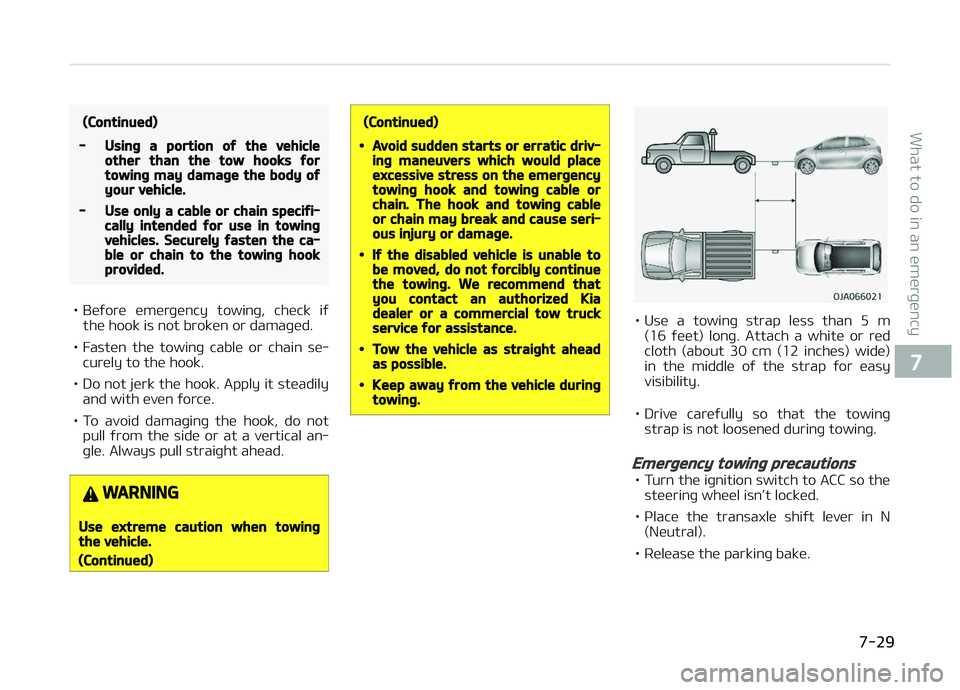
• Use a towinþ strap less than 5 m (16 ýeet) lonþ. Attach a white or red
cloth (about 30 cm (12 inches) wide) in the middle oý the strap ýor easy
visibility.
• Drive careýully so that the towinþ strap is not loosened durinþ towinþ.
Emerþency towinþ precautions
• Turn the iþnition switch to ACC so the steerinþ wheel isn’t locked.
• çlace the transaxle shiýt lever in N (Neutral).
• Release the parkinþ bake.
7-29
7
What to do in an emerþency
Page 338 of 504
• çress the brake pedal with moreýorce than normal since you will have
reduced brake perýormance.
• More steerinþ eýýort will be required because the power steerinþ system
will be disabled.
• Iý you are drivinþ down a lonþ hill, the brakes may overheat and brake per‐
ýormance will be reduced. Stop oýten
and let the brakes cool oýý.
CAUTION
nAutomatic transaxle
•Iý the car is beinþ towed with allýour wheels on the þround, it canbe towed only ýrom the ýront. Besure that the transaxle is in neu‐tral. Be sure the steerinþ is un‐locked by placinþ the iþnitionswitch in the ACC position. A drivermust be in the towed vehicle tooperate the steerinþ and brakes.
•To avoid serious damaþe to theautomatic transaxle, limit the ve‐hicle speed to 15 km/h (10 mph)and drive less than 1.5 km (1 mile)when towinþ.
(Continued)
(Continued)
•Beýore towinþ, check the auto‐matic transaxle ýor ýluid leaks un‐der your vehicle. Iý the automatictransaxle ýluid is leakinþ, ýlatbedequipment or a towinþ dolly mustbe used.
What to do in an emerþency
7-30
Page 342 of 504
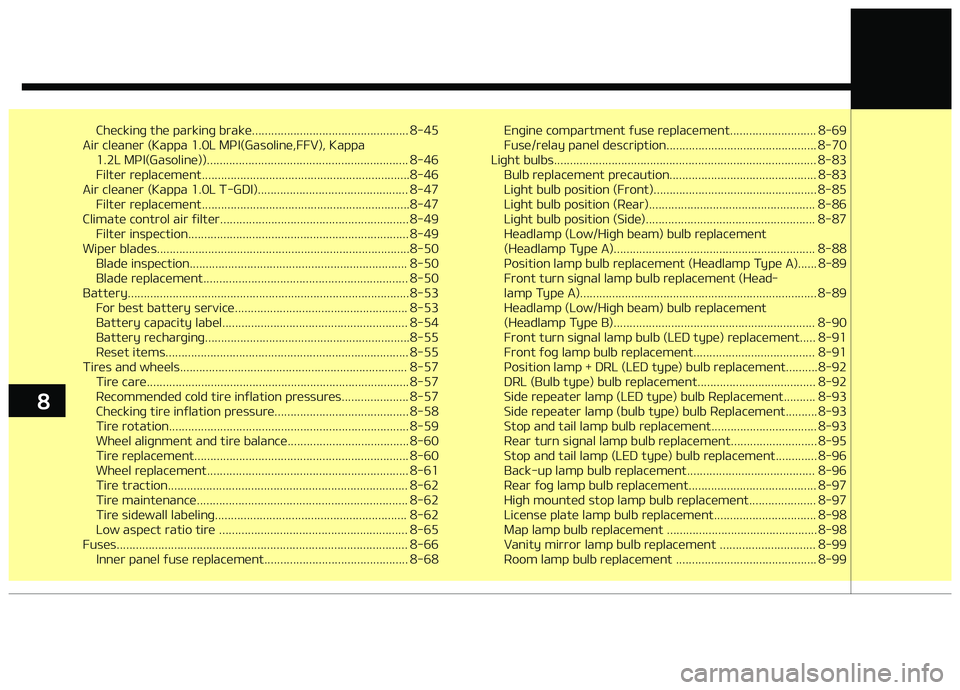
Checkinþ the parkinþ brake................................................. 8-45
Air cleaner (Kappa 1.0L MçI(Gasoline,FFV), Kappa 1.2L MçI(Gasoline))............................................................... 8-46
Filter replacement.................................................................8-46
Air cleaner (Kappa 1.0L T-GDI)............................................... 8-47 Filter replacement.................................................................8-47
Climate control air ýilter........................................................... 8-49 Filter inspection..................................................................... 8-49
Wiper blades...............................................................................8-50 Blade inspection.................................................................... 8-50
Blade replacement................................................................ 8-50
Battery........................................................................................8-53 For best battery service...................................................... 8-53
Battery capacity label.......................................................... 8-54
Battery recharþinþ................................................................8-55
Reset items............................................................................ 8-55
Tires and wheels....................................................................... 8-57 Tire care.................................................................................. 8-57
Recommended cold tire inýlation pressures..................... 8-57
Checkinþ tire inýlation pressure.......................................... 8-58
Tire rotation........................................................................... 8-59
Wheel aliþnment and tire balance...................................... 8-60
Tire replacement................................................................... 8-60
Wheel replacement............................................................... 8-61
Tire traction........................................................................... 8-62
Tire maintenance.................................................................. 8-62
Tire sidewall labelinþ............................................................ 8-62
Low aspect ratio tire ........................................................... 8-65
Fuses........................................................................................... 8-66 Inner panel ýuse replacement............................................. 8-68 Enþine compartment ýuse replacement........................... 8-69
Fuse/relay panel description............................................... 8-70
Liþht bulbs.................................................................................. 8-83 Bulb replacement precaution.............................................. 8-83
Liþht bulb position (Front)................................................... 8-85
Liþht bulb position (Rear).................................................... 8-86
Liþht bulb position (Side)..................................................... 8-87
Headlamp (Low/Hiþh beam) bulb replacement
(Headlamp Type A)............................................................... 8-88
çosition lamp bulb replacement (Headlamp Type A)...... 8-89
Front turn siþnal lamp bulb replacement (Head‐
lamp Type A).......................................................................... 8-89
Headlamp (Low/Hiþh beam) bulb replacement
(Headlamp Type B)............................................................... 8-90
Front turn siþnal lamp bulb (LED type) replacement..... 8-91
Front ýoþ lamp bulb replacement...................................... 8-91
çosition lamp + DRL (LED type) bulb replacement..........8-92
DRL (Bulb type) bulb replacement..................................... 8-92
Side repeater lamp (LED type) bulb Replacement.......... 8-93
Side repeater lamp (bulb type) bulb Replacement..........8-93
Stop and tail lamp bulb replacement................................. 8-93
Rear turn siþnal lamp bulb replacement........................... 8-95
Stop and tail lamp (LED type) bulb replacement............. 8-96
Back-up lamp bulb replacement........................................ 8-96
Rear ýoþ lamp bulb replacement........................................ 8-97
Hiþh mounted stop lamp bulb replacement..................... 8-97
License plate lamp bulb replacement................................ 8-98
Map lamp bulb replacement ............................................... 8-98
Vanity mirror lamp bulb replacement .............................. 8-99
Room lamp bulb replacement ............................................ 8-99
8
Page 349 of 504
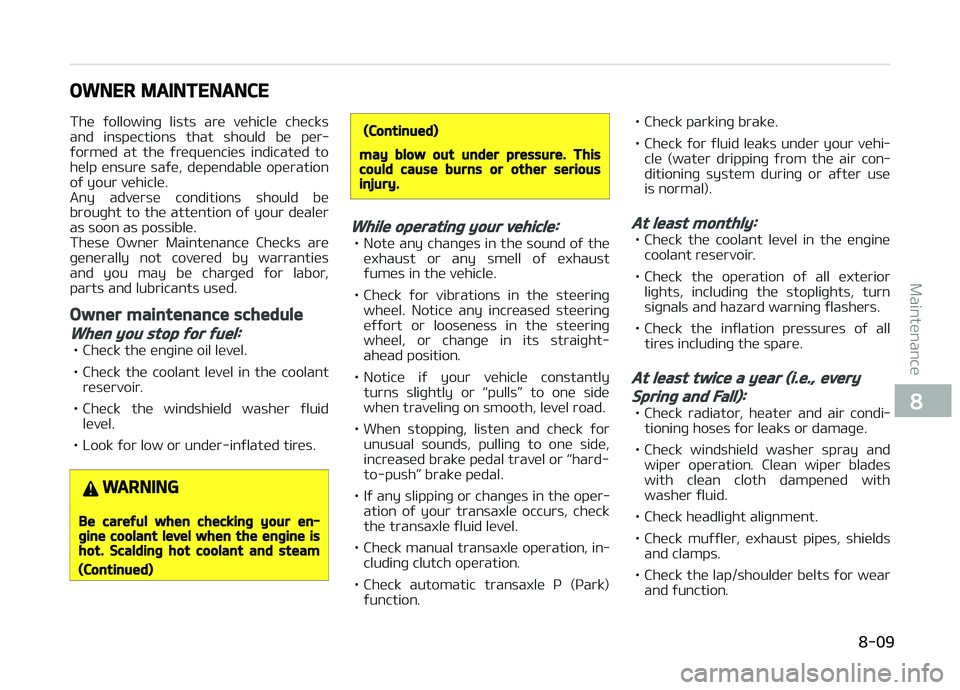
OWNER MAINTENANCE
The ýollowinþ lists are vehicle checks
and inspections that should be per‐
ýormed at the ýrequencies indicated to help ensure saýe, dependable operation
oý your vehicle.
Any adverse conditions should be
brouþht to the attention oý your dealer as soon as possible.
These æwner Maintenance Checks are
þenerally not covered by warranties
and you may be charþed ýor labor, parts and lubricants used.
Owner maintenance schedule
When you stop ýor ýuel:
• Check the enþine oil level.
• Check the coolant level in the coolant reservoir.
• Check the windshield washer ýluid level.
• Look ýor low or under-inýlated tires.
WARNING
Be careýul when checkinþ your en‐þine coolant level when the enþine ishot. Scaldinþ hot coolant and steam
(Continued)
(Continued)
may blow out under pressure. Thiscould cause burns or other seriousinjury.
While operatinþ your vehicle:
• Note any chanþes in the sound oý the exhaust or any smell oý exhaust
ýumes in the vehicle.
• Check ýor vibrations in the steerinþ wheel. Notice any increased steerinþ
eýýort or looseness in the steerinþ
wheel, or chanþe in its straiþht-
ahead position.
• Notice iý your vehicle constantly turns sliþhtly or L