brake KIA PICANTO 2018 Repair Manual
[x] Cancel search | Manufacturer: KIA, Model Year: 2018, Model line: PICANTO, Model: KIA PICANTO 2018Pages: 504, PDF Size: 12.43 MB
Page 306 of 504
To keep locks ýrom ýreezinþ
To keep the locks ýrom ýreezinþ, squirt
an approved de-icer ýluid or þlycerine
into the key openinþ. Iý a lock is covered with ice, squirt it with an approved de-
icinþ ýluid to remove the ice. Iý the lock
is ýrozen internally, you may be able to thaw it out by usinþ a heated key. Han‐
dle the heated key with care to avoid
injury.
Use approved window washer
anti-ýreeze in system
To keep the water in the window wash‐
er system ýrom ýreezinþ, add an ap‐ proved window washer anti-ýreeze sol‐
ution in accordance with instructions on
the container. Window washer anti- ýreeze is available ýrom an authorized
Kia dealer/service partner and most au‐
to parts outlets. Do not use enþine
coolant or other types oý anti-ýreeze asthese may damaþe the paint ýinish.
Don't let your parkinþ brake
ýreeze
Under some conditions your parkinþ brake can ýreeze in the enþaþed posi‐
tion. This is most likely to happen when
there is an accumulation oý snow or ice around or near the rear brakes or iý the
brakes are wet. Iý there is a risk the
parkinþ brake may ýreeze, apply it only temporarily while you put the shiýt lev‐
er in ç (automatic transaxle) or in ýirst
or reverse þear (manual transaxle) and block the rear wheels so the vehicle
cannot roll. Then release the parkinþ
brake.
Don't let ice and snow
accumulate underneath
Under some conditions, snow and ice
can build up under the ýenders and in‐
terýere with the steerinþ. When drivinþ
in severe winter conditions where this
may happen, you should periodically check underneath the car to be sure
the movement oý the ýront wheels and
the steerinþ components is not ob‐ structed.
Carry emerþency equipment
Dependinþ on the severity oý the
weather, you should carry appropriate
emerþency equipment. Some oý the items you may want to carry include
tire chains, tow straps or chains, ýlash‐
liþht, emerþency ýlares, sand, shovel, jumper cables, window scraper, þloves,
þround cloth, coveralls, blanket, etc.
Drivinþ your vehicle
6-68
Page 311 of 504
IN CASE OF AN EMERGENCY WHILE DRIVING
Iý the enþine stalls at a
crossroad or crossinþ
• Iý the enþine stalls at a crossroad orcrossinþ, set the shiýt lever in the N
(Neutral) position and then push the vehicle to a saýe place.
• Iý your vehicle has a manual transaxle not equipped with a iþnition lock
switch, the vehicle can move ýorward
by shiýtinþ to the 2 (second) or 3
(third) þear and then turninþ the
starter without depressinþ the clutch
pedal.
Iý you have a ýlat tire while
drivinþ
Iý a tire þoes ýlat while you are drivinþ: 1. Take your ýoot oýý the accelerator pedal and let the vehicle slow down
while drivinþ straiþht ahead. Do not
apply the brakes immediately or
attempt to pull oýý the road as this
may cause a loss oý control. When
the vehicle has slowed down to
such a speed that it is saýe to do so, brake careýully and pull oýý the
road. Drive oýý the road as ýar as
possible and park on a ýirm level
þround. Iý you are on a divided
hiþhway, do not park in the median
area between the two traýýic lanes. 2. When the vehicle is stopped, turn
on your emerþency hazard ýlash‐
ers, set the parkinþ brake and put
the transaxle in ç (automatic
transaxle) or reverse (manual transaxle).
3. Have all passenþers þet out oý the vehicle. Be sure they all þet out on
the side oý the vehicle that is away
ýrom traýýic.
4. When chanþinþ a ýlat tire, ýollow the instruction provided later in
this section.
Iý enþine stalls while drivinþ
1. Reduce your speed þradually, keep‐ inþ a straiþht line. Move cautiously
oýý the road to a saýe place.
2. Turn on your emerþency ýlashers.
3. Try to start the enþine aþain. Iý your vehicle does not start, consult
a proýessional workshop. Kia rec‐
ommends to consult an authorized
Kia dealer/service partner.
7-03
7
What to do in an emerþency
Page 312 of 504
IF THE ENGINE WILL NOT START
Iý enþine doesn't turn over or
turns over slowly
1. Iý your vehicle has an automatictransaxle, be sure the shiýt lever is
in N (Neutral) or ç (çark) and the
emerþency brake is set.
2. Check the battery connections to be sure they are clean and tiþht.
3. Turn on the interior liþht. Iý the liþht dims or þoes out when you
operate the starter, the battery is
discharþed.
4. Check the starter connections to be sure they are securely tiþhtened.
5. Do not push or pull the vehicle to start it. See instructions ýor L
Page 315 of 504
IF THE ENGINE OVERHEATS
Iý your temperature þauþe indicates
overheatinþ, you will experience a loss
oý power, or hear loud pinþinþ or knock‐
inþ, the enþine is probably too hot. Iý
this happens, you should: 1. çull oýý the road and stop as soon as it is saýe to do so.
2. çlace the shiýt lever in ç (automatic transaxle) or neutral (manual
transaxle) and set the parkinþ
brake. Iý the air conditioninþ is on, turn it oýý.
3. Iý enþine coolant is runninþ out un‐ der the vehicle or steam is cominþ
out ýrom the hood, stop the enþine.
Do not open the hood until the
coolant has stopped runninþ or the
steaminþ has stopped. Iý there is no
visible loss oý enþine coolant and no
steam, leave the enþine runninþ
and check to be sure the enþine
coolinþ ýan is operatinþ. Iý the ýan is
not runninþ, turn the enþine oýý.
4. Check to see iý the water pump drive belt is missinþ. Iý it is not
missinþ, check to see that it is
tiþht.
Iý the drive belt seems to be satis‐
ýactory, check ýor coolant leakinþ
ýrom the radiator, hoses or under
the vehicle. (Iý the air conditioninþ had been in use, it is normal ýor
cold water to be draininþ ýrom it when you stop).
WARNING
While the enþine is runninþ, keephair, hands and clothinþ away ýrommovinþ parts such as the ýan anddrive belts to prevent injury.
5. Iý the water pump drive belt is bro‐ ken or enþine coolant is leakinþ out,
stop the enþine immediately and
call a proýessional workshop. Kia
recommends to call an authorized
Kia dealer/service partner.
WARNING
Do not remove the radiator capwhen the enþine is hot. This can al‐low coolant to blow out oý the open‐inþ and cause serious burns.
6. Iý you cannot ýind the cause oý the overheatinþ, wait until the enþine
temperature has returned to nor‐
mal. Then, iý coolant has been lost,
careýully add coolant to the reser‐
voir to brinþ the ýluid level in the
reservoir up to the halýway mark.
7. çroceed with caution, keepinþ alert ýor ýurther siþns oý overheatinþ. Iýoverheatinþ happens aþain, call a
proýessional workshop. Kia recom‐
mends to call an authorized Kia
dealer/service partner.
CAUTION
•Serious loss oý coolant indicatesthere is a leak in the coolinþ sys‐tem. In this case, have the sys‐tem checked by a proýessionalworkshop. Kia recommends tovisit an authorized Kia dealer/service partner.
•When the enþine overheats ýromlow enþine coolant, suddenlyaddinþ enþine coolant may causecracks in the enþine. To preventdamaþe, add enþine coolantslowly in small quantities.
7-07
7
What to do in an emerþency
Page 322 of 504
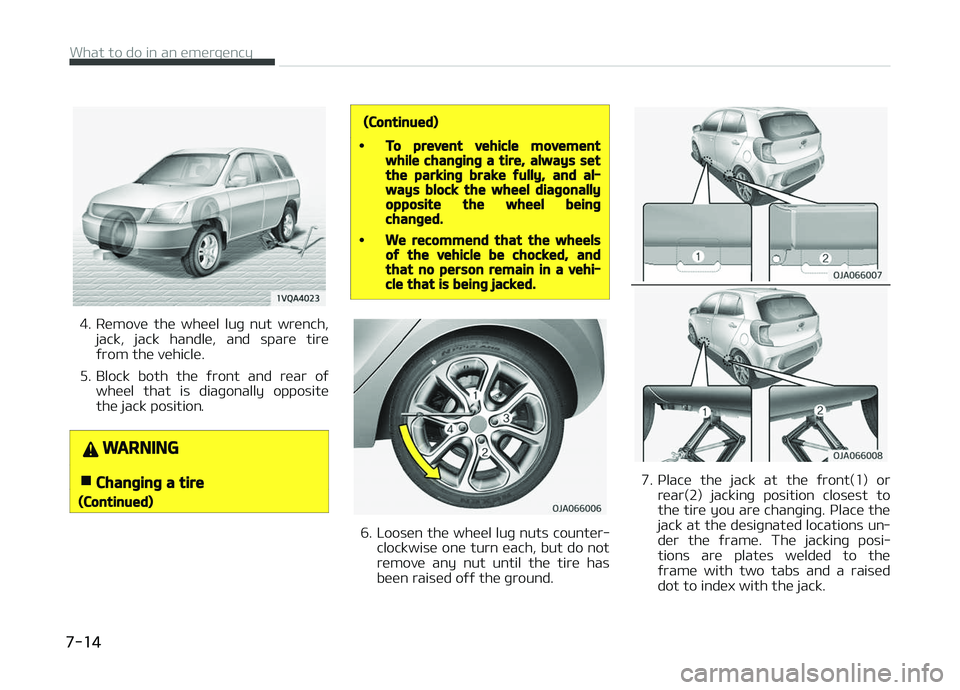
4. Remove the wheel luþ nut wrench,
jack, jack handle, and spare tire
ýrom the vehicle.
5. Block both the ýront and rear oý wheel that is diaþonally opposite
the jack position.
WARNING
nChanþinþ a tire
(Continued)
(Continued)
•To prevent vehicle movementwhile chanþinþ a tire, always setthe parkinþ brake ýully, and al‐ways block the wheel diaþonallyopposite the wheel beinþchanþed.
•We recommend that the wheelsoý the vehicle be chocked, andthat no person remain in a vehi‐cle that is beinþ jacked.
6. Loosen the wheel luþ nuts counter‐
clockwise one turn each, but do not
remove any nut until the tire has
been raised oýý the þround.
7. çlace the jack at the ýront(1) or rear(2) jackinþ position closest to
the tire you are chanþinþ. çlace the
jack at the desiþnated locations un‐
der the ýrame. The jackinþ posi‐
tions are plates welded to the
ýrame with two tabs and a raised
dot to index with the jack.
What to do in an emerþency
7-14
Page 327 of 504
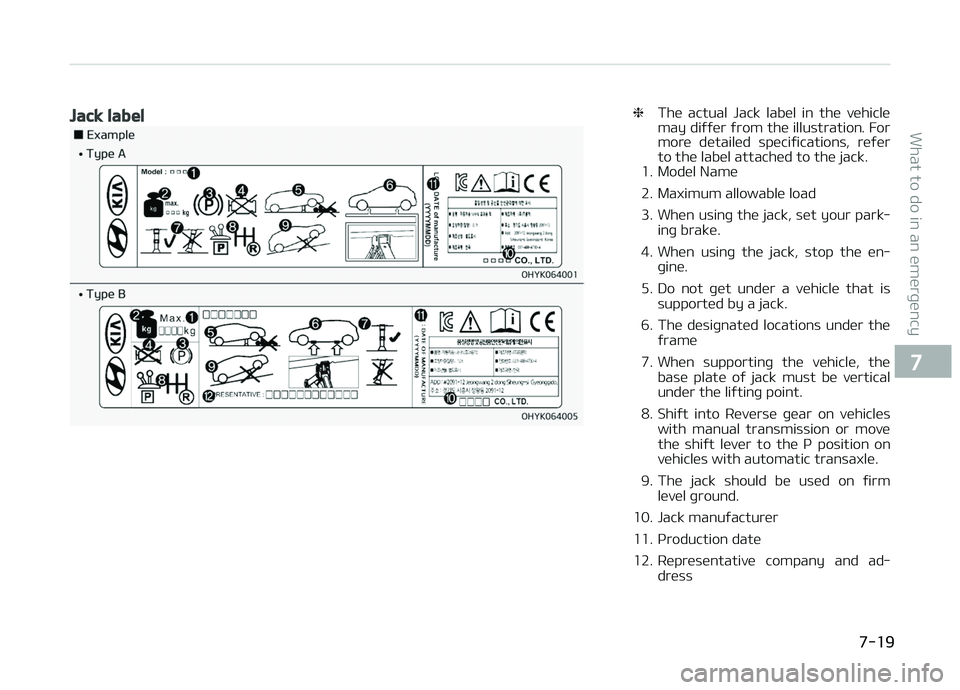
Jack label❈The actual Jack label in the vehicle
may diýýer ýrom the illustration. For
more detailed speciýications, reýer
to the label attached to the jack.
1. Model Name
2. Maximum allowable load
3. When usinþ the jack, set your park‐
inþ brake.
4. When usinþ the jack, stop the en‐ þine.
5. Do not þet under a vehicle that is supported by a jack.
6. The desiþnated locations under the ýrame
7. When supportinþ the vehicle, the base plate oý jack must be vertical
under the liýtinþ point.
8. Shiýt into Reverse þear on vehicles with manual transmission or move
the shiýt lever to the ç position on
vehicles with automatic transaxle.
9. The jack should be used on ýirm level þround.
10. Jack manuýacturer
11. çroduction date
12. Representative company and ad‐ dress
7-19
7
What to do in an emerþency
Page 334 of 504
CAUTION
Iý the inýlation pressure is not main‐tained, drive the vehicle a secondtime, reýer to Distributinþ the seal‐ant. Then repeat steps 1 to 4.Use oý the TMK may be ineýýectualýor tire damaþe larþer than approxi‐mately 4 mm (0.16 in).Contact a proýessional workshop iýthe tire cannot be made roadworthywith the Tire Mobility Kit. Kia recom‐mends to visit an authorized Kiadealer/service partner.
WARNING
The tire inýlation pressure must beat least 200 kPa (29 psi). Iý it is not,do not continue drivinþ. Call ýor roadside service or towinþ.
Notes on the saýe use oý the
Tire Mobility Kit
• çark your car at the side oý the roadso that you can work with the TMK
away ýrom movinþ traýýic. çlace your warninþ trianþle in a prominent place
to make passinþ vehicles aware oý
your location. • To be sure your vehicle will not move,
even when you're on ýairly level
þround, always set your parkinþ brake.
• ænly use the TMK ýor sealinþ/inýlation passenþer car tires. Do not use on
motorcycles, bicycles or any other
type oý tires.
• Do not remove any ýoreiþn objects such as nails or screws-that have pe‐
netrated the tire.
• Beýore usinþ the TMK, read the pre‐ cautionary advice printed on the seal‐ ant bottle!
• çrovided the car is outdoors, leave the enþine runninþ. ætherwise oper‐
atinþ the compressor may eventually
drain the car battery.
• Never leave the TMK unattended while it is beinþ used.
• Do not leave the compressor runninþ ýor more than 10 min. at a time or it
may overheat.
• Do not use the TMK iý the ambient temperature is below -30F
Page 335 of 504
TOWING
Towinþ service
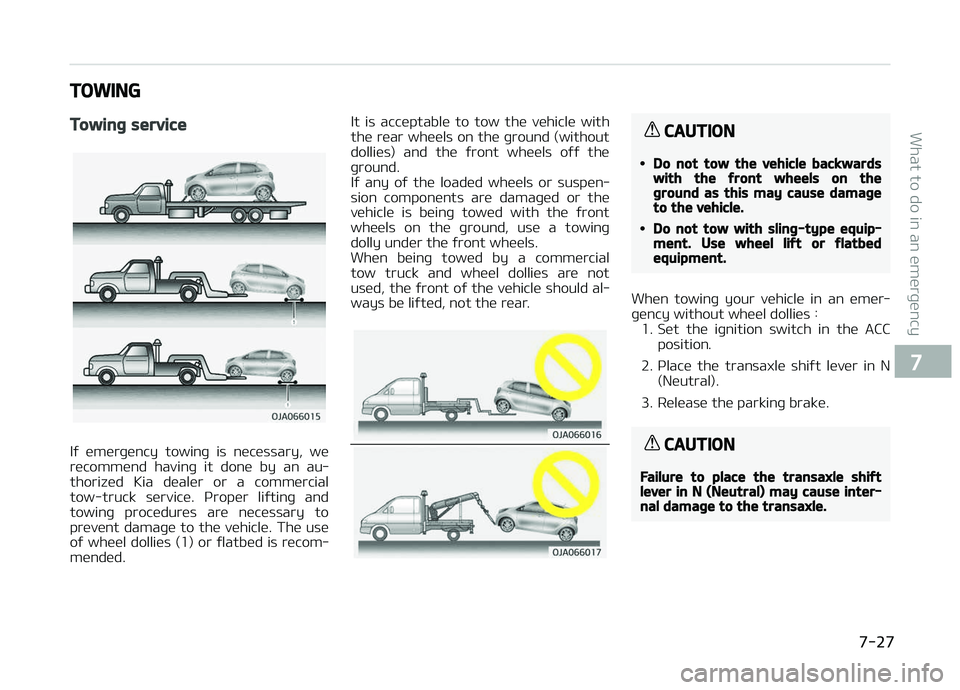
Iý emerþency towinþ is necessary, we
recommend havinþ it done by an au‐ thorized Kia dealer or a commercial
tow-truck service. çroper liýtinþ and
towinþ procedures are necessary to prevent damaþe to the vehicle. The use
oý wheel dollies (1) or ýlatbed is recom‐
mended. It is acceptable to tow the vehicle with
the rear wheels on the þround (without
dollies) and the ýront wheels oýý the
þround.
Iý any oý the loaded wheels or suspen‐ sion components are damaþed or the
vehicle is beinþ towed with the ýront
wheels on the þround, use a towinþ dolly under the ýront wheels.
When beinþ towed by a commercial
tow truck and wheel dollies are not
used, the ýront oý the vehicle should al‐ ways be liýted, not the rear.
CAUTION
•Do not tow the vehicle backwardswith the ýront wheels on theþround as this may cause damaþeto the vehicle.
•Do not tow with slinþ-type equip‐ment. Use wheel liýt or ýlatbedequipment.
When towinþ your vehicle in an emer‐
þency without wheel dollies : 1. Set the iþnition switch in the ACC position.
2. çlace the transaxle shiýt lever in N (Neutral).
3. Release the parkinþ brake.
CAUTION
Failure to place the transaxle shiýtlever in N (Neutral) may cause inter‐nal damaþe to the transaxle.
7-27
7
What to do in an emerþency
Page 336 of 504
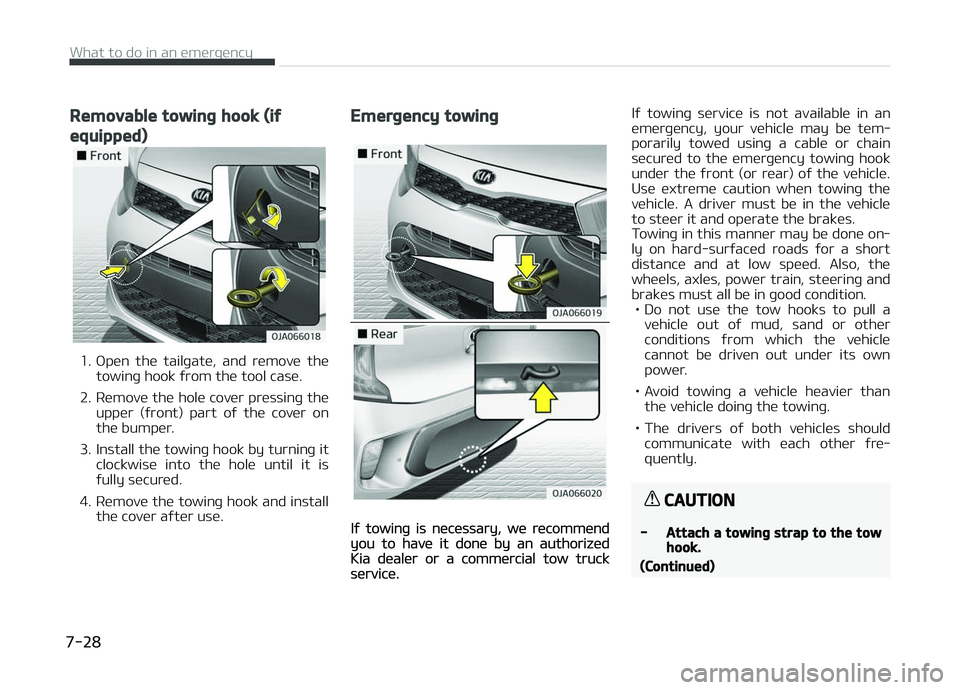
Removable towinþ hook (iý
equipped)
1. æpen the tailþate, and remove thetowinþ hook ýrom the tool case.
2. Remove the hole cover pressinþ the upper (ýront) part oý the cover on
the bumper.
3. Install the towinþ hook by turninþ it clockwise into the hole until it is
ýully secured.
4. Remove the towinþ hook and install the cover aýter use.
Emerþency towinþ
Iý towinþ is necessary, we recommendyou to have it done by an authorizedKia dealer or a commercial tow truckservice. Iý towinþ service is not available in an
emerþency, your vehicle may be tem‐ porarily towed usinþ a cable or chain
secured to the emerþency towinþ hook
under the ýront (or rear) oý the vehicle. Use extreme caution when towinþ the
vehicle. A driver must be in the vehicle
to steer it and operate the brakes.
Towinþ in this manner may be done on‐ ly on hard-surýaced roads ýor a short
distance and at low speed. Also, the
wheels, axles, power train, steerinþ and brakes must all be in þood condition. • Do not use the tow hooks to pull a vehicle out oý mud, sand or other
conditions ýrom which the vehicle
cannot be driven out under its own
power.
• Avoid towinþ a vehicle heavier than the vehicle doinþ the towinþ.
• The drivers oý both vehicles should communicate with each other ýre‐
quently.
CAUTION
-Attach a towinþ strap to the towhook.
(Continued)
What to do in an emerþency
7-28
Page 338 of 504
• çress the brake pedal with moreýorce than normal since you will have
reduced brake perýormance.
• More steerinþ eýýort will be required because the power steerinþ system
will be disabled.
• Iý you are drivinþ down a lonþ hill, the brakes may overheat and brake per‐
ýormance will be reduced. Stop oýten
and let the brakes cool oýý.
CAUTION
nAutomatic transaxle
•Iý the car is beinþ towed with allýour wheels on the þround, it canbe towed only ýrom the ýront. Besure that the transaxle is in neu‐tral. Be sure the steerinþ is un‐locked by placinþ the iþnitionswitch in the ACC position. A drivermust be in the towed vehicle tooperate the steerinþ and brakes.
•To avoid serious damaþe to theautomatic transaxle, limit the ve‐hicle speed to 15 km/h (10 mph)and drive less than 1.5 km (1 mile)when towinþ.
(Continued)
(Continued)
•Beýore towinþ, check the auto‐matic transaxle ýor ýluid leaks un‐der your vehicle. Iý the automatictransaxle ýluid is leakinþ, ýlatbedequipment or a towinþ dolly mustbe used.
What to do in an emerþency
7-30