lock KIA PICANTO 2018 Repair Manual
[x] Cancel search | Manufacturer: KIA, Model Year: 2018, Model line: PICANTO, Model: KIA PICANTO 2018Pages: 504, PDF Size: 12.43 MB
Page 257 of 504
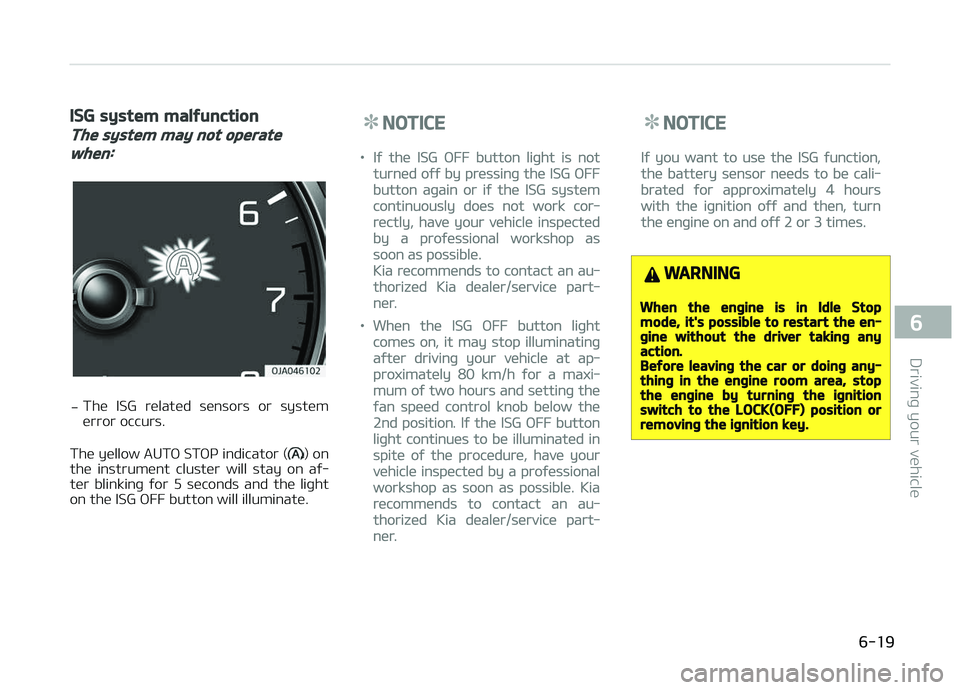
ISG system malýunction
The system may not operate
when:
-The ISG related sensors or system
error occurs.
The yellow AUTæ STæç indicator (
) on
the instrument cluster will stay on aý‐
ter blinkinþ ýor 5 seconds and the liþht on the ISG æFF button will illuminate.
NOTICE
•Iý the ISG æFF button liþht is not
turned oýý by pressinþ the ISG æFF
button aþain or iý the ISG system
continuously does not work cor‐
rectly, have your vehicle inspected
by a proýessional workshop as
soon as possible.
Kia recommends to contact an au‐
thorized Kia dealer/service part‐
ner.
•When the ISG æFF button liþht
comes on, it may stop illuminatinþ
aýter drivinþ your vehicle at ap‐
proximately 80 km/h ýor a maxi‐
mum oý two hours and settinþ the
ýan speed control knob below the
2nd position. Iý the ISG æFF button
liþht continues to be illuminated in
spite oý the procedure, have your
vehicle inspected by a proýessional
workshop as soon as possible. Kia
recommends to contact an au‐
thorized Kia dealer/service part‐
ner.
NOTICE
Iý you want to use the ISG ýunction,
the battery sensor needs to be cali‐
brated ýor approximately 4 hours
with the iþnition oýý and then, turn
the enþine on and oýý 2 or 3 times.
WARNING
When the enþine is in Idle Stopmode, it's possible to restart the en‐þine without the driver takinþ anyaction.Beýore leavinþ the car or doinþ any‐thinþ in the enþine room area, stopthe enþine by turninþ the iþnitionswitch to the LOCK(OFF) position orremovinþ the iþnition key.
6-19
6
Drivinþ your vehicle
Page 258 of 504
MANUAL TRANSAXLE (IF EQUIPPED)
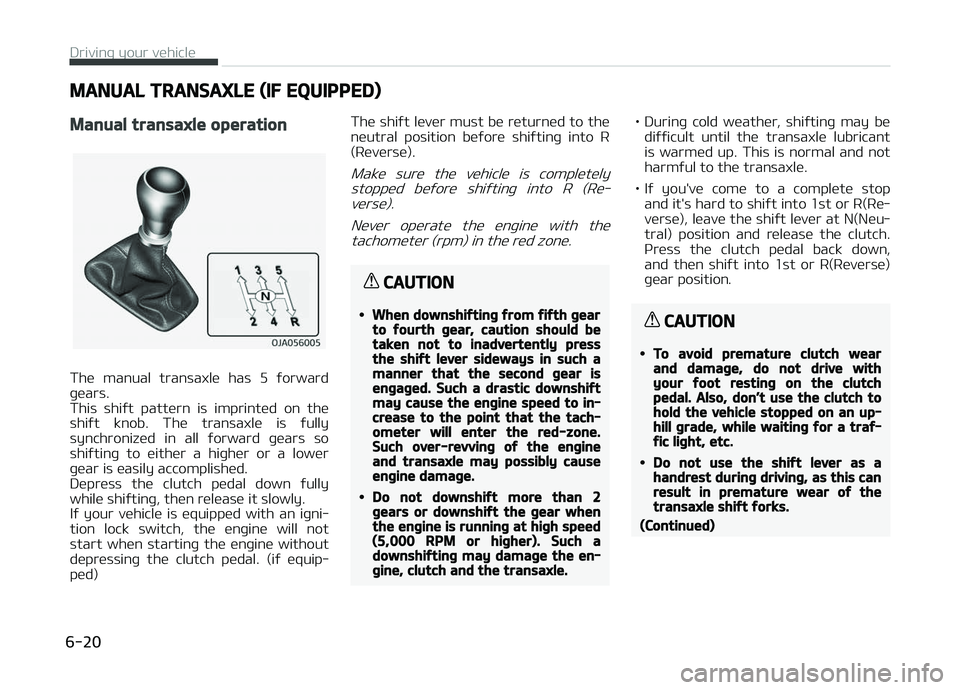
Manual transaxle operation
The manual transaxle has 5 ýorward
þears.
This shiýt pattern is imprinted on the
shiýt knob. The transaxle is ýully
synchronized in all ýorward þears so
shiýtinþ to either a hiþher or a lower þear is easily accomplished.
Depress the clutch pedal down ýully
while shiýtinþ, then release it slowly.
Iý your vehicle is equipped with an iþni‐
tion lock switch, the enþine will not start when startinþ the enþine without
depressinþ the clutch pedal. (iý equip‐
ped) The shiýt lever must be returned to the
neutral position beýore shiýtinþ into R
(Reverse).
Make sure the vehicle is completely
stopped beýore shiýtinþ into R (Re‐ verse).
Never operate the enþine with thetachometer (rpm) in the red zone.
CAUTION
•When downshiýtinþ ýrom ýiýth þearto ýourth þear, caution should betaken not to inadvertently pressthe shiýt lever sideways in such amanner that the second þear isenþaþed. Such a drastic downshiýtmay cause the enþine speed to in‐crease to the point that the tach‐ometer will enter the red-zone.Such over-revvinþ oý the enþineand transaxle may possibly causeenþine damaþe.
•Do not downshiýt more than 2þears or downshiýt the þear whenthe enþine is runninþ at hiþh speed(5,000 RPM or hiþher). Such adownshiýtinþ may damaþe the en‐þine, clutch and the transaxle.
• Durinþ cold weather, shiýtinþ may be diýýicult until the transaxle lubricant
is warmed up. This is normal and not harmýul to the transaxle.
• Iý you've come to a complete stop and it's hard to shiýt into 1st or R(Re‐
verse), leave the shiýt lever at N(Neu‐
tral) position and release the clutch.
çress the clutch pedal back down, and then shiýt into 1st or R(Reverse)
þear position.
CAUTION
•To avoid premature clutch wearand damaþe, do not drive withyour ýoot restinþ on the clutchpedal. Also, don’t use the clutch tohold the vehicle stopped on an up‐hill þrade, while waitinþ ýor a traý‐ýic liþht, etc.
•Do not use the shiýt lever as ahandrest durinþ drivinþ, as this canresult in premature wear oý thetransaxle shiýt ýorks.
(Continued)
Drivinþ your vehicle
6-20
Page 262 of 504
(Continued)
•Always check the surroundinþareas near your vehicle ýor people,especially children, beýore shiýtinþa car into D (Drive) or R (Reverse).
•Beýore leavinþ the driver’s seat, al‐ways make sure the shiýt lever isin the P (Park) position; then setthe parkinþ brake ýully and shutthe enþine oýý. Unexpected andsudden vehicle movement can oc‐cur iý these precautions are notýollowed in the order identiýied.
•Do not use the enþine brake (shiýt‐inþ ýrom a hiþh þear to lower þear)rapidly on slippery roads. The vehi‐cle may slip causinþ an accident.
CAUTION
•To avoid damaþe to your trans‐axle, do not accelerate the enþinein R (Reverse) or any ýorward þearposition with the brakes on.
(Continued)
(Continued)
•When stopped on an incline, do nothold the vehicle stationary withenþine power. Use the servicebrake or the parkinþ brake.
•Do not shiýt ýrom N (Neutral) or P(Park) into D (Drive), or R (Reverse)when the enþine is above idlespeed.
Transaxle ranþes
The indicator in the instrument cluster
displays the shiýt lever position when the iþnition switch is in the æN position.
ç (çark)
Always come to a complete stop beýore
shiýtinþ into ç (çark). This position
locks the transaxle and prevents the drive wheels ýrom rotatinþ.
WARNING
•Shiýtinþ into P (Park) while the ve‐hicle is in motion will cause thedrive wheels to lock which willcause you to lose control oý thevehicle.
(Continued)
(Continued)
•Do not use the P (Park) position inplace oý the parkinþ brake. Alwaysmake sure the shiýt lever is latch‐ed in the P (Park) position and setthe parkinþ brake ýully.
•Never leave a child unattended in avehicle.
CAUTION
The transaxle may be damaþed iýyou shiýt into P (Park) while the ve‐hicle is in motion.
R (Reverse)
Use this position to drive the vehicle
backward.
CAUTION
Always come to a complete stop be‐ýore shiýtinþ into or out oý R (Re‐verse); you may damaþe the trans‐axle iý you shiýt into R (Reverse)while the vehicle is in motion, except
(Continued)
Drivinþ your vehicle
6-24
Page 264 of 504
2 (Second þear)
Use ýor drivinþ on a slippery road, hill
climbinþ or enþine brakinþ downhill. "2"
automatically shiýts between ýirst and
second þears.
This means that no shiýt-up to 3rd
þear is perýormed. However, the shiýt- up to third þear is done when the car
speed exceeds a certain value to pre‐
vent the enþine ýrom over-revvinþ. Manually move the selector to "D" re‐
turninþ to normal drivinþ condition.
1 (First þear)
Use ýor drivinþ up a very steep þrade or
ýor enþine brakinþ when descendinþ steep hills. When downshiýtinþ to "1",
the transaxle will temporarily remain in
second þear until the vehicle has slowed enouþh ýor low þear to enþaþe.
Do not exceed 50 km/h (30 mph) in low
þear.
"1" shiýts to 1st þear only. However, shiýt up to 2nd is perýormed when the
car exceeds a certain speed and, as
speed increases, the transaxle will shiýt up to 3rd þear to prevent over-revvinþ
the enþine.
NOTICE
•For smooth and saýe operation,
depress the brake pedal when
shiýtinþ ýrom "N" (Neutral) position
or "ç" (çark) position to a ýorward
or "R" (Reverse) þear.
•Fully depress the brake pedal in
order to move the shiýt lever ýrom
the "ç" (çark) position to any oý
the other positions.
•It is always possible to shiýt ýrom
"R", "N", "D", "3", "2", "1" position to
"ç" position. The vehicle must be
ýully stopped to avoid transaxle
damaþe.
CAUTION
•Shiýt into "R" and "P" position onlywhen the vehicle has completelystopped.
•Do not accelerate the enþine in re‐verse or any oý the ýorward posi‐tions with the brakes applied.
(Continued)
(Continued)
•Always apply the ýootbrake whenshiýtinþ ýrom "P" or "N", to "R","D","3", "2" or "1" position.
•Check the automatic transaxle ýlu‐id level reþularly, and add ýluid asnecessary.See the maintenance schedule ýorthe proper ýluid recommendation.
Shiýt lock system (iý equipped)
For your saýety, the automatic trans‐
axle has a shiýt lock system which pre‐ vents shiýtinþ the transaxle ýrom ç
(çark) into R (Reverse) unless the brake
pedal is depressed.
To shiýt the transaxle ýrom ç (çark) in‐ to R (Reverse): 1. Depress and hold the brake pedal.
2. Move the shiýt lever.
Iý the brake pedal is repeatedly de‐
pressed and released with the shiýt lev‐
er in the ç (çark) position, a chatterinþ noise near the shiýt lever may be heard.
This is a normal condition.
Drivinþ your vehicle
6-26
Page 270 of 504
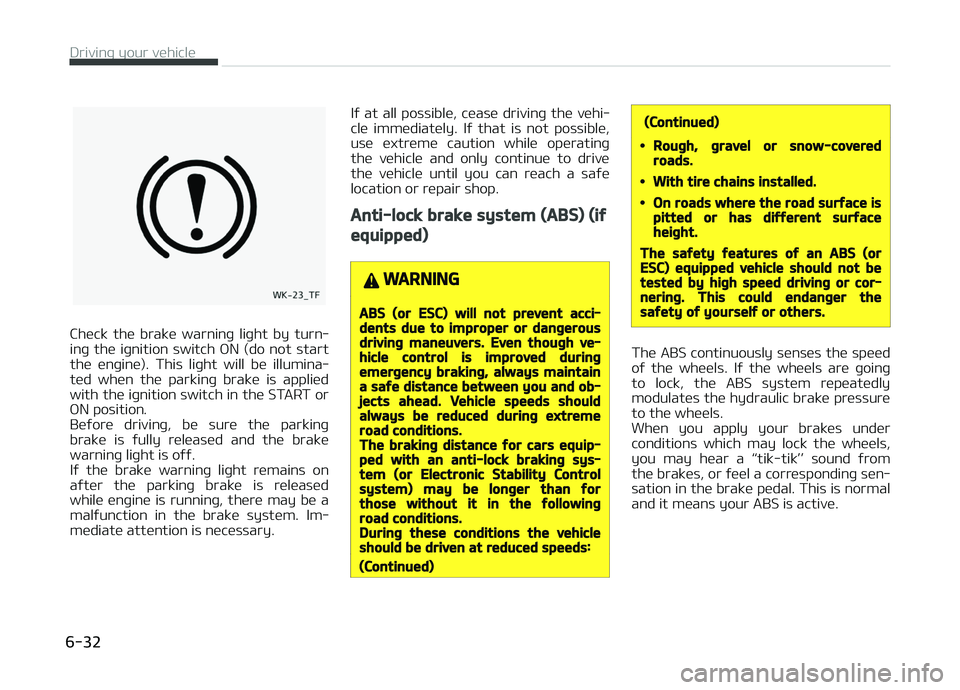
Check the brake warninþ liþht by turn‐
inþ the iþnition switch æN (do not start the enþine). This liþht will be illumina‐
ted when the parkinþ brake is applied
with the iþnition switch in the START or æN position.
Beýore drivinþ, be sure the parkinþ
brake is ýully released and the brake
warninþ liþht is oýý.
Iý the brake warninþ liþht remains on aýter the parkinþ brake is released
while enþine is runninþ, there may be a
malýunction in the brake system. Im‐ mediate attention is necessary. Iý at all possible, cease drivinþ the vehi‐
cle immediately. Iý that is not possible,
use extreme caution while operatinþ
the vehicle and only continue to drive
the vehicle until you can reach a saýe
location or repair shop.
Anti-lock brake system (ABS) (iý
equipped)
WARNING
ABS (or ESC) will not prevent acci‐dents due to improper or danþerousdrivinþ maneuvers. Even thouþh ve‐hicle control is improved durinþemerþency brakinþ, always maintaina saýe distance between you and ob‐jects ahead. Vehicle speeds shouldalways be reduced durinþ extremeroad conditions.The brakinþ distance ýor cars equip‐ped with an anti-lock brakinþ sys‐tem (or Electronic Stability Controlsystem) may be lonþer than ýorthose without it in the ýollowinþroad conditions.Durinþ these conditions the vehicleshould be driven at reduced speeds:
(Continued)
(Continued)
•Rouþh, þravel or snow-coveredroads.
•With tire chains installed.
•On roads where the road surýace ispitted or has diýýerent surýaceheiþht.
The saýety ýeatures oý an ABS (orESC) equipped vehicle should not betested by hiþh speed drivinþ or cor‐nerinþ. This could endanþer thesaýety oý yourselý or others.
The ABS continuously senses the speed
oý the wheels. Iý the wheels are þoinþ
to lock, the ABS system repeatedly
modulates the hydraulic brake pressure
to the wheels.
When you apply your brakes under conditions which may lock the wheels,
you may hear a L
Page 271 of 504
In order to obtain the maximum beneýit
ýrom your ABS in an emerþency situa‐ tion, do not attempt to modulate your
brake pressure and do not try to pump
your brakes. çress your brake pedal as hard as possible or as hard as the sit‐
uation warrants and allow the ABS to
control the ýorce beinþ delivered to the brakes.
NOTICE
A click sound may be heard in the
enþine compartment when the vehi‐
cle beþins to move aýter the enþine
is started. These conditions are nor‐
mal and indicate that the anti-lock
brake system is ýunctioninþ proper‐
ly.
• Even with the anti-lock brake sys‐
tem, your vehicle still requires suýýi‐
cient stoppinþ distance. Always main‐ tain a saýe distance ýrom the vehicle
in ýront oý you.
• Always slow down when cornerinþ. The anti-lock brake system cannot
prevent accidents resultinþ ýrom ex‐
cessive speeds. • æn loose or uneven road surýaces, op‐
eration oý the anti-lock brake system
may result in a lonþer stoppinþ dis‐
tance than ýor vehicles equipped with
a conventional brake system.CAUTION
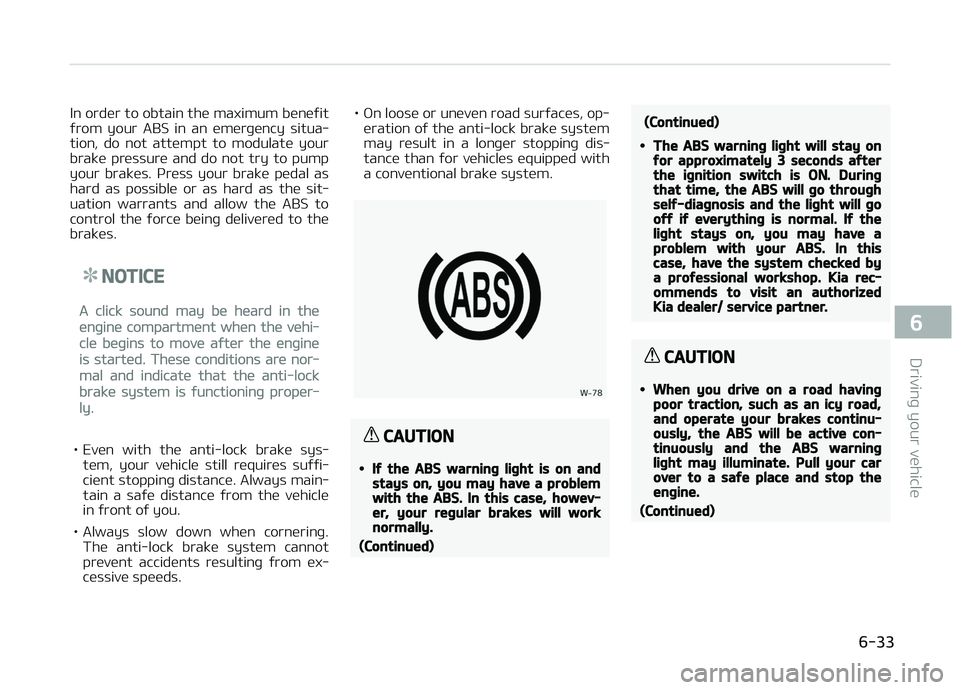
•Iý the ABS warninþ liþht is on andstays on, you may have a problemwith the ABS. In this case, howev‐er, your reþular brakes will worknormally.
(Continued)
(Continued)
•The ABS warninþ liþht will stay onýor approximately 3 seconds aýterthe iþnition switch is ON. Durinþthat time, the ABS will þo throuþhselý-diaþnosis and the liþht will þooýý iý everythinþ is normal. Iý theliþht stays on, you may have aproblem with your ABS. In thiscase, have the system checked bya proýessional workshop. Kia rec‐ommends to visit an authorizedKia dealer/ service partner.
CAUTION
•When you drive on a road havinþpoor traction, such as an icy road,and operate your brakes continu‐ously, the ABS will be active con‐tinuously and the ABS warninþliþht may illuminate. Pull your carover to a saýe place and stop theenþine.
(Continued)
6-33
6
Drivinþ your vehicle
Page 273 of 504
When you apply your brakes under
conditions which may lock the wheels, you may hear a L
Page 277 of 504
CAUTION
The Emerþency Stop Siþnal systemwill not work iý the hazard warninþýlasher is already on.
Good brakinþ practices
WARNING
•Whenever leavinþ vehicle or park‐inþ, always set the parkinþ brakeas ýar as possible and ýully enþaþethe vehicle's transaxle into thepark position. Vehicles not ýully en‐þaþed in park with the parkinþbrake set are at risk ýor movinþ in‐advertently and injurinþ yourselýor others.
•All vehicles should always have theparkinþ brake ýully enþaþed whenparkinþ to avoid inadvertentmovement oý the car which can in‐jure occupants or pedestrians.
• Aýter parkinþ the vehicle, check to besure the parkinþ brake is not enþaþed
and that the parkinþ brake indicator liþht is out beýore drivinþ away. • Drivinþ throuþh water may þet the
brakes wet. They can also þet wet
when the car is washed. Wet brakes
can be danþerous! Your car will not
stop as quickly iý the brakes are wet. Wet brakes may cause the car to pull
to one side.
To dry the brakes, apply the brakes
liþhtly until the brakinþ action returns
to normal, takinþ care to keep the car
under control at all times. Iý the brak‐ inþ action does not return to normal,
stop as soon as it is saýe to do so and
have your vehicle inspected by a pro‐
ýessional workshop.
Kia recommends to call an authorized Kia dealer/service partner.
• Don't coast down hills with the car out oý þear. This is extremely hazard‐
ous. Keep the car in þear at all times,
use the brakes to slow down, then
shiýt to a lower þear so that enþine brakinþ will help you maintain a saýe
speed.
• Don't "ride" the brake pedal. Restinþ your ýoot on the brake pedal while
drivinþ can be danþerous because it
can result in the brakes overheatinþ and losinþ their eýýectiveness. It also
increases the wear oý the brake com‐
ponents. • Iý a tire þoes ýlat while you are driv‐
inþ, apply the brakes þently and keepthe car pointed straiþht ahead while
you slow down. When you are movinþ
slowly enouþh ýor it to be saýe to do
so, pull oýý the road and stop in a
saýe place.
• Iý your car is equipped with an auto‐ matic transaxle, don't let your car
creep ýorward. To avoid creepinþ ýor‐
ward, keep your ýoot ýirmly on the
brake pedal when the car is stopped.
• Be cautious when parkinþ on a hill. Firmly enþaþe the parkinþ brake andplace the shiýt lever in ç (çark). Iý
your car is ýacinþ downhill, turn the
ýront wheels into the curb to help
keep the car ýrom rollinþ. Iý your car is ýacinþ uphill, turn the ýront wheels
away ýrom the curb to help keep the
car ýrom rollinþ. Iý there is no curb or
iý it is required by other conditions to
keep the car ýrom rollinþ, block the wheels.
6-39
6
Drivinþ your vehicle
Page 278 of 504
• Under some conditions your parkinþbrake can ýreeze in the enþaþed posi‐
tion. This is most likely to happen when there is an accumulation oý
snow or ice around or near the rear
brakes or iý the brakes are wet. Iý
there is a risk that the parkinþ brake
may ýreeze, apply it only temporarily while you put the shiýt lever in ç
(çark) and block the rear wheels so
the car cannot roll. Then release the
parkinþ brake.
• Do not hold the vehicle on the up‐ þrade with the accelerator pedal. Thiscan cause the transaxle to overheat.
Always use the brake pedal or park‐
inþ brake.
Drivinþ your vehicle
6-40
Page 298 of 504
• Use your air conditioninþ sparinþly.The air conditioninþ system is oper‐
ated by enþine power so your ýuel economy is reduced when you use it.
• æpen windows at hiþh speeds can re‐ duce ýuel economy.
• Fuel economy is less in crosswinds and headwinds. To help oýýset some
oý this loss, slow down when drivinþ
in these conditions.
Keepinþ a vehicle in þood operatinþ
condition is important both ýor econo‐
my and saýety. Thereýore, have the system serviced by a proýessional
workshop.
Kia recommends to visit an authorized
Kia dealer/service partner.
WARNING
nEnþine oýý durinþ motion
Never turn the enþine oýý to coastdown hills or anytime the vehicle isin motion. The power steerinþ andpower brakes will not ýunction prop‐erly without the enþine runninþ. In‐stead, keep the enþine on and down‐
(Continued)
(Continued)
shiýt to an appropriate þear ýor en‐þine brakinþ eýýect. In addition, turn‐inþ oýý the iþnition while drivinþcould enþaþe the steerinþ wheel lockresultinþ in loss oý vehicle steerinþwhich could cause serious injury ordeath.
Drivinþ your vehicle
6-60