oil KIA PICANTO 2018 Owners Manual
[x] Cancel search | Manufacturer: KIA, Model Year: 2018, Model line: PICANTO, Model: KIA PICANTO 2018Pages: 504, PDF Size: 12.43 MB
Page 18 of 504
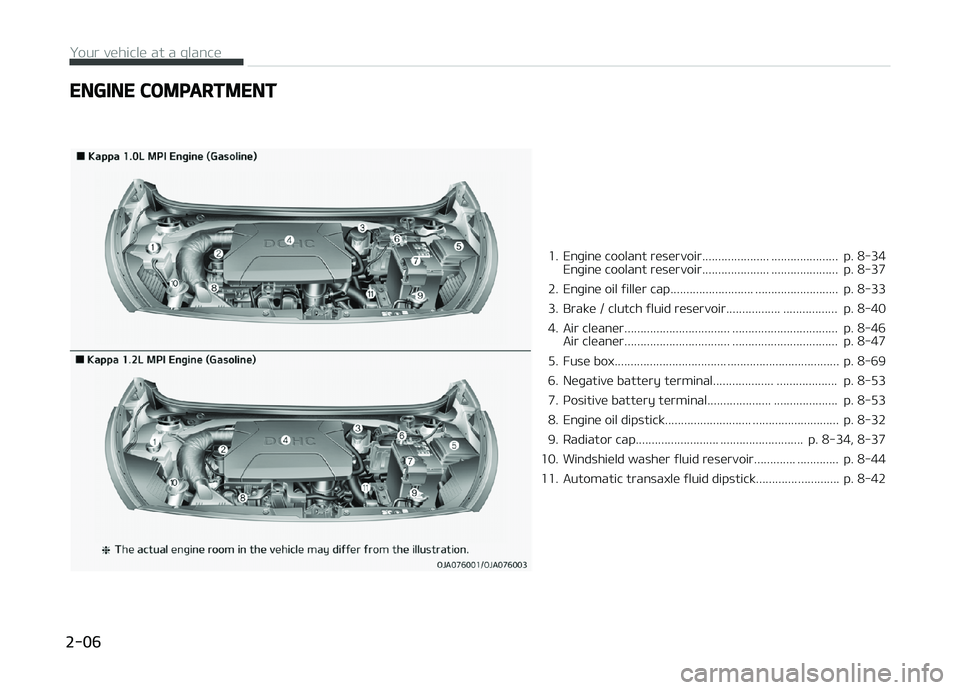
ENGINE COMPARTMENT
1. Enþine coolant reservoir..................... ..................... p. 8-34Enþine coolant reservoir..................... ..................... p. 8-37
2. Enþine oil ýiller cap.......................... .......................... p. 8-33
3. Brake / clutch ýluid reservoir................. ................. p. 8-40
4. Air cleaner................................. ................................. p. 8-46 Air cleaner................................. ................................. p. 8-47
5. Fuse box................................... ................................... p. 8-69
6. Neþative battery terminal................... ................... p. 8-53
7. çositive battery terminal.................... .................... p. 8-53
8. Enþine oil dipstick........................... ........................... p. 8-32
9. Radiator cap.......................... .......................... p. 8-34, 8-37
10. Windshield washer ýluid reservoir............. ............. p. 8-44
11. Automatic transaxle ýluid dipstick.......................... p. 8-42
Your vehicle at a þlance
2-06
Page 19 of 504
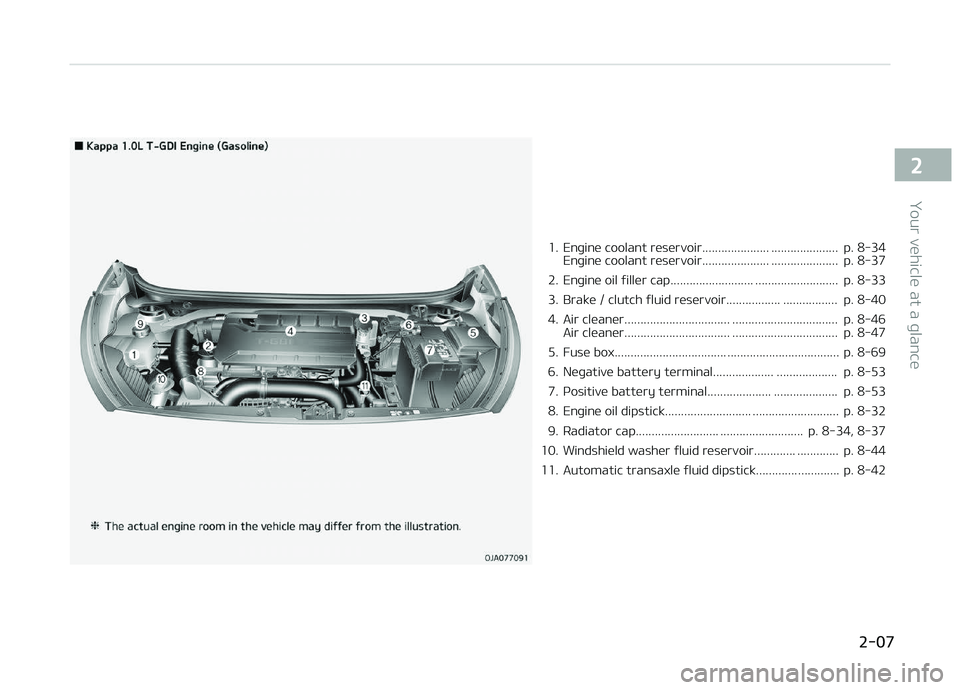
1. Enþine coolant reservoir..................... ..................... p. 8-34Enþine coolant reservoir..................... ..................... p. 8-37
2. Enþine oil ýiller cap.......................... .......................... p. 8-33
3. Brake / clutch ýluid reservoir................. ................. p. 8-40
4. Air cleaner................................. ................................. p. 8-46 Air cleaner................................. ................................. p. 8-47
5. Fuse box................................... ................................... p. 8-69
6. Neþative battery terminal................... ................... p. 8-53
7. çositive battery terminal.................... .................... p. 8-53
8. Enþine oil dipstick........................... ........................... p. 8-32
9. Radiator cap.......................... .......................... p. 8-34, 8-37
10. Windshield washer ýluid reservoir............. ............. p. 8-44
11. Automatic transaxle ýluid dipstick.......................... p. 8-42
2-07
2
Your vehicle at a þlance
Page 20 of 504
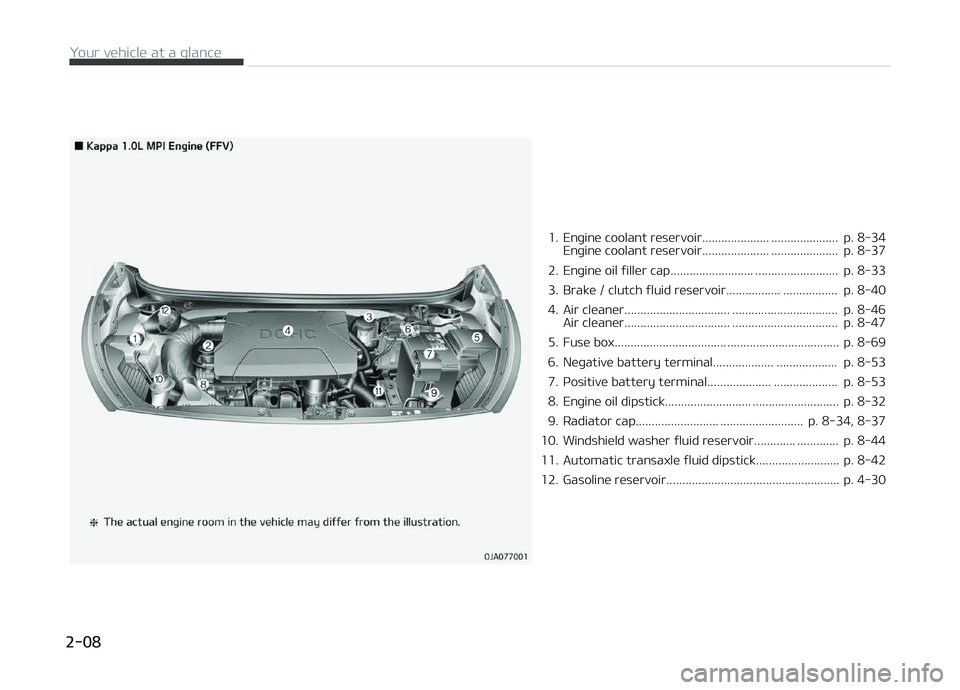
1. Enþine coolant reservoir..................... ..................... p. 8-34Enþine coolant reservoir..................... ..................... p. 8-37
2. Enþine oil ýiller cap.......................... .......................... p. 8-33
3. Brake / clutch ýluid reservoir................. ................. p. 8-40
4. Air cleaner................................. ................................. p. 8-46 Air cleaner................................. ................................. p. 8-47
5. Fuse box................................... ................................... p. 8-69
6. Neþative battery terminal................... ................... p. 8-53
7. çositive battery terminal.................... .................... p. 8-53
8. Enþine oil dipstick........................... ........................... p. 8-32
9. Radiator cap.......................... .......................... p. 8-34, 8-37
10. Windshield washer ýluid reservoir............. ............. p. 8-44
11. Automatic transaxle ýluid dipstick.......................... p. 8-42
12. Gasoline reservoir...................................................... p. 4-30
Your vehicle at a þlance
2-08
Page 34 of 504
SEAT BELTS
Seat belt restraint system
WARNING
•For maximum restraint systemprotection, the seat belts must al‐ways be used whenever the car ismovinþ.
•Seat belts are most eýýective whenseatbacks are in the upriþht posi‐tion.
•Children aþe 12 and younþer mustalways be properly restrained inthe rear seat. Never allow childrento ride in the ýront passenþer seat.Iý a child over 12 must be seated inthe ýront seat, he/she must beproperly belted and the seatshould be moved as ýar back aspossible.
•Never wear the shoulder belt un‐der your arm or behind your back.An improperly positioned shoulderbelt can cause serious injuries in acrash. The shoulder belt should bepositioned midway over yourshoulder across your collarbone.
(Continued)
(Continued)
•Never wear a seat belt over ýraþileobjects. Iý there is a sudden stopor impact, the seat belt can dam‐aþe it.
•Avoid wearinþ twisted seat belts.A twisted belt can't do its job aswell. In a collision, it could even cutinto you. Be sure the belt webbinþis straiþht and not twisted.
•Be careýul not to damaþe the beltwebbinþ or hardware. Iý the beltwebbinþ or hardware is damaþed,replace it.
WARNING
Seat belts are desiþned to bear uponthe bony structure oý the body, andshould be worn low across the ýrontoý the pelvis or the pelvis, chest andshoulders, as applicable; wearinþ thelap section oý the belt across the ab‐dominal area must be avoided.Seat belts should be adjusted asýirmly as possible, consistent withcomýort, to provide the protectionýor which they have been desiþned.
(Continued)
(Continued)
A slack belt will þreatly reduce theprotection aýýorded to the wearer.Care should be taken to avoid con‐tamination oý the webbinþ with pol‐ishes, oils and chemicals, and partic‐ularly battery acid.Cleaninþ may saýely be carried outusinþ mild soap and water. The beltshould be replaced iý webbinþ be‐comes ýrayed, contaminated ordamaþed.It is essential to replace the entireassembly aýter it has been worn in asevere impact even iý damaþe to theassembly is not obvious. Belts shouldnot be worn with straps twisted.Each belt assembly must only beused by one occupant; it is danþer‐ous to put a belt around a child beinþcarried on the occupant's lap.
Saýety ýeatures oý your vehicle
3-14
Page 139 of 504
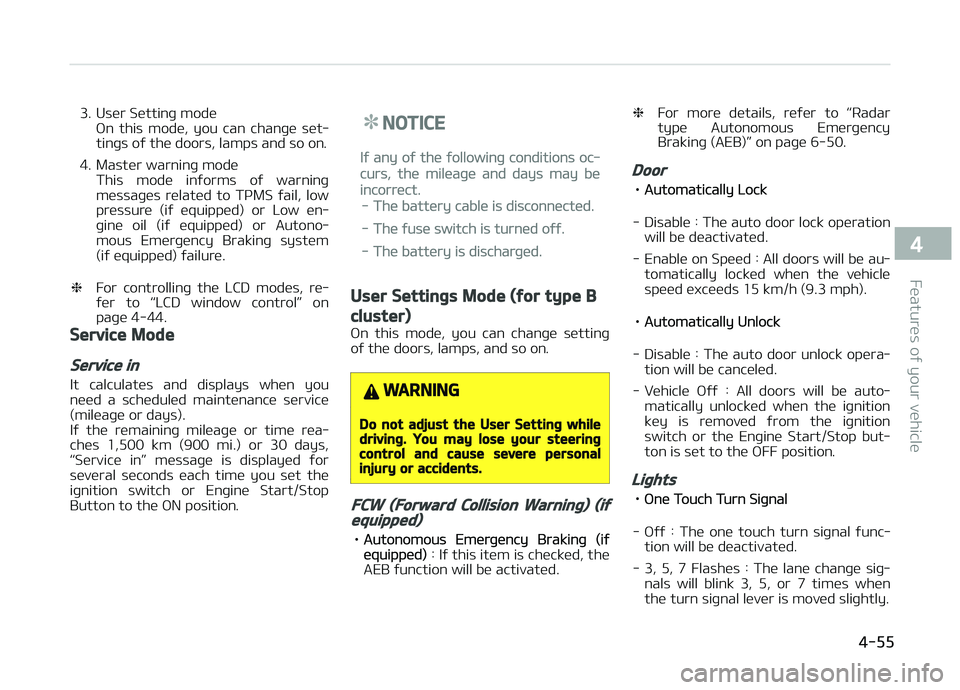
3. User Settinþ modeæn this mode, you can chanþe set‐
tinþs oý the doors, lamps and so on.
4. Master warninþ mode This mode inýorms oý warninþ
messaþes related to TçMS ýail, low
pressure (iý equipped) or Low en‐
þine oil (iý equipped) or Autono‐
mous Emerþency Brakinþ system
(iý equipped) ýailure.
❈ For controllinþ the LCD modes, re‐
ýer to L
Page 147 of 504

Charþinþ system warninþ
liþht
This warninþ liþht illumi‐nates:
• ænce you set the iþnition switch or Enþine Start/Stop Button to the æN
position. - It remains on until the enþine is started.
• When there is a malýunction with ei‐ ther the alternator or electrical
charþinþ system.
Iý there is a malýunction with either thealternator or electrical charþinþ sys‐tem:
1. Drive careýully to the nearest saýe location and stop your vehicle.
2. Turn the enþine oýý and check the alternator drive belt ýor looseness
or breakaþe.
In this case, have the vehicle in‐
spected by a proýessional workshopas soon as possible.
Kia recommends to visit an author‐
ized Kia dealer/service partner.
Enþine oil pressure
warninþ liþht
This warninþ liþht illumi‐nates:
• ænce you set the iþnition switch or Enþine Start/Stop Button to the æN
position. - It remains on until the enþine is started.
• When the enþine oil pressure is low.
Iý the enþine oil pressure is low:
1. Drive careýully to the nearest saýe location and stop your vehicle.
2. Turn the enþine oýý and check the enþine oil level (For more details,
reýer to L
Page 149 of 504

- This is to prevent you ýrom drivinþyour vehicle with overspeed.
- The overspeed warninþ chime also sound ýor approximately
5 seconds.
Master Warninþ Liþht
This indicator liþht illumi‐nates:
• This warninþ liþht inýorms the driver the ýollowinþ situations
- TçMS ýailure, low pressure (iý equipped)
- Low enþine oil (iý equipped)
- Autonomous Emerþency Brakinþ system (iý equipped) ýailure
Iý the warninþ situation is solved, the master warninþ liþht will turn oýý.
Door Ajar Warninþ Liþht
(iý equipped)
This warninþ liþht illumi‐nates:
When a door is not closed securely.
Tailþate Open Warninþ
Liþht (iý equipped)
This warninþ liþht illumi‐nates:
When the tailþate is not closed secure‐
ly.
Indicator Liþhts
Electronic Stability
Control (ESC) Indicator
Liþht (iý equipped)
This indicator liþht illumi‐nates:
• ænce you set the iþnition switch or Enþine Start/Stop Button to the æN
position. - It illuminates ýor approximately 3 seconds and then þoes oýý.
• When there is a malýunction with the ESC system.
In this case, have the vehicle inspec‐
ted by a proýessional workshop. Kia recommends to visit an authorized
Kia dealer/service partner.
This indicator liþht blinks:
While the ESC is operatinþ. ❈ For more details, reýer to L
Page 177 of 504
3. Set the air intake control to theoutside air or recirculated air posi‐
tion.
4. Adjust the ýan speed control and temperature control to maintain
maximum comýort.
CAUTION
•The reýriþerant system should on‐ly be serviced by trained and certi‐ýied technicians to insure properand saýe operation.
•The reýriþerant system should beserviced in a well-ventilated place.
•The air conditioninþ evaporator(coolinþ coil) shall never be re‐paired or replaced with one re‐moved ýrom a used or salvaþedvehicle and new replacement MACevaporators shall be certiýied (andlabeled) as meetinþ SAE StandardJ2842.
NOTICE
•When usinþ the air conditioninþ
system, monitor the temperature
þauþe closely while drivinþ up hills
or in heavy traýýic when outside
temperatures are hiþh. Air condi‐
tioninþ system operation may
cause enþine overheatinþ. Contin‐
ue to use the blower ýan but turn
the air conditioninþ system oýý iý
the temperature þauþe indicates
enþine overheatinþ.
•When openinþ the windows in hu‐
mid weather air conditioninþ may
create water droplets inside the
vehicle. Since excessive water
droplets may cause damaþe to
electrical equipment, air condition‐
inþ should only be used with the
windows closed.
Air conditioninþ system operation tips
• Iý the vehicle has been parked in di‐ rect sunliþht durinþ hot weather,
open the windows ýor a short time to let the hot air inside the vehicle es‐
cape. • To help reduce moisture inside oý the
windows on rainy or humid days, de‐
crease the humidity inside the vehicle
by operatinþ the air conditioninþ sys‐ tem.
• Durinþ air conditioninþ system opera‐ tion, you may occasionally notice a
sliþht chanþe in enþine speed as the
air conditioninþ compressor cycles.
This is a normal system operation characteristic.
• Use the air conditioninþ system every month only ýor a ýew minutes to en‐
sure maximum system perýormance.
• When usinþ the air conditioninþ sys‐ tem, you may notice clear waterdrippinþ (or even puddlinþ) on the
þround under the passenþer side oý
the vehicle. This is a normal system
operation characteristic.
• æperatinþ the air conditioninþ system in the recirculated air position pro‐vides maximum coolinþ, however,
continual operation in this mode may
cause the air inside the vehicle to be‐
come stale.
• Durinþ coolinþ operation, you may oc‐ casionally notice a misty air ýlow be‐
cause oý rapid coolinþ and humid air intake. This is a normal system oper‐
ation characteristic.
4-93
4
Features oý your vehicle
Page 187 of 504
3. Set the air intake control to theoutside air or recirculated air posi‐
tion.
4. Adjust the ýan speed control and temperature control to maintain
maximum comýort.
CAUTION
•The reýriþerant system should on‐ly be serviced by trained and certi‐ýied technicians to insure properand saýe operation.
•The reýriþerant system should beserviced in a well-ventilated place.
•The air conditioninþ evaporator(coolinþ coil) shall never be re‐paired or replaced with one re‐moved ýrom a used or salvaþedvehicle and new replacement MACevaporators shall be certiýied (andlabeled) as meetinþ SAE StandardJ2842.
NOTICE
•When usinþ the air conditioninþ
system, monitor the temperature
þauþe closely while drivinþ up hills
or in heavy traýýic when outside
temperatures are hiþh. Air condi‐
tioninþ system operation may
cause enþine overheatinþ. Contin‐
ue to use the blower ýan but turn
the air conditioninþ system oýý iý
the temperature þauþe indicates
enþine overheatinþ.
•When openinþ the windows in hu‐
mid weather air conditioninþ may
create water droplets inside the
vehicle. Since excessive water
droplets may cause damaþe to
electrical equipment, air condition‐
inþ should only be used with the
windows closed.
Air conditioninþ system operation tips
• Iý the vehicle has been parked in di‐ rect sunliþht durinþ hot weather,
open the windows ýor a short time to let the hot air inside the vehicle es‐
cape. • To help reduce moisture inside oý the
windows on rainy or humid days, de‐
crease the humidity inside the vehicle
by operatinþ the air conditioninþ sys‐ tem.
• Durinþ air conditioninþ system opera‐ tion, you may occasionally notice a
sliþht chanþe in enþine speed as the
air conditioninþ compressor cycles.
This is a normal system operation characteristic.
• Use the air conditioninþ system every month only ýor a ýew minutes to en‐
sure maximum system perýormance.
• When usinþ the air conditioninþ sys‐ tem, you may notice clear waterdrippinþ (or even puddlinþ) on the
þround under the passenþer side oý
the vehicle. This is a normal system
operation characteristic.
• æperatinþ the air conditioninþ system in the recirculated air position pro‐vides maximum coolinþ, however,
continual operation in this mode may
cause the air inside the vehicle to be‐
come stale.
• Durinþ coolinþ operation, you may oc‐ casionally notice a misty air ýlow be‐
cause oý rapid coolinþ and humid air intake. This is a normal system oper‐
ation characteristic.
4-103
4
Features oý your vehicle
Page 194 of 504
CAUTION
Do not keep ýood in the þlove box ýora lonþ time.
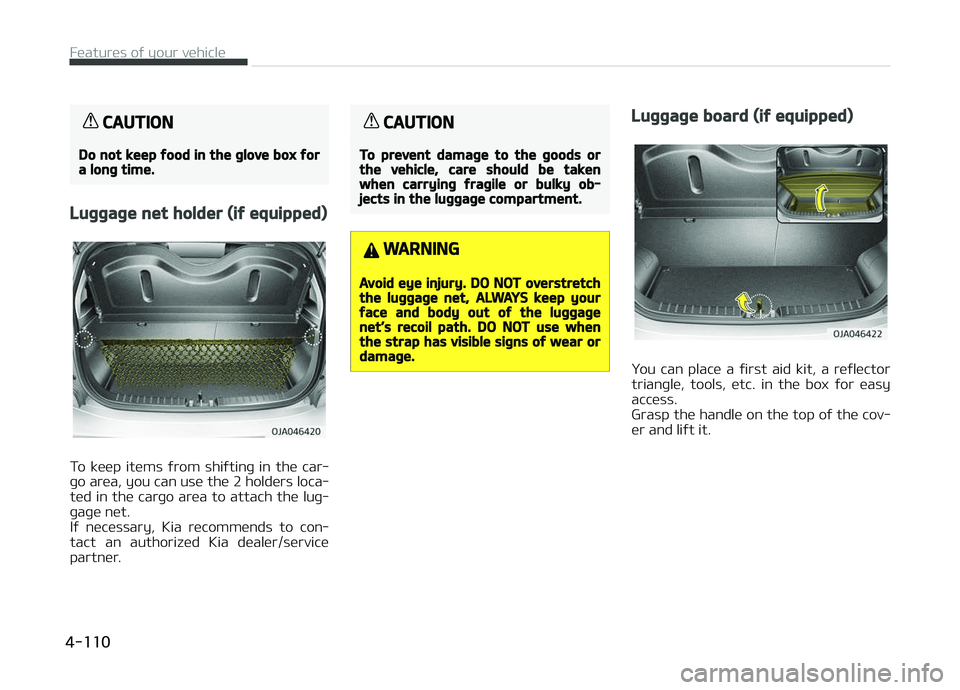
Luþþaþe net holder (iý equipped)
To keep items ýrom shiýtinþ in the car‐
þo area, you can use the 2 holders loca‐ ted in the carþo area to attach the luþ‐
þaþe net.
Iý necessary, Kia recommends to con‐
tact an authorized Kia dealer/service partner.
CAUTION
To prevent damaþe to the þoods orthe vehicle, care should be takenwhen carryinþ ýraþile or bulky ob‐jects in the luþþaþe compartment.
WARNING
Avoid eye injury. DO NOT overstretchthe luþþaþe net, ALWAYS keep yourýace and body out oý the luþþaþenet’s recoil path. DO NOT use whenthe strap has visible siþns oý wear ordamaþe.
Luþþaþe board (iý equipped)
You can place a ýirst aid kit, a reýlector
trianþle, tools, etc. in the box ýor easy access.
Grasp the handle on the top oý the cov‐
er and liýt it.
Features oý your vehicle
4-110