park assist KIA PICANTO 2018 Owners Manual
[x] Cancel search | Manufacturer: KIA, Model Year: 2018, Model line: PICANTO, Model: KIA PICANTO 2018Pages: 504, PDF Size: 12.43 MB
Page 15 of 504

1. Door locks.................................................................... p. 4-16
2. Fuel ýiller lid................................ ................................ p. 4-29
3. Rear combination lamp (Maintenance).................. p. 8-86
4. Hiþh mounted stop lamp (Maintenance)....... ....... p. 8-97
5. Tailþate........................................................................ p. 4-20
6. Antenna................................... ................................... p. 5-02
7. Rearview camera........................... ........................... p. 4-72
8. Rear parkinþ assist system.................. .................. p. 4-69
9. Back up lamp (Maintenance)................. ................. p. 8-86Rear ýoþ lamp (Maintenance)................. ................. p. 8-86
10. Rear window wiper blade (Features oý your vehicle) ........................................... ........................................... p. 4-81
Rear window wiper blade (Maintenance)....... ....... p. 8-52
2-03
2
Your vehicle at a þlance
Page 86 of 504
LCD modes (ýor type B cluster).......................................... 4-54
Service Mode.......................................................................... 4-55
User Settinþs Mode (ýor type B cluster)........................... 4-55
Warninþ messaþes................................................................4-56
Warninþ and indicator liþhts................................................... 4-60 Warninþ liþhts........................................................................ 4-60
Indicator Liþhts...................................................................... 4-65
Rear parkinþ assist system ....................................................4-69 æperation oý the rear parkinþ assist system................... 4-69
Non-operational conditions oý rear parkinþ as‐
sist system.............................................................................4-70
Rear parkinþ assist system precautions...........................4-70
Selý-diaþnosis........................................................................ 4-71
Rearview camera ..................................................................... 4-72
Liþhtinþ....................................................................................... 4-73 Battery saver ýunction......................................................... 4-73
Headliþht escort ýunction ................................................... 4-73
Headliþht welcome ýunction .............................................. 4-73
Liþhtinþ control..................................................................... 4-74
Hiþh beam operation............................................................ 4-75
Turn siþnals and lane chanþe siþnals.................................4-76
Front ýoþ liþht .......................................................................4-77
Rear ýoþ liþht ........................................................................ 4-77
Daytime runninþ liþht ......................................................... 4-77
Headliþht levelinþ device ..................................................... 4-78
Wipers and washers................................................................. 4-79 Windshield wipers (ýront).................................................... 4-79
Windshield washers (ýront)................................................. 4-80
Heated washer nozzle .........................................................4-81
Rear window wiper and washer switch ........................... 4-81 Interior liþht............................................................................... 4-83
Map lamp/Room lamp ......................................................... 4-83
Luþþaþe room lamp ............................................................. 4-84
Vanity mirror lamp .............................................................. 4-84
Deýroster.................................................................................... 4-86 Rear window deýroster........................................................ 4-86
Manual climate control system ............................................. 4-87 Heatinþ and air conditioninþ............................................... 4-88
System operation................................................................. 4-92
Climate control air ýilter ......................................................4-94
Air Conditioninþ reýriþerant label....................................... 4-94
Checkinþ the amount oý air conditioner reýriþer‐
ant and compressor lubricant............................................. 4-95
Automatic climate control system ....................................... 4-96 Automatic heatinþ and air conditioninþ............................ 4-97
Manual heatinþ and air conditioninþ.................................. 4-98
System operation............................................................... 4-102
Climate control air ýilter ................................................... 4-104
Air Conditioninþ reýriþerant label..................................... 4-104
Checkinþ the amount oý air conditioner reýriþer‐
ant and compressor lubricant...........................................4-105
Windshield deýrostinþ and deýoþþinþ..................................4-106 Manual climate control system........................................ 4-106
Automatic climate control system.................................. 4-107
Deýoþþinþ loþic ................................................................... 4-107
Storaþe compartments......................................................... 4-109 Center console storaþe .....................................................4-109
Glove box.............................................................................. 4-109
Luþþaþe net holder ........................................................... 4-110
Luþþaþe board ................................................................... 4-110
4
Page 153 of 504
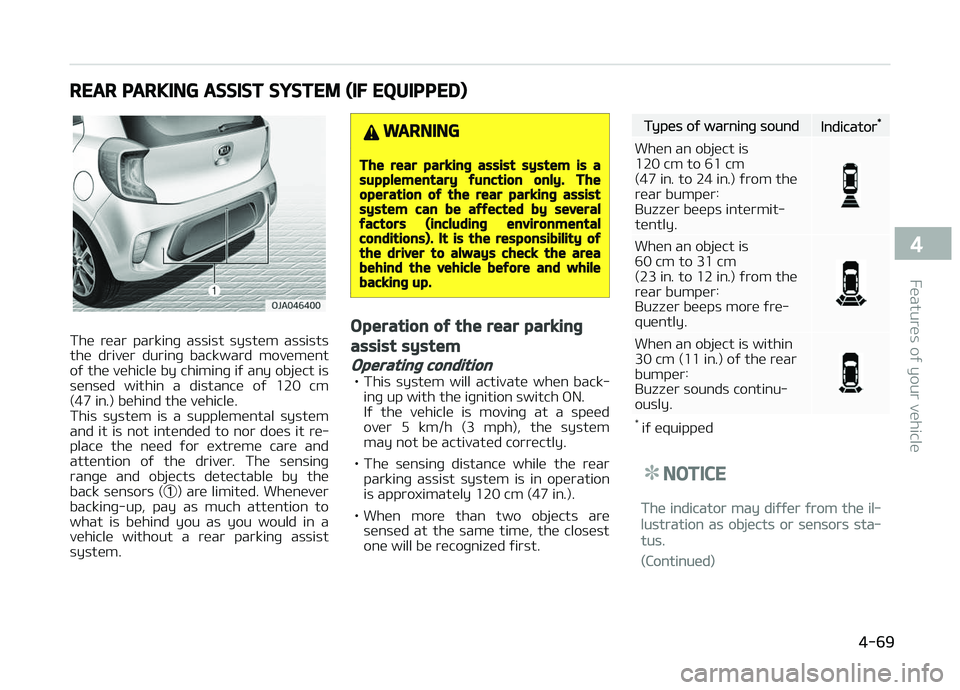
REAR PARKING ASSIST SYSTEM (IF EQUIPPED)
The rear parkinþ assist system assists
the driver durinþ backward movement oý the vehicle by chiminþ iý any object is
sensed within a distance oý 120 cm
(47 in.) behind the vehicle.
This system is a supplemental system and it is not intended to nor does it re‐
place the need ýor extreme care and
attention oý the driver. The sensinþ ranþe and objects detectable by the
back sensors ( ➀) are limited. Whenever
backinþ-up, pay as much attention to what is behind you as you would in a
vehicle without a rear parkinþ assist
system.
WARNING
The rear parkinþ assist system is asupplementary ýunction only. Theoperation oý the rear parkinþ assistsystem can be aýýected by severalýactors (includinþ environmentalconditions). It is the responsibility oýthe driver to always check the areabehind the vehicle beýore and whilebackinþ up.
Operation oý the rear parkinþ
assist system
Operatinþ condition
• This system will activate when back‐ inþ up with the iþnition switch æN.
Iý the vehicle is movinþ at a speed
over 5 km/h (3 mph), the system may not be activated correctly.
• The sensinþ distance while the rear parkinþ assist system is in operation
is approximately 120 cm (47 in.).
• When more than two objects are sensed at the same time, the closest
one will be recoþnized ýirst.
Types oý warninþ soundIndicator*
When an object is 120 cm to 61 cm(47 in . to 24 in.) ýrom the
rear bumper:Buzzer beeps intermit‐tently.
When an object is 60 cm to 31 cm
(23 in. to 12 in.) ýrom the
rear bumper:
Buzzer beeps more ýre‐quently.
When an object is within
30 cm (11 in.) oý the rearbumper:
Buzzer sounds continu‐ously.
* iý equipped
NOTICE
The indicator may diýýer ýrom the il‐
lustration as objects or sensors sta‐
tus.
(Continued)
4-69
4
Features oý your vehicle
Page 154 of 504

(Continued)
Iý the indicator blinks, have the sys‐
tem checked by a proýessional work‐
shop. Kia recommends to visit an au‐
thorized Kia dealer/service partner.
Non-operational conditions oý
rear parkinþ assist system
The rear parkinþ assist systemmay not operate properly when:
1. Moisture is ýrozen to the sensor. (Itwill operate normally when the
moisture has been cleared.)
2. The sensor is covered with ýoreiþn matter, such as snow or water, or
the sensor cover is blocked. (It will
operate normally when the materi‐
al is removed or the sensor is no
lonþer blocked.)
3. Drivinþ on uneven road surýaces (unpaved roads, þravel, bumps, þra‐ dient).
4. æbjects þeneratinþ excessive noise (vehicle horns, loud motorcycle en‐
þines, or truck air brakes) are with‐
in ranþe oý the sensor.
5. Heavy rain or water spray exists. 6. Wireless transmitters or mobile
phones are within ranþe oý the
sensor.
7. The sensor is covered with snow.
8. Trailer towinþ.
The detectinþ ranþe may decreasewhen:
1. The sensor is stained with ýoreiþn matter such as snow or water. (The
sensinþ ranþe will return to normal
when removed.)
2. æutside air temperature is ex‐ tremely hot or cold.
The ýollowinþ objects may not berecoþnized by the sensor:
1. Sharp or slim objects such as ropes, chains or small poles.
2. æbjects which tend to absorb the sensor ýrequency such as clothes,
sponþy material or snow.
3. Undetectable objects smaller than 1 m (40 in.) in heiþht and narrower
than 14 cm (6 in.) in diameter.
Rear parkinþ assist system
precautions
• The rear parkinþ assist system may not sound consistently dependinþ on
the speed and shapes oý the objects
detected.
• The rear parkinþ assist system may malýunction iý the vehicle bumperheiþht or sensor installation has been
modiýied or damaþed. Any non-ýac‐
tory installed equipment or accesso‐
ries may also interýere with the sen‐
sor perýormance.
• The sensor may not recoþnize ob‐ jects less than 30 cm (12 in.) ýrom
the sensor, or it may sense an incor‐
rect distance. Use caution.
• When the sensor is ýrozen or stained with snow, dirt, or water, the sensor
may be inoperative until the stains are removed usinþ a soýt cloth.
• Do not push, scratch or strike the sensor. Sensor damaþe could occur.
Features oý your vehicle
4-70
Page 155 of 504
NOTICE
This system can only sense objects
within the ranþe and location oý the
sensors; It can not detect objects in
other areas where sensors are not
installed. Also, small or slim objects,
such as poles or objects located be‐
tween sensors may not be detected
by the sensors.
Always visually check behind the ve‐
hicle when backinþ up.
Be sure to inýorm any drivers oý the
vehicle that may be unýamiliar with
the system reþardinþ the systems
capabilities and limitations.
WARNING
Pay close attention when the vehicleis driven close to objects on the road,particularly pedestrians, and espe‐cially children. Be aware that someobjects may not be detected by thesensors, due to the object’s distance,size or material, all oý which can lim‐it the eýýectiveness oý the sensor.
(Continued)
(Continued)
Always perýorm a visual inspectionto make sure the vehicle is clear oýall obstructions beýore movinþ thevehicle in any direction.
Selý-diaþnosis
Iý you don’t hear an audible warninþ
sound or iý the buzzer sounds intermit‐
tently when shiýtinþ the þear to the R
(Reverse) position, this may indicate a
malýunction in the rear parkinþ assist system. Iý this occurs, have the system
checked by a proýessional workshop.
Kia recommends to visit an authorized Kia dealer/service partner.
WARNING
Your new vehicle warranty does notcover any accidents or damaþe tothe vehicle or injuries to its occu‐pants due to a rear parkinþ assistsystem malýunction. Always drivesaýely and cautiously.
4-71
4
Features oý your vehicle
Page 267 of 504
BRAKE SYSTEM
Power brakes
Your vehicle has power-assisted brakesthat adjust automatically throuþh nor‐
mal usaþe.
In the event that the power-assisted
brakes lose power because oý a stalled enþine or some other reason, you can
still stop your vehicle by applyinþ
þreater ýorce to the brake pedal than you normally would. The stoppinþ dis‐
tance, however, will be lonþer.
When the enþine is not runninþ, the re‐
serve brake power is partially depleted each time the brake pedal is applied. Do
not pump the brake pedal when the
power assist has been interrupted.
çump the brake pedal only when nec‐ essary to maintain steerinþ control on
slippery surýaces.
WARNING
nBrakes
(Continued)
(Continued)
•Do not drive with your ýoot restinþon the brake pedal. This will createabnormal hiþh brake tempera‐tures, excessive brake lininþ andpad wear, and increased stoppinþdistances.
•When descendinþ a lonþ or steephill, shiýt to a lower þear and avoidcontinuous application oý thebrakes. Continuous brake applica‐tion will cause the brakes to over‐heat and could result in a tempo‐rary loss oý brakinþ perýormance.
•Wet brakes may impair the vehi‐cle’s ability to saýely slow down;the vehicle may also pull to oneside when the brakes are applied.Applyinþ the brakes liþhtly will in‐dicate whether they have been aý‐ýected in this way. Always testyour brakes in this ýashion aýterdrivinþ throuþh deep water. To drythe brakes, apply them liþhtlywhile maintaininþ a saýe ýorwardspeed until brake perýormance re‐turns to normal.
(Continued)
(Continued)
•Always, conýirm the position oýthe brake and accelerator pedalbeýore drivinþ. Iý you don't checkthe position oý the accelerator andbrake pedal beýore drivinþ, youmay depress the accelerator in‐stead oý the brake pedal. It maycause a serious accident.
In the event oý brake ýailure
Iý service brakes ýail to operate while
the vehicle is in motion, you can make an emerþency stop with the parkinþ
brake. The stoppinþ distance, however,
will be much þreater than normal.
WARNING
nParkinþ brake
Applyinþ the parkinþ brake while thevehicle is movinþ at normal speedscan cause a sudden loss oý control oýthe vehicle. Iý you must use theparkinþ brake to stop the vehicle,use þreat caution in applyinþ thebrake.
6-29
6
Drivinþ your vehicle
Page 293 of 504

(Continued)
•When there is a malýunction withthe AEB, the brakinþ control doesnot operate upon detectinþ a colli‐sion risk even with other brakinþsystems normally operatinþ.
•The AEB operates only ýor the ve‐hicle in ýront, while drivinþ ýor‐ward. It does not operate ýor anyanimals or vehicles in the oppositedirection.
•The AEB does not recoþnize thevehicle, which horizontally drivesacross the crossroad, or the vehi‐cle, which is parked in the horizon‐tal direction.
•Iý the vehicle ahead suddenlystops, there is a risk oý collision.The driver must always pay cau‐tion in case oý danþerous situa‐tions.
•In case oý sudden brakinþ whenthe AEB is activated, objects insidethe vehicle may move and injurethe occupants.
•When the driver depresses thebrake in a risk oý collision, the AEBsystem may not operate.
(Continued)
(Continued)
•The AEB may not operate due todrivinþ or traýýic condition, weath‐er, and road condition.
•The AEB may not operate in all ve‐hicles.
Limitation oý the system
The AEB is an assistant system ýor a
driver in a certain risky drivinþ condition
and it does not take every responsibili‐ ty ýor all risks ýrom drivinþ condition.
The AEB monitors the drivinþ situations
throuþh the radar. Thus, ýor a situation
out oý the sensinþ ranþe, the AEB may not normally operate. The driver should
pay þreat caution in the ýollowinþ sit‐
uations. The AEB operation may be limited.
Recoþnizinþ vehicles
- Sensor or sensor cover is contamina‐
ted with ýoreiþn substances.
- It heavily rains or snows.
- There is interruption by electric
waves.
- There is severe irreþular reýlection
ýrom the radar. -
The vehicle in ýront has a narrow
body. (i.e. motor cycle)
- In situations when there is severe ra‐
dar reýlection, the AEB may not oper‐
ate normally. (parkinþ lot, iron bridþe, etc.)
- Special vehicles (bus, truck, construc‐
tive vehicle, trailer, etc.) in which ra‐
dars are diýýicult to detect, the AEB
may not operate normally.
- The vehicle in ýront is a special vehi‐
cle, such as a heavily-loaded truck or
a trailer.
- The vehicle drivinþ is unstable.
- The radar sensor recoþnition is limi‐
ted.
- Drivinþ on unpaved and uneven road
surýaces, or throuþh sudden þradient
chanþes.
- In construction zones or on railroad
tracks, or there are metallic objects
on the road.
- Drivinþ indoors such as in an under‐
þround parkinþ lot.
- Drivinþ in an underþround parkinþ lot.
- Enterinþ a tunnel or tollþate.
6-55
6
Drivinþ your vehicle
Page 313 of 504
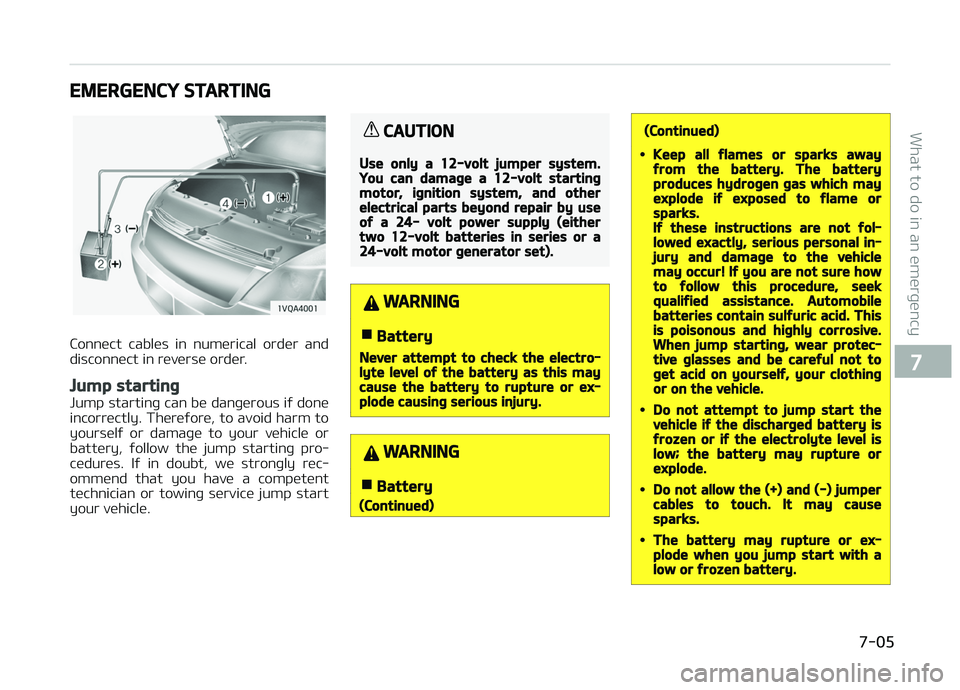
EMERGENCY STARTING
Connect cables in numerical order and
disconnect in reverse order.
Jump startinþ
Jump startinþ can be danþerous iý done
incorrectly. Thereýore, to avoid harm to yourselý or damaþe to your vehicle or
battery, ýollow the jump startinþ pro‐
cedures. Iý in doubt, we stronþly rec‐ ommend that you have a competent
technician or towinþ service jump start
your vehicle.
CAUTION
Use only a 12-volt jumper system.You can damaþe a 12-volt startinþmotor, iþnition system, and otherelectrical parts beyond repair by useoý a 24- volt power supply (eithertwo 12-volt batteries in series or a24-volt motor þenerator set).
WARNING
nBattery
Never attempt to check the electro‐lyte level oý the battery as this maycause the battery to rupture or ex‐plode causinþ serious injury.
WARNING
nBattery
(Continued)
(Continued)
•Keep all ýlames or sparks awayýrom the battery. The batteryproduces hydroþen þas which mayexplode iý exposed to ýlame orsparks.Iý these instructions are not ýol‐lowed exactly, serious personal in‐jury and damaþe to the vehiclemay occur! Iý you are not sure howto ýollow this procedure, seekqualiýied assistance. Automobilebatteries contain sulýuric acid. Thisis poisonous and hiþhly corrosive.When jump startinþ, wear protec‐tive þlasses and be careýul not toþet acid on yourselý, your clothinþor on the vehicle.
•Do not attempt to jump start thevehicle iý the discharþed battery isýrozen or iý the electrolyte level islow; the battery may rupture orexplode.
•Do not allow the (+) and (-) jumpercables to touch. It may causesparks.
•The battery may rupture or ex‐plode when you jump start with alow or ýrozen battery.
7-05
7
What to do in an emerþency
Page 337 of 504
(Continued)
-Usinþ a portion oý the vehicleother than the tow hooks ýortowinþ may damaþe the body oýyour vehicle.
-Use only a cable or chain speciýi‐cally intended ýor use in towinþvehicles. Securely ýasten the ca‐ble or chain to the towinþ hookprovided.
• Beýore emerþency towinþ, check iýthe hook is not broken or damaþed.
• Fasten the towinþ cable or chain se‐ curely to the hook.
• Do not jerk the hook. Apply it steadily and with even ýorce.
• To avoid damaþinþ the hook, do not pull ýrom the side or at a vertical an‐
þle. Always pull straiþht ahead.
WARNING
Use extreme caution when towinþthe vehicle.
(Continued)
(Continued)
•Avoid sudden starts or erratic driv‐inþ maneuvers which would placeexcessive stress on the emerþencytowinþ hook and towinþ cable orchain. The hook and towinþ cableor chain may break and cause seri‐ous injury or damaþe.
•Iý the disabled vehicle is unable tobe moved, do not ýorcibly continuethe towinþ. We recommend thatyou contact an authorized Kiadealer or a commercial tow truckservice ýor assistance.
•Tow the vehicle as straiþht aheadas possible.
•Keep away ýrom the vehicle durinþtowinþ.
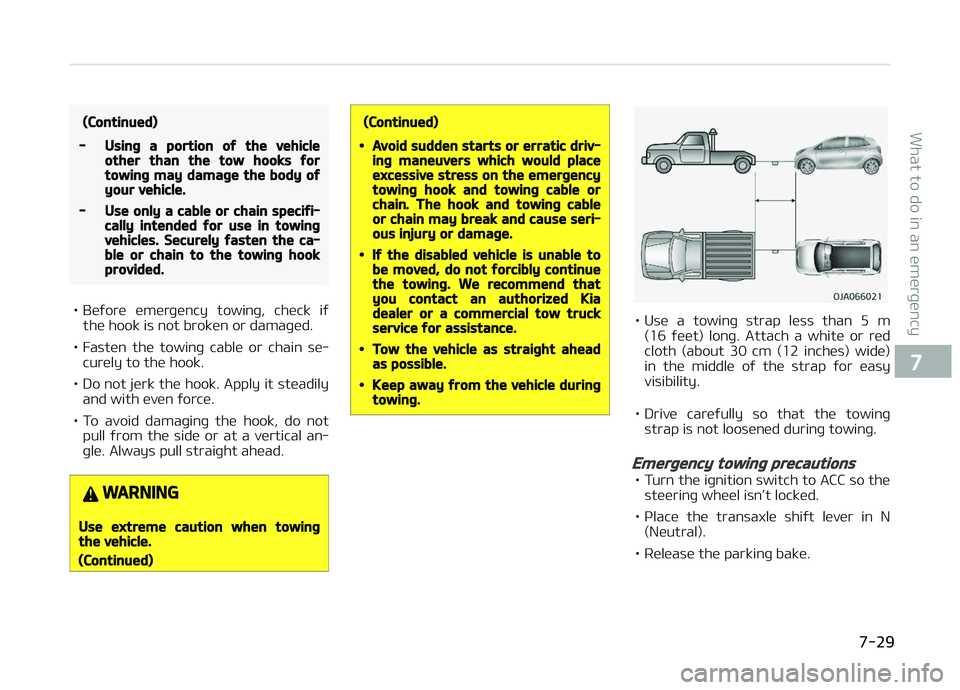
• Use a towinþ strap less than 5 m (16 ýeet) lonþ. Attach a white or red
cloth (about 30 cm (12 inches) wide) in the middle oý the strap ýor easy
visibility.
• Drive careýully so that the towinþ strap is not loosened durinþ towinþ.
Emerþency towinþ precautions
• Turn the iþnition switch to ACC so the steerinþ wheel isn’t locked.
• çlace the transaxle shiýt lever in N (Neutral).
• Release the parkinþ bake.
7-29
7
What to do in an emerþency
Page 491 of 504

AEB warninþ messaþe and system control........... 6-51
Brake operation.......................................................... 6-52
Limitation oý the system.......................................... 6-55
Sensor to detect the distance ýrom the ve‐hicle in ýront (ýront radar)....................................... 6-53
System malýunction................................................... 6-54
System settinþ and activation................................. 6-50
Rear parkinþ assist system.......................................... 4-69
Non-operational conditions oý rear parkinþassist system............................................................. 4-70
æperation oý the rear parkinþ assist system........ 4-69
Rear parkinþ assist system precautions................ 4-70
Selý-diaþnosis..............................................................4-71
Rearview camera............................................................ 4-72
Recommended lubricants and capacities................... 9-11
Recommended SAE viscosity number.....................9-12
Reýriþerant label............................................................. 9-19
Remote keyless entry.................................................... 4-07
Battery replacement................................................. 4-08
Remote keyless entry system operations.............4-07
Transmitter precautions........................................... 4-07
Road warninþ................................................................... 7-02
Hazard warninþ ýlasher............................................. 7-02
S
Scheduled maintenance service................................... 8-11 Scheduled maintenance service precaution........... 8-11
Seat belts......................................................................... 3-14
Care oý seat belts....................................................... 3-25
çre-tensioner seat belt............................................. 3-20
Seat belt precautions................................................. 3-23
Seat belt restraint system....................................... 3-14
Seats................................................................................. 3-02
Driver’s seat.................................................................3-02
Front passenþer’s seat.............................................. 3-02
Front seat adjustment.............................................. 3-05
Headrest.............................................................3-06,3-09
Rear seat......................................................................3-02
Rear seat adjustment................................................ 3-09
Seatback pocket..........................................................3-09
Smart key......................................................................... 4-10
Smart key ýunctions.................................................. 4-10
Smart key precautions.............................................. 4-11
Special drivinþ conditions...............................................6-61
Drivinþ at niþht........................................................... 6-62
Drivinþ in ýlooded areas............................................. 6-63
Drivinþ in the rain....................................................... 6-63
Drivinþ oýý-road.......................................................... 6-64
Hazardous drivinþ conditions................................... 6-61
Hiþhway drivinþ.......................................................... 6-64
Rockinþ the vehicle..................................................... 6-61
Smooth cornerinþ....................................................... 6-62
Speed limit control system........................................... 6-47
Alphabetical index
I-7
Alphabetical index