power steering KIA QUORIS 2013 User Guide
[x] Cancel search | Manufacturer: KIA, Model Year: 2013, Model line: QUORIS, Model: KIA QUORIS 2013Pages: 485, PDF Size: 31.55 MB
Page 274 of 485
531
Driving your vehicle
BRAKE SYSTEM
Power brakes
Your vehicle has power-assisted
brakes that adjust automatically
through normal usage.
In the event that the power-assisted
brakes lose power because of astalled engine or some other reason,
you can still stop your vehicle by
applying greater force to the brake
pedal than you normally would. The
stopping distance, however, will be
longer.
When the engine is not running, the
reserve brake power is partially
depleted each time the brake pedal
is applied. Do not pump the brake
pedal when the power assist has
been interrupted.
Pump the brake pedal only when
necessary to maintain steering con-
trol on slippery surfaces.
(Continued) Always test your brakes in this fashion after driving
through deep water. To dry the
brakes, apply them lightly
while maintaining a safe for-
ward speed until brake per-
formance returns to normal.
Always, confirm the position of the brake and accelerator
pedal before driving. If you
don’t check the position of theaccelerator and brake pedal
before driving, you maydepress the accelerator
instead of the brake pedal. It
may cause a serious accident.WARNING - Brakes
Do not drive with your foot resting on the brake pedal. This will create abnormal high
brake temperatures, exces-sive brake lining and pad
wear, and increased stoppingdistances.
When descending a long or steep hill, shift to a lower gear
and avoid continuous applica-
tion of the brakes. Continuousbrake application will cause
the brakes to overheat and
could result in a temporary
loss of braking performance.
Wet brakes may impair the vehicle’s ability to safely slow
down; the vehicle may alsopull to one side when the
brakes are applied. Applying
the brakes lightly will indicate
whether they have been
affected in this way.
(Continued)
Page 293 of 485
Driving your vehicle
50
5
Vehicle stability management (VSM)
This system provides further
enhancements to vehicle stability
and steering responses when a vehi-
cle is driving on a slippery road or a
vehicle detected changes in coeffi-
cient of friction between right wheels
and left wheels when braking.VSM operation
When the VSM is operating:
ESC (Electronic Stability Control)
( ) light will blink.
The steering wheel may be con- trolled.
When the vehicle stability manage-
ment is operating properly, you can
feel a slight pulsation in the vehicle.
This is only the effect of brake control
and indicates nothing unusual.
The VSM does not operate when:
Driving on bank road such as gra- dient or incline
Driving rearward
ESC OFF indicator light ( ) remains on the instrument cluster
EPS (Electronic Power Steering) indicator light remains on the
instrument cluster
VSM operation off
If you press the ESC OFF button to
turn off the ESC, the VSM will alsocancel and the ESC OFF indicator
light ( ) illuminates.
To turn on the VSM, press the button
again. The ESC OFF indicator lightgoes out.
Page 294 of 485
551
Driving your vehicle
Malfunction indicator
The VSM can be deactivated even if
you don’t cancel the VSM operation
by pressing the ESC OFF button. Itindicates that a malfunction has
been detected somewhere in the
EPS (Electronic Power Steering)
system or VSM system. If the ESC
indicator light ( ) or EPS warning
light remains on, we recommend that
you contact an authorized Kia dealer.
✽✽NOTICE
The VSM is designed to function above approximately 15 km/h (9
mph) on curves.
The VSM is designed to function above approximately 30 km/h (18
mph) when a vehicle is braking on
a split-mu road. The split-mu road
is made of surfaces which have dif-
ferent friction forces.
Hill-start assist control (HAC) (if equipped)
A vehicle has the tendency to slip
back on a steep hill when it starts to
go after stopping. The Hill-start
Assist Control (HAC) prevents the
vehicle from slipping back by operat-
ing the brakes automatically for
about 2 seconds. The brakes are
released when the accelerator pedalis depressed or after about 2 sec-
onds.WARNING
The Vehicle Stability Management system is not a
substitute for safe driving
practices but a supplemen-
tary function only. It is theresponsibility of the driver to
always check the speed and
the distance to the vehicle
ahead. Always hold the steer-
ing wheel firmly while driving.
Your vehicle is designed to activate according to the dri-
ver’s intention, even with the
VSM installed. Always follow
all the normal precautions for
driving at safe speeds for the
conditions – including driving
in inclement weather and on a
slippery road.
Driving with varying tire or wheel sizes may cause theVSM system to malfunction.
When replacing tires, make
sure they are the same size as
your original tires.
WARNING
The HAC is activated only for
about 2 seconds, so when the
vehicle is starting off alwaysdepress the accelerator pedal.
Page 338 of 485
595
Driving your vehicle
Remember, your vehicle does notrequire extended warm-up. After
the engine has started, allow the
engine to run for 10 to 20 seconds
prior to placing the vehicle in gear.
In very cold weather, however, give
your engine a slightly longer warm-
up period.
Do not "lug" or "over-rev" the engine. Lugging is driving too
slowly in too high a gear resulting
engine bucking. If this happens,
shift to a lower gear. Over-revving
is racing the engine beyond its safe
limit. This can be avoided by shift-
ing at the recommended speeds.
Use your air conditioning sparingly. The air conditioning system is
operated by engine power so your
fuel economy is reduced when youuse it.
Open windows at high speeds can reduce fuel economy.
Fuel economy is less in crosswinds and headwinds. To help offset
some of this loss, slow down when
driving in these conditions. Keeping a vehicle in good operating
condition is important both for econ-
omy and safety. Therefore, we rec-
ommend that the system be serviced
by an authorized Kia dealer.
WARNING
- Engine off
during motion
Never turn the engine off to
coast down hills or anytime the
vehicle is in motion. The power
steering and power brakes will
not function properly without
the engine running. Instead,
keep the engine on and down-
shift to an appropriate gear for
engine braking effect. In addi-
tion, turning off the ignition
while driving could engage the
steering wheel lock (ifequipped) resulting in loss of
vehicle steering which could
cause serious injury or death.
Page 373 of 485
625
What to do in an emergency
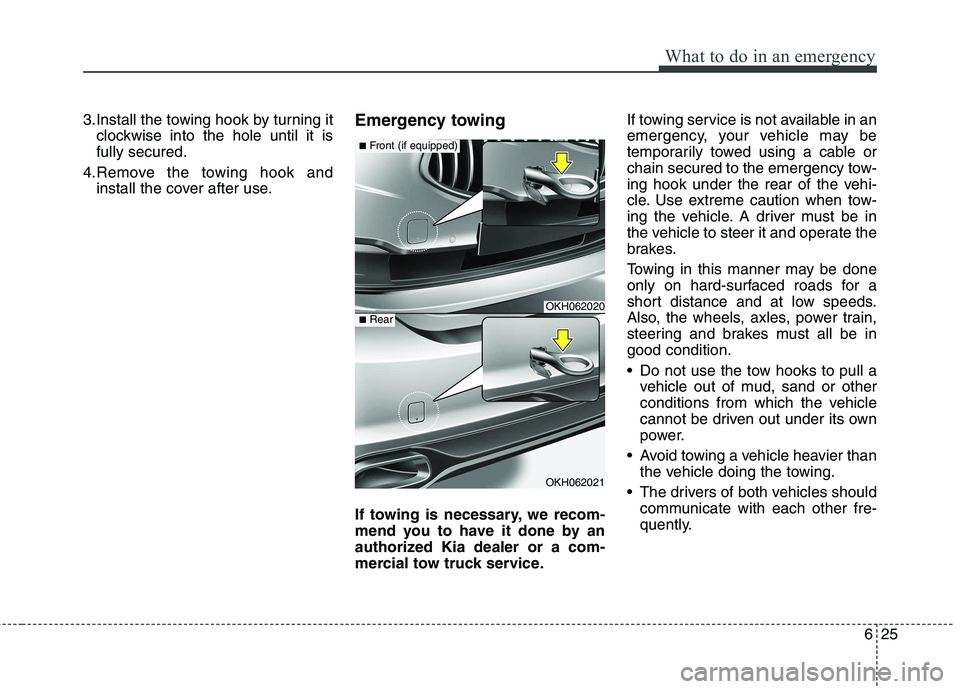
3.Install the towing hook by turning itclockwise into the hole until it is fully secured.
4.Remove the towing hook and install the cover after use. Emergency towing
If towing is necessary, we recom-
mend you to have it done by an
authorized Kia dealer or a com-
mercial tow truck service. If towing service is not available in an
emergency, your vehicle may be
temporarily towed using a cable or
chain secured to the emergency tow-
ing hook under the rear of the vehi-
cle. Use extreme caution when tow-
ing the vehicle. A driver must be in
the vehicle to steer it and operate the
brakes.
Towing in this manner may be done
only on hard-surfaced roads for a
short distance and at low speeds.
Also, the wheels, axles, power train,
steering and brakes must all be ingood condition.
Do not use the tow hooks to pull a
vehicle out of mud, sand or other
conditions from which the vehicle
cannot be driven out under its own
power.
Avoid towing a vehicle heavier than the vehicle doing the towing.
The drivers of both vehicles should communicate with each other fre-
quently.
OKH062020
OKH062021
■Front (if equipped)
■Rear
Page 375 of 485
627
What to do in an emergency
Emergency towing precautions
Place the ignition switch in ACC sothe steering wheel isn’t locked.
Place the transaxle shift lever in N (Neutral).
Release the parking bake.
Press the brake pedal with more force than normal since you will
have reduced brake performance.
More steering effort will be required because the power steer-
ing system will be disabled.
If you are driving down a long hill, the brakes may overheat and brake
performance will be reduced. Stop
often and let the brakes cool off.CAUTION - Automatic
transaxle
If the car is being towed with all four wheels on the ground,it can be towed only from thefront. Be sure that thetransaxle is in neutral. Be surethe steering is unlocked byplacing the ignition switch in the ACC position. A drivermust be in the towed vehicleto operate the steering andbrakes.
To avoid serious damage to the automatic transaxle, limitthe vehicle speed to 15 km/h (10 mph) and drive less than1.5 km (1 mile) when towing.
Before towing, check the auto- matic transaxle for fluid leaksunder your vehicle. If the auto-matic transaxle fluid is leak-ing, a flatbed equipment ortowing dolly must be used.
Page 377 of 485
Maintenance
7
Engine compartment . . . . . . . . . . . . . . . . . . . . . . . . 7-3
Maintenance services . . . . . . . . . . . . . . . . . . . . . . . . 7-4• Owner’s responsibility . . . . . . . . . . . . . . . . . . . . . . . . 7-4
. . . . . . . . . . . . . . . . 7-4
Owner maintenance . . . . . . . . . . . . . . . . . . . . . . . . . 7-6 . . . . . . . . . . . . . . . . . . . 7-6
Scheduled maintenance service . . . . . . . . . . . . . . 7-8 . . . . . . . . . . . . . . . . . . . 7-9
Explanation of scheduled maintenance items . . . 7-20
Engine oil. . . . . . . . . . . . . . . . . . . . . . . . . . . . . . . . . 7-24 . . . . . . . . . . . . . . . . . . 7-24
. . . . . . . . . . . . . . . 7-25
Engine coolant . . . . . . . . . . . . . . . . . . . . . . . . . . . . 7-26 . . . . . . . . . . . . . . . . . . 7-26
. . . . . . . . . . . . . . . . . . . . . . . . . 7-28
Brake fluid . . . . . . . . . . . . . . . . . . . . . . . . . . . . . . . 7-29 . . . . . . . . . . . . . . . . . 7-29
Power steering fluid . . . . . . . . . . . . . . . . . . . . . . . . 7-30 . . . . . . . . . 7-30
. . . . . . . . . . . . . . . 7-30
Washer fluid . . . . . . . . . . . . . . . . . . . . . . . . . . . . . . 7-31 . . . . . . . . . . . . . . . . 7-31
Air cleaner. . . . . . . . . . . . . . . . . . . . . . . . . . . . . . . . 7-32 . . . . . . . . . . . . . . . . . . . . . . . . . . . 7-32 Climate control air filter . . . . . . . . . . . . . . . . . . . . 7-35
. . . . . . . . . . . . . . . . . . . . . . . . . . . . . . 7-35
. . . . . . . . . . . . . . . . . . . . . . . . . . . . 7-35
Wiper blades . . . . . . . . . . . . . . . . . . . . . . . . . . . . . . 7-37 . . . . . . . . . . . . . . . . . . . . . . . . . . . . . . 7-37
. . . . . . . . . . . . . . . . . . . . . . . . . . . 7-37
Battery . . . . . . . . . . . . . . . . . . . . . . . . . . . . . . . . . . . 7-39 . . . . . . . . . . . . . . . . . . . . . . . 7-39
. . . . . . . . . . . . . . . . . . . . . . . . . 7-40
. . . . . . . . . . . . . . . . . . . . . . . . . . 7-41
. . . . . . . . . . . . . . . . . . . . . . . . . . . . . . . . . . 7-42
Tires and wheels . . . . . . . . . . . . . . . . . . . . . . . . . . . 7-43 . . . . . . . . . . . . . . . . . . . . . . . . . . . . . . . . . . . 7-43
. . . . . . 7-43
. . . . . . . . . . . . . . . . . . . . . . . . . . . . . . . . 7-45
. . . . . . . . . . . . . . 7-46
. . . . . . . . . . . . . . . . . . . . . . . . . . . . . 7-47
. . . . . . . . . . . . . . . . . . . . . . . . . . . 7-48
. . . . . . . . . . . . . . . . . . . . . . . . . . . . . . . . . 7-48
. . . . . . . . . . . . . . . . . . . . . . . . . . . . 7-48
. . . . . . . . . . . . . . . . . . . . . . . . . 7-49
Fuses . . . . . . . . . . . . . . . . . . . . . . . . . . . . . . . . . . . . 7-53 . . . . . . . . . . . . . . 7-54
Page 379 of 485
73
Maintenance
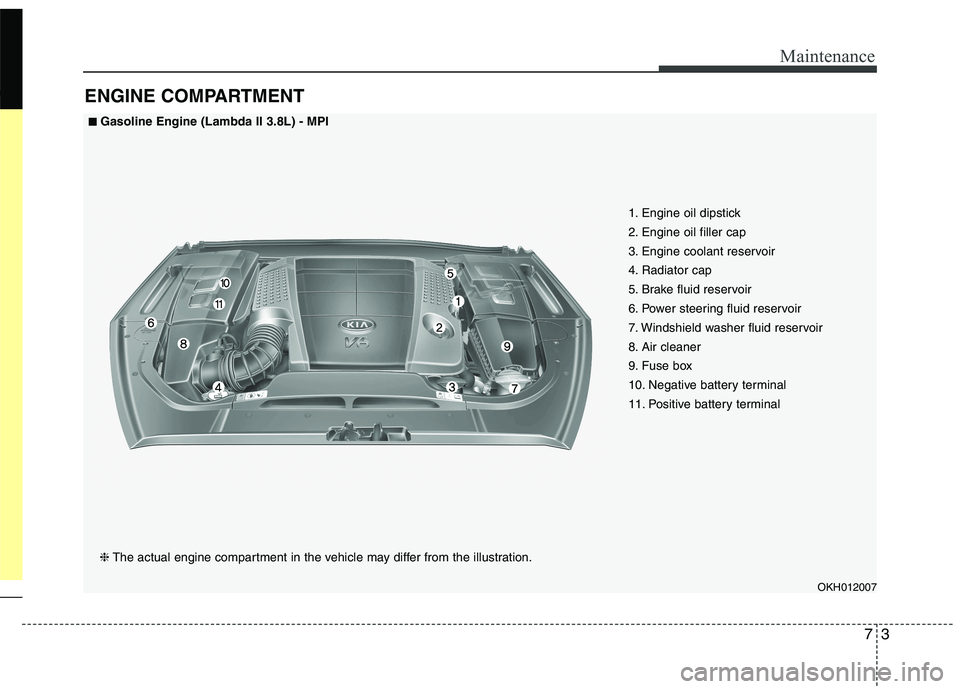
ENGINE COMPARTMENT
1. Engine oil dipstick
2. Engine oil filler cap
3. Engine coolant reservoir
4. Radiator cap
5. Brake fluid reservoir
6. Power steering fluid reservoir
7. Windshield washer fluid reservoir
8. Air cleaner
9. Fuse box
10. Negative battery terminal
11. Positive battery terminalOKH012007
❈The actual engine compartment in the vehicle may differ from the illustration.
■■
Gasoline Engine (Lambda II 3.8L) - MPI
Page 383 of 485
77
Maintenance
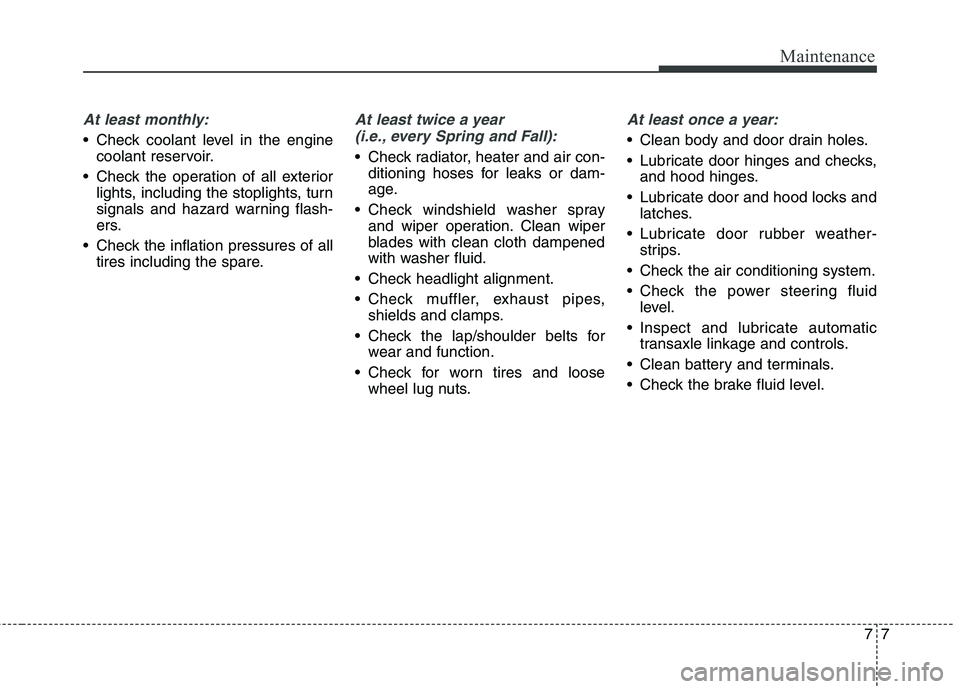
At least monthly:
Check coolant level in the enginecoolant reservoir.
Check the operation of all exterior lights, including the stoplights, turn
signals and hazard warning flash-
ers.
Check the inflation pressures of all tires including the spare.
At least twice a year
(i.e., every Spring and Fall):
Check radiator, heater and air con- ditioning hoses for leaks or dam-
age.
Check windshield washer spray and wiper operation. Clean wiper
blades with clean cloth dampened
with washer fluid.
Check headlight alignment.
Check muffler, exhaust pipes, shields and clamps.
Check the lap/shoulder belts for wear and function.
Check for worn tires and loose wheel lug nuts.
At least once a year:
Clean body and door drain holes.
Lubricate door hinges and checks,and hood hinges.
Lubricate door and hood locks and latches.
Lubricate door rubber weather- strips.
Check the air conditioning system.
Check the power steering fluid level.
Inspect and lubricate automatic transaxle linkage and controls.
Clean battery and terminals.
Check the brake fluid level.
Page 386 of 485
Maintenance
10
7
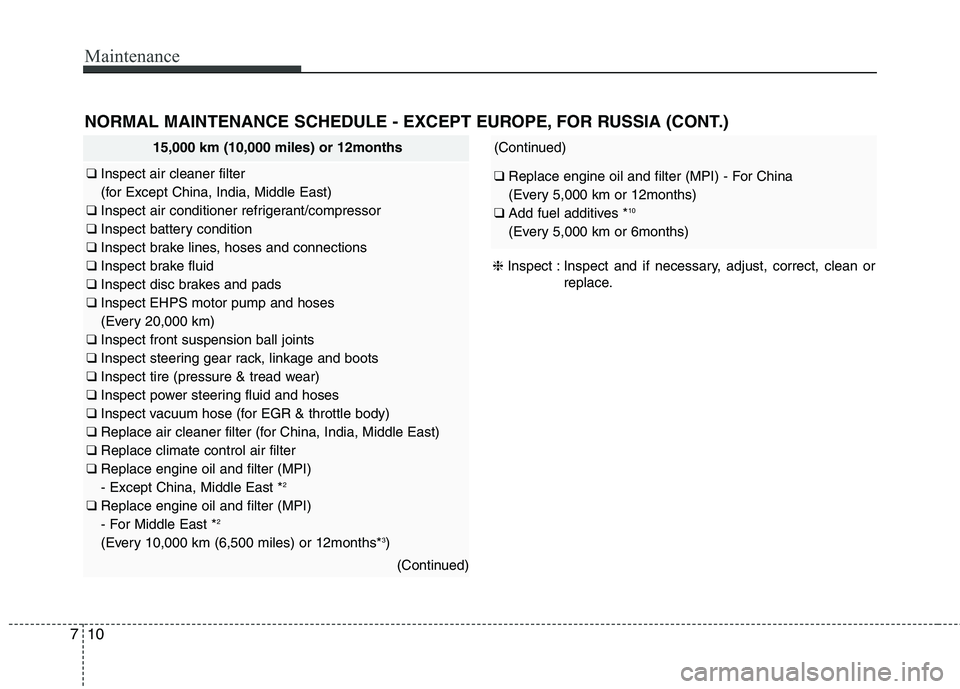
NORMAL MAINTENANCE SCHEDULE - EXCEPT EUROPE, FOR RUSSIA (CONT.)
15,000 km (10,000 miles) or 12months
❑ Inspect air cleaner filter
(for Except China, India, Middle East)
❑ Inspect air conditioner refrigerant/compressor
❑ Inspect battery condition
❑ Inspect brake lines, hoses and connections
❑ Inspect brake fluid
❑ Inspect disc brakes and pads
❑ Inspect EHPS motor pump and hoses
(Every 20,000 km)
❑ Inspect front suspension ball joints
❑ Inspect steering gear rack, linkage and boots
❑ Inspect tire (pressure & tread wear)
❑ Inspect power steering fluid and hoses
❑ Inspect vacuum hose (for EGR & throttle body)
❑ Replace air cleaner filter (for China, India, Middle East)
❑ Replace climate control air filter
❑ Replace engine oil and filter (MPI) - Except China, Middle East * 2
❑ Replace engine oil and filter (MPI)
- For Middle East * 2
(Every 10,000 km (6,500 miles) or 12months* 3
)
(Continued)
(Continued)
❑ Replace engine oil and filter (MPI) - For China
(Every 5,000 km or 12months)
❑ Add fuel additives * 10
(Every 5,000 km or 6months)
❈ Inspect : Inspect and if necessary, adjust, correct, clean or
replace.