service KIA QUORIS 2013 User Guide
[x] Cancel search | Manufacturer: KIA, Model Year: 2013, Model line: QUORIS, Model: KIA QUORIS 2013Pages: 485, PDF Size: 31.55 MB
Page 257 of 485
Driving your vehicle
14
5
R (Reverse)
Use this position to drive the vehicle
backward. N (Neutral)
The wheels and transmission are not
engaged. The vehicle will roll freely
even on the slightest incline unless
the parking brake or service brakesare applied.
D (Drive)
This is the normal forward driving
position. The transmission will auto-matically shift through a 8-gear
sequence, providing the best fuel
economy and power.
For extra power when passing anoth-
er vehicle or climbing grades,
depress the accelerator fully, at
which time the transmission will
automatically downshift to the lower
gear.
✽✽
NOTICE
Always come to a complete stop
before shifting into D (Drive).
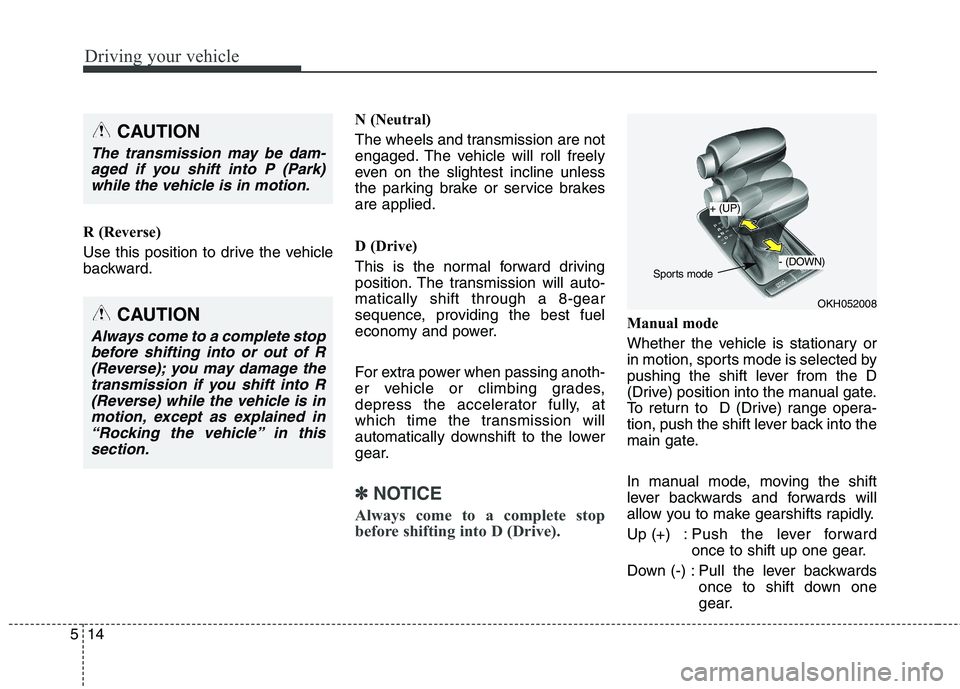
Manual mode
Whether the vehicle is stationary or
in motion, sports mode is selected by
pushing the shift lever from the D
(Drive) position into the manual gate.
To return to D (Drive) range opera-
tion, push the shift lever back into the
main gate.
In manual mode, moving the shift
lever backwards and forwards will
allow you to make gearshifts rapidly.
Up (+) : Push the lever forward once to shift up one gear.
Down (-) : Pull the lever backwards once to shift down one
gear.CAUTION
Always come to a complete stop
before shifting into or out of R(Reverse); you may damage the transmission if you shift into R(Reverse) while the vehicle is inmotion, except as explained in “Rocking the vehicle” in thissection.
OKH052008
+ (UP)
- (DOWN)
Sports mode
CAUTION
The transmission may be dam-
aged if you shift into P (Park)while the vehicle is in motion.
Page 261 of 485
Driving your vehicle
18
5
Moving up a steep grade from a
standing start
To move up a steep grade from a
standing start, depress the brake
pedal, shift the shift lever to D
(Drive). Select the appropriate gear
depending on load weight and steep-
ness of the grade, and release the
parking brake. Depress the accelera-
tor gradually while releasing the
service brakes.
Page 263 of 485
Driving your vehicle
20
5
For smooth operation, depress the
brake pedal when shifting from N(Neutral) to a forward or reverse gear.Transmission ranges
The indicator in the instrument clus-
ter displays the shift lever position
when the ignition switch is in the ONposition.
WARNING - Automatic
transmis- sion
Always check the surrounding areas near your vehicle for
people, especially children,
before shifting a car into D
(Drive) or R (Reverse).
Before leaving the driver’s seat, always make sure the
shift lever is in the P (Park)
position; then set the parking
brake fully and shut the
engine off. Unexpected and
sudden vehicle movementcan occur if these precautions
are not followed in the orderidentified.
CAUTION
To avoid damage to your
transmission, do not acceler-ate the engine in R (Reverse)or any forward gear positionwith the brakes on.
When stopped on an incline, do not hold the vehicle sta-tionary with engine power.Use the service brake or theparking brake.
Do not shift from N (Neutral) or P (Park) into D (Drive), or R(Reverse) when the engine isabove idle speed.
Page 265 of 485
![KIA QUORIS 2013 User Guide Driving your vehicle
22
5
R (Reverse)
Use this position to drive the vehicle
backward.
To shift the gear to [R] press the
[UNLOCK] button of transmission
with depressing brake pedal and
move the t](/img/2/57975/w960_57975-264.png "KIA QUORIS 2013 User Guide Driving your vehicle
22
5
R (Reverse)
Use this position to drive the vehicle
backward.
To shift the gear to [R] press the
[UNLOCK] button of transmission
with depressing brake pedal and
move the t")
Driving your vehicle
22
5
R (Reverse)
Use this position to drive the vehicle
backward.
To shift the gear to [R] press the
[UNLOCK] button of transmission
with depressing brake pedal and
move the transmission lever forward. N (Neutral)
The wheels and transmission are not
engaged. The vehicle will roll freely
even on the slightest incline unless
the parking brake or service brakesare applied.
In neutral range if you turn off the
engine, the range will be on [N] and
the ignition position will be on ACC.
To turn off engine :
1.press the engine start/stop button
to make the ignition position be on [ON].
2.Press the [P] button.
3.Press the engine start/stop button.
CAUTION
Always come to a complete stop before shifting into or out of R (Reverse); you may damage thetransmission if you shift into R(Reverse) while the vehicle is in motion, except as explained in“Rocking the vehicle” in thissection.
OKH052015L
OKH052013L
OKH052014L
Page 268 of 485
![KIA QUORIS 2013 User Guide 525
Driving your vehicle
■■When the battery is dis-charged:
When the battery is discharged, the
automatic transmission (shift by wire)is not shifted.
In emergency, if you want to shift into
[N]](/img/2/57975/w960_57975-267.png "KIA QUORIS 2013 User Guide 525
Driving your vehicle
■■When the battery is dis-charged:
When the battery is discharged, the
automatic transmission (shift by wire)is not shifted.
In emergency, if you want to shift into
[N]")
525
Driving your vehicle
■■When the battery is dis-charged:
When the battery is discharged, the
automatic transmission (shift by wire)is not shifted.
In emergency, if you want to shift into
[N], follow actions
You can shift into [N] by using the
driver if the jump starting is impossi-
ble to do.
1) Open the storage cover.
2) Remove the rubber on bottom ofstorage box.
3) Insert the driver (-) to service hole as direction of clockwise 10 times. The shifting is changed to [N] from
[P] position. If you want to shift to
[P] position, turn the driver count-
er-clockwise.
OKH052045L
CAUTION
If the electric parking brake is
not released, we recommendthat the vehicle is towed as flat-bed towing.
Page 273 of 485
![KIA QUORIS 2013 User Guide Driving your vehicle
30
5
Moving up a steep grade from a
standing start
To move up a steep grade from a
standing start, depress the brake
pedal, shift the shift lever to D (Drive)
or [1st] gear of [M](/img/2/57975/w960_57975-272.png "KIA QUORIS 2013 User Guide Driving your vehicle
30
5
Moving up a steep grade from a
standing start
To move up a steep grade from a
standing start, depress the brake
pedal, shift the shift lever to D (Drive)
or [1st] gear of [M")
Driving your vehicle
30
5
Moving up a steep grade from a
standing start
To move up a steep grade from a
standing start, depress the brake
pedal, shift the shift lever to D (Drive)
or [1st] gear of [M] mode. Select the
appropriate gear depending on load
weight and steepness of the grade,
and release the parking brake.
Depress the accelerator gradually
while releasing the service brakes.
WARNING
If your vehicle becomes stuck in
snow, mud, sand, etc., then you
may attempt to rock the vehicle
free by moving it forward and
backward. Do not attempt this
procedure if people or objects
are anywhere near the vehicle.
During the rocking operation
the vehicle may suddenly move
forward or backward as it
becomes unstuck, causing
injury or damage to nearby peo-ple or objects.
Page 275 of 485
Driving your vehicle
32
5
In the event of brake failure
If service brakes fail to operate while
the vehicle is in motion, you can
make an emergency stop with the
parking brake. The stopping dis-
tance, however, will be much greater
than normal.
Disc brakes wear indicator
Your vehicle has disc brakes.
When your brake pads are worn and
new pads are required, you will hear
a high-pitched warning sound from
your front brakes or rear brakes. You
may hear this sound come and go or
it may occur whenever you depress
the brake pedal.
Please remember that some driving
conditions or climates may cause a
brake squeal when you first apply (or
lightly apply) the brakes. This is nor-
mal and does not indicate a problem
with your brakes.
WARNING - Parking
brake
Applying the parking brake
while the vehicle is moving atnormal speeds can cause a
sudden loss of control of the
vehicle. If you must use theparking brake to stop the vehi-
cle, use great caution in apply-
ing the brake.
CAUTION
Do not operate the parking brake while the vehicle is mov-ing except in an emergency sit- uation. It could damage thevehicle system and makeendanger driving safety.
WARNING - Brake wear
This brake wear warning sound
means your vehicle needs serv-
ice. If you ignore this audible
warning, you will eventually
lose braking performance,
which could lead to a seriousaccident.
CAUTION
To avoid costly brake repairs, do not continue to drive withworn brake pads.
Always replace the front or rear brake pads as pairs.
Page 337 of 485
Driving your vehicle
94
5
ECONOMICAL OPERATION
Your vehicle's fuel economy depends
mainly on your style of driving, where
you drive and when you drive.
Each of these factors affects how
many kilometers (miles) you can get
from a liter (gallon) of fuel. To operate
your vehicle as economically as pos-
sible, use the following driving sug-
gestions to help save money in bothfuel and repairs:
Drive smoothly. Accelerate at a moderate rate. Do not make "jack-
rabbit" starts or full-throttle shifts
and maintain a steady cruising
speed. Do not race between stop-
lights. Try to adjust your speed to
the traffic so you do not have to
change speeds unnecessarily.
Avoid heavy traffic whenever pos-
sible. Always maintain a safe dis-
tance from other vehicles so you
can avoid unnecessary braking.
This also reduces brake wear.
Drive at a moderate speed. The faster you drive, the more fuel your
vehicle uses. Driving at a moderate
speed, especially on the highway,
is one of the most effective ways toreduce fuel consumption. Do not "ride" the brake pedal. This
can increase fuel consumption and
also increase wear on these com-
ponents. In addition, driving with
your foot resting on the brake pedal
may cause the brakes to overheat,
which reduces their effectiveness
and may lead to more serious con-
sequences.
Take care of your tires. Keep them inflated to the recommended pres-
sure. Incorrect inflation, either too
much or too little, results in unnec-
essary tire wear. Check the tirepressures at least once a month.
Be sure that the wheels are aligned correctly. Improper align-ment can result from hitting curbs
or driving too fast over irregular
surfaces. Poor alignment causes
faster tire wear and may also result
in other problems as well as
greater fuel consumption. Keep your vehicle in good condi-
tion. For better fuel economy and
reduced maintenance costs, main-
tain your vehicle in accordancewith the maintenance schedule in
section 7. If you drive your vehicle
in severe conditions, more frequentmaintenance is required (see sec-
tion 7 for details).
Keep your vehicle clean. For maxi- mum service, your vehicle should
be kept clean and free of corrosive
materials. It is especially important
that mud, dirt, ice, etc. not be
allowed to accumulate on the
underside of the vehicle. This extra
weight can result in increased fuel
consumption and also contribute tocorrosion.
Travel lightly. Do not carry unnec- essary weight in your vehicle.
Weight reduces fuel economy.
Do not let the engine idle longer than necessary. If you are waiting
(and not in traffic), turn off your
engine and restart only when
you're ready to go.
Page 338 of 485
595
Driving your vehicle
Remember, your vehicle does notrequire extended warm-up. After
the engine has started, allow the
engine to run for 10 to 20 seconds
prior to placing the vehicle in gear.
In very cold weather, however, give
your engine a slightly longer warm-
up period.
Do not "lug" or "over-rev" the engine. Lugging is driving too
slowly in too high a gear resulting
engine bucking. If this happens,
shift to a lower gear. Over-revving
is racing the engine beyond its safe
limit. This can be avoided by shift-
ing at the recommended speeds.
Use your air conditioning sparingly. The air conditioning system is
operated by engine power so your
fuel economy is reduced when youuse it.
Open windows at high speeds can reduce fuel economy.
Fuel economy is less in crosswinds and headwinds. To help offset
some of this loss, slow down when
driving in these conditions. Keeping a vehicle in good operating
condition is important both for econ-
omy and safety. Therefore, we rec-
ommend that the system be serviced
by an authorized Kia dealer.
WARNING
- Engine off
during motion
Never turn the engine off to
coast down hills or anytime the
vehicle is in motion. The power
steering and power brakes will
not function properly without
the engine running. Instead,
keep the engine on and down-
shift to an appropriate gear for
engine braking effect. In addi-
tion, turning off the ignition
while driving could engage the
steering wheel lock (ifequipped) resulting in loss of
vehicle steering which could
cause serious injury or death.
Page 354 of 485
What to do in an emergency
6
6
Jump starting procedure
✽✽
NOTICE
Your vehicle has a battery in the
trunk room, but when you jump
start your vehicle, use the jumper
terminal in the engine room.
1.Make sure the booster battery is 12-volt and that its negative termi-
nal is grounded.
2.If the booster battery is in another vehicle, do not allow the vehicles totouch.
3.Turn off all unnecessary electrical loads.
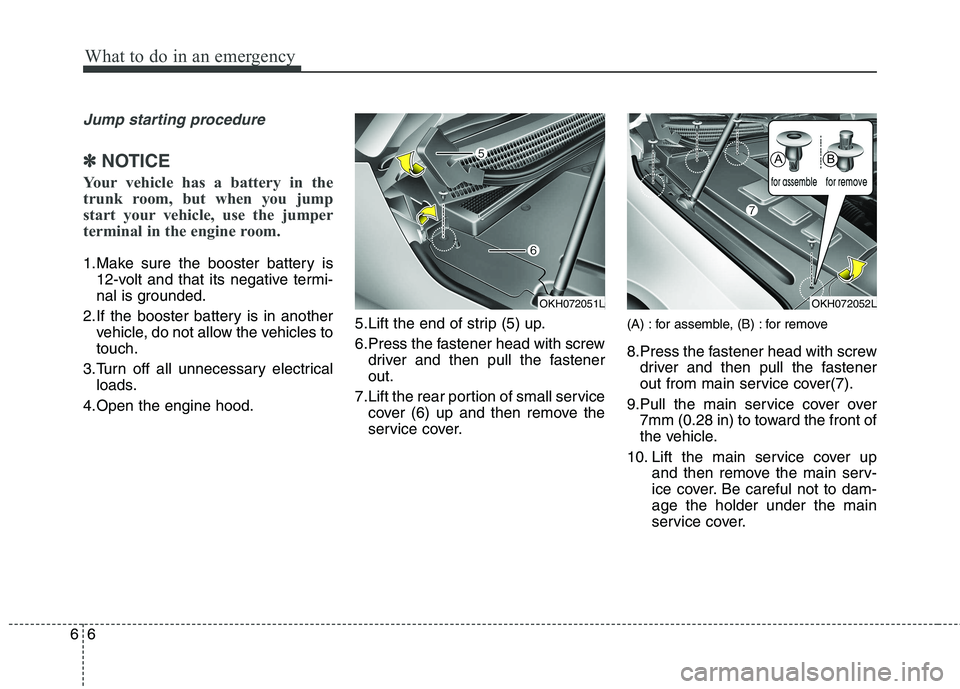
4.Open the engine hood. 5.Lift the end of strip (5) up.
6.Press the fastener head with screw
driver and then pull the fastener out.
7.Lift the rear portion of small service cover (6) up and then remove the
service cover. (A) : for assemble, (B) : for remove
8.Press the fastener head with screw
driver and then pull the fastener
out from main service cover(7).
9.Pull the main service cover over 7mm (0.28 in) to toward the front of
the vehicle.
10. Lift the main service cover up and then remove the main serv-
ice cover. Be careful not to dam-age the holder under the main
service cover.
OKH072051LOKH072052L
AB