change wheel KIA QUORIS 2013 Owner's Manual
[x] Cancel search | Manufacturer: KIA, Model Year: 2013, Model line: QUORIS, Model: KIA QUORIS 2013Pages: 485, PDF Size: 31.55 MB
Page 339 of 485
Driving your vehicle
96
5
Hazardous driving conditions
When hazardous driving conditions
are encountered such as water,
snow, ice, mud, sand, or similar haz-
ards, follow these suggestions:
Drive cautiously and allow extra
distance for braking.
Avoid sudden braking or steering.
If stalled in snow, mud, or sand, use second gear. Accelerate slow-
ly to avoid spinning the drive
wheels.
Use sand, rock salt, tire chains, or other non-slip material under the
drive wheels to provide traction
when stalled in ice, snow, or mud. Rocking the vehicle
If it is necessary to rock the vehicle
to free it from snow, sand, or mud,
first turn the steering wheel right and
left to clear the area around your
front wheels. Then, shift back and
forth between R (Reverse) and any
forward gear in vehicles equipped
with an automatic transaxle. Do not
race the engine, and spin the wheels
as little as possible. If you are still
stuck after a few tries, have the vehi-
cle pulled out by a tow vehicle to
avoid engine overheating and possi-
ble damage to the transaxle.
SPECIAL DRIVING CONDITIONS WARNING
- Downshifting
Downshifting with an automatic
transaxle, while driving on slip-
pery surfaces can cause an
accident. The sudden change intire speed could cause the tires
to skid. Be careful when down-
shifting on slippery surfaces.
WARNING - ABS
Do not pump the brake pedal on
a vehicle equipped with ABS.
CAUTION
Prolonged rocking may cause engine over-heating, transaxledamage or failure, and tire dam- age.
Page 346 of 485
5103
Driving your vehicle
Use high quality ethylene gly- col coolant
Your vehicle is delivered with high
quality ethylene glycol coolant in the
cooling system. It is the only type ofcoolant that should be used because
it helps prevent corrosion in the cool-
ing system, lubricates the water
pump and prevents freezing. Be sure
to replace or replenish your coolantin accordance with the maintenance
schedule in section 7. Before winter,
have your coolant tested to assure
that its freezing point is sufficient for
the temperatures anticipated during
the winter.
Check battery and cables
Winter puts additional burdens on
the battery system. Visually inspect
the battery and cables as described
in section 7. We recommend that the
level of charge in your battery be
checked by an authorized Kia dealer.Change to "winter weight" oil
if necessary In some climates it is recommended
that a lower viscosity "winter weight"
oil be used during cold weather. See
section 8 for recommendations. If
you aren't sure what weight oil you
should use, we recommend that you
consult an authorized Kia dealer.
Check spark plugs and igni- tion system
Inspect your spark plugs as
described in section 7 and replace
them if necessary. Also check all
ignition wiring and components to be
sure they are not cracked, worn or
damaged in any way.
CAUTION
The AutoSock (fabric snow
chain) that are the wrong sizeor improperly installed can damage your vehicle's brakelines, suspension, body andwheels.
Stop driving and retighten the AutoSock (fabric snow chain)any time you hear them hittingthe vehicle.
WARNING - Tire chains
The use of the AutoSock (fab- ric snow chain) may adversely
affect vehicle handling.
Do not exceed 30 km/h (20 mph) or the AutoSock (fabric
snow chain) manufacturer’srecommended speed limit,
whichever is lower.
Drive carefully and avoid bumps, holes, sharp turns, and
other road hazards, which may
cause the vehicle to bounce.
Avoid sharp turns or locked- wheel braking.
Page 363 of 485
615
What to do in an emergency
(Continued)
Be sure to use the correctfront and rear jacking posi-
tions on the vehicle; never
use the bumpers or any other
part of the vehicle for jacking
support.
The vehicle can easily roll off the jack causing serious
injury or death.
Do not get under a vehicle that is supported by a jack.
Do not start or run the engine while the vehicle is on the
jack.
Do not allow anyone to remain in the vehicle while it is on the
jack.
Make sure any children pres- ent are in a secure place away
from the road and from the
vehicle to be raised with the
jack.
IF YOU HAVE A FLAT TIRE
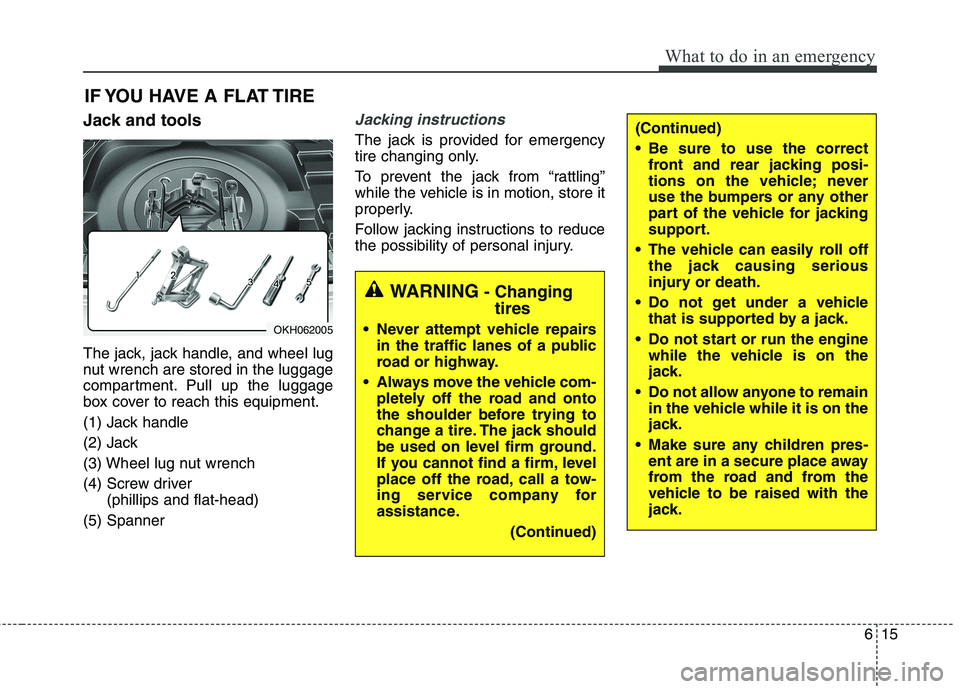
Jack and tools
The jack, jack handle, and wheel lug
nut wrench are stored in the luggage
compartment. Pull up the luggage
box cover to reach this equipment.
(1) Jack handle
(2) Jack
(3) Wheel lug nut wrench
(4) Screw driver (phillips and flat-head)
(5) Spanner
Jacking instructions
The jack is provided for emergency
tire changing only.
To prevent the jack from “rattling”
while the vehicle is in motion, store it
properly.
Follow jacking instructions to reduce
the possibility of personal injury.
WARNING - Changing
tires
Never attempt vehicle repairs in the traffic lanes of a public
road or highway.
Always move the vehicle com- pletely off the road and onto
the shoulder before trying to
change a tire. The jack should
be used on level firm ground.
If you cannot find a firm, level
place off the road, call a tow-
ing service company for
assistance.
(Continued)
OKH062005
Page 365 of 485
617
What to do in an emergency
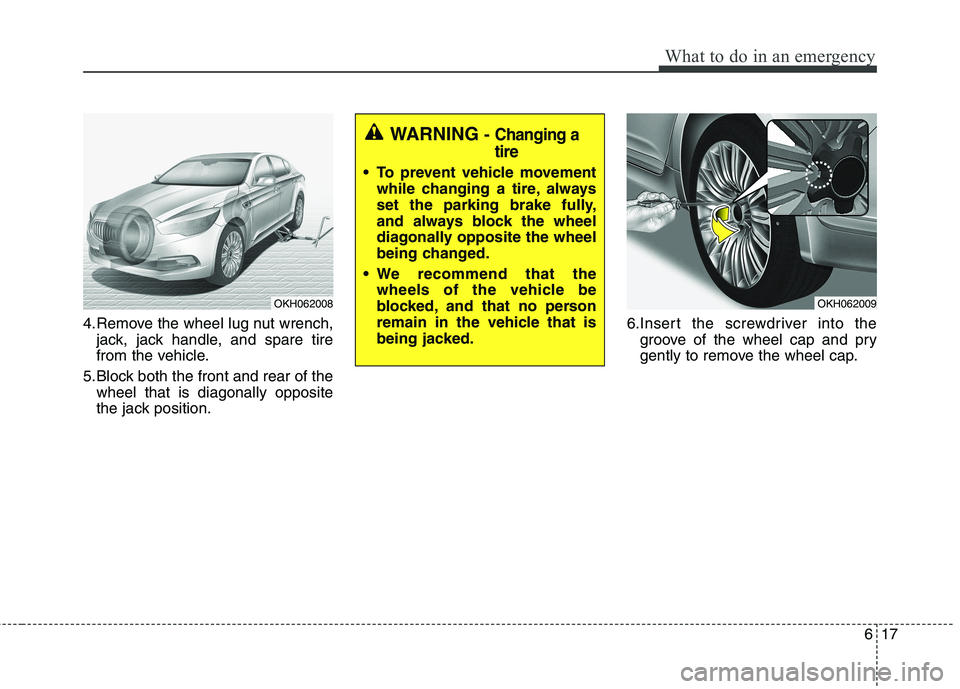
4.Remove the wheel lug nut wrench,jack, jack handle, and spare tire
from the vehicle.
5.Block both the front and rear of the wheel that is diagonally opposite
the jack position. 6.Insert the screwdriver into the
groove of the wheel cap and pry
gently to remove the wheel cap.
OKH062008
WARNING - Changing a tire
To prevent vehicle movement
while changing a tire, always
set the parking brake fully,
and always block the wheel
diagonally opposite the wheel
being changed.
We recommend that the wheels of the vehicle be
blocked, and that no person
remain in the vehicle that is
being jacked.
OKH062009
Page 368 of 485
What to do in an emergency
20
6
11. To reinstall the wheel, hold it on
the studs, put the wheel nuts on the studs and tighten them finger
tight. The nuts should be installedwith their tapered small diameter
ends directed inward. Jiggle thetire to be sure it is completely
seated, then tighten the nuts as
much as possible with your fin-gers again.
12. Lower the car to the ground by turning the wheel nut wrench
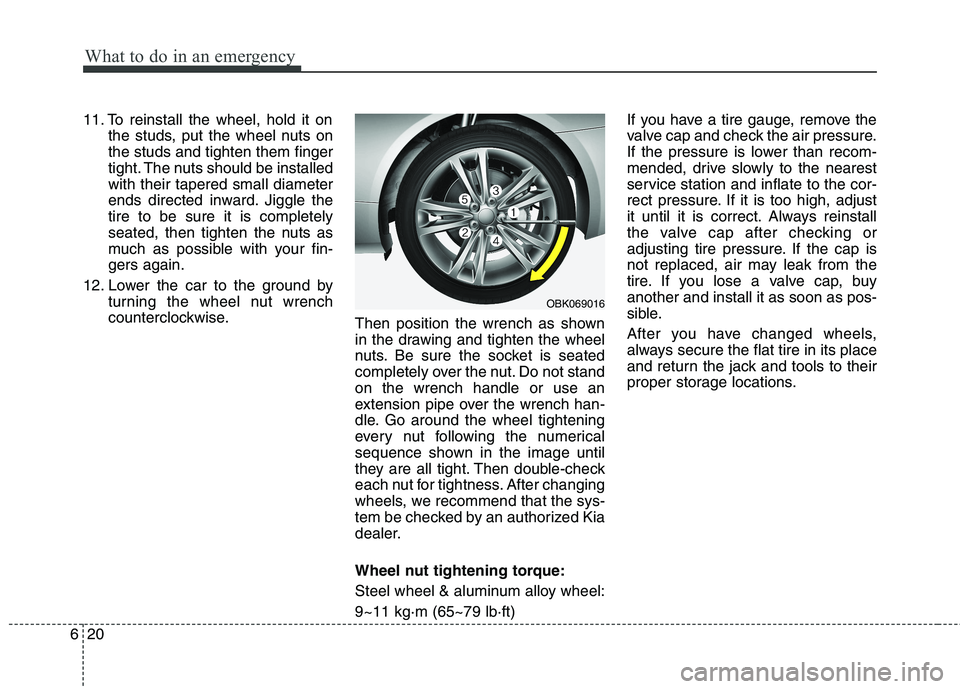
counterclockwise. Then position the wrench as shown
in the drawing and tighten the wheel
nuts. Be sure the socket is seated
completely over the nut. Do not standon the wrench handle or use an
extension pipe over the wrench han-
dle. Go around the wheel tightening
every nut following the numerical
sequence shown in the image until
they are all tight. Then double-check
each nut for tightness. After changing
wheels, we recommend that the sys-
tem be checked by an authorized Kia
dealer.
Wheel nut tightening torque:
Steel wheel & aluminum alloy wheel:9~11 kg·m (65~79 lb·ft) If you have a tire gauge, remove the
valve cap and check the air pressure.
If the pressure is lower than recom-
mended, drive slowly to the nearest
service station and inflate to the cor-
rect pressure. If it is too high, adjust
it until it is correct. Always reinstall
the valve cap after checking or
adjusting tire pressure. If the cap is
not replaced, air may leak from the
tire. If you lose a valve cap, buyanother and install it as soon as pos-
sible.
After you have changed wheels,
always secure the flat tire in its place
and return the jack and tools to their
proper storage locations.
OBK069016
Page 382 of 485
Maintenance
6
7
OWNER MAINTENANCE
The following lists are vehicle checks and inspections that should be per-
formed at the frequencies indicated
to help ensure safe, dependable
operation of your vehicle.
If you have any question, we recom-
mend that you consult an authorized
Kia dealer.
These Owner Maintenance Checks
are generally not covered by war-
ranties and you may be charged for
labor, parts and lubricants used. Owner maintenance schedule
When you stop for fuel:
• Check the engine oil level.
Check coolant level in coolant
reservoir.
Check the windshield washer fluid level.
Look for low or under-inflated tires.
While operating your vehicle:
Note any changes in the sound of the exhaust or any smell of
exhaust fumes in the vehicle.
Check for vibrations in the steering wheel. Notice any increased steer-
ing effort or looseness in the steer-
ing wheel, or change in its straight-ahead position.
Notice if your vehicle constantly turns slightly or “pulls” to one side
when traveling on smooth, levelroad.
When stopping, listen and check for unusual sounds, pulling to one
side, increased brake pedal travel
or “hard-to-push” brake pedal.
If any slipping or changes in the operation of your transaxle occurs,
check the transaxle fluid level.
Check automatic transaxle P (Park) function.
Check parking brake.
Check for fluid leaks under your vehicle (water dripping from the air
conditioning system during or after
use is normal).
WARNING
Be careful when checking your
engine coolant level when the
engine is hot. Scalding hot
coolant and steam may blow
out under pressure. This could
cause burns or other serious
injury.
Page 484 of 485
Index
10
I
Steering wheel. . . . . . . . . . . . . . . . . . . . . . . . . . . . . . . . 4-41
Electronic Hydraulic Power Steering (EHPS) . . . . . . 4-41
Heated steering wheel . . . . . . . . . . . . . . . . . . . . . . . . 4-42
Horn . . . . . . . . . . . . . . . . . . . . . . . . . . . . . . . . . . . . . . 4-43
Tilt steering . . . . . . . . . . . . . . . . . . . . . . . . . . . . . . . . . 4-41
Steering wheel audio control . . . . . . . . . . . . . . . . . . . 4-163
Storage compartment . . . . . . . . . . . . . . . . . . . . . . . . . 4-146 Center console storage . . . . . . . . . . . . . . . . . . . . . . . 4-146
Glove box . . . . . . . . . . . . . . . . . . . . . . . . . . . . . . . . . 4-147
Map pocket . . . . . . . . . . . . . . . . . . . . . . . . . . . . . . . . 4-149
Rear seat storage. . . . . . . . . . . . . . . . . . . . . . . . . . . . 4-146
Seatback pocket . . . . . . . . . . . . . . . . . . . . . . . . . . . . 4-148
Sunglass holder. . . . . . . . . . . . . . . . . . . . . . . . . . . . . 4-147
Sunglass holder . . . . . . . . . . . . . . . . . . . . . . . . . . . . . . 4-147
Sunroof . . . . . . . . . . . . . . . . . . . . . . . . . . . . . . . . . . . . . 4-37
Sunvisor . . . . . . . . . . . . . . . . . . . . . . . . . . . . . . . . . . . 4-151
Tachometer . . . . . . . . . . . . . . . . . . . . . . . . . . . . . . . . . . 4-52
Tether anchor system . . . . . . . . . . . . . . . . . . . . . . . . . . 3-38
Theft-alarm system . . . . . . . . . . . . . . . . . . . . . . . . . . . . 4-12
Tilt steering . . . . . . . . . . . . . . . . . . . . . . . . . . . . . . . . . . 4-41
Tire chains. . . . . . . . . . . . . . . . . . . . . . . . . . . . . . . . . . 5-102
Tire pressure monitoring system . . . . . . . . . . . . . . . . . . 6-9
Tire rotation . . . . . . . . . . . . . . . . . . . . . . . . . . . . . . . . . 7-45
Tire specification and pressure label . . . . . . . . . . . . . . 8-10 Tires and wheels . . . . . . . . . . . . . . . . . . . . . . . . . . 7-43, 8-4
Checking tire inflation pressure . . . . . . . . . . . . . . . . . 7-44
Recommended cold tire inflation pressures . . . . . . . . 7-43
Tire care . . . . . . . . . . . . . . . . . . . . . . . . . . . . . . . . . . . 7-43
Tire maintenance . . . . . . . . . . . . . . . . . . . . . . . . . . . . 7-48
Tire replacement . . . . . . . . . . . . . . . . . . . . . . . . . . . . . 7-47
Tire rotation . . . . . . . . . . . . . . . . . . . . . . . . . . . . . . . . 7-45
Tire sidewall labeling . . . . . . . . . . . . . . . . . . . . . . . . . 7-49
Tire traction . . . . . . . . . . . . . . . . . . . . . . . . . . . . . . . . 7-48
Wheel alignment and tire balance . . . . . . . . . . . . . . . 7-46
Wheel replacement . . . . . . . . . . . . . . . . . . . . . . . . . . . 7-48
Towing . . . . . . . . . . . . . . . . . . . . . . . . . . . . . . . . . . . . . 6-22
Traffic change . . . . . . . . . . . . . . . . . . . . . . . . . . . . . . . 4-111
Transaxle Shift Indicator . . . . . . . . . . . . . . . . . . . . . . . 4-55
Transmission
Automatic transmission (shift by cable) . . . . . . . . . . 5-12
Automatic transmission (shift by wire) . . . . . . . . . . . 5-19
Trip computer . . . . . . . . . . . . . . . . . . . . . . . . . . . . . . . . 4-75 Average Fuel Economy . . . . . . . . . . . . . . . . . . . . . . . 4-78
Average Vehicle Speed . . . . . . . . . . . . . . . . . . . . . . . . 4-76
Distance To Empty . . . . . . . . . . . . . . . . . . . . . . . . . . . 4-77
Elapsed Time . . . . . . . . . . . . . . . . . . . . . . . . . . . . . . . 4-77
Instant Fuel Economy. . . . . . . . . . . . . . . . . . . . . . . . . 4-79
Trip modes (Type A) . . . . . . . . . . . . . . . . . . . . . . . . . 4-75
Trip modes (Type B) . . . . . . . . . . . . . . . . . . . . . . . . . 4-75
Tripmeter . . . . . . . . . . . . . . . . . . . . . . . . . . . . . . . . . . 4-76
T