belt KIA QUORIS 2015 Owner's Manual
[x] Cancel search | Manufacturer: KIA, Model Year: 2015, Model line: QUORIS, Model: KIA QUORIS 2015Pages: 486, PDF Size: 35.55 MB
Page 53 of 486
Safety features of your vehicle
38
3
Installing a child restraint system
by lap/shoulder belt
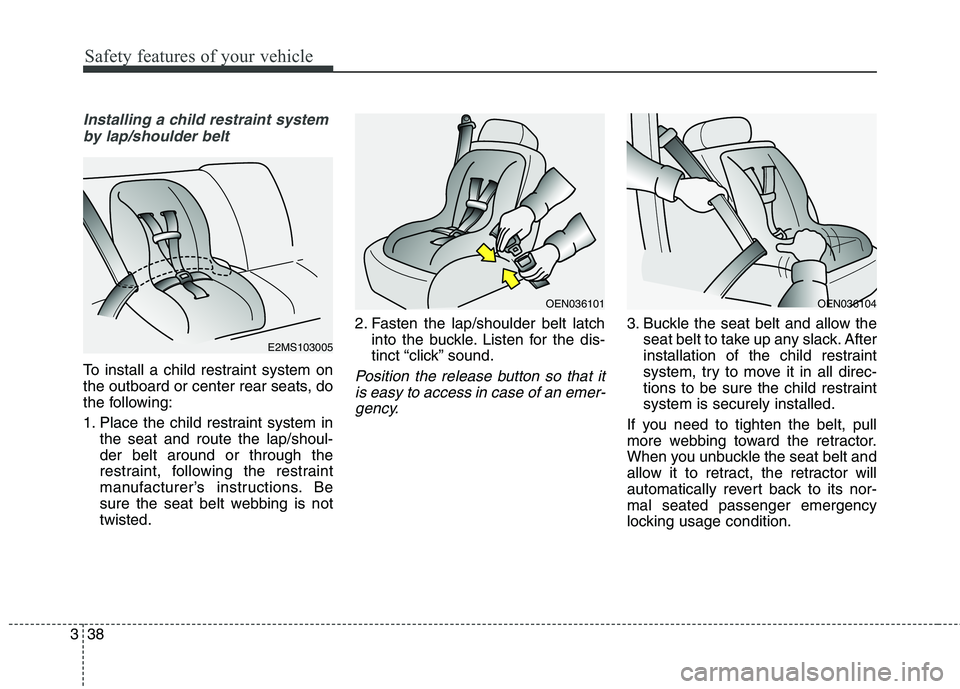
To install a child restraint system on
the outboard or center rear seats, do
the following:
1. Place the child restraint system in the seat and route the lap/shoul- der belt around or through the
restraint, following the restraint
manufacturer’s instructions. Be
sure the seat belt webbing is nottwisted. 2. Fasten the lap/shoulder belt latch
into the buckle. Listen for the dis-
tinct “click” sound.Position the release button so that it
is easy to access in case of an emer-gency.
3. Buckle the seat belt and allow the seat belt to take up any slack. After
installation of the child restraint
system, try to move it in all direc-
tions to be sure the child restraintsystem is securely installed.
If you need to tighten the belt, pull
more webbing toward the retractor.
When you unbuckle the seat belt and
allow it to retract, the retractor will
automatically revert back to its nor-mal seated passenger emergency
locking usage condition.
OEN036101
E2MS103005
OEN036104
Page 54 of 486
339
Safety features of your vehicle
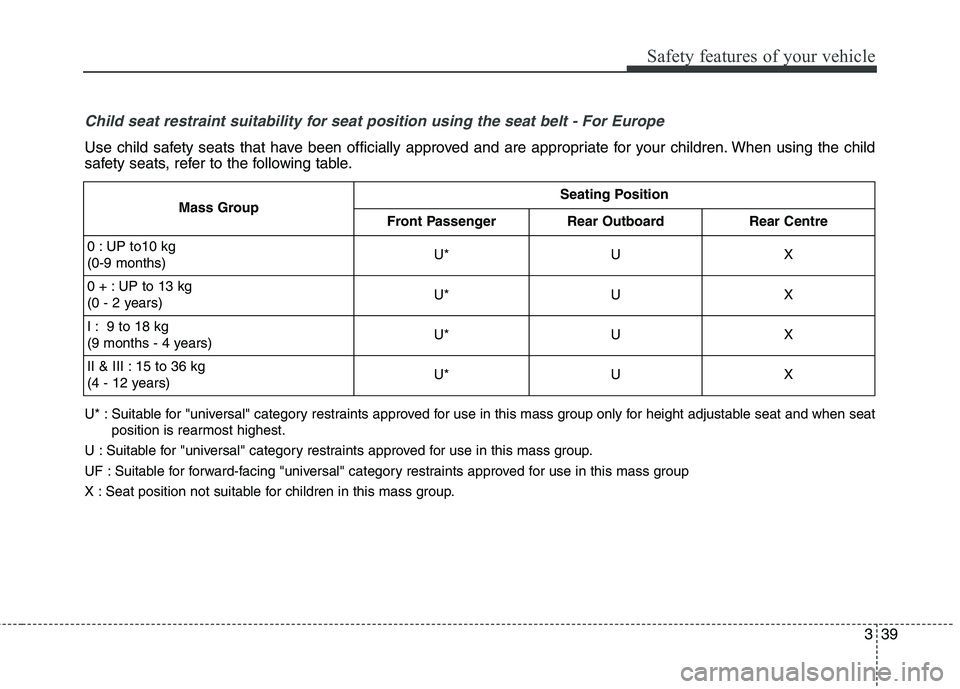
Child seat restraint suitability for seat position using the seat belt - For Europe
Use child safety seats that have been officially approved and are appropriate for your children. When using the child
safety seats, refer to the following table.
U* : Suitable for "universal" category restraints approved for use in this mass group only for height adjustable seat and when seat
position is rearmost highest.
U : Suitable for "universal" category restraints approved for use in this mass group.
UF : Suitable for forward-facing "universal" category restraints approved for use in this mass group
X : Seat position not suitable for children in this mass group.
Mass GroupSeating Position
Front PassengerRear OutboardRear Centre
0 : UP to10 kg (0-9 months)U*UX
0 + : UP to 13 kg
(0 - 2 years)U*UX
I : 9 to 18 kg
(9 months - 4 years)U*UX
II & III : 15 to 36 kg
(4 - 12 years)U*UX
Page 56 of 486
341
Safety features of your vehicle
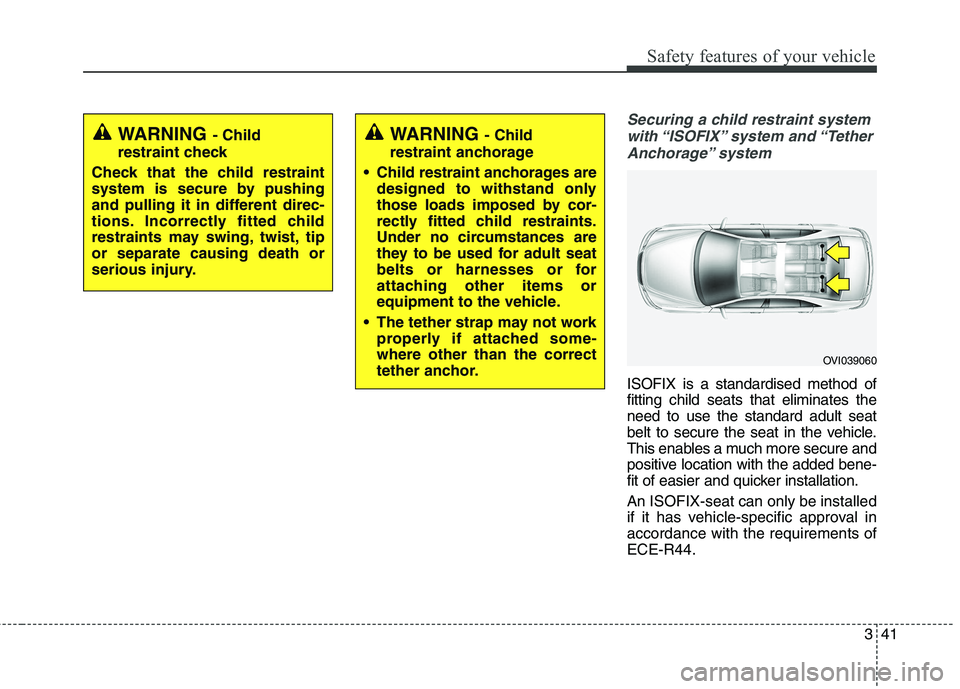
Securing a child restraint systemwith “ISOFIX” system and “Tether Anchorage” system
ISOFIX is a standardised method of fitting child seats that eliminates theneed to use the standard adult seat
belt to secure the seat in the vehicle.
This enables a much more secure and
positive location with the added bene-
fit of easier and quicker installation. An ISOFIX-seat can only be installed
if it has vehicle-specific approval inaccordance with the requirements ofECE-R44.
WARNING - Child
restraint check
Check that the child restraint
system is secure by pushing
and pulling it in different direc-
tions. Incorrectly fitted child
restraints may swing, twist, tipor separate causing death or
serious injury.WARNING - Child
restraint anchorage
Child restraint anchorages are designed to withstand only
those loads imposed by cor-
rectly fitted child restraints.
Under no circumstances are
they to be used for adult seat
belts or harnesses or for
attaching other items or
equipment to the vehicle.
The tether strap may not work properly if attached some-where other than the correct
tether anchor.
OVI039060
Page 57 of 486
Safety features of your vehicle
42
3
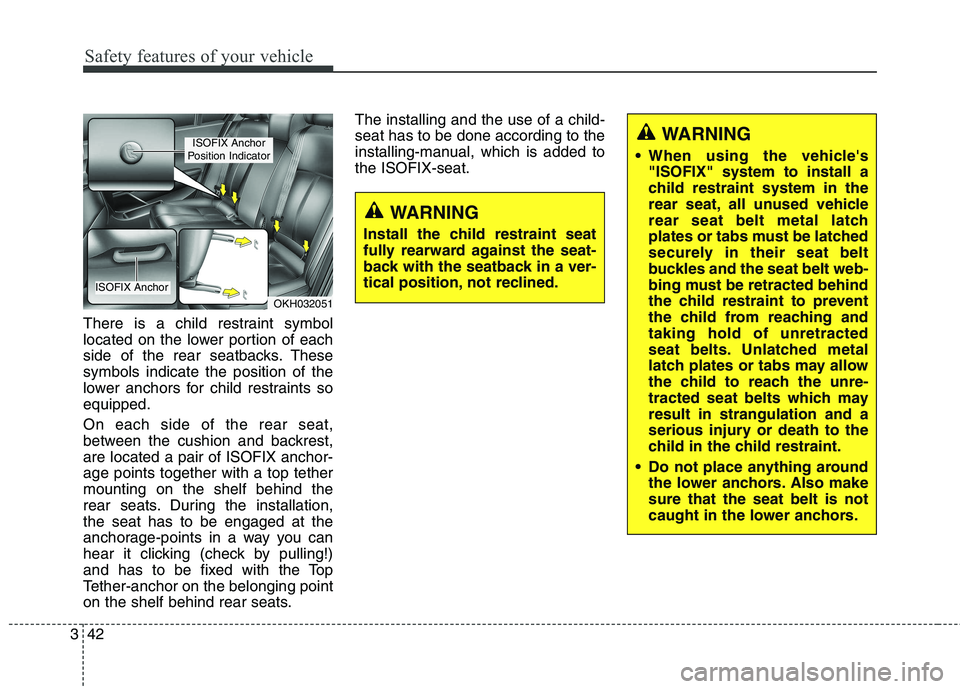
There is a child restraint symbol
located on the lower portion of each
side of the rear seatbacks. Thesesymbols indicate the position of the
lower anchors for child restraints soequipped. On each side of the rear seat,
between the cushion and backrest,are located a pair of ISOFIX anchor-age points together with a top tethermounting on the shelf behind the
rear seats. During the installation,the seat has to be engaged at the
anchorage-points in a way you can
hear it clicking (check by pulling!)
and has to be fixed with the Top
Tether-anchor on the belonging point
on the shelf behind rear seats. The installing and the use of a child-seat has to be done according to the
installing-manual, which is added tothe ISOFIX-seat.
WARNING
Install the child restraint seat
fully rearward against the seat-
back with the seatback in a ver-
tical position, not reclined.
WARNING
When using the vehicle's "ISOFIX" system to install a
child restraint system in the
rear seat, all unused vehicle
rear seat belt metal latch
plates or tabs must be latched
securely in their seat belt
buckles and the seat belt web-
bing must be retracted behind
the child restraint to prevent
the child from reaching andtaking hold of unretracted
seat belts. Unlatched metal
latch plates or tabs may allow
the child to reach the unre-
tracted seat belts which mayresult in strangulation and a
serious injury or death to the
child in the child restraint.
Do not place anything around the lower anchors. Also makesure that the seat belt is not
caught in the lower anchors.
OKH032051
ISOFIX Anchor
Position Indicator
ISOFIX Anchor
Page 58 of 486
343
Safety features of your vehicle
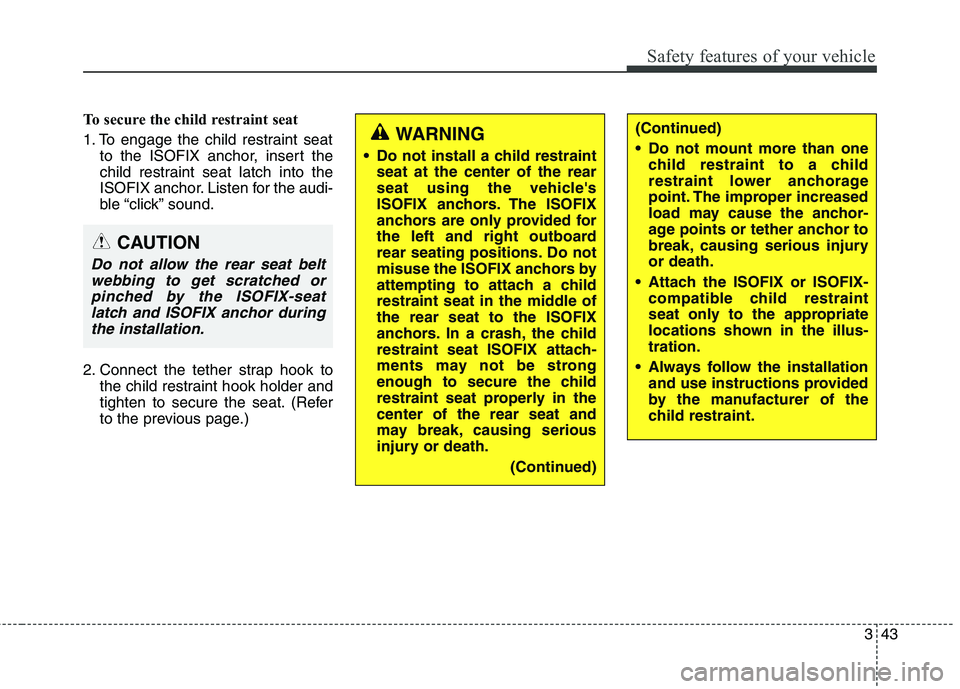
To secure the child restraint seat
1. To engage the child restraint seatto the ISOFIX anchor, insert the
child restraint seat latch into the
ISOFIX anchor. Listen for the audi-
ble “click” sound.
2. Connect the tether strap hook to the child restraint hook holder and
tighten to secure the seat. (Refer
to the previous page.)
WARNING
Do not install a child restraint seat at the center of the rear
seat using the vehicle's
ISOFIX anchors. The ISOFIX
anchors are only provided for
the left and right outboard
rear seating positions. Do not
misuse the ISOFIX anchors by
attempting to attach a child
restraint seat in the middle ofthe rear seat to the ISOFIX
anchors. In a crash, the child
restraint seat ISOFIX attach-
ments may not be strong
enough to secure the child
restraint seat properly in thecenter of the rear seat and
may break, causing serious
injury or death.
(Continued)(Continued)
Do not mount more than onechild restraint to a child
restraint lower anchorage
point. The improper increased
load may cause the anchor-
age points or tether anchor to
break, causing serious injuryor death.
Attach the ISOFIX or ISOFIX- compatible child restraint
seat only to the appropriate
locations shown in the illus-tration.
Always follow the installation and use instructions provided
by the manufacturer of the
child restraint.
CAUTION
Do not allow the rear seat belt
webbing to get scratched orpinched by the ISOFIX-seat latch and ISOFIX anchor duringthe installation.
Page 60 of 486
345
Safety features of your vehicle
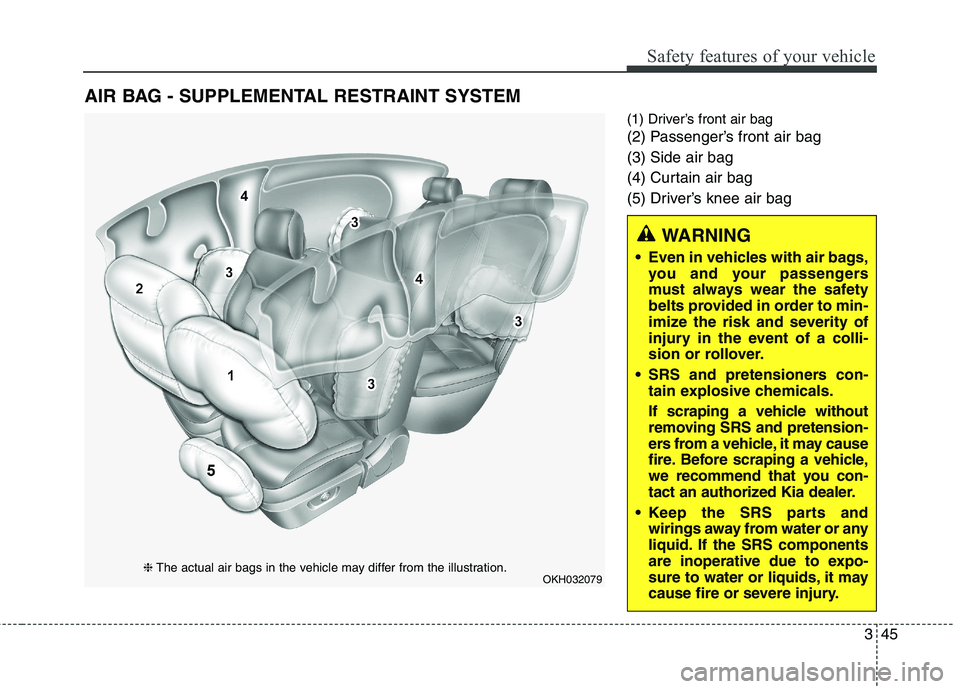
(1) Driver’s front air bag
(2) Passenger’s front air bag (3) Side air bag
(4) Curtain air bag
(5) Driver’s knee air bag
AIR BAG - SUPPLEMENTAL RESTRAINT SYSTEM
OKH032079
❈
The actual air bags in the vehicle may differ from the illustration.
WARNING
Even in vehicles with air bags, you and your passengers
must always wear the safety
belts provided in order to min-
imize the risk and severity of
injury in the event of a colli-
sion or rollover.
SRS and pretensioners con- tain explosive chemicals.
If scraping a vehicle without
removing SRS and pretension-
ers from a vehicle, it may cause
fire. Before scraping a vehicle,
we recommend that you con-
tact an authorized Kia dealer.
Keep the SRS parts and wirings away from water or any
liquid. If the SRS components
are inoperative due to expo-
sure to water or liquids, it may
cause fire or severe injury.
Page 62 of 486
347
Safety features of your vehicle
Noise and smoke
When the air bags inflate, they make
a loud noise and they leave smoke
and powder in the air inside of the
vehicle. This is normal and is a result
of the ignition of the air bag inflator.
After the air bag inflates, you may
feel substantial discomfort in breath-
ing due to the contact of your chestwith both the seat belt and the air
bag, as well as from breathing the
smoke and powder.Open your
doors and/or windows as soon as
possible after impact in order to
reduce discomfort and prevent
prolonged exposure to the smoke
and powder.
Though the smoke and powder are
non-toxic, they may cause irritation
to the skin (eyes, nose and throat,
etc). If this is the case, wash and
rinse with cold water immediatelyand consult a doctor if the symptom
persists.
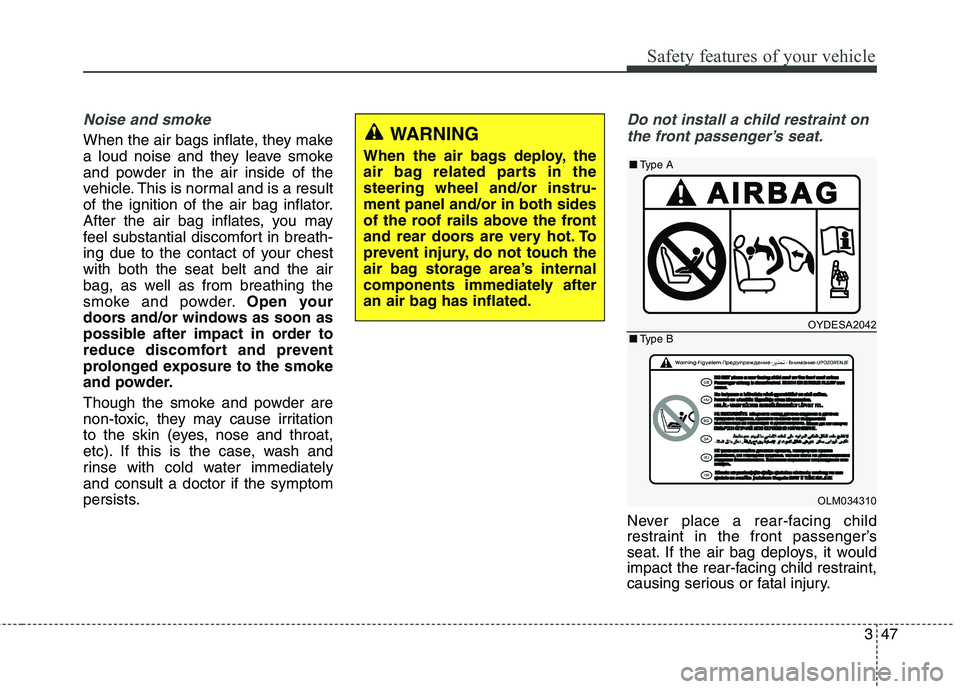
Do not install a child restraint on
the front passenger’s seat.
Never place a rear-facing child
restraint in the front passenger’s
seat. If the air bag deploys, it would
impact the rear-facing child restraint,
causing serious or fatal injury.
WARNING
When the air bags deploy, the
air bag related parts in thesteering wheel and/or instru-ment panel and/or in both sides
of the roof rails above the front
and rear doors are very hot. To
prevent injury, do not touch the
air bag storage area’s internal
components immediately after
an air bag has inflated.
OYDESA2042
OLM034310
■ Type A
■Type B
Page 64 of 486
349
Safety features of your vehicle
The light stays on after illuminatingfor approximately 6 seconds.
The light comes on while the vehi- cle is in motion.
The light blinks when the engine start/stop button is in ON position. SRS components and func- tions
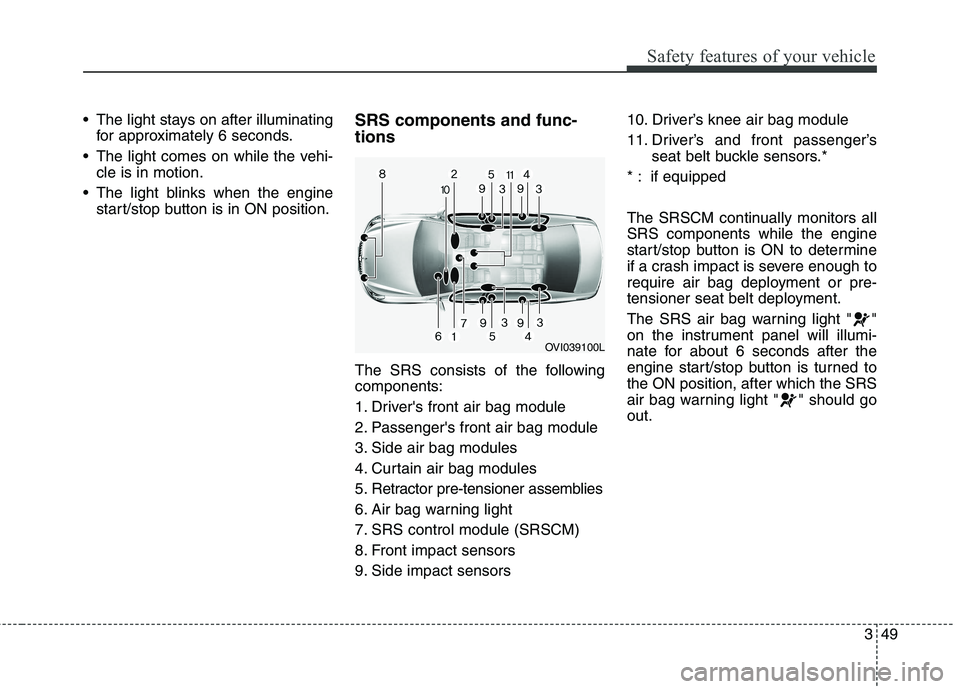
The SRS consists of the following components:
1. Driver's front air bag module
2. Passenger's front air bag module
3. Side air bag modules
4. Curtain air bag modules
5. Retractor pre-tensioner assemblies
6. Air bag warning light
7. SRS control module (SRSCM)
8. Front impact sensors
9. Side impact sensors 10. Driver’s knee air bag module
11. Driver’s and front passenger’s
seat belt buckle sensors.*
* : if equipped
The SRSCM continually monitors all SRS components while the engine
start/stop button is ON to determine
if a crash impact is severe enough to
require air bag deployment or pre-
tensioner seat belt deployment.
The SRS air bag warning light " "
on the instrument panel will illumi-
nate for about 6 seconds after the
engine start/stop button is turned tothe ON position, after which the SRS
air bag warning light " " should goout.
OVI039100L
Page 66 of 486
351
Safety features of your vehicle
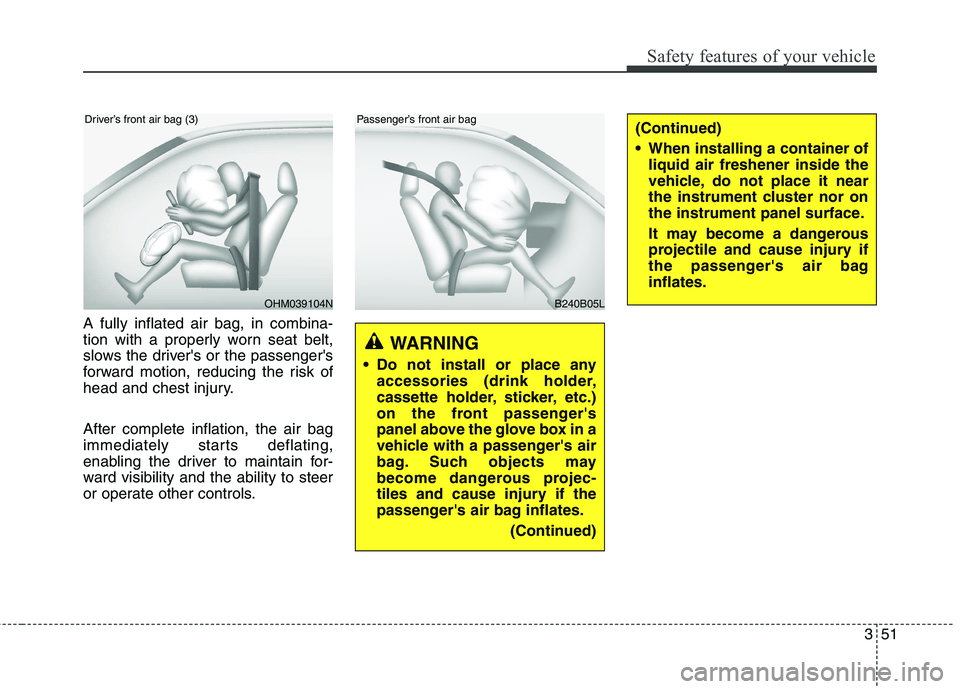
A fully inflated air bag, in combina-
tion with a properly worn seat belt,
slows the driver's or the passenger's
forward motion, reducing the risk of
head and chest injury. After complete inflation, the air bag
immediately starts deflating,
enabling the driver to maintain for-
ward visibility and the ability to steer
or operate other controls.
WARNING
Do not install or place any accessories (drink holder,
cassette holder, sticker, etc.)
on the front passenger's
panel above the glove box in a
vehicle with a passenger's air
bag. Such objects may
become dangerous projec-
tiles and cause injury if the
passenger's air bag inflates.
(Continued)
(Continued)
When installing a container ofliquid air freshener inside the
vehicle, do not place it near
the instrument cluster nor on
the instrument panel surface.
It may become a dangerous
projectile and cause injury if
the passenger's air baginflates.
B240B05L
Passenger’s front air bag
OHM039104N
Driver’s front air bag (3)
Page 67 of 486
Safety features of your vehicle
52
3
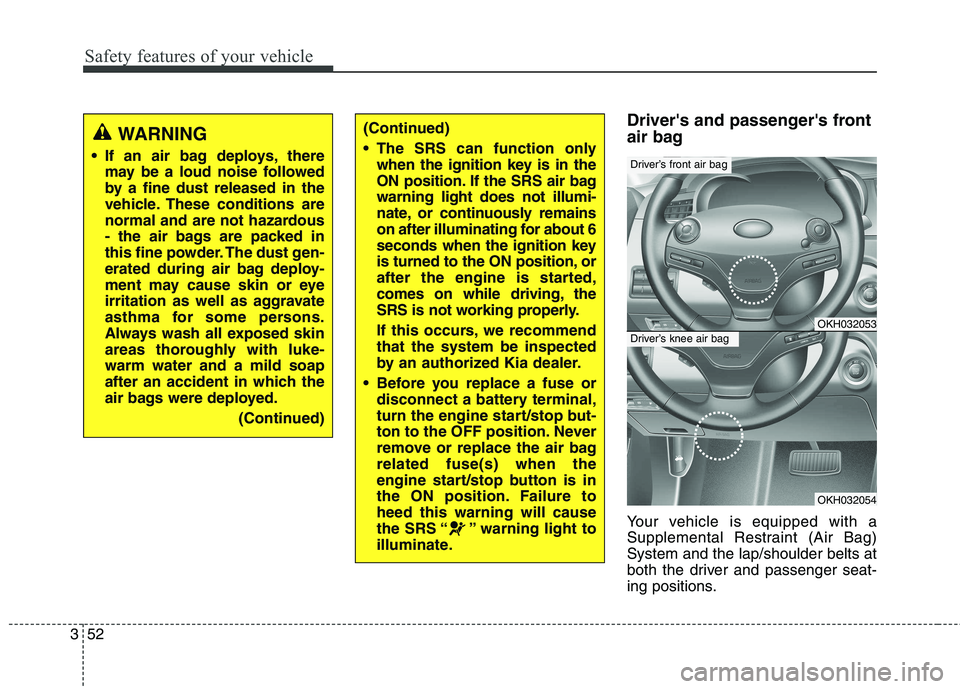
Driver's and passenger's front
air bag
Your vehicle is equipped with a
Supplemental Restraint (Air Bag)System and the lap/shoulder belts at
both the driver and passenger seat-
ing positions.
OKH032053
OKH032054
Driver’s knee air bag
Driver’s front air bag
(Continued)
The SRS can function only
when the ignition key is in the
ON position. If the SRS air bagwarning light does not illumi-
nate, or continuously remains
on after illuminating for about 6
seconds when the ignition key
is turned to the ON position, or
after the engine is started,
comes on while driving, the
SRS is not working properly.
If this occurs, we recommend that the system be inspected
by an authorized Kia dealer.
Before you replace a fuse or disconnect a battery terminal,
turn the engine start/stop but-
ton to the OFF position. Never
remove or replace the air bagrelated fuse(s) when the
engine start/stop button is in
the ON position. Failure toheed this warning will cause
the SRS “ ” warning light to
illuminate.WARNING
If an air bag deploys, there may be a loud noise followed
by a fine dust released in the
vehicle. These conditions are
normal and are not hazardous
- the air bags are packed in
this fine powder. The dust gen-
erated during air bag deploy-
ment may cause skin or eye
irritation as well as aggravate
asthma for some persons.
Always wash all exposed skin
areas thoroughly with luke-warm water and a mild soap
after an accident in which the
air bags were deployed.
(Continued)