mirror KIA QUORIS 2015 Owner's Manual
[x] Cancel search | Manufacturer: KIA, Model Year: 2015, Model line: QUORIS, Model: KIA QUORIS 2015Pages: 486, PDF Size: 35.55 MB
Page 231 of 486
Features of your vehicle
150
4
When using the sunvisor for the side
window, you can use the secondary
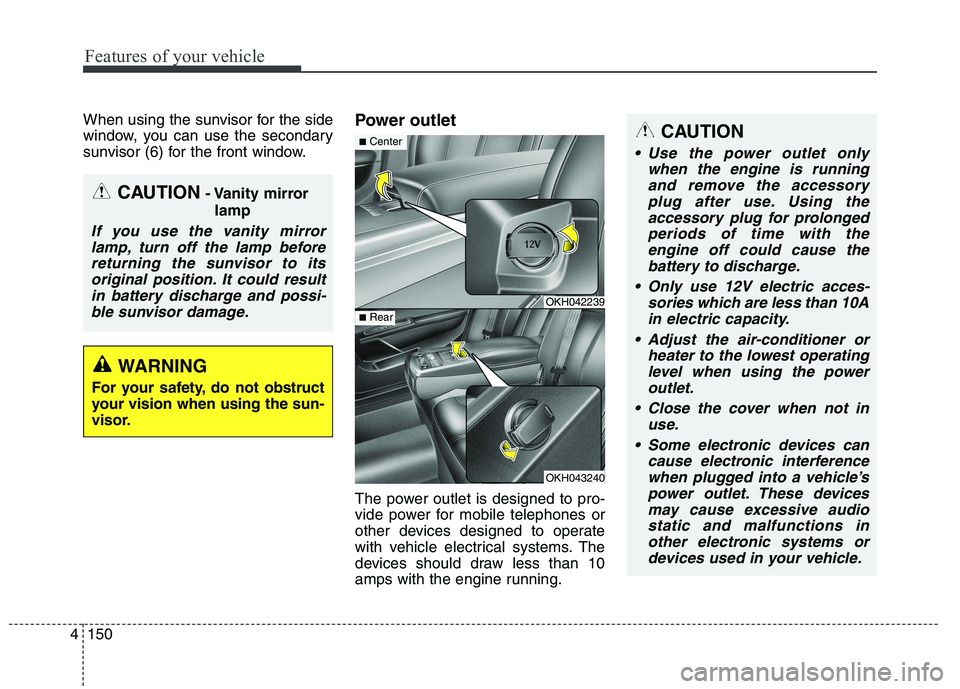
sunvisor (6) for the front window. Power outlet
The power outlet is designed to pro-
vide power for mobile telephones or
other devices designed to operate
with vehicle electrical systems. The
devices should draw less than 10
amps with the engine running.
CAUTION
- Vanity mirror
lamp
If you use the vanity mirrorlamp, turn off the lamp beforereturning the sunvisor to its original position. It could resultin battery discharge and possi-ble sunvisor damage.
WARNING
For your safety, do not obstruct
your vision when using the sun-
visor.
OKH042239
OKH043240
■ Center
■Rear
CAUTION
Use the power outlet only
when the engine is runningand remove the accessory plug after use. Using theaccessory plug for prolongedperiods of time with the engine off could cause thebattery to discharge.
Only use 12V electric acces- sories which are less than 10Ain electric capacity.
Adjust the air-conditioner or heater to the lowest operatinglevel when using the poweroutlet.
Close the cover when not in use.
Some electronic devices can cause electronic interferencewhen plugged into a vehicle’spower outlet. These devicesmay cause excessive audiostatic and malfunctions in other electronic systems ordevices used in your vehicle.
Page 237 of 486
Features of your vehicle
156
4
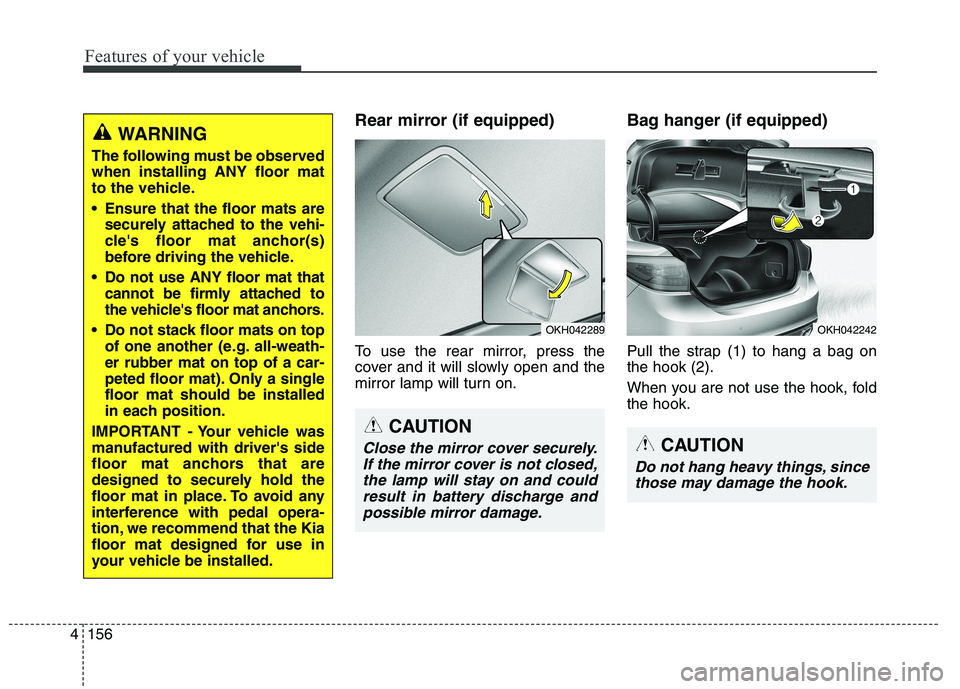
Rear mirror (if equipped)
To use the rear mirror, press the
cover and it will slowly open and the
mirror lamp will turn on. Bag hanger (if equipped)
Pull the strap (1) to hang a bag on the hook (2).
When you are not use the hook, fold the hook.
OKH042289
CAUTION
Close the mirror cover securely.
If the mirror cover is not closed,the lamp will stay on and could result in battery discharge andpossible mirror damage.
OKH042242
CAUTION
Do not hang heavy things, since those may damage the hook.
WARNING
The following must be observed when installing ANY floor mat
to the vehicle.
Ensure that the floor mats are securely attached to the vehi-
cle's floor mat anchor(s)
before driving the vehicle.
Do not use ANY floor mat that cannot be firmly attached to
the vehicle's floor mat anchors.
Do not stack floor mats on top of one another (e.g. all-weath-er rubber mat on top of a car-
peted floor mat). Only a singlefloor mat should be installed
in each position.
IMPORTANT - Your vehicle was
manufactured with driver's side
floor mat anchors that are
designed to securely hold the
floor mat in place. To avoid any
interference with pedal opera-
tion, we recommend that the Kia
floor mat designed for use in
your vehicle be installed.
Page 247 of 486
53
Driving your vehicle
Before entering vehicle
• Be sure that all windows, outsidemirror(s), and outside lights are clean.
Check the condition of the tires.
Check under the vehicle for any sign of leaks.
Be sure there are no obstacles behind you if you intend to back up. Necessary inspections
Fluid levels, such as engine oil,
engine coolant, brake fluid, and
washer fluid should be checked on a
regular basis, with the exact interval
depending on the fluid. Further
details are provided in section 7,“Maintenance”.
Before starting
Close and lock all doors.
Position the seat so that all con-
trols are easily reached.
Adjust the inside and outside rearview mirrors.
Be sure that all lights work.
Check all gauges.
Check the operation of warning lights when the ignition switch is
turned to the ON position.
Release the parking brake and make sure the brake warning lightgoes out.
For safe operation, be sure you are
familiar with your vehicle and itsequipment.
BEFORE DRIVING
WARNING
Driving while distracted can
result in a loss of vehicle control,
that may lead to an accident,
severe personal injury, and
death. The driver’s primary
responsibility is in the safe and
legal operation of a vehicle, and
use of any handheld devices,
other equipment, or vehicle sys-
tems which take the driver’s
eyes, attention and focus away
from the safe operation of a vehi-
cle or which are not permissible
by law should never be used dur-
ing operation of the vehicle.
Page 327 of 486
583
Driving your vehicle
The surrounding of the inside rearview mirror temperature is high
due to a direct ray of light.
The lane is very wide or narrow.
The lane line is damaged or indis- tinct.
The windshield is fogged by humid air in the vehicle.
The shadow is on the lane line by a median strip.
The sensor cannot distinguish the lane from the road due to the dust.
There is a mark similar to a lane line.
There is a boundary structure.
The distance from vehicle ahead is very short or the vehicle ahead
drives hiding the lane line.
The vehicle shakes heavily.
The lane number increases or decreases or the lane lines are
crossing complicatedly.
Putting something on the dash- board. Driving with the sun in front of you.
Driving in areas under construc-
tion.
The lane line is more than two in either side (Left/Right)
Page 329 of 486
585
Driving your vehicle
BSD (Blind Spot Detection) /
LCA (Lane Change Assist)
Operating conditions
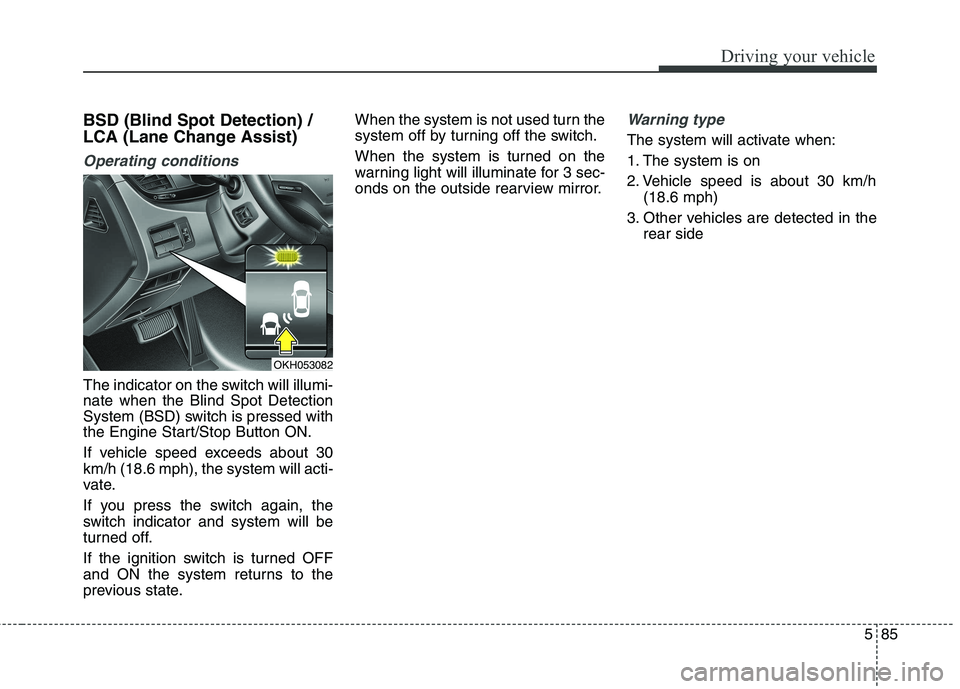
The indicator on the switch will illumi- nate when the Blind Spot Detection
System (BSD) switch is pressed with
the Engine Start/Stop Button ON.
If vehicle speed exceeds about 30 km/h (18.6 mph), the system will acti-
vate.
If you press the switch again, the
switch indicator and system will be
turned off.
If the ignition switch is turned OFF
and ON the system returns to the
previous state.When the system is not used turn the
system off by turning off the switch.
When the system is turned on the
warning light will illuminate for 3 sec-
onds on the outside rearview mirror.
Warning type
The system will activate when:
1. The system is on
2. Vehicle speed is about 30 km/h
(18.6 mph)
3. Other vehicles are detected in the rear side
OKH053082
Page 330 of 486
Driving your vehicle
86
5
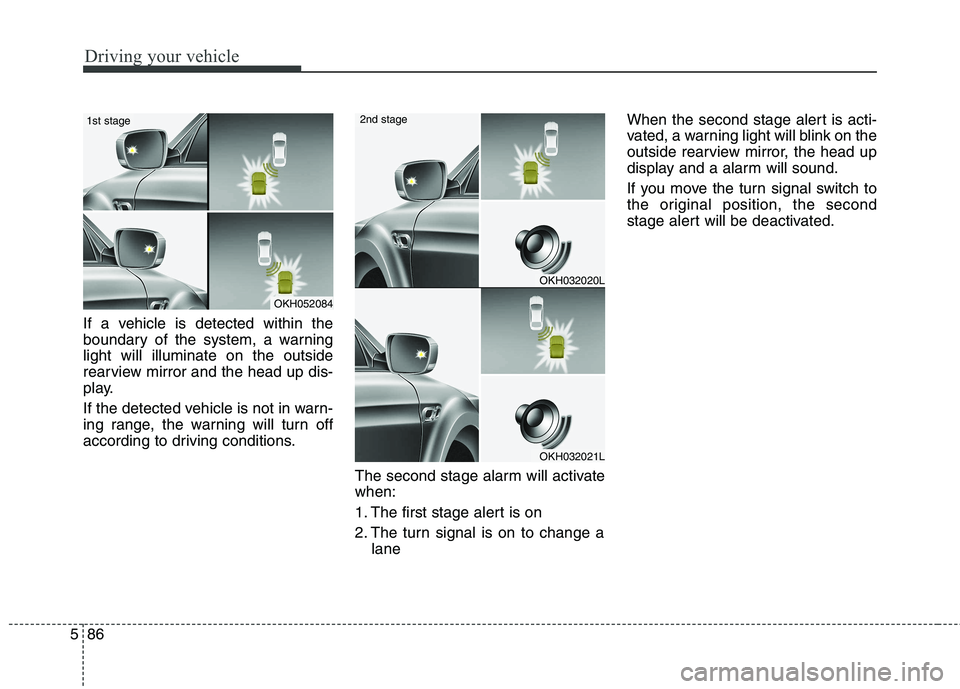
If a vehicle is detected within the
boundary of the system, a warninglight will illuminate on the outside
rearview mirror and the head up dis-
play.
If the detected vehicle is not in warn-
ing range, the warning will turn off
according to driving conditions.
The second stage alarm will activatewhen:
1. The first stage alert is on
2. The turn signal is on to change alane When the second stage alert is acti-
vated, a warning light will blink on the
outside rearview mirror, the head up
display and a alarm will sound.
If you move the turn signal switch to
the original position, the second
stage alert will be deactivated.
OKH052084
1st stage
OKH032020L
OKH032021L
2nd stage
Page 333 of 486
589
Driving your vehicle
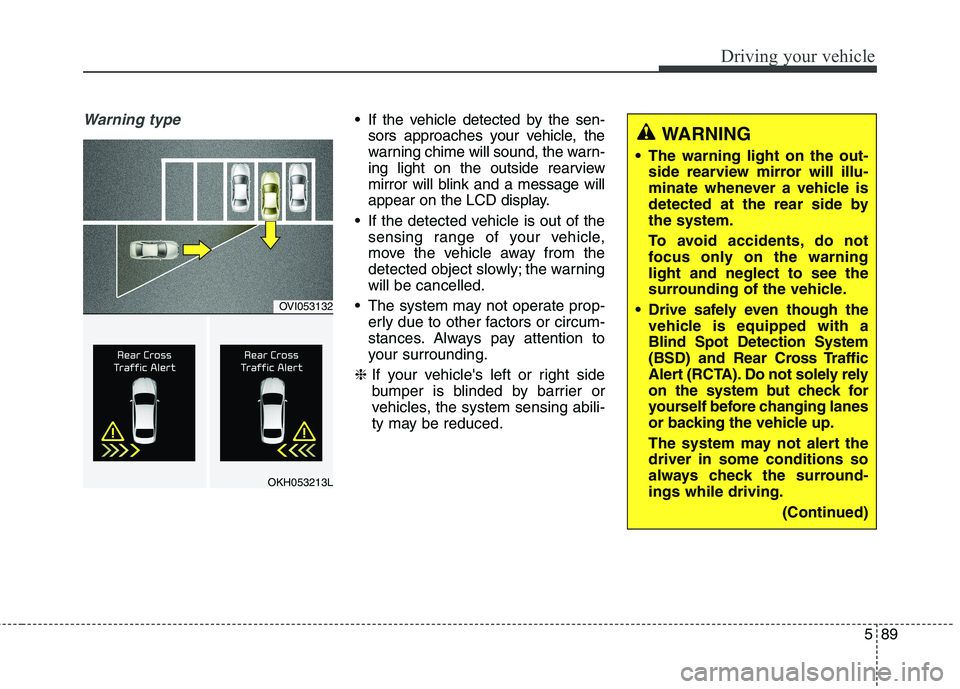
Warning type If the vehicle detected by the sen-sors approaches your vehicle, the
warning chime will sound, the warn-
ing light on the outside rearview
mirror will blink and a message will
appear on the LCD display.
If the detected vehicle is out of the sensing range of your vehicle,
move the vehicle away from the
detected object slowly; the warningwill be cancelled.
The system may not operate prop- erly due to other factors or circum-
stances. Always pay attention to
your surrounding.
❈ If your vehicle's left or right side
bumper is blinded by barrier or
vehicles, the system sensing abili-
ty may be reduced.
WARNING
The warning light on the out- side rearview mirror will illu-
minate whenever a vehicle is
detected at the rear side bythe system.
To avoid accidents, do not
focus only on the warninglight and neglect to see the
surrounding of the vehicle.
Drive safely even though the vehicle is equipped with aBlind Spot Detection System
(BSD) and Rear Cross Traffic
Alert (RCTA). Do not solely rely
on the system but check for
yourself before changing lanes
or backing the vehicle up.
The system may not alert the driver in some conditions so
always check the surround-ings while driving.
(Continued)
OVI053132
OKH053213L
Page 335 of 486
591
Driving your vehicle
- Metal substances are near thevehicles such as in a construction area.
- A big vehicle is near such as a bus or truck.
- A motorcycle or bicycle is near.
- A flat trailer like vehicle is near.
- If the vehicle has started at the same time as the vehicle next to it
and has accelerated.
- When the other vehicle passes by very fast.
- When changing lanes.
- When going down or up a steep road where the height of the lane is
different.
- When the other vehicle drives at the rear very nearby or drives very
close.
- When a trailer or carrier is installed.
- When the temperature of the rear bumper is high.
- When the sensors are covered by the vehicle, wall or a pillar of park- ing lot. - When your vehicle is backing up, if
the detected vehicle approaches
your vehicle or also backs up.
- Small objects like shopping carts and baby carriages.
- If there is a vehicle with decreased ride height (lowered).
- When the vehicle is close to anoth- er vehicle.
- When the vehicle in the next lane moves two lanes away from my
vehicle OR when the vehicle two
lanes away moves to the next lane
from my vehicle.Outside rearview mirror may not
alert the driver when:
- The outside rearview mirror hous- ing is damaged or covered with
debris.
- The window is covered with debris.
- The windows are severely tinted.
Page 340 of 486
Driving your vehicle
96
5
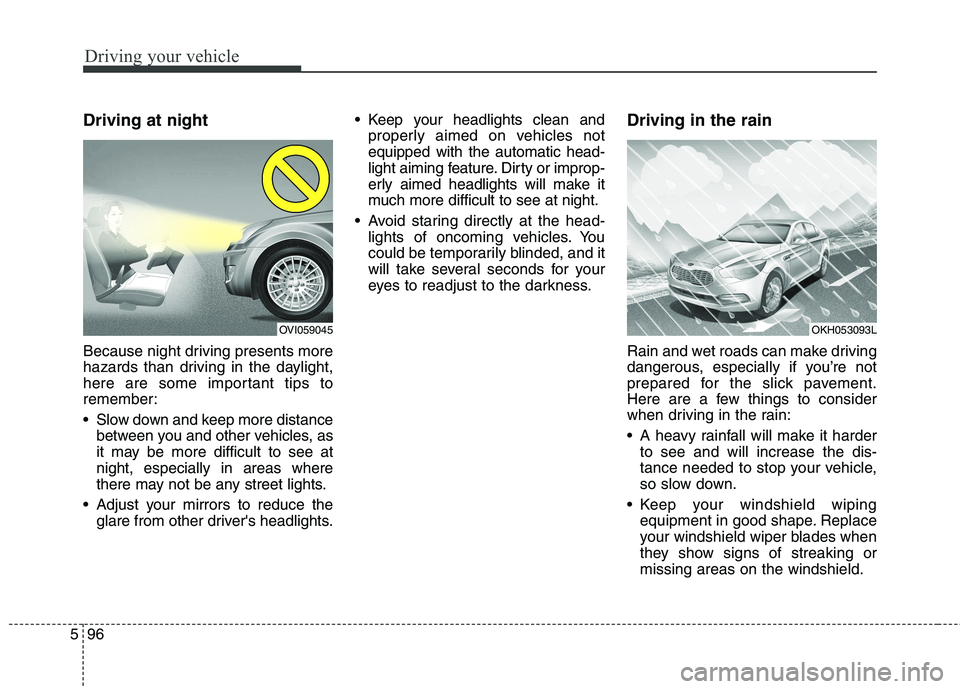
Driving at night
Because night driving presents more
hazards than driving in the daylight,
here are some important tips to
remember:
Slow down and keep more distance
between you and other vehicles, as
it may be more difficult to see atnight, especially in areas where
there may not be any street lights.
Adjust your mirrors to reduce the glare from other driver's headlights. Keep your headlights clean and
properly aimed on vehicles notequipped with the automatic head-
light aiming feature. Dirty or improp-
erly aimed headlights will make it
much more difficult to see at night.
Avoid staring directly at the head- lights of oncoming vehicles. You
could be temporarily blinded, and it
will take several seconds for your
eyes to readjust to the darkness. Driving in the rain
Rain and wet roads can make driving
dangerous, especially if you’re not
prepared for the slick pavement.
Here are a few things to consider
when driving in the rain:
A heavy rainfall will make it harder
to see and will increase the dis-
tance needed to stop your vehicle,
so slow down.
Keep your windshield wiping equipment in good shape. Replace
your windshield wiper blades when
they show signs of streaking ormissing areas on the windshield.
OKH053093LOVI059045
Page 437 of 486
Maintenance
60
7
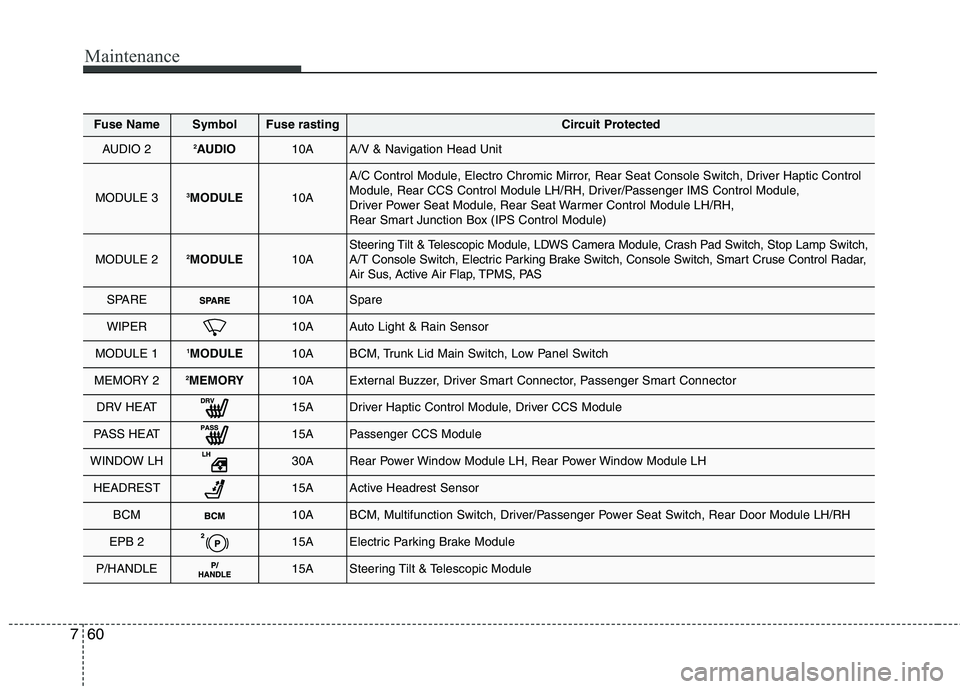
Fuse NameSymbolFuse rastingCircuit Protected
AUDIO 22
AUDIO10AA/V & Navigation Head Unit
MODULE 33MODULE10A
A/C Control Module, Electro Chromic Mirror, Rear Seat Console Switch, Driver Haptic Control
Module, Rear CCS Control Module LH/RH, Driver/Passenger IMS Control Module,
Driver Power Seat Module, Rear Seat Warmer Control Module LH/RH,
Rear Smart Junction Box (IPS Control Module)
MODULE 22MODULE10ASteering Tilt & Telescopic Module, LDWS Camera Module, Crash Pad Switch, Stop Lamp Switch,
A/T Console Switch, Electric Parking Brake Switch, Console Switch, Smart Cruse Control Radar,
Air Sus, Active Air Flap, TPMS, PAS
SPARE10ASpare
WIPER10AAuto Light & Rain Sensor
MODULE 11MODULE10ABCM, Trunk Lid Main Switch, Low Panel Switch
MEMORY 22 MEMORY10AExternal Buzzer, Driver Smart Connector, Passenger Smart Connector
DRV HEAT15ADriver Haptic Control Module, Driver CCS Module
PASS HEAT15APassenger CCS Module
WINDOW LH30ARear Power Window Module LH, Rear Power Window Module LH
HEADREST15AActive Headrest Sensor
BCM10ABCM, Multifunction Switch, Driver/Passenger Power Seat Switch, Rear Door Module LH/RH
EPB 215AElectric Parking Brake Module
P/HANDLE15ASteering Tilt & Telescopic Module