seats KIA QUORIS 2017 User Guide
[x] Cancel search | Manufacturer: KIA, Model Year: 2017, Model line: QUORIS, Model: KIA QUORIS 2017Pages: 514, PDF Size: 35.2 MB
Page 56 of 514
339
Safety features of your vehicle
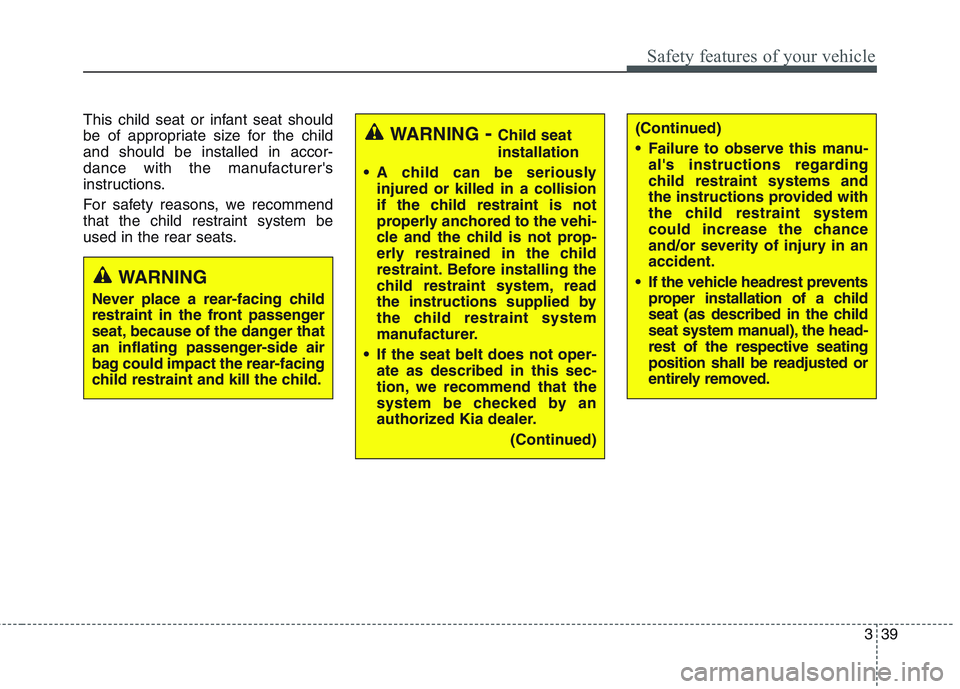
This child seat or infant seat should
be of appropriate size for the childand should be installed in accor-
dance with the manufacturer's
instructions.
For safety reasons, we recommend
that the child restraint system be
used in the rear seats.
WARNING
Never place a rear-facing child
restraint in the front passenger
seat, because of the danger that
an inflating passenger-side air
bag could impact the rear-facing
child restraint and kill the child.
WARNING - Child seat installation
A child can be seriously injured or killed in a collision
if the child restraint is not
properly anchored to the vehi-
cle and the child is not prop-
erly restrained in the child
restraint. Before installing the
child restraint system, read
the instructions supplied by
the child restraint system
manufacturer.
If the seat belt does not oper- ate as described in this sec-
tion, we recommend that the
system be checked by an
authorized Kia dealer.
(Continued)(Continued)
Failure to observe this manu-al's instructions regarding
child restraint systems and
the instructions provided with
the child restraint system
could increase the chance
and/or severity of injury in anaccident.
If the vehicle headrest prevents proper installation of a child
seat (as described in the child
seat system manual), the head-rest of the respective seatingposition shall be readjusted or
entirely removed.
Page 57 of 514

Safety features of your vehicle
40
3
Installing a child restraint system
by lap belt (on the center rear seat) (if equipped)
To install a child restraint system on
the center rear seats, do the following:
1. Place the child restraint system on the center rear seat.
2. Extend the latch plate tongue of the lap belt.
3. Route the lap belt through the restraint according to the seat
manufacturer’s instructions. 4. Buckle the seat belt and adjust the
lap belt for a snug hold on the child
restraint by pulling on the loose
end of the belt. After installation of
the child restraint system, try to
move it in all directions to be sure
the child restraint system issecurely installed.
Installing a child restraint system
by lap/shoulder belt
To install a child restraint system on
the outboard or center rear seats, do
the following:
1. Place the child restraint system in the seat and route the lap/shoul- der belt around or through the
restraint, following the restraint
manufacturer’s instructions. Be
sure the seat belt webbing is nottwisted.1GHA2260/HE2MS103005
Page 59 of 514

Safety features of your vehicle
42
3
Child seat restraint suitability for seat position using the seat belt - For Europe
Use child safety seats that have been officially approved and are appropriate for your children. When using the child
safety seats, refer to the following table.
U* : Suitable for "universal" category restraints approved for use in this mass group only for height adjustable seat and when s eat
position is rearmost highest.
U : Suitable for "universal" category restraints approved for use in this mass group.
UF : Suitable for forward-facing "universal" category restraints approved for use in this mass group
X : Seat position not suitable for children in this mass group.
Mass GroupSeating Position
Front PassengerRear OutboardRear Centre
0 : UP to10 kg (0-9 months)U*UX
0 + : UP to 13 kg
(0 - 2 years)U*UX
I : 9 to 18 kg
(9 months - 4 years)U*UX
II & III : 15 to 36 kg
(4 - 12 years)U*UX
Page 60 of 514

343
Safety features of your vehicle
Securing a child restraint seatwith “Tether Anchor” system
Child restraint hook holders are
located on the package tray. 1. Route the child restraint seat strap
over the seatback.
For vehicles with adjustable head-
rest, route the tether strap under
the headrest and between the
headrest posts, otherwise route
the tether strap over the top of the
seatback. In case of interference
between the child restraint seat
and the headrest remove the par-
ticular head restraint for better fit-
ment of the child restraint seat.
2. Connect the tether strap hook to the appropriate child restrainthook holder and tighten to secure
the child restraint seat.
OKH035049
OKH032050
WARNING - Tether strap
Never mount more than one
child restraint to a single tether
or to a single lower anchorage
point. The increased load
caused by multiple seats may
cause the tethers or anchorage
points to break, causing serious
injury or death.
WARNING
A child can be seriously injured or killed in a collision if the
child restraint is not properly
anchored to the car and the
child is not properly restrained
in the child restraint. Always fol-
low the child seat manufactur-
er’s instructions for installation
and use.
Page 61 of 514

Safety features of your vehicle
44
3
Securing a child restraint system
with “ISOFIX” system and “Tether Anchorage” system
ISOFIX is a standardised method of fitting child seats that eliminates theneed to use the standard adult seat
belt to secure the seat in the vehicle.
This enables a much more secure and
positive location with the added bene-
fit of easier and quicker installation. An ISOFIX-seat can only be installed
if it has vehicle-specific approval inaccordance with the requirements ofECE-R44.
WARNING - Child restraint
check
Check that the child restraint
system is secure by pushing
and pulling it in different direc-
tions. Incorrectly fitted child
restraints may swing, twist, tipor separate causing death or
serious injury.WARNING - Child restraint
anchorage
Child restraint anchorages are designed to withstand only
those loads imposed by cor-
rectly fitted child restraints.
Under no circumstances are
they to be used for adult seat
belts or harnesses or for
attaching other items or
equipment to the vehicle.
The tether strap may not work properly if attached some-where other than the correct
tether anchor.
OVI039060
Page 62 of 514

345
Safety features of your vehicle
There is a child restraint symbol
located on the lower portion of each
side of the rear seatbacks. Thesesymbols indicate the position of the
lower anchors for child restraints soequipped. On each side of the rear seat,
between the cushion and backrest,are located a pair of ISOFIX anchor-age points together with a top tethermounting on the shelf behind the
rear seats.During the installation, the seat has
to be engaged at the anchorage-
points in a way you can hear it click-
ing (check by pulling!) and has to be
fixed with the Top Tether-anchor onthe belonging point on the shelf
behind rear seats. The installing and the use of a child- seat has to be done according to the
installing-manual, which is added tothe ISOFIX-seat.WARNING
Install the child restraint seat
fully rearward against the seat-
back with the seatback in a ver-
tical position, not reclined.
WARNING
When using the vehicle's "ISOFIX" system to install a
child restraint system in the
rear seat, all unused vehicle
rear seat belt metal latch
plates or tabs must be latched
securely in their seat belt
buckles and the seat belt web-
bing must be retracted behind
the child restraint to prevent
the child from reaching andtaking hold of unretracted
seat belts. Unlatched metal
latch plates or tabs may allow
the child to reach the unre-
tracted seat belts which mayresult in strangulation and a
serious injury or death to the
child in the child restraint.
Do not place anything around the lower anchors. Also makesure that the seat belt is not
caught in the lower anchors.
OKH032051
ISOFIX Anchor
Position Indicator
ISOFIX Anchor
Page 67 of 514

Safety features of your vehicle
50
3
There are even circumstances
under which contact with the
steering wheel air bag can cause
fatal injuries, especially if the
occupant is positioned exces-
sively close to the steering wheel.Noise and smoke
When the air bags inflate, they make
a loud noise and they leave smoke
and powder in the air inside of the
vehicle. This is normal and is a result
of the ignition of the air bag inflator.
After the air bag inflates, you may
feel substantial discomfort in breath-
ing due to the contact of your chestwith both the seat belt and the air
bag, as well as from breathing the
smoke and powder. Open your
doors and/or windows as soon as
possible after impact in order to
reduce discomfort and prevent
prolonged exposure to the smoke
and powder.
Though the smoke and powder are
non-toxic, they may cause irritation
to the skin (eyes, nose and throat,
etc). If this is the case, wash and
rinse with cold water immediatelyand consult a doctor if the symptom
persists.WARNING
To avoid severe personal injury or death caused by
deploying air bags in a colli-
sion, the driver should sit as
far back from the steering
wheel air bag as possible (at
least 250 mm (10 inches)
away). The front passengers
should always move their
seats as far back as possible
and sit back in their seat.
Air bags inflate instantly in the event of collision, and passen-
gers may be injured by the air
bag expansion force if they are
not in a proper position.
Air bag inflation may cause injuries including facial or
bodily abrasions, injuries
from broken glasses or burns.
Page 69 of 514

Safety features of your vehicle
52
3
Air bag warning light
The purpose of the air bag warning
light in your instrument panel is to
alert you of a potential problem with
your air bag - Supplemental
Restraint System (SRS).
When the Engine Start/Stop button
is turned ON, the warning light
should illuminate for approximately 6
seconds, then go off. Have the system checked if:
The light does not turn on briefly
when you turn the engine start/stop
button to the ON position.
The light stays on after illuminating for approximately 6 seconds.
The light comes on while the vehi- cle is in motion.
The light blinks when the engine start/stop button is in ON position.
W7-147
WARNING
NEVER use a rearward facing child restraint on a seat pro-
tected by an ACTIVE AIR BAG
in front of it, DEATH or SERI-
OUS INJURY to the CHILD can
occur.
Never put a child restraint in the front passenger’s seat. If
the front passenger air bag
inflates, it can cause serious
or fatal injuries.
When children are seated in the rear outboard seats of a
vehicle equipped with side
and/or curtain air bags, be sure
to install the child restraint sys-
tem as far away from the door
side as possible, and securely
lock the child restraint system
in position. Inflation of side
and/or curtain air bags could
cause serious injury or death
to an infant or child.
Page 74 of 514

357
Safety features of your vehicle
The seat belt buckle sensors (if
equipped) determine if the driver and
front passenger's seat belts are fas-
tened. These sensors provide the
ability to control the SRS deploymentbased on whether or not the seat
belts are fastened, and how severe
the impact is.
WARNING
Always use seat belts and child
restraints – every trip, every
time, everyone! Air bags inflate
with considerable force and in
the blink of an eye. Seat belts
help keep occupants in proper
position to obtain maximum
benefit from the air bag. Even
with air bags, improperly andunbelted occupants can be
severely injured when the air
bag inflates. Always follow the
precautions about seat belts, air
bags and occupant safety con-
tained in this manual. (Continued)
(Continued)
To reduce the chance of serious or fatal injuries and receive the
maximum safety benefit from
your restraint system:
Never place a child in anychild or booster seat in the
front seat.
ABC – Always Buckle Children in the back seat. It is
the safest place for children of
any age to ride.
Front and side air bags can injure occupants improperly
positioned in the front seats.
Move your seat as far back as practical from the front air
bags, while still maintaining
control of the vehicle.
You and your passengers should never sit or lean
unnecessarily close to the air
bags. Improperly positioned
drivers and passengers can
be severely injured by inflat-
ing air bags.
(Continued)(Continued)
Never lean against the door orcenter console – always sit in an upright position.
No objects should be placed over or near the air bag mod-ules on the steering wheel,
instrument panel or the front
passenger's panel above the
glove box, because any suchobject could cause harm if the
vehicle is in a crash severe
enough to cause the air bags
to deploy.
Do not tamper with or discon- nect SRS wiring or other com-ponents of the SRS system.
Doing so could result in injury,
due to accidental deployment
of the air bags or by rendering
the SRS inoperative.
If the SRS air bag warning light remains illuminated
while the vehicle is being driv-
en, we recommend that the
system be inspected by an
authorized Kia dealer.
(Continued)
Page 77 of 514

Safety features of your vehicle
60
3
WARNING
The side air bag is supple- mental to the driver’s and the
passengers seat belt systems
and is not a substitute for
them. Therefore your seat
belts must be worn at all times
while the vehicle is in motion.
The air bags deploy only in
certain side impact conditions
severe enough to cause sig-
nificant injury to the vehicleoccupants.
For best protection from the side air bag system and to
avoid being injured by the
deploying side air bag, both
front and all rear (if equipped)seat occupants should sit inan upright position with the
seat belt properly fastened.The driver's hands should beplaced on the steering wheelat the 9:00 and 3:00 positions.
The passenger’ arms andhands should be placed ontheir laps.
(Continued)(Continued)
Do not use any accessoryseat covers.
Use of seat covers could reduce or prevent the effec- tiveness of the system.
To prevent unexpected deploy- ment of the side air bag that
may result in personal injury,
avoid impact to the sideimpact sensor when the
Engine Start/Stop button is on.
If the seat or seat cover is dam- aged, we recommend that the
system be serviced by an
authorized Kia dealer.WARNING
Do not allow the passengers to lean their heads or bodies onto
doors, put their arms on the
doors, stretch their arms out of
the window, or place objects
between the doors and passen-
gers when they are seated onseats equipped with side and/or
curtain air bags.