seats KIA QUORIS 2017 Owners Manual
[x] Cancel search | Manufacturer: KIA, Model Year: 2017, Model line: QUORIS, Model: KIA QUORIS 2017Pages: 514, PDF Size: 35.2 MB
Page 18 of 514

Safety features of your vehicle
Seats . . . . . . . . . . . . . . . . . . . . . . . . . . . . . . . . . . . . . 3-2• Front seat adjustment . . . . . . . . . . . . . . . . . . . . . . . . . 3-5
. . . . . . . . . . . . . . . . . . 3-7
. . . . . . . . . . . . . . . . . . . . . . . . . . . . . . . . 3-9
. . . . . . . . . . . . . . . . . . . . . . . . . 3-14
. . . . . . . . . . . . . . . . . . . . . . . . . . . . . . . . 3-19
Seat belts . . . . . . . . . . . . . . . . . . . . . . . . . . . . . . . . . 3-22 . . . . . . . . . . . . . . . . . . . . . . 3-22
. . . . . . . . . . . . . . . . . . . . . . . . 3-29
. . . . . . . . . . . . . . . . . . . . . . 3-31
. . . . . . . . . . . . . . . . . . . . . . . . . . 3-32
. . . . . . . . . . . . . . . . . . . . . . . . . . . . . 3-35
Child restraint system . . . . . . . . . . . . . . . . . . . . . . 3-36 . . . . . . . . . . . . . . . . . . 3-38
Air bag - supplemental restraint system . . . . . . . 3-48 . . . . . . . . . . . . 3-49
. . . . . . . . . . . . . . . . . . . . . . . . . 3-52
. . . . . . . . . . . . . . . . . 3-53
. . . . . . . . . . . 3-56
. . . . . . . . . . . . . . . . . . . . . . . . . . . . . . . . . 3-59
. . . . . . . . . . . . . . . . . . . . . . . . . . . . . . 3-61
. . . . . . . . . . . . . . . . . . . . . . . . . . . . . . . . . . . . 3-68
. . . . . . . . . . . . . . . . . . . 3-69
air bag-equipped vehicle. . . . . . . . . . . . . . . . . . . . . . 3-70 . . . . . . . . . . . . . . . . . . . . . . . . . 3-70
3
Page 19 of 514

Safety features of your vehicle
2
3
Driver’s seat
(1) Forward and rearward (2) Seat cushion length
(3) Seatback angle(4) Headrest height
(5) Driver position memory system*
(6) Lumbar support
Front passenger’s seat
(7) Forward and rearward
(8) Seatback angle(9) Headrest height Rear seat
(10) Forward and rearward
(11) Easy access button*
(12) Front passenger’s seat forward
and rearward*
(13) F ront passenger’s seat back
angle*
(14) Lumbar support
(15) Rear control lock button
(16) Front passenger’s seat walk in button
SEATS
OKH033001L
Page 20 of 514
33
Safety features of your vehicle
(17) Relaxation mode button*(Front passenger's seat andrear seat are operated simulta- neously)
(18) Armrest
*: if equipped
WARNING - Loose objects
Loose objects in the driver’s
foot area could interfere with
the operation of the foot pedals,
possibly causing an accident.
Do not place anything under the
front seats.
WARNING - Driver
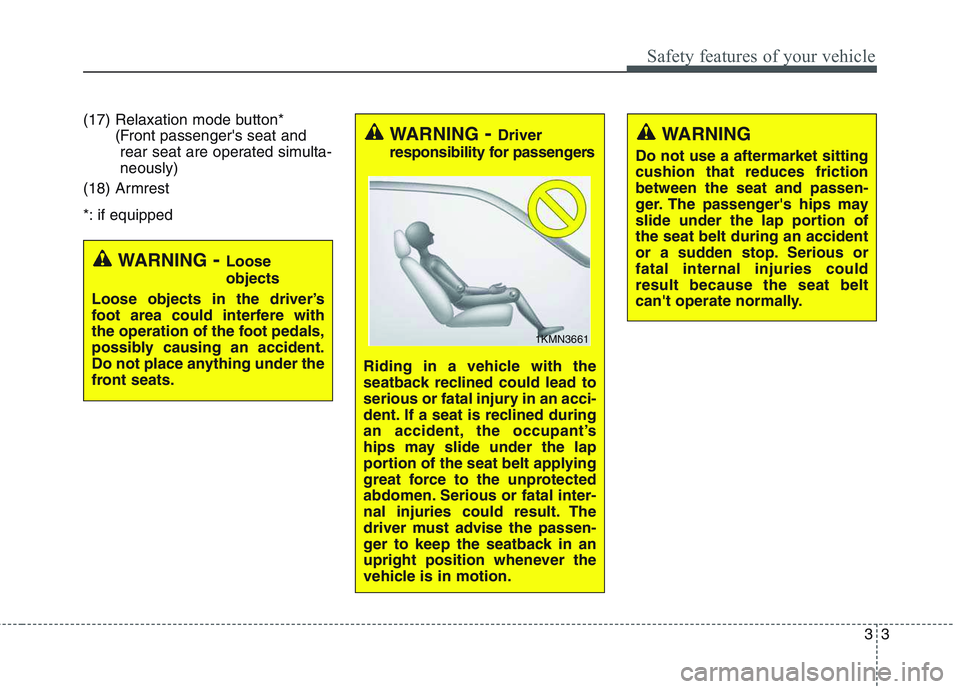
responsibility for passengers
Riding in a vehicle with the
seatback reclined could lead to
serious or fatal injury in an acci-
dent. If a seat is reclined during
an accident, the occupant’s
hips may slide under the lap
portion of the seat belt applying
great force to the unprotected
abdomen. Serious or fatal inter-
nal injuries could result. The
driver must advise the passen-
ger to keep the seatback in an
upright position whenever the
vehicle is in motion.WARNING
Do not use a aftermarket sitting cushion that reduces frictionbetween the seat and passen-
ger. The passenger's hips may
slide under the lap portion ofthe seat belt during an accident
or a sudden stop. Serious orfatal internal injuries couldresult because the seat belt
can't operate normally.
1KMN3661
Page 21 of 514
Safety features of your vehicle
4
3
WARNING
Do not adjust the seat while wearing seat belts. Moving the
seat cushion forward may
cause strong pressure on theabdomen.
Use extreme caution so that hands or other objects are not
caught in the seat mechanisms
while the seat is moving.
Use extreme caution when picking small objects trappedunder the seats or betweenthe seat and the center con-
sole. Your hands might be cut
or injured by the sharp edges
of the seats mechanism.
Do not put a cigarette lighter on the floor or seat. When you
operate the seat, gas maygush out of the lighter and
cause fire.
If there are occupants in the rear seats, be careful while
adjusting the front seat posi-tion.(Continued)
In order to avoid unnecessaryand perhaps severe air bag
injuries, always sit as far back
as possible from the steeringwheel while maintaining com-
fortable control of the vehicle.
We recommend that your chest
be at least 250 mm (10 inches)
away from the steering wheel.WARNING - Driver’s seat
Never attempt to adjust the seat while the vehicle is mov-
ing. This could result in loss
of control, and an accident
causing death, serious injury,
or property damage.
Do not allow anything to inter- fere with the normal position
of the seatback. Storing items
against a seatback or in any
other way interfering with
proper locking of a seatbackcould result in serious or fatal
injury in a sudden stop or col-lision.
Always drive and ride with your seatback upright and the lap
portion of the seat belt snug
and low across the hips. This
is the best position to protect
you in case of an accident.
(Continued)
Page 26 of 514
39
Safety features of your vehicle
Easy access function
The steering wheel will move away
from the driver and the seat will move
rearward, when the engine start/stop
button is turned to the OFF position
and front driver’s door is opened.
The steering wheel will move toward
the driver and the seat will move for-
ward, when the engine start/stop but-
ton is turned to the ACC position or
when you insert the smart key into
the smart key holder with the shift
lever in the P position.
✽✽NOTICE
You can activate or deactivate the
easy access function in the instru-
ment cluster.
If you want detailed informations,
refer to the chapter 4.
Headrest (for front seat)
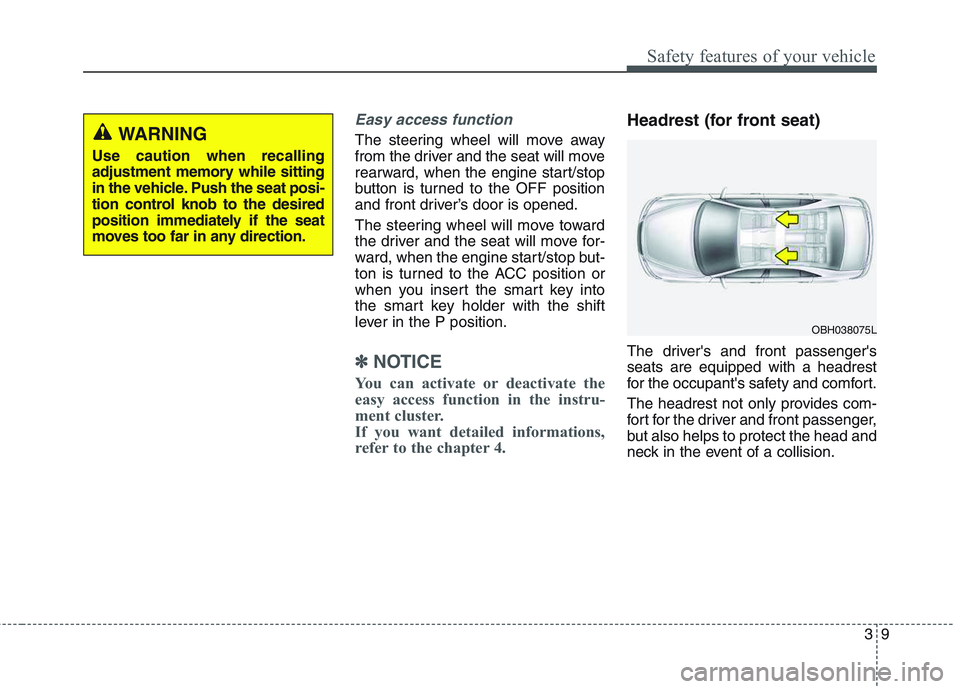
The driver's and front passenger's seats are equipped with a headrest
for the occupant's safety and comfort.
The headrest not only provides com-
fort for the driver and front passenger,
but also helps to protect the head and
neck in the event of a collision.WARNING
Use caution when recalling
adjustment memory while sitting
in the vehicle. Push the seat posi-
tion control knob to the desired
position immediately if the seat
moves too far in any direction.
OBH038075L
Page 33 of 514
Safety features of your vehicle
16
3
Easy access switch (for power seat)
Your vehicle features easy access
system to provide convenient access
for rear passengers. When opening
the rear door, the rear seats will
move rearward automatically to
make passenger get off easily. This
easy access system will operate only
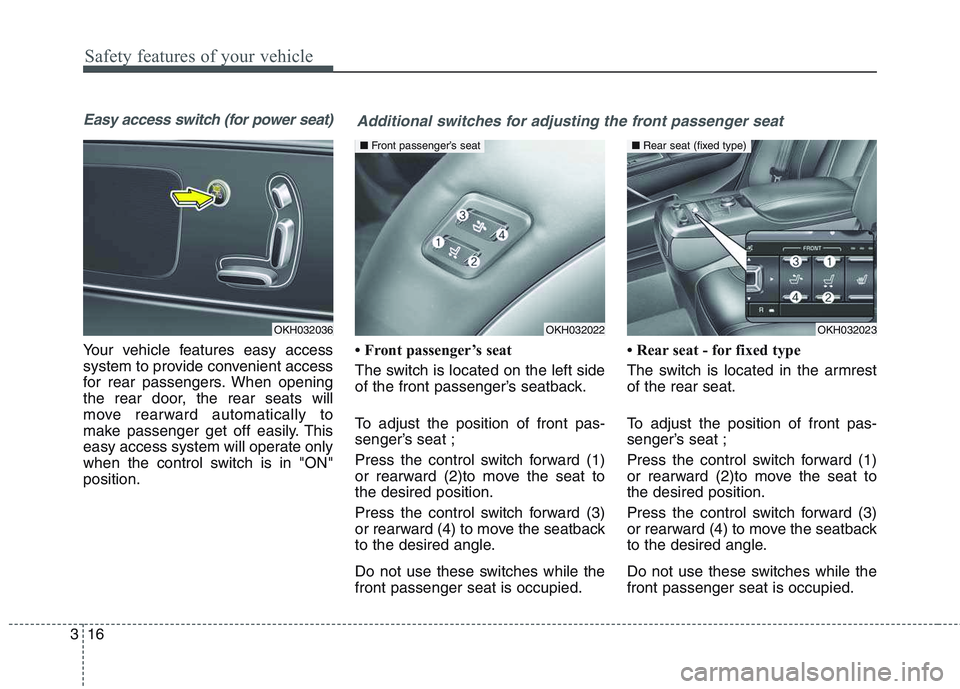
when the control switch is in "ON"position. Front passenger’s seat
The switch is located on the left side
of the front passenger’s seatback.
To adjust the position of front pas-
senger’s seat ;
Press the control switch forward (1)
or rearward (2)to move the seat tothe desired position.
Press the control switch forward (3)
or rearward (4) to move the seatback
to the desired angle.
Do not use these switches while the front passenger seat is occupied. Rear seat - for fixed type
The switch is located in the armrest of the rear seat.
To adjust the position of front pas-
senger’s seat ;
Press the control switch forward (1)
or rearward (2)to move the seat tothe desired position.
Press the control switch forward (3)
or rearward (4) to move the seatback
to the desired angle.
Do not use these switches while the front passenger seat is occupied.
OKH032022
■
Front passenger’s seat
OKH032036OKH032023
■ Rear seat (fixed type)
Additional switches for adjusting the front passenger seat
Page 37 of 514

Safety features of your vehicle
20
3
Adjusting the height up and down
To raise the headrest, pull it up to the
desired position (1). To lower theheadrest, push and hold the release
button (2) on the headrest support
and lower the headrest to the desiredposition (3).
OKH032024
CAUTION
When there is no occupant in
the rear seats, adjust the heightof the headrest to the lowest position. The rear seat headrestcan reduce the visibility of therear area.
WARNING
For maximum effectiveness in case of an accident, the head- rest should be adjusted so the
middle of the headrest is atthe same height of the center
of gravity of an occupant's
head. Generally, the center of
gravity of most people's headis similar with the height of
the top of their eyes. Also
adjust the headrest as close
to your head as possible. Theuse of a cushion that holds
the body away from the seat-
back is not recommended.
Do not operate the vehicle with the headrests removed
as severe injury to an occu-
pant may occur in the event of
an accident. Headrests may
provide protection against
severe neck injuries when
properly adjusted.
WARNING
Do not place or attach the accessories or other things near
the headrest. When the vehicle
stops suddenly or in certain col-
lisions, they could come loose
and injure vehicle occupants.
OKH032092
Page 49 of 514

Safety features of your vehicle
32
3
Seat belt precautionsInfant or small child
You should be aware of the specific
requirements in your country. Child
and/or infant seats must be properlyplaced and installed in the rear seat.
For more information about the use
of these restraints, refer to “Child
restraint system” in this section.
✽✽
NOTICE
Small children are best protected
from injury in an accident when
properly restrained in the rear seat
by a child restraint system that
meets the requirements of the Safety
Standards of your country. Before
buying any child restraint system,
make sure that it has a label certify-
ing that it meets Safety Standards of
your country. The restraint must be
appropriate for your child's height
and weight. Check the label on the
child restraint for this information.
Refer to “Child restraint system” in
this section.
WARNING
All occupants of the vehicle
must wear their seat belts at all
times. Seat belts and childrestraints reduce the risk of
serious or fatal injuries for all
occupants in the event of a col-
lision or sudden stop. Without a
seat belt, occupants could be
shifted too close to a deploying
air bag, strike the interior struc-
ture or be thrown from the vehi-
cle. Properly worn seat belts
greatly reduce these hazards.
Always follow the precautions
about seat belts, air bags andoccupant seating contained in
this manual.
WARNING
Every person in your vehicle
needs to be properly restrained
at all times, including infants
and children. Never hold a child
in your arms or lap when riding
in a vehicle. The violent forcescreated during a crash will tear
the child from your arms and
throw the child against the inte-
rior. Always use a child restraint
appropriate for your child'sheight and weight.
Page 51 of 514

Safety features of your vehicle
34
3
Injured person
A seat belt should be used when an
injured person is being transported.
When this is necessary, you should
consult a physician for recommenda-
tions.
One person per belt
Two people (including children) should
never attempt to use a single seat belt.
This could increase the severity of
injuries in case of an accident.
Do not lie down
To reduce the chance of injuries in
the event of an accident and to
achieve maximum effectiveness of
the restraint system, all passengersshould be sitting up and the front and
rear seats should be in an upright
position when the car is moving. A
seat belt cannot provide proper pro-
tection if the person is lying down inthe rear seat or if the front and rearseats are in a reclined position.WARNING
Riding with a reclined seatback
increases your chance of seri-
ous or fatal injuries in the event
of a collision or sudden stop.
The protection of your restraint
system (seat belts and air bags)
is greatly reduced by reclining
your seat. Seat belts must be
snug against your hips and
chest to work properly. The more
the seatback is reclined, the
greater the chance that an occu-pant's hips will slide under thelap belt causing serious internal
injuries or the occupant's neckcould strike the shoulder belt.
Drivers and passengers should
always sit well back in their
seats, properly belted, and with
the seatbacks upright.
Page 53 of 514

Safety features of your vehicle
36
3
CHILD RESTRAINT SYSTEM
Children riding in the car should sit in
the rear seat and must always be
properly restrained to minimize the
risk of injury in an accident, sudden
stop or sudden maneuver. According
to accident statistics, children are
safer when properly restrained in therear seats than in the front seat.
Larger children not in a child restraintshould use one of the seat belts pro-vided.
You should be aware of the specific
requirements in your country. Child
and/or infant safety seats must be
properly placed and installed in the
rear seat. You must use a commer-
cially available child restraint systemthat meets the requirements of the
Safety Standards of your country.
Child restraint systems are designed
to be secured in vehicle seats by lap
belts or the lap belt portion of a
lap/shoulder belt, or by a tether
anchor and/or ISOFIX anchors. Children could be injured or killed in
a crash if their restraints are not
properly secured. For small children
and babies, a child seat or infant seat
must be used. Before buying a par-
ticular child restraint system, make
sure it fits your car seat and seat
belts, and fits your child. Follow all
the instructions provided by the man-
ufacturer when installing the child
restraint system.
WARNING
A child restraint system must be placed in the rear seat.
Never install a child or infant
seat on the front passenger's
seat. Should an accidentoccur and cause the passen-
ger-side air bag to deploy, it
could severely injure or kill an
infant or child seated in an
infant or child seat. Thus only
use a child restraint in the
rear seat of your vehicle.
A seat belt or child restraint system can become very hot
if it is left in a closed vehicle
on a sunny day, even if theoutside temperature does not
feel hot. Be sure to check the
seat cover and buckles before
placing a child there.
(Continued)