child seat KIA QUORIS 2017 Owners Manual
[x] Cancel search | Manufacturer: KIA, Model Year: 2017, Model line: QUORIS, Model: KIA QUORIS 2017Pages: 514, PDF Size: 35.2 MB
Page 18 of 514

Safety features of your vehicle
Seats . . . . . . . . . . . . . . . . . . . . . . . . . . . . . . . . . . . . . 3-2• Front seat adjustment . . . . . . . . . . . . . . . . . . . . . . . . . 3-5
. . . . . . . . . . . . . . . . . . 3-7
. . . . . . . . . . . . . . . . . . . . . . . . . . . . . . . . 3-9
. . . . . . . . . . . . . . . . . . . . . . . . . 3-14
. . . . . . . . . . . . . . . . . . . . . . . . . . . . . . . . 3-19
Seat belts . . . . . . . . . . . . . . . . . . . . . . . . . . . . . . . . . 3-22 . . . . . . . . . . . . . . . . . . . . . . 3-22
. . . . . . . . . . . . . . . . . . . . . . . . 3-29
. . . . . . . . . . . . . . . . . . . . . . 3-31
. . . . . . . . . . . . . . . . . . . . . . . . . . 3-32
. . . . . . . . . . . . . . . . . . . . . . . . . . . . . 3-35
Child restraint system . . . . . . . . . . . . . . . . . . . . . . 3-36 . . . . . . . . . . . . . . . . . . 3-38
Air bag - supplemental restraint system . . . . . . . 3-48 . . . . . . . . . . . . 3-49
. . . . . . . . . . . . . . . . . . . . . . . . . 3-52
. . . . . . . . . . . . . . . . . 3-53
. . . . . . . . . . . 3-56
. . . . . . . . . . . . . . . . . . . . . . . . . . . . . . . . . 3-59
. . . . . . . . . . . . . . . . . . . . . . . . . . . . . . 3-61
. . . . . . . . . . . . . . . . . . . . . . . . . . . . . . . . . . . . 3-68
. . . . . . . . . . . . . . . . . . . 3-69
air bag-equipped vehicle. . . . . . . . . . . . . . . . . . . . . . 3-70 . . . . . . . . . . . . . . . . . . . . . . . . . 3-70
3
Page 22 of 514
35
Safety features of your vehicle
Front seat adjustment
The front seat can be adjusted by
using the control switch located on
the doors. Before driving, adjust theseat to the proper position so as to
easily control the steering wheel,
pedals and switches on the instru-ment panel.Forward and backward
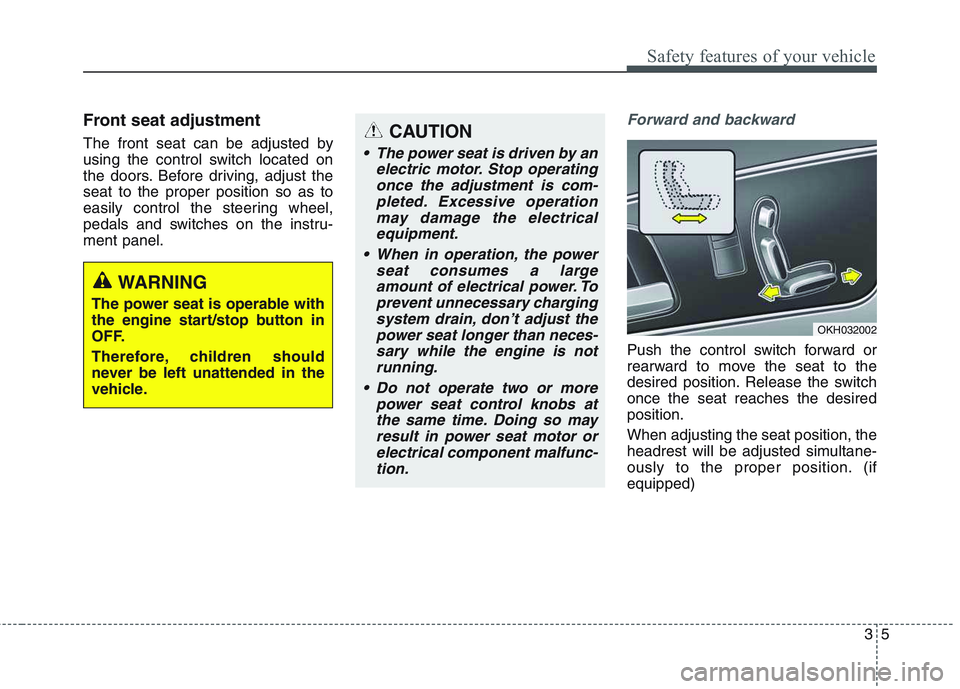
Push the control switch forward or
rearward to move the seat to the
desired position. Release the switchonce the seat reaches the desiredposition. When adjusting the seat position, the
headrest will be adjusted simultane-
ously to the proper position. (ifequipped)
CAUTION
The power seat is driven by anelectric motor. Stop operatingonce the adjustment is com- pleted. Excessive operationmay damage the electricalequipment.
When in operation, the power seat consumes a largeamount of electrical power. Toprevent unnecessary chargingsystem drain, don’t adjust the power seat longer than neces-sary while the engine is notrunning.
Do not operate two or more power seat control knobs atthe same time. Doing so mayresult in power seat motor orelectrical component malfunc- tion.
WARNING
The power seat is operable with
the engine start/stop button in
OFF.
Therefore, children should
never be left unattended in the
vehicle.
OKH032002
Page 31 of 514
Safety features of your vehicle
14
3
Electronic active headrest
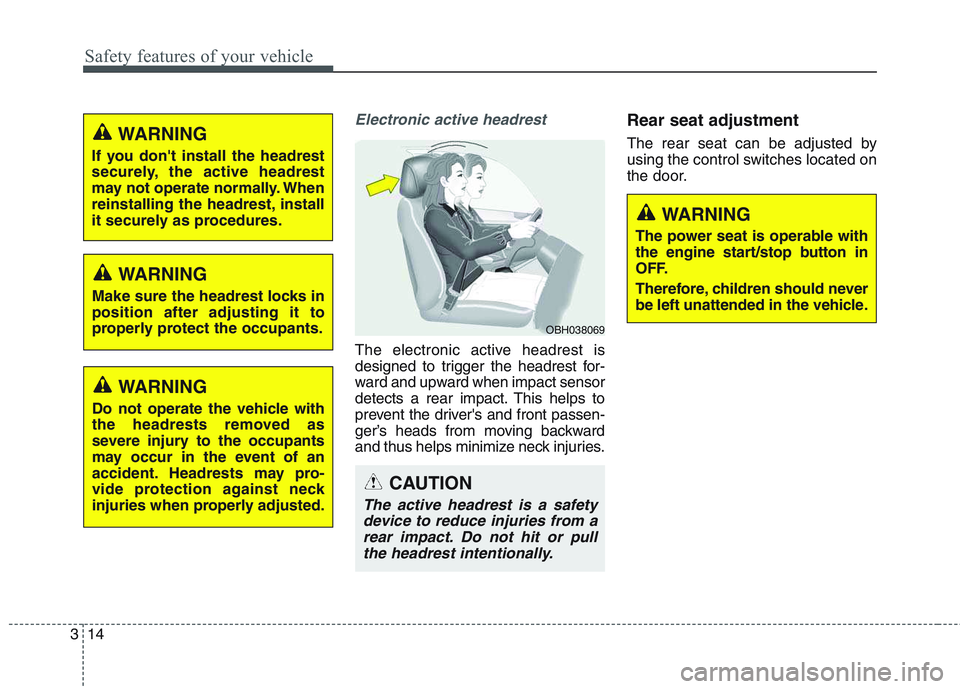
The electronic active headrest is
designed to trigger the headrest for-
ward and upward when impact sensor
detects a rear impact. This helps to
prevent the driver's and front passen-
ger’s heads from moving backward
and thus helps minimize neck injuries. Rear seat adjustment
The rear seat can be adjusted by
using the control switches located on
the door.
WARNING
If you don't install the headrest
securely, the active headrest
may not operate normally. When
reinstalling the headrest, install
it securely as procedures.
OBH038069
WARNING
Do not operate the vehicle with
the headrests removed as
severe injury to the occupants
may occur in the event of an
accident. Headrests may pro-
vide protection against neck
injuries when properly adjusted.
WARNING
Make sure the headrest locks in position after adjusting it to
properly protect the occupants.
CAUTION
The active headrest is a safety device to reduce injuries from arear impact. Do not hit or pull the headrest intentionally.
WARNING
The power seat is operable with
the engine start/stop button in
OFF.
Therefore, children should never
be left unattended in the vehicle.
Page 32 of 514

315
Safety features of your vehicle
Forward, backward and seatbackangle (for power seat)
Push the control switch forward or
backward to move the seat to the
desired position. Release the switchonce the seat reaches the desiredposition.
WARNING
Use extreme caution so that hands or other objects are not
caught in the seat mechanisms
while the seat is moving. Do not adjust the seat while
wearing seat belts. Moving the
seat cushion forward may
cause strong pressure on theabdomen.
WARNING
Do not operate the rear power
seat while the child seat isinstalled.
CAUTION
The power seat is driven by an electric motor. Stop operatingonce the adjustment is com-pleted. Excessive operationmay damage the electrical equipment.
When in operation, the power seat consumes a large amountof electrical power. To preventunnecessary charging system drain, don’t adjust the powerseat longer than necessarywhile the engine is not running.
Do not operate two or more power seat control switches atthe same time. Doing so mayresult in power seat motor orelectrical component malfunc- tion.
OKH032035
Page 39 of 514
Safety features of your vehicle
22
3
Seat belt restraint system SEAT BELTS
WARNING
For maximum restraint sys- tem protection, the seat belts
must always be used whenev-
er the car is moving.
Seat belts are most effective when seatbacks are in theupright position.
Children age 12 and under must always be properlyrestrained in the rear seat.
Never allow children to ride in
the front passenger seat. If a
child over 12 must be seated
in the front seat, he/she must
be properly belted and the
seat should be moved as far
back as possible.
(Continued)
WARNING
Seat belts are designed to bear
upon the bony structure of the
body, and should be worn low
across the front of the pelvis or
the pelvis, chest and shoulders,
as applicable; wearing the lap
section of the belt across the
abdominal area must be avoided. Seat belts should be adjusted
as firmly as possible, consis-
tent with comfort, to provide the
protection for which they havebeen designed.
A slack belt will greatly reduce
the protection afforded to the
wearer.
(Continued)(Continued)
Never wear the shoulder beltunder your arm or behind
your back. An improperlypositioned shoulder belt cancause serious injuries in a
crash. The shoulder belt
should be positioned midway
over your shoulder across
your collarbone.
Never wear a seat belt over fragile objects. If there is a
sudden stop or impact, the
seat belt can damage it.
Avoid wearing twisted seat belts. A twisted belt can't do
its job as well. In a collision, it
could even cut into you. Besure the belt webbing isstraight and not twisted.
Be careful not to damage the belt webbing or hardware. If
the belt webbing or hardware
is damaged, replace it.
Page 40 of 514

323
Safety features of your vehicle
WARNING
No modifications or additions should be made by the user
which will either prevent the
seat belt adjusting devices
from operating to remove
slack, or prevent the seat belt
assembly from being adjusted
to remove slack.
When you fasten the seat belt, be careful not to latch the seat
belt in buckles of other seat. It's
very dangerous and you may
not be protected by the seat
belt properly.
Do not unfasten the seat belt and do not fasten and unfas-
ten the seat belt repeatedly
while driving. This could
result in loss of control, andan accident causing death,
serious injury, or property
damage.
(Continued)(Continued)
When fastening the seat belt,make sure that the seat belt
does not pass over objects that
are hard or can break easily.
Make sure there is nothing in the buckle. The seat belt may
not be fastened securely.(Continued)
Care should be taken to avoid contamination of the webbing
with polishes, oils and chemi-
cals, and particularly battery
acid. Cleaning may safely becarried out using mild soap and
water. The belt should bereplaced if webbing becomes
frayed, contaminated or dam-
aged. It is essential to replace
the entire assembly after it has
been worn in a severe impact
even if damage to the assembly
is not obvious. Belts should not
be worn with straps twisted.
Each belt assembly must only
be used by one occupant; it is
dangerous to put a belt around
a child being carried on theoccupant's lap.
Page 49 of 514

Safety features of your vehicle
32
3
Seat belt precautionsInfant or small child
You should be aware of the specific
requirements in your country. Child
and/or infant seats must be properlyplaced and installed in the rear seat.
For more information about the use
of these restraints, refer to “Child
restraint system” in this section.
✽✽
NOTICE
Small children are best protected
from injury in an accident when
properly restrained in the rear seat
by a child restraint system that
meets the requirements of the Safety
Standards of your country. Before
buying any child restraint system,
make sure that it has a label certify-
ing that it meets Safety Standards of
your country. The restraint must be
appropriate for your child's height
and weight. Check the label on the
child restraint for this information.
Refer to “Child restraint system” in
this section.
WARNING
All occupants of the vehicle
must wear their seat belts at all
times. Seat belts and childrestraints reduce the risk of
serious or fatal injuries for all
occupants in the event of a col-
lision or sudden stop. Without a
seat belt, occupants could be
shifted too close to a deploying
air bag, strike the interior struc-
ture or be thrown from the vehi-
cle. Properly worn seat belts
greatly reduce these hazards.
Always follow the precautions
about seat belts, air bags andoccupant seating contained in
this manual.
WARNING
Every person in your vehicle
needs to be properly restrained
at all times, including infants
and children. Never hold a child
in your arms or lap when riding
in a vehicle. The violent forcescreated during a crash will tear
the child from your arms and
throw the child against the inte-
rior. Always use a child restraint
appropriate for your child'sheight and weight.
Page 50 of 514

333
Safety features of your vehicle
Larger children
Children who are too large for child
restraint systems should always
occupy the rear seat and use the
available lap/shoulder belts. The lap
portion should be fastened and
snugged on the hips and as low as
possible. Check periodically if belt
fits. A child's squirming could put the
belt out of position. Children are given
the most safety in the event of an
accident when they are restrained by
a proper restraint system in the rear
seat. If a larger child (over age 12)
must be seated in the front seat, the
child should be securely restrained
by the available lap/shoulder belt andthe seat should be placed in the rear-
most position. Children age 12 and
under should be restrained securely
in the rear seat. NEVER place a childage 12 and under in the front seat.
NEVER place a rear facing child seat
in the front seat of a vehicle.If the shoulder belt portion slightly
touches the child’s neck or face, tryplacing the child closer to the center of
the vehicle. If the shoulder belt still
touches their face or neck they need to
be returned to a child restraint system.
Restraint of pregnant women
Pregnant women should wear
lap/shoulder belt assemblies when-
ever possible according to specific
recommendations by their doctors.
The lap portion of the belt should be
worn AS SNUGLY AND LOW AS
POSSIBLE on the hips, not a crossthe abdomen.
WARNING
- Shoulder
belts on small children
Never allow a shoulder belt to be in contact with a child’s
neck or face while the vehicleis in motion.
If seat belts are not properly worn and adjusted on chil-
dren, there is a risk of death or
serious injury.
WARNING - Pregnant
women
Pregnant women must never
place the lap portion of the
safety belt over the area of the
abdomen where the fetus is
located or above the abdomenwhere the belt could crush the
fetus during an impact.
Page 51 of 514

Safety features of your vehicle
34
3
Injured person
A seat belt should be used when an
injured person is being transported.
When this is necessary, you should
consult a physician for recommenda-
tions.
One person per belt
Two people (including children) should
never attempt to use a single seat belt.
This could increase the severity of
injuries in case of an accident.
Do not lie down
To reduce the chance of injuries in
the event of an accident and to
achieve maximum effectiveness of
the restraint system, all passengersshould be sitting up and the front and
rear seats should be in an upright
position when the car is moving. A
seat belt cannot provide proper pro-
tection if the person is lying down inthe rear seat or if the front and rearseats are in a reclined position.WARNING
Riding with a reclined seatback
increases your chance of seri-
ous or fatal injuries in the event
of a collision or sudden stop.
The protection of your restraint
system (seat belts and air bags)
is greatly reduced by reclining
your seat. Seat belts must be
snug against your hips and
chest to work properly. The more
the seatback is reclined, the
greater the chance that an occu-pant's hips will slide under thelap belt causing serious internal
injuries or the occupant's neckcould strike the shoulder belt.
Drivers and passengers should
always sit well back in their
seats, properly belted, and with
the seatbacks upright.
Page 53 of 514

Safety features of your vehicle
36
3
CHILD RESTRAINT SYSTEM
Children riding in the car should sit in
the rear seat and must always be
properly restrained to minimize the
risk of injury in an accident, sudden
stop or sudden maneuver. According
to accident statistics, children are
safer when properly restrained in therear seats than in the front seat.
Larger children not in a child restraintshould use one of the seat belts pro-vided.
You should be aware of the specific
requirements in your country. Child
and/or infant safety seats must be
properly placed and installed in the
rear seat. You must use a commer-
cially available child restraint systemthat meets the requirements of the
Safety Standards of your country.
Child restraint systems are designed
to be secured in vehicle seats by lap
belts or the lap belt portion of a
lap/shoulder belt, or by a tether
anchor and/or ISOFIX anchors. Children could be injured or killed in
a crash if their restraints are not
properly secured. For small children
and babies, a child seat or infant seat
must be used. Before buying a par-
ticular child restraint system, make
sure it fits your car seat and seat
belts, and fits your child. Follow all
the instructions provided by the man-
ufacturer when installing the child
restraint system.
WARNING
A child restraint system must be placed in the rear seat.
Never install a child or infant
seat on the front passenger's
seat. Should an accidentoccur and cause the passen-
ger-side air bag to deploy, it
could severely injure or kill an
infant or child seated in an
infant or child seat. Thus only
use a child restraint in the
rear seat of your vehicle.
A seat belt or child restraint system can become very hot
if it is left in a closed vehicle
on a sunny day, even if theoutside temperature does not
feel hot. Be sure to check the
seat cover and buckles before
placing a child there.
(Continued)