height KIA QUORIS 2017 Owners Manual
[x] Cancel search | Manufacturer: KIA, Model Year: 2017, Model line: QUORIS, Model: KIA QUORIS 2017Pages: 514, PDF Size: 35.2 MB
Page 14 of 514
25
Your vehicle at a glance
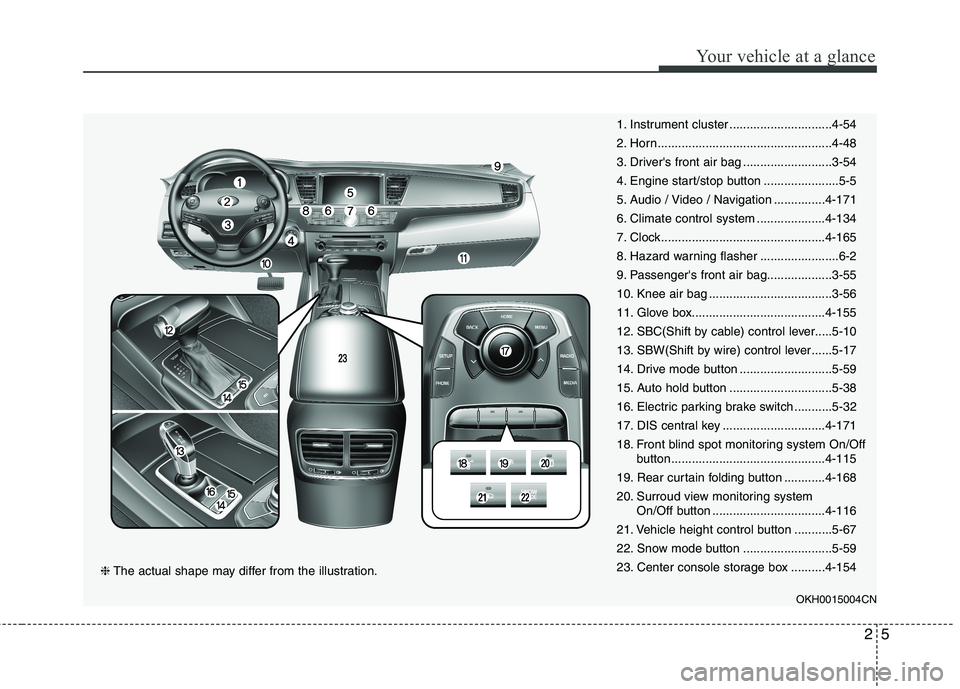
1. Instrument cluster ..............................4-54
2. Horn...................................................4-48
3. Driver's front air bag ..........................3-54
4. Engine start/stop button ......................5-5
5. Audio / Video / Navigation ...............4-171
6. Climate control system ....................4-134
7. Clock................................................4-165
8. Hazard warning flasher .......................6-2
9. Passenger's front air bag...................3-55
10. Knee air bag ....................................3-56
11. Glove box.......................................4-155
12. SBC(Shift by cable) control lever.....5-10
13. SBW(Shift by wire) control lever......5-17
14. Drive mode button ...........................5-59
15. Auto hold button ..............................5-38
16. Electric parking brake switch ...........5-32
17. DIS central key ..............................4-171
18. Front blind spot monitoring system On/Offbutton.............................................4-115
19. Rear curtain folding button ............4-168
20. Surroud view monitoring system On/Off button .................................4-116
21. Vehicle height control button ...........5-67
22. Snow mode button ..........................5-59
23. Center console storage box ..........4-154
OKH0015004CN
❈The actual shape may differ from the illustration.
Page 19 of 514

Safety features of your vehicle
2
3
Driver’s seat
(1) Forward and rearward (2) Seat cushion length
(3) Seatback angle(4) Headrest height
(5) Driver position memory system*
(6) Lumbar support
Front passenger’s seat
(7) Forward and rearward
(8) Seatback angle(9) Headrest height Rear seat
(10) Forward and rearward
(11) Easy access button*
(12) Front passenger’s seat forward
and rearward*
(13) F ront passenger’s seat back
angle*
(14) Lumbar support
(15) Rear control lock button
(16) Front passenger’s seat walk in button
SEATS
OKH033001L
Page 23 of 514

Safety features of your vehicle
6
3
Cushion length adjustment
(for driver’s seat)
Push the control switch forward or
backward to move the seat cushion
to the desired length. Release the
switch once the seat cushion reach-es the desired length.
Seatback angle
Push the upper part of the control
switch forward or backward to move
the seatback to the desired angle.
Release the switch once the seatreaches the desired position.
Seat cushion height (if equipped)
Push the front portion of the control
switch up to raise or down to lower
the front part of the seat cushion.
Push the rear portion of the control
switch up to raise or down to lowerthe height of the seat cushion.
Release the switch once the seatreaches the desired position.
OKH033006CNOKH032005OKH032004
Page 27 of 514
Safety features of your vehicle
10
3
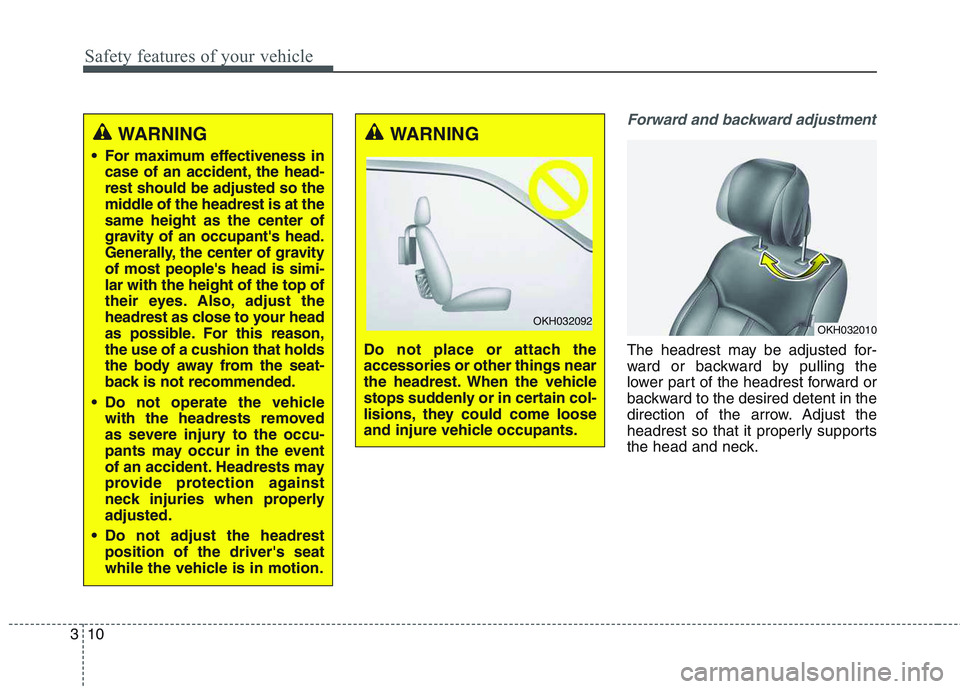
Forward and backward adjustment
The headrest may be adjusted for-
ward or backward by pulling the
lower part of the headrest forward or
backward to the desired detent in the
direction of the arrow. Adjust the
headrest so that it properly supports
the head and neck.
WARNING
For maximum effectiveness in case of an accident, the head- rest should be adjusted so the
middle of the headrest is at thesame height as the center of
gravity of an occupant's head.
Generally, the center of gravityof most people's head is simi-lar with the height of the top of
their eyes. Also, adjust the
headrest as close to your head
as possible. For this reason,the use of a cushion that holds
the body away from the seat-
back is not recommended.
Do not operate the vehicle with the headrests removed
as severe injury to the occu-
pants may occur in the event
of an accident. Headrests may
provide protection against
neck injuries when properlyadjusted.
Do not adjust the headrest position of the driver's seat
while the vehicle is in motion.WARNING
Do not place or attach the accessories or other things near
the headrest. When the vehicle
stops suddenly or in certain col-
lisions, they could come loose
and injure vehicle occupants.
OKH032092OKH032010
Page 28 of 514

311
Safety features of your vehicle
Adjusting the height up and down
For manual type
To raise the headrest, pull it up to the
desired position (1). To lower theheadrest, push and hold the release
button (2) on the headrest support
and lower the headrest to the desiredposition (3).For power type
Push the control switch up to raise or
down to lower the headrest. Release
the switch once the headrest reach-es the desired position.
OKH032008CAUTION
If you recline the seatback
towards the front with the head-rest and seat cushion raised, the headrest may come in con-tact with the sunvisor or otherparts of the vehicle.
OYFH034205OKH032011
Page 30 of 514

313
Safety features of your vehicle
Installation
1. Recline the seatback (2) with therecliner control switch (1). For manual type
2. Put the headrest poles (3) into the
holes while pressing the release
button (4).
3. Recline the seatback (6) with the recliner control switch (5).
4. Adjust the headrest to the appro- priate height. For power type
2. Raise it as far as it can go by
pulling the switch up (3).
3. Put the headrest poles (4) into the holes and then pull the switch
down (5) until the headrest moves
to the lowest position.
4. To install the headrest securely, move the headrest up and down 2
or 3 times by pulling the switch up
and down.
5. Recline the seatback (7) with the recliner control switch (6).
6. Adjust the headrest to the appro- priate height.
OKH033101
OKH033100
OKH033102
Page 37 of 514

Safety features of your vehicle
20
3
Adjusting the height up and down
To raise the headrest, pull it up to the
desired position (1). To lower theheadrest, push and hold the release
button (2) on the headrest support
and lower the headrest to the desiredposition (3).
OKH032024
CAUTION
When there is no occupant in
the rear seats, adjust the heightof the headrest to the lowest position. The rear seat headrestcan reduce the visibility of therear area.
WARNING
For maximum effectiveness in case of an accident, the head- rest should be adjusted so the
middle of the headrest is atthe same height of the center
of gravity of an occupant's
head. Generally, the center of
gravity of most people's headis similar with the height of
the top of their eyes. Also
adjust the headrest as close
to your head as possible. Theuse of a cushion that holds
the body away from the seat-
back is not recommended.
Do not operate the vehicle with the headrests removed
as severe injury to an occu-
pant may occur in the event of
an accident. Headrests may
provide protection against
severe neck injuries when
properly adjusted.
WARNING
Do not place or attach the accessories or other things near
the headrest. When the vehicle
stops suddenly or in certain col-
lisions, they could come loose
and injure vehicle occupants.
OKH032092
Page 38 of 514

321
Safety features of your vehicle
Removal (for power type)
To remove the headrest move the
seat forward as much as possible.
Raise it as far as it can go then press
the release button (1) while pullingthe headrest up (2).
Reinstall (for power type)
To reinstall the headrest move the
seat forward as much as possible.Put the headrest poles (3) into the
holes while pressing the release but-
ton (1). Then adjust it to the appro-
priate height (2).
Wing-out (if equipped)
For rear passenger's convenience, the ends of the headrest can be bent
inward.
OKH032039
WARNING
Make sure the headrest locks in position after adjusting it to
properly protects the occupants.
OKH032026
WARNING
Do not operate the vehicle with
the headrests removed as
severe injury to the occupants
may occur in the event of an
accident. Headrests may pro-
vide protection against neck
injuries when properly adjusted.
Page 42 of 514
325
Safety features of your vehicle
✽✽NOTICE
If you are not able to pull out the
seat belt from the retractor, firmly
pull the belt out and release it. Then
you will be able to pull the belt out
smoothly.
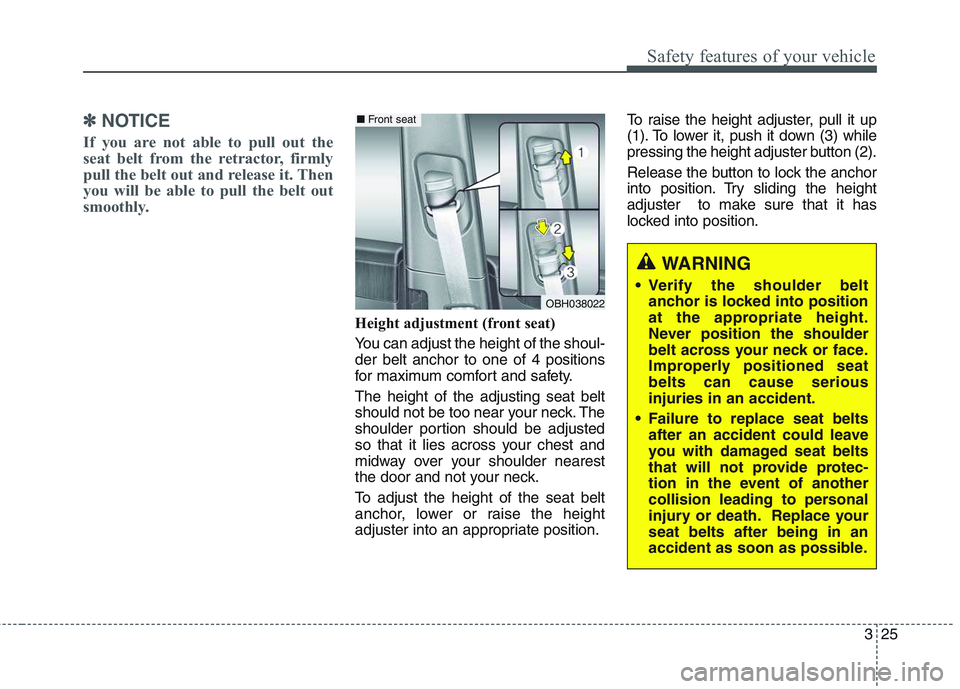
Height adjustment (front seat)
You can adjust the height of the shoul- der belt anchor to one of 4 positions
for maximum comfort and safety. The height of the adjusting seat belt
should not be too near your neck. The
shoulder portion should be adjusted
so that it lies across your chest and
midway over your shoulder nearest
the door and not your neck.
To adjust the height of the seat belt
anchor, lower or raise the height
adjuster into an appropriate position. To raise the height adjuster, pull it up
(1). To lower it, push it down (3) while
pressing the height adjuster button (2).
Release the button to lock the anchor
into position. Try sliding the height
adjuster to make sure that it has
locked into position.
WARNING
Verify the shoulder belt anchor is locked into position
at the appropriate height.
Never position the shoulder
belt across your neck or face.
Improperly positioned seatbelts can cause seriousinjuries in an accident.
Failure to replace seat belts after an accident could leave
you with damaged seat belts
that will not provide protec-
tion in the event of another
collision leading to personal
injury or death. Replace yourseat belts after being in an
accident as soon as possible.
OBH038022
■Front seat
Page 49 of 514

Safety features of your vehicle
32
3
Seat belt precautionsInfant or small child
You should be aware of the specific
requirements in your country. Child
and/or infant seats must be properlyplaced and installed in the rear seat.
For more information about the use
of these restraints, refer to “Child
restraint system” in this section.
✽✽
NOTICE
Small children are best protected
from injury in an accident when
properly restrained in the rear seat
by a child restraint system that
meets the requirements of the Safety
Standards of your country. Before
buying any child restraint system,
make sure that it has a label certify-
ing that it meets Safety Standards of
your country. The restraint must be
appropriate for your child's height
and weight. Check the label on the
child restraint for this information.
Refer to “Child restraint system” in
this section.
WARNING
All occupants of the vehicle
must wear their seat belts at all
times. Seat belts and childrestraints reduce the risk of
serious or fatal injuries for all
occupants in the event of a col-
lision or sudden stop. Without a
seat belt, occupants could be
shifted too close to a deploying
air bag, strike the interior struc-
ture or be thrown from the vehi-
cle. Properly worn seat belts
greatly reduce these hazards.
Always follow the precautions
about seat belts, air bags andoccupant seating contained in
this manual.
WARNING
Every person in your vehicle
needs to be properly restrained
at all times, including infants
and children. Never hold a child
in your arms or lap when riding
in a vehicle. The violent forcescreated during a crash will tear
the child from your arms and
throw the child against the inte-
rior. Always use a child restraint
appropriate for your child'sheight and weight.