lights KIA Rio 2005 2.G User Guide
[x] Cancel search | Manufacturer: KIA, Model Year: 2005, Model line: Rio, Model: KIA Rio 2005 2.GPages: 238, PDF Size: 2.6 MB
Page 108 of 238
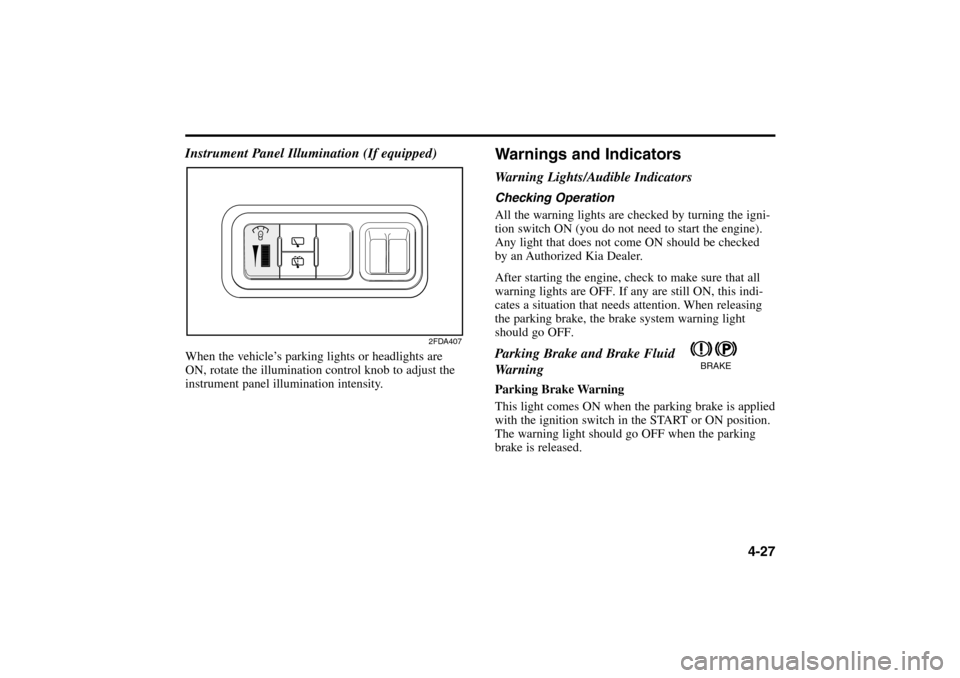
4-27 Instrument Panel Illumination (If equipped)
When the vehicle’s parking lights or headlights are
ON, rotate the illumination control knob to adjust the
instrument panel illumination intensity.
Warnings and IndicatorsWarning Lights/Audible IndicatorsChecking Operation
All the warning lights are checked by turning the igni-
tion switch ON (you do not need to start the engine).
Any light that does not come ON should be checked
by an Authorized Kia Dealer.
After starting the engine, check to make sure that all
warning lights are OFF. If any are still ON, this indi-
cates a situation that needs attention. When releasing
the parking brake, the brake system warning light
should go OFF.Parking Brake and Brake Fluid
Warning Parking Brake Warning
This light comes ON when the parking brake is applied
with the ignition switch in the START or ON position.
The warning light should go OFF when the parking
brake is released.
2FDA407
BRAKE
RIO ENG CNA 4.qxd 7/29/05 5:06 PM Page 27
Page 109 of 238
Driving Your Vehicle4-28Low Brake Fluid Level Warning
If the warning light remains ON when the parking
brake is released, it may indicate that the brake fluid
level in the reservoir is low.
If the warning light remains ON:
1. Drive to the nearest safe location and carefully stop
your vehicle.
2. With the engine stopped, check the brake fluid level
immediately and add fluid as required. All brake
components should also be checked immediately
for fluid leaks.
3. If leaks are found, if the warning light remains ON,
or if the brakes do not operate properly, do not
drive the vehicle. Have it towed to an Authorized
Kia Dealer for a brake system inspection and nec-
essary repairs.To check bulb operation, the warning light illuminates
when the ignition switch is in the ON position.
Safety Belt Warning As a reminder to the driver and passenger, safety belt
warning light will illuminate for approximately 6 sec-
onds each time you turn the ignition switch ON.
If the driver’s lap/shoulder belt is not fastened when
the key is turned ON, a chime sounds for approximate-
ly six seconds and the safety belt warning light illumi-
nates for approximately six seconds. If the system does
not operate as described, see an Authorized Kia Dealer
for assistance.Air Bag Warning This warning light will remain ON for approximately
6 seconds each time you turn the ignition switch ON.
If the system does not operate as described or if the
light comes on while the vehicle is being driven, see an
Authorized Kia Dealer for immediate assistance.Charging System Warning This warning light indicates a malfunction of either the
generator or electrical charging system.
–
+
WARNING - Brake Warning
Lights
Driving the vehicle with a warning light ON is
dangerous. If the brake warning light remains
ON, have the brakes checked and repaired
immediately.
RIO ENG CNA 4.qxd 7/29/05 5:06 PM Page 28
Page 113 of 238
Driving Your Vehicle4-32Key Reminder Warning Chime
If the driver’s door is opened and the ignition key is
left in the ignition switch, the key reminder warning
chime will sound. This is to remind you to remove
your keys from the ignition before you lock the vehi-
cle.Lights-On Warning ChimeThe lights-on warning chime will sound if the head-
light switch is left in the 1st or 2nd position and the
door is opened.Headlight High Beam Indicator This indicator illuminates when the headlights are on
and in the high beam position or when the turn signal
lever is pulled into the Flash-to-Pass position.O/D OFF Indicator
(automatic transaxle)This indicator comes on when the O/D system is
deactivated.
✽
NOTICE
A loose fuel filler cap may cause the On Board
DiagnosticSystem Malfunction Indicator Light
( ) in the instrument panel to illuminate
unnecessarily. Always make sure that the fuel
filler cap is tight.
CHECK
CHECK
RIO ENG CNA 4.qxd 7/29/05 5:06 PM Page 32
Page 114 of 238
4-33 Door Ajar Warning
This warning light comes on when a door is not closed
securely with the ignition switch in any position.Anti-Lock Brake System (ABS)
Warning Light (if equipped)This light illuminates when you start the engine. The
light will go off if the ABS system is operating nor-
mally. Also, this light comes on if the key is turned to
ON, and then goes off in 2-3 seconds if the system is
operating normally.
If this warning light illuminates while the vehicle is
being driven, have the vehicle checked by an autho-
rized Kia Dealer as soon as possible.Rear Window Defroster Indicator This light comes on when the rear defroster is ON.Rear Hatch Warning Light
(5 door-if equipped)This warning light comes on when a rear hatch is not
closed securely with the ignition switch in any posi-
tion.
AS2B04020
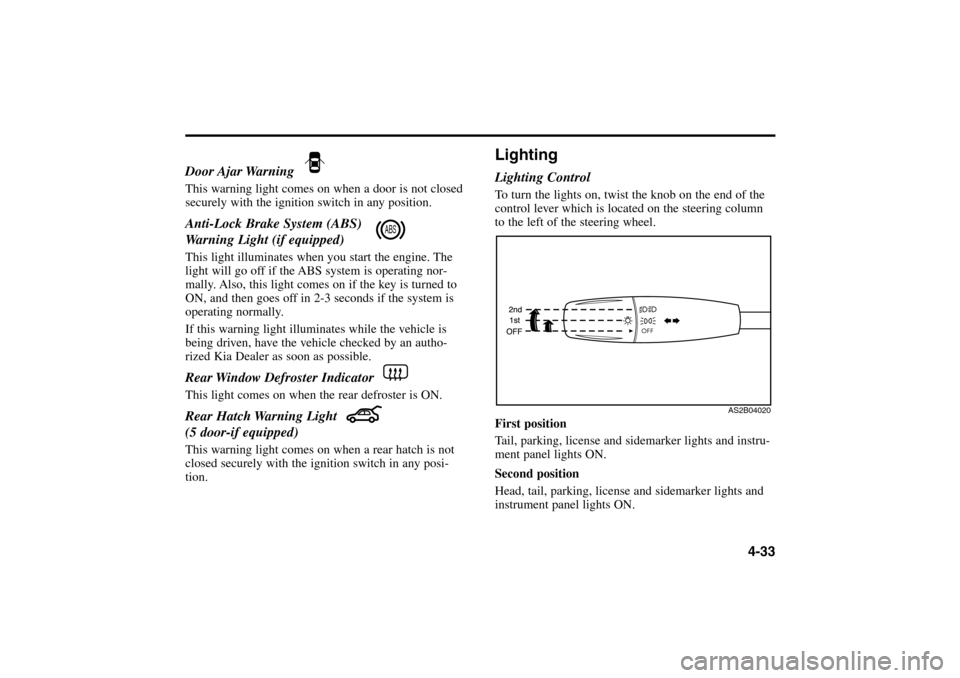
LightingLighting ControlTo turn the lights on, twist the knob on the end of the
control lever which is located on the steering column
to the left of the steering wheel.
First position
Tail, parking, license and sidemarker lights and instru-
ment panel lights ON.
Second position
Head, tail, parking, license and sidemarker lights and
instrument panel lights ON.
ABS
RIO ENG CNA 4.qxd 7/29/05 5:06 PM Page 33
Page 115 of 238
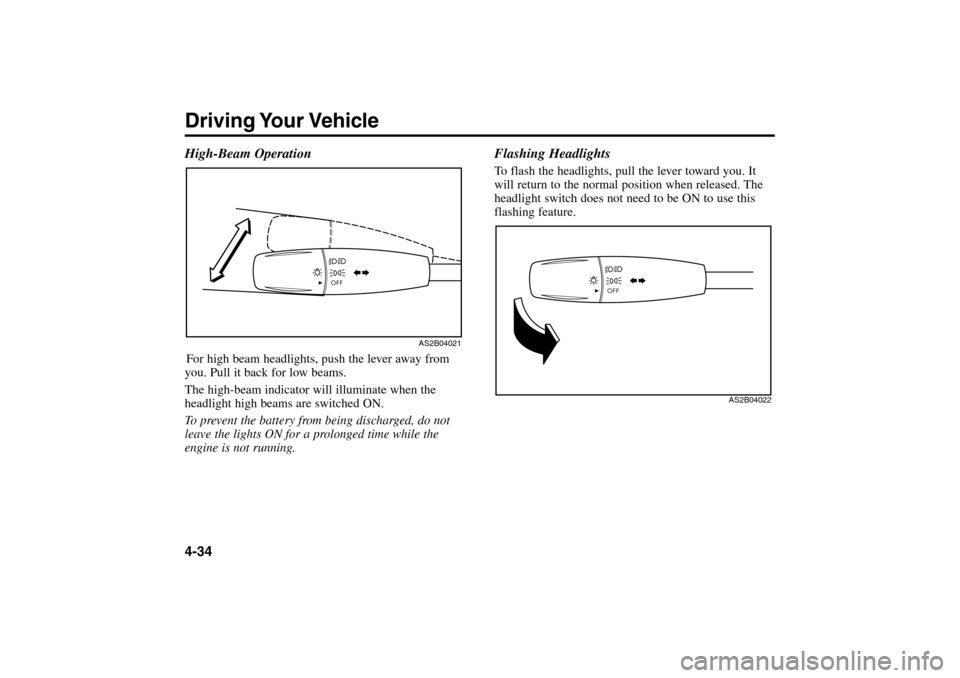
Driving Your Vehicle4-34 High-Beam OperationFor high beam headlights, push the lever away from
you. Pull it back for low beams.
The high-beam indicator will illuminate when the
headlight high beams are switched ON.
To prevent the battery from being discharged, do not
leave the lights ON for a prolonged time while the
engine is not running.
Flashing HeadlightsTo flash the headlights, pull the lever toward you. It
will return to the normal position when released. The
headlight switch does not need to be ON to use this
flashing feature.
AS2B04021
AS2B04022
RIO ENG CNA 4.qxd 7/29/05 5:06 PM Page 34
Page 116 of 238
4-35 Turn Signals
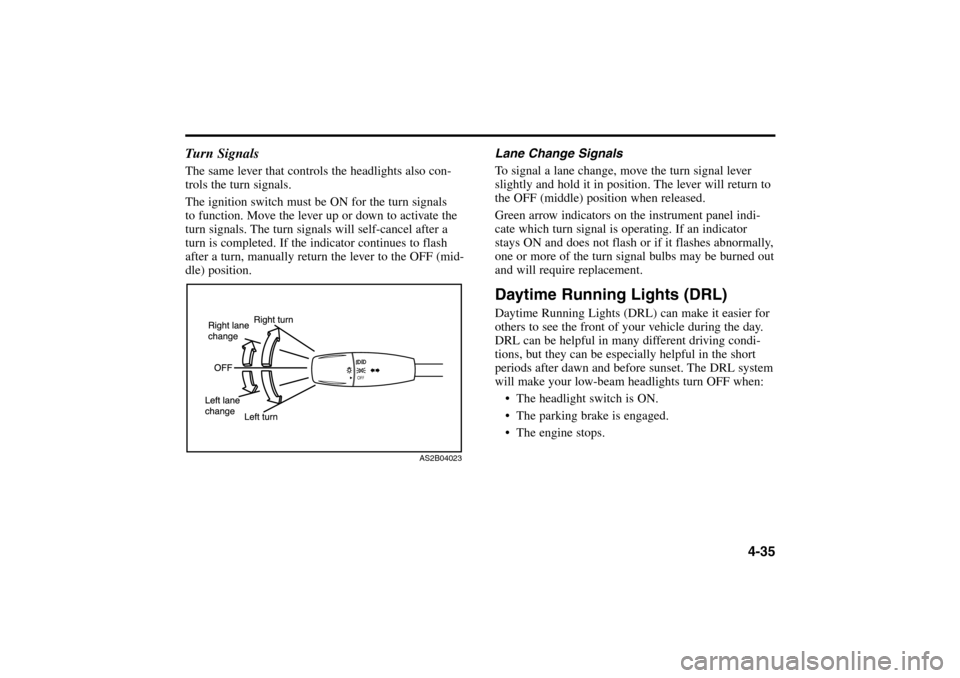
The same lever that controls the headlights also con-
trols the turn signals.
The ignition switch must be ON for the turn signals
to function. Move the lever up or down to activate the
turn signals. The turn signals will self-cancel after a
turn is completed. If the indicator continues to flash
after a turn, manually return the lever to the OFF (mid-
dle) position.
Lane Change Signals
To signal a lane change, move the turn signal lever
slightly and hold it in position. The lever will return to
the OFF (middle) position when released.
Green arrow indicators on the instrument panel indi-
cate which turn signal is operating. If an indicator
stays ON and does not flash or if it flashes abnormally,
one or more of the turn signal bulbs may be burned out
and will require replacement.Daytime Running Lights (DRL)Daytime Running Lights (DRL) can make it easier for
others to see the front of your vehicle during the day.
DRL can be helpful in many different driving condi-
tions, but they can be especially helpful in the short
periods after dawn and before sunset. The DRL system
will make your low-beam headlights turn OFF when:
The headlight switch is ON.
The parking brake is engaged.
The engine stops.
AS2B04023
RIO ENG CNA 4.qxd 7/29/05 5:06 PM Page 35
Page 120 of 238
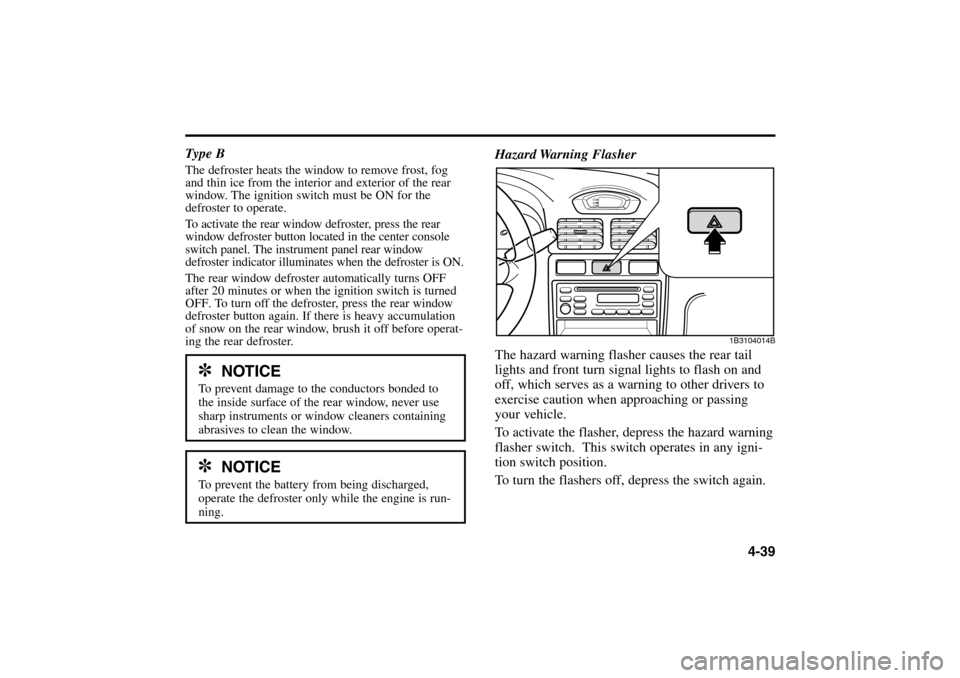
Hazard Warning Flasher
The hazard warning flasher causes the rear tail
lights and front turn signal lights to flash on and
off, which serves as a warning to other drivers to
exercise caution when approaching or passing
your vehicle.
To activate the flasher, depress the hazard warning
flasher switch. This switch operates in any igni-
tion switch position.
To turn the flashers off, depress the switch again.
4-39 Type B
The defroster heats the window to remove frost, fog
and thin ice from the interior and exterior of the rear
window. The ignition switch must be ON for the
defroster to operate.
To activate the rear window defroster, press the rear
window defroster button located in the center console
switch panel. The instrument panel rear window
defroster indicator illuminates when the defroster is ON.
The rear window defroster automatically turns OFF
after 20 minutes or when the ignition switch is turned
OFF. To turn off the defroster, press the rear window
defroster button again. If there is heavy accumulation
of snow on the rear window, brush it off before operat-
ing the rear defroster.
✽
NOTICE
To prevent damage to the conductors bonded to
the inside surface of the rear window, never use
sharp instruments or window cleaners containing
abrasives to clean the window.✽
NOTICE
To prevent the battery from being discharged,
operate the defroster only while the engine is run-
ning.
1B3104014B
RIO ENG CNA 4.qxd 7/29/05 5:06 PM Page 39
Page 138 of 238
Operating Precautions for Catalytic ConvertersYour vehicle is equipped with a catalytic converter
emission control device.
Therefore, the following precautions must be observed:
Use only UNLEADED FUEL.
Do not park the vehicle over or near flammable
objects, such as dry grass, paper, leaves, etc. Under
certain conditions, they could be ignited by a hot
exhaust system.
Do not operate the vehicle when there are signs of
engine malfunction, such as misfire or a noticeable
loss of performance.
Do not misuse or abuse the engine. Examples of
misuse are coasting with the ignition off and
descending steep grades in gear with the ignition
off.
Do not operate the engine at high idle speed for
extended periods (5 minutes or more). Do not modify or tamper with any part of the engine
or emission control system. All inspections and
adjustments must be made by a qualified technician.
Failure to observe the above precautions could result in
damage to the catalytic converter and to your vehicle
and could void your warranties.
Before DrivingBefore entering vehicle:
Be sure that all windows, outside mirror(s), and
outside lights are clean.
Check the condition of the tires.
Check under the vehicle for any sign of leaks.
Be sure there are no obstacles behind you if you
intend to back up.
Driving Tips5-4
RIO ENG CNA 5.qxd 7/29/05 5:07 PM Page 4
Page 139 of 238
Necessary InspectionsFluid levels, such as engine oil, engine coolant,
brake/clutch fluid, and washer fluid should be checked
on a regular basis, with the exact interval depending on
the fluid. Further details are provided in Maintenance,
Section 7.Before Starting Close and lock all doors.
Position the seat so that all controls are easily
reached.
Adjust the inside and outside rearview mirrors.
Be sure that all lights work.
Check all gauges.
Check the operation of warning lights when the
ignition switch is turned to the ON position.
Release the parking brake and make sure the brake
warning light goes out.
For safe operation, be sure you are familiar with your
vehicle and its equipment.
Drunk DrivingDrinking and driving is dangerous. Drunk driving is
the number one contributor to the highway death toll
each year. Alcohol impairs a driver’s judgment, vision
and muscular coordination. Even a small amount of
alcohol will affect a driver’s reflexes, perceptions and
judgment.
Please don’t drink and drive, or ride with a driver who
has been drinking. Choose a designated driver if you’re
with a group, or if you’re alone, call a cab.Drugs and DrivingDriving while under the influence of drugs is as
dangerous or more dangerous than driving under the
influence of alcohol, depending on the drug(s) used
and the quantity consumed. Don’t take drugs and drive.
If you are taking a prescription medicine, check with
your doctor or pharmacist regarding whether you may
operate a motor vehicle.
5-5
RIO ENG CNA 5.qxd 7/29/05 5:07 PM Page 5
Page 143 of 238

5-9 Driving at Night
Because night driving presents many more hazards
than driving in the daylight, here are some important
tips to remember:
Slow down and keep more distance between you
and other vehicles as it may be more difficult to see
at night, especially in rural areas where there may
not be any street lights.
Adjust your mirrors to reduce the glare from other
driver’s headlights.
Keep your headlights clean and properly aimed.
Dirty or misaimed headlights will make it much
more difficult to see at night.
Avoid staring directly at the headlights of oncoming
vehicles. You could be temporarily blinded and it
will take several seconds for your eyes to readjust to
the darkness.
Driving in the RainRain and wet roads can make driving dangerous,
especially if you’re not prepared for the slick
pavement. Here are a few things to consider when
driving in the rain:
Be sure your windshield wipers are in good
condition.
A heavy rainfall will make it harder to see and will
increase the distance needed to stop your vehicle, so
slow down.
If your tires aren’t in good condition, making a
quick stop on wet pavement can cause a skid and
possibly lead to an accident. Be sure your tires and
windshield wipers are in good shape.
Turn on your headlights to make it easier for others
to see you.
Driving too fast through large puddles can affect
your brakes. If you must go through puddles, try to
drive through them slowly.
If you believe you may have gotten your brakes wet,
apply them lightly while driving until normal
braking operation returns.
RIO ENG CNA 5.qxd 7/29/05 5:07 PM Page 9