lock KIA Rio 2005 2.G User Guide
[x] Cancel search | Manufacturer: KIA, Model Year: 2005, Model line: Rio, Model: KIA Rio 2005 2.GPages: 238, PDF Size: 2.6 MB
Page 21 of 238
3-11
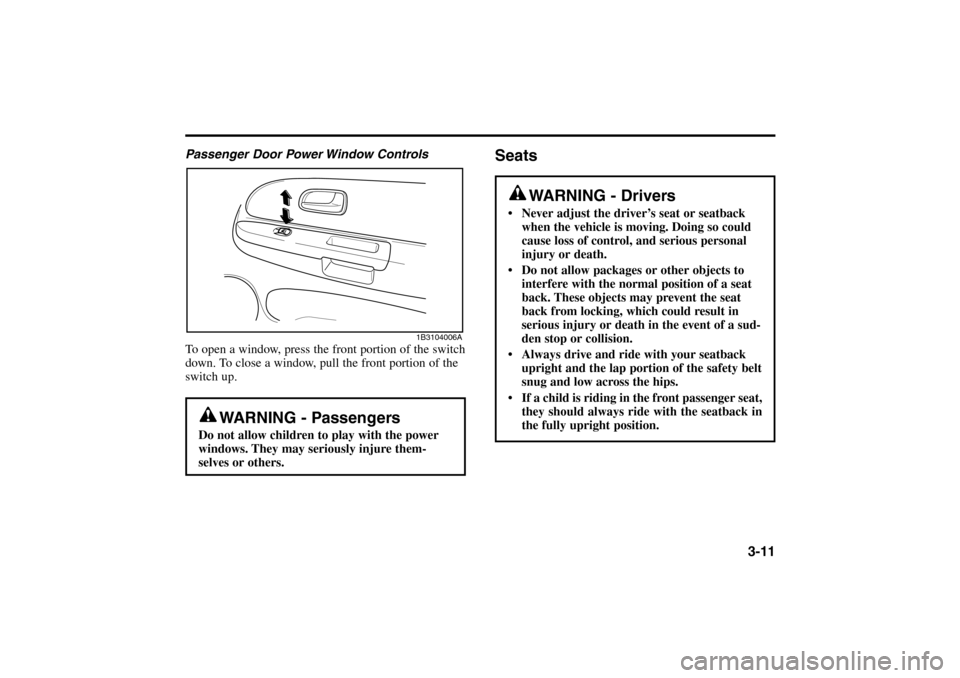
Passenger Door Power Window Controls
To open a window, press the front portion of the switch
down. To close a window, pull the front portion of the
switch up.
Seats
WARNING - Passengers
Do not allow children to play with the power
windows. They may seriously injure them-
selves or others.
WARNING - Drivers
Never adjust the driver’s seat or seatback
when the vehicle is moving. Doing so could
cause loss of control, and serious personal
injury or death.
Do not allow packages or other objects to
interfere with the normal position of a seat
back. These objects may prevent the seat
back from locking, which could result in
serious injury or death in the event of a sud-
den stop or collision.
Always drive and ride with your seatback
upright and the lap portion of the safety belt
snug and low across the hips.
If a child is riding in the front passenger seat,
they should always ride with the seatback in
the fully upright position.
1B3104006A
RIO ENG CNA 3.qxd 7/29/05 5:13 PM Page 11
Page 22 of 238
Knowing Your Vehicle3-12Front Seat Adjustment
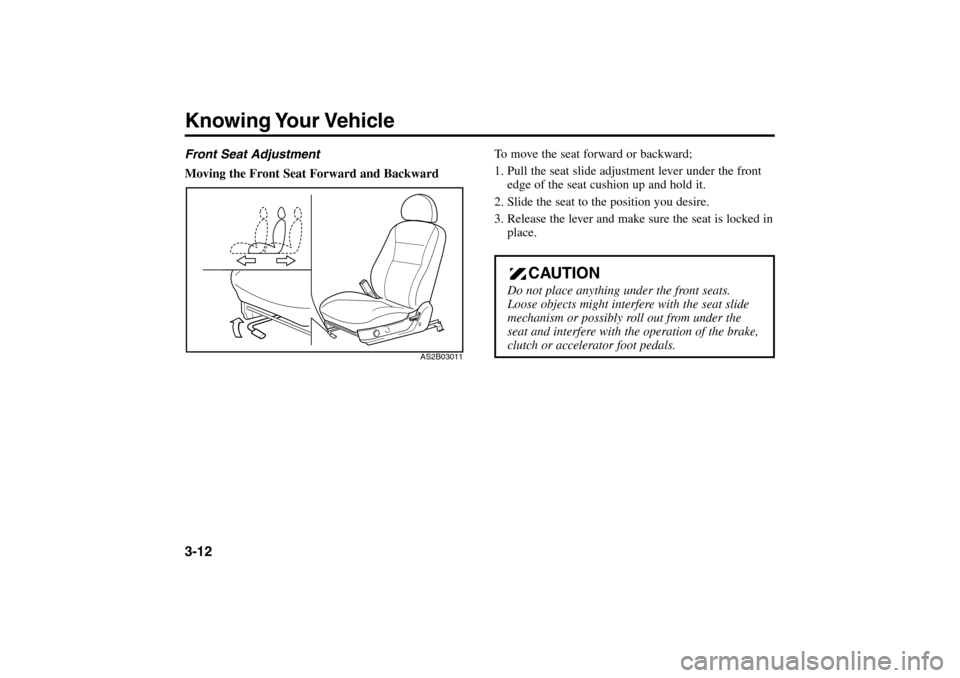
Moving the Front Seat Forward and Backward
To move the seat forward or backward;
1. Pull the seat slide adjustment lever under the front
edge of the seat cushion up and hold it.
2. Slide the seat to the position you desire.
3. Release the lever and make sure the seat is locked in
place.
CAUTION
Do not place anything under the front seats.
Loose objects might interfere with the seat slide
mechanism or possibly roll out from under the
seat and interfere with the operation of the brake,
clutch or accelerator foot pedals.
AS2B03011
RIO ENG CNA 3.qxd 7/29/05 5:13 PM Page 12
Page 23 of 238
3-13
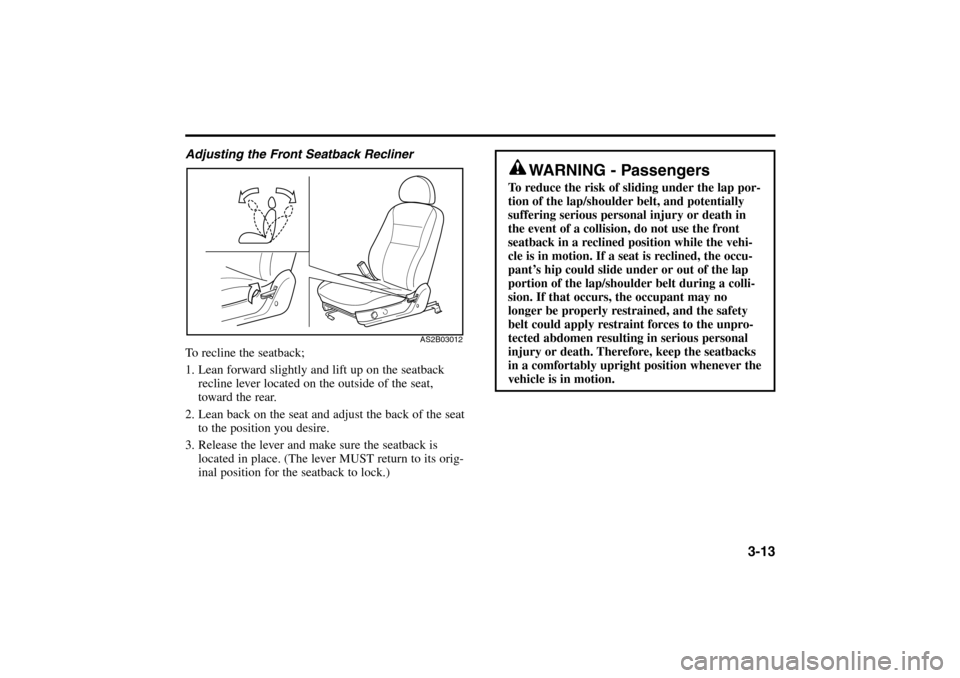
Adjusting the Front Seatback Recliner
To recline the seatback;
1. Lean forward slightly and lift up on the seatback
recline lever located on the outside of the seat,
toward the rear.
2. Lean back on the seat and adjust the back of the seat
to the position you desire.
3. Release the lever and make sure the seatback is
located in place. (The lever MUST return to its orig-
inal position for the seatback to lock.)
WARNING - Passengers
To reduce the risk of sliding under the lap por-
tion of the lap/shoulder belt, and potentially
suffering serious personal injury or death in
the event of a collision, do not use the front
seatback in a reclined position while the vehi-
cle is in motion. If a seat is reclined, the occu-
pant’s hip could slide under or out of the lap
portion of the lap/shoulder belt during a colli-
sion. If that occurs, the occupant may no
longer be properly restrained, and the safety
belt could apply restraint forces to the unpro-
tected abdomen resulting in serious personal
injury or death. Therefore, keep the seatbacks
in a comfortably upright position whenever the
vehicle is in motion.
AS2B03012
RIO ENG CNA 3.qxd 7/29/05 5:13 PM Page 13
Page 28 of 238
Knowing Your Vehicle3-18
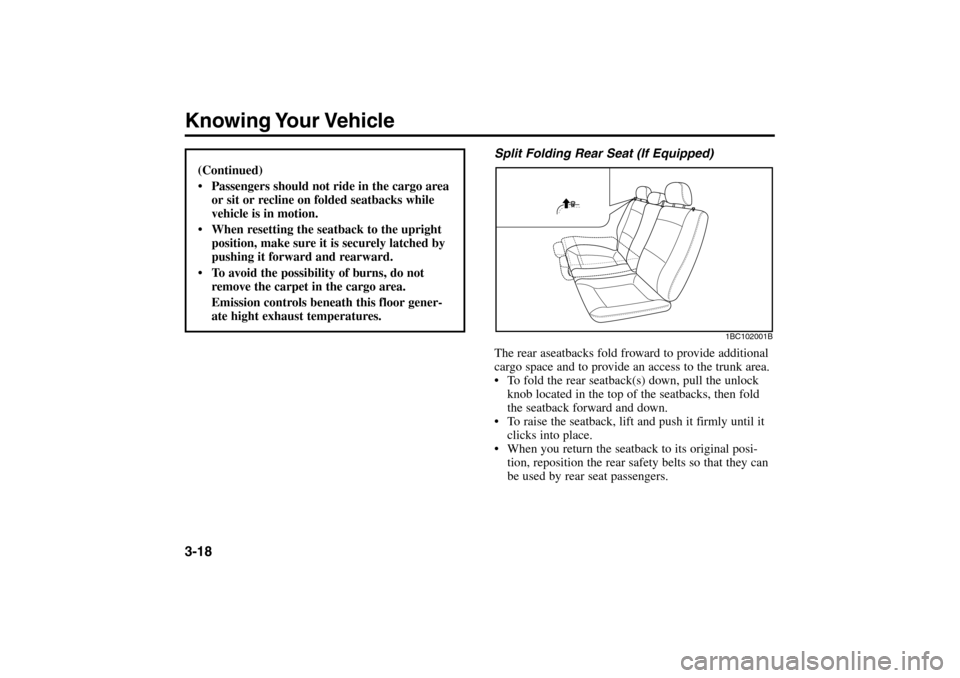
Split Folding Rear Seat (If Equipped)
The rear aseatbacks fold froward to provide additional
cargo space and to provide an access to the trunk area.
To fold the rear seatback(s) down, pull the unlock
knob located in the top of the seatbacks, then fold
the seatback forward and down.
To raise the seatback, lift and push it firmly until it
clicks into place.
When you return the seatback to its original posi-
tion, reposition the rear safety belts so that they can
be used by rear seat passengers.
1BC102001B
(Continued)
Passengers should not ride in the cargo area
or sit or recline on folded seatbacks while
vehicle is in motion.
When resetting the seatback to the upright
position, make sure it is securely latched by
pushing it forward and rearward.
To avoid the possibility of burns, do not
remove the carpet in the cargo area.
Emission controls beneath this floor gener-
ate hight exhaust temperatures.
RIO ENG CNA 3.qxd 7/29/05 5:13 PM Page 18
Page 30 of 238
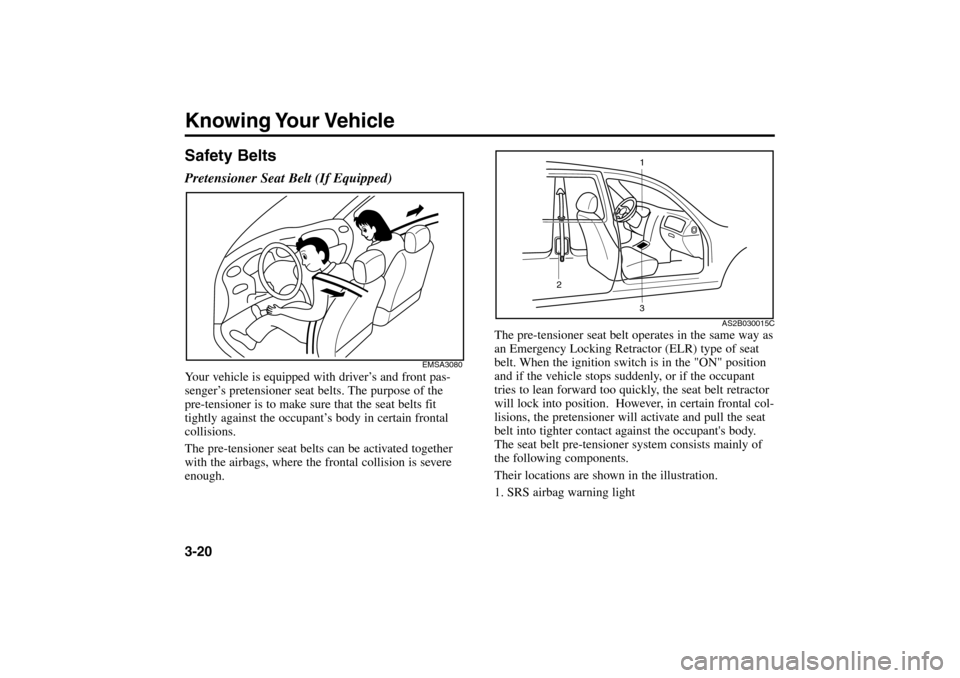
Knowing Your Vehicle3-20Safety BeltsPretensioner Seat Belt (If Equipped)Your vehicle is equipped with driver’s and front pas-
senger’s pretensioner seat belts. The purpose of the
pre-tensioner is to make sure that the seat belts fit
tightly against the occupant’s body in certain frontal
collisions.
The pre-tensioner seat belts can be activated together
with the airbags, where the frontal collision is severe
enough.
The pre-tensioner seat belt operates in the same way as
an Emergency Locking Retractor (ELR) type of seat
belt. When the ignition switch is in the "ON" position
and if the vehicle stops suddenly, or if the occupant
tries to lean forward too quickly, the seat belt retractor
will lock into position. However, in certain frontal col-
lisions, the pretensioner will activate and pull the seat
belt into tighter contact against the occupant's body.
The seat belt pre-tensioner system consists mainly of
the following components.
Their locations are shown in the illustration.
1. SRS airbag warning light
EMSA3080AS2B030015C
1
3 2
RIO ENG CNA 3.qxd 7/29/05 5:13 PM Page 20
Page 33 of 238
3-23
To help you remember to fasten your safety belt, a
warning light may come on and a chime may sound.
See Safety Belt Warning on page 4-28.
All seats, except the center rear seat, have lap/shoulder
belts. The center rear seat has a lap belt.
Inertial locks in the safety belt retractors allow all of
the lap/shoulder safety belts to remain unlocked during
normal vehicle operation. This allows the occupants
some freedom of movement and increased comfort
while using the safety belts. If a force is applied to the
vehicle, such as a strong stop, a sharp turn, or a colli-
sion, the safety belt retractors will automatically lock
the safety belts.
Since the inertial locks do not require a collision in
order to lock up, you may become aware of the safety
belts locking while braking or going around sharp cor-
ners.
The center rear seat safety belt does not have an iner-
tial lock so it is always in a locked condition.
Whenever possible, use the center rear seat position to
install your child restraint. The center rear seat is the
best position to install your child restraint. However, if
the center seat is unavailable, a child restraint may be
installed in the rear outboard seats using the special
auto lock mode feature provided with those safety belt.
Safety Belt Restraint SystemWe strongly recommend that the driver and all passen-
gers be properly restrained at all times by using the
safety belts provided with the vehicle. Proper use of
the safety belts decreases the risk of severe injury or
death in accidents or sudden stops. In most states and
in Canada, the law requires their use.
Safety belts provide the best restraint when:
the seatback is upright
the occupant is sitting upright (not slouched)
the lap belt portion of the safety belt is snug and low
on the hips
the shoulder belt portion of the safety belt is snug
against the chest
the knees are straight forward
WARNING
The driver and all passengers should always
use the safety belts provided in order to mini-
mize the risk of severe bodily injury.
RIO ENG CNA 3.qxd 7/29/05 5:13 PM Page 23
Page 34 of 238
Knowing Your Vehicle3-24
WARNING -Safety Belt Usage
Each seating position in your vehicle has a spe-
cific safety belt assembly which includes a
buckle and tongue that are designed to be used
together. 1) Use the shoulder belt on the out-
side shoulder only. Never wear the shoulder
belt under the arm. 2) Never swing the safety
belt around your neck to fit over the inside
shoulder. 3) Never use a single belt for more
than one person.
WARNING - After a Collision
Lap/shoulder belt assemblies may be
stretched or damaged when subjected to the
stress and forces of a collision.
The entire restraint system should be
inspected following any collision. All belts,
retractors, anchors and hardware damaged
by a collision should be replaced before the
vehicle is operated again.
The rear outboard safety belts have been designed to
allow a child restraint to be used in these positions
without an added locking clip. These safety belts nor-
mally lock only under extreme or emergency condi-
tions (this is the emergency lock mode which uses the
locking retractor). However, they can be adjusted so
that they remain fixed and locked when a child
restraint is placed in those positions (this auto lock
mode should only be used to secure a child restraint).
The driver’s safety belt can only operate in the emer-
gency lock mode.
WARNING -Twisted Safety Belts
Never drive or ride with a twisted or jammed
safety belt. If you cannot untwist or unjam the
safety belt, see your Kia dealer immediately.
RIO ENG CNA 3.qxd 7/29/05 5:13 PM Page 24
Page 38 of 238
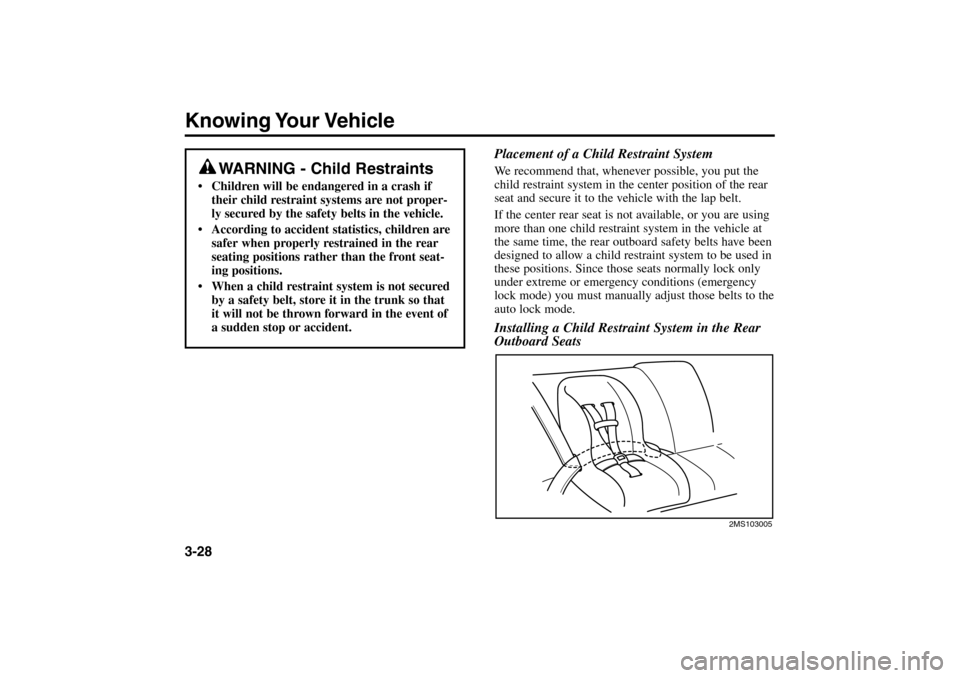
Knowing Your Vehicle3-28Placement of a Child Restraint System
We recommend that, whenever possible, you put the
child restraint system in the center position of the rear
seat and secure it to the vehicle with the lap belt.
If the center rear seat is not available, or you are using
more than one child restraint system in the vehicle at
the same time, the rear outboard safety belts have been
designed to allow a child restraint system to be used in
these positions. Since those seats normally lock only
under extreme or emergency conditions (emergency
lock mode) you must manually adjust those belts to the
auto lock mode.Installing a Child Restraint System in the Rear
Outboard Seats
2MS103005
WARNING - Child Restraints
Children will be endangered in a crash if
their child restraint systems are not proper-
ly secured by the safety belts in the vehicle.
According to accident statistics, children are
safer when properly restrained in the rear
seating positions rather than the front seat-
ing positions.
When a child restraint system is not secured
by a safety belt, store it in the trunk so that
it will not be thrown forward in the event of
a sudden stop or accident.
RIO ENG CNA 3.qxd 7/29/05 5:13 PM Page 28
Page 39 of 238
3-29
For safety reasons, we recommend that the child
restraint system be used in the center rear seat. If the
center rear seat is unavailable, a child restraint may be
installed in the rear outboard seats.
WARNING - Restraint Instructions
Failure to observe this manual’s instructions
regarding child restraint systems and the
instructions provided with the child restraint
system could increase the chance and/or severi-
ty of injury in an accident.
Since all three of these safety belts move freely under
normal conditions and only lock under extreme or
emergency conditions (emergency lock mode) you
must manually adjust these belts to the auto lock mode
(if equipped) to secure a child restraint.
The driver’s safety belt incorporates the emergency
lock mode only.
RIO ENG CNA 3.qxd 7/29/05 5:13 PM Page 29
Page 40 of 238
Knowing Your Vehicle3-30
Placing a Passenger Safety Belt into the
“Auto Lock” Mode (If Equipped)
The use of the auto lock mode will ensure that the nor-
mal movement of the child in the vehicle does not
cause the safety belt to be pulled out and loosen the
firmness of its hold on the child restraint.
To secure a child restraint in the front passenger seat or
rear outboard seats, follow the procedure below.
1. Place the child restraint system in the seat and route
the lap/shoulder belt around or through the
restraint, following the restraint manufacturer’s
instructions. Be sure the belt webbing is not twist-
ed.
WARNING - Child Restraint
Placement
NEVER use a child restraint in the front pas-
senger seat. A child in a child restraint installed
in the front passenger seat can be severely or
fatally injured by an air bag which could
impact the child restraint with great force when
the air bag inflates.
RIO ENG CNA 3.qxd 7/29/05 5:13 PM Page 30