trunk KIA Rio 2010 2.G User Guide
[x] Cancel search | Manufacturer: KIA, Model Year: 2010, Model line: Rio, Model: KIA Rio 2010 2.GPages: 236, PDF Size: 4.54 MB
Page 140 of 236
Driving your vehicle
28
4
Low brake fluid level warning
If the warning light remains on, it may
indicate that the brake fluid level in the
reservoir is low.
If the warning light remains on:
1. Drive carefully to the nearest safe
location and stop your vehicle.
2. With the engine stopped, check the brake fluid level immediately and add
fluid as required. Then check all brake
components for fluid leaks.
3. Do not drive the vehicle if leaks are found, the warning light remains on or
the brakes do not operate properly.
Have it towed to any authorized Kia
dealer for a brake system inspection
and necessary repairs.
To check bulb operation, check whether
the parking brake and brake fluid warning
light illuminates when the ignition switch
is in the ON position.
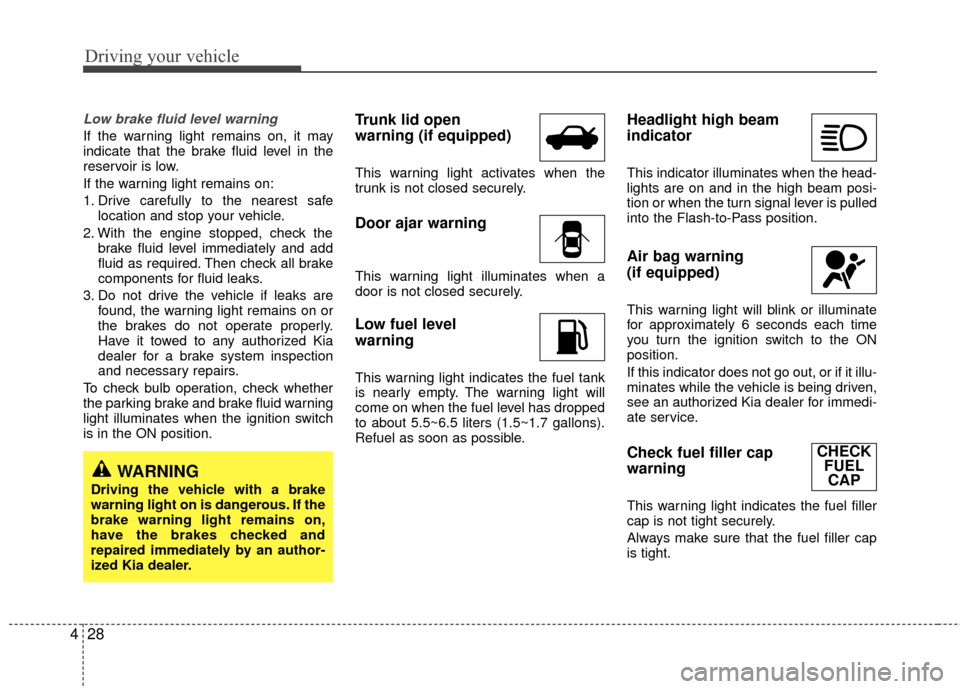
Trunk lid open
warning (if equipped)
This warning light activates when the
trunk is not closed securely.
Door ajar warning
This warning light illuminates when a
door is not closed securely.
Low fuel level
warning
This warning light indicates the fuel tank
is nearly empty. The warning light will
come on when the fuel level has dropped
to about 5.5~6.5 liters (1.5~1.7 gallons).
Refuel as soon as possible.
Headlight high beam
indicator
This indicator illuminates when the head-
lights are on and in the high beam posi-
tion or when the turn signal lever is pulled
into the Flash-to-Pass position.
Air bag warning
(if equipped)
This warning light will blink or illuminate
for approximately 6 seconds each time
you turn the ignition switch to the ON
position.
If this indicator does not go out, or if it illu-
minates while the vehicle is being driven,
see an authorized Kia dealer for immedi-
ate service.
Check fuel filler cap
warning
This warning light indicates the fuel filler
cap is not tight securely.
Always make sure that the fuel filler cap
is tight.
WARNING
Driving the vehicle with a brake
warning light on is dangerous. If the
brake warning light remains on,
have the brakes checked and
repaired immediately by an author-
ized Kia dealer.
CHECK FUELCAP
Page 183 of 236
In case of an emergency
14
6
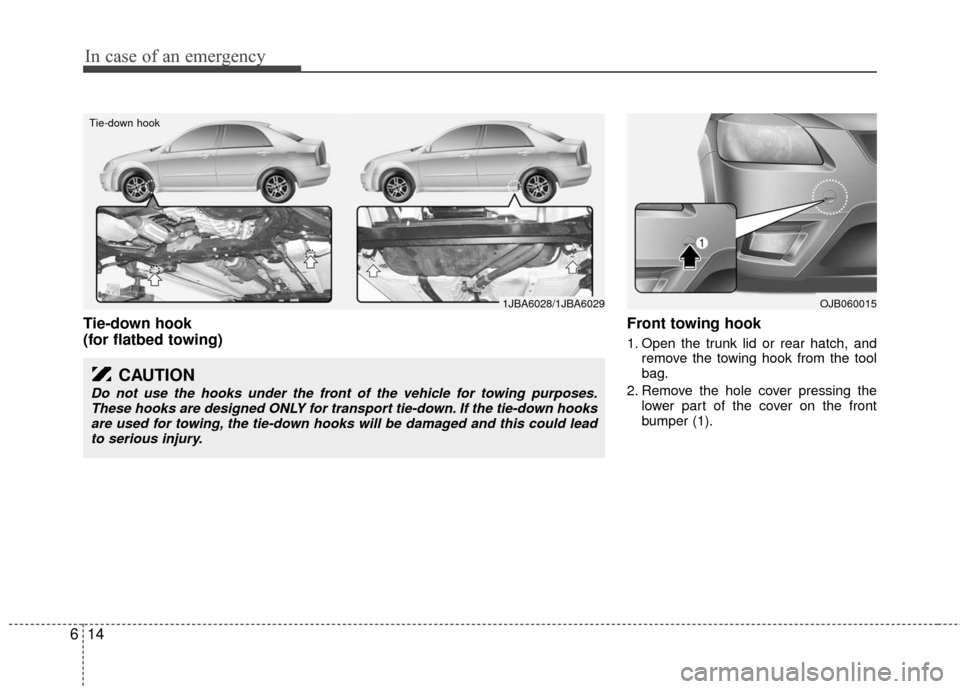
Tie-down hook
(for flatbed towing) Front towing hook
1. Open the trunk lid or rear hatch, and
remove the towing hook from the tool
bag.
2. Remove the hole cover pressing the lower part of the cover on the front
bumper (1).
Tie-down hook
1JBA6028/1JBA6029
CAUTION
Do not use the hooks under the front of the vehicle for towing purposes.These hooks are designed ONLY for transport tie-down. If the tie-down hooks are used for towing, the tie-down hooks will be damaged and this could leadto serious injury.
OJB060015
Page 232 of 236
Specifications
48
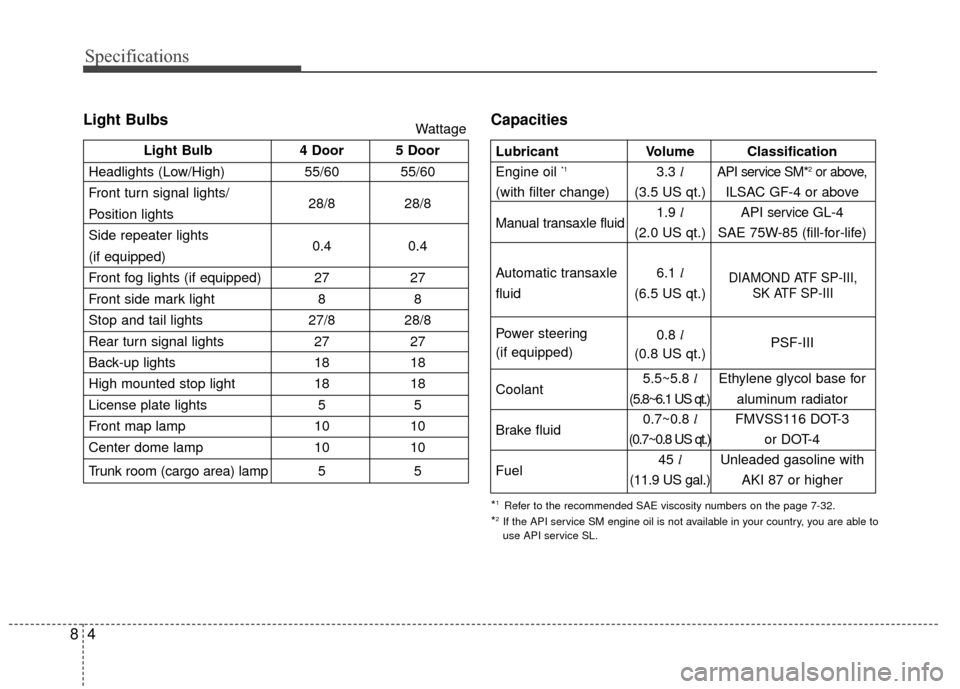
Light BulbsCapacities
Light Bulb4 Door 5 Door
Headlights (Low/High) 55/60 55/60
Front turn signal lights/ 28/8 28/8
Position lights
Side repeater lights
0.40.4
(if equipped)
Front fog lights (if equipped) 27 27
Front side mark light 88
Stop and tail lights 27/8 28/8
Rear turn signal lights 2727
Back-up lights 1818
High mounted stop light 1818
License plate lights 55
Front map lamp 1010
Center dome lamp 1010
Trunk room (cargo area) lamp 5 5
Wattage
LubricantVolume Classification
Engine oil
*13.3 lAPI service SM*2or above,
(with filter change) (3.5 US qt.) ILSAC GF-4 or above
Manual transaxle fluid1.9 l API serviceGL-4
(2.0 US qt.) SAE 75W-85 (fill-for-life)
Automatic transaxle 6.1 l
fluid (6.5 US qt.)
Power steering 0.8 l
PSF-III
(if equipped) (0.8 US qt.)
Coolant 5.5~5.8
lEthylene glycol base for
(5.8~6.1 US qt.) aluminum radiator
Brake fluid 0.7~0.8
lFMVSS116 DOT-3
(0.7~0.8 US qt.) o r D OT- 4
Fuel 45
l Unleaded gasoline with
(11.9 US gal.) AKI 87 or higher
*1Refer to the recommended SAE viscosity numbers on the page 7-32.
*2If the API service SM engine oil is not available in your country, you are able to
use API service SL.
DIAMOND ATF SP-III,
SK ATF SP-III
Page 235 of 236

93
Index
In case of an emergency while driving··················\
··········6-2
Instrument cluster ··················\
··················\
··················\
····4-20
Instrument panel overview ··················\
··················\
··········2-3
Interior care··················\
··················\
··················\
··············7-36
Interior features··················\
··················\
··················\
········3-76
Interior lights ··················\
··················\
··················\
···········3-73
Interior overview ··················\
··················\
··················\
·······2-2
Keys ··················\
··················\
··················\
··················\
·········3-2
Label information ··················\
··················\
··················\
····5-10
Lighting··················\
··················\
··················\
··················\
··4-31
Lubricant specifications ··················\
··················\
·············7-33
Lubricants and fluids ··················\
··················\
·················7-17\
Luggage net ··················\
··················\
··················\
·············3-81
Maintenance schedule··················\
··················\
··················\
7-3
Maintenance services ··················\
··················\
··················\
·7-2
Manual transaxle··················\
··················\
··················\
········4-4
Mirrors ··················\
··················\
··················\
··················\
···3-70
Overheating··················\
··················\
··················\
················6-3
Overloading ··················\
··················\
··················\
···············5-9
Owner maintenance ··················\
··················\
··················\
···7-7Power steering ··················\
··················\
··················\
·········7-15
Remote keyless entry ··················\
··················\
··················\
·3-3
Road warning ··················\
··················\
··················\
·············6-2
Safety belts··················\
··················\
··················\
···············3-28
Seat··················\
··················\
··················\
··················\
·········3-17
Special driving conditions ··················\
··················\
···········5-6
Specifications ··················\
··················\
··················\
·············8-2
Starting the engine ··················\
··················\
··················\
·····4-3
Steering wheel···············\
··················\
··················\
·············4-18
Storage compartment ··················\
··················\
·················3-74\
Suggestions for economical operation··················\
···········5-5
Sunroof··················\
··················\
··················\
··················\
···3-79
Theft-alarm system ··················\
··················\
··················\
····3-5
Tires and wheels ··················\
··················\
··················\
······7-24
Towing ··················\
··················\
··················\
··················\
···6-12
Trailer towing ··················\
··················\
··················\
············5-9
Trunk ··················\
··················\
··················\
··················\
······3-64
Vehicle break-in process ··················\
··················\
··············1-2
K
L
M
O
P
R
S
T
V