child lock KIA Rio 2011 2.G User Guide
[x] Cancel search | Manufacturer: KIA, Model Year: 2011, Model line: Rio, Model: KIA Rio 2011 2.GPages: 240, PDF Size: 4.68 MB
Page 63 of 240
Knowing your vehicle
54
3
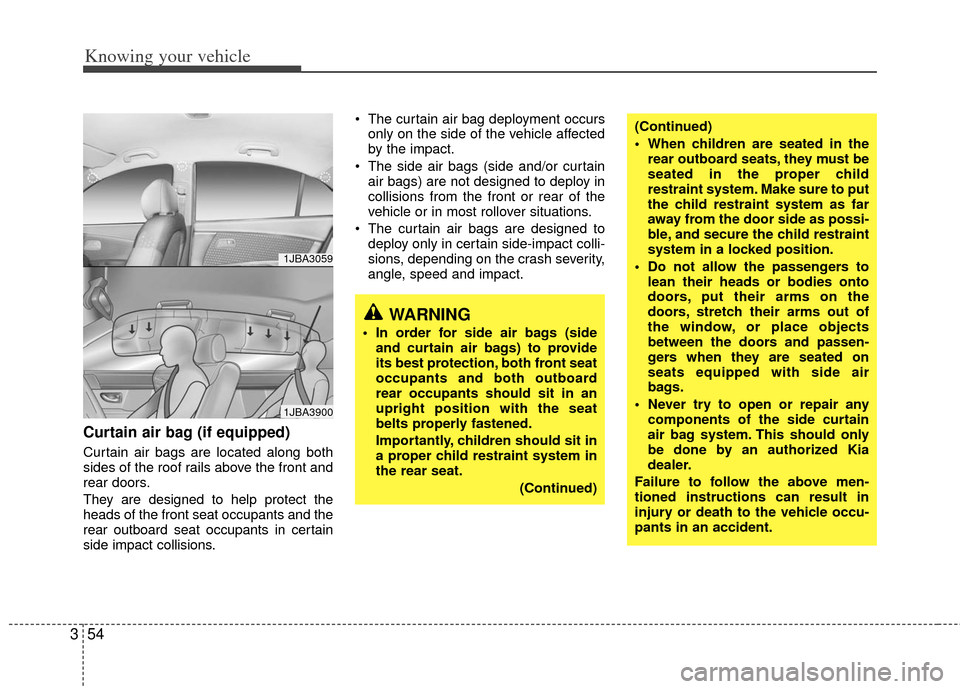
Curtain air bag (if equipped)
Curtain air bags are located along both
sides of the roof rails above the front and
rear doors.
They are designed to help protect the
heads of the front seat occupants and the
rear outboard seat occupants in certain
side impact collisions. The curtain air bag deployment occurs
only on the side of the vehicle affected
by the impact.
The side air bags (side and/or curtain air bags) are not designed to deploy in
collisions from the front or rear of the
vehicle or in most rollover situations.
The curtain air bags are designed to deploy only in certain side-impact colli-
sions, depending on the crash severity,
angle, speed and impact.
1JBA3059
1JBA3900
WARNING
In order for side air bags (sideand curtain air bags) to provide
its best protection, both front seat
occupants and both outboard
rear occupants should sit in an
upright position with the seat
belts properly fastened.
Importantly, children should sit in
a proper child restraint system in
the rear seat.
(Continued)
(Continued)
When children are seated in therear outboard seats, they must be
seated in the proper child
restraint system. Make sure to put
the child restraint system as far
away from the door side as possi-
ble, and secure the child restraint
system in a locked position.
Do not allow the passengers to lean their heads or bodies onto
doors, put their arms on the
doors, stretch their arms out of
the window, or place objects
between the doors and passen-
gers when they are seated on
seats equipped with side air
bags.
Never try to open or repair any components of the side curtain
air bag system. This should only
be done by an authorized Kia
dealer.
Failure to follow the above men-
tioned instructions can result in
injury or death to the vehicle occu-
pants in an accident.
Page 71 of 240

Knowing your vehicle
62
3
Air bag warning light
The purpose of air bag warning light in
your instrument panel is to alert you of a
potential problem with your air bag -
Supplemental Restraint System (SRS).
When the ignition switch is turned ON,
the indicator light should blink or illumi-
nate for approximately 6 seconds, then
go off.
Have the system checked if:
The light does not turn on briefly when
you turn the ignition ON.
The light stays on after the engine starts.
The light comes on while the vehicle is in motion.
Air bag (Supplemental Restraint
System) service
Your Supplemental Restraint System is
virtually maintenance-free. There are no
parts which you can service.
You must have the system serviced
under the following circumstances:
If an air bag ever inflates, the air bagmust be replaced. Do not try to remove
or discard the air bag by yourself. This
must be done by an authorized Kia
dealer.
If the air bag warning indicator light alerts you to a problem, have the air
bag system checked as soon as possi-
ble. Otherwise, your air bag system
may be ineffective.
WARNING
Never put child restraint in thefront passenger seat. If the front
passenger air bag inflates, it may
cause severe or fatal injuries.
When children are seated in the rear outboard seats in which cur-
tain air bags are equipped, be
sure to put the child restraint sys-
tem as far away from the door
side as possible, and secure the
child restraint system to be
locked in position.
Inflation of side or curtain air bag
(if equipped) could cause severe
injury or death due to the expan-
sion impact.
CAUTION - No modification
Do not modify any part of the air bagsystem. Modification could make the air bag system ineffective orcould cause unnecessary deploy- ment.
W7-147
Page 74 of 240

365
Knowing your vehicle
Inside the vehicle
To open the trunk from inside the vehicle,
pull the trunk lid release lever.
Emergency trunk safety release
(if equipped)
Your vehicle is equipped with an emer-
gency trunk release cable located inside
the trunk. The lever glows in the dark
when the trunk lid is closed. If someone
is inadvertently locked in the trunk,
pulling this handle will release the trunk
latch mechanism and open the trunk.
WARNING- Exhaust
fumes
If you drive with the trunk lid open,
you will draw dangerous exhaust
fumes into your vehicle causing
serious injury or death to vehicle
occupants. Open trunk lids can also
dangerously obscure rear view
vision.
If you must drive with the trunk lid
open, keep the air vents open so
that additional outside air comes
into the vehicle.
1JBA30771JBN6017
WARNING
No one should be allowed to occu-
py the trunk of the vehicle at any
time. If the trunk is partially or total-
ly latched and the person is unable
to get out, severe injury or death
could occur due to lack of ventila-
tion, exhaust fumes and rapid heat
build-up, or because of exposure to
cold weather conditions. The trunk
is also a highly dangerous location
in the event of a crash because it is
not a protected occupant space but
merely a part of the vehicle’s crush
zone.
CAUTION
If a person is locked in the trunk,they can pull the emergencyrelease to open the trunk lid.
We recommend that cars be kept locked and keys be kept out ofthe reach of children, and thatparents teach their children about the dangers of playing in trunks.
Page 102 of 240
393
Knowing your vehicle
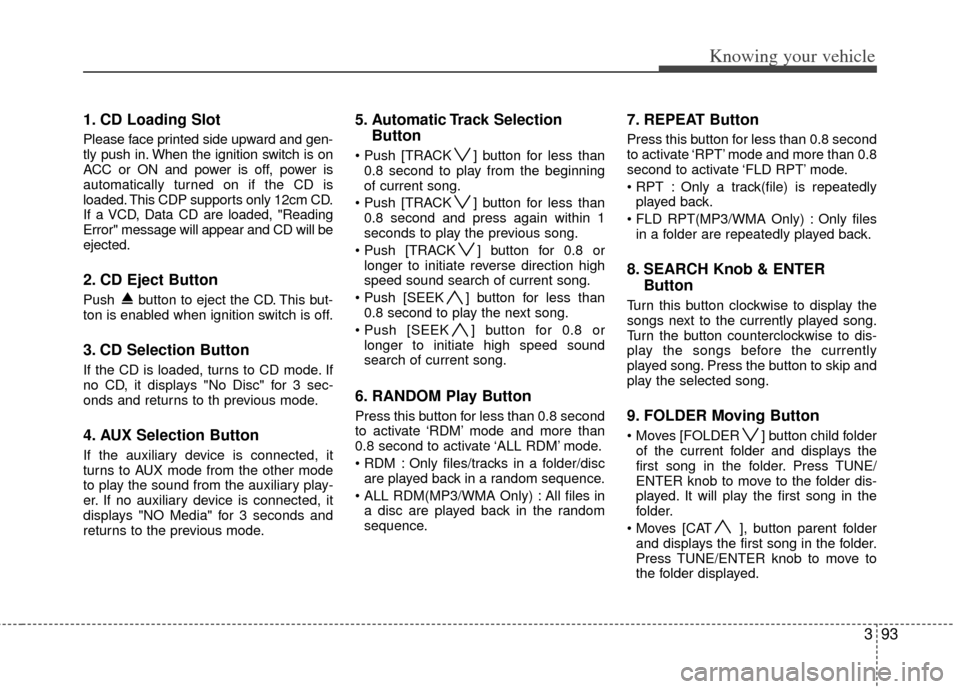
1. CD Loading Slot
Please face printed side upward and gen-
tly push in. When the ignition switch is on
ACC or ON and power is off, power is
automatically turned on if the CD is
loaded. This CDP supports only 12cm CD.
If a VCD, Data CD are loaded, "Reading
Error" message will appear and CD will be
ejected.
2. CD Eject Button
Push button to eject the CD. This but-
ton is enabled when ignition switch is off.
3. CD Selection Button
If the CD is loaded, turns to CD mode. If
no CD, it displays "No Disc" for 3 sec-
onds and returns to th previous mode.
4. AUX Selection Button
If the auxiliary device is connected, it
turns to AUX mode from the other mode
to play the sound from the auxiliary play-
er. If no auxiliary device is connected, it
displays "NO Media" for 3 seconds and
returns to the previous mode.
5. Automatic Track SelectionButton
] button for less than
0.8 second to play from the beginning
of current song.
] button for less than 0.8 second and press again within 1
seconds to play the previous song.
] button for 0.8 or longer to initiate reverse direction high
speed sound search of current song.
] button for less than 0.8 second to play the next song.
] button for 0.8 or longer to initiate high speed sound
search of current song.
6. RANDOM Play Button
Press this button for less than 0.8 second
to activate ‘RDM’ mode and more than
0.8 second to activate ‘ALL RDM’ mode.
Only files/tracks in a folder/discare played back in a random sequence.
All files in a disc are played back in the random
sequence.
7. REPEAT Button
Press this button for less than 0.8 second
to activate ‘RPT’ mode and more than 0.8
second to activate ‘FLD RPT’ mode.
Only a track(file) is repeatedlyplayed back.
Only files in a folder are repeatedly played back.
8. SEARCH Knob & ENTER Button
Turn this button clockwise to display the
songs next to the currently played song.
Turn the button counterclockwise to dis-
play the songs before the currently
played song. Press the button to skip and
play the selected song.
9. FOLDER Moving Button
] button child folder
of the current folder and displays the
first song in the folder. Press TUNE/
ENTER knob to move to the folder dis-
played. It will play the first song in the
folder.
], button parent folder and displays the first song in the folder.
Press TUNE/ENTER knob to move to
the folder displayed.
Page 119 of 240
47
Driving your vehicle
(Continued)
• Do not shift from N (Neutral) or P(Park) into D (Drive), or R (Reverse)
when the engine is above idle speed.
Transaxle ranges
P (Park)
This position locks the transaxle and pre-
vents the front wheels from rotating.
Always come to a complete stop before
shifting into this position.
✽ ✽ NOTICE
The transaxle may be damaged if you
shift into P (Park) while the vehicle is in
motion.
R (Reverse)
Use this position to drive the vehicle
backward.
✽ ✽NOTICE
Always come to a complete stop before
shifting into or out of R (Reverse); you
may damage the transaxle if you shift
into R while the vehicle is in motion.
N (Neutral)
With the gearshift in the N position, the
wheels and transaxle are not locked. The
vehicle will roll freely even on the slight-
est incline unless the parking brake or
service brakes are applied.
D (Drive)
This is the normal forward driving posi-
tion. The transaxle will automatically shift
through a 4-gear sequence, providing the
best fuel economy and power.
For extra power when passing another
vehicle or climbing grades, depress the
accelerator fully, at which time the
transaxle will automatically downshift to
the next lower gear.
✽ ✽NOTICE
Always come to a complete stop before
shifting into D (Drive).
(Continued)
Before leaving the driver’s seat,
always make sure the shift lever
is in the P (Park) position. Set the
parking brake fully, shut the
engine off and take the key with
you. Unexpected and sudden
vehicle movement can occur if
you do not follow these precau-
tions in the order specified.
Never leave a child unattended in a vehicle.
WARNING
Shifting into P (Park) while thevehicle is in motion will cause the
drive wheels to lock which will
cause you to lose control of the
vehicle.
Do not use the P (Park) position in place of the parking brake.
Always make sure the shift lever
is latched in the P (Park) position
so that it cannot be moved unless
the lock release button is pushed
in, AND set the parking brake fully.
(Continued)
Page 234 of 240

Index
29
Air bags··················\
··················\
··················\
··················\
··3-49Air bag warning label··················\
··················\
············3-63
Air bag warning light ··················\
··················\
············3-62
Curtain air bag··················\
··················\
··················\
·····3-54
Driver's air bag ··················\
··················\
··················\
····3-51
Front passenger’s air bag ··················\
··················\
······3-52
Side impact air bag··················\
··················\
················3-53
Air cleaner ··················\
··················\
··················\
···············7-18
Alarm system ··················\
··················\
··················\
·············3-5
Antenna ··················\
··················\
··················\
··················\
··3-82
Anti-lock brake system (ABS) ··················\
··················\
··4-12
Appearance care··················\
··················\
··················\
·······7-34 Exterior care ··················\
··················\
··················\
········7-34
Interior care ··················\
··················\
··················\
·········7-36
Armrest ··················\
··················\
··················\
··················\
··3-22
Audio system ··················\
··················\
··················\
···········3-84 Antenna ··················\
··················\
··················\
···············3-82
Steering wheel audio control ··················\
··················\
3-83
Auto lock mode (Passenger seat belt) ··················\
·········3-44
Automatic transaxle ··················\
··················\
··················\
···4-6 Ignition key interlock system ··················\
··················\
··4-9
Shift lock system ··················\
··················\
··················\
···4-9 Battery··················\
··················\
··················\
··················\
····7-21
Battery saver function ··················\
··················\
················4-31
Before driving ··················\
··················\
··················\
············5-4
Bottle holders, see cup holders ··················\
··················\
··3-76
Brake system··················\
··················\
··················\
··············4-9
Anti-lock brake system (ABS) ··················\
················4-12
Parking brake··················\
··················\
··················\
·······4-10
Power brakes ··················\
··················\
··················\
·········4-9
Brakes fluid··················\
··················\
··················\
··············7-14
Bulb wattage ··················\
··················\
··················\
··············8-4
Capacities (Lubricants) ··················\
··················\
················8-4
Care Exterior care ··················\
··················\
··················\
········7-34
Interior care ··················\
··················\
··················\
·········7-36
Tire care··················\
··················\
··················\
···············7-24
Central door lock switch··················\
··················\
············3-10
Certification label ··················\
··················\
··················\
····5-10
Changing tires ··················\
··················\
··················\
··········6-19
Checking tire inflation pressure··················\
··················\
·7-25
Child-protector rear door lock ··················\
··················\
···3-12
Child restraint system ··················\
··················\
················3-42 Auto lock mode (Passenger seat belt) ··················\
·····3-44
Lower anchor system ··················\
··················\
············3-47
Tether anchor system··················\
··················\
·············3-46
AB
C
Page 235 of 240

93
Index
Climate control air filter ··················\
··················\
············7-19
Climate control system ··················\
··················\
··············4-39Air conditioning ··················\
··················\
··················\
··4-44
Clock (Digital) ··················\
··················\
··················\
·········3-78
Combined instrument, see instrument cluster ···············4-20
Compact spare tire ··················\
··················\
··················\
···6-18
Compact spare tire replacement ··················\
··················\
6-19
Coolant ··················\
··················\
··················\
··················\
···7-12
Cooling fluid, see engine coolant ··················\
················7-12
Cruise control system ··················\
··················\
················4-14
Cup holder ··················\
··················\
··················\
···············3-76
Curtain air bag ··················\
··················\
··················\
·········3-54
Dashboard illumination, see instrument panel illumination ··················\
···········4-25
Dashboard, see instrument cluster ··················\
···············4-20
Defogging (Windshield) ··················\
··················\
············4-46
Defroster (Rear window) ··················\
··················\
···········4-38
Defrosting (Windshield) ··················\
··················\
············4-46
Digital clock··················\
··················\
··················\
·············3-78
Dimensions ··················\
··················\
··················\
················8-2
Display illumination, see instrument panel illumination ··················\
···········4-25
Displays, see instrument cluster ··················\
··················\
4-20
Door locks··················\
··················\
··················\
··················\
3-9 Central door lock switch ··················\
··················\
·······3-10
Child-protector rear door lock ··················\
················3-12 Drinks holders, see cup holders··················\
··················\
·3-76
Driver's air bag··················\
··················\
··················\
·········3-51
Driving at night ··················\
··················\
··················\
··········5-7
Driving in flooded areas ··················\
··················\
··············5-8
Driving in the rain··················\
··················\
··················\
······5-7
Economical operation ··················\
··················\
··················\
5-5
Emergency starting ··················\
··················\
··················\
····6-4
Jump starting ··················\
··················\
··················\
·········6-4
Push starting ··················\
··················\
··················\
··········6-5
Emergency trunk safety release ··················\
··················\
·3-65
Emergency while driving ··················\
··················\
·············6-2
Emission control system ··················\
··················\
··············5-2
Engine compartment ··················\
··················\
············2-4, 7-9
Engine coolant ··················\
··················\
··················\
·········7-11
Engine number ··················\
··················\
··················\
·········5-11
Engine oil ··················\
··················\
··················\
·················7-11\
Engine overheats ··················\
··················\
··················\
········6-3
Exterior care··················\
··················\
··················\
·············7-34
Flat tire ··················\
··················\
··················\
··················\
···6-17 Changing tires ··················\
··················\
··················\
·····6-19
Compact spare tire ··················\
··················\
················6-18
Jack and tools ··················\
··················\
··················\
······6-17
Removing and storing the spare tire ··················\
·······6-17
D
E
F