lock KIA Rio 2011 2.G User Guide
[x] Cancel search | Manufacturer: KIA, Model Year: 2011, Model line: Rio, Model: KIA Rio 2011 2.GPages: 240, PDF Size: 4.68 MB
Page 23 of 240
Knowing your vehicle
14
3
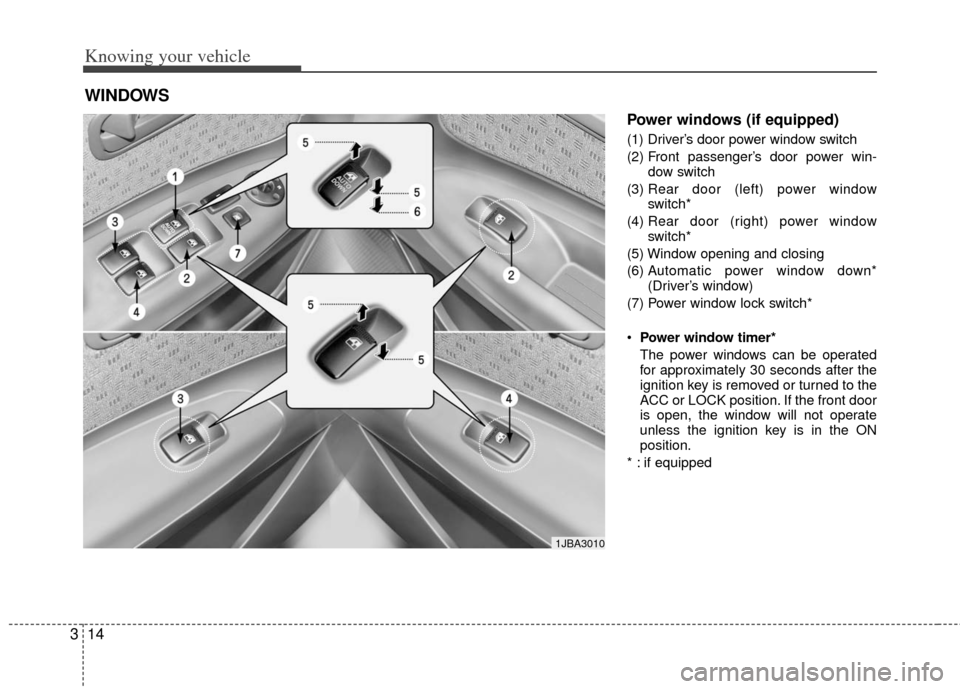
Power windows (if equipped)
(1) Driver’s door power window switch
(2) Front passenger’s door power win-
dow switch
(3) Rear door (left) power window
switch*
(4) Rear door (right) power window
switch*
(5) Window opening and closing
(6) A utomatic power window down*
(Driver’s window)
(7) Power window lock switch*
Power window timer*
The power windows can be operated
for approximately 30 seconds after the
ignition key is removed or turned to the
ACC or LOCK position. If the front door
is open, the window will not operate
unless the ignition key is in the ON
position.
* : if equipped
WINDOWS
1JBA3010
Page 24 of 240
315
Knowing your vehicle
Power windows (if equipped)
The ignition switch must be in the ON
position for power windows to operate.
Each door has a power window switch
that controls that door’s window.
However, the driver has a power window
lock switch which can block the operation
of passenger windows.
✽ ✽NOTICE
While driving with the rear windows
down or with the sunroof (if equipped)
in an open(or partially open position),
your vehicle may demonstrate a wind
buffeting or pulsation noise. This noise
is a normal occurrence and can be
reduced or eliminated by taking the fol-
lowing actions. If the noise occurs with
one or both of the rear windows down,
partially lower both front windows
approximately one inch. If you experi-
ence the noise with the snroof open,
slightly reduce the size of the sunroof
opening.
✽ ✽NOTICE
• To prevent the power window system
from the possibility of damage, do not
open or close two windows at the same
time. This will also ensure the longevi-
ty of the fuse. (Continued)(Continued)
• Never try to operate the main switch
on the driver's door and the individ-
ual door window switch in opposing
directions at the same time. If this is
done, the window will stop and cannot
be opened or closed.
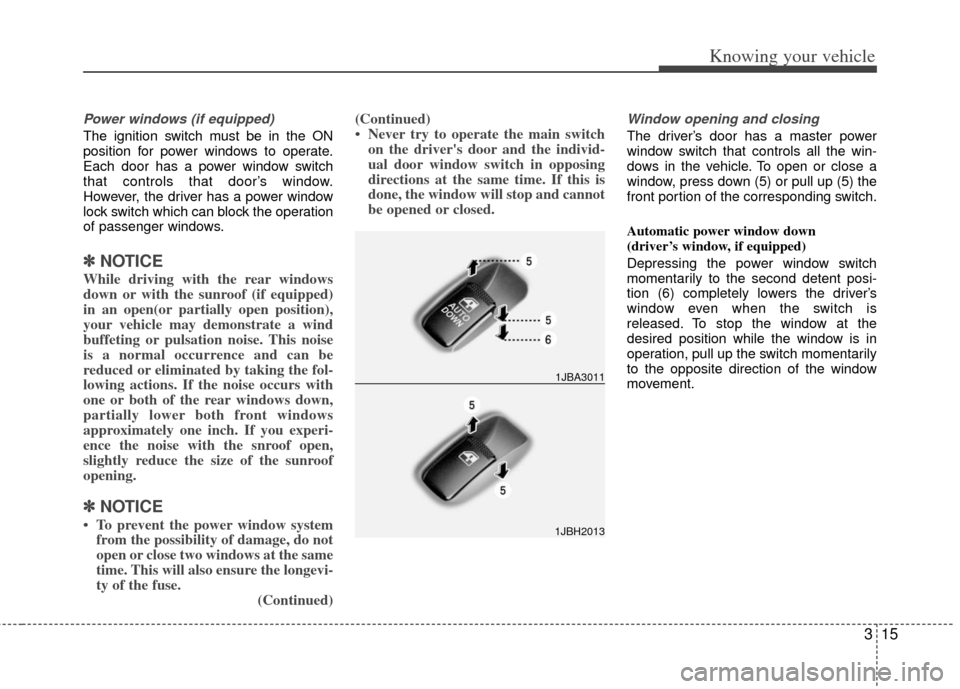
Window opening and closing
The driver’s door has a master power
window switch that controls all the win-
dows in the vehicle. To open or close a
window, press down (5) or pull up (5) the
front portion of the corresponding switch.
Automatic power window down
(driver’s window, if equipped)
Depressing the power window switch
momentarily to the second detent posi-
tion (6) completely lowers the driver’s
window even when the switch is
released. To stop the window at the
desired position while the window is in
operation, pull up the switch momentarily
to the opposite direction of the window
movement.
1JBH20131JBA3011
Page 25 of 240
Knowing your vehicle
16
3
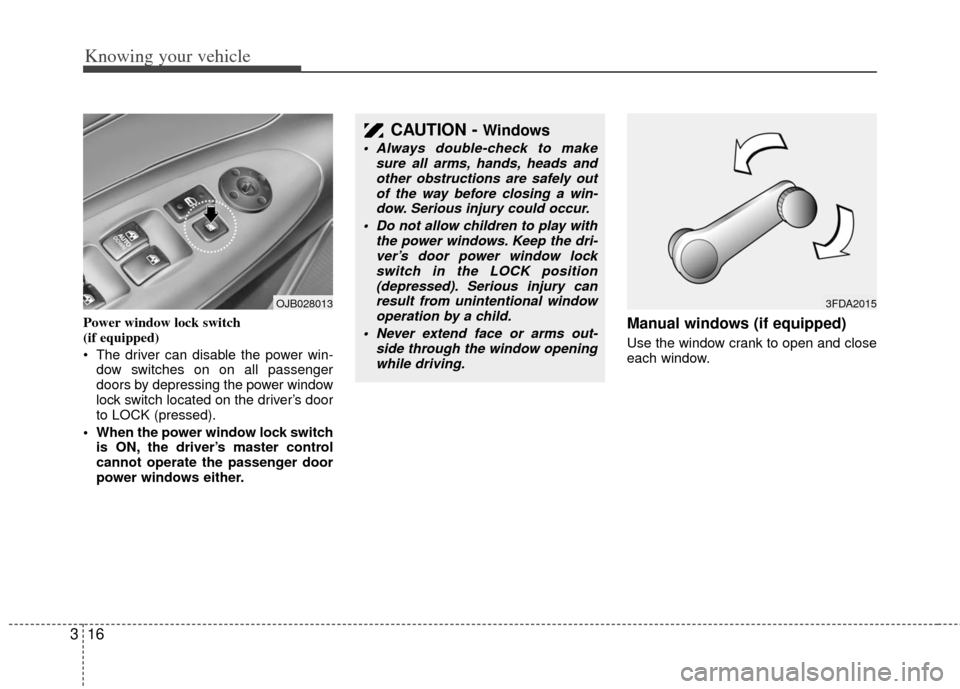
Power window lock switch
(if equipped)
The driver can disable the power win-
dow switches on on all passenger
doors by depressing the power window
lock switch located on the driver’s door
to LOCK (pressed).
When the power window lock switch is ON, the driver’s master control
cannot operate the passenger door
power windows either.Manual windows (if equipped)
Use the window crank to open and close
each window.
CAUTION - Windows
Always double-check to make sure all arms, hands, heads andother obstructions are safely outof the way before closing a win-dow. Serious injury could occur.
Do not allow children to play with the power windows. Keep the dri-ver’s door power window lockswitch in the LOCK position(depressed). Serious injury can result from unintentional windowoperation by a child.
Never extend face or arms out- side through the window openingwhile driving.
3FDA2015OJB028013
Page 27 of 240
Knowing your vehicle
18
3
Front seat adjustment
Adjusting the seat forward and back-
ward
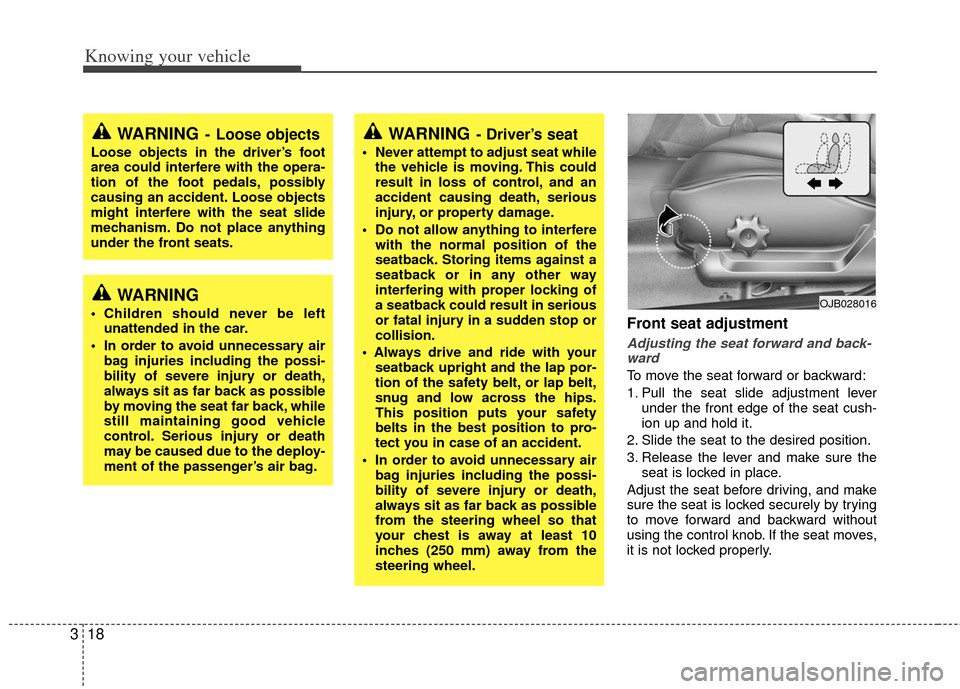
To move the seat forward or backward:
1. Pull the seat slide adjustment lever under the front edge of the seat cush-
ion up and hold it.
2. Slide the seat to the desired position.
3. Release the lever and make sure the seat is locked in place.
Adjust the seat before driving, and make
sure the seat is locked securely by trying
to move forward and backward without
using the control knob. If the seat moves,
it is not locked properly.
WARNING- Loose objects
Loose objects in the driver’s foot
area could interfere with the opera-
tion of the foot pedals, possibly
causing an accident. Loose objects
might interfere with the seat slide
mechanism. Do not place anything
under the front seats.
WARNING
Children should never be left unattended in the car.
In order to avoid unnecessary air bag injuries including the possi-
bility of severe injury or death,
always sit as far back as possible
by moving the seat far back, while
still maintaining good vehicle
control. Serious injury or death
may be caused due to the deploy-
ment of the passenger’s air bag.
WARNING- Driver’s seat
Never attempt to adjust seat whilethe vehicle is moving. This could
result in loss of control, and an
accident causing death, serious
injury, or property damage.
Do not allow anything to interfere with the normal position of the
seatback. Storing items against a
seatback or in any other way
interfering with proper locking of
a seatback could result in serious
or fatal injury in a sudden stop or
collision.
seatback upright and the lap por-
tion of the safety belt, or lap belt,
snug and low across the hips.
This position puts your safety
belts in the best position to pro-
tect you in case of an accident.
In order to avoid unnecessary air bag injuries including the possi-
bility of severe injury or death,
always sit as far back as possible
from the steering wheel so that
your chest is away at least 10
inches (250 mm) away from the
steering wheel.
OJB028016
Page 28 of 240
319
Knowing your vehicle
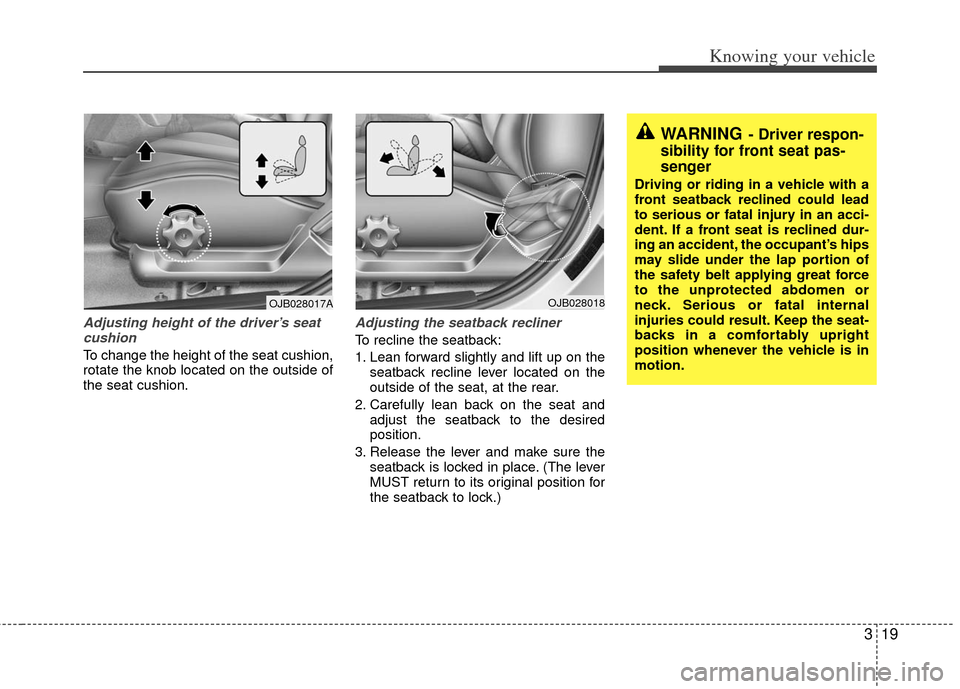
Adjusting height of the driver’s seatcushion
To change the height of the seat cushion,
rotate the knob located on the outside of
the seat cushion.
Adjusting the seatback recliner
To recline the seatback:
1. Lean forward slightly and lift up on the seatback recline lever located on the
outside of the seat, at the rear.
2. Carefully lean back on the seat and adjust the seatback to the desired
position.
3. Release the lever and make sure the seatback is locked in place. (The lever
MUST return to its original position for
the seatback to lock.)
WARNING- Driver respon-
sibility for front seat pas-
senger
Driving or riding in a vehicle with a
front seatback reclined could lead
to serious or fatal injury in an acci-
dent. If a front seat is reclined dur-
ing an accident, the occupant’s hips
may slide under the lap portion of
the safety belt applying great force
to the unprotected abdomen or
neck. Serious or fatal internal
injuries could result. Keep the seat-
backs in a comfortably upright
position whenever the vehicle is in
motion.
OJB028017AOJB028018
Page 31 of 240
Knowing your vehicle
22
3
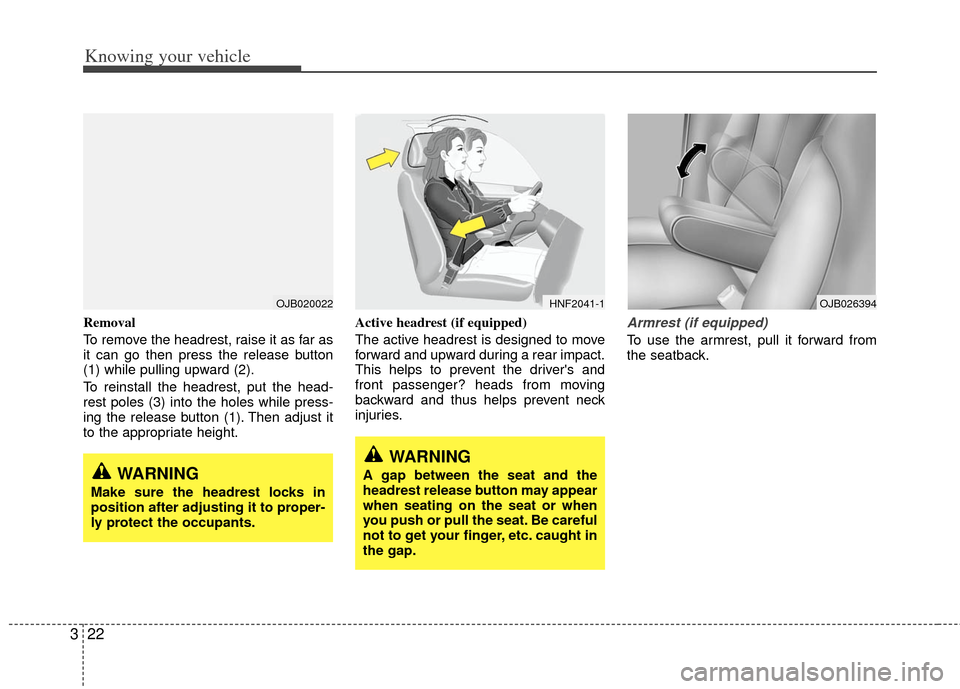
Removal
To remove the headrest, raise it as far as
it can go then press the release button
(1) while pulling upward (2).
To reinstall the headrest, put the head-
rest poles (3) into the holes while press-
ing the release button (1). Then adjust it
to the appropriate height. Active headrest (if equipped)
The active headrest is designed to move
forward and upward during a rear impact.
This helps to prevent the driver's and
front passenger? heads from moving
backward and thus helps prevent neck
injuries.Armrest (if equipped)
To use the armrest, pull it forward from
the seatback.
OJB026394OJB020022HNF2041-1
WARNING
Make sure the headrest locks in
position after adjusting it to proper-
ly protect the occupants.
WARNING
A gap between the seat and the
headrest release button may appear
when seating on the seat or when
you push or pull the seat. Be careful
not to get your finger, etc. caught in
the gap.
Page 32 of 240
323
Knowing your vehicle
Rear seat
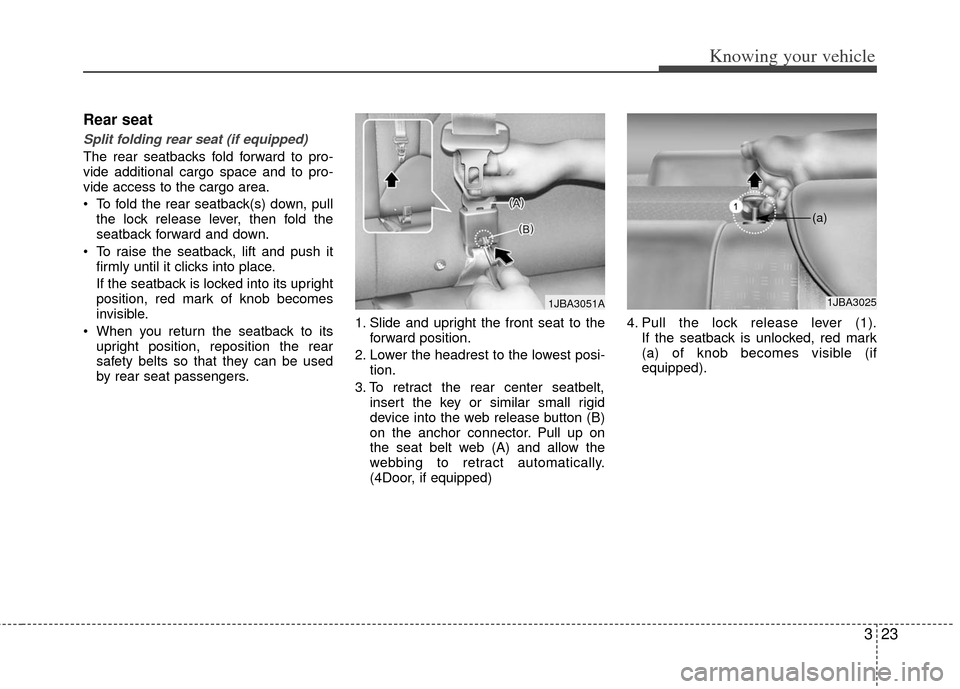
Split folding rear seat (if equipped)
The rear seatbacks fold forward to pro-
vide additional cargo space and to pro-
vide access to the cargo area.
To fold the rear seatback(s) down, pullthe lock release lever, then fold the
seatback forward and down.
To raise the seatback, lift and push it firmly until it clicks into place.
If the seatback is locked into its upright
position, red mark of knob becomes
invisible.
When you return the seatback to its upright position, reposition the rear
safety belts so that they can be used
by rear seat passengers. 1. Slide and upright the front seat to the
forward position.
2. Lower the headrest to the lowest posi- tion.
3. To retract the rear center seatbelt, insert the key or similar small rigid
device into the web release button (B)
on the anchor connector. Pull up on
the seat belt web (A) and allow the
webbing to retract automatically.
(4Door, if equipped) 4. Pull the lock release lever (1).
If the seatback is unlocked, red mark
(a) of knob becomes visible (if
equipped).
1JBA3025
(a)
1JBA3051A
Page 34 of 240
325
Knowing your vehicle
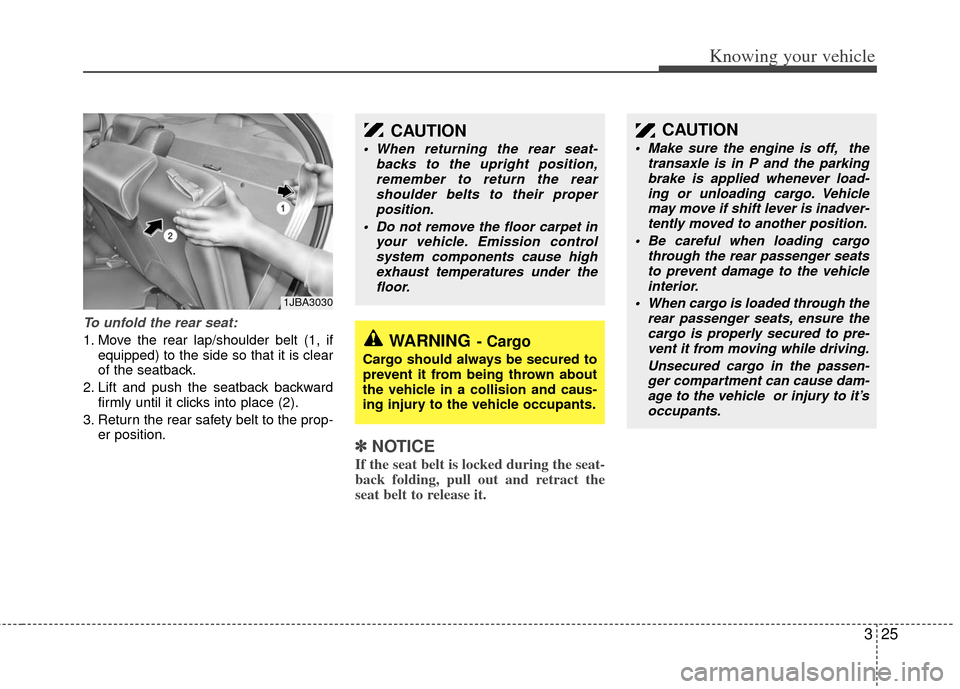
To unfold the rear seat:
1. Move the rear lap/shoulder belt (1, ifequipped) to the side so that it is clear
of the seatback.
2. Lift and push the seatback backward firmly until it clicks into place (2).
3. Return the rear safety belt to the prop- er position.
✽ ✽NOTICE
If the seat belt is locked during the seat-
back folding, pull out and retract the
seat belt to release it.
1JBA3030
CAUTION
When returning the rear seat-
backs to the upright position,remember to return the rearshoulder belts to their proper position.
Do not remove the floor carpet in your vehicle. Emission controlsystem components cause highexhaust temperatures under thefloor.
WARNING- Cargo
Cargo should always be secured to
prevent it from being thrown about
the vehicle in a collision and caus-
ing injury to the vehicle occupants.
CAUTION
Make sure the engine is off, the transaxle is in P and the parkingbrake is applied whenever load- ing or unloading cargo. Vehiclemay move if shift lever is inadver- tently moved to another position.
Be careful when loading cargo through the rear passenger seatsto prevent damage to the vehicleinterior.
When cargo is loaded through the rear passenger seats, ensure thecargo is properly secured to pre- vent it from moving while driving.
Unsecured cargo in the passen-ger compartment can cause dam- age to the vehicle or injury to it’soccupants.
Page 36 of 240
327
Knowing your vehicle
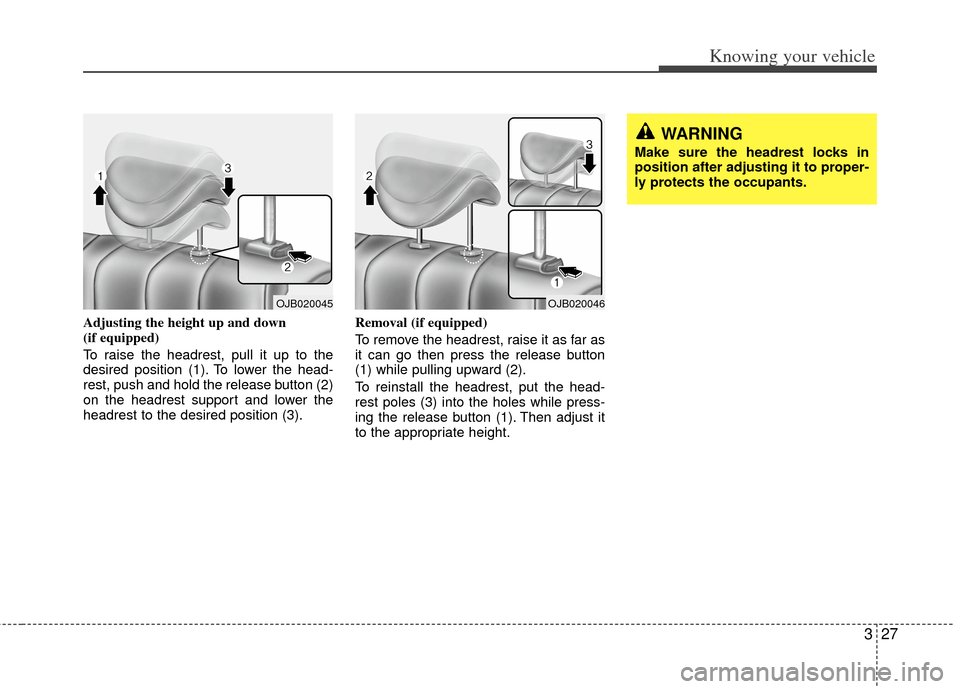
Adjusting the height up and down
(if equipped)
To raise the headrest, pull it up to the
desired position (1). To lower the head-
rest, push and hold the release button (2)
on the headrest support and lower the
headrest to the desired position (3).Removal (if equipped)
To remove the headrest, raise it as far as
it can go then press the release button
(1) while pulling upward (2).
To reinstall the headrest, put the head-
rest poles (3) into the holes while press-
ing the release button (1). Then adjust it
to the appropriate height.
OJB020045OJB020046
WARNING
Make sure the headrest locks in
position after adjusting it to proper-
ly protects the occupants.
Page 39 of 240
Knowing your vehicle
30
3
Safety belt restraint system We strongly recommend that the driver
and all passengers be properly
restrained at all times by using the safety
belts provided with the vehicle. Proper
use of the safety belts decreases the risk
of severe injury or death in accidents or
sudden stops. In most states, and in
Canada, the law requires their use.
All seats have lap/shoulder belts. Inertial
locks in the safety belt retractors allow all
of the lap/shoulder safety belts to remain
unlocked during normal vehicle opera-
tion. This allows the occupants some
freedom of movement and increased
comfort while using the safety belts. If a
force is applied to the vehicle, such as a
strong stop, a sharp turn, or a collision,
the safety belt retractors will automatical-
ly lock the safety belts.
Since the inertial locks do not require a
collision in order to lock up, you may
become aware of the safety belts locking
while braking or going around sharp cor-
ners.
Always use the rear seat position(s) to
install your child restraint(s). The rear safety belts use a special auto-
lock feature designed to allow a child
restraint to be used in these positions
without an added locking clip. They nor-
mally lock only under extreme or emer-
gency conditions (emergency lock
mode). However they can be adjusted so
that they remain fixed and locked when a
child restraint system is placed in these
positions. (Use this auto-lock mode only
to secure a child restraint, never for pas-
sengers restrained by the safety belts.)
Page 3-42 gives instructions on placing
the safety belt in the auto lock mode.
The drivers safety belt can only operate
in the emergency lock mode.
WARNING- Safety belts
To minimize the risk of serious or
fatal injury in an accident, the driv-
er and all passengers should use
the appropriate safety restraints for
their age and size. The presence of
air bags does not change the need
to be properly restrained by a safe-
ty belt or size-appropriate child
restraint. In fact, air bags are
designed to work the best when
passengers are correctly restrained
in the vehicle.
Be sure you are familiar with the
information in this section,
including the information on
infant and child restraints.
Read the safety warnings on the sun visors of your vehicle also.
WARNING- Child restraint
in front seat
Never install a child restraint sys-
tem in the front passenger position,
as an inflating air bag could cause
serious or fatal injury to a child in
that position.