lock KIA Rio 2011 2.G Owner's Guide
[x] Cancel search | Manufacturer: KIA, Model Year: 2011, Model line: Rio, Model: KIA Rio 2011 2.GPages: 240, PDF Size: 4.68 MB
Page 43 of 240
Knowing your vehicle
34
3
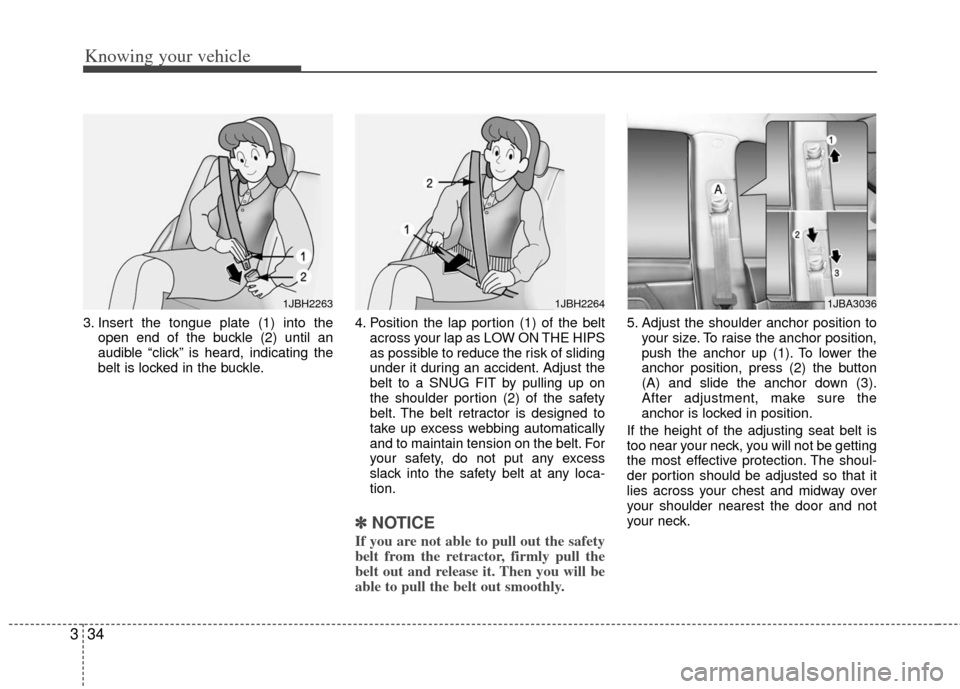
3. Insert the tongue plate (1) into the
open end of the buckle (2) until an
audible “click” is heard, indicating the
belt is locked in the buckle. 4. Position the lap portion (1) of the belt
across your lap as LOW ON THE HIPS
as possible to reduce the risk of sliding
under it during an accident. Adjust the
belt to a SNUG FIT by pulling up on
the shoulder portion (2) of the safety
belt. The belt retractor is designed to
take up excess webbing automatically
and to maintain tension on the belt. For
your safety, do not put any excess
slack into the safety belt at any loca-
tion.
✽ ✽NOTICE
If you are not able to pull out the safety
belt from the retractor, firmly pull the
belt out and release it. Then you will be
able to pull the belt out smoothly.
5. Adjust the shoulder anchor position to
your size. To raise the anchor position,
push the anchor up (1). To lower the
anchor position, press (2) the button
(A) and slide the anchor down (3).
After adjustment, make sure the
anchor is locked in position.
If the height of the adjusting seat belt is
too near your neck, you will not be getting
the most effective protection. The shoul-
der portion should be adjusted so that it
lies across your chest and midway over
your shoulder nearest the door and not
your neck.
1JBH22631JBH22641JBA3036
Page 44 of 240
335
Knowing your vehicle
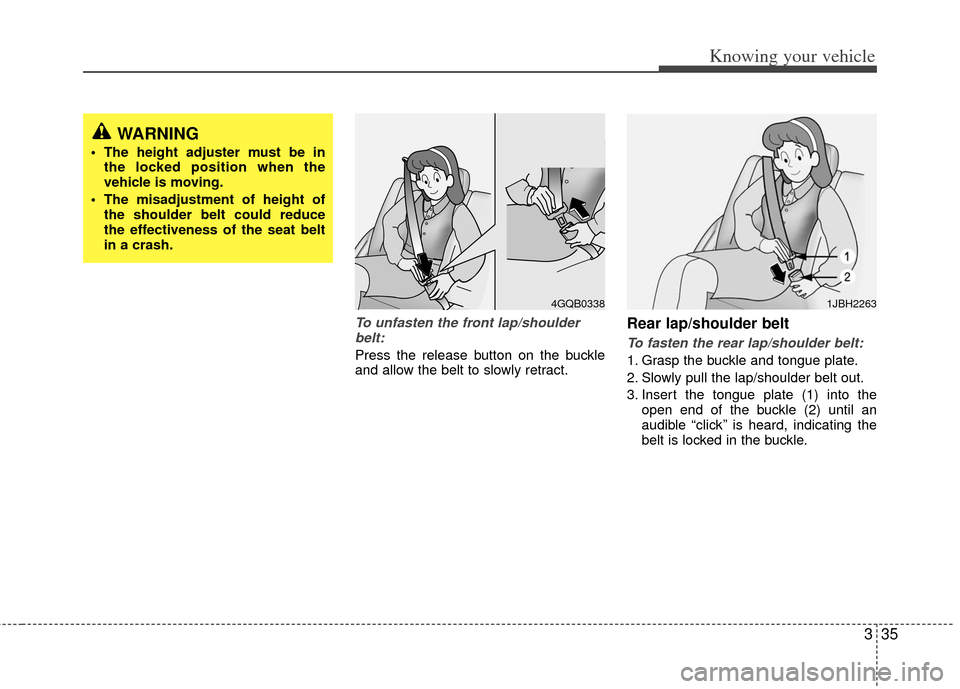
To unfasten the front lap/shoulderbelt:
Press the release button on the buckle
and allow the belt to slowly retract.
Rear lap/shoulder belt
To fasten the rear lap/shoulder belt:
1. Grasp the buckle and tongue plate.
2. Slowly pull the lap/shoulder belt out.
3. Insert the tongue plate (1) into the open end of the buckle (2) until an
audible “click’’ is heard, indicating the
belt is locked in the buckle.
4GQB03381JBH2263
WARNING
The height adjuster must be inthe locked position when the
vehicle is moving.
The misadjustment of height of the shoulder belt could reduce
the effectiveness of the seat belt
in a crash.
Page 46 of 240
337
Knowing your vehicle
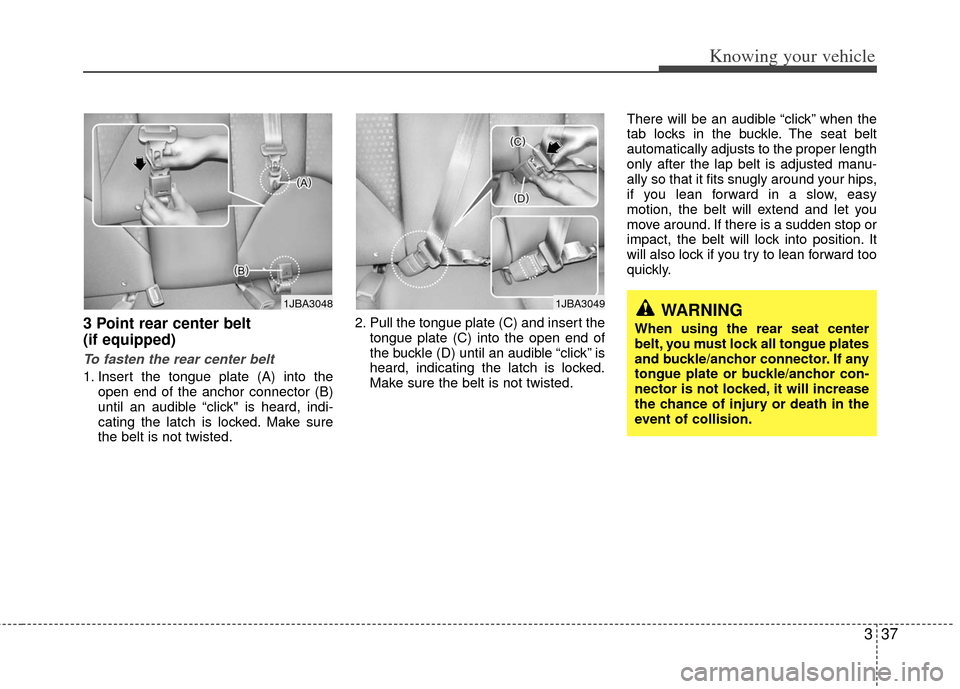
3 Point rear center belt
(if equipped)
To fasten the rear center belt
1. Insert the tongue plate (A) into theopen end of the anchor connector (B)
until an audible “click" is heard, indi-
cating the latch is locked. Make sure
the belt is not twisted. 2. Pull the tongue plate (C) and insert the
tongue plate (C) into the open end of
the buckle (D) until an audible “click” is
heard, indicating the latch is locked.
Make sure the belt is not twisted. There will be an audible “click” when the
tab locks in the buckle. The seat belt
automatically adjusts to the proper length
only after the lap belt is adjusted manu-
ally so that it fits snugly around your hips,
if you lean forward in a slow, easy
motion, the belt will extend and let you
move around. If there is a sudden stop or
impact, the belt will lock into position. It
will also lock if you try to lean forward too
quickly.
1JBA3048WARNING
When using the rear seat center
belt, you must lock all tongue plates
and buckle/anchor connector. If any
tongue plate or buckle/anchor con-
nector is not locked, it will increase
the chance of injury or death in the
event of collision.
1JBA3049
Page 47 of 240
Knowing your vehicle
38
3
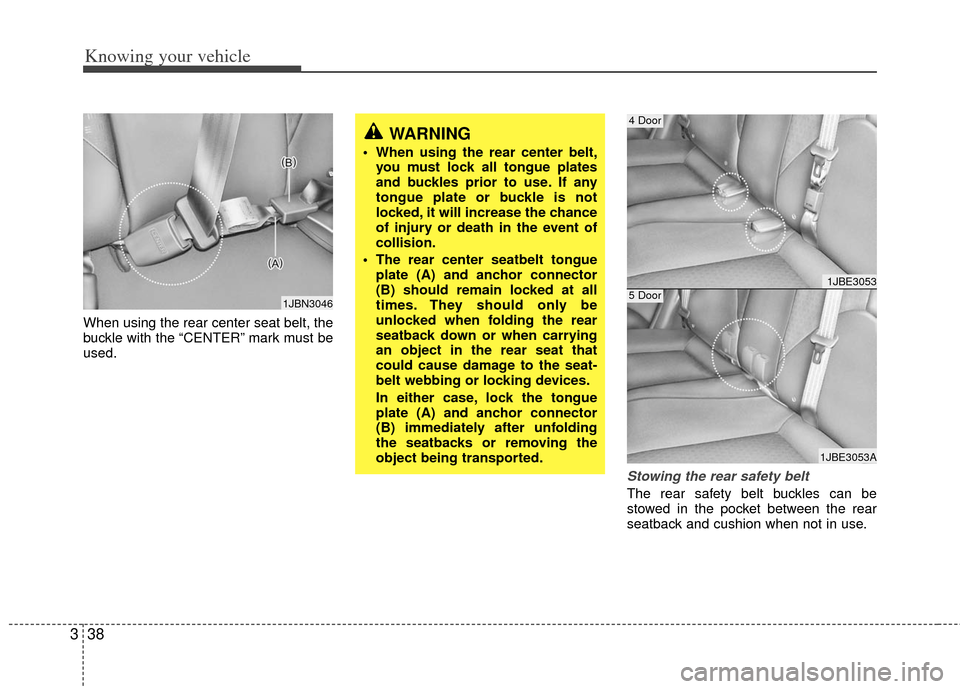
When using the rear center seat belt, the
buckle with the “CENTER” mark must be
used.
Stowing the rear safety belt
The rear safety belt buckles can be
stowed in the pocket between the rear
seatback and cushion when not in use.
1JBN3046
1JBE3053
1JBE3053A
4 Door
5 Door
WARNING
When using the rear center belt,
you must lock all tongue plates
and buckles prior to use. If any
tongue plate or buckle is not
locked, it will increase the chance
of injury or death in the event of
collision.
The rear center seatbelt tongue plate (A) and anchor connector
(B) should remain locked at all
times. They should only be
unlocked when folding the rear
seatback down or when carrying
an object in the rear seat that
could cause damage to the seat-
belt webbing or locking devices.
In either case, lock the tongue
plate (A) and anchor connector
(B) immediately after unfolding
the seatbacks or removing the
object being transported.
Page 52 of 240
343
Knowing your vehicle
Installing a child restraint system
For safety reasons, we recommend that
the child restraint system be used in the
rear seats.
Never place a rear-facing child
restraint in the front passenger seat,
because of the danger that an inflat-
ing passenger side air bag could
impact the rear-facing child restraint
and kill the child.
Since all passenger safety belts move
freely under normal conditions and only
lock under extreme or emergency condi-
tions (emergency lock mode), you must
manually change these safety belts to
the auto lock mode to secure a child
restraint.(Continued)
If the vehicle’s safety belt will notproperly fit the child, you must
use an appropriate child restraint
or booster seat in the rear.
Never allow a child to stand up or kneel while the vehicle is moving.
Never use an infant carrier or child seat that "hooks" over a
seatback. It will not provide ade-
quate protection in an accident.
Never allow a child to be held while they are in a moving vehi-
cle, as this could result in serious
injury or death to the child in the
event of an accident or sudden
stop. Holding a child in a moving
vehicle does not provide the child
with any protection during an
accident, even if the person hold-
ing the child is wearing a seat
belt.WARNING- Child seat
installation
Before installing the child
restraint system, read the instruc-
tions supplied by the child
restraint system manufacturer.
If the safety belt does not operate as described in this section, have
the system checked immediately
by your authorized Kia dealer.
Failure to observe this manual's instructions regarding child
restraint system and the instruc-
tions provided with the child
restraint system could increase
the chance and/or severity of
injury or death in an accident.
Page 53 of 240
Knowing your vehicle
44
3
Placing a passenger safety belt
into the auto lock mode
The use of the auto lock mode will
ensure that the normal movement of the
child in the vehicle does not cause the
safety belt to be pulled out and loosen
the firmness of its hold on the child
restraint system. To secure a child
restraint system, use the following proce-
dure.
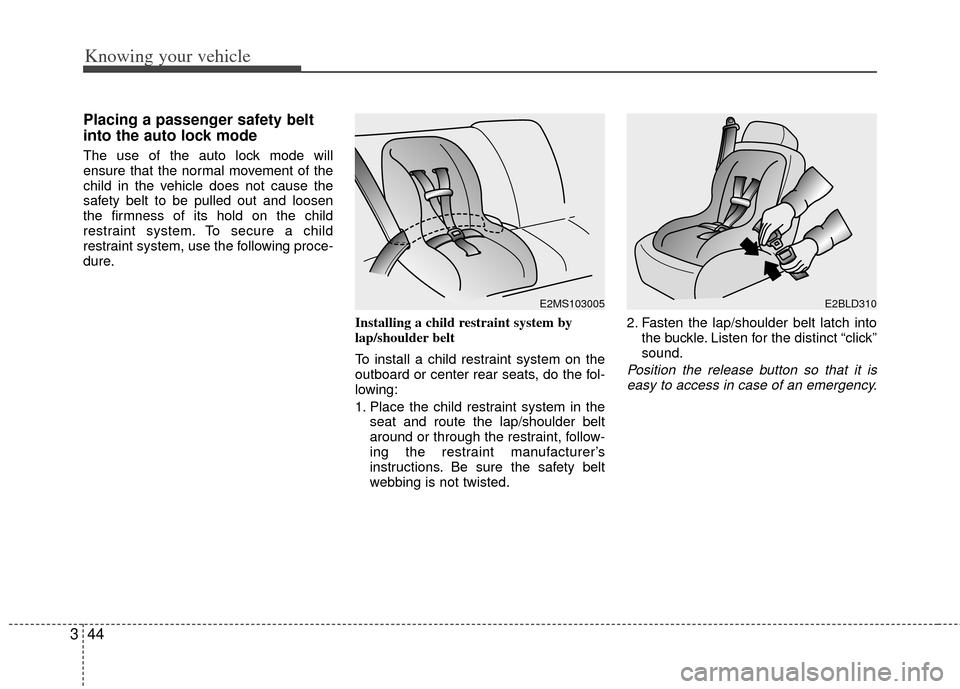
Installing a child restraint system by
lap/shoulder belt
To install a child restraint system on the
outboard or center rear seats, do the fol-
lowing:
1. Place the child restraint system in theseat and route the lap/shoulder belt
around or through the restraint, follow-
ing the restraint manufacturer’s
instructions. Be sure the safety belt
webbing is not twisted. 2. Fasten the lap/shoulder belt latch into
the buckle. Listen for the distinct “click”
sound.
Position the release button so that it iseasy to access in case of an emergency.
E2MS103005E2BLD310
Page 54 of 240
345
Knowing your vehicle
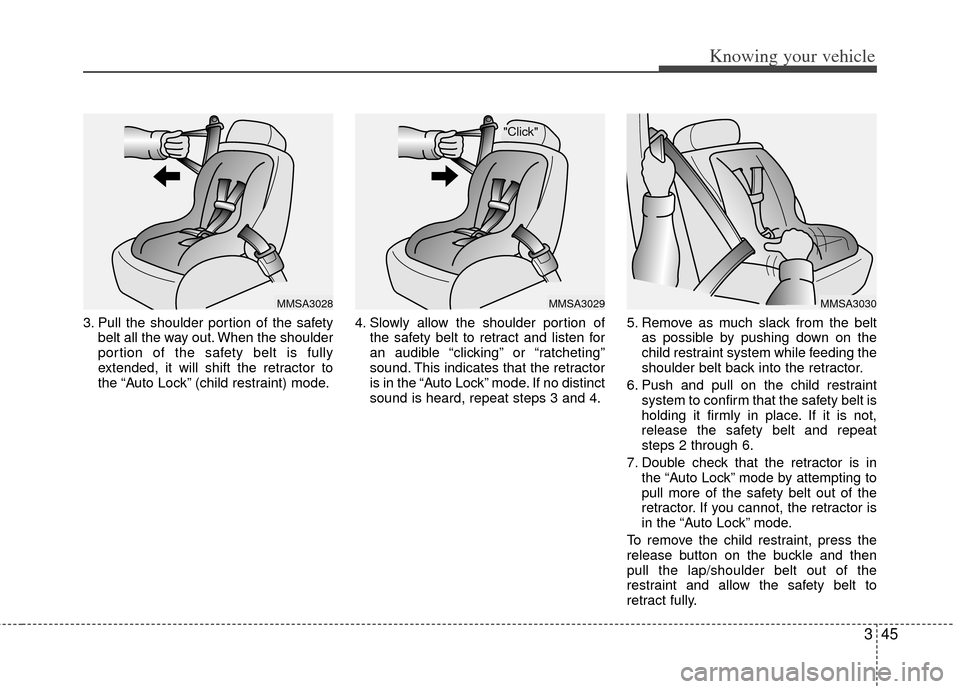
3. Pull the shoulder portion of the safetybelt all the way out. When the shoulder
portion of the safety belt is fully
extended, it will shift the retractor to
the “Auto Lock” (child restraint) mode. 4. Slowly allow the shoulder portion of
the safety belt to retract and listen for
an audible “clicking” or “ratcheting”
sound. This indicates that the retractor
is in the “Auto Lock” mode. If no distinct
sound is heard, repeat steps 3 and 4. 5. Remove as much slack from the belt
as possible by pushing down on the
child restraint system while feeding the
shoulder belt back into the retractor.
6. Push and pull on the child restraint system to confirm that the safety belt is
holding it firmly in place. If it is not,
release the safety belt and repeat
steps 2 through 6.
7. Double check that the retractor is in the “Auto Lock” mode by attempting to
pull more of the safety belt out of the
retractor. If you cannot, the retractor is
in the “Auto Lock” mode.
To remove the child restraint, press the
release button on the buckle and then
pull the lap/shoulder belt out of the
restraint and allow the safety belt to
retract fully.
"Click"
MMSA3029MMSA3028MMSA3030
Page 55 of 240
Knowing your vehicle
46
3
When the safety belt is allowed to
retract to its fully stowed position, the
retractor will automatically switch
from the “Auto Lock” mode to the
emergency lock mode for normal
adult usage.
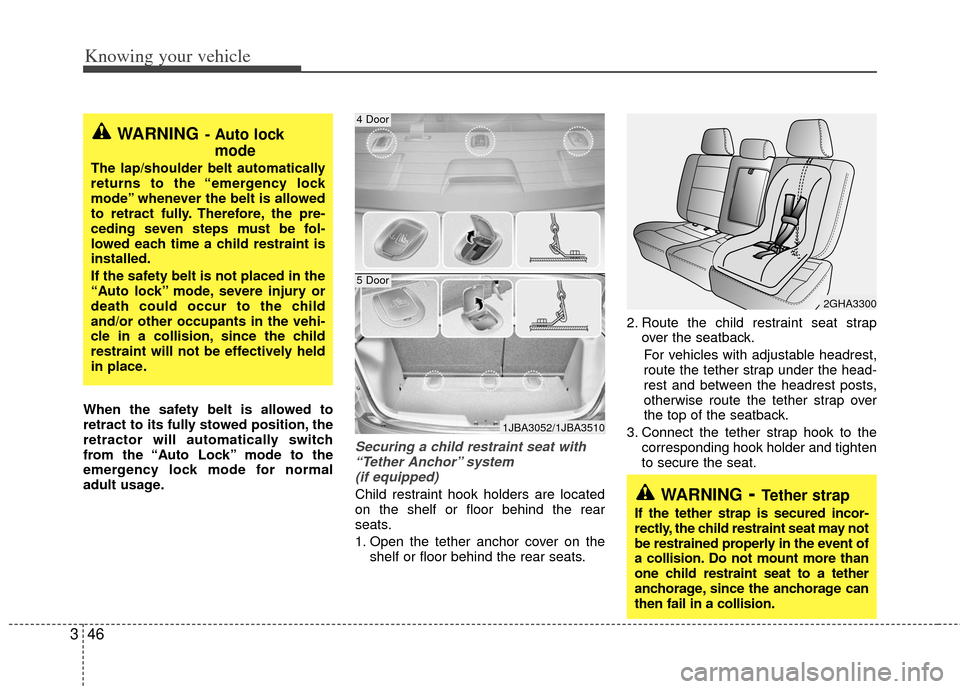
Securing a child restraint seat with
“Tether Anchor” system (if equipped)
Child restraint hook holders are located
on the shelf or floor behind the rear
seats.
1. Open the tether anchor cover on the shelf or floor behind the rear seats. 2. Route the child restraint seat strap
over the seatback.
For vehicles with adjustable headrest,
route the tether strap under the head-
rest and between the headrest posts,
otherwise route the tether strap over
the top of the seatback.
3. Connect the tether strap hook to the corresponding hook holder and tighten
to secure the seat.
WARNING- Auto lockmode
The lap/shoulder belt automatically
returns to the “emergency lock
mode” whenever the belt is allowed
to retract fully. Therefore, the pre-
ceding seven steps must be fol-
lowed each time a child restraint is
installed.
If the safety belt is not placed in the
“Auto lock” mode, severe injury or
death could occur to the child
and/or other occupants in the vehi-
cle in a collision, since the child
restraint will not be effectively held
in place.
1JBA3052/1JBA3510
4 Door
5 Door
2GHA3300
WARNING- Tether strap
If the tether strap is secured incor-
rectly, the child restraint seat may not
be restrained properly in the event of
a collision. Do not mount more than
one child restraint seat to a tether
anchorage, since the anchorage can
then fail in a collision.
Page 63 of 240
Knowing your vehicle
54
3
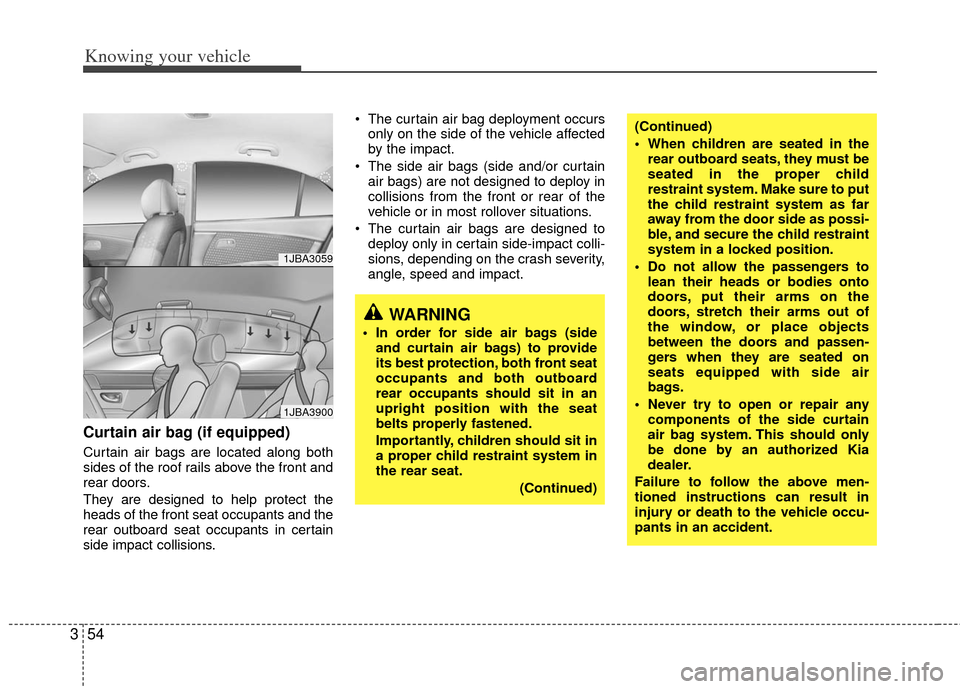
Curtain air bag (if equipped)
Curtain air bags are located along both
sides of the roof rails above the front and
rear doors.
They are designed to help protect the
heads of the front seat occupants and the
rear outboard seat occupants in certain
side impact collisions. The curtain air bag deployment occurs
only on the side of the vehicle affected
by the impact.
The side air bags (side and/or curtain air bags) are not designed to deploy in
collisions from the front or rear of the
vehicle or in most rollover situations.
The curtain air bags are designed to deploy only in certain side-impact colli-
sions, depending on the crash severity,
angle, speed and impact.
1JBA3059
1JBA3900
WARNING
In order for side air bags (sideand curtain air bags) to provide
its best protection, both front seat
occupants and both outboard
rear occupants should sit in an
upright position with the seat
belts properly fastened.
Importantly, children should sit in
a proper child restraint system in
the rear seat.
(Continued)
(Continued)
When children are seated in therear outboard seats, they must be
seated in the proper child
restraint system. Make sure to put
the child restraint system as far
away from the door side as possi-
ble, and secure the child restraint
system in a locked position.
Do not allow the passengers to lean their heads or bodies onto
doors, put their arms on the
doors, stretch their arms out of
the window, or place objects
between the doors and passen-
gers when they are seated on
seats equipped with side air
bags.
Never try to open or repair any components of the side curtain
air bag system. This should only
be done by an authorized Kia
dealer.
Failure to follow the above men-
tioned instructions can result in
injury or death to the vehicle occu-
pants in an accident.
Page 71 of 240

Knowing your vehicle
62
3
Air bag warning light
The purpose of air bag warning light in
your instrument panel is to alert you of a
potential problem with your air bag -
Supplemental Restraint System (SRS).
When the ignition switch is turned ON,
the indicator light should blink or illumi-
nate for approximately 6 seconds, then
go off.
Have the system checked if:
The light does not turn on briefly when
you turn the ignition ON.
The light stays on after the engine starts.
The light comes on while the vehicle is in motion.
Air bag (Supplemental Restraint
System) service
Your Supplemental Restraint System is
virtually maintenance-free. There are no
parts which you can service.
You must have the system serviced
under the following circumstances:
If an air bag ever inflates, the air bagmust be replaced. Do not try to remove
or discard the air bag by yourself. This
must be done by an authorized Kia
dealer.
If the air bag warning indicator light alerts you to a problem, have the air
bag system checked as soon as possi-
ble. Otherwise, your air bag system
may be ineffective.
WARNING
Never put child restraint in thefront passenger seat. If the front
passenger air bag inflates, it may
cause severe or fatal injuries.
When children are seated in the rear outboard seats in which cur-
tain air bags are equipped, be
sure to put the child restraint sys-
tem as far away from the door
side as possible, and secure the
child restraint system to be
locked in position.
Inflation of side or curtain air bag
(if equipped) could cause severe
injury or death due to the expan-
sion impact.
CAUTION - No modification
Do not modify any part of the air bagsystem. Modification could make the air bag system ineffective orcould cause unnecessary deploy- ment.
W7-147