Rear KIA Rio 2014 3.G Owner's Manual
[x] Cancel search | Manufacturer: KIA, Model Year: 2014, Model line: Rio, Model: KIA Rio 2014 3.GPages: 397, PDF Size: 7.56 MB
Page 10 of 397
Your vehicle at a glance
22
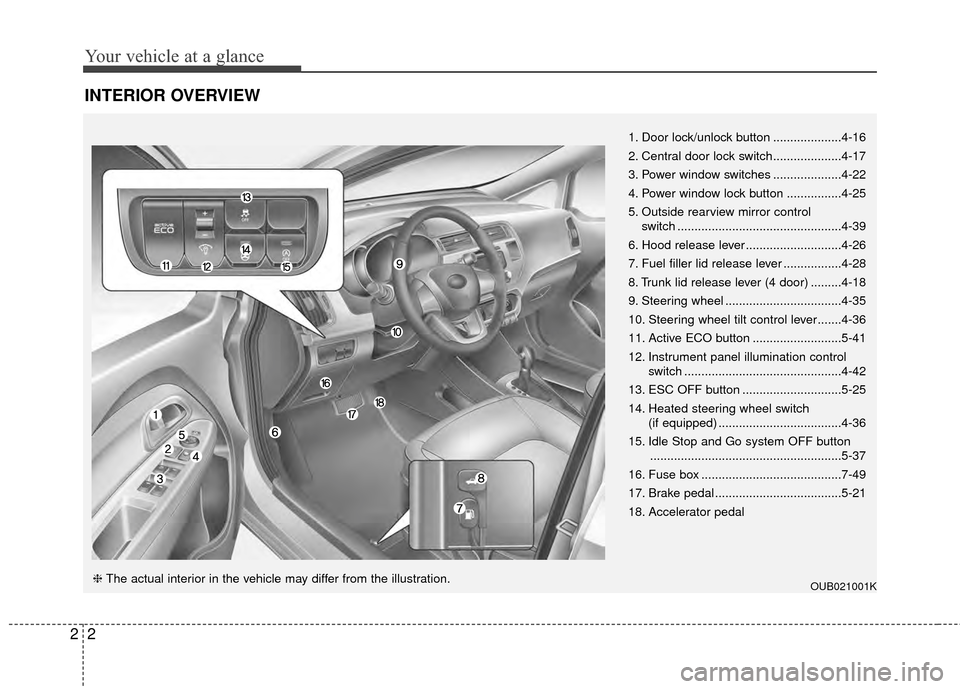
INTERIOR OVERVIEW
OUB021001K
1. Door lock/unlock button ....................4-16
2. Central door lock switch....................4-17
3. Power window switches ....................4-22
4. Power window lock button ................4-25
5. Outside rearview mirror control switch ................................................4-39
6. Hood release lever ............................4-26
7. Fuel filler lid release lever .................4-28
8. Trunk lid release lever (4 door) .........4-18
9. Steering wheel ..................................4-35
10. Steering wheel tilt control lever.......4-36
11. Active ECO button ..........................5-41
12. Instrument panel illumination control switch ..............................................4-42
13. ESC OFF button .............................5-25
14. Heated steering wheel switch (if equipped) ....................................4-36
15. Idle Stop and Go system OFF button ........................................................5-37
16. Fuse box .........................................7-49
17. Brake pedal .....................................5-21
18. Accelerator pedal
❈ The actual interior in the vehicle may differ from the illustration.
Page 14 of 397
Safety features of your vehicle
23
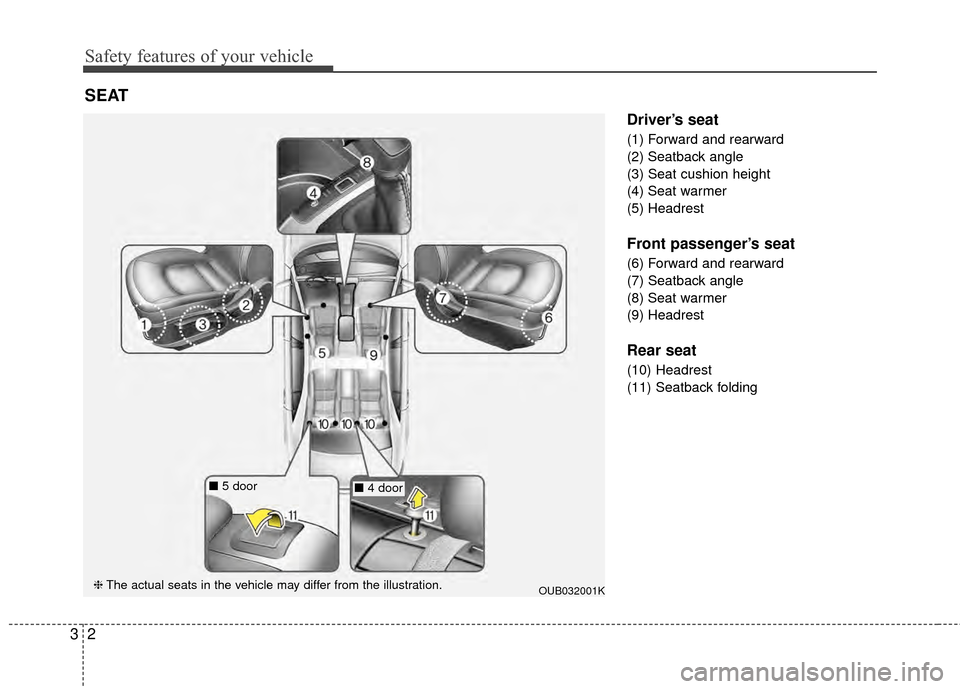
Driver’s seat
(1) Forward and rearward
(2) Seatback angle
(3) Seat cushion height
(4) Seat warmer
(5) Headrest
Front passenger’s seat
(6) Forward and rearward
(7) Seatback angle
(8) Seat warmer
(9) Headrest
Rear seat
(10) Headrest
(11) Seatback folding
SEAT
OUB032001K
■5 door■4 door
❈ The actual seats in the vehicle may differ from the illustration.
Page 20 of 397
Safety features of your vehicle
83
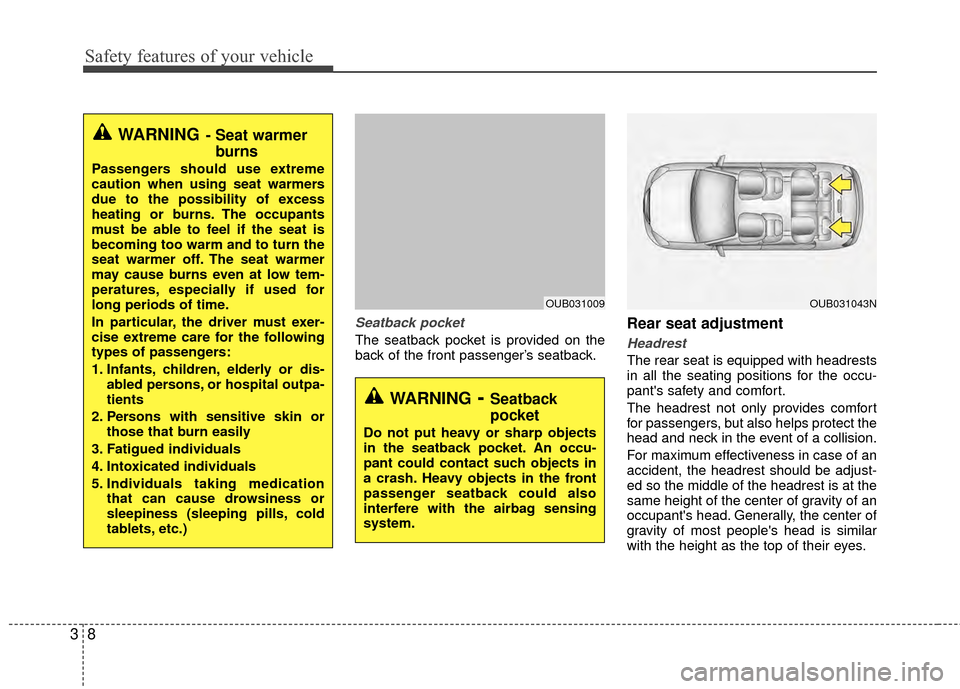
Seatback pocket
The seatback pocket is provided on the
back of the front passenger’s seatback.
Rear seat adjustment
Headrest
The rear seat is equipped with headrests
in all the seating positions for the occu-
pant's safety and comfort.
The headrest not only provides comfort
for passengers, but also helps protect the
head and neck in the event of a collision.
For maximum effectiveness in case of an
accident, the headrest should be adjust-
ed so the middle of the headrest is at the
same height of the center of gravity of an
occupant's head. Generally, the center of
gravity of most people's head is similar
with the height as the top of their eyes.
WARNING- Seat warmerburns
Passengers should use extreme
caution when using seat warmers
due to the possibility of excess
heating or burns. The occupants
must be able to feel if the seat is
becoming too warm and to turn the
seat warmer off. The seat warmer
may cause burns even at low tem-
peratures, especially if used for
long periods of time.
In particular, the driver must exer-
cise extreme care for the following
types of passengers:
1. Infants, children, elderly or dis-
abled persons, or hospital outpa-
tients
2. Persons with sensitive skin or those that burn easily
3. Fatigued individuals
4. Intoxicated individuals
5. Individuals taking medication that can cause drowsiness or
sleepiness (sleeping pills, cold
tablets, etc.)
WARNING- Seatback
pocket
Do not put heavy or sharp objects
in the seatback pocket. An occu-
pant could contact such objects in
a crash. Heavy objects in the front
passenger seatback could also
interfere with the airbag sensing
system.
OUB031009OUB031043N
Page 22 of 397
Safety features of your vehicle
10
3
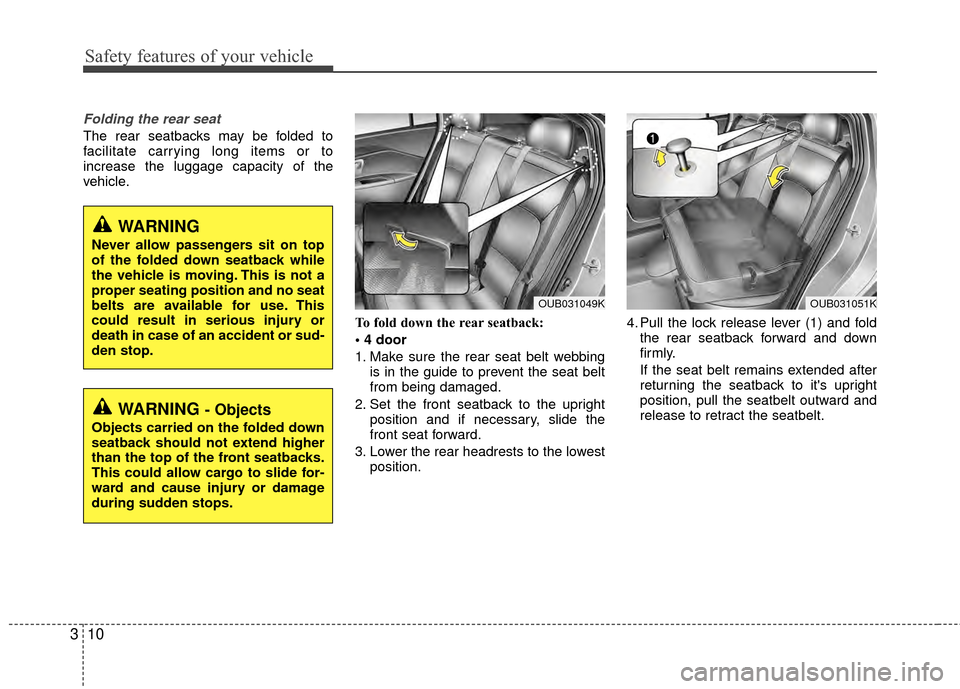
Folding the rear seat
The rear seatbacks may be folded to
facilitate carrying long items or to
increase the luggage capacity of the
vehicle.
To fold down the rear seatback:
1. Make sure the rear seat belt webbingis in the guide to prevent the seat belt
from being damaged.
2. Set the front seatback to the upright position and if necessary, slide the
front seat forward.
3. Lower the rear headrests to the lowest position. 4. Pull the lock release lever (1) and fold
the rear seatback forward and down
firmly.
If the seat belt remains extended after
returning the seatback to it's upright
position, pull the seatbelt outward and
release to retract the seatbelt.
WARNING
Never allow passengers sit on top
of the folded down seatback while
the vehicle is moving. This is not a
proper seating position and no seat
belts are available for use. This
could result in serious injury or
death in case of an accident or sud-
den stop.
WARNING - Objects
Objects carried on the folded down
seatback should not extend higher
than the top of the front seatbacks.
This could allow cargo to slide for-
ward and cause injury or damage
during sudden stops.
OUB031049KOUB031051K
Page 23 of 397
311
Safety features of your vehicle
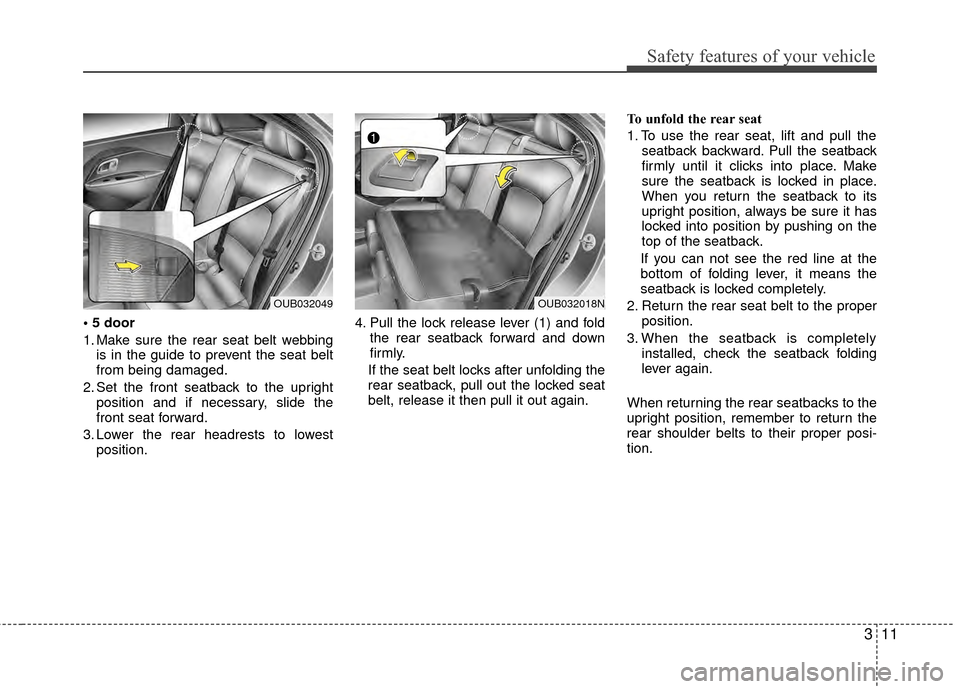
1. Make sure the rear seat belt webbingis in the guide to prevent the seat belt
from being damaged.
2. Set the front seatback to the upright position and if necessary, slide the
front seat forward.
3. Lower the rear headrests to lowest position. 4. Pull the lock release lever (1) and fold
the rear seatback forward and down
firmly.
If the seat belt locks after unfolding the
rear seatback, pull out the locked seat
belt, release it then pull it out again. To unfold the rear seat
1. To use the rear seat, lift and pull the
seatback backward. Pull the seatback
firmly until it clicks into place. Make
sure the seatback is locked in place.
When you return the seatback to its
upright position, always be sure it has
locked into position by pushing on the
top of the seatback.
If you can not see the red line at the
bottom of folding lever, it means the
seatback is locked completely.
2. Return the rear seat belt to the proper position.
3. When the seatback is completely installed, check the seatback folding
lever again.
When returning the rear seatbacks to the
upright position, remember to return the
rear shoulder belts to their proper posi-
tion.
OUB032049OUB032018N
Page 24 of 397
Safety features of your vehicle
12
3
Seat belt restraint system
Seat belts are designed to bear upon the
bony structure of the body, and should
be worn low across the front of the pelvis
or the pelvis, chest and shoulders, as
applicable; wearing the lap section of the
belt across the abdominal area must be
avoided.
Seat belts should be adjusted as firmly
as possible, consistent with comfort, to
provide the protection for which they
have been designed.
A slack belt will greatly reduce the pro-
tection afforded to the wearer.
Care should be taken to avoid contami-
nation of the webbing with polishes, oils
and chemicals, and particularly battery
acid. Cleaning may safely be carried out
using mild soap and water. The belt
should be replaced if webbing becomes
frayed, contaminated or damaged.
For maximum restraint system protec-
tion, the seat belts must always be
used whenever the vehicle is moving.
A properly positioned shoulder belt
should be positioned midway over your
shoulder across your collarbone.
Never allow children to ride in the front passenger seat. See child restraint
system section for further discussion.WARNING- Shoulder belt
Never wear the shoulder belt under
your arm or behind your back. An
improperly positioned shoulder
belt cannot protect the occupant in
a crash.
WARNING- Damaged seatbelt
Replace the entire seat belt assem-
bly if any part of the webbing or
hardware is damage as you can no
longer be sure that a damage seat
belt will provide protection in a
crash.
WARNING - Rear seatback
When returning the rear seatback
from a folded to an upright posi-
tion, hold the seatback and return it
slowly. Ensure that the seatback is
completely locked into its upright
position by pushing on the top of
the seatback. In an accident or sud-
den stop, the unlocked seatback
could allow cargo to move forward
with great force and enter the pas-
senger compartment.
WARNING- Cargo
Do not place heavy objects in the
rear seats, since they cannot be
properly secured and may hit vehi-
cle occupants in a frontal collision.
SEAT BELTS
Page 28 of 397
Safety features of your vehicle
16
3
To raise the height adjuster, pull it up (1).
To lower it, push it down (3) while press-
ing the height adjuster button (2).
Release the button to lock the anchor
into position. Try sliding the height
adjuster to make sure that it has locked
into position.
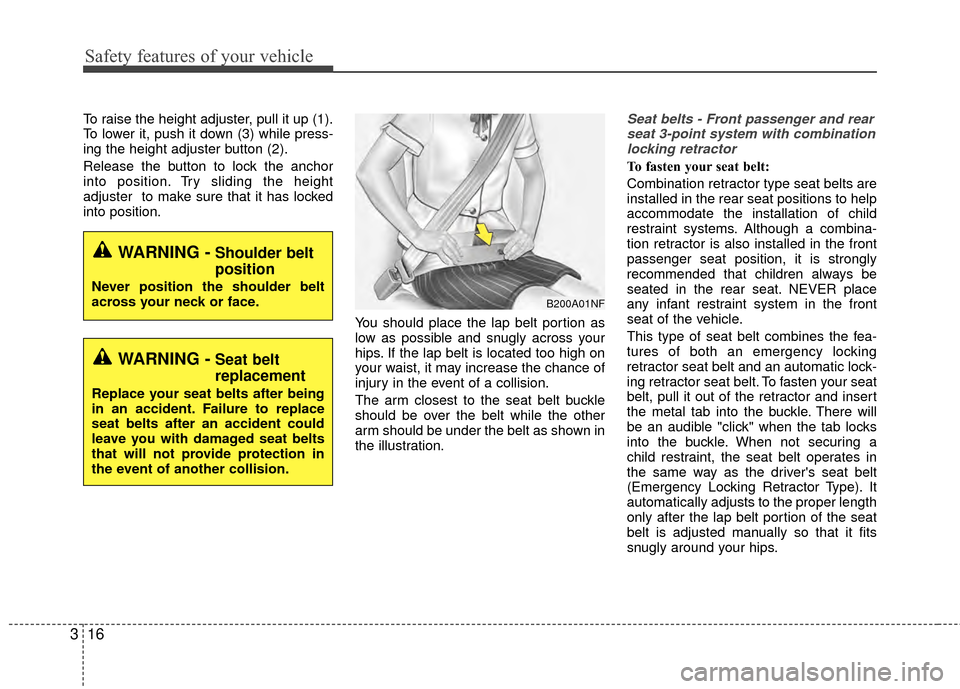
You should place the lap belt portion as
low as possible and snugly across your
hips. If the lap belt is located too high on
your waist, it may increase the chance of
injury in the event of a collision.
The arm closest to the seat belt buckle
should be over the belt while the other
arm should be under the belt as shown in
the illustration.Seat belts - Front passenger and rearseat 3-point system with combination locking retractor
To fasten your seat belt:
Combination retractor type seat belts are
installed in the rear seat positions to help
accommodate the installation of child
restraint systems. Although a combina-
tion retractor is also installed in the front
passenger seat position, it is strongly
recommended that children always be
seated in the rear seat. NEVER place
any infant restraint system in the front
seat of the vehicle.
This type of seat belt combines the fea-
tures of both an emergency locking
retractor seat belt and an automatic lock-
ing retractor seat belt. To fasten your seat
belt, pull it out of the retractor and insert
the metal tab into the buckle. There will
be an audible "click" when the tab locks
into the buckle. When not securing a
child restraint, the seat belt operates in
the same way as the driver's seat belt
(Emergency Locking Retractor Type). It
automatically adjusts to the proper length
only after the lap belt portion of the seat
belt is adjusted manually so that it fits
snugly around your hips.
WARNING -Shoulder belt
position
Never position the shoulder belt
across your neck or face.
WARNING -Seat belt
replacement
Replace your seat belts after being
in an accident. Failure to replace
seat belts after an accident could
leave you with damaged seat belts
that will not provide protection in
the event of another collision.
B200A01NF
Page 29 of 397
317
Safety features of your vehicle
When the seat belt is fully extended from
the retractor to allow the installation of a
child restraint system, the seat belt oper-
ation changes to allow the belt to retract,
but not to extend (Automatic Locking
Retractor Type). Refer to “Using a child
restraint system” in this section.
To convert from the automatic locking
feature to the emergency locking opera-
tion mode, allow the unbuckled seat belt
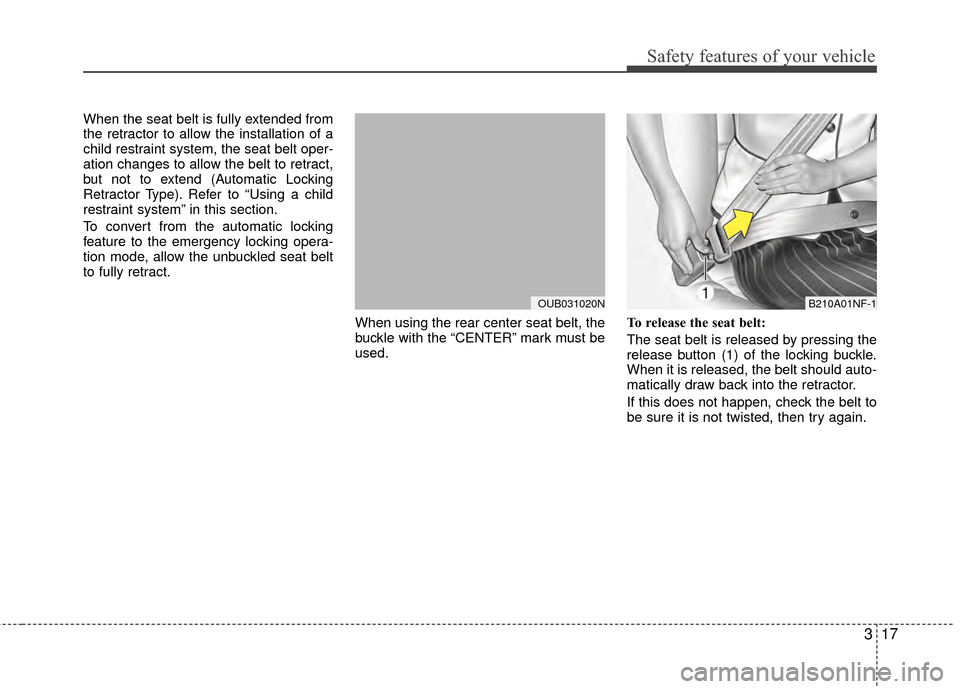
to fully retract.When using the rear center seat belt, the
buckle with the “CENTER” mark must be
used.To release the seat belt:
The seat belt is released by pressing the
release button (1) of the locking buckle.
When it is released, the belt should auto-
matically draw back into the retractor.
If this does not happen, check the belt to
be sure it is not twisted, then try again.
B210A01NF-1OUB031020N
Page 32 of 397
Safety features of your vehicle
20
3
Seat belt precautions
Infant or small child
You should be aware of the specific
requirements in your country. Child
and/or infant seats must be properly
placed and installed in the rear seat. For
more information about the use of these
restraints, refer to “Child restraint sys-
tem” in this section.
Larger children
Children who are too large for child
restraint systems should always occupy
the rear seat and use the available
lap/shoulder belts. The lap portion should
be fastened and snugged on the hips
and as low as possible. Check if the belt
fits periodically. A child's squirming could
put the belt out of position. Children are
given the most safety in the event of an
accident when they are restrained by a
proper restraint system in the rear seat. If
a larger child (over age 12) must be seat-
ed in the front seat, the child should be
securely restrained by the available
lap/shoulder belt and the seat should be
placed in the rearmost position. Children
age 12 and under should be restrained
securely in the rear seat. NEVER place a
child age 12 and under in the front seat.
NEVER place a rear facing child seat in
the front seat of a vehicle.
If the shoulder belt portion slightly touch-
es the child’s neck or face, try placing the
child closer to the center of the vehicle. If
the shoulder belt still touches their face
or neck they need to be returned to a
child restraint system.
Restraint of pregnant women
Pregnant women should wear lap/shoul-
der belt assemblies whenever possible
according to specific recommendations
by their doctors. The lap portion of the
belt should be worn AS SNUGLY AND
LOW AS POSSIBLE.
WARNING - Small children
Do not allow small children to ride
in the vehicle without an appropri-
ate child restraint system. If the
shoulder belt comes in contact with
your child's neck or face your child
is too small to ride in the vehicle. In
a crash the seat belt will inflict
injury to your child's neck, throat
and face.
WARNING - Pregnant
women
Pregnant women must never place
the lap portion of the seat belt
above or on the abdomen where
the fetus is located. The force of the
seat belt during a collision will
crush the fetus.
Page 33 of 397
321
Safety features of your vehicle
Injured person
A seat belt should be used when an
injured person is being transported.
When this is necessary, you should con-
sult a physician for recommendations.
One person per belt
Two people (including children) should
never attempt to use a single seat belt.
This could increase the severity of
injuries in case of an accident.
Do not lie down
To reduce the chance of injuries in the
event of an accident and to achieve maxi-
mum effectiveness of the restraint system,
all passengers should be sitting up and
the front seats should be in an upright
position when the vehicle is moving. A
seat belt cannot provide proper protection
if the person is lying down in the rear seat
or if the front seat is in a reclined position.
Care of seat belts
Seat belt systems should never be disas-
sembled or modified. In addition, care
should be taken to assure that seat belts
and belt hardware are not damaged by
seat hinges, doors or other abuse.
Periodic inspection
All seat belts should be inspected peri-
odically for wear or damage of any kind.
Any damaged parts should be replaced
as soon as possible.
Keep belts clean and dry
Seat belts should be kept clean and dry.
If belts become dirty, they can be
cleaned by using a mild soap solution
and warm water. Bleach, dye, strong
detergents or abrasives should not be
used because they may damage and
weaken the fabric.
When to replace seat belts
The entire in-use seat belt assembly or
assemblies should be replaced if the
vehicle has been involved in an accident.
This should be done even if no damage
is visible. Additional questions concern-
ing seat belt operation should be directed
to an authorized Kia dealer.
WARNING - Pinched seat
belt
Make sure that the webbing and/or
buckle does not get caught or
pinched in the rear seat when
returning the rear seatback to its
upright position. A caught or
pinched webbing/buckle may
become damaged and could fail
during a collision or sudden stop.