Rear KIA Rio 2014 3.G User Guide
[x] Cancel search | Manufacturer: KIA, Model Year: 2014, Model line: Rio, Model: KIA Rio 2014 3.GPages: 397, PDF Size: 7.56 MB
Page 34 of 397
Safety features of your vehicle
22
3
CHILD RESTRAINT SYSTEM
Children riding in the car should sit in the
rear seat and must always be properly
restrained to minimize the risk of injury in
an accident, sudden stop or sudden
maneuver. According to accident statis-
tics, children are safer when properly
restrained in the rear seats than in the
front seat. Larger children not in a child
restraint should use one of the seat belts
provided.
You should be aware of the specific
requirements in your country. Child and/or
infant safety seats must be properly
placed and installed in the rear seat. You
must use a commercially available child
restraint system that m eets the require-
ments of the safety standards of your
country.
Child restraint systems are designed to be
secured in vehicle seats by seat belt, or by
a tether anchor and/or LATCH anchors (if
equipped). Children could be injured or killed in a
crash if their restraints are not properly
secured. For small children and babies, a
child seat or infant seat must be used.
Before buying a particular child restraint
system, make sure it fits your vehicle
seat and seat belts, and fits your child.
Follow all the instructions provided by the
manufacturer when installing the child
restraint system.
When the child restraint system is not in
use, store it in the luggage area or fasten
it with a seat belt so that it will not be
thrown forward in case of a sudden stop
or an accident.
WARNING- Restraint location
Never install a child or infant seat
on the front passenger's seat.
A child riding in the front passen-
ger seat can be forcefully struck by
an inflating airbag.
WARNING- Hot childrestraint
A child restraint system can
become very hot if it is left in a
closed vehicle on a sunny day. Be
sure to check the seat cover, buck-
les and latches before placing a
child in the restraint system.
Page 35 of 397
323
Safety features of your vehicle
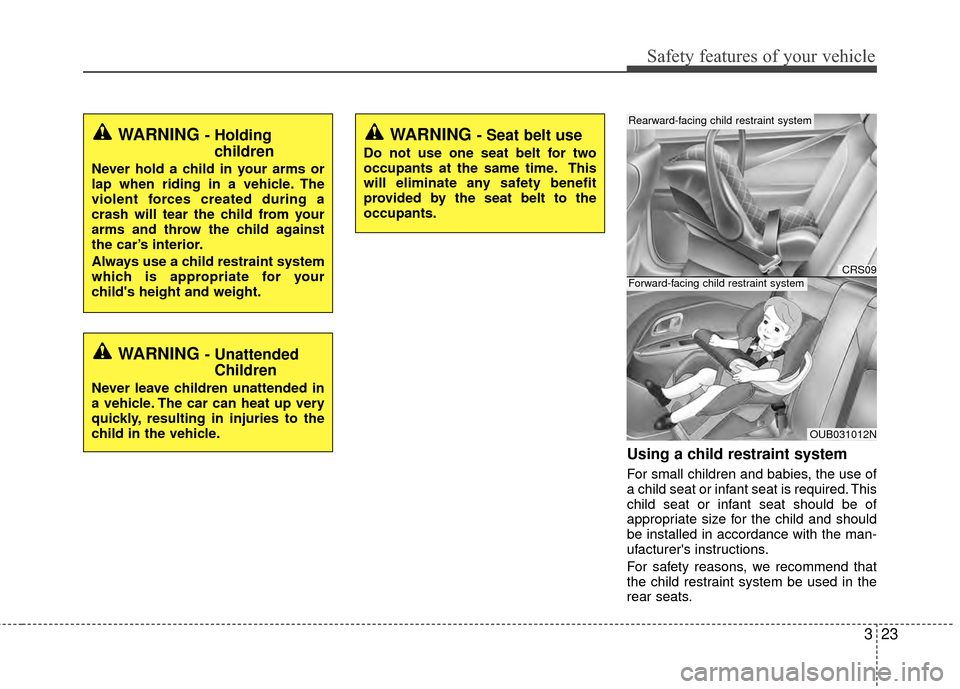
Using a child restraint system
For small children and babies, the use of
a child seat or infant seat is required. This
child seat or infant seat should be of
appropriate size for the child and should
be installed in accordance with the man-
ufacturer's instructions.
For safety reasons, we recommend that
the child restraint system be used in the
rear seats.
WARNING - Holding children
Never hold a child in your arms or
lap when riding in a vehicle. The
violent forces created during a
crash will tear the child from your
arms and throw the child against
the car’s interior.
Always use a child restraint system
which is appropriate for your
child's height and weight.
WARNING - UnattendedChildren
Never leave children unattended in
a vehicle. The car can heat up very
quickly, resulting in injuries to the
child in the vehicle.
WARNING - Seat belt use
Do not use one seat belt for two
occupants at the same time. This
will eliminate any safety benefit
provided by the seat belt to the
occupants.
CRS09
OUB031012N
Rearward-facing child restraint system
Forward-facing child restraint system
Page 37 of 397
325
Safety features of your vehicle
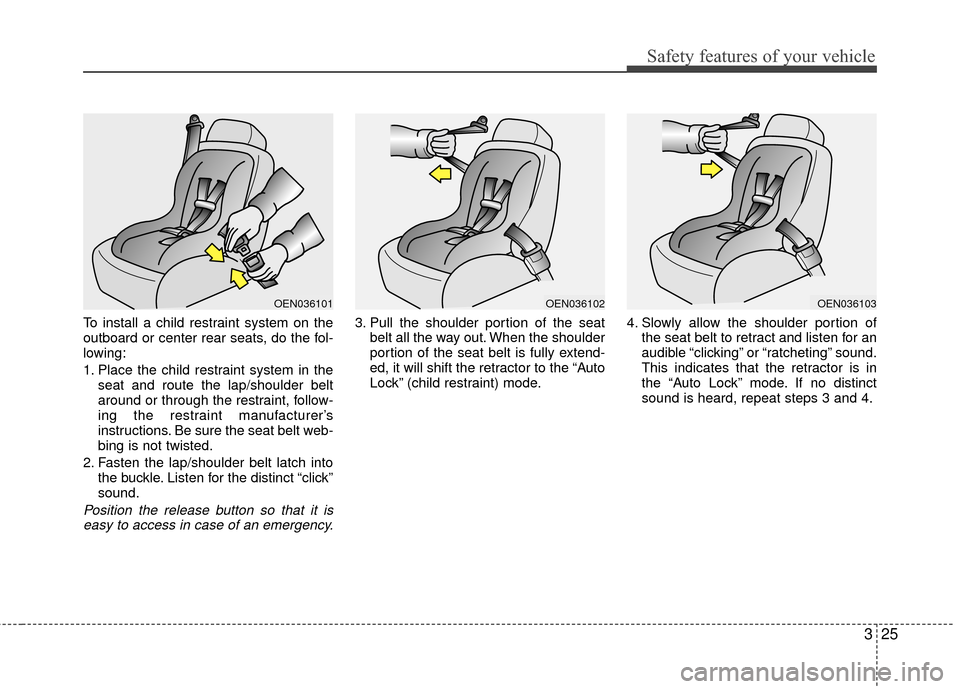
To install a child restraint system on the
outboard or center rear seats, do the fol-
lowing:
1. Place the child restraint system in theseat and route the lap/shoulder belt
around or through the restraint, follow-
ing the restraint manufacturer’s
instructions. Be sure the seat belt web-
bing is not twisted.
2. Fasten the lap/shoulder belt latch into the buckle. Listen for the distinct “click”
sound.
Position the release button so that it iseasy to access in case of an emergency.
3. Pull the shoulder portion of the seat belt all the way out. When the shoulder
portion of the seat belt is fully extend-
ed, it will shift the retractor to the “Auto
Lock” (child restraint) mode. 4. Slowly allow the shoulder portion of
the seat belt to retract and listen for an
audible “clicking” or “ratcheting” sound.
This indicates that the retractor is in
the “Auto Lock” mode. If no distinct
sound is heard, repeat steps 3 and 4.
OEN036101OEN036102OEN036103
Page 39 of 397
327
Safety features of your vehicle
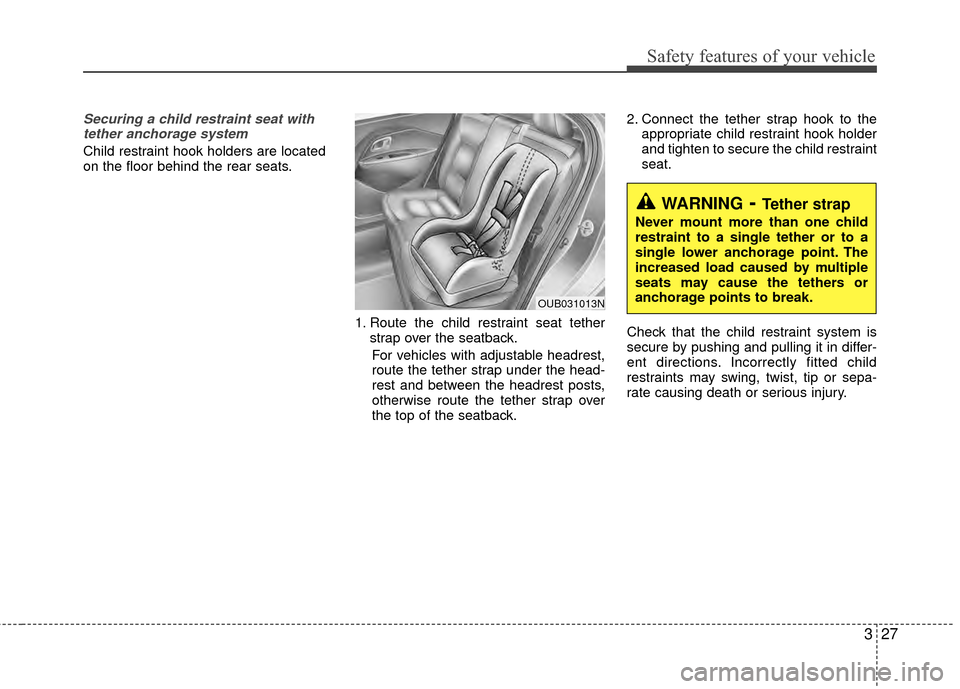
Securing a child restraint seat withtether anchorage system
Child restraint hook holders are located
on the floor behind the rear seats.
1. Route the child restraint seat tetherstrap over the seatback.
For vehicles with adjustable headrest,
route the tether strap under the head-
rest and between the headrest posts,
otherwise route the tether strap over
the top of the seatback. 2. Connect the tether strap hook to the
appropriate child restraint hook holder
and tighten to secure the child restraint
seat.
Check that the child restraint system is
secure by pushing and pulling it in differ-
ent directions. Incorrectly fitted child
restraints may swing, twist, tip or sepa-
rate causing death or serious injury.
WARNING- Tether strap
Never mount more than one child
restraint to a single tether or to a
single lower anchorage point. The
increased load caused by multiple
seats may cause the tethers or
anchorage points to break.
OUB031013N
Page 40 of 397
Safety features of your vehicle
28
3
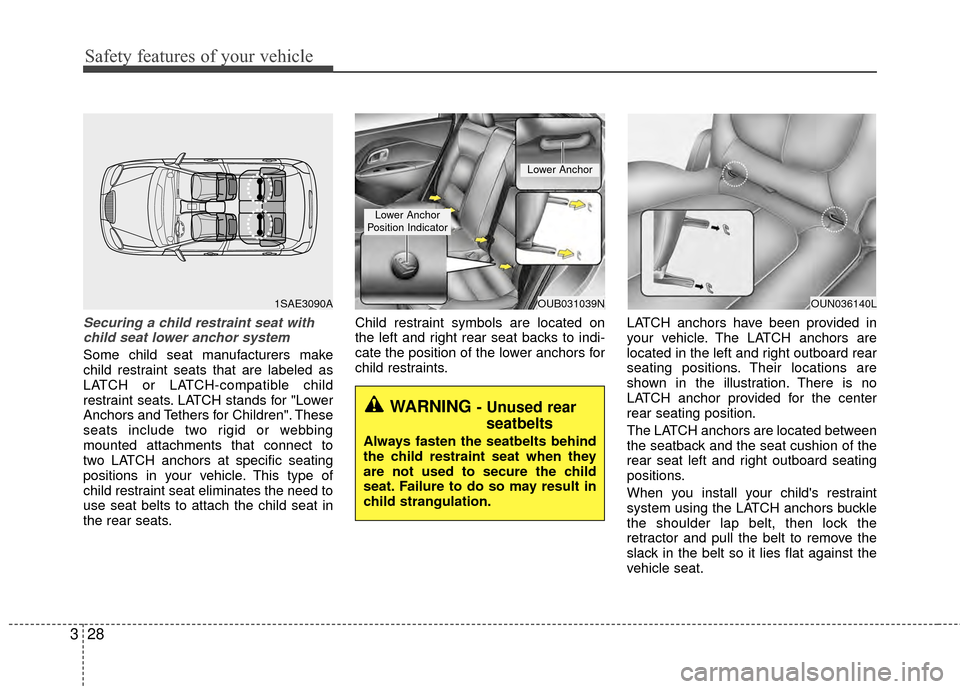
Securing a child restraint seat with
child seat lower anchor system
Some child seat manufacturers make
child restraint seats that are labeled as
LATCH or LATCH-compatible child
restraint seats. LATCH stands for "Lower
Anchors and Tethers for Children". These
seats include two rigid or webbing
mounted attachments that connect to
two LATCH anchors at specific seating
positions in your vehicle. This type of
child restraint seat eliminates the need to
use seat belts to attach the child seat in
the rear seats. Child restraint symbols are located on
the left and right rear seat backs to indi-
cate the position of the lower anchors for
child restraints.
LATCH anchors have been provided in
your vehicle. The LATCH anchors are
located in the left and right outboard rear
seating positions. Their locations are
shown in the illustration. There is no
LATCH anchor provided for the center
rear seating position.
The LATCH anchors are located between
the seatback and the seat cushion of the
rear seat left and right outboard seating
positions.
When you install your child's restraint
system using the LATCH anchors buckle
the shoulder lap belt, then lock the
retractor and pull the belt to remove the
slack in the belt so it lies flat against the
vehicle seat.
OUB031039N
Lower Anchor
Position Indicator
Lower Anchor
WARNING - Unused rear seatbelts
Always fasten the seatbelts behind
the child restraint seat when they
are not used to secure the child
seat. Failure to do so may result in
child strangulation.
OUN036140L1SAE3090A
Page 41 of 397
329
Safety features of your vehicle
Follow the child seat manufacturer’s
instructions to properly install child
restraint seats with LATCH or LATCH-
compatible attachments.
Once you have installed the LATCH child
restraint, assure that the seat is properly
attached to the LATCH and tether
anchors.
Also, test the child restraint seat before
you place the child in it. Tilt the seat from
side to side. Also try to tug the seat for-
ward. Check to see if the anchors hold
the seat in place.
WARNING - LATCH lower
anchors
Never attempt to attach a LATCH
equipped seat in the center seating
position. LATCH lower anchors are
only to be used with the left and
right rear outboard seating posi-
tions. You may damage the
anchors or the anchors may fail
and break in a collision.
Page 44 of 397
Safety features of your vehicle
32
3
Noise and smoke
When the air bags inflate, they make a
loud noise and they leave smoke and
powder in the air inside of the vehicle.
This is normal and is a result of the igni-
tion of the air bag inflator. After the air
bag inflates, you may feel substantial dis-
comfort in breathing due to the contact of
your chest to both the seat belt and the
air bag, as well as from breathing the
smoke and powder. Open your doors
and/or windows as soon as possible
after the impact in order to reduce dis-
comfort and prevent prolonged expo-
sure to smoke and powder.
Though smoke and powder are non-
toxic, it may cause irritation to the skin
(eyes, nose and throat etc). If this is the
case, wash and rinse with the cold water
immediately and consult the doctor if the
symptom persists.
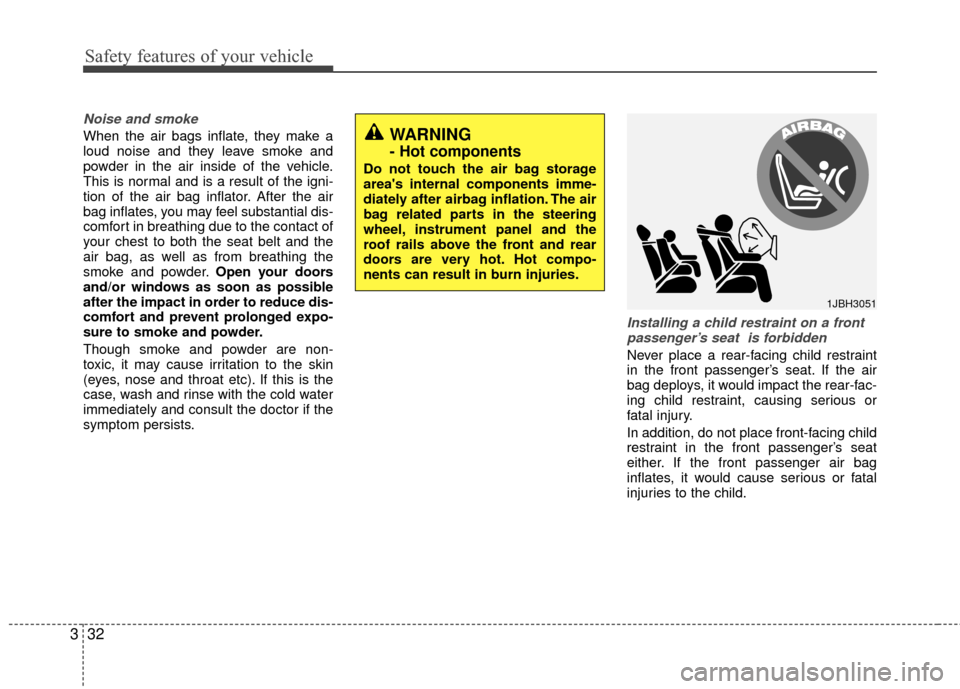
Installing a child restraint on a front passenger’s seat is forbidden
Never place a rear-facing child restraint
in the front passenger’s seat. If the air
bag deploys, it would impact the rear-fac-
ing child restraint, causing serious or
fatal injury.
In addition, do not place front-facing child
restraint in the front passenger’s seat
either. If the front passenger air bag
inflates, it would cause serious or fatal
injuries to the child.
1JBH3051
WARNING
- Hot components
Do not touch the air bag storage
area's internal components imme-
diately after airbag inflation. The air
bag related parts in the steering
wheel, instrument panel and the
roof rails above the front and rear
doors are very hot. Hot compo-
nents can result in burn injuries.
Page 45 of 397
333
Safety features of your vehicle
Air bag warning light
The purpose of the air bag warning light
in your instrument panel is to alert you of
a potential problem with your air bag -
Supplemental Restraint System (SRS).
When the ignition switch is turned ON,
the indicator light should illuminate for
approximately 6 seconds, then go off.
Have the system checked by an author-
ized Kia dealer if:
The light does not turn on briefly whenyou turn the ignition ON.
The light stays on after illuminating for approximately 6 seconds.
The light comes on while the vehicle is in motion.
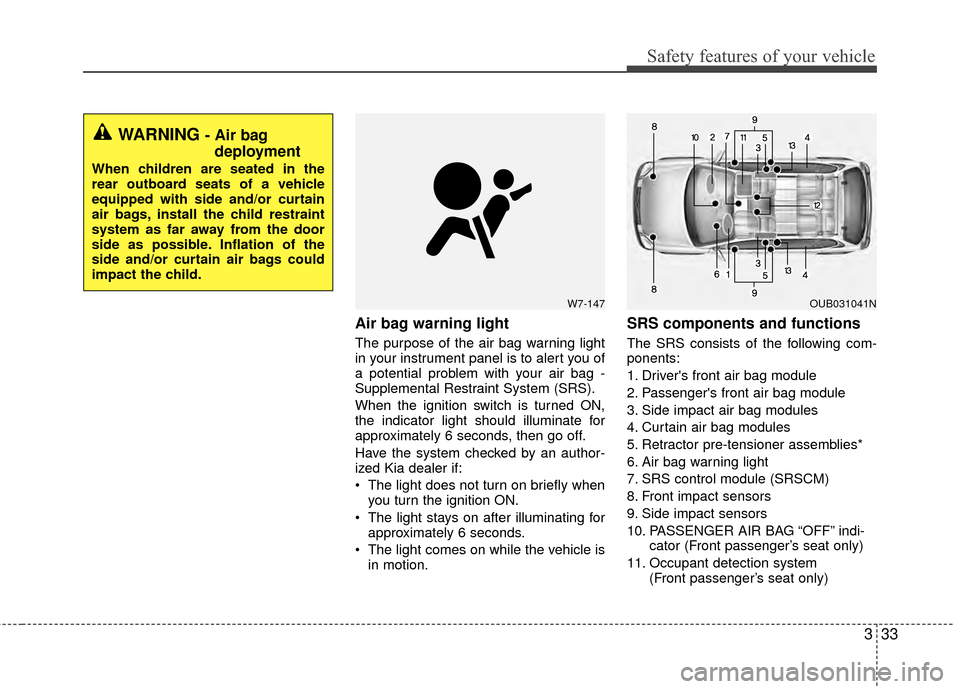
SRS components and functions
The SRS consists of the following com-
ponents:
1. Driver's front air bag module
2. Passenger's front air bag module
3. Side impact air bag modules
4. Curtain air bag modules
5. Retractor pre-tensioner assemblies*
6. Air bag warning light
7. SRS control module (SRSCM)
8. Front impact sensors
9. Side impact sensors
10. PASSENGER AIR BAG “OFF” indi- cator (Front passenger’s seat only)
11. Occupant detection system (Front passenger’s seat only)
W7-147
WARNING - Air bagdeployment
When children are seated in the
rear outboard seats of a vehicle
equipped with side and/or curtain
air bags, install the child restraint
system as far away from the door
side as possible. Inflation of the
side and/or curtain air bags could
impact the child.
OUB031041N
Page 52 of 397
Safety features of your vehicle
40
3
When an adult is seated in the front pas-
senger seat, if the PASSENGER AIR
BAG “OFF” indicator is on, turn the igni-
tion switch to the LOCK position and ask
the passenger to sit properly (sitting
upright with the seat back in an upright
position, centered on the seat cushion
with their seat belt on, legs comfortably
extended and their feet on the floor).
Restart the engine and have the person
remain in that position. This will allow the
system to detect the person and to
enable the passenger air bag. If the PASSENGER AIR BAG “OFF” indi-
cator is still on, ask the passenger to
move to the rear seat.
✽ ✽
NOTICE
The PASSENGER AIR BAG “OFF”
indicator illuminates for about 4 sec-
onds after the ignition switch is turned
to the ON position or after the engine is
started. If the front passenger seat is
occupied, the occupant detection sensor
will then classify the front passenger
after several more seconds.
B990A01O
WARNING - “AIR BAG
OFF” light
Do not allow an adult passenger to
ride in the front seat when the PAS-
SENGER AIR BAG “OFF” indicator
is illuminated, because the air bag
will not deploy in the event of a
crash. The driver must instruct the
passenger to reposition himself in
the seat. Failure to properly posi-
tion yourself may lead to airbag
deactivation resulting in airbag
non-deployment and in a collision.
If the PASSENGER AIR BAG “OFF”
indicator remains illuminated after
the passenger repositions them-
selves properly and the car is
restarted, it is recommended that
passenger move to the rear seat
because the passenger's front air
bag will not deploy.
Page 53 of 397
341
Safety features of your vehicle
Any child age 12 and under should ride
in the rear seat. Children too large for
child restraints should use the available
lap/shoulder belts. No matter what type
of crash, children of all ages are safer
when restrained in the rear seat.
✽ ✽NOTICE
Do not modify or replace the front pas-
senger seat. Don't place anything on or
attach anything such as a blanket, front
seat covers or after market seat heater
to the front passenger seat. This can
adversely affect the occupant detection
system.
If the occupant detection system is not
working properly, the SRS air bag warn-
ing light on the instrument panel will
illuminate because the passenger's front
air bag is connected with the occupant
detection system. If there is a malfunc-
tion of the occupant detection system,
the PASSENGER AIR BAG “OFF” indica-
tor will not illuminate and the passenger's
front air bag will inflate in frontal impact
crashes even if there is no occupant in
the front passenger's seat.
Driver's and passenger's front air
bag
Your vehicle is equipped with an
Advanced Supplemental Restraint (Air
Bag) System and lap/shoulder belts at
both the driver and passenger seating
position.
OUB031026
OUB031027
Driver’s front air bag
Passenger’s front air bag