Warning panel KIA Rio 2016 3.G User Guide
[x] Cancel search | Manufacturer: KIA, Model Year: 2016, Model line: Rio, Model: KIA Rio 2016 3.GPages: 449, PDF Size: 14.93 MB
Page 135 of 449
Features of your vehicle
64
4
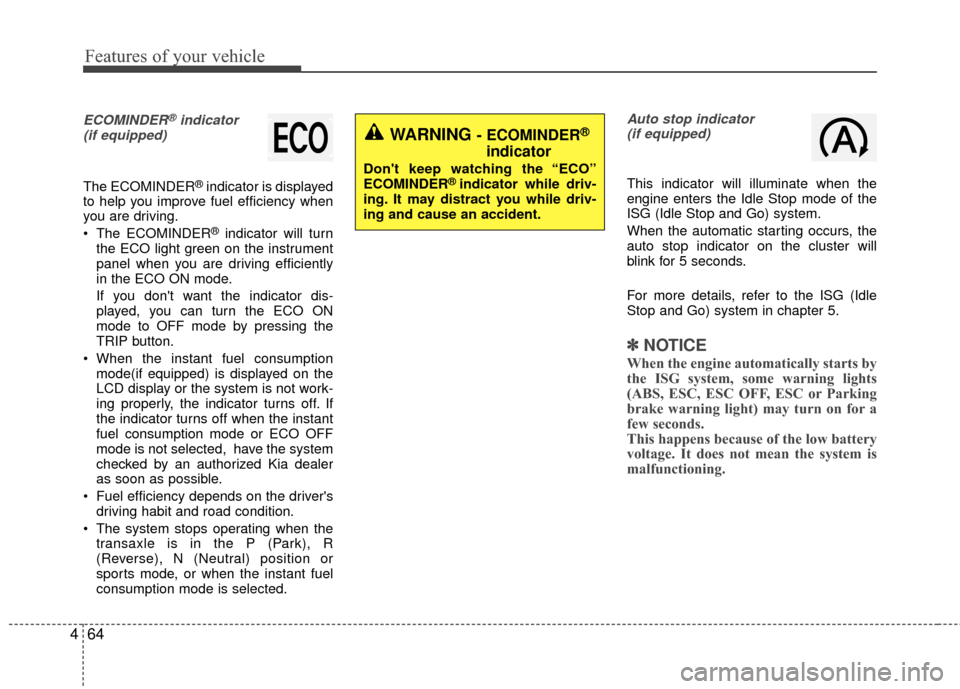
ECOMINDER®indicator
(if equipped)
The ECOMINDER®indicator is displayed
to help you improve fuel efficiency when
you are driving.
The ECOMINDER
®indicator will turn
the ECO light green on the instrument
panel when you are driving efficiently
in the ECO ON mode.
If you don't want the indicator dis-
played, you can turn the ECO ON
mode to OFF mode by pressing the
TRIP button.
When the instant fuel consumption mode(if equipped) is displayed on the
LCD display or the system is not work-
ing properly, the indicator turns off. If
the indicator turns off when the instant
fuel consumption mode or ECO OFF
mode is not selected, have the system
checked by an authorized Kia dealer
as soon as possible.
Fuel efficiency depends on the driver's driving habit and road condition.
The system stops operating when the transaxle is in the P (Park), R
(Reverse), N (Neutral) position or
sports mode, or when the instant fuel
consumption mode is selected.
Auto stop indicator(if equipped)
This indicator will illuminate when the
engine enters the Idle Stop mode of the
ISG (Idle Stop and Go) system.
When the automatic starting occurs, the
auto stop indicator on the cluster will
blink for 5 seconds.
For more details, refer to the ISG (Idle
Stop and Go) system in chapter 5.
✽ ✽ NOTICE
When the engine automatically starts by
the ISG system, some warning lights
(ABS, ESC, ESC OFF, ESC or Parking
brake warning light) may turn on for a
few seconds.
This happens because of the low battery
voltage. It does not mean the system is
malfunctioning.
WARNING - ECOMINDER®
indicator
Don't keep watching the “ECO”
ECOMINDER®indicator while driv-
ing. It may distract you while driv-
ing and cause an accident.
Page 307 of 449
What to do in an emergency
26
ROAD WARNING
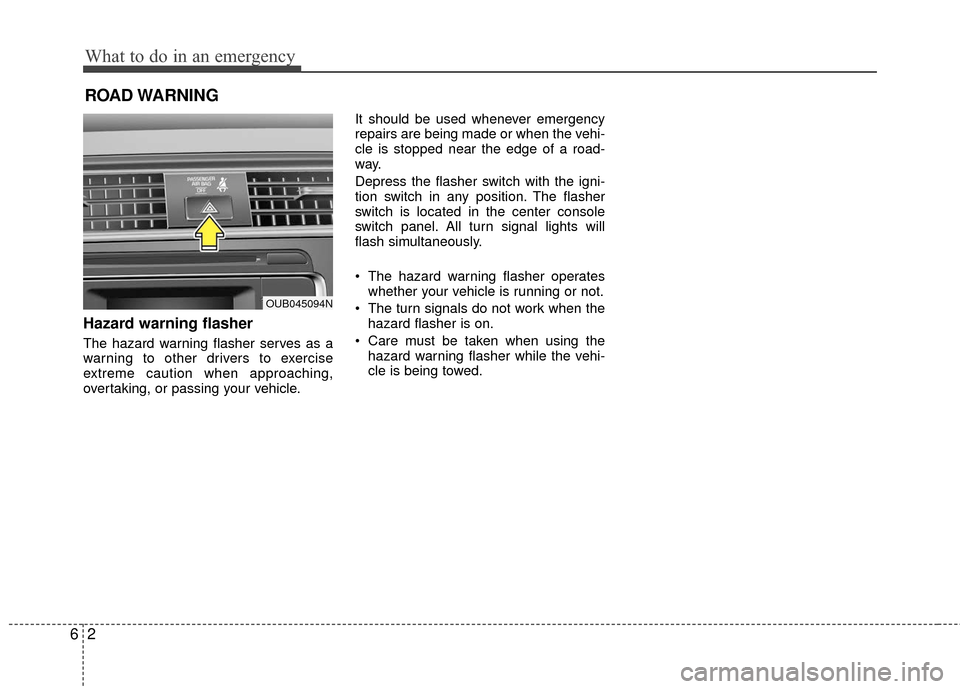
Hazard warning flasher
The hazard warning flasher serves as a
warning to other drivers to exercise
extreme caution when approaching,
overtaking, or passing your vehicle.It should be used whenever emergency
repairs are being made or when the vehi-
cle is stopped near the edge of a road-
way.
Depress the flasher switch with the igni-
tion switch in any position. The flasher
switch is located in the center console
switch panel. All turn signal lights will
flash simultaneously.
• The hazard warning flasher operates
whether your vehicle is running or not.
The turn signals do not work when the hazard flasher is on.
Care must be taken when using the hazard warning flasher while the vehi-
cle is being towed.
OUB045094N
Page 315 of 449
What to do in an emergency
10
6
If the TPMS indicator does not illumi-
nate for 3 seconds when the ignition
switch is turned to the ON position or
engine is running, or If it comes on
after blinking for approximately one
minute, take your car to your nearest
authorized kia dealer and have the
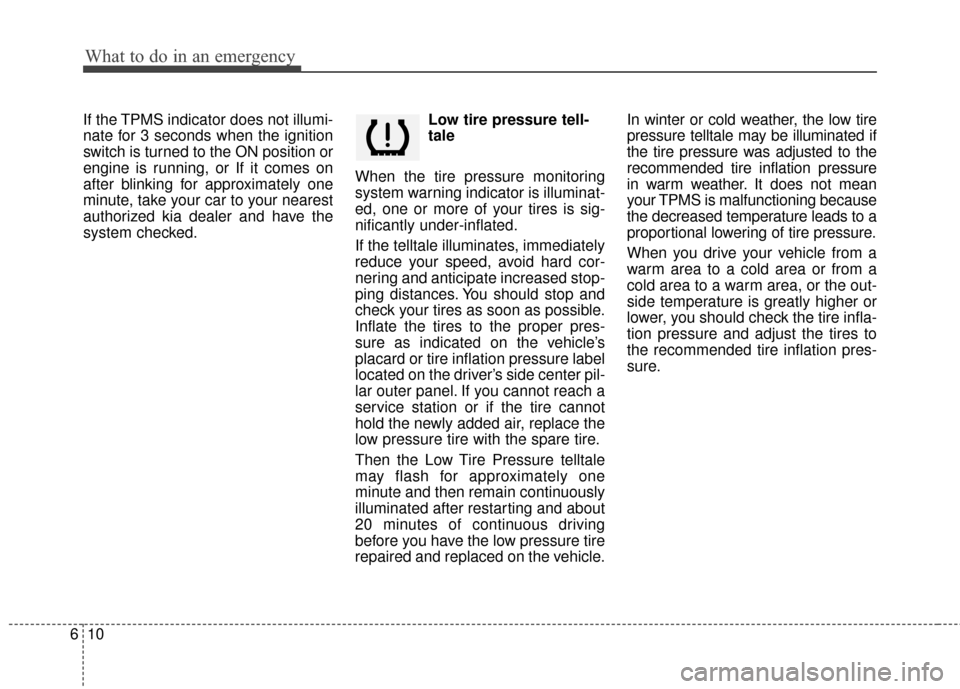
system checked. Low tire pressure tell-
tale
When the tire pressure monitoring
system warning indicator is illuminat-
ed, one or more of your tires is sig-
nificantly under-inflated.
If the telltale illuminates, immediately
reduce your speed, avoid hard cor-
nering and anticipate increased stop-
ping distances. You should stop and
check your tires as soon as possible.
Inflate the tires to the proper pres-
sure as indicated on the vehicle’s
placard or tire inflation pressure label
located on the driver’s side center pil-
lar outer panel. If you cannot reach a
service station or if the tire cannot
hold the newly added air, replace the
low pressure tire with the spare tire.
Then the Low Tire Pressure telltale
may flash for approximately one
minute and then remain continuously
illuminated after restarting and about
20 minutes of continuous driving
before you have the low pressure tire
repaired and replaced on the vehicle. In winter or cold weather, the low tire
pressure telltale may be illuminated if
the tire pressure was adjusted to the
recommended tire inflation pressure
in warm weather. It does not mean
your TPMS is malfunctioning because
the decreased temperature leads to a
proportional lowering of tire pressure.
When you drive your vehicle from a
warm area to a cold area or from a
cold area to a warm area, or the out-
side temperature is greatly higher or
lower, you should check the tire infla-
tion pressure and adjust the tires to
the recommended tire inflation pres-
sure.
Page 397 of 449
761
Maintenance
FUSES
A vehicle’s electrical system is protected
from electrical overload damage by
fuses.This vehicle has 2 fuse panels, one locat-
ed in the driver’s side panel bolster, the
other in the engine compartment near
the battery.
If any of your vehicle’s lights, acces-
sories, or controls do not work, check the
appropriate circuit fuse. If a fuse has
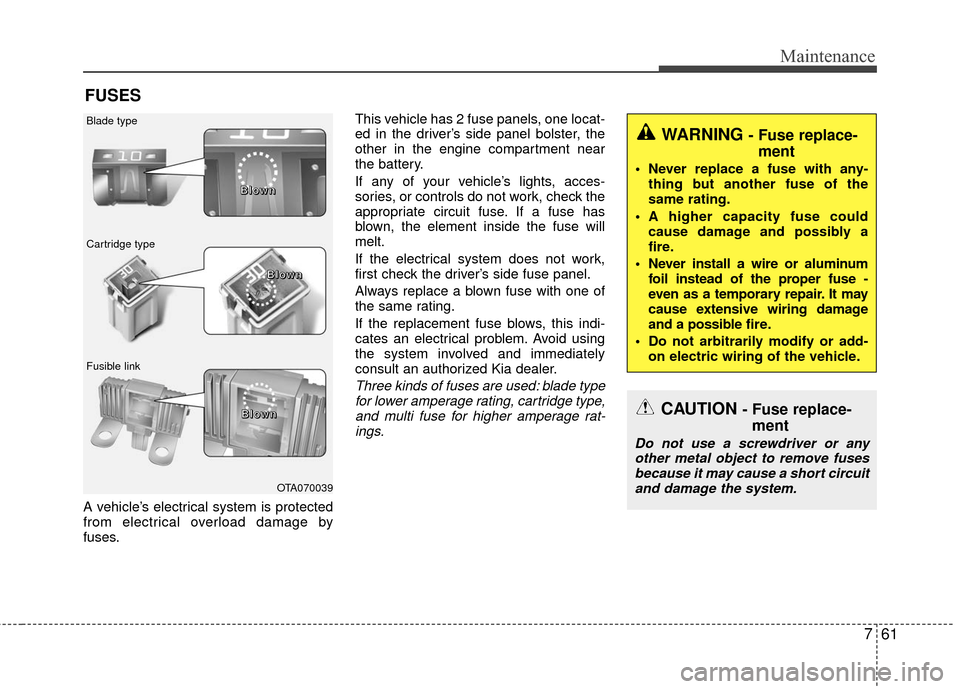
blown, the element inside the fuse will
melt.
If the electrical system does not work,
first check the driver’s side fuse panel.
Always replace a blown fuse with one of
the same rating.
If the replacement fuse blows, this indi-
cates an electrical problem. Avoid using
the system involved and immediately
consult an authorized Kia dealer.
Three kinds of fuses are used: blade type
for lower amperage rating, cartridge type, and multi fuse for higher amperage rat-ings.
OTA070039
Blade type
Cartridge type
Fusible link B B
B
B
l
l
l
l
o
o
o
o
w
w
w
w
n
n
n
n
B
B
B
B
l
l
l
l
o
o
o
o
w
w
w
w
n
n
n
n
B
B
B
B
l
l
l
l
o
o
o
o
w
w
w
w
n
n
n
n
WARNING - Fuse replace-
ment
Never replace a fuse with any-
thing but another fuse of the
same rating.
A higher capacity fuse could cause damage and possibly a
fire.
Never install a wire or aluminum foil instead of the proper fuse -
even as a temporary repair. It may
cause extensive wiring damage
and a possible fire.
Do not arbitrarily modify or add- on electric wiring of the vehicle.
CAUTION - Fuse replace-ment
Do not use a screwdriver or any
other metal object to remove fuses because it may cause a short circuitand damage the system.
Page 398 of 449
Maintenance
62
7
✽
✽
NOTICE
The actual fuse/relay panel label may
differ depending on equipment/options.
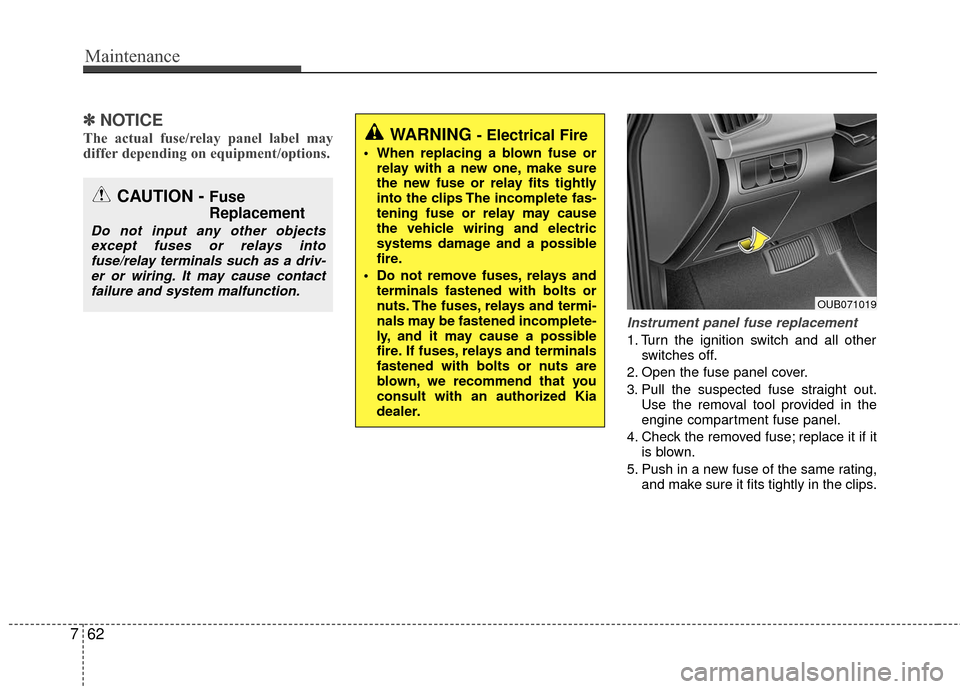
Instrument panel fuse replacement
1. Turn the ignition switch and all other
switches off.
2. Open the fuse panel cover.
3. Pull the suspected fuse straight out. Use the removal tool provided in the
engine compartment fuse panel.
4. Check the removed fuse; replace it if it is blown.
5. Push in a new fuse of the same rating, and make sure it fits tightly in the clips.
CAUTION - Fuse
Replacement
Do not input any other objectsexcept fuses or relays intofuse/relay terminals such as a driv-er or wiring. It may cause contactfailure and system malfunction.
WARNING - Electrical Fire
When replacing a blown fuse or relay with a new one, make sure
the new fuse or relay fits tightly
into the clips The incomplete fas-
tening fuse or relay may cause
the vehicle wiring and electric
systems damage and a possible
fire.
Do not remove fuses, relays and terminals fastened with bolts or
nuts. The fuses, relays and termi-
nals may be fastened incomplete-
ly, and it may cause a possible
fire. If fuses, relays and terminals
fastened with bolts or nuts are
blown, we recommend that you
consult with an authorized Kia
dealer.
OUB071019
Page 399 of 449
763
Maintenance
If it fits loosely, consult an authorized Kia
dealer.
If you do not have a spare, use a fuse ofthe same rating from a circuit you maynot need for operating the vehicle, suchas the cigar lighter fuse.
If the headlights or other electrical com-
ponents do not work and the fuses are
OK, check the fuse block in the engine
compartment. If a fuse is blown, it must
be replaced.
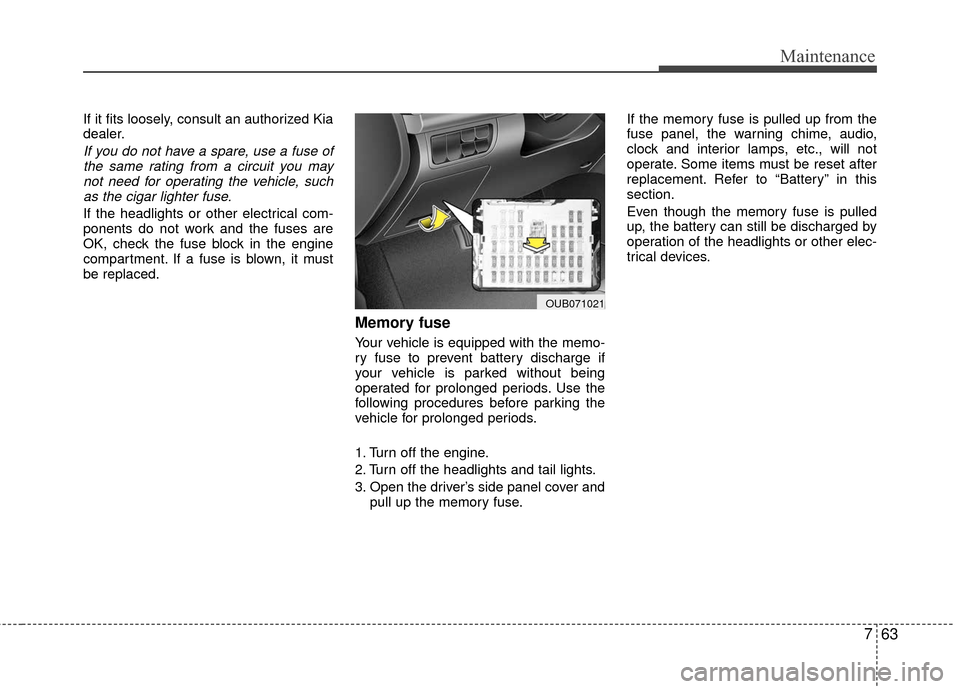
Memory fuse
Your vehicle is equipped with the memo-
ry fuse to prevent battery discharge if
your vehicle is parked without being
operated for prolonged periods. Use the
following procedures before parking the
vehicle for prolonged periods.
1. Turn off the engine.
2. Turn off the headlights and tail lights.
3. Open the driver’s side panel cover and pull up the memory fuse. If the memory fuse is pulled up from the
fuse panel, the warning chime, audio,
clock and interior lamps, etc., will not
operate. Some items must be reset after
replacement. Refer to “Battery” in this
section.
Even though the memory fuse is pulled
up, the battery can still be discharged by
operation of the headlights or other elec-
trical devices.
OUB071021
Page 404 of 449
Maintenance
68
7
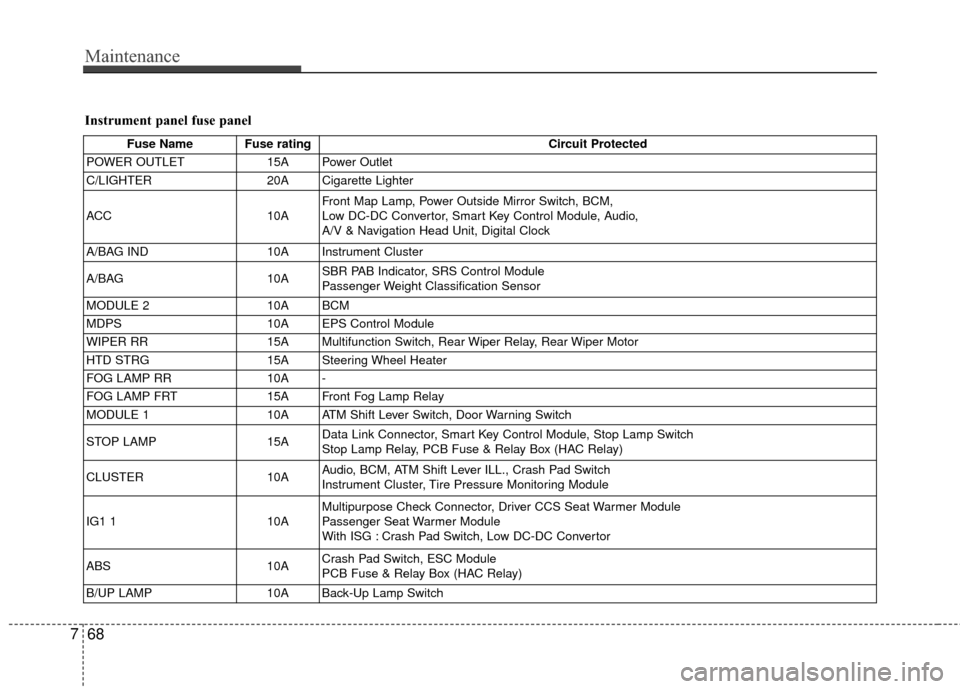
Instrument panel fuse panel
Fuse Name Fuse rating Circuit Protected
POWER OUTLET 15A Power Outlet
C/LIGHTER 20A Cigarette Lighter
ACC 10AFront Map Lamp, Power Outside Mirror Switch, BCM,
Low DC-DC Convertor, Smart Key Control Module, Audio,
A/V & Navigation Head Unit, Digital Clock
A/BAG IND 10A Instrument Cluster
A/BAG 10ASBR PAB Indicator, SRS Control Module
Passenger Weight Classification Sensor
MODULE 2 10A BCM
MDPS 10A EPS Control Module
WIPER RR 15A Multifunction Switch, Rear Wiper Relay, Rear Wiper Motor
HTD STRG 15A Steering Wheel Heater
FOG LAMP RR 10A -
FOG LAMP FRT 15A Front Fog Lamp Relay
MODULE 1 10A ATM Shift Lever Switch, Door Warning Switch
STOP LAMP 15AData Link Connector, Smart Key Control Module, Stop Lamp Switch
Stop Lamp Relay, PCB Fuse & Relay Box (HAC Relay)
CLUSTER 10AAudio, BCM, ATM Shift Lever ILL., Crash Pad Switch
Instrument Cluster, Tire Pressure Monitoring Module
IG1 1 10AMultipurpose Check Connector, Driver CCS Seat Warmer Module
Passenger Seat Warmer Module
With ISG : Crash Pad Switch, Low DC-DC Convertor
ABS 10ACrash Pad Switch, ESC Module
PCB Fuse & Relay Box (HAC Relay)
B/UP LAMP 10A Back-Up Lamp Switch
Page 422 of 449
Maintenance
86
7
APPEARANCE CARE
Exterior care
Exterior general caution
It is very important to follow the label
directions when using any chemical
cleaner or polish. Read all warning and
caution statements that appear on the
label.
Finish maintenance
Washing
To help protect your vehicle’s finish from
rust and deterioration, wash it thoroughly
and frequently at least once a month with
lukewarm or cold water.
If you use your vehicle for off-road driv-
ing, you should wash it after each off-
road trip. Pay special attention to the
removal of any accumulation of salt, dirt,
mud, and other foreign materials. Make
sure the drain holes in the lower edges of
the doors and rocker panels are kept
clear and clean.
Insects, tar, tree sap, bird droppings,
industrial pollution and similar deposits
can damage your vehicle’s finish if not
removed immediately.
Even prompt washing with plain water
may not completely remove all these
deposits. A mild soap, safe for use on
painted surfaces, may be used.
After washing, rinse the vehicle thor-
oughly with lukewarm or cold water. Do
not allow soap to dry on the finish. After washing the vehicle, test the brakes
while driving slowly to see if they have
been affected by water. If braking per-
formance is impaired, dry the brakes by
applying them lightly while maintaining a
slow forward speed.
Page 444 of 449

Index
4I
Engine number ··················\
··················\
··················\
·········8-10
Engine oil ··················\
··················\
··················\
·················7-34\
Changing the engine oil and filter ··················\
·············7-35
Checking the engine oil level ··················\
··················\
7-34
ENGINE START/STOP button ··················\
··················\
···5-7 ENGINE START/STOP button position ··················\
·····5-7
Illuminated ENGINE START/STOP button·················\
·5-7
Explanation of scheduled maintenance items ···············7-31
Exterior overview I ··················\
··················\
··················\
····2-2
Exterior overview II ··················\
··················\
··················\
···2-3
Fuel filler lid ··················\
··················\
··················\
············4-30 Closing the fuel filler lid ··················\
··················\
·········4-30
Fuel requirements ··················\
··················\
··················\
····1-3
Fuel requirements Opening the fuel filler lid ··················\
··················\
········4-30
Fuses ··················\
··················\
··················\
··················\
······7-61 Engine compartment fuse panel ··················\
················7-67
Fuse/relay panel description ··················\
··················\
····7-65
Instrument panel fuse panel··················\
··················\
·····7-66
Memory fuse··················\
··················\
··················\
··········7-63 Hazard warning flasher ··················\
··················\
··············4-72
Hood··················\
··················\
··················\
··················\
·······4-28
Closing the hood··················\
··················\
··················\
····4-29
Opening the hood ··················\
··················\
··················\
·4-28
How to use this manual ··················\
··················\
···············1-2
If the engine overheats··················\
··················\
·················6-8
If the engine will not start ··················\
··················\
···········6-4 If engine turns over normally but does not start ···········6-4
If the engine doesn't turn over or turns over slowly······6-4
If you have a flat tire ··················\
··················\
·················6-14\
Changing tires ···············\
··················\
··················\
··········6-15
Jack and tools ··················\
··················\
··················\
········6-14
Removing and storing the spare tire ··················\
·······6-15
If you have a flat tire (Tire Mobility Kit) ··················\
····6-22 Components of the Tire Mobility Kit··················\
········6-24
Distributing the sealant ··················\
··················\
············6-26
Introduction ··················\
··················\
··················\
···········6-22
Notes on the safe use of the Tire Mobility Kit ···········6-23
Using the Tire Mobility Kit ··················\
··················\
·····6-25
In case of an emergency while driving ··················\
··········6-3 If engine stalls while driving ··················\
··················\
·····6-3H
F
I
Page 445 of 449

I5
Index
If the engine stalls at a crossroad or crossing ···············6-3
If you have a flat tire while driving··················\
·············6-3
Instrument cluster ··················\
··················\
··················\
····4-43 Automatic transaxle shift position indicator ···············4-51
Car option (only for Type B cluster) ··················\
·········4-52
Gauges ··················\
··················\
··················\
··················\
·4-44
Illumination intensity ··················\
··················\
··············4-51
Instrument panel illumination ··················\
··················\
·4-44
Maintenance system (only for Type B cluster) ···········4-53
Manual transaxle shift indicator ··················\
················4-50
User Settings (only for Type B cluster)···············\
········4-51
Warnings and indicators ··················\
··················\
··········4-55
Instrument panel overview··················\
··················\
···········2-5
Interior features··················\
··················\
··················\
······4-114 Ashtray ··················\
··················\
··················\
················4-114
Cigarette lighter ··················\
··················\
··················\
···4-114
Clothes hanger ··················\
··················\
··················\
·····4-119
Cup holder ··················\
··················\
··················\
···········4-115
Digital clock and calendar ··················\
··················\
·····4-118
Floor mat anchor(s) ··················\
··················\
···············4-119
Navigation system ··················\
··················\
·················4-12\
0
Power outlet ··················\
··················\
··················\
·········4-117
Shopping bag holder··················\
··················\
··············4-117
Sliding armrest ··················\
··················\
··················\
····4-116
Sunvisor ··················\
··················\
··················\
···············4-116
Interior light ··················\
··················\
··················\
·············4-81 Glove box lamp ··················\
··················\
··················\
·····4-82
Luggage room lamp··················\
··················\
·················4-82\
Map lamp ··················\
··················\
··················\
··············4-81
Room lamp ··················\
··················\
··················\
············4-81
Vanity mirror lamp ··················\
··················\
··················\
4-82
Interior overview··················\
··················\
··················\
········2-4
ISG (Idle Stop and Go) system ··················\
··················\
·5-39 Auto start ··················\
··················\
··················\
···············5-40
Auto stop ··················\
··················\
··················\
···············5-39
Condition of ISG system operation ··················\
···········5-41
ISG system deactivation ··················\
··················\
··········5-42
ISG system malfunction ··················\
··················\
··········5-42
Key positions ··················\
··················\
··················\
·············5-5 Ignition switch position ··················\
··················\
·············5-5
Illuminated ignition switch··················\
··················\
········5-5
Keys ··················\
··················\
··················\
··················\
·········4-3 Key operations ··················\
··················\
··················\
·········4-3
Record your key number ··················\
··················\
···········4-3
Light bulbs ··················\
··················\
··················\
···············7-73 Headlight, position light, turn signal light, sidemarker light and front fog light bulb replacement ····7-74
High mounted stop light replacement ··················\
·······7-83
K
L