towing KIA RIO 2018 User Guide
[x] Cancel search | Manufacturer: KIA, Model Year: 2018, Model line: RIO, Model: KIA RIO 2018Pages: 490, PDF Size: 11.28 MB
Page 357 of 490
739
What to do in an emergency
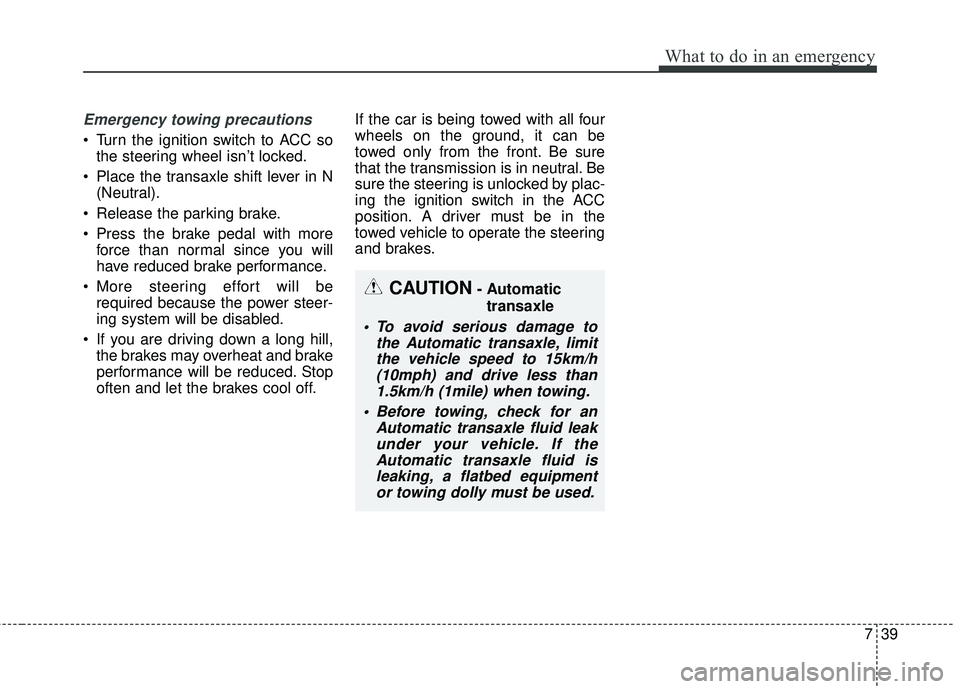
Emergency towing precautions
Turn the ignition switch to ACC sothe steering wheel isn’t locked.
Place the transaxle shift lever in N (Neutral).
Release the parking brake.
Press the brake pedal with more force than normal since you will
have reduced brake performance.
More steering effort will be required because the power steer-
ing system will be disabled.
If you are driving down a long hill, the brakes may overheat and brake
performance will be reduced. Stop
often and let the brakes cool off. If the car is being towed with all four
wheels on the ground, it can be
towed only from the front. Be sure
that the transmission is in neutral. Be
sure the steering is unlocked by plac-
ing the ignition switch in the ACC
position. A driver must be in the
towed vehicle to operate the steering
and brakes.
CAUTION- Automatic
transaxle
To avoid serious damage to the Automatic transaxle, limitthe vehicle speed to 15km/h(10mph) and drive less than1.5km/h (1mile) when towing.
Before towing, check for an Automatic transaxle fluid leakunder your vehicle. If theAutomatic transaxle fluid isleaking, a flatbed equipmentor towing dolly must be used.
Page 366 of 490
89
Maintenance
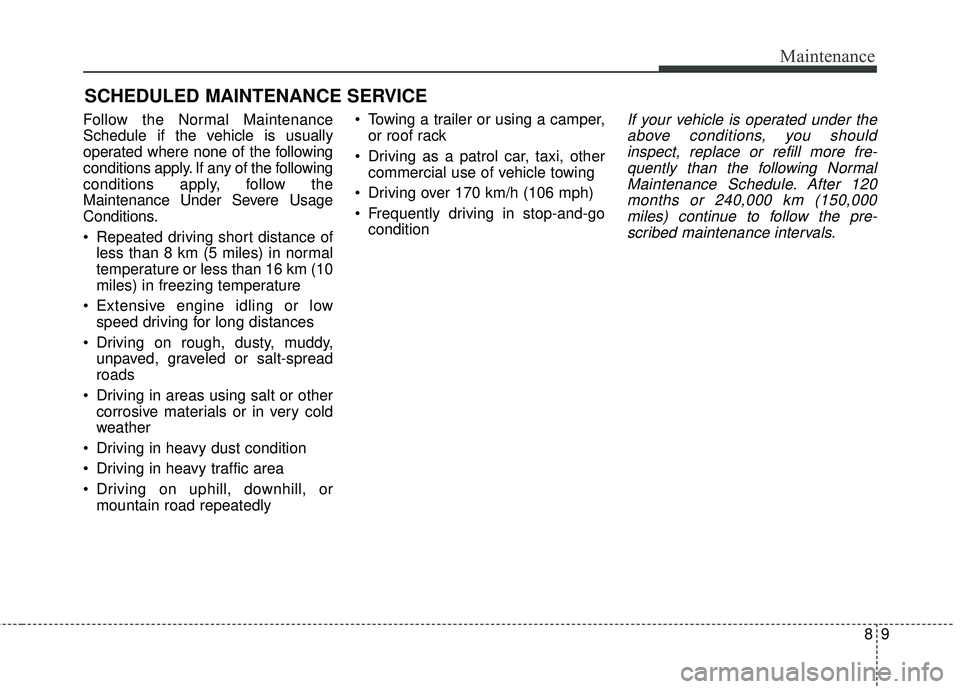
SCHEDULED MAINTENANCE SERVICE
Follow the Normal Maintenance
Schedule if the vehicle is usually
operated where none of the following
conditions apply. If any of the following
conditions apply, follow the
Maintenance Under Severe Usage
Conditions.
Repeated driving short distance ofless than 8 km (5 miles) in normal
temperature or less than 16 km (10
miles) in freezing temperature
Extensive engine idling or low speed driving for long distances
Driving on rough, dusty, muddy, unpaved, graveled or salt-spread
roads
Driving in areas using salt or other corrosive materials or in very cold
weather
Driving in heavy dust condition
Driving in heavy traffic area
Driving on uphill, downhill, or mountain road repeatedly Towing a trailer or using a camper,
or roof rack
Driving as a patrol car, taxi, other commercial use of vehicle towing
Driving over 170 km/h (106 mph)
Frequently driving in stop-and-go conditionIf your vehicle is operated under theabove conditions, you shouldinspect, replace or refill more fre-quently than the following NormalMaintenance Schedule. After 120months or 240,000 km (150,000miles) continue to follow the pre-scribed maintenance intervals.
Page 378 of 490
821
Maintenance
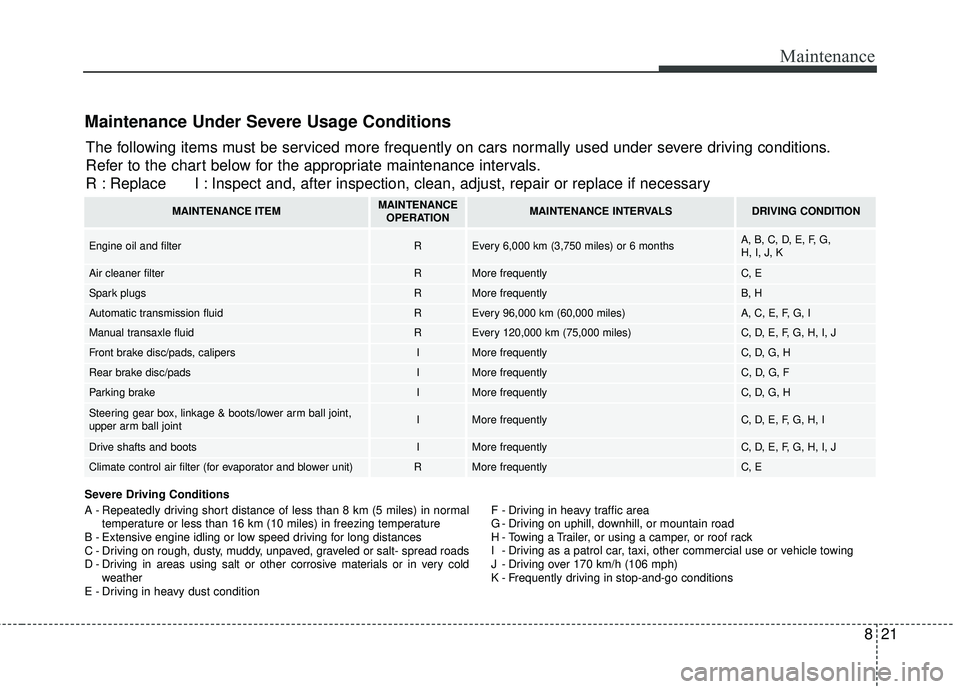
Maintenance Under Severe Usage Conditions
Severe Driving Conditions
A - Repeatedly driving short distance of less than 8 km (5 miles) in normaltemperature or less than 16 km (10 miles) in freezing temperature
B - Extensive engine idling or low speed driving for long distances
C - Driving on rough, dusty, muddy, unpaved, graveled or salt- spread roads
D - Driving in areas using salt or other corrosive materials or in very cold weather
E - Driving in heavy dust condition F - Driving in heavy traffic area
G - Driving on uphill, downhill, or mountain road
H - Towing a Trailer, or using a camper, or roof rack
I - Driving as a patrol car, taxi, other commercial use or vehicle towing
J - Driving over 170 km/h (106 mph)
K - Frequently driving in stop-and-go conditions
The following items must be serviced more frequently on cars normally used under severe driving conditions.
Refer to the chart below for the appropriate maintenance intervals.
R : Replace I : Inspect and, after inspection, clean, adjust, repair or replace if neces\
sary
MAINTENANCE ITEMMAINTENANCE
OPERATIONMAINTENANCE INTERVALSDRIVING CONDITION
Engine oil and filterREvery 6,000 km (3,750 miles) or 6 monthsA, B, C, D, E, F, G,
H, I, J, K
Air cleaner filterRMore frequentlyC, E
Spark plugsRMore frequentlyB, H
Automatic transmission fluidREvery 96,000 km (60,000 miles)A, C, E, F, G, I
Manual transaxle fluidREvery 120,000 km (75,000 miles)C, D, E, F, G, H, I, J
Front brake disc/pads, calipersIMore frequentlyC, D, G, H
Rear brake disc/padsIMore frequentlyC, D, G, F
Parking brakeIMore frequentlyC, D, G, H
Steering gear box, linkage & boots/lower arm ball joint,
upper arm ball jointIMore frequentlyC, D, E, F, G, H, I
Drive shafts and bootsIMore frequentlyC, D, E, F, G, H, I, J
Climate control air filter (for evaporator and blower unit)RMore frequentlyC, E
Page 489 of 490
I9
Index
Recommended cold tire inflation pressures................8-45
Snow tires ..................................................................8-57
Summer tires ..............................................................8-57
Tire care ......................................................................8-\
45
Tire maintenance ........................................................8-50
Tire pressure................................................................8-46
Tire replacement ........................................................8-49
Tire rotation ................................................................8-47
Tire sidewall labeling..................................................8-50
Tire traction ................................................................8-50
Wheel alignment and tire balance ..............................8-48
Wheel replacement ....................................................8-50
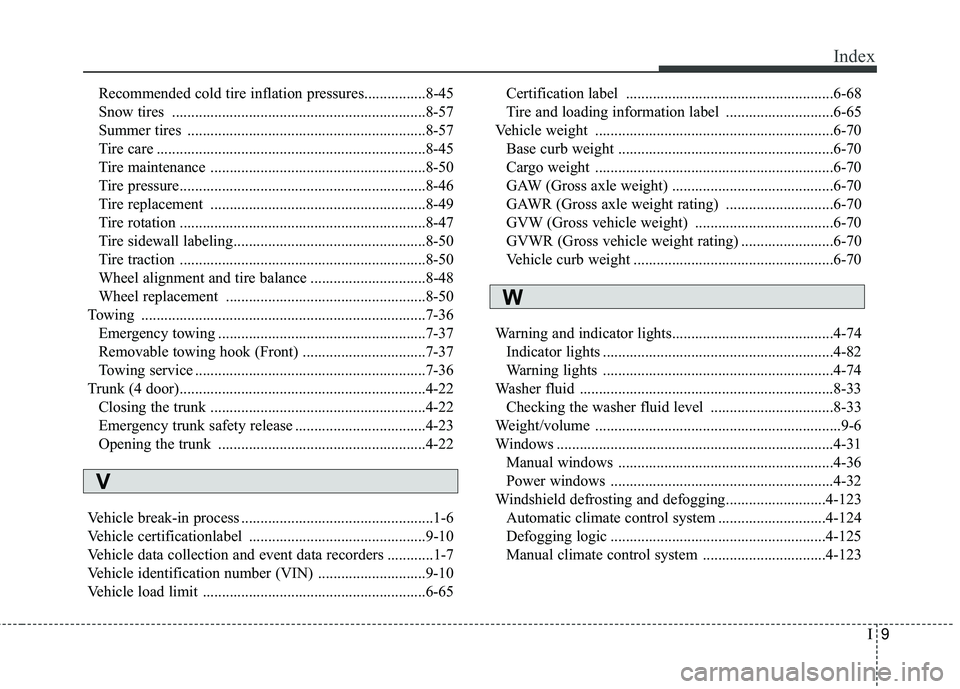
Towing ........................................................................\
..7-36 Emergency towing ......................................................7-37
Removable towing hook (Front) ................................7-37
Towing service ............................................................7-36
Trunk (4 door)................................................................4-22 Closing the trunk ........................................................4-22
Emergency trunk safety release ..................................4-23
Opening the trunk ......................................................4-22
Vehicle break-in process ..................................................1-6
Vehicle certificationlabel ..............................................9-10
Vehicle data collection and event data recorders ............1-7
Vehicle identification number (VIN) ............................9-10
Vehicle load limit ..........................................................6-65 Certification label ......................................................6-68
Tire and loading information label ............................6-65
Vehicle weight ..............................................................6-70 Base curb weight ........................................................6-70
Cargo weight ..............................................................6-70
GAW (Gross axle weight) ..........................................6-70
GAWR (Gross axle weight rating) ............................6-70
GVW (Gross vehicle weight) ....................................6-70
GVWR (Gross vehicle weight rating) ........................6-70
Vehicle curb weight ....................................................6-70
Warning and indicator lights..........................................4-74 Indicator lights ............................................................4-82
Warning lights ............................................................4-74
Washer fluid ..................................................................8-33 Checking the washer fluid level ................................8-33
Weight/volume ................................................................9-6
Windows ........................................................................\
4-31 Manual windows ........................................................4-36
Power windows ..........................................................4-32
Windshield defrosting and defogging..........................4-123 Automatic climate control system ............................4-124
Defogging logic ........................................................4-125
Manual climate control system ................................4-123
V
W