tow KIA RIO 2020 Owner's Manual
[x] Cancel search | Manufacturer: KIA, Model Year: 2020, Model line: RIO, Model: KIA RIO 2020Pages: 516, PDF Size: 10.49 MB
Page 214 of 516
Features of your vehicle
134
4
Automatic climate control system
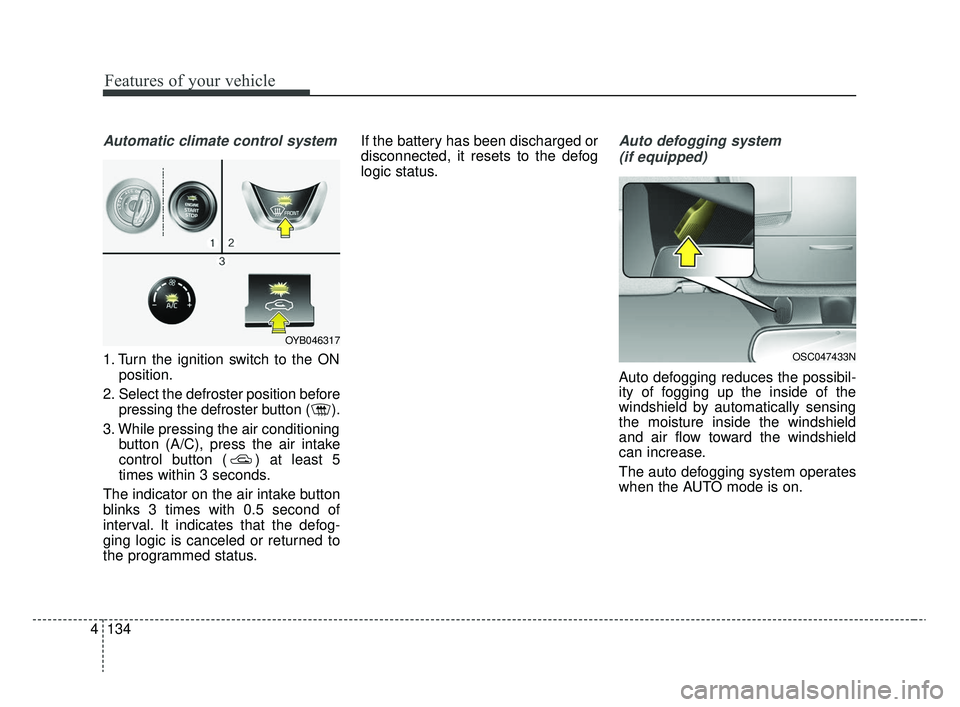
1. Turn the ignition switch to the ON
position.
2. Select the defroster position before pressing the defroster button ( ).
3. While pressing the air conditioning button (A/C), press the air intake
control button ( ) at least 5
times within 3 seconds.
The indicator on the air intake button
blinks 3 times with 0.5 second of
interval. It indicates that the defog-
ging logic is canceled or returned to
the programmed status. If the battery has been discharged or
disconnected, it resets to the defog
logic status.
Auto defogging system
(if equipped)
Auto defogging reduces the possibil-
ity of fogging up the inside of the
windshield by automatically sensing
the moisture inside the windshield
and air flow toward the windshield
can increase.
The auto defogging system operates
when the AUTO mode is on.
OSC047433N
OYB046317
SC CAN (ENG) 4.QXP 12/12/2019 5:15 PM Page 134
Page 215 of 516

4135
Features of your vehicle
This indicator illuminates
when the auto defogging
system senses moisture
on the inside of the wind-
shield and is activated.
If more moisture is in the vehicle, the
auto defogging system addresses
excess moisture on the inside of the
windshield in stages as follows:
Step 1 : Operating the air condition- ing
Step 2 : Outside air position
Step 3 : Blowing air flow toward the windshield
Step 4 : Increasing air flow toward the windshield
If your vehicle is equipped with the
auto defogging system, it is automat-
ically activated when the conditions
are met.
However, if you would like to deacti-
vate the auto defogging system,
keep the front defroster button
pressed longer than 3 seconds. The “ADS OFF” symbol will be
shown in the climate display to
inform you that the system is deacti-
vated.
To re-activate the auto defogging
system again, follow the procedure
mentioned above and the “ADS
OFF” symbol will disappear.
If the battery has been disconnected
or discharged, it resets to the auto
defogging status.
✽ ✽
NOTICE
• When the air conditioning is
turned on by Auto defogging sys-
tem, if you try to turn off the air
conditioning, the indicator will
blink 3 times and the air condi-
tioning will not be turned off.
• For efficiency, do not select recir- culated air position while Auto
defogging system is operating.
CAUTION
Do not remove the sensor cover
located on the upper end of thedriver side windshield glass.Damage to the system partscould occur and may not be cov-ered by your vehicle warranty.
SC CAN (ENG) 4.QXP 12/12/2019 5:15 PM Page 135
Page 228 of 516
Audio system
35
AUX, USB port (if equipped)
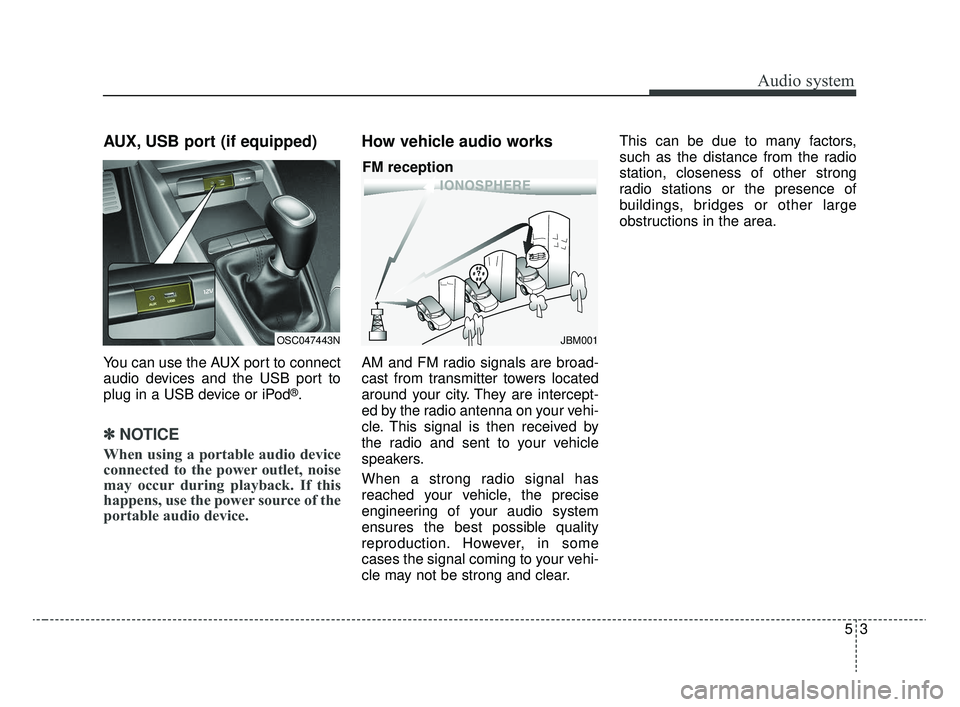
You can use the AUX port to connect
audio devices and the USB port to
plug in a USB device or iPod
®.
✽ ✽NOTICE
When using a portable audio device
connected to the power outlet, noise
may occur during playback. If this
happens, use the power source of the
portable audio device.
How vehicle audio works
AM and FM radio signals are broad-
cast from transmitter towers located
around your city. They are intercept-
ed by the radio antenna on your vehi-
cle. This signal is then received by
the radio and sent to your vehicle
speakers.
When a strong radio signal has
reached your vehicle, the precise
engineering of your audio system
ensures the best possible quality
reproduction. However, in some
cases the signal coming to your vehi-
cle may not be strong and clear. This can be due to many factors,
such as the distance from the radio
station, closeness of other strong
radio stations or the presence of
buildings, bridges or other large
obstructions in the area.
OSC047443NJBM001
FM reception
SC CAN (ENG) 5(audio).qxp 6/7/2019 9:52 AM Page 3
Page 273 of 516
Driving your vehicle
66
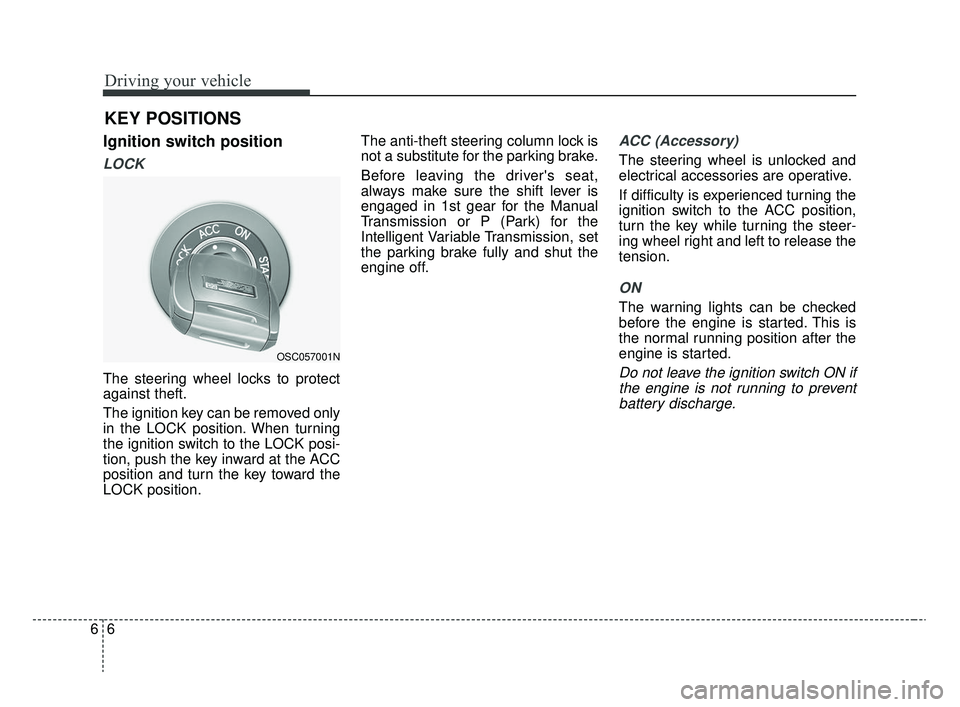
Ignition switch position
LOCK
The steering wheel locks to protect
against theft.
The ignition key can be removed only
in the LOCK position. When turning
the ignition switch to the LOCK posi-
tion, push the key inward at the ACC
position and turn the key toward the
LOCK position.The anti-theft steering column lock is
not a substitute for the parking brake.
Before leaving the driver's seat,
always make sure the shift lever is
engaged in 1st gear for the Manual
Transmission or P (Park) for the
Intelligent Variable Transmission, set
the parking brake fully and shut the
engine off.
ACC (Accessory)
The steering wheel is unlocked and
electrical accessories are operative.
If difficulty is experienced turning the
ignition switch to the ACC position,
turn the key while turning the steer-
ing wheel right and left to release the
tension.
ON
The warning lights can be checked
before the engine is started. This is
the normal running position after the
engine is started.
Do not leave the ignition switch ON if
the engine is not running to preventbattery discharge.
KEY POSITIONS
OSC057001N
SC CAN (ENG) 6.QXP 6/7/2019 9:49 AM Page 6
Page 315 of 516
Driving your vehicle
48
6
System malfunction
When FCA is not working properly,
FCA warning light ( ) will illumi-
nate and the warning message
(“Check FCA system”) will appear
for a few seconds. After the mes-
sage disappears, the master warn-
ing light ( ) will illuminate. In this
case, have the vehicle inspected by
an authorized Kia dealer.
FCA warning message may appear along with the illumination
of the ESC warning light.WARNING
FCA system is only a supple-mental system for the driver's
convenience. The driver
should hold the responsibility
to control the vehicle opera-
tion. Do not solely depend on
FCA system. Rather, maintain
a safe braking distance, and, if
necessary, depress the brake
pedal to reduce the driving
speed.
In certain instances and under certain driving condi-
tions, FCA system may acti-
vate prematurely. This initial
warning message appears on
the LCD display with a warn-
ing chime. Also, in certain
instances the front radar sen-
sor may not detect the vehicle
ahead. FCA system may not
activate and the warning mes-
sage will not be displayed.
(Continued)
(Continued)
If there is a malfunction withFCA system, Forward
Collision-Avoidance Assist
(FCA) system is not applied
even though the braking sys-
tem is operating normally.
If the vehicle in front stops suddenly, you may have less
control of the brake system.
Therefore, always keep a safe
distance between your vehicle
and the vehicle in front of you.
FCA system may activate dur- ing braking and the vehicle
may stop suddenly shifting
loose objects toward the pas-
sengers. Always keep loose
objects secured.
FCA system may not activate if the driver applies the brake
pedal to avoid a collision.
(Continued)
SC CAN (ENG) 6.QXP 6/7/2019 9:50 AM Page 48
Page 320 of 516

653
Driving your vehicle
✽ ✽NOTICE
In some instances, FCA system may
be canceled when subjected to elec-
tromagnetic interference.
WARNING - Testing FCA
system
The FCA system may not oper-
ate in certain situations.
Therefore, never test the opera-
tion of the FCA system using a
person or object, as doing so
may cause severe injury or
even death.
WARNING - FCA system
and Towing
Cancel FCA system in the User
Settings on the LCD display,
before towing another vehicle.
While towing, the brake applica-
tion may adversely affect your
vehicle safety.
WARNING
Use extreme caution when the vehicle in front of you has
cargo that extends rearward
from the cab, or when the
vehicle in front of you has
higher ground clearance.
FCA system is designed to detect and monitor the vehicle
ahead through sensor recog-
nition. It is not designed to
detect bicycles, motorcycles,
or smaller wheeled objects
such as luggage bags, shop-
ping carts, or strollers.
When replacing or reinstalling of front bumper or radar, have
the vehicle inspected for the
system check by an author-
ized Kia dealer.
SC CAN (ENG) 6.QXP 6/7/2019 9:50 AM Page 53
Page 329 of 516
Driving your vehicle
62
6
Hazardous driving conditions
When hazardous driving conditions
are encountered such as water,
snow, ice, mud, sand, or similar haz-
ards, follow these suggestions:
Drive cautiously and allow extra
distance for braking.
Avoid sudden braking or steering.
When braking with non-ABS brakes, pump the brake pedal with
a light up-and-down motion until
the vehicle is stopped. Do not pump the brake pedal on a
vehicle equipped with ABS.
If stalled in snow, mud, or sand,
use second gear. Accelerate slow-
ly to avoid spinning the drive
wheels.
Use sand, rock salt, or other non- slip material under the drive
wheels to provide traction when
stalled in ice, snow, or mud.
Rocking the vehicle
If it is necessary to rock the vehicle
to free it from snow, sand, or mud,
first turn the steering wheel right and
left to clear the area around your
front wheels. Then, shift back and
forth between 1st (First) and R
(Reverse) in vehicles equipped with
a Manual Transmission or R
(Reverse) and any forward gear in
vehicles equipped with an Intelligent
Variable Transmission. Do not race
the engine, and spin the wheels as
little as possible. If you are still stuck
after a few tries, have the vehicle
pulled out by a tow vehicle to avoid
engine overheating and possible
damage to the transmission.
The ESC system should be turned
OFF prior to rocking the vehicle.
SPECIAL DRIVING CONDITIONS
CAUTION- Vehicle
rocking
Prolonged rocking may causeengine overheating, transmis-sion damage or failure, and tiredamage.
WARNING- Downshifting
Do not downshift with an intelli-
gent variable transmission
while driving on slippery sur-
faces. The sudden change in
tire speed could cause the tires
to skid and result in an acci-
dent.
SC CAN (ENG) 6.QXP 6/7/2019 9:51 AM Page 62
Page 336 of 516
669
Driving your vehicle
Don't let your parking brake
freeze
Under some conditions, your parking
brake can freeze in the engaged
position. This is most likely to hap-
pen when there is an accumulation
of snow or ice around or near the
rear brakes or if the brakes are wet.
If there is a risk the parking brake
may freeze, apply it only temporarily
while you put the shift lever in P
(Intelligent Variable Transmission) or
in first or reverse gear (Manual
Transmission) and chock the rear
wheels so the vehicle cannot roll.
Then release the parking brake.
Don't let ice and snow accu-
mulate underneath
Under some conditions, snow and
ice can build up under the fenders
and interfere with the steering. When
driving in severe winter conditions
where this may happen, you should
periodically check underneath the
car to be sure the movement of the
front wheels and the steering com-
ponents is not obstructed.
Carry emergency equipment
Depending on the severity of the
weather you should carry appropri-
ate emergency equipment. Some of
the items you may want to carry
include tow straps or chains, emer-
gency flares, sand, a shovel, jumper
cables, a window scraper, gloves,
ground cloth, coveralls, a blanket,
etc.
TRAILER TOWING
We do not recommend using this
vehicle for trailer towing.
SC CAN (ENG) 6.QXP 6/7/2019 9:51 AM Page 69
Page 338 of 516
671
Driving your vehicle
Seating capacity:
Total : 5 persons (Front seat : 2 persons, Rear seat : 3 persons)
Seating capacity is the maximum
number of occupants, including a
driver, your vehicle may carry.
However, the seating capacity may
be reduced based upon the weight of
all of the occupants and the weight of
the cargo being carried or towed.
Do not overload the vehicle as there
is a limit to the total weight, or load
limit including occupants and cargo,
the vehicle can carry.
Towing capacity:
We do not recommend using this
vehicle for trailer towing.
Cargo capacity:
The cargo capacity of your vehicle
will increase or decrease depending
on the weight and the number of
occupants.
Steps For Determining Correct Load Limit -
1. Locate the statement "The com- bined weight of occupants and
cargo should never exceed XXX
kg or XXX lbs.'' on your vehicle's
placard.
2. Determine the combined weight of the driver and passengers that will
be riding in your vehicle.
3. Subtract the combined weight of the driver and passengers from
XXX kg or XXX lbs. 4. The resulting figure equals the
available amount of cargo and lug-
gage load capacity. For example, if
the “XXX” amount equals 635 kg
(1400 lbs.) and there will be five 68
kg (150 lb) passengers in your
vehicle, the amount of available
cargo and luggage load capacity
is 295 kg (650 lbs).
(635-340 (5 x 68) = 295 kg or
1400-750 (5 x 150) = 650 lbs.)
5. Determine the combined weight of luggage and cargo being loaded
on the vehicle. That weight may
not safely exceed the available
cargo and luggage load capacity
calculated in Step 4.
6. If your vehicle will be towing a trail- er, load from your trailer will be
transferred to your vehicle. Consult
this manual to determine how this
reduces the available cargo and
luggage load capacity of your
vehicle.
SC CAN (ENG) 6.QXP 6/7/2019 9:51 AM Page 71
Page 343 of 516
What to do in an emergency
Road warning . . . . . . . . . . . . . . . . . . . . . . . . . . . . . . 7-2
• Hazard warning flasher . . . . . . . . . . . . . . . . . . . . . . . . 7-2
In case of an emergency while driving . . . . . . . . . . 7-3
• If the engine stalls at a crossroad or crossing. . . . . . . 7-3
• If you have a flat tire while driving . . . . . . . . . . . . . . . 7-3
• If engine stalls while driving . . . . . . . . . . . . . . . . . . . . 7-3
If the engine will not start . . . . . . . . . . . . . . . . . . . . 7-4
• If the engine doesn't turn over or turns over slowly . 7-4
• If engine turns over normally but does not start . . . . 7-4
Emergency starting . . . . . . . . . . . . . . . . . . . . . . . . . 7-5
• Jump starting . . . . . . . . . . . . . . . . . . . . . . . . . . . . . . . . . 7-5
• Push-starting . . . . . . . . . . . . . . . . . . . . . . . . . . . . . . . . . 7-6
If the engine overheats . . . . . . . . . . . . . . . . . . . . . . . 7-7
Tire Pressure Monitoring System (TPMS - Type A) . . . . . . . . . . . . . . . . . . . . . . . . . . 7-8
• Low tire pressure telltale . . . . . . . . . . . . . . . . . . . . . . . 7-9
• TPMS (Tire Pressure Monitoring System) malfunction
indicator . . . . . . . . . . . . . . . . . . . . . . . . . . . . . . . . . . . 7-\
10
• Changing a tire with TPMS . . . . . . . . . . . . . . . . . . . . 7-11
Tire Pressure Monitoring System (TPMS - Type B) . . . . . . . . . . . . . . . . . . . . . . . . . 7-13
• Check tire pressure . . . . . . . . . . . . . . . . . . . . . . . . . . . 7-13
• Low tire pressure telltale . . . . . . . . . . . . . . . . . . . . . . 7-15
• Low tire pressure position telltale . . . . . . . . . . . . . . . 7-15
• Changing a tire with TPMS . . . . . . . . . . . . . . . . . . . . 7-17
If you have a flat tire (with Tire Mobility Kit) . . 7-19
• Introduction . . . . . . . . . . . . . . . . . . . . . . . . . . . . . . . . . 7-19
• Notes on the safe use of the Tire Mobility Kit . . . . . 7-20
• Components of the Tire Mobility Kit . . . . . . . . . . . . 7-21
• Using the Tire Mobility Kit . . . . . . . . . . . . . . . . . . . . 7-22
• Distributing the sealant. . . . . . . . . . . . . . . . . . . . . . . . 7-24
• Checking the tire inflation pressure . . . . . . . . . . . . . 7-25
• Technical Data . . . . . . . . . . . . . . . . . . . . . . . . . . . . . . . 7-26
If you have a flat tire (with spare tire) . . . . . . . . . 7-27
• Jack and tools . . . . . . . . . . . . . . . . . . . . . . . . . . . . . . . 7-27
• Removing and storing the spare tire . . . . . . . . . . . . . 7-28
• Changing tires . . . . . . . . . . . . . . . . . . . . . . . . . . . . . . . 7-29
• Jack label . . . . . . . . . . . . . . . . . . . . . . . . . . . . . . . . . . . 7-\
36
Towing . . . . . . . . . . . . . . . . . . . . . . . . . . . . . . . . . . . 7-\
37
• Towing service . . . . . . . . . . . . . . . . . . . . . . . . . . . . . . . 7-37
• Removable towing hook (front) . . . . . . . . . . . . . . . . . 7-38
• Emergency towing . . . . . . . . . . . . . . . . . . . . . . . . . . . . 7-39
7
SC CAN (ENG) 7.qxp 6/7/2019 9:46 AM Page 1