park assist KIA RIO 2021 User Guide
[x] Cancel search | Manufacturer: KIA, Model Year: 2021, Model line: RIO, Model: KIA RIO 2021Pages: 534, PDF Size: 13.49 MB
Page 334 of 534
597
Driving your vehicle
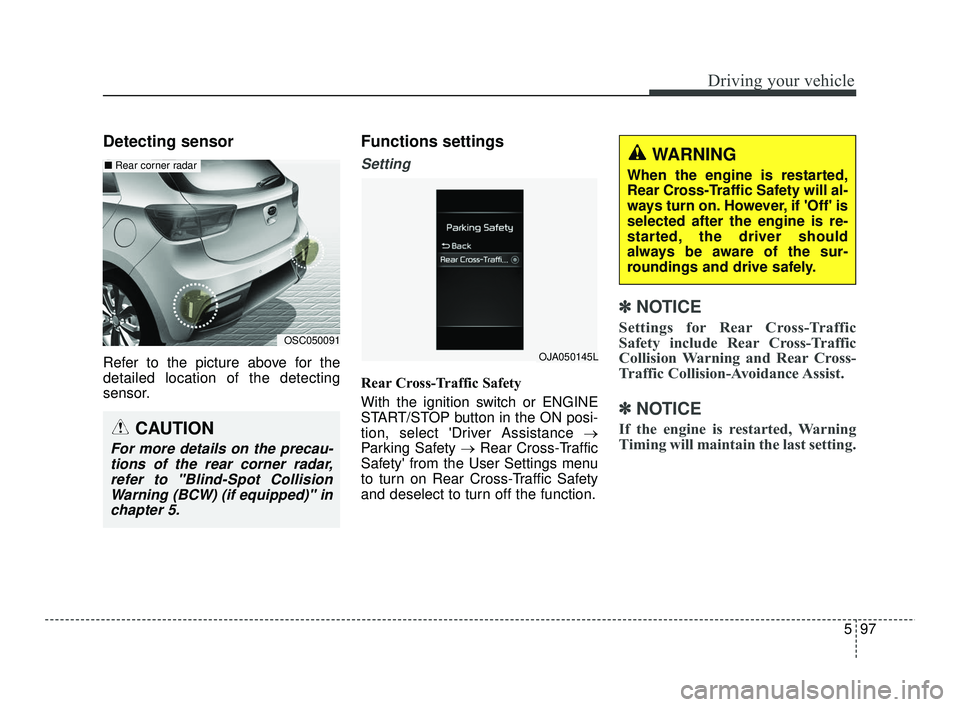
Detecting sensor
Refer to the picture above for the
detailed location of the detecting
sensor.
Functions settings
Setting
Rear Cross-Traffic Safety
With the ignition switch or ENGINE
START/STOP button in the ON posi-
tion, select 'Driver Assistance →
Parking Safety →Rear Cross-Traffic
Safety' from the User Settings menu
to turn on Rear Cross-Traffic Safety
and deselect to turn off the function.
✽ ✽
NOTICE
Settings for Rear Cross-Traffic
Safety include Rear Cross-Traffic
Collision Warning and Rear Cross-
Traffic Collision-Avoidance Assist.
✽ ✽
NOTICE
If the engine is restarted, Warning
Timing will maintain the last setting.
OSC050091
■ Rear corner radar
CAUTION
For more details on the precau-
tions of the rear corner radar,refer to "Blind-Spot CollisionWarning (BCW) (if equipped)" inchapter 5.
WARNING
When the engine is restarted,
Rear Cross-Traffic Safety will al-
ways turn on. However, if 'Off' is
selected after the engine is re-
started, the driver should
always be aware of the sur-
roundings and drive safely.
OJA050145L
SC PE USA 5.QXP 10/23/2020 5:54 PM Page 97
Page 362 of 534
63
What to do in an emergency
If the engine stalls at a cross-
road or crossing
If the engine stalls at a crossroad or
crossing, set the shift lever in the N
(Neutral) position and then push the
vehicle to a safe place.
If you have a flat tire while
driving
If a tire goes flat while you are driv-
ing:
1. Take your foot off the acceleratorpedal and let the vehicle slow
down while driving straight ahead.
Do not apply the brakes immedi-
ately or attempt to pull off the road
as this may cause a loss of con-
trol. When the vehicle has slowed
down to such a speed that it is
safe to do so, brake carefully and
pull off the road. Drive off the road
as far as possible and park on a
firm level ground. If you are on a
divided highway, do not park in the
median area between the two traf-
fic lanes.
2. When the vehicle is stopped, turn on your emergency hazard flash-
ers, set the parking brake and put
the transmission in P (Intelligent
Variable Transmission) or reverse
(Manual Transmission). 3. Have all passengers get out of the
vehicle. Be sure they all get out on
the side of the vehicle that is away
from traffic.
4. When changing a flat tire, follow the instruction provided later in
this section.
If engine stalls while driving
1. Reduce your speed gradually,keeping a straight line. Move cau-
tiously off the road to a safe place.
2. Turn on your emergency flashers.
3. Try to start the engine again. If your vehicle will not start, contact
an authorized Kia dealer or seek
other qualified assistance.
IN CASE OF AN EMERGENCY WHILE DRIVING
SC PE USA 6.qxp 10/23/2020 6:02 PM Page 3
Page 363 of 534
What to do in an emergency
46
IF THE ENGINE WILL NOT START
If the engine doesn't turn over
or turns over slowly
1. If your vehicle has an intelligentvariable transmission, be sure the
shift lever is in N (Neutral) or P
(Park) and the emergency brake is
set.
2. Check the battery connections to be sure they are clean and tight.
3. Turn on the interior light. If the light dims or goes out when you oper-
ate the starter, the battery is dis-
charged.
4. Check the starter connections to be sure they are securely tight-
ened.
5. Do not push or pull the vehicle to start it. See instructions for “Jump
starting”.
If engine turns over normally
but does not start
1. Check fuel level.
2. With the ignition switch in theLOCK position, check all connec-
tors at the ignition coil and spark
plugs. Reconnect any that may be
disconnected or loose.
3. Check the fuel line in the engine compartment.
4. If the engine still does not start, call an authorized Kia dealer or
seek other qualified assistance.
WARNING- Push/
pull start
Do not push or pull the vehicle
to start it. Push or pull starting
may cause the catalytic con-
verter to overload and create a
fire hazard.
SC PE USA 6.qxp 10/23/2020 6:02 PM Page 4
Page 366 of 534
67
What to do in an emergency
IF THE ENGINE OVERHEATS
If your temperature gauge indicates
overheating, you will experience a
loss of power, or hear loud pinging or
knocking, the engine is probably too
hot. If this happens, you should:
1. Pull off the road and stop as soonas it is safe to do so.
2. Place the shift lever in P (Intelligent Variable Transmission)
or neutral (Manual Transmission)
and set the parking brake. If the air
conditioning is on, turn it off.
3. If engine coolant is running out under the vehicle or steam is com-
ing out from underneath the hood,
stop the engine. Do not open the
hood until the coolant has
stopped running or the steaming
has stopped. If there is no visible
loss of engine coolant and no
steam, leave the engine running
and check to be sure the engine
cooling fan is operating. If the fan
is not running, turn the engine off. 4. Check to see if the water pump
drive belt is missing. If it is not
missing, check to see that it is
tight. If the drive belt seems to be
satisfactory, check for coolant
leaking from the radiator, hoses or
under the vehicle. (If the air condi-
tioning had been in use, it is nor-
mal for cold water to be draining
from it when you stop).
5. If the water pump drive belt is bro- ken or engine coolant leaks, stop
the engine immediately and call
the nearest authorized Kia dealer
for assistance. 6. If you cannot find the cause of the
overheating, wait until the engine
temperature has returned to nor-
mal. Then, if coolant has been lost,
carefully add coolant to the reser-
voir to bring the fluid level in the
reservoir up to the halfway mark.
7. Proceed with caution, keeping alert for further signs of overheat-
ing. If overheating happens again,
call an authorized Kia dealer for
assistance.
Serious loss of coolant indicates
there is a leak in the cooling system
and this should be checked as soon
as possible by an authorized Kia
dealer.
WARNING- Under the hood
While the engine is running,
keep hair, hands and clothing
away from moving parts such
as the fan and drive belts.
WARNING- Radiator cap
Do not remove the radiator cap
when the engine is hot. This can
allow coolant to be blown out of
the opening and cause serious
burns.
SC PE USA 6.qxp 10/23/2020 6:02 PM Page 7
Page 524 of 534
Index
2I
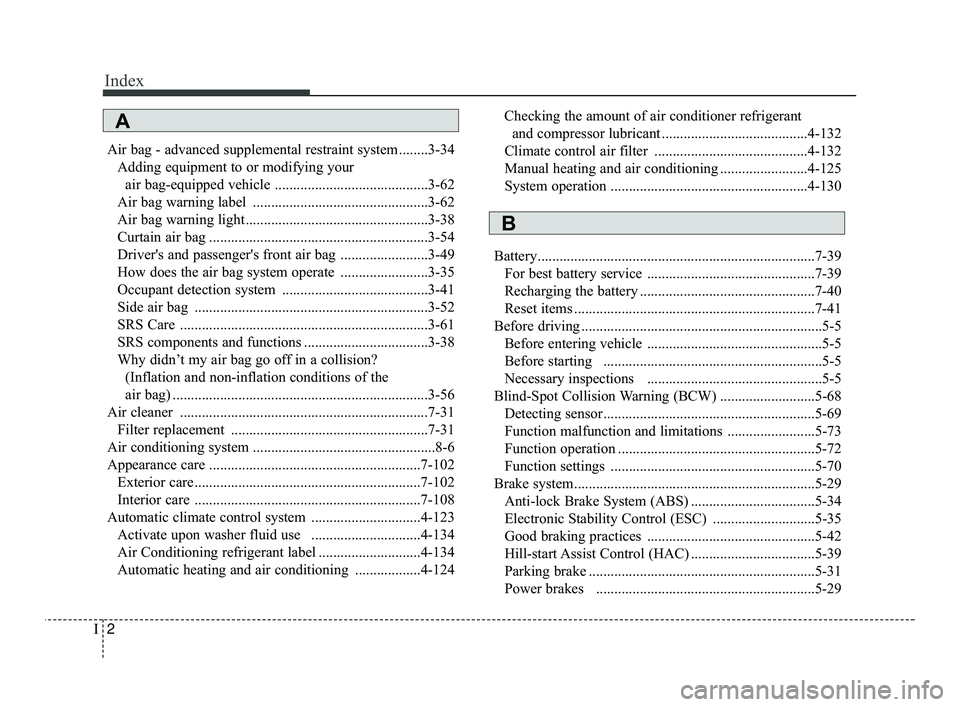
Air bag - advanced supplemental restraint system ........3-34Adding equipment to or modifying yourair bag-equipped vehicle ..........................................3-62
Air bag warning label ................................................3-62
Air bag warning light ..................................................3-38
Curtain air bag ............................................................3-54
Driver's and passenger's front air bag ........................3-49
How does the air bag system operate ........................3-35
Occupant detection system ........................................3-41
Side air bag ................................................................3-52
SRS Care ....................................................................3-61\
SRS components and functions ..................................3-38
Why didn’t my air bag go off in a collision? (Inflation and non-inflation conditions of the
air bag) ......................................................................3-\
56
Air cleaner ....................................................................7-31\
Filter replacement ......................................................7-31
Air conditioning system ..................................................8-6
Appearance care ..........................................................7-102 Exterior care ..............................................................7-102
Interior care ..............................................................7-108
Automatic climate control system ..............................4-123 Activate upon washer fluid use ..............................4-134
Air Conditioning refrigerant label ............................4-134
Automatic heating and air conditioning ..................4-124 Checking the amount of air conditioner refrigerant
and compressor lubricant ........................................4-132
Climate control air filter ..........................................4-132
Manual heating and air conditioning ........................4-125
System operation ......................................................4-130
Battery........................................................................\
....7-39 For best battery service ..............................................7-39
Recharging the battery ................................................7-40
Reset items ..................................................................7-41
Before driving ..................................................................5-5 Before entering vehicle ................................................5-5
Before starting ............................................................5-5
Necessary inspections ................................................5-5
Blind-Spot Collision Warning (BCW) ..........................5-68 Detecting sensor ..........................................................5-69
Function malfunction and limitations ........................5-73
Function operation ......................................................5-72
Function settings ........................................................5-70
Brake system..................................................................5-29 Anti-lock Brake System (ABS) ..................................5-34
Electronic Stability Control (ESC) ............................5-35
Good braking practices ..............................................5-42
Hill-start Assist Control (HAC) ..................................5-39
Parking brake ..............................................................5-31
Power brakes ............................................................5-29
A
B
SC PE USA Index.qxp 10/23/2020 6:23 PM Page 2