transmission KIA RIO 2021 Owner's Manual
[x] Cancel search | Manufacturer: KIA, Model Year: 2021, Model line: RIO, Model: KIA RIO 2021Pages: 534, PDF Size: 13.49 MB
Page 254 of 534
517
Driving your vehicle
Manual transmission opera-
tion
The manual transmission has 6 for-
ward gears.
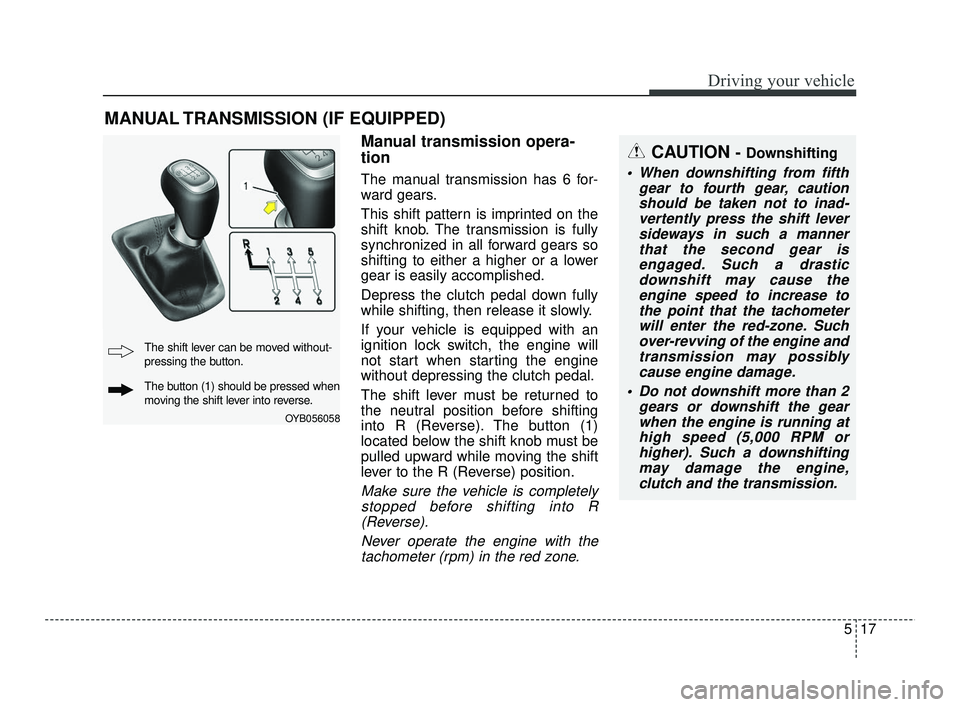
This shift pattern is imprinted on the
shift knob. The transmission is fully
synchronized in all forward gears so
shifting to either a higher or a lower
gear is easily accomplished.
Depress the clutch pedal down fully
while shifting, then release it slowly.
If your vehicle is equipped with an
ignition lock switch, the engine will
not start when starting the engine
without depressing the clutch pedal.
The shift lever must be returned to
the neutral position before shifting
into R (Reverse). The button (1)
located below the shift knob must be
pulled upward while moving the shift
lever to the R (Reverse) position.
Make sure the vehicle is completelystopped before shifting into R(Reverse).
Never operate the engine with thetachometer (rpm) in the red zone.
MANUAL TRANSMISSION (IF EQUIPPED)
CAUTION - Downshifting
When downshifting from fifth gear to fourth gear, cautionshould be taken not to inad-vertently press the shift leversideways in such a mannerthat the second gear isengaged. Such a drasticdownshift may cause theengine speed to increase tothe point that the tachometerwill enter the red-zone. Suchover-revving of the engine andtransmission may possiblycause engine damage.
Do not downshift more than 2 gears or downshift the gearwhen the engine is running athigh speed (5,000 RPM orhigher). Such a downshiftingmay damage the engine,clutch and the transmission.
OYB056058
The shift lever can be moved without-
pressing the button.
The button (1) should be pressed when
moving the shift lever into reverse.
SC PE USA 5.QXP 10/23/2020 5:49 PM Page 17
Page 255 of 534
Driving your vehicle
18
5
During cold weather, shifting may
be difficult until the transmission
lubricant is warmed up. This is nor-
mal and not harmful to the trans-
mission.
If you've come to a complete stop and it's hard to shift into 1st or R
(Reverse), leave the shift lever at
the N (Neutral) position and
release the clutch. Depress the
clutch pedal and then shift into 1st
or R (Reverse) gear position.
CAUTION - Premature
wear
Do not use the shift lever as ahandrest during driving, as thiscan result in premature wear ofthe transmission shift forks.
CAUTION
To prevent possible damage to the clutch system, do notstart with the 2nd (second)gear engaged except whenyou start on a slippery road.
If the clutch pedal is released rapidly after shifting into 1stor R(Reverse), it could causethe engine to stall and lead toan accident.
The clutch pedal should be fully depressed. When thepedal is released, make surenot to depress the pedal againbefore it returns to the normalposition. Failure to do sorepeatedly may cause damageto the clutch system.
Do not overload the vehicle. Driving with the vehicle over-loaded could cause abnormalfriction heat to the clutch diskand damage the clutch coverand disk.
WARNING- Shift lever
position
Before leaving the driver’s seat, always set the parking
brake fully and shut the
engine off. Then make sure
the transmission is shifted
into 1st gear when the vehicle
is parked on a level or uphill
grade, and shifted into R
(Reverse) on a downhill
grade. Unexpected and sud-
den vehicle movement can
occur if these precautions are
not followed in the order iden-
tified.
Do not use the engine brake (shifting from a high gear to
lower gear) rapidly on slip-
pery roads. The vehicle may
slip, causing an accident.
SC PE USA 5.QXP 10/23/2020 5:49 PM Page 18
Page 257 of 534
Driving your vehicle
20
5
Good driving practices
Never take the vehicle out of gear
and coast down a hill. This is
extremely hazardous. Always leave
the vehicle in gear.
Don't "ride" the brakes. This can cause them to overheat and mal-
function. Instead, when you are
driving down a long hill, shift to a
lower gear. When you do this,
engine braking will help slow down
the vehicle.
Slow down before shifting to a lower gear. This will help avoid
over-revving the engine, which can
cause damage.
Slow down when you encounter cross winds. This gives you much
better control of your vehicle.
Be sure the vehicle is completely stopped before you attempt to shift
into R (Reverse). The transmission
can be damaged if you do not.WARNING
Exercise extreme cautionwhen driving on a slippery
surface. Be especially careful
when braking, accelerating or
shifting gears. On a slippery
surface, an abrupt change in
vehicle speed can cause the
drive wheels to lose traction
and the vehicle to lose con-
trol.
Always buckle-up! In a colli- sion, an unbelted occupant is
significantly more likely to be
seriously injured or killed
than a properly belted occu-
pant.
Never exceed posted speed limits.
Avoid high speeds when cor- nering or turning. High speed
cornering and turning
increases the risk of vehicle
rollover due to loss of vehicle
control. Rollover accidents
are extremely violent and
unpredictable.
SC PE USA 5.QXP 10/23/2020 5:49 PM Page 20
Page 258 of 534
521
Driving your vehicle
Intelligent Variable Transmission
(IVT) operation
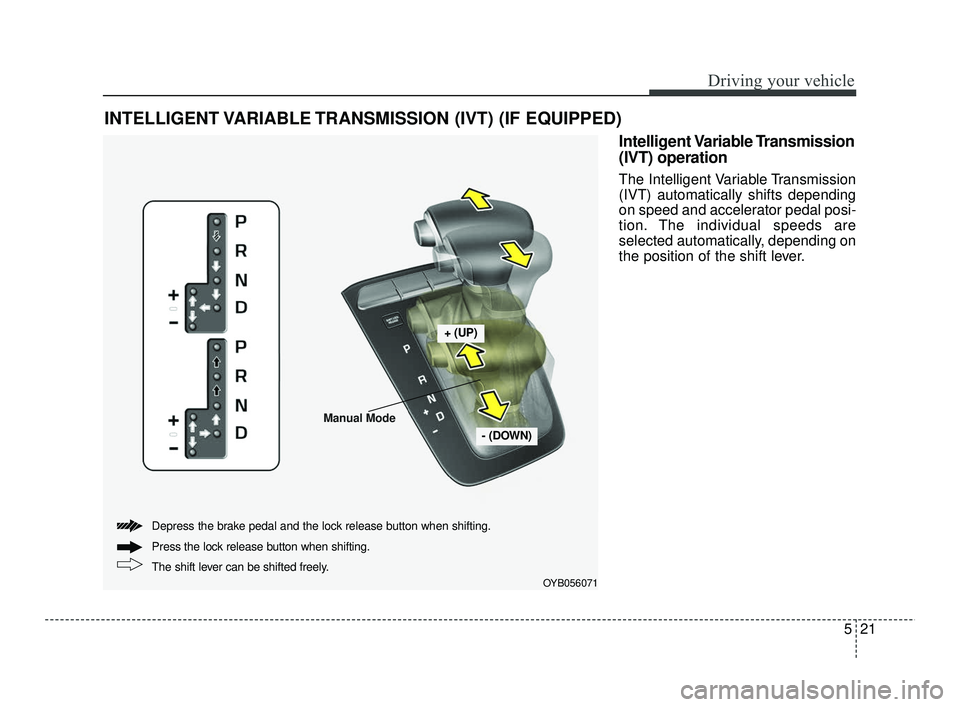
The Intelligent Variable Transmission
(IVT) automatically shifts depending
on speed and accelerator pedal posi-
tion. The individual speeds are
selected automatically, depending on
the position of the shift lever.
INTELLIGENT VARIABLE TRANSMISSION (IVT) (IF EQUIPPED)
OYB056071
+ (UP)
- (DOWN)
The shift lever can be shifted freely. Press the lock release button when shifting.
Depress the brake pedal and the lock release button when shifting.
Manual Mode
SC PE USA 5.QXP 10/23/2020 5:50 PM Page 21
Page 259 of 534
Driving your vehicle
22
5
CAUTION
The transmission may be dam-
aged if you shift into P (Park)while the vehicle is in motion.
For smooth operation, depress thebrake pedal when shifting from N(Neutral) to a forward or reverse gear.
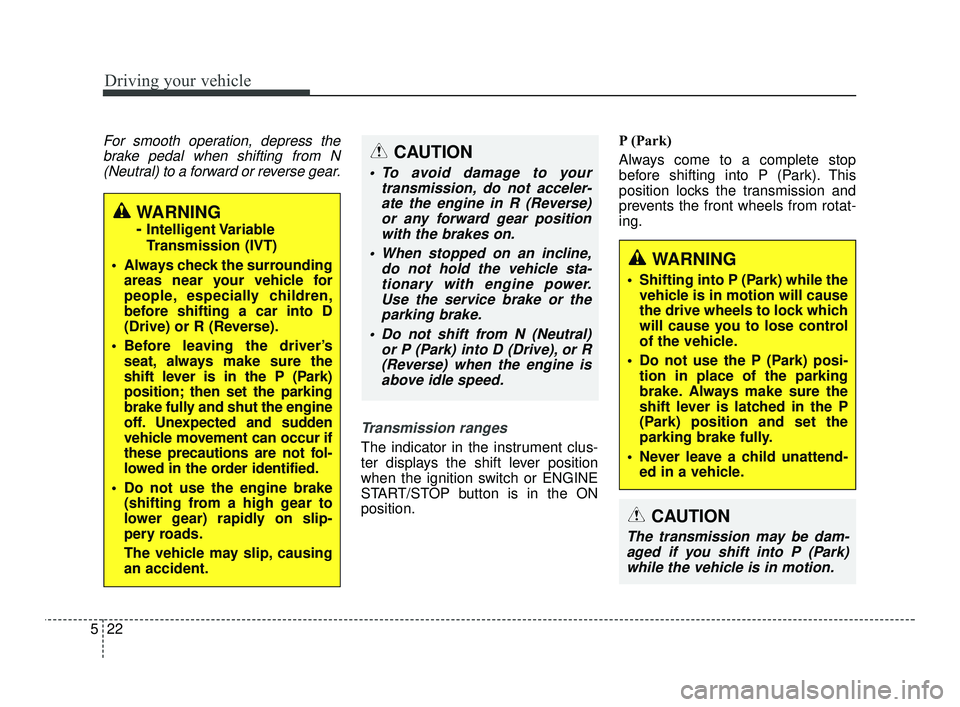
Transmission ranges
The indicator in the instrument clus-
ter displays the shift lever position
when the ignition switch or ENGINE
START/STOP button is in the ON
position.P (Park)
Always come to a complete stop
before shifting into P (Park). This
position locks the transmission and
prevents the front wheels from rotat-
ing.
WARNING
- Intelligent Variable
Transmission (IVT)
Always check the surrounding areas near your vehicle for
people, especially children,
before shifting a car into D
(Drive) or R (Reverse).
Before leaving the driver’s seat, always make sure the
shift lever is in the P (Park)
position; then set the parking
brake fully and shut the engine
off. Unexpected and sudden
vehicle movement can occur if
these precautions are not fol-
lowed in the order identified.
Do not use the engine brake (shifting from a high gear to
lower gear) rapidly on slip-
pery roads.
The vehicle may slip, causing
an accident.
CAUTION
To avoid damage to your transmission, do not acceler-ate the engine in R (Reverse)or any forward gear positionwith the brakes on.
When stopped on an incline, do not hold the vehicle sta-tionary with engine power.Use the service brake or theparking brake.
Do not shift from N (Neutral) or P (Park) into D (Drive), or R(Reverse) when the engine isabove idle speed.
WARNING
Shifting into P (Park) while the vehicle is in motion will cause
the drive wheels to lock which
will cause you to lose control
of the vehicle.
Do not use the P (Park) posi- tion in place of the parking
brake. Always make sure the
shift lever is latched in the P
(Park) position and set the
parking brake fully.
Never leave a child unattend- ed in a vehicle.
SC PE USA 5.QXP 10/23/2020 5:50 PM Page 22
Page 260 of 534
523
Driving your vehicle
R (Reverse)
Use this position to drive the vehicle
backward.
N (Neutral)
The wheels and transmission are not
engaged. The vehicle will roll freely
even on the slightest incline unless
the parking brake or service brakes
are applied.-Parking in N (Neutral) gear
Follow the steps below when parking
if you want the vehicle to move when
pushed.
1.After parking your vehicle, step on
the brake pedal and move the shift
lever to “P” with the ignition switch or
ENGINE START/STOP button in
“ON” or while the engine is running.
2.If the parking brake is applied unlock the parking brake.
3.While pressing the brake pedal, turn the ignition switch or ENGINE
START/STOP button “OFF”.
- For smart key equipped vehicles,the ignition switch or ENGINE
START/STOP button can be
moved to “OFF” only when the
shift lever is in “P”.
4.Change the gear shift lever to “N” (Neutral) while pressing the brake
pedal and pushing “SHIFT LOCK
RELEASE” button or inserting, a
tool (e.g. flathead screw-driver) into
the “SHIFT LOCK RELEASE”
access hole at the same time. Then,
the vehicle will move when external
force is applied.
CAUTION
Always come to a complete stopbefore shifting into or out of R(Reverse); you may damage thetransmission if you shift into Rwhile the vehicle is in motion,except as explained in “Rockingthe vehicle” in this chapter.
WARNING
Do not drive with the shift lever
in N (Neutral).
The engine brake may not work,
which may lead to an accident.
WARNING
With the exception of parking in neutral gear, always park
the vehicle in “P” (Park) for
safety and engage the parking
brake.
Before parking in “N” (Neutral) gear, first make sure the park-
ing ground is level and flat. Do
not park in “N” gear on any
slopes or gradients.
If parked and left in “N”, the
vehicle may move and cause
serious damage and injury.
SC PE USA 5.QXP 10/23/2020 5:50 PM Page 23
Page 261 of 534
Driving your vehicle
24
5
D (Drive)
This is the normal forward driving
position. The transmission will auto-
matically shift, providing the best fuel
economy and power.
For extra power when passing anoth-
er vehicle or climbing grades,
depress the accelerator fully, at which
time the transmission will automati-
cally downshift to the next lower gear.
✽ ✽
NOTICE
Always come to a complete stop
before shifting into D (Drive).
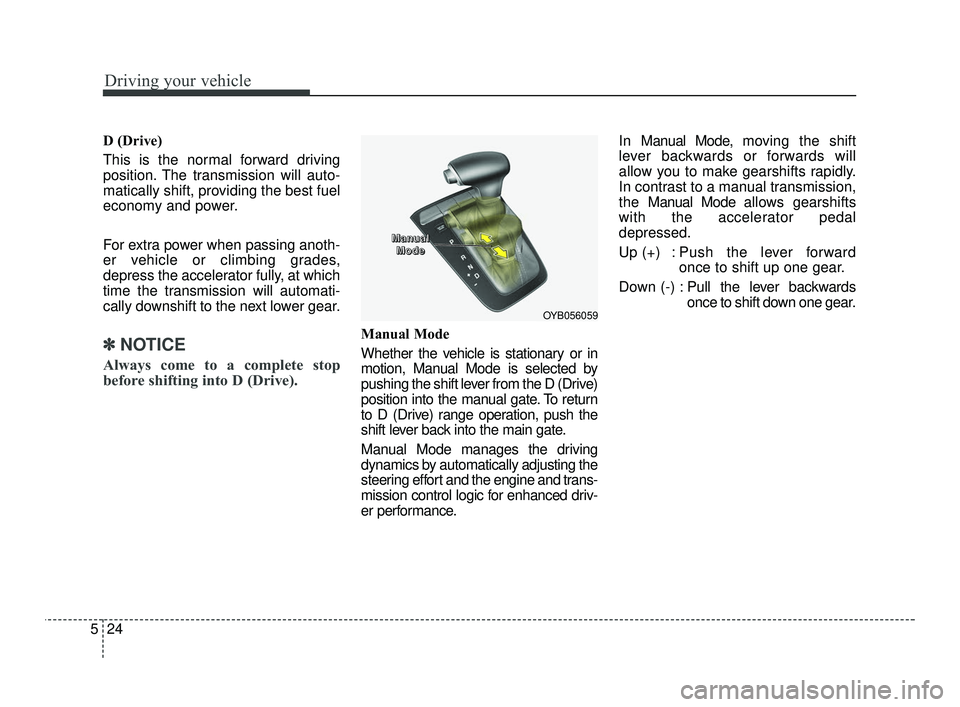
Manual Mode
Whether the vehicle is stationary or in
motion, Manual Mode is selected by
pushing the shift lever from the D (Drive)
position into the manual gate. To return
to D (Drive) range operation, push the
shift lever back into the main gate.
Manual Mode manages the driving
dynamics by automatically adjusting the
steering effort and the engine and trans-
mission control logic for enhanced driv-
er performance. In Manual Mode, mo
ving the shift
lever backwards or forwards will
allow you to make gearshifts rapidly.
In contrast to a manual transmission,
the Man ual Mode allows gearshifts
with the accelerator pedal
depressed.
Up (+) : Push the lever forward once to shift up one gear.
Down (-) : Pull the lever backwards
once to shift down one gear.
OYB056059
M M
M M
a a
a a
n n
n n
u u
u u
a a
a a
l l
l l
M M
M M
o o
o o
d d
d d
e e
e e
SC PE USA 5.QXP 10/23/2020 5:50 PM Page 24
Page 262 of 534

525
Driving your vehicle
✽ ✽NOTICE
• In Manual Mode, the driver must
execute upshifts in accordance
with road conditions, being care-
ful to keep the engine speed below
the red zone.
• In Manual Mode, only the 8 for- ward gears can be selected. To
reverse or park the vehicle, move
the shift lever to the R (Reverse)
or P (Park) position as required.
• In Manual Mode, downshifts are made automatically when the
vehicle slows down. When the
vehicle stops, 1st gear is automati-
cally selected.
• In Manual Mode, when the engine rpm approaches the red zone, shift
points are varied to upshift auto-
matically.
• To maintain the required levels of vehicle performance and safety,
the system may not execute cer-
tain gearshifts when the shift lever
is operated. (Continued)(Continued)
• When driving on a slippery road,
push the shift lever forward into
the +(up) position. This causes the
transmission to shift into the 2nd
gear which is better for smooth
driving on a slippery road. Push
the shift lever to the -(down) side
to shift back to the 1st gear.
• When Manual Mode is activated: - The engine rpm will tend toremain raised over a certain
length of time even after releas-
ing the accelerator
- Upshifts are delayed when accel- erating
• In Manual Mode, the fuel efficien- cy may decrease.
Shift lock system
For your safety, the Intelligent
Variable Transmission (IVT) has a
shift lock system which prevents
shifting the transmission from P
(Park) into R (Reverse) unless the
brake pedal is depressed.
To shift the transmission from P
(Park) into R (Reverse):
1. Depress and hold the brake pedal.
2. Start the engine or turn the ignition
switch or ENGINE START/STOP
button to the ON position.
3. Move the shift lever.
If the brake pedal is repeatedly
depressed and released with the shift
lever in the P (Park) position, a chat-
tering noise near the shift lever may
be heard. This is a normal condition.
WARNING
Always fully depress the brake
pedal before and while shifting
out of the P (Park) position into
another position to avoid inad-
vertent motion of the vehicle,
which could injure persons in
or around the vehicle.
SC PE USA 5.QXP 10/23/2020 5:50 PM Page 25
Page 268 of 534
531
Driving your vehicle
Rear drum brakes (if equipped)
Your rear drum brakes do not have
wear indicators. Therefore, have the
rear brake linings inspected if you
hear a rear brake rubbing noise. Also
have your rear brakes inspected
each time you change or rotate your
tires and when you have the front
brakes replaced.
Parking brake
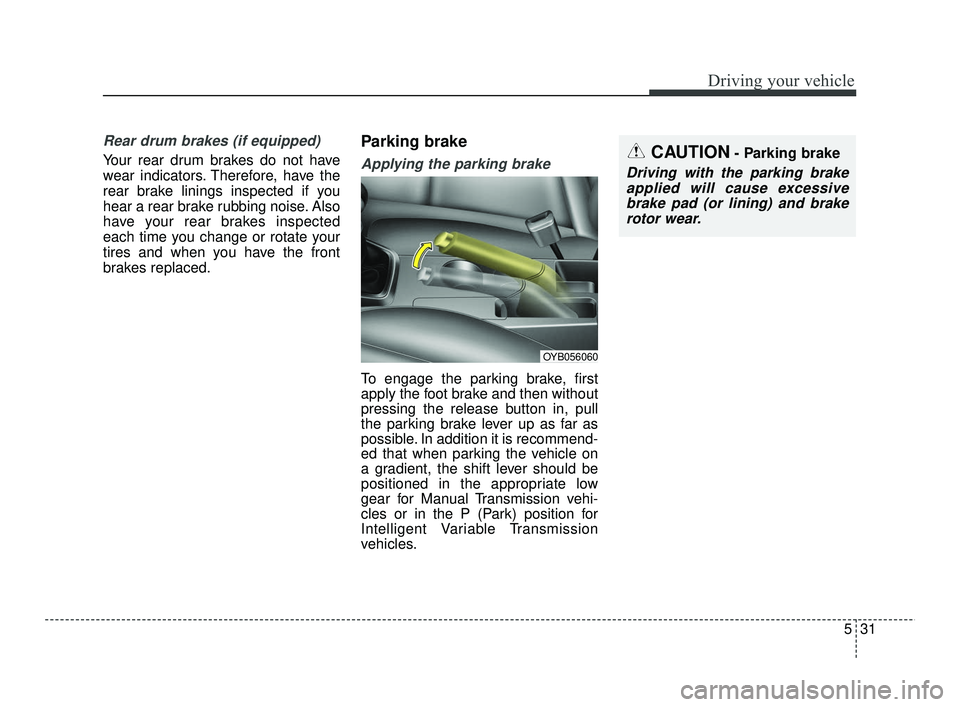
Applying the parking brake
To engage the parking brake, first
apply the foot brake and then without
pressing the release button in, pull
the parking brake lever up as far as
possible. In addition it is recommend-
ed that when parking the vehicle on
a gradient, the shift lever should be
positioned in the appropriate low
gear for Manual Transmission vehi-
cles or in the P (Park) position for
Intelligent Variable Transmission
vehicles.
CAUTION- Parking brake
Driving with the parking brakeapplied will cause excessivebrake pad (or lining) and brakerotor wear.
OYB056060
SC PE USA 5.QXP 10/23/2020 5:50 PM Page 31
Page 269 of 534
Driving your vehicle
32
5
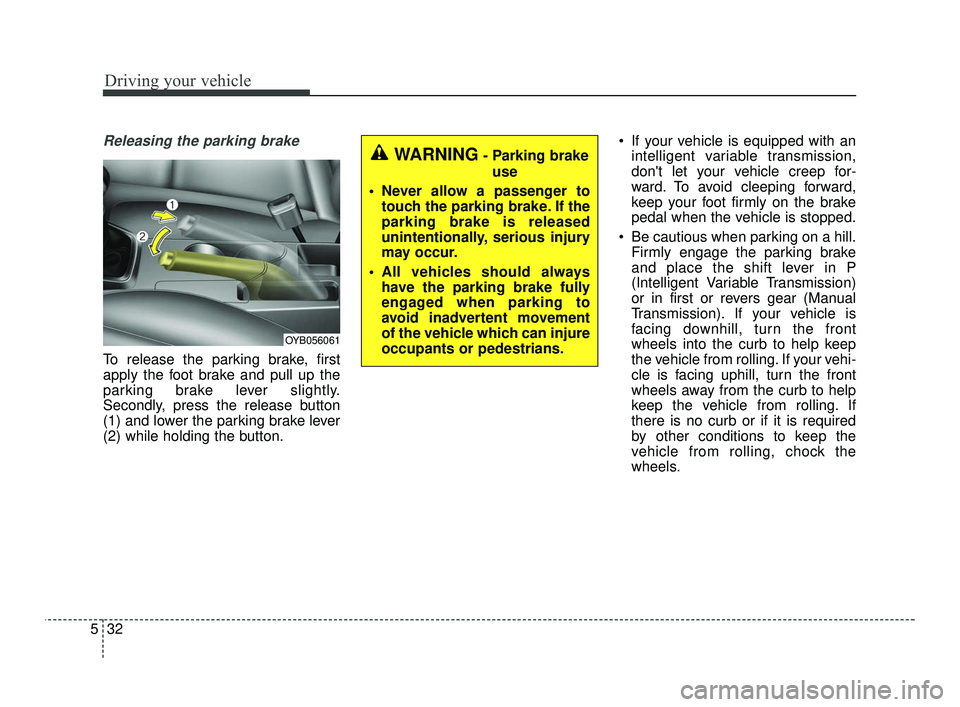
Releasing the parking brake
To release the parking brake, first
apply the foot brake and pull up the
parking brake lever slightly.
Secondly, press the release button
(1) and lower the parking brake lever
(2) while holding the button. If your vehicle is equipped with an
intelligent variable transmission,
don't let your vehicle creep for-
ward. To avoid cleeping forward,
keep your foot firmly on the brake
pedal when the vehicle is stopped.
Be cautious when parking on a hill. Firmly engage the parking brake
and place the shift lever in P
(Intelligent Variable Transmission)
or in first or revers gear (Manual
Transmission). If your vehicle is
facing downhill, turn the front
wheels into the curb to help keep
the vehicle from rolling. If your vehi-
cle is facing uphill, turn the front
wheels away from the curb to help
keep the vehicle from rolling. If
there is no curb or if it is required
by other conditions to keep the
vehicle from rolling, chock the
wheels.
WARNING- Parking brake
use
Never allow a passenger to touch the parking brake. If the
parking brake is released
unintentionally, serious injury
may occur.
All vehicles should always have the parking brake fully
engaged when parking to
avoid inadvertent movement
of the vehicle which can injure
occupants or pedestrians.
OYB056061
SC PE USA 5.QXP 10/23/2020 5:50 PM Page 32