oil change KIA RIO 2021 Owners Manual
[x] Cancel search | Manufacturer: KIA, Model Year: 2021, Model line: RIO, Model: KIA RIO 2021Pages: 534, PDF Size: 13.49 MB
Page 10 of 534
15
Introduction
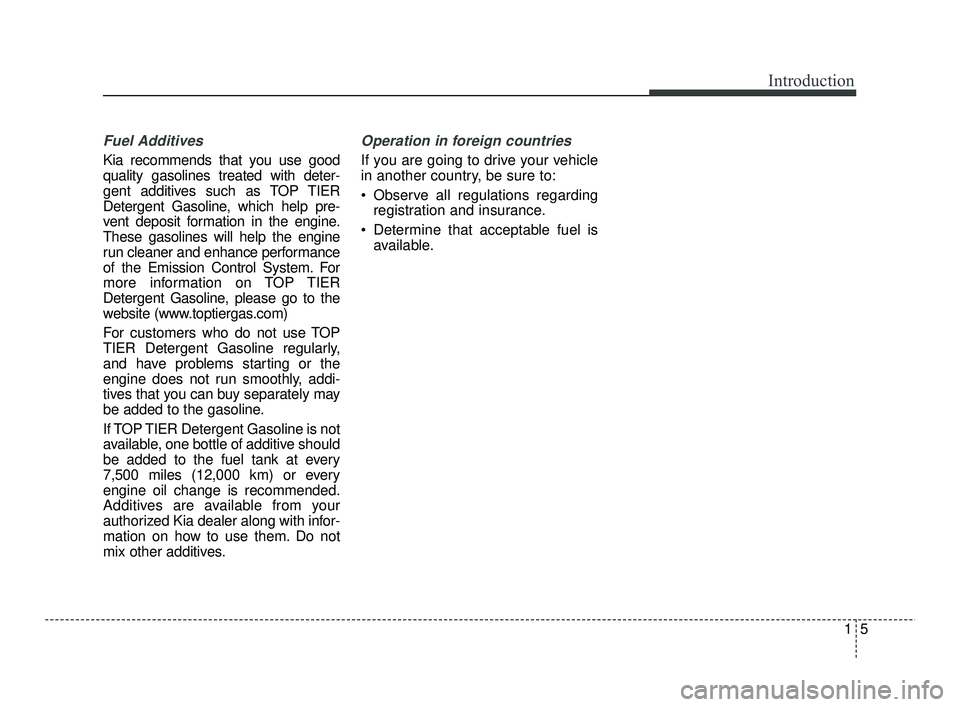
Fuel Additives
Kia recommends that you use good
quality gasolines treated with deter-
gent additives such as TOP TIER
Detergent Gasoline, which help pre-
vent deposit formation in the engine.
These gasolines will help the engine
run cleaner and enhance performance
of the Emission Control System. For
more information on TOP TIER
Detergent Gasoline, please go to the
website (www.toptiergas.com)
For customers who do not use TOP
TIER Detergent Gasoline regularly,
and have problems starting or the
engine does not run smoothly, addi-
tives that you can buy separately may
be added to the gasoline.
If TOP TIER Detergent Gasoline is not
available, one bottle of additive should
be added to the fuel tank at every
7,500 miles (12,000 km) or every
engine oil change is recommended.
Additives are available from your
authorized Kia dealer along with infor-
mation on how to use them. Do not
mix other additives.
Operation in foreign countries
If you are going to drive your vehicle
in another country, be sure to:
Observe all regulations regardingregistration and insurance.
Determine that acceptable fuel is available.
SC PE USA 1.QXP 10/23/2020 5:31 PM Page 5
Page 199 of 534
Features of your vehicle
118
4
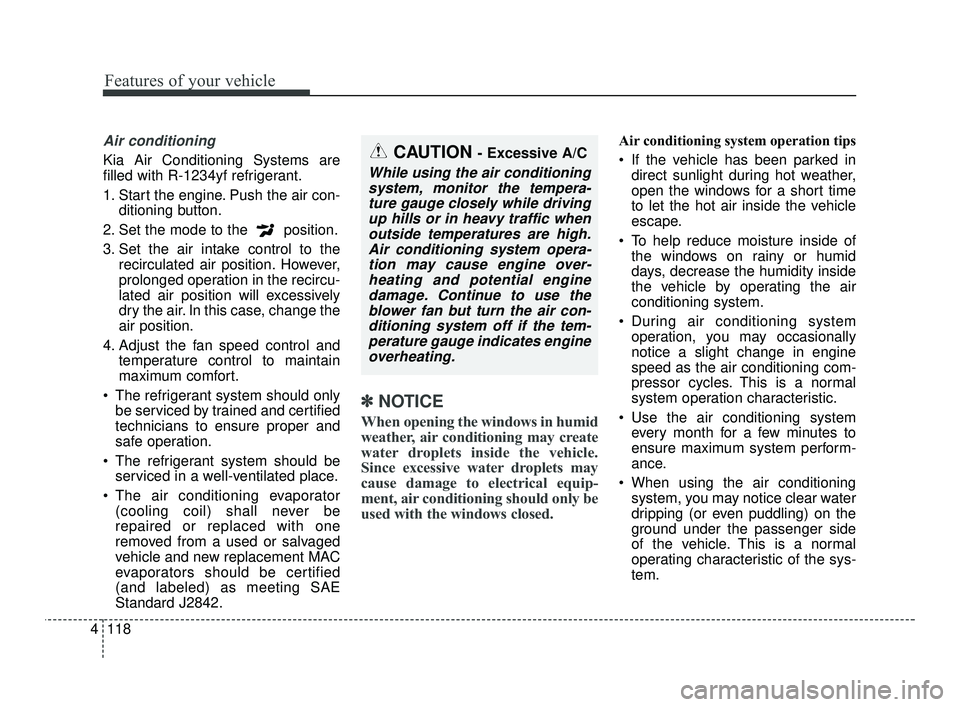
Air conditioning
Kia Air Conditioning Systems are
filled with R-1234yf refrigerant.
1. Start the engine. Push the air con-
ditioning button.
2. Set the mode to the position.
3. Set the air intake control to the recirculated air position. However,
prolonged operation in the recircu-
lated air position will excessively
dry the air. In this case, change the
air position.
4. Adjust the fan speed control and temperature control to maintain
maximum comfort.
The refrigerant system should only be serviced by trained and certified
technicians to ensure proper and
safe operation.
The refrigerant system should be serviced in a well-ventilated place.
The air conditioning evaporator (cooling coil) shall never be
repaired or replaced with one
removed from a used or salvaged
vehicle and new replacement MAC
evaporators should be certified
(and labeled) as meeting SAE
Standard J2842.
✽ ✽ NOTICE
When opening the windows in humid
weather, air conditioning may create
water droplets inside the vehicle.
Since excessive water droplets may
cause damage to electrical equip-
ment, air conditioning should only be
used with the windows closed.
Air conditioning system operation tips
If the vehicle has been parked in
direct sunlight during hot weather,
open the windows for a short time
to let the hot air inside the vehicle
escape.
To help reduce moisture inside of the windows on rainy or humid
days, decrease the humidity inside
the vehicle by operating the air
conditioning system.
During air conditioning system operation, you may occasionally
notice a slight change in engine
speed as the air conditioning com-
pressor cycles. This is a normal
system operation characteristic.
Use the air conditioning system every month for a few minutes to
ensure maximum system perform-
ance.
When using the air conditioning system, you may notice clear water
dripping (or even puddling) on the
ground under the passenger side
of the vehicle. This is a normal
operating characteristic of the sys-
tem.CAUTION - Excessive A/C
While using the air conditioningsystem, monitor the tempera-ture gauge closely while drivingup hills or in heavy traffic whenoutside temperatures are high.Air conditioning system opera-tion may cause engine over-heating and potential enginedamage. Continue to use theblower fan but turn the air con-ditioning system off if the tem-perature gauge indicates engineoverheating.
SC PE USA 4.QXP 10/23/2020 5:46 PM Page 118
Page 239 of 534
 . . . . . . . . . . . . 5-78
• Basic function. . . . . . . . . . . . . . . . . . . . . . . . . . . . . . . . \
5-78
• Leading Vehicle Departure Alert function . . .")
Driver Attention Warning (DAW) . . . . . . . . . . . . 5-78
• Basic function. . . . . . . . . . . . . . . . . . . . . . . . . . . . . . . . \
5-78
• Leading Vehicle Departure Alert function . . . . . . . . 5-78
• Detecting sensor . . . . . . . . . . . . . . . . . . . . . . . . . . . . . . 5-78
• Function settings . . . . . . . . . . . . . . . . . . . . . . . . . . . . . 5-79
• Function operation . . . . . . . . . . . . . . . . . . . . . . . . . . . 5-81
• Function malfunction and limitations . . . . . . . . . . . . 5-84
Cruise Control (CC). . . . . . . . . . . . . . . . . . . . . . . . 5-87
• Function operation . . . . . . . . . . . . . . . . . . . . . . . . . . . 5-87
• To increase set speed . . . . . . . . . . . . . . . . . . . . . . . . . . 5-88
• To decrease speed . . . . . . . . . . . . . . . . . . . . . . . . . . . . 5-88
• To temporarily pause the function . . . . . . . . . . . . . . 5-89
• To resume the function . . . . . . . . . . . . . . . . . . . . . . . . 5-89
Lane Following Assist (LFA) . . . . . . . . . . . . . . . . . 5-91
• Detecting sensor . . . . . . . . . . . . . . . . . . . . . . . . . . . . . . 5-91
• Function settings . . . . . . . . . . . . . . . . . . . . . . . . . . . . . 5-92
• Function operation . . . . . . . . . . . . . . . . . . . . . . . . . . . 5-92
• Function malfunction and limitations . . . . . . . . . . . . 5-95
Rear Cross-Traffic Collision Warning (RCCW) . 5-96
• Detecting sensor . . . . . . . . . . . . . . . . . . . . . . . . . . . . . . 5-97
• Functions settings . . . . . . . . . . . . . . . . . . . . . . . . . . . . 5-97
• Function operation . . . . . . . . . . . . . . . . . . . . . . . . . . . 5-98
Function malfunction and limitations . . . . . . . . . . . . . 5-99
Declaration of Conformity . . . . . . . . . . . . . . . . . 5-104
• The radio frequency components(Rear Corner Radar) complies . . . . . . . . . . . . . . . 5-104
Economical operation . . . . . . . . . . . . . . . . . . . . . 5-105
Special driving conditions . . . . . . . . . . . . . . . . . . . 5107
• Hazardous driving conditions . . . . . . . . . . . . . . . . 5-107
• Rocking the vehicle . . . . . . . . . . . . . . . . . . . . . . . . . 5-107
• Smooth cornering . . . . . . . . . . . . . . . . . . . . . . . . . . . 5-108
• Driving at night . . . . . . . . . . . . . . . . . . . . . . . . . . . . 5-108
• Driving in the rain . . . . . . . . . . . . . . . . . . . . . . . . . . . 5-109
• Driving in flooded areas . . . . . . . . . . . . . . . . . . . . . . 5-110
• Driving off-road . . . . . . . . . . . . . . . . . . . . . . . . . . . . . 5-110
• Highway driving . . . . . . . . . . . . . . . . . . . . . . . . . . . . 5-110
Winter driving . . . . . . . . . . . . . . . . . . . . . . . . . . . 5-112
• Snowy or Icy conditions . . . . . . . . . . . . . . . . . . . . . . 5-112
• Use high quality ethylene glycol coolant . . . . . . . . . 5-114
• Check battery and cables . . . . . . . . . . . . . . . . . . . . . 5-114
• Change to "winter weight" oil if necessary . . . . . . 5-115
• Check spark plugs and ignition system . . . . . . . . . . 5-115
• To keep locks from freezing . . . . . . . . . . . . . . . . . . . 5-115
• Use approved window washer anti-freeze in system5-115
• Don't let your parking brake freeze . . . . . . . . . . . . 5-115
• Don't let ice and snow accumulate underneath . . . 5-115
• Carry emergency equipment . . . . . . . . . . . . . . . . . . 5-116
5
SC PE USA 5.QXP 10/23/2020 5:49 PM Page 2
Page 241 of 534
Driving your vehicle
45
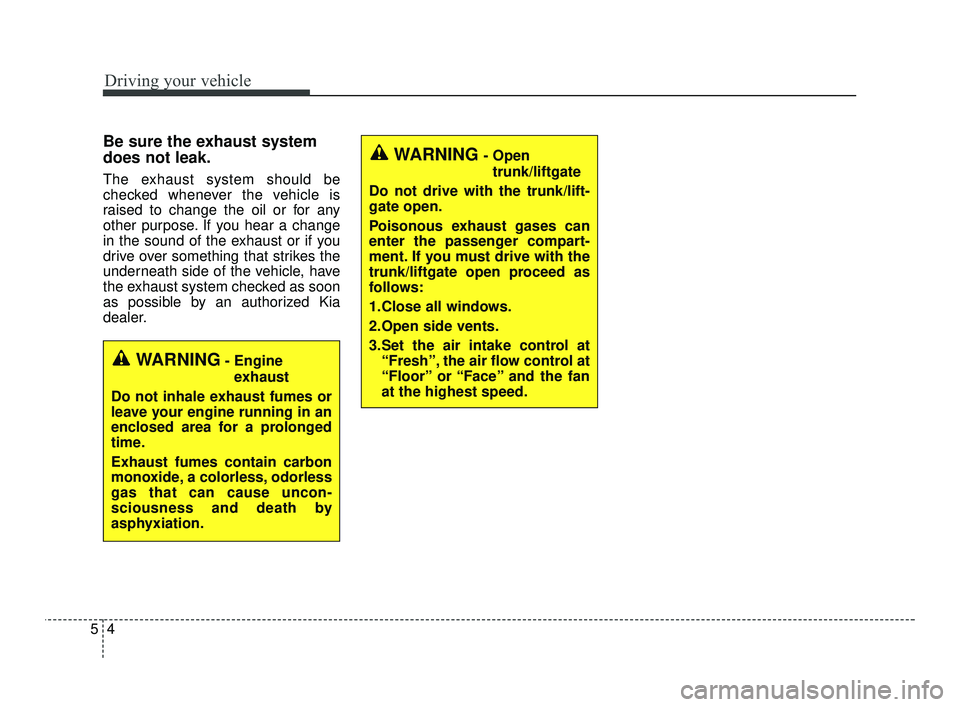
Be sure the exhaust system
does not leak.
The exhaust system should be
checked whenever the vehicle is
raised to change the oil or for any
other purpose. If you hear a change
in the sound of the exhaust or if you
drive over something that strikes the
underneath side of the vehicle, have
the exhaust system checked as soon
as possible by an authorized Kia
dealer.
WARNING- Engineexhaust
Do not inhale exhaust fumes or
leave your engine running in an
enclosed area for a prolonged
time.
Exhaust fumes contain carbon
monoxide, a colorless, odorless
gas that can cause uncon-
sciousness and death by
asphyxiation.
WARNING- Open trunk/liftgate
Do not drive with the trunk/lift-
gate open.
Poisonous exhaust gases can
enter the passenger compart-
ment. If you must drive with the
trunk/liftgate open proceed as
follows:
1.Close all windows.
2.Open side vents.
3.Set the air intake control at “Fresh”, the air flow control at
“Floor” or “Face” and the fan
at the highest speed.
SC PE USA 5.QXP 10/23/2020 5:49 PM Page 4
Page 352 of 534
5115
Driving your vehicle
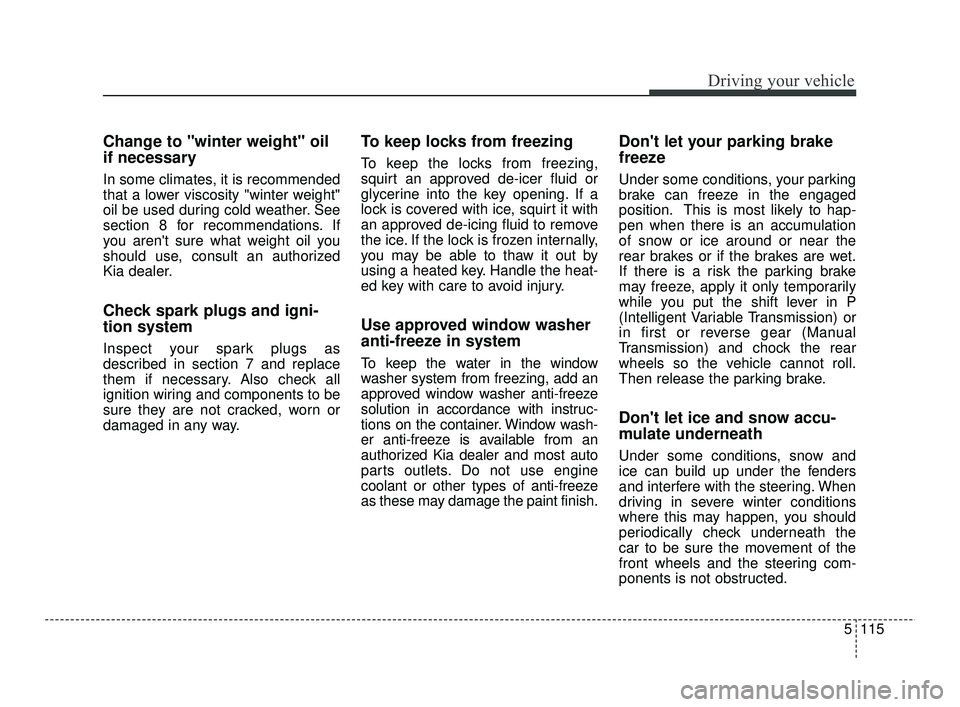
Change to "winter weight" oil
if necessary
In some climates, it is recommended
that a lower viscosity "winter weight"
oil be used during cold weather. See
section 8 for recommendations. If
you aren't sure what weight oil you
should use, consult an authorized
Kia dealer.
Check spark plugs and igni-
tion system
Inspect your spark plugs as
described in section 7 and replace
them if necessary. Also check all
ignition wiring and components to be
sure they are not cracked, worn or
damaged in any way.
To keep locks from freezing
To keep the locks from freezing,
squirt an approved de-icer fluid or
glycerine into the key opening. If a
lock is covered with ice, squirt it with
an approved de-icing fluid to remove
the ice. If the lock is frozen internally,
you may be able to thaw it out by
using a heated key. Handle the heat-
ed key with care to avoid injury.
Use approved window washer
anti-freeze in system
To keep the water in the window
washer system from freezing, add an
approved window washer anti-freeze
solution in accordance with instruc-
tions on the container. Window wash-
er anti-freeze is available from an
authorized Kia dealer and most auto
parts outlets. Do not use engine
coolant or other types of anti-freeze
as these may damage the paint finish.
Don't let your parking brake
freeze
Under some conditions, your parking
brake can freeze in the engaged
position. This is most likely to hap-
pen when there is an accumulation
of snow or ice around or near the
rear brakes or if the brakes are wet.
If there is a risk the parking brake
may freeze, apply it only temporarily
while you put the shift lever in P
(Intelligent Variable Transmission) or
in first or reverse gear (Manual
Transmission) and chock the rear
wheels so the vehicle cannot roll.
Then release the parking brake.
Don't let ice and snow accu-
mulate underneath
Under some conditions, snow and
ice can build up under the fenders
and interfere with the steering. When
driving in severe winter conditions
where this may happen, you should
periodically check underneath the
car to be sure the movement of the
front wheels and the steering com-
ponents is not obstructed.
SC PE USA 5.QXP 10/23/2020 5:54 PM Page 115
Page 399 of 534
77
Maintenance
OWNER MAINTENANCE
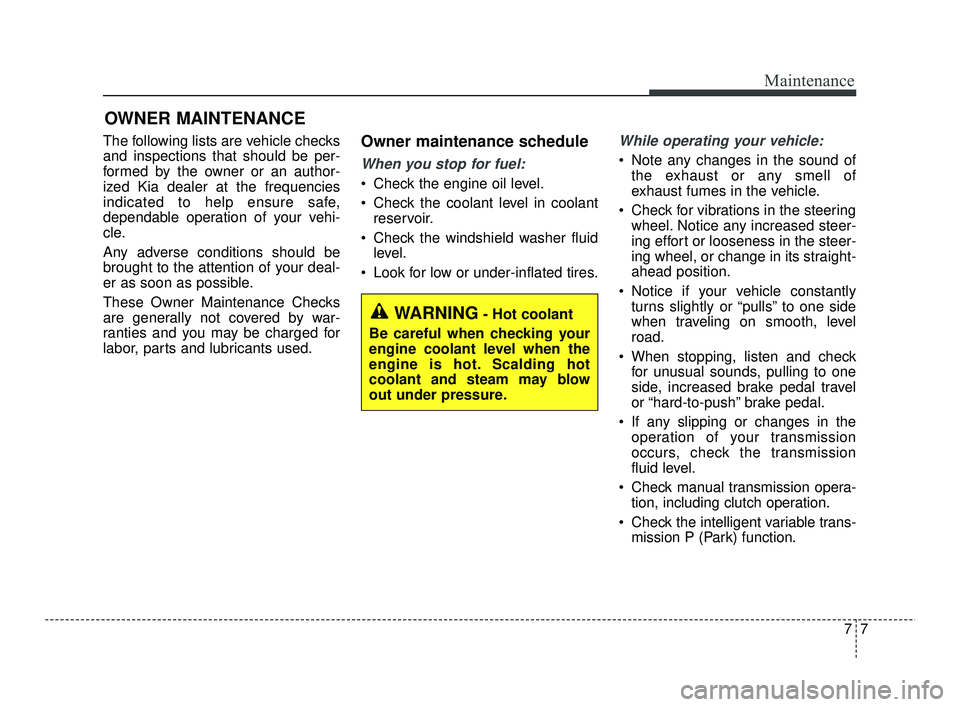
The following lists are vehicle checks
and inspections that should be per-
formed by the owner or an author-
ized Kia dealer at the frequencies
indicated to help ensure safe,
dependable operation of your vehi-
cle.
Any adverse conditions should be
brought to the attention of your deal-
er as soon as possible.
These Owner Maintenance Checks
are generally not covered by war-
ranties and you may be charged for
labor, parts and lubricants used.Owner maintenance schedule
When you stop for fuel:
Check the engine oil level.
Check the coolant level in coolantreservoir.
Check the windshield washer fluid level.
Look for low or under-inflated tires.
While operating your vehicle:
Note any changes in the sound of the exhaust or any smell of
exhaust fumes in the vehicle.
Check for vibrations in the steering wheel. Notice any increased steer-
ing effort or looseness in the steer-
ing wheel, or change in its straight-
ahead position.
Notice if your vehicle constantly turns slightly or “pulls” to one side
when traveling on smooth, level
road.
When stopping, listen and check for unusual sounds, pulling to one
side, increased brake pedal travel
or “hard-to-push” brake pedal.
If any slipping or changes in the operation of your transmission
occurs, check the transmission
fluid level.
Check manual transmission opera- tion, including clutch operation.
Check the intelligent variable trans- mission P (Park) function.
WARNING- Hot coolant
Be careful when checking your
engine coolant level when the
engine is hot. Scalding hot
coolant and steam may blow
out under pressure.
SC PE USA 7.qxp 10/23/2020 6:05 PM Page 7
Page 402 of 534
Maintenance
10
7
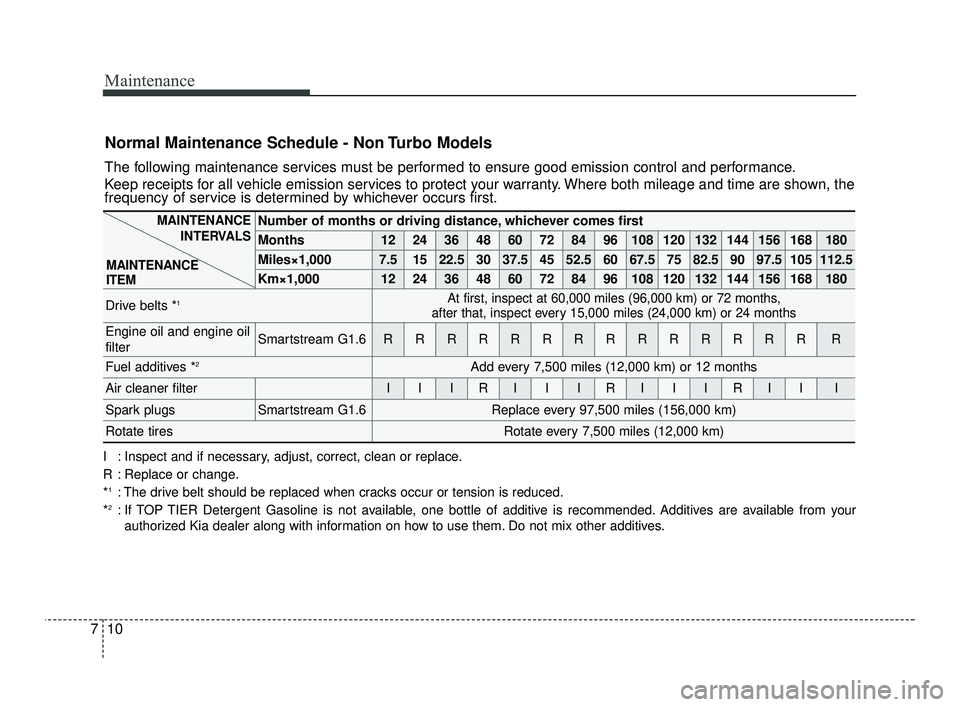
Normal Maintenance Schedule - Non Turbo Models
The following maintenance services must be performed to ensure good emission control and performance.
Keep receipts for all vehicle emission services to protect your warranty. Where both mileage and time are shown, the
frequency of service is determined by whichever occurs first.
Number of months or driving distance, whichever comes first
Months1224364860728496108120132144156168180
Miles×1,0007.51522.530 37.5 45 52.5 60 67.5 75 82.5 90 97.5 105 112.5
Km×1,00012 24 36 48 60 72 84 96 108 120 132 144 156 168 180
Drive belts *1At first, inspect at 60,000 miles (96,000 km) or 72 months,
after that, inspect every 15,000 miles (24,000 km) or 24 months
Engine oil and engine oil
filterSmartstream G1.6RRRRRRRRRRRRRRR
Fuel additives *2Add every 7,500 miles (12,000 km) or 12 months
Air cleaner filterIIIRIIIRIIIRIII
Spark plugsSmartstream G1.6Replace every 97,500 miles (156,000 km)
Rotate tiresRotate every 7,500 miles (12,000 km)
MAINTENANCE
INTERVALS
MAINTENANCE
ITEM
I : Inspect and if necessary, adjust, correct, clean or replace.
R : Replace or change.
*
1: The drive belt should be replaced when cracks occur or tension is reduced.
*2: If TOP TIER Detergent Gasoline is not available, one bottle of additive is recommended. Additives are available from your authorized Kia dealer along with information on how to use them. Do not mix other additives.
SC PE USA 7.qxp 10/23/2020 6:05 PM Page 10
Page 407 of 534
715
Maintenance
EXPLANATION OF SCHEDULED MAINTENANCE ITEMS
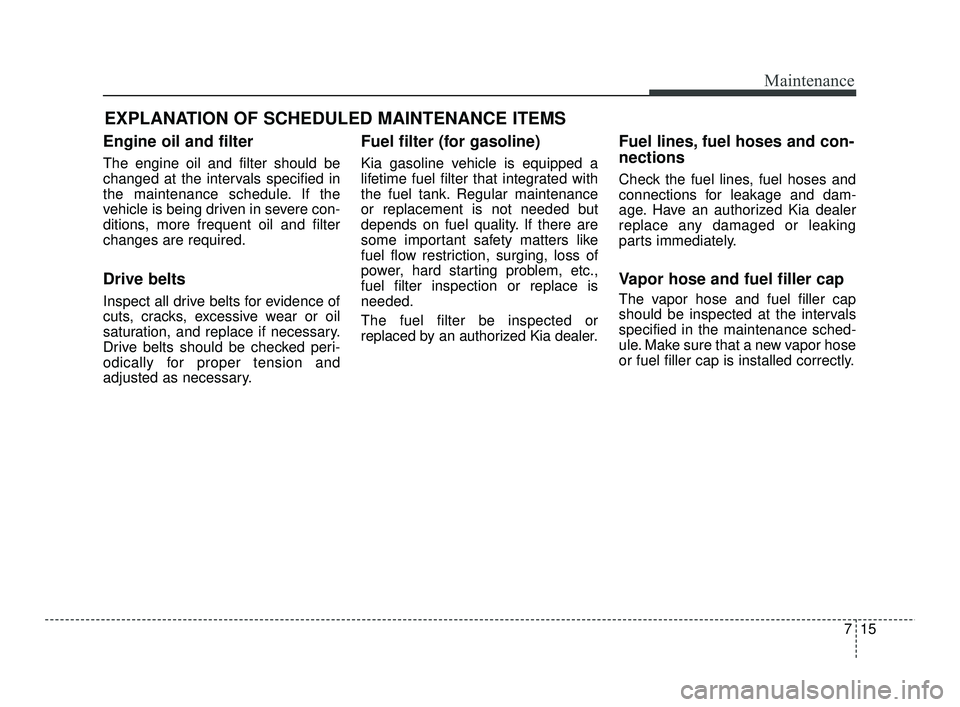
Engine oil and filter
The engine oil and filter should be
changed at the intervals specified in
the maintenance schedule. If the
vehicle is being driven in severe con-
ditions, more frequent oil and filter
changes are required.
Drive belts
Inspect all drive belts for evidence of
cuts, cracks, excessive wear or oil
saturation, and replace if necessary.
Drive belts should be checked peri-
odically for proper tension and
adjusted as necessary.
Fuel filter (for gasoline)
Kia gasoline vehicle is equipped a
lifetime fuel filter that integrated with
the fuel tank. Regular maintenance
or replacement is not needed but
depends on fuel quality. If there are
some important safety matters like
fuel flow restriction, surging, loss of
power, hard starting problem, etc.,
fuel filter inspection or replace is
needed.
The fuel filter be inspected or
replaced by an authorized Kia dealer.
Fuel lines, fuel hoses and con-
nections
Check the fuel lines, fuel hoses and
connections for leakage and dam-
age. Have an authorized Kia dealer
replace any damaged or leaking
parts immediately.
Vapor hose and fuel filler cap
The vapor hose and fuel filler cap
should be inspected at the intervals
specified in the maintenance sched-
ule. Make sure that a new vapor hose
or fuel filler cap is installed correctly.
SC PE USA 7.qxp 10/23/2020 6:05 PM Page 15
Page 414 of 534
Maintenance
22
7
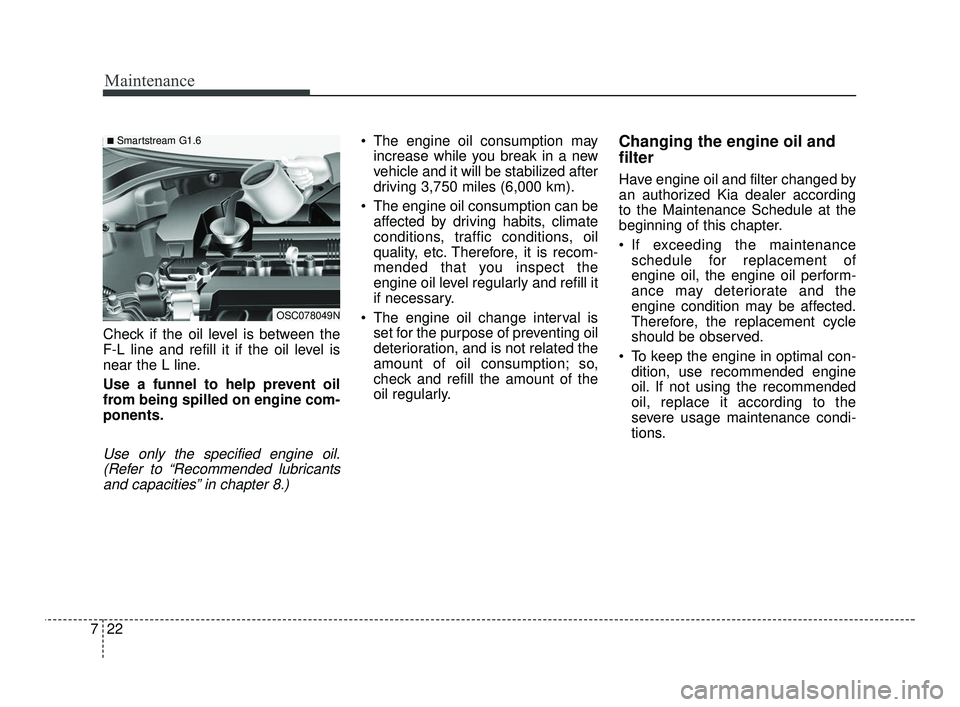
Check if the oil level is between the
F-L line and refill it if the oil level is
near the L line.
Use a funnel to help prevent oil
from being spilled on engine com-
ponents.
Use only the specified engine oil.
(Refer to “Recommended lubricantsand capacities” in chapter 8.)
The engine oil consumption may increase while you break in a new
vehicle and it will be stabilized after
driving 3,750 miles (6,000 km).
The engine oil consumption can be affected by driving habits, climate
conditions, traffic conditions, oil
quality, etc. Therefore, it is recom-
mended that you inspect the
engine oil level regularly and refill it
if necessary.
The engine oil change interval is set for the purpose of preventing oil
deterioration, and is not related the
amount of oil consumption; so,
check and refill the amount of the
oil regularly.Changing the engine oil and
filter
Have engine oil and filter changed by
an authorized Kia dealer according
to the Maintenance Schedule at the
beginning of this chapter.
If exceeding the maintenanceschedule for replacement of
engine oil, the engine oil perform-
ance may deteriorate and the
engine condition may be affected.
Therefore, the replacement cycle
should be observed.
To keep the engine in optimal con- dition, use recommended engine
oil. If not using the recommended
oil, replace it according to the
severe usage maintenance condi-
tions.
OSC078049N
■Smartstream G1.6
SC PE USA 7.qxp 10/23/2020 6:05 PM Page 22
Page 515 of 534
89
Specifications, Consumer information, Reporting safety defects
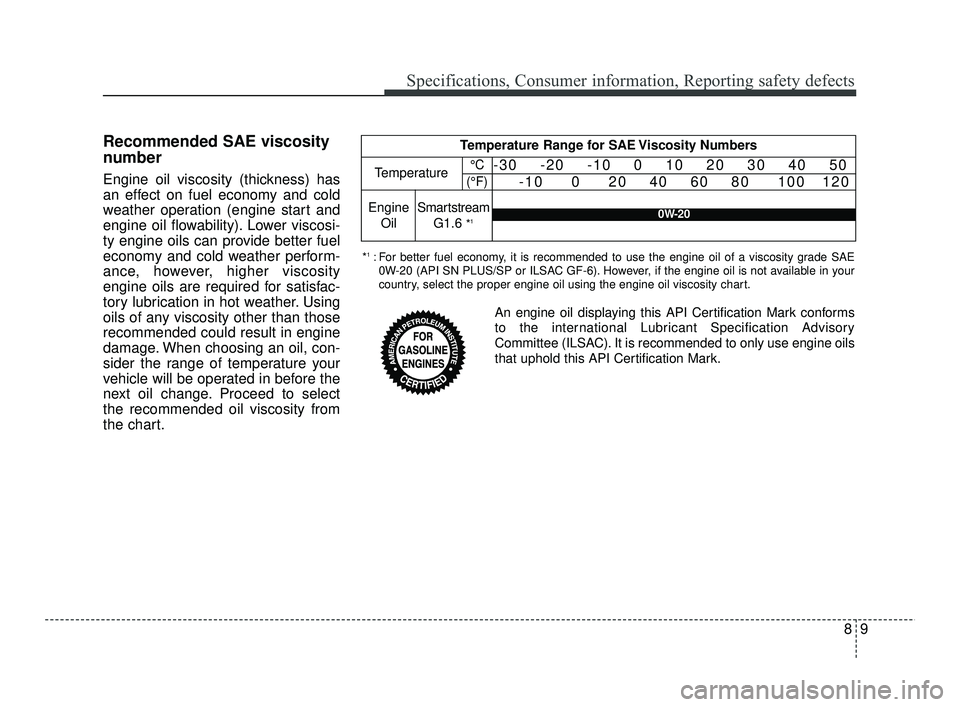
Recommended SAE viscosity
number
Engine oil viscosity (thickness) has
an effect on fuel economy and cold
weather operation (engine start and
engine oil flowability). Lower viscosi-
ty engine oils can provide better fuel
economy and cold weather perform-
ance, however, higher viscosity
engine oils are required for satisfac-
tory lubrication in hot weather. Using
oils of any viscosity other than those
recommended could result in engine
damage. When choosing an oil, con-
sider the range of temperature your
vehicle will be operated in before the
next oil change. Proceed to select
the recommended oil viscosity from
the chart.
*1: For better fuel economy, it is recommended to use the engine oil of a viscosity grade SAE0W-20 (API SN PLUS/SP or ILSAC GF-6). However, if the engine oil is not available in your
country, select the proper engine oil using the engine oil viscosity chart.
Temperature Range for SAE Viscosity Numbers
Temperature°C
(°F)-30 -20 -10 0 10 20 30 40 50 -10 0 20 40 60 80 100 120
Smartstream
G1.6
*10W-20EngineOil
An engine oil displaying this API Certification Mark conforms
to the international Lubricant Specification Advisory
Committee (ILSAC). It is recommended to only use engine oils
that uphold this API Certification Mark.
SC PE USA 8.qxp 10/23/2020 6:22 PM Page 9