BRAKE FLUID KIA RIO 2022 User Guide
[x] Cancel search | Manufacturer: KIA, Model Year: 2022, Model line: RIO, Model: KIA RIO 2022Pages: 528, PDF Size: 11.8 MB
Page 394 of 528
77
Maintenance
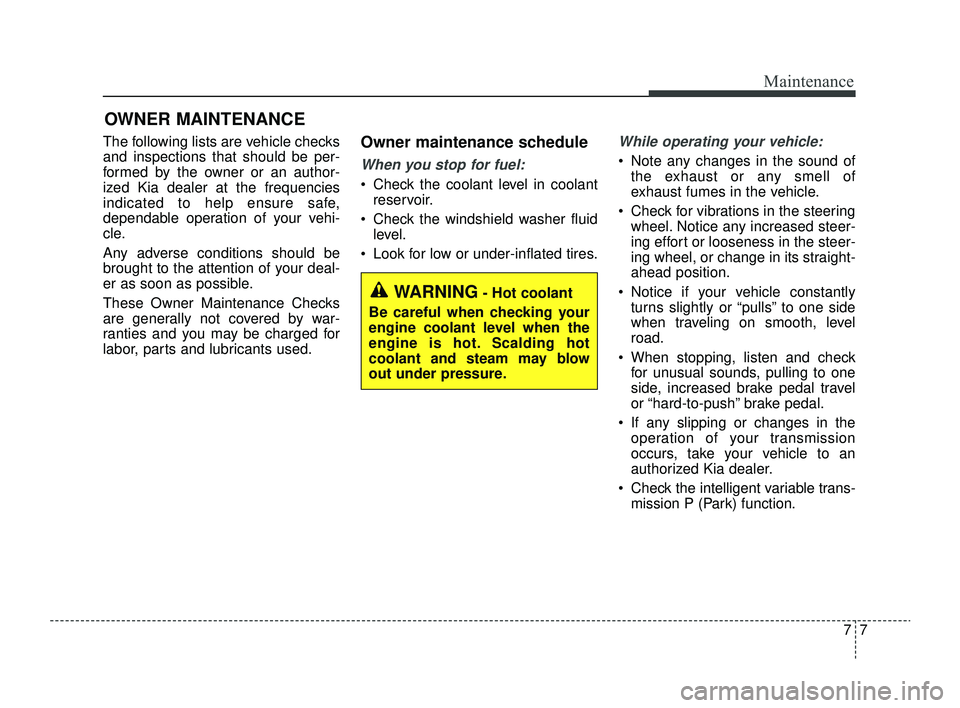
OWNER MAINTENANCE
The following lists are vehicle checks
and inspections that should be per-
formed by the owner or an author-
ized Kia dealer at the frequencies
indicated to help ensure safe,
dependable operation of your vehi-
cle.
Any adverse conditions should be
brought to the attention of your deal-
er as soon as possible.
These Owner Maintenance Checks
are generally not covered by war-
ranties and you may be charged for
labor, parts and lubricants used.Owner maintenance schedule
When you stop for fuel:
Check the coolant level in coolantreservoir.
Check the windshield washer fluid level.
Look for low or under-inflated tires.
While operating your vehicle:
Note any changes in the sound of the exhaust or any smell of
exhaust fumes in the vehicle.
Check for vibrations in the steering wheel. Notice any increased steer-
ing effort or looseness in the steer-
ing wheel, or change in its straight-
ahead position.
Notice if your vehicle constantly turns slightly or “pulls” to one side
when traveling on smooth, level
road.
When stopping, listen and check for unusual sounds, pulling to one
side, increased brake pedal travel
or “hard-to-push” brake pedal.
If any slipping or changes in the operation of your transmission
occurs, take your vehicle to an
authorized Kia dealer.
Check the intelligent variable trans- mission P (Park) function.
WARNING- Hot coolant
Be careful when checking your
engine coolant level when the
engine is hot. Scalding hot
coolant and steam may blow
out under pressure.
SC PE USA 7.qxp 9/9/2021 6:26 PM Page 7
Page 395 of 528
Maintenance
87
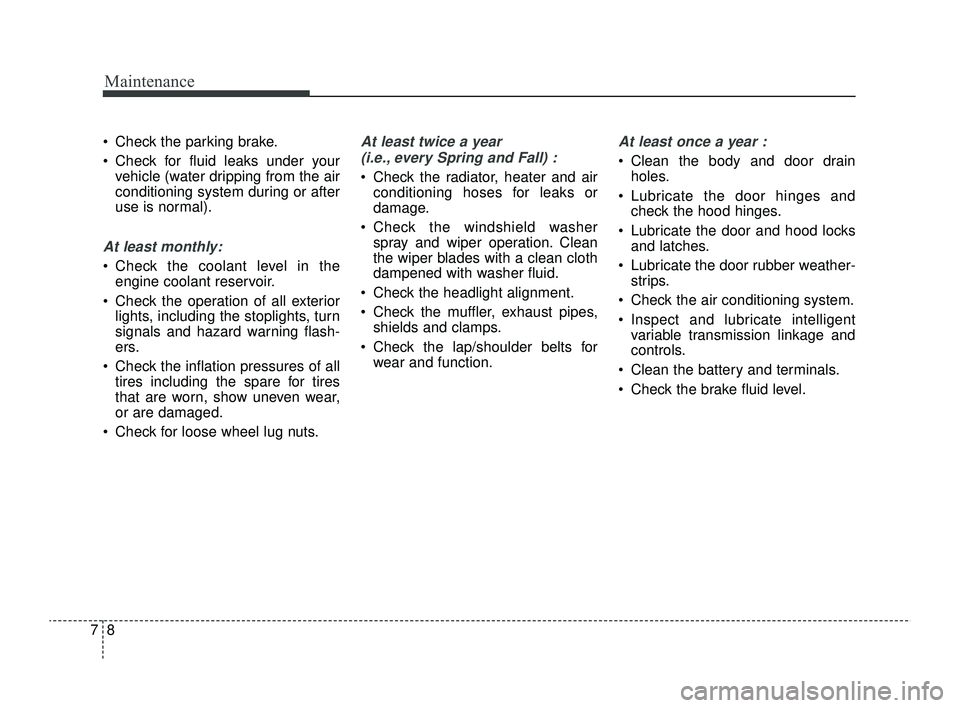
Check the parking brake.
Check for fluid leaks under yourvehicle (water dripping from the air
conditioning system during or after
use is normal).
At least monthly:
Check the coolant level in theengine coolant reservoir.
Check the operation of all exterior lights, including the stoplights, turn
signals and hazard warning flash-
ers.
Check the inflation pressures of all tires including the spare for tires
that are worn, show uneven wear,
or are damaged.
Check for loose wheel lug nuts.
At least twice a year (i.e., every Spring and Fall) :
Check the radiator, heater and air conditioning hoses for leaks or
damage.
Check the windshield washer spray and wiper operation. Clean
the wiper blades with a clean cloth
dampened with washer fluid.
Check the headlight alignment.
Check the muffler, exhaust pipes, shields and clamps.
Check the lap/shoulder belts for wear and function.
At least once a year :
Clean the body and door drainholes.
Lubricate the door hinges and check the hood hinges.
Lubricate the door and hood locks and latches.
Lubricate the door rubber weather- strips.
Check the air conditioning system.
Inspect and lubricate intelligent variable transmission linkage and
controls.
Clean the battery and terminals.
Check the brake fluid level.
SC PE USA 7.qxp 9/9/2021 6:26 PM Page 8
Page 397 of 528
Maintenance
10
7
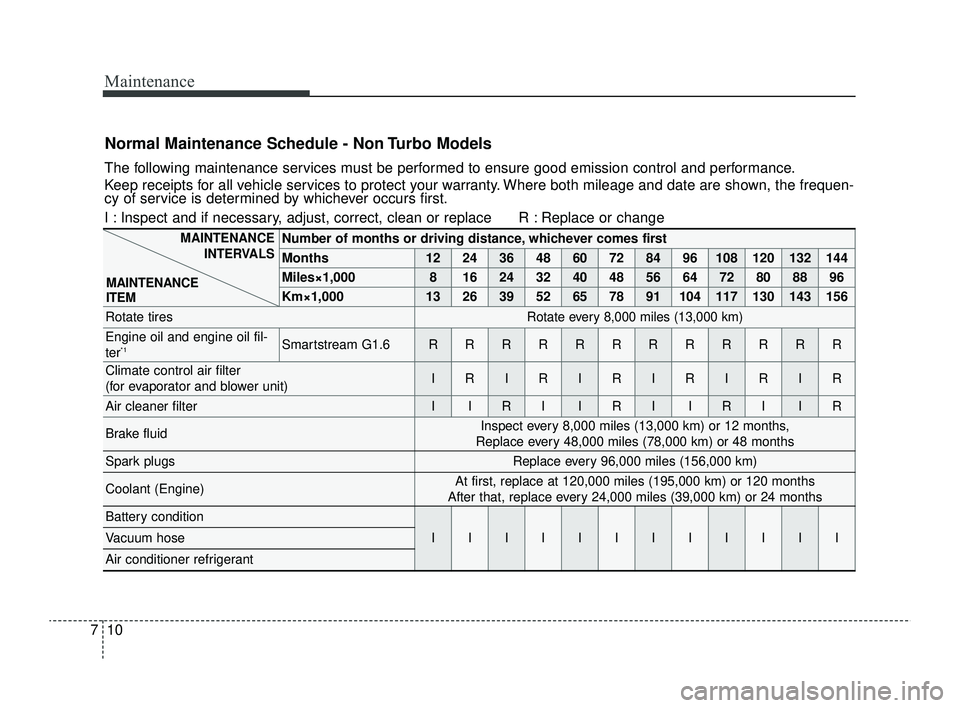
Normal Maintenance Schedule - Non Turbo Models
The following maintenance services must be performed to ensure good emission control and performance.
Keep receipts for all vehicle services to protect your warranty. Where both mileage and date are shown, the frequen-
cy of service is determined by whichever occurs first.
I : Inspect and if necessary, adjust, correct, clean or replace R : Replace or change
Number of months or driving distance, whichever comes first
Months1224364860728496108120132144
Miles×1,00081624324048566472808896
Km×1,00013263952657891104117130143156
Rotate tiresRotate every 8,000 miles (13,000 km)
Engine oil and engine oil fil-
ter*1Smartstream G1.6RRRRRRRRRRRR
Climate control air filter
(for evaporator and blower unit)IRIRIRIRIRIR
Air cleaner filterIIRIIRIIRIIR
Brake fluidInspect every 8,000 miles (13,000 km) or 12 months,
Replace every 48,000 miles (78,000 km) or 48 months
Spark plugsReplace every 96,000 miles (156,000 km)
Coolant (Engine)At first, replace at 120,000 miles (195,000 km) or 120 months
After that, replace every 24,000 miles (39,000 km) or 24 months
Battery condition
IIIIIIIIIIIIVacuum hose
Air conditioner refrigerant
MAINTENANCE INTERVALS
MAINTENANCE
ITEM
SC PE USA 7.qxp 9/9/2021 6:26 PM Page 10
Page 400 of 528
713
Maintenance
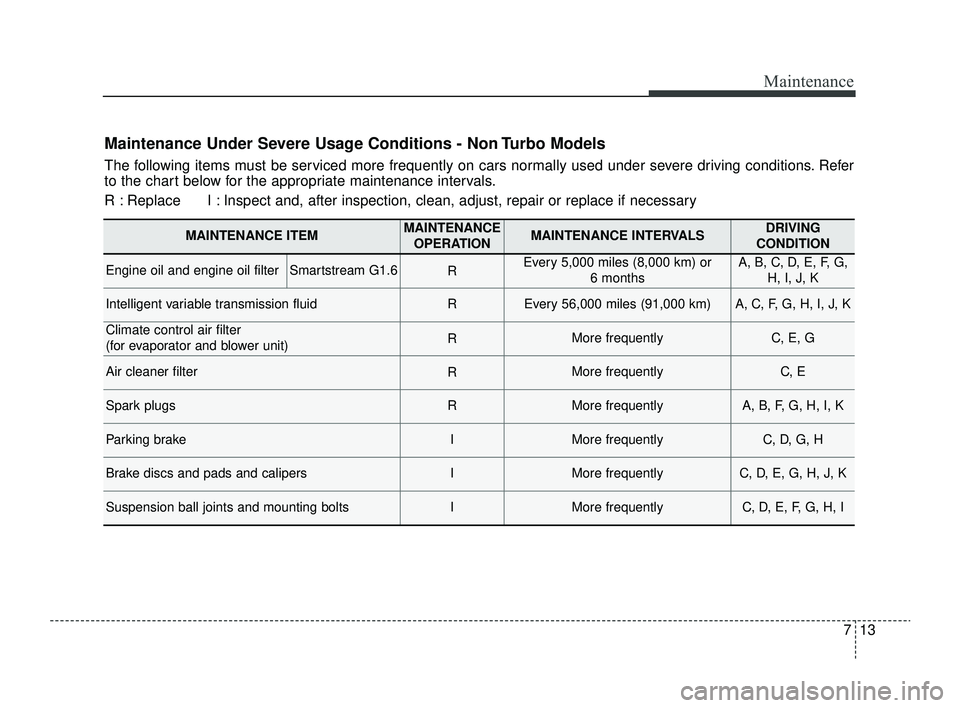
Maintenance Under Severe Usage Conditions - Non Turbo Models
The following items must be serviced more frequently on cars normally used under severe driving conditions. Refer
to the chart below for the appropriate maintenance intervals.
R : Replace I : Inspect and, after inspection, clean, adjust, repair or replace if neces\
sary
MAINTENANCE ITEMMAINTENANCEOPERATIONMAINTENANCE INTERVALSDRIVING
CONDITION
Engine oil and engine oil filterSmartstream G1.6REvery 5,000 miles (8,000 km) or 6 monthsA, B, C, D, E, F, G,H, I, J, K
Intelligent variable transmission fluidREvery 56,000 miles (91,000 km)A, C, F, G, H, I, J, K
Climate control air filter
(for evaporator and blower unit)RMore frequentlyC, E, G
Air cleaner filterRMore frequentlyC, E
Spark plugsRMore frequentlyA, B, F, G, H, I, K
Parking brakeIMore frequentlyC, D, G, H
Brake discs and pads and calipersIMore frequentlyC, D, E, G, H, J, K
Suspension ball joints and mounting boltsIMore frequentlyC, D, E, F, G, H, I
SC PE USA 7.qxp 9/9/2021 6:26 PM Page 13
Page 404 of 528
717
Maintenance
✽ ✽NOTICE
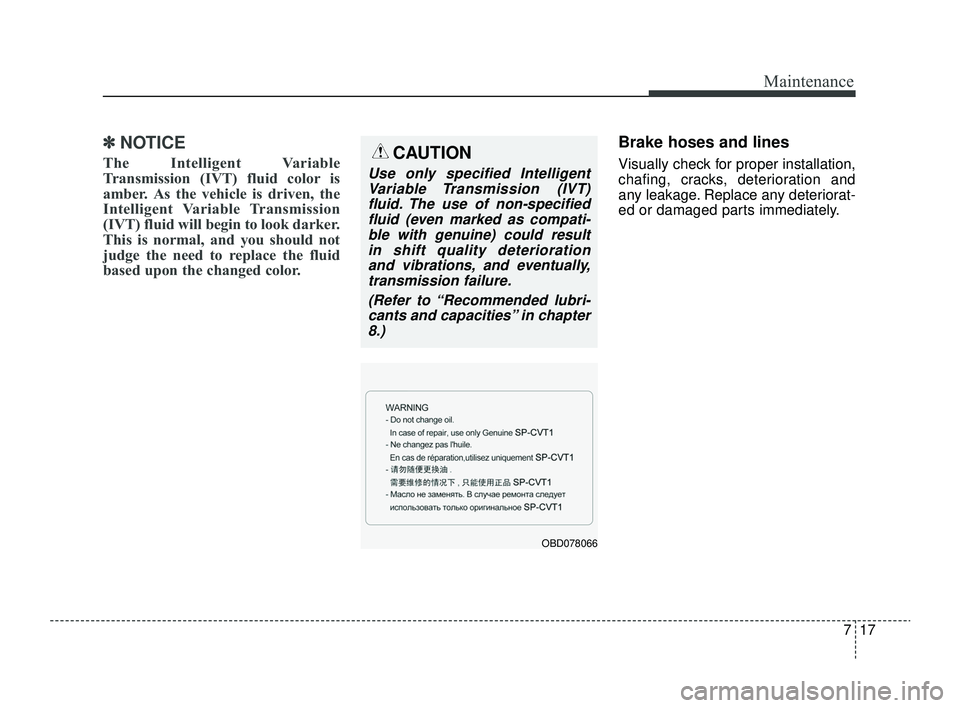
The Intelligent Variable
Transmission (IVT) fluid color is
amber. As the vehicle is driven, the
Intelligent Variable Transmission
(IVT) fluid will begin to look darker.
This is normal, and you should not
judge the need to replace the fluid
based upon the changed color.
Brake hoses and lines
Visually check for proper installation,
chafing, cracks, deterioration and
any leakage. Replace any deteriorat-
ed or damaged parts immediately.CAUTION
Use only specified Intelligent
Variable Transmission (IVT)fluid. The use of non-specifiedfluid (even marked as compati-ble with genuine) could resultin shift quality deteriorationand vibrations, and eventually,transmission failure.
(Refer to “Recommended lubri-cants and capacities” in chapter8.)
OBD078066
SC PE USA 7.qxp 9/9/2021 6:26 PM Page 17
Page 405 of 528
Maintenance
18
7
✽ ✽
NOTICE - NHTSA Safety
Corrosion Alert
NHTSA has warned all vehicle own-
ers of all brands that they must main-
tain their vehicles in a manner which
will prevent brake hose and brake line
failures due to corrosion when such
vehicles are exposed to winter road
salt and related chemicals. While seri-
ous corrosion conditions typically only
manifest themselves as safety issues
after 7 years of vehicle use, the corro-
sion process starts immediately and
thus underbody cleaning maintenance
must commence from your vehicle's
first exposure to road salts and chem-
icals. NHTSA urges vehicle owners to
take the following steps to prevent
corrosion:
(Continued)(Continued)
1. Wash the undercarriage of your
vehicle regularly throughout the
winter and do a thorough washing
in the spring to remove road salt
and other de-icing chemicals.
2. Monitor the brake system for signs of corrosion by having regu-
lar professional inspections and
watching for signs of problems,
including loss of brake fluid,
unusual leaks and soft or spongy
feel in the brake pedal.
3. Replace the entire brake pipe assembly if you find severe corro-
sion that causes scaling or flaking
of brake components.
Brake fluid
Check the brake fluid level in the
brake fluid reservoir. The level should
be between the “MIN” and “MAX”
marks on the side of the reservoir.
Use only hydraulic brake fluid con-
forming to DOT 4 specification.
Parking brake
Inspect the parking brake system
including the parking brake lever and
cables.
SC PE USA 7.qxp 9/9/2021 6:26 PM Page 18
Page 406 of 528
719
Maintenance
Brake discs, pads and calipers
Check the pads for excessive wear,
discs for run out and wear, and
calipers for fluid leakage.
Exhaust pipe and muffler
Visually inspect the exhaust pipes,
muffler and hangers for cracks, dete-
rioration, or damage. Start the
engine and listen carefully for any
exhaust gas leakage. Tighten con-
nections or replace parts as neces-
sary.
Suspension mounting bolts
Check the suspension connections
for looseness or damage. Retighten
to the specified torque.
Steering gear box, linkage &
boots/lower arm ball joint
With the vehicle stopped and engine
off, check for excessive free-play in
the steering wheel.
Check the linkage for bends or dam-
age. Check the dust boots and ball
joints for deterioration, cracks, or
damage. Replace any damaged
parts.
Drive shafts and boots
Check the drive shafts, boots and
clamps for cracks, deterioration, or
damage. Replace any damaged
parts and, if necessary, repack the
grease.
Air conditioning refrigerant
Check the air conditioning lines and
connections for leakage and damage.
SC PE USA 7.qxp 9/9/2021 6:26 PM Page 19
Page 407 of 528
Maintenance
20
7
CHECKING FLUID LEVELS
When checking engine oil, engine
coolant, brake fluid, and washer fluid,
always be sure to clean the area
around any filler plug, drain plug, or
dipstick before checking or draining
any lubricant or fluid. This is espe-
cially important in dusty or sandy
areas and when the vehicle is used
on unpaved roads. Cleaning the plug
and dipstick areas will prevent dirt
and grit from entering the engine and
other mechanisms that could be
damaged.
SC PE USA 7.qxp 9/9/2021 6:26 PM Page 20
Page 414 of 528
727
Maintenance
BRAKE FLUID (IF EQUIPPED)
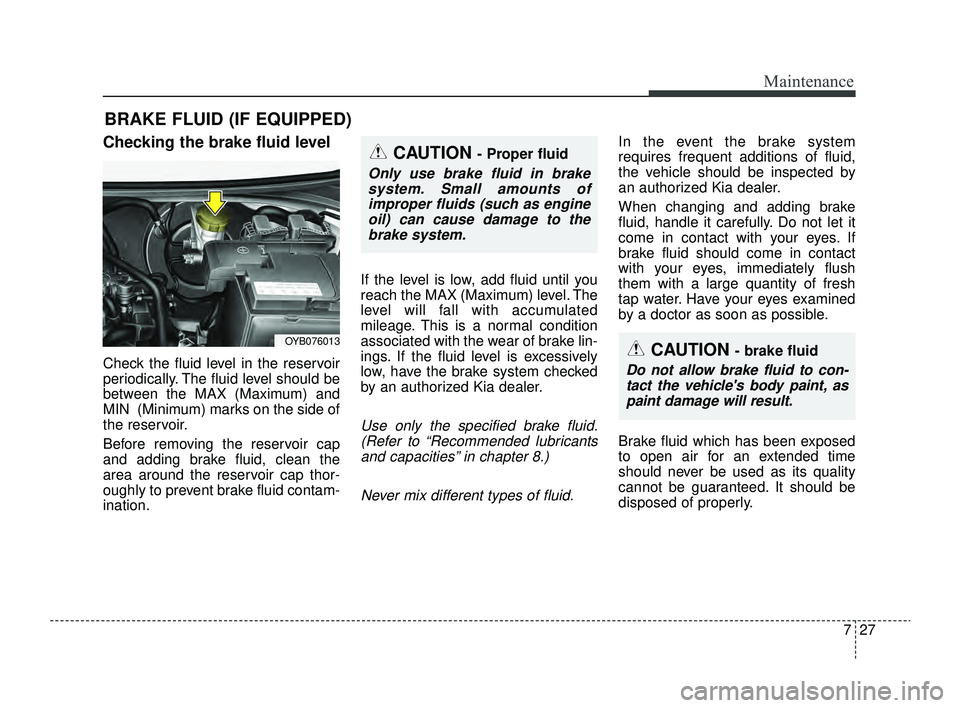
Checking the brake fluid level
Check the fluid level in the reservoir
periodically. The fluid level should be
between the MAX (Maximum) and
MIN (Minimum) marks on the side of
the reservoir.
Before removing the reservoir cap
and adding brake fluid, clean the
area around the reservoir cap thor-
oughly to prevent brake fluid contam-
ination.If the level is low, add fluid until you
reach the MAX (Maximum) level. The
level will fall with accumulated
mileage. This is a normal condition
associated with the wear of brake lin-
ings. If the fluid level is excessively
low, have the brake system checked
by an authorized Kia dealer.
Use only the specified brake fluid.
(Refer to “Recommended lubricantsand capacities” in chapter 8.)
Never mix different types of fluid.
In the event the brake system
requires frequent additions of fluid,
the vehicle should be inspected by
an authorized Kia dealer.
When changing and adding brake
fluid, handle it carefully. Do not let it
come in contact with your eyes. If
brake fluid should come in contact
with your eyes, immediately flush
them with a large quantity of fresh
tap water. Have your eyes examined
by a doctor as soon as possible.
Brake fluid which has been exposed
to open air for an extended time
should never be used as its quality
cannot be guaranteed. It should be
disposed of properly.
OYB076013CAUTION - brake fluid
Do not allow brake fluid to con-tact the vehicle's body paint, aspaint damage will result.
CAUTION - Proper fluid
Only use brake fluid in brakesystem. Small amounts ofimproper fluids (such as engineoil) can cause damage to thebrake system.
SC PE USA 7.qxp 9/9/2021 6:27 PM Page 27
Page 415 of 528
Maintenance
28
7
CAUTION
To maintain your vehicle’s best
brake and ABS/ESC perform-ance, use Kia genuine brakefluid as in the specification.(Classification : FMVSS116 DOT-4)
SC PE USA 7.qxp 9/9/2021 6:27 PM Page 28