power steering KIA RIO 2022 User Guide
[x] Cancel search | Manufacturer: KIA, Model Year: 2022, Model line: RIO, Model: KIA RIO 2022Pages: 528, PDF Size: 11.8 MB
Page 270 of 528
Driving your vehicle
36
5
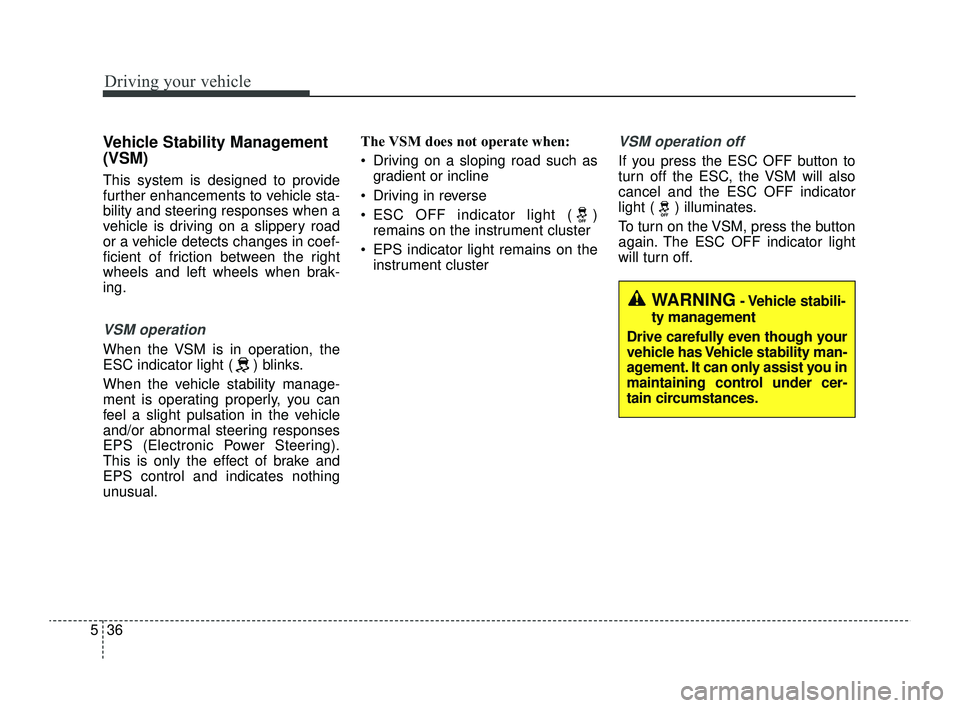
Vehicle Stability Management
(VSM)
This system is designed to provide
further enhancements to vehicle sta-
bility and steering responses when a
vehicle is driving on a slippery road
or a vehicle detects changes in coef-
ficient of friction between the right
wheels and left wheels when brak-
ing.
VSM operation
When the VSM is in operation, the
ESC indicator light ( ) blinks.
When the vehicle stability manage-
ment is operating properly, you can
feel a slight pulsation in the vehicle
and/or abnormal steering responses
EPS (Electronic Power Steering).
This is only the effect of brake and
EPS control and indicates nothing
unusual. The VSM does not operate when:
Driving on a sloping road such as
gradient or incline
Driving in reverse
ESC OFF indicator light ( ) remains on the instrument cluster
EPS indicator light remains on the instrument cluster
VSM operation off
If you press the ESC OFF button to
turn off the ESC, the VSM will also
cancel and the ESC OFF indicator
light ( ) illuminates.
To turn on the VSM, press the button
again. The ESC OFF indicator light
will turn off.
WARNING- Vehicle stabili-
ty management
Drive carefully even though your
vehicle has Vehicle stability man-
agement. It can only assist you in
maintaining control under cer-
tain circumstances.
SC PE USA 5.QXP 9/9/2021 6:18 PM Page 36
Page 271 of 528
537
Driving your vehicle
Malfunction indicator
The VSM can be deactivated even if
you don’t cancel the VSM operation
by pressing the ESC OFF button. It
indicates that a malfunction has
been detected somewhere in the
Electric Power Steering system or
VSM system. If the ESC indicator
light ( ) or EPS warning light
remains on, take your vehicle to an
authorized Kia dealer and have the
system checked.
Your vehicle is designed to activateaccording to the driver’s intention,
even with installed VSM. Always
follow all the normal precautions
for driving at safe speeds for the
conditions – including driving in
inclement weather and on a slip-
pery road.WARNING
For maximum protection, always
wear your seat belt. No system,
no matter how advanced, can
compensate for all driver error
and/or driving conditions.
Always drive responsibly.
WARNING- Tire/Wheel
size
When replacing tires and
wheels, make sure they are the
same size as the original tires
and wheels installed. Driving
with varying tire or wheel sizes
may affect the vehicle's han-
dling.
WARNING
The Vehicle Stability
Management system is not a
substitute for safe driving prac-
tices but a supplementary func-
tion only. It is the responsibility
of the driver to always check the
speed and the distance to the
vehicle ahead. Always hold the
steering wheel firmly while driv-
ing.
SC PE USA 5.QXP 9/9/2021 6:18 PM Page 37
Page 280 of 528
Driving your vehicle
46
5
For the pedestrian, the vehicle
speed is greater than or equal to 3
mph (5 km/h) and less than 37
mph (60 km/h). (Depending on the
condition of pedestrian and the
surrounding environment the pos-
sible maximum operating speed
may be reduced.)
- If you select "Warning Only",Forward Collision-Avoidance
Assist activates and produces
only warning alarms in accor-
dance with the collision risk lev-
els. You should control the brake
directly because Forward
Collision-Avoidance Assist do not
control the brake.Brake operation
In an urgent situation, the braking
system enters into the ready status
for prompt reaction to assist the driv-
er in depressing the brake pedal.
Forward Collision-Avoidance Assist provides additional braking
power for optimum braking per-
formance when the driver depress-
es the brake pedal during warning.
The braking control is automatical- ly deactivated when the driver
sharply depresses the accelerator
pedal, or when the driver abruptly
operates the steering wheel.
The braking control is automatical- ly canceled when risk factors dis-
appear.
The driver should always exercise
caution when operating the vehicle,
even though there is no warning
message or warning alarm.WARNING
Forward Collision-Avoidance
Assist cannot avoid all colli-
sions nor completely stop the
vehicle before collision. The
driver has the responsibility to
drive safely and control the
vehicle.
WARNING
Forward Collision-Avoidance
Assist is a supplemental func-
tion and cannot completely
stop the vehicle in all situations
or avoid all collisions. It is the
responsibility of the driver to
safely drive and control the
vehicle.
SC PE USA 5.QXP 9/9/2021 6:18 PM Page 46
Page 338 of 528
Driving your vehicle
104
5
Remember, your vehicle does not
require extended warm-up. After
the engine has started, allow the
engine to run for 10 to 20 seconds
prior to placing the vehicle in gear.
In very cold weather, however, give
your engine a slightly longer warm-
up period.
Don't “lug” or “over-rev” the engine. Lugging is driving too slowly in a
very high gear resulting in engine
bucking. If this happens, shift to a
lower gear. Over-revving is racing
the engine beyond its safe limit.
This can be avoided by shifting at
the recommended speed. Use your air conditioning sparingly.
The air conditioning system is
operated by engine power so your
fuel economy is reduced when you
use it.
Open windows at high speeds can reduce fuel economy.
Fuel economy is reduced by cross- winds and headwinds. To help off-
set some of this loss, slow down
when driving in these conditions.
Keeping a vehicle in good operating
condition is important both for econ-
omy and safety. Therefore, have an
authorized Kia dealer perform
scheduled inspections and mainte-
nance.
WARNING- Engine off during
motion
Never turn the engine off to
coast down hills or anytime the
vehicle is in motion. The power
steering and power brakes will
not function properly without
the engine running. In addition,
turning off the ignition while
driving could engage the steer-
ing wheel lock resulting in loss
of vehicle steering. Keep the
engine on and downshift to an
appropriate gear for engine
braking effect.
SC PE USA 5.QXP 9/9/2021 6:22 PM Page 104
Page 385 of 528
631
What to do in an emergency
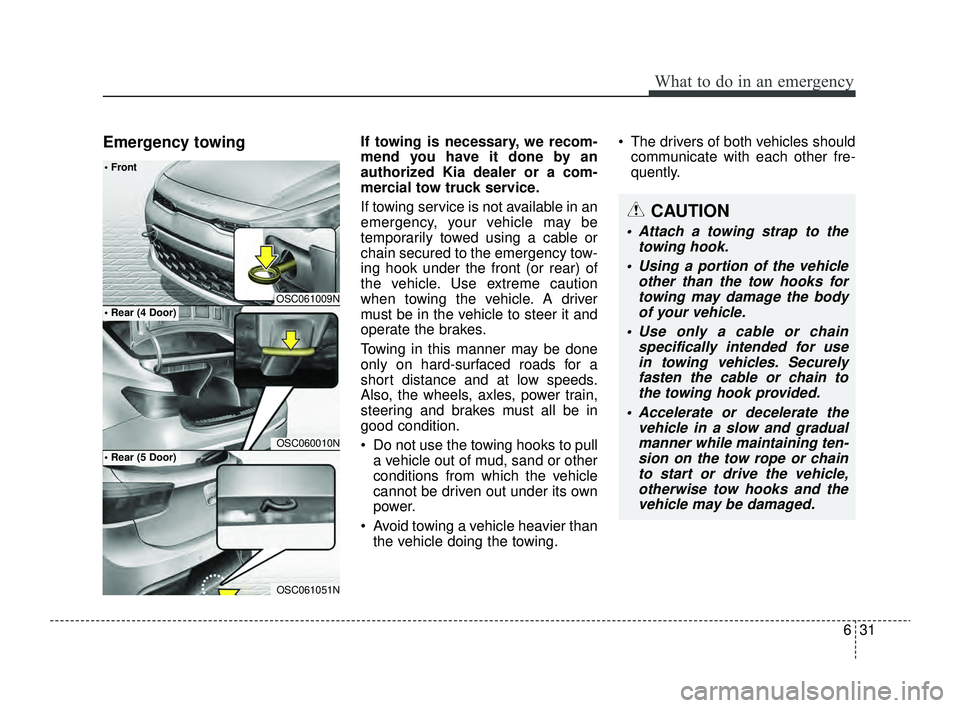
Emergency towingIf towing is necessary, we recom-
mend you have it done by an
authorized Kia dealer or a com-
mercial tow truck service.
If towing service is not available in an
emergency, your vehicle may be
temporarily towed using a cable or
chain secured to the emergency tow-
ing hook under the front (or rear) of
the vehicle. Use extreme caution
when towing the vehicle. A driver
must be in the vehicle to steer it and
operate the brakes.
Towing in this manner may be done
only on hard-surfaced roads for a
short distance and at low speeds.
Also, the wheels, axles, power train,
steering and brakes must all be in
good condition.
Do not use the towing hooks to pulla vehicle out of mud, sand or other
conditions from which the vehicle
cannot be driven out under its own
power.
Avoid towing a vehicle heavier than the vehicle doing the towing. The drivers of both vehicles should
communicate with each other fre-
quently.
OSC061009N
OSC060010N
Front
Rear (4 Door)
OSC061051N
Rear (5 Door)
CAUTION
Attach a towing strap to the
towing hook.
Using a portion of the vehicle other than the tow hooks fortowing may damage the bodyof your vehicle.
Use only a cable or chain specifically intended for usein towing vehicles. Securelyfasten the cable or chain tothe towing hook provided.
Accelerate or decelerate the vehicle in a slow and gradualmanner while maintaining ten-sion on the tow rope or chainto start or drive the vehicle,otherwise tow hooks and thevehicle may be damaged.
SC PE USA 6.qxp 8/23/2021 6:02 PM Page 31
Page 387 of 528
633
What to do in an emergency
Emergency towing precautions
Turn the ignition switch to ACC sothe steering wheel isn’t locked.
Place the transmission shift lever in N (Neutral).
Release the parking brake.
Press the brake pedal with more force than normal since you will
have reduced brake performance.
More steering effort will be required because the power steer-
ing system will be disabled.
If you are driving down a long hill, the brakes may overheat and brake
performance will be reduced. Stop
often and let the brakes cool off.
To avoid serious damage to the Intelligent Variable Transmission,
limit the vehicle speed to 10 mph
(15 km/h) and drive less than 1
mile (1.5 km) when towing. (for
Intelligent Variable Transmission
vehicle) If the car is being towed with all four
wheels on the ground, it can be
towed only from the front. Be sure
that the transmission is in neutral. Be
sure the steering is unlocked by plac-
ing the ignition switch in the ACC
position. A driver must be in the
towed vehicle to operate the steering
and brakes.CAUTION- Intelligent
Variable Transmission
Before towing, check for an Intelligent Variable Transmissionfluid leak under your vehicle. If theIntelligent Variable Transmissionfluid is leaking, a flatbed equip-ment or towing dolly must beused.
SC PE USA 6.qxp 8/23/2021 6:02 PM Page 33
Page 452 of 528
765
Maintenance
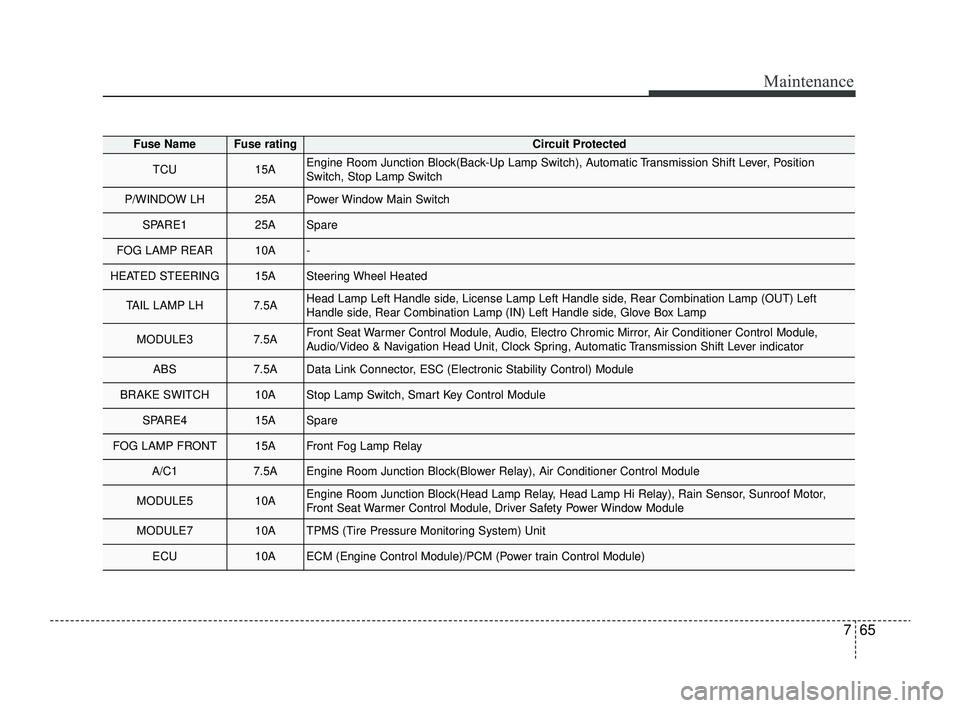
Fuse NameFuse ratingCircuit Protected
TCU15AEngine Room Junction Block(Back-Up Lamp Switch), Automatic Transmission Shift Lever, Position
Switch, Stop Lamp Switch
P/WINDOW LH25APower Window Main Switch
SPARE125ASpare
FOG LAMP REAR10A-
HEATED STEERING15ASteering Wheel Heated
TAIL LAMP LH7.5AHead Lamp Left Handle side, License Lamp Left Handle side, Rear Combination Lamp (OUT) Left
Handle side, Rear Combination Lamp (IN) Left Handle side, Glove Box Lamp
MODULE37.5AFront Seat Warmer Control Module, Audio, Electro Chromic Mirror, Air Conditioner Control Module,
Audio/Video & Navigation Head Unit, Clock Spring, Automatic Transmission Shift Lever indicator
ABS7.5AData Link Connector, ESC (Electronic Stability Control) Module
BRAKE SWITCH10AStop Lamp Switch, Smart Key Control Module
SPARE415ASpare
FOG LAMP FRONT15AFront Fog Lamp Relay
A/C17.5AEngine Room Junction Block(Blower Relay), Air Conditioner Control Module
MODULE510AEngine Room Junction Block(Head Lamp Relay, Head Lamp Hi Relay), Rain Sensor, Sunroof Motor,
Front Seat Warmer Control Module, Driver Safety Power Window Module
MODULE710ATPMS (Tire Pressure Monitoring System) Unit
ECU10AECM (Engine Control Module)/PCM (Power train Control Module)
SC PE USA 7.qxp 9/9/2021 6:28 PM Page 65
Page 454 of 528
767
Maintenance
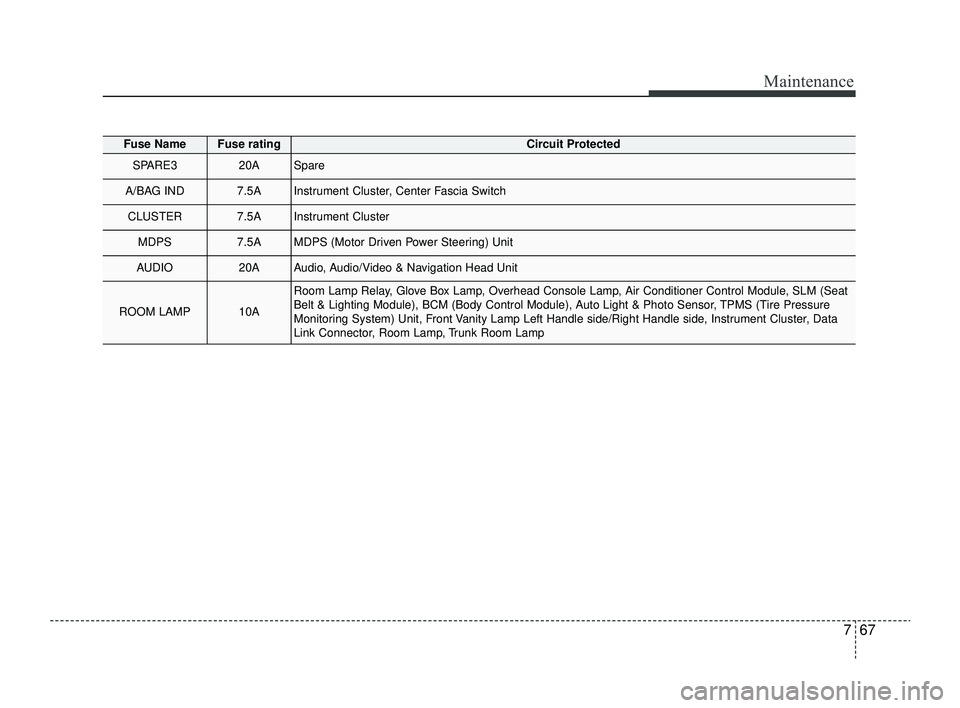
Fuse NameFuse ratingCircuit Protected
SPARE320ASpare
A/BAG IND7.5AInstrument Cluster, Center Fascia Switch
CLUSTER7.5AInstrument Cluster
MDPS7.5AMDPS (Motor Driven Power Steering) Unit
AUDIO20AAudio, Audio/Video & Navigation Head Unit
ROOM LAMP10A
Room Lamp Relay, Glove Box Lamp, Overhead Console Lamp, Air Conditioner Control Module, SLM (Seat
Belt & Lighting Module), BCM (Body Control Module), Auto Light & Photo Sensor, TPMS (Tire Pressure
Monitoring System) Unit, Front Vanity Lamp Left Handle side/Right Handle side, Instrument Cluster, Data
Link Connector, Room Lamp, Trunk Room Lamp
SC PE USA 7.qxp 9/9/2021 6:28 PM Page 67
Page 456 of 528
769
Maintenance
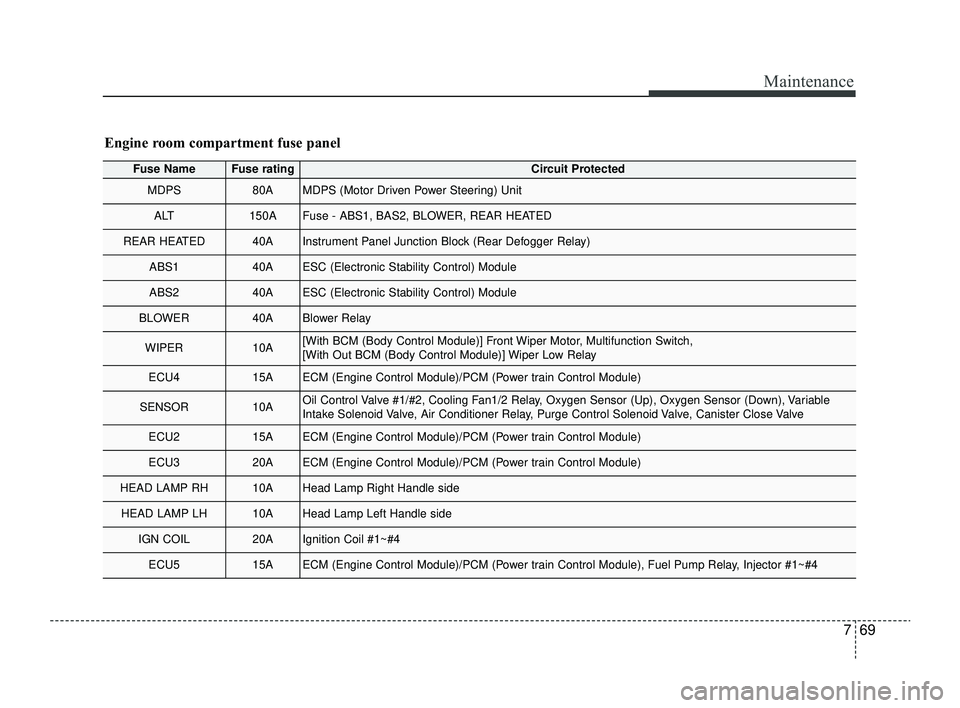
Engine room compartment fuse panel
Fuse NameFuse ratingCircuit Protected
MDPS80AMDPS (Motor Driven Power Steering) Unit
ALT150AFuse - ABS1, BAS2, BLOWER, REAR HEATED
REAR HEATED40AInstrument Panel Junction Block (Rear Defogger Relay)
ABS140AESC (Electronic Stability Control) Module
ABS240AESC (Electronic Stability Control) Module
BLOWER40ABlower Relay
WIPER10A[With BCM (Body Control Module)] Front Wiper Motor, Multifunction Switch,
[With Out BCM (Body Control Module)] Wiper Low Relay
ECU415AECM (Engine Control Module)/PCM (Power train Control Module)
SENSOR10AOil Control Valve #1/#2, Cooling Fan1/2 Relay, Oxygen Sensor (Up), Oxygen Sensor (Down), Variable
Intake Solenoid Valve, Air Conditioner Relay, Purge Control Solenoid Valve, Canister Close Valve
ECU215AECM (Engine Control Module)/PCM (Power train Control Module)
ECU320AECM (Engine Control Module)/PCM (Power train Control Module)
HEAD LAMP RH10AHead Lamp Right Handle side
HEAD LAMP LH10AHead Lamp Left Handle side
IGN COIL20AIgnition Coil #1~#4
ECU515AECM (Engine Control Module)/PCM (Power train Control Module), Fuel Pump Relay, Injector #1~#4
SC PE USA 7.qxp 9/9/2021 6:28 PM Page 69
Page 525 of 528
I9
Index
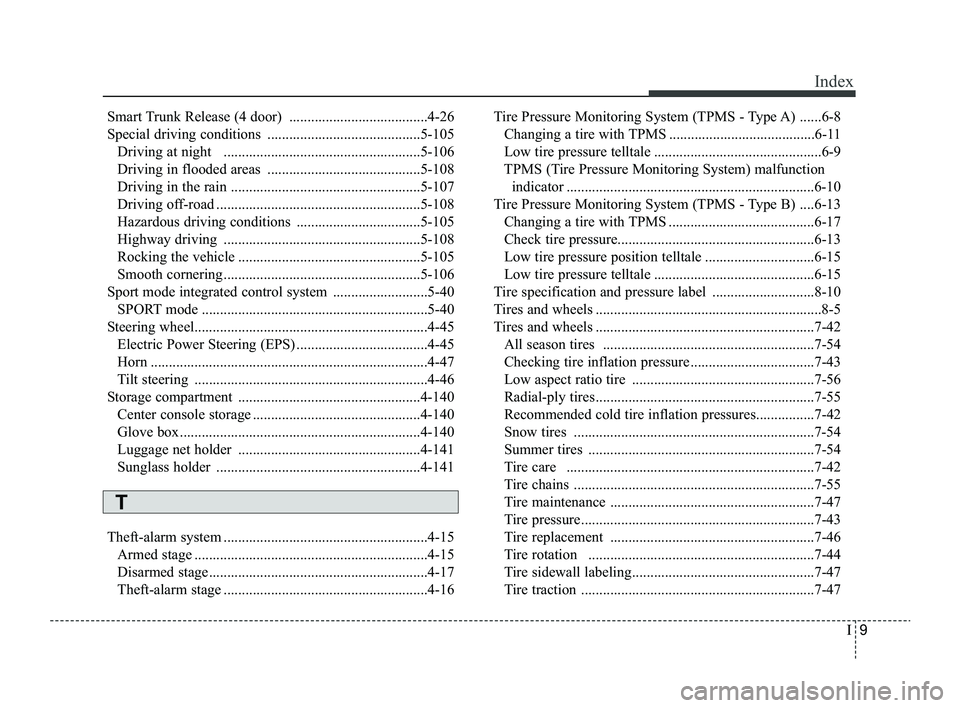
Smart Trunk Release (4 door) ......................................4-26
Special driving conditions ..........................................5-105Driving at night ......................................................5-106
Driving in flooded areas ..........................................5-108
Driving in the rain ....................................................5-107
Driving off-road ........................................................5-108
Hazardous driving conditions ..................................5-105
Highway driving ......................................................5-108
Rocking the vehicle ..................................................5-105
Smooth cornering ......................................................5-106
Sport mode integrated control system ..........................5-40 SPORT mode ..............................................................5-40
Steering wheel...........................................................\
.....4-45 Electric Power Steering (EPS) ....................................4-45
Horn ........................................................................\
....4-47
Tilt steering ................................................................4-46
Storage compartment ..................................................4-140 Center console storage ..............................................4-140
Glove box ..................................................................4-140
Luggage net holder ..................................................4-141
Sunglass holder ........................................................4-141
Theft-alarm system ........................................................4-15 Armed stage ................................................................4-15
Disarmed stage ............................................................4-17
Theft-alarm stage ........................................................4-16 Tire Pressure Monitoring System (TPMS - Type A) ......6-8
Changing a tire with TPMS ........................................6-11
Low tire pressure telltale ..............................................6-9
TPMS (Tire Pressure Monitoring System) malfunction indicator ....................................................................6-10\
Tire Pressure Monitoring System (TPMS - Type B) ....6-13 Changing a tire with TPMS ........................................6-17
Check tire pressure.....................................................\
.6-13
Low tire pressure position telltale ..............................6-15
Low tire pressure telltale ............................................6-15
Tire specification and pressure label ............................8-10
Tires and wheels ..............................................................8-5
Tires and wheels ............................................................7-42 All season tires ..........................................................7-54
Checking tire inflation pressure ..................................7-43
Low aspect ratio tire ..................................................7-56
Radial-ply tires ............................................................7-55
Recommended cold tire inflation pressures................7-42
Snow tires ..................................................................7-54
Summer tires ..............................................................7-54
Tire care ....................................................................7-42\
Tire chains ..................................................................7-55
Tire maintenance ........................................................7-47
Tire pressure................................................................7-43
Tire replacement ........................................................7-46
Tire rotation ..............................................................7-44
Tire sidewall labeling..................................................7-47
Tire traction ................................................................7-47
T
SC PE USA Index.qxp 8/23/2021 5:25 PM Page 9