change wheel KIA RIO 2022 Owner's Manual
[x] Cancel search | Manufacturer: KIA, Model Year: 2022, Model line: RIO, Model: KIA RIO 2022Pages: 528, PDF Size: 11.8 MB
Page 378 of 528
What to do in an emergency
24
6
10. To install the wheel, hold it on the
studs, put the wheel nuts on the
studs and tighten them finger
tight. Jiggle the tire to be sure it is
completely seated, then tighten
the nuts as much as possible
with your fingers again.
11. Lower the vehicle to the ground by turning the wheel nut wrench
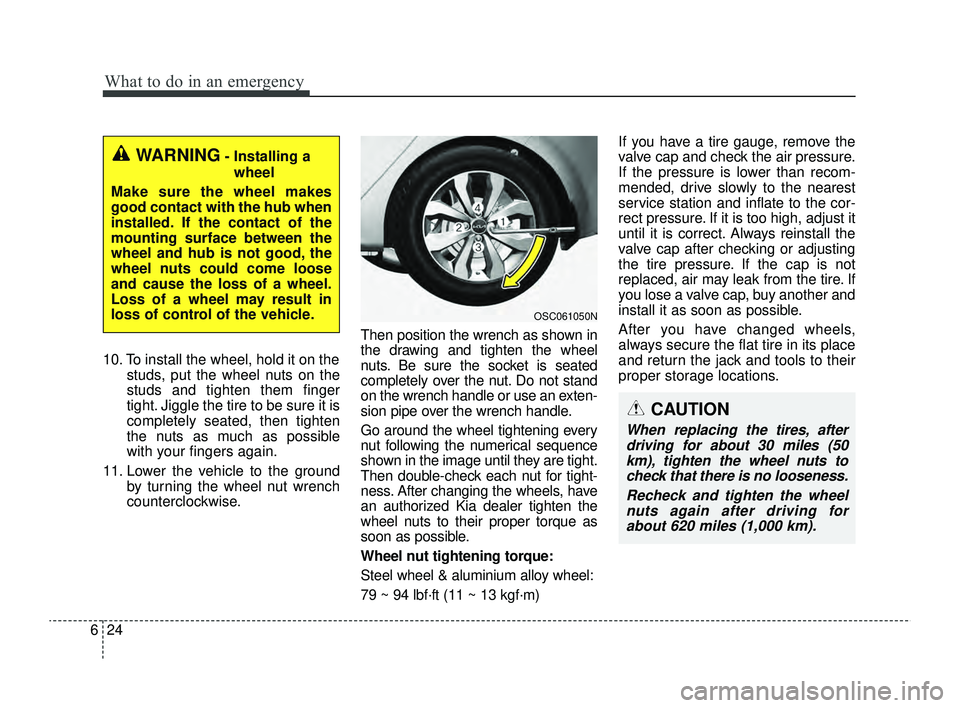
counterclockwise. Then position the wrench as shown in
the drawing and tighten the wheel
nuts. Be sure the socket is seated
completely over the nut. Do not stand
on the wrench handle or use an exten-
sion pipe over the wrench handle.
Go around the wheel tightening every
nut following the numerical sequence
shown in the image until they are tight.
Then double-check each nut for tight-
ness. After changing the wheels, have
an authorized Kia dealer tighten the
wheel nuts to their proper torque as
soon as possible.
Wheel nut tightening torque:
Steel wheel & aluminium alloy wheel:
79 ~ 94 lbf·ft (11 ~ 13 kgf·m) If you have a tire gauge, remove the
valve cap and check the air pressure.
If the pressure is lower than recom-
mended, drive slowly to the nearest
service station and inflate to the cor-
rect pressure. If it is too high, adjust it
until it is correct. Always reinstall the
valve cap after checking or adjusting
the tire pressure. If the cap is not
replaced, air may leak from the tire. If
you lose a valve cap, buy another and
install it as soon as possible.
After you have changed wheels,
always secure the flat tire in its place
and return the jack and tools to their
proper storage locations.
WARNING- Installing a
wheel
Make sure the wheel makes
good contact with the hub when
installed. If the contact of the
mounting surface between the
wheel and hub is not good, the
wheel nuts could come loose
and cause the loss of a wheel.
Loss of a wheel may result in
loss of control of the vehicle.
OSC061050N
CAUTION
When replacing the tires, after driving for about 30 miles (50km), tighten the wheel nuts tocheck that there is no looseness.
Recheck and tighten the wheelnuts again after driving forabout 620 miles (1,000 km).
SC PE USA 6.qxp 8/23/2021 6:01 PM Page 24
Page 394 of 528
77
Maintenance
OWNER MAINTENANCE
The following lists are vehicle checks
and inspections that should be per-
formed by the owner or an author-
ized Kia dealer at the frequencies
indicated to help ensure safe,
dependable operation of your vehi-
cle.
Any adverse conditions should be
brought to the attention of your deal-
er as soon as possible.
These Owner Maintenance Checks
are generally not covered by war-
ranties and you may be charged for
labor, parts and lubricants used.Owner maintenance schedule
When you stop for fuel:
Check the coolant level in coolantreservoir.
Check the windshield washer fluid level.
Look for low or under-inflated tires.
While operating your vehicle:
Note any changes in the sound of the exhaust or any smell of
exhaust fumes in the vehicle.
Check for vibrations in the steering wheel. Notice any increased steer-
ing effort or looseness in the steer-
ing wheel, or change in its straight-
ahead position.
Notice if your vehicle constantly turns slightly or “pulls” to one side
when traveling on smooth, level
road.
When stopping, listen and check for unusual sounds, pulling to one
side, increased brake pedal travel
or “hard-to-push” brake pedal.
If any slipping or changes in the operation of your transmission
occurs, take your vehicle to an
authorized Kia dealer.
Check the intelligent variable trans- mission P (Park) function.
WARNING- Hot coolant
Be careful when checking your
engine coolant level when the
engine is hot. Scalding hot
coolant and steam may blow
out under pressure.
SC PE USA 7.qxp 9/9/2021 6:26 PM Page 7
Page 441 of 528
Maintenance
54
7
All season tires
Kia specifies all season tires on
some models to provide good per-
formance for use all year round,
including snowy and icy road condi-
tions. All season tires are identified
by ALL SEASON and/or M+S (Mud
and Snow) on the tire sidewall. Snow
tires have better snow traction than
all season tires and may be more
appropriate in some areas.
Summer tires
Kia specifies summer tires on some
models to provide superior perform-
ance on dry roads. Summer tire per-
formance is substantially reduced in
snow and ice. Summer tires do not
have the tire traction rating M+S
(Mud and Snow) on the tire side wall.
If you plan to operate your vehicle in
snowy or icy conditions, Kia recom-
mends the use of snow tires or all
season tires on all four wheels.
Snow tires
If you equip your car with snow tires,
they should be the same size and
have the same load capacity as the
original tires. Snow tires should be
installed on all four wheels; other-
wise, poor handling may result.
Snow tires should carry 4 psi (28
kPa) more air pressure than the
pressure recommended for the stan-
dard tires on the tire label on the dri-
ver's side of the center pillar, or up to
the maximum pressure shown on the
tire sidewall, whichever is less.
Do not drive faster than 75 mph (120
km/h) when your vehicle is equipped
with snow tires.WARNING
Do not use summer tires at tem-
peratures below 45°F (7°C) or
when driving on snow or ice. At
temperatures below 45°F (7°C),
summer tires can lose elastici-
ty, and therefore traction and
braking power as well. Change
the tires on your vehicle to win-
ter or all-weather tires of the
same size as the standard tires
of the vehicle. Both types of
tires are identified by the M+S
(Mud and Snow) marking. Using
summer tires at very cold tem-
peratures could cause cracks to
form, thereby damaging the
tires permanently.
SC PE USA 7.qxp 9/9/2021 6:27 PM Page 54
Page 492 of 528
7105
Maintenance
Underbody maintenance
Road salt and other corrosive chemi-
cals are used in cold weather states to
melt snow and prevent ice accumula-
tion. If these chemicals are not regu-
larly removed, they will corrode the
vehicle underbody and over time dam-
age fuel lines, the fuel tank retention
system, the vehicle suspension, the
exhaust system, and even the body
frame. The National Highway Traffic
Safety Administration has warned all
vehicle owners of all brands of the
need to take the following steps:
Wash the undercarriage of yourvehicle regularly during the winter
and whenever your vehicle has
been exposed to such salts or
chemicals. Do a thorough washing of the
undercarriage at the end of the
winter.
Use professional service techni- cians or governmental inspection
stations to annually inspect for cor-
rosion.
Immediately seek an inspection of your vehicle if you become visually
aware of corrosion flaking or scal-
ing or if you become aware of a
change in vehicle performance,
such as soft or spongey brakes,
fluids leaking, impairment of direc-
tional control, suspension noises
or rattling metal straps.
Aluminum wheel maintenance
The aluminum wheels are coated
with a clear protective finish.
Do not use any abrasive cleaner,polishing compound, solvent, or
wire brushes on aluminum wheels.
They may scratch the finish.
Clean the wheel when it has cooled.
Use only a mild soap or neutral detergent, and rinse thoroughly
with water. Also, be sure to clean
the wheels after driving on salted
roads. This helps prevent corro-
sion.
Avoid washing the wheels with highspeed vehicle wash brushes.
Do not use any alkaline or acid detergents as they may damage or
corrode aluminum wheels coated
with a clear protective finish.
SC PE USA 7.qxp 9/9/2021 6:31 PM Page 105
Page 526 of 528
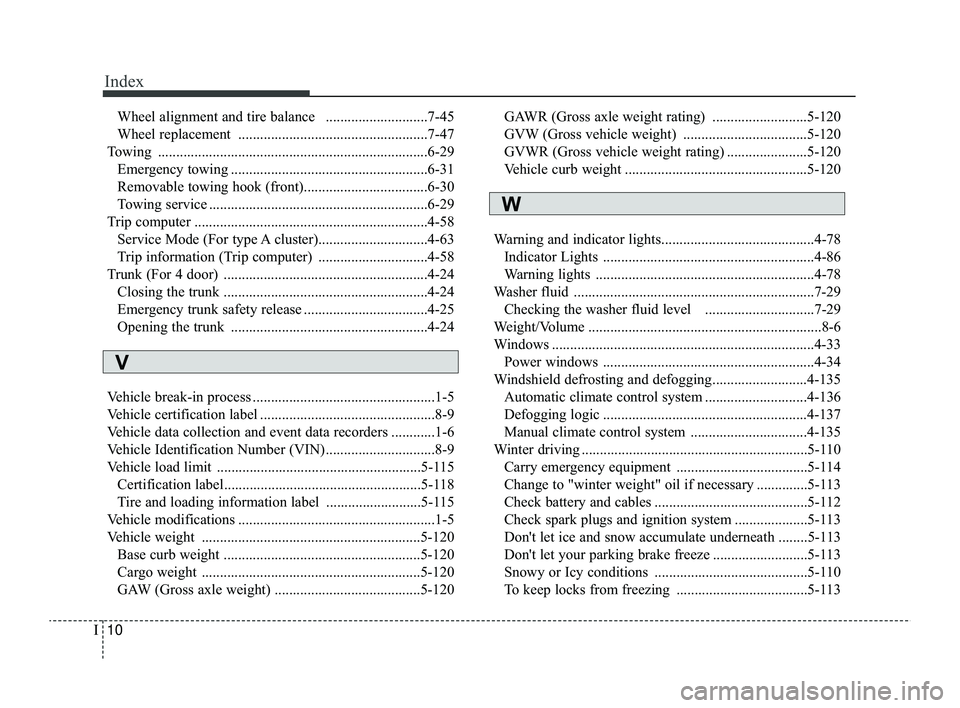
Index
10I
Wheel alignment and tire balance ............................7-45
Wheel replacement ....................................................7-47
Towing ........................................................................\
..6-29 Emergency towing ......................................................6-31
Removable towing hook (front)..................................6-30
Towing service ............................................................6-29
Trip computer ................................................................4-58 Service Mode (For type A cluster)..............................4-63
Trip information (Trip computer) ..............................4-58
Trunk (For 4 door) ........................................................4-24 Closing the trunk ........................................................4-24
Emergency trunk safety release ..................................4-25
Opening the trunk ......................................................4-24
Vehicle break-in process ..................................................1-5
Vehicle certification label ................................................8-9
Vehicle data collection and event data recorders ............1-6
Vehicle Identification Number (VIN)..............................8-9
Vehicle load limit ........................................................5-115 Certification label......................................................5-118
Tire and loading information label ..........................5-115
Vehicle modifications ......................................................1-5
Vehicle weight ............................................................5-120 Base curb weight ......................................................5\
-120
Cargo weight ............................................................5-120
GAW (Gross axle weight) ........................................5-120 GAWR (Gross axle weight rating) ..........................5-120
GVW (Gross vehicle weight) ..................................5-120
GVWR (Gross vehicle weight rating) ......................5-120
Vehicle curb weight ..................................................5-120
Warning and indicator lights..........................................4-78 Indicator Lights ..........................................................4-86
Warning lights ............................................................4-78
Washer fluid ..................................................................7-29 Checking the washer fluid level ..............................7-29
Weight/Volume ................................................................8-6
Windows ........................................................................\
4-33 Power windows ..........................................................4-34
Windshield defrosting and defogging..........................4-135 Automatic climate control system ............................4-136
Defogging logic ........................................................4-137
Manual climate control system ................................4-135
Winter driving ..............................................................5-110 Carry emergency equipment ....................................5-114
Change to "winter weight" oil if necessary ..............5-113
Check battery and cables ..........................................5-112
Check spark plugs and ignition system ....................5-113
Don't let ice and snow accumulate underneath ........5-113
Don't let your parking brake freeze ..........................5-113
Snowy or Icy conditions ..........................................5-110
To keep locks from freezing ....................................5-113
W
V
SC PE USA Index.qxp 8/23/2021 5:25 PM Page 10