stop start KIA RIO 2022 Repair Manual
[x] Cancel search | Manufacturer: KIA, Model Year: 2022, Model line: RIO, Model: KIA RIO 2022Pages: 528, PDF Size: 11.8 MB
Page 363 of 528
69
What to do in an emergency
✽ ✽NOTICE
If the TPMS indicator does not illu-
minate for 3 seconds when the igni-
tion switch is turned to the ON posi-
tion or engine is running, or if it
comes on after blinking for approxi-
mately one minute, take your car to
your nearest authorized Kia dealer
and have the system checked.
Low tire pressure
telltale
When the tire pressure monitoring
system warning indicator is illuminat-
ed, one or more of your tires is sig-
nificantly under-inflated.
If the telltale illuminates, immediately
reduce your speed, avoid hard cor-
nering and anticipate increased stop-
ping distances. You should stop and
check your tires as soon as possible.
Inflate the tires to the proper pres-
sure as indicated on the vehicle’s
placard or tire inflation pressure label
located on the driver’s side center pil-
lar outer panel. If you cannot reach a
service station or if the tire cannot
hold the newly added air, replace the
low pressure tire with the spare tire.
Then the Low Tire Pressure telltale
may flash for approximately one
minute and then remain continuously
illuminated after restarting and about
20 minutes of continuous driving
before you have the low pressure tire
repaired and replaced on the vehicle. In winter or cold weather, the low tire
pressure telltale may be illuminated if
the tire pressure was adjusted to the
recommended tire inflation pressure
in warm weather. It does not mean
your TPMS is malfunctioning
because the decreased temperature
leads to a proportional lowering of
tire pressure.
When you drive your vehicle from a
warm area to a cold area or from a
cold area to a warm area, or the out-
side temperature is greatly higher or
lower, you should check the tire infla-
tion pressure and adjust the tires to
the recommended tire inflation pres-
sure.
When filling tires with more air, con-
ditions to turn off the low tire pres-
sure telltale may not be met. This is
because a tire inflator has a margin
of error in performance. The low tire
pressure telltale will be turned off if
the tire pressure is above the recom-
mended tire inflation pressure.
SC PE USA 6.qxp 8/23/2021 6:01 PM Page 9
Page 368 of 528
What to do in an emergency
14
6
Each tire, including the spare (if pro-
vided), should be checked monthly
when cold and inflated to the inflation
pressure recommended by the vehi-
cle manufacturer on the vehicle plac-
ard or tire inflation pressure label. (If
your vehicle has tires of a different
size than the size indicated on the
vehicle placard or tire inflation pres-
sure label, you should determine the
proper tire inflation pressure for
those tires.)
As an added safety feature, your
vehicle has been equipped with a tire
pressure monitoring system (TPMS)
that illuminates a low tire pressure
telltale when one or more of your
tires is significantly under-inflated.
Accordingly, when the low tire pres-
sure telltale illuminates, you should
stop and check your tires as soon as
possible, and inflate them to the
proper pressure. Driving on a signifi-
cantly under-inflated tire causes the
tire to overheat and can lead to tire
failure. Under-inflation also reduces
fuel efficiency and tire tread life, and
may affect the vehicle’s handling and
stopping ability. Please note that the TPMS is not a
substitute for proper tire maintenance,
and it is the driver’s responsibility to
maintain correct tire pressure, even if
under-inflation has not reached the
level to trigger illumination of the
TPMS low tire pressure telltale.
Your vehicle has also been equipped
with a TPMS malfunction indicator to
indicate when the system is not
operating properly. The TPMS mal-
function indicator is combined with
the low tire pressure telltale. When
the system detects a malfunction,
the telltale will flash for approximate-
ly one minute and then remain con-
tinuously illuminated. This sequence
will continue upon subsequent vehi-
cle start-ups as long as the malfunc-
tion exists. When the malfunction
indicator is illuminated, the system
may not be able to detect or signal
low tire pressure as intended. TPMS
malfunctions may occur for a variety
of reasons, including the installation
of replacement or alternate tires or
wheels on the vehicle that prevent
the TPMS from functioning properly.
Always check the TPMS malfunction
telltale after replacing one or more
tires or wheels on your vehicle to
ensure that the replacement or alter-
nate tires and wheels allow the TPMS
to continue to function properly.
SC PE USA 6.qxp 8/23/2021 6:01 PM Page 14
Page 369 of 528
615
What to do in an emergency
✽ ✽NOTICE
If the TPMS, Low Tire Pressure
indicator does not illuminate for 3
seconds when the ignition switch is
turned to the ON position or engine
is running, or if they remain illumi-
nated after coming on for approxi-
mately 3 seconds, take your vehicle
to your nearest authorized Kia deal-
er and have the system checked.
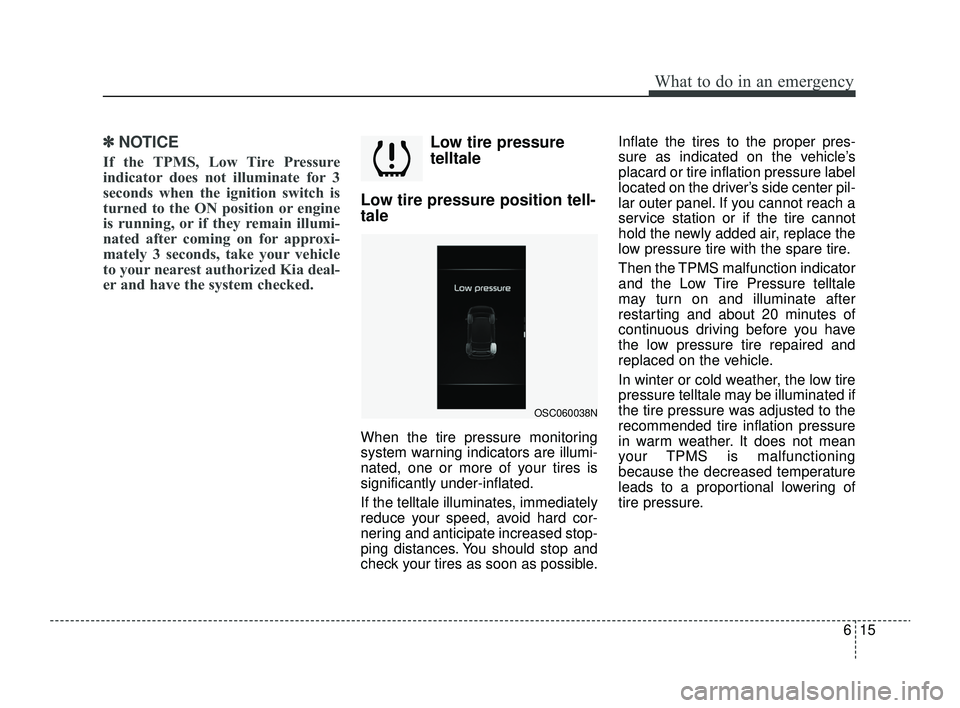
Low tire pressure
telltale
Low tire pressure position tell-
tale
When the tire pressure monitoring
system warning indicators are illumi-
nated, one or more of your tires is
significantly under-inflated.
If the telltale illuminates, immediately
reduce your speed, avoid hard cor-
nering and anticipate increased stop-
ping distances. You should stop and
check your tires as soon as possible. Inflate the tires to the proper pres-
sure as indicated on the vehicle’s
placard or tire inflation pressure label
located on the driver’s side center pil-
lar outer panel. If you cannot reach a
service station or if the tire cannot
hold the newly added air, replace the
low pressure tire with the spare tire.
Then the TPMS malfunction indicator
and the Low Tire Pressure telltale
may turn on and illuminate after
restarting and about 20 minutes of
continuous driving before you have
the low pressure tire repaired and
replaced on the vehicle.
In winter or cold weather, the low tire
pressure telltale may be illuminated if
the tire pressure was adjusted to the
recommended tire inflation pressure
in warm weather. It does not mean
your TPMS is malfunctioning
because the decreased temperature
leads to a proportional lowering of
tire pressure.
OSC060038N
SC PE USA 6.qxp 8/23/2021 6:01 PM Page 15
Page 406 of 528
719
Maintenance
Brake discs, pads and calipers
Check the pads for excessive wear,
discs for run out and wear, and
calipers for fluid leakage.
Exhaust pipe and muffler
Visually inspect the exhaust pipes,
muffler and hangers for cracks, dete-
rioration, or damage. Start the
engine and listen carefully for any
exhaust gas leakage. Tighten con-
nections or replace parts as neces-
sary.
Suspension mounting bolts
Check the suspension connections
for looseness or damage. Retighten
to the specified torque.
Steering gear box, linkage &
boots/lower arm ball joint
With the vehicle stopped and engine
off, check for excessive free-play in
the steering wheel.
Check the linkage for bends or dam-
age. Check the dust boots and ball
joints for deterioration, cracks, or
damage. Replace any damaged
parts.
Drive shafts and boots
Check the drive shafts, boots and
clamps for cracks, deterioration, or
damage. Replace any damaged
parts and, if necessary, repack the
grease.
Air conditioning refrigerant
Check the air conditioning lines and
connections for leakage and damage.
SC PE USA 7.qxp 9/9/2021 6:26 PM Page 19
Page 451 of 528
Maintenance
64
7
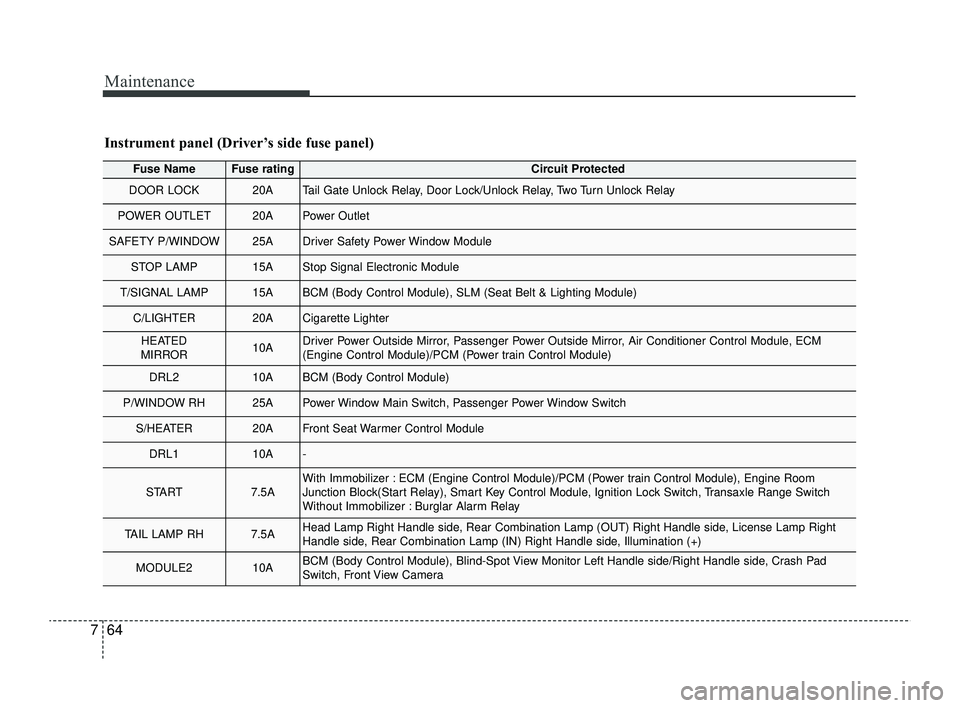
Fuse NameFuse ratingCircuit Protected
DOOR LOCK20ATail Gate Unlock Relay, Door Lock/Unlock Relay, Two Turn Unlock Relay
POWER OUTLET20APower Outlet
SAFETY P/WINDOW25ADriver Safety Power Window Module
STOP LAMP15AStop Signal Electronic Module
T/SIGNAL LAMP15ABCM (Body Control Module), SLM (Seat Belt & Lighting Module)
C/LIGHTER20ACigarette Lighter
HEATED
MIRROR10ADriver Power Outside Mirror, Passenger Power Outside Mirror, Air Conditioner Control Module, ECM
(Engine Control Module)/PCM (Power train Control Module)
DRL210ABCM (Body Control Module)
P/WINDOW RH25APower Window Main Switch, Passenger Power Window Switch
S/HEATER20AFront Seat Warmer Control Module
DRL110A-
START7.5AWith Immobilizer : ECM (Engine Control Module)/PCM (Power train Control Module), Engine Room
Junction Block(Start Relay), Smart Key Control Module, Ignition Lock Switch, Transaxle Range Switch
Without Immobilizer : Burglar Alarm Relay
TAIL LAMP RH7.5AHead Lamp Right Handle side, Rear Combination Lamp (OUT) Right Handle side, License Lamp Right
Handle side, Rear Combination Lamp (IN) Right Handle side, Illumination (+)
MODULE210ABCM (Body Control Module), Blind-Spot View Monitor Left Handle side/Right Handle side, Crash Pad
Switch, Front View Camera
Instrument panel (Driver’s side fuse panel)
SC PE USA 7.qxp 9/9/2021 6:28 PM Page 64
Page 457 of 528
Maintenance
70
7
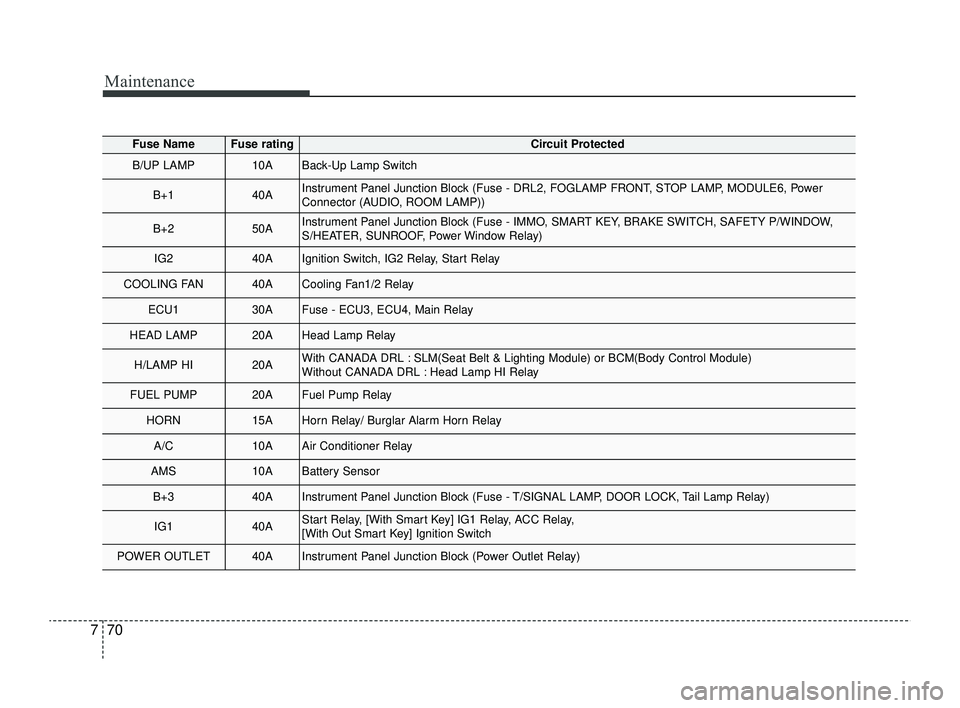
Fuse NameFuse ratingCircuit Protected
B/UP LAMP10ABack-Up Lamp Switch
B+140AInstrument Panel Junction Block (Fuse - DRL2, FOGLAMP FRONT, STOP LAMP, MODULE6, Power
Connector (AUDIO, ROOM LAMP))
B+250AInstrument Panel Junction Block (Fuse - IMMO, SMART KEY, BRAKE SWITCH, SAFETY P/WINDOW,
S/HEATER, SUNROOF, Power Window Relay)
IG240AIgnition Switch, IG2 Relay, Start Relay
COOLING FAN40ACooling Fan1/2 Relay
ECU130AFuse - ECU3, ECU4, Main Relay
HEAD LAMP20AHead Lamp Relay
H/LAMP HI20AWith CANADA DRL : SLM(Seat Belt & Lighting Module) or BCM(Body Control Module)
Without CANADA DRL : Head Lamp HI Relay
FUEL PUMP20AFuel Pump Relay
HORN15AHorn Relay/ Burglar Alarm Horn Relay
A/C10AAir Conditioner Relay
AMS10ABattery Sensor
B+340AInstrument Panel Junction Block (Fuse - T/SIGNAL LAMP, DOOR LOCK, Tail Lamp Relay)
IG140AStart Relay, [With Smart Key] IG1 Relay, ACC Relay,
[With Out Smart Key] Ignition Switch
POWER OUTLET40AInstrument Panel Junction Block (Power Outlet Relay)
SC PE USA 7.qxp 9/9/2021 6:28 PM Page 70
Page 500 of 528
7113
Maintenance
Do not operate the engine in con-fined or closed areas (such as
garages) any more than what is
necessary to move the vehicle in or
out of the area.
When the vehicle is stopped in an open area for more than a short
time with the engine running,
adjust the ventilation system (as
needed) to draw outside air into the
vehicle.
Never sit in a parked or stopped vehicle for any extended time with
the engine running.
When the engine stalls or fails to start, excessive attempts to restart
the engine may cause damage to
the emission control system.Operating precautions for catalyt-
ic converters (if equipped)
WARNING- Catalytic converter
Keep away from the catalytic
converter and exhaust system
while the vehicle is running or
immediately thereafter. The
exhaust and catalytic systems
are very hot and may burn you.
WARNING- Fire
Do not park, idle or drive the vehicle over or near flamma-
ble objects, such as grass,
vegetation, paper, leaves, etc.
A hot exhaust system can
ignite flammable items under
your vehicle.
Also, do not remove the heat shield around the exhaust
system, do not seal the bot-
tom of the vehicle and do not
coat the vehicle for corrosion
control. It may present a fire
risk under certain conditions.
SC PE USA 7.qxp 9/9/2021 6:31 PM Page 113
Page 520 of 528
Index
4I
Emission control system ..............................................7-111Crankcase emission control system ..........................7-111
Evaporative emission control (including ORVR: Onboard Refueling Vapor Recovery) system ........7-111
Exhaust emission control system ..............................7-112
Engine .................................................................\
...........8-2
Engine compartment ................................................2-7, 7-4
Engine coolant ..............................................................7-24 Changing the coolant ..................................................7-26
Checking the coolant level..........................................7-24\
Engine number ..............................................................8-10
Engine oil ......................................................................7-\
21 Changing the engine oil and filter ..............................7-22
Checking the engine oil level ....................................7-21
ENGINE START/STOP button ....................................5-10 ENGINE START/STOP button position ....................5-10
Illuminated ENGINE START/STOP button ..............5-10
Starting the engine ......................................................5-13
Explanation of scheduled maintenance items ..............7-15
Exterior overview ............................................................2-2
Forward Collision-Avoidance Assist (FCA)..................5-41 Brake operation ..........................................................5-46
Detecting sensor ..........................................................5-41
Forward Collision-Avoidance Assist malfunction ......5-48
Forward Collision-Avoidance Assist settings ............5-42 Forward Collision-Avoidance Assist warning message
and function control ..................................................5-44
Limitations of Forward Collision-Avoidance Assist ..5-50
Warning message and warning light ..........................5-47
Fuel filler door ..............................................................4-42 Closing the fuel filler door..........................................4-\
43
Opening the fuel filler door ........................................4-42
Fuel requirements ............................................................1-3 Do not use methanol ....................................................1-4
Gasoline containing alcohol and methanol ..................1-3
Fuses ........................................................................\
......7-57 Engine compartment fuse replacement ......................7-61
Fuse/relay panel description ......................................7-63
Inner panel fuse replacement ......................................7-59
Memory fuse ..............................................................7-60
Hood ........................................................................\
......4-39 Closing the hood ........................................................4-40
Hood open warning ....................................................4-40
Opening the hood ......................................................4-39
How to use this manual ..................................................1-2
F
H
SC PE USA Index.qxp 8/23/2021 5:25 PM Page 4
Page 522 of 528
Index
6I
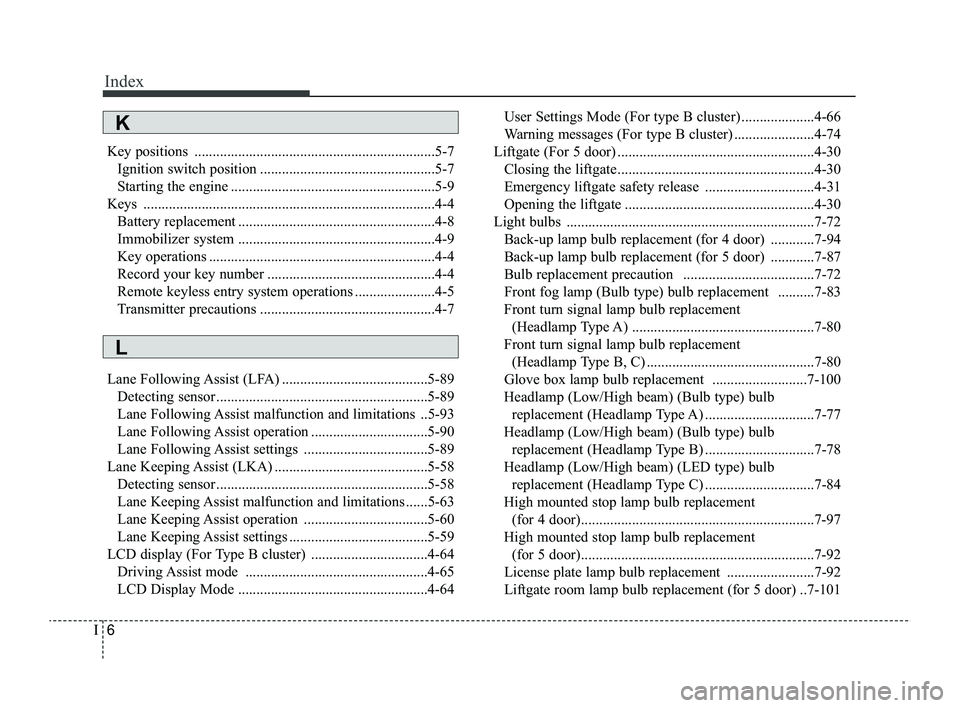
Key positions ..................................................................5-7Ignition switch position ................................................5-7
Starting the engine ........................................................5-9
Keys ........................................................................\
........4-4 Battery replacement ......................................................4-8
Immobilizer system ......................................................4-9
Key operations ..............................................................4-4
Record your key number ..............................................4-4
Remote keyless entry system operations ......................4-5
Transmitter precautions ................................................4-7
Lane Following Assist (LFA) ........................................5-89 Detecting sensor ..........................................................5-89
Lane Following Assist malfunction and limitations ..5-93
Lane Following Assist operation ................................5-90
Lane Following Assist settings ..................................5-89
Lane Keeping Assist (LKA) ..........................................5-58 Detecting sensor ..........................................................5-58
Lane Keeping Assist malfunction and limitations ......5-63
Lane Keeping Assist operation ..................................5-60
Lane Keeping Assist settings ......................................5-59
LCD display (For Type B cluster) ................................4-64 Driving Assist mode ..................................................4-65
LCD Display Mode ....................................................4-6\
4 User Settings Mode (For type B cluster) ....................4-66
Warning messages (For type B cluster) ......................4-74
Liftgate (For 5 door) ......................................................4-30 Closing the liftgate ......................................................4-30
Emergency liftgate safety release ..............................4-31
Opening the liftgate ....................................................4-30
Light bulbs ....................................................................7-72\
Back-up lamp bulb replacement (for 4 door) ............7-94
Back-up lamp bulb replacement (for 5 door) ............7-87
Bulb replacement precaution ....................................7-72
Front fog lamp (Bulb type) bulb replacement ..........7-83
Front turn signal lamp bulb replacement (Headlamp Type A) ..................................................7-80
Front turn signal lamp bulb replacement (Headlamp Type B, C) ..............................................7-80
Glove box lamp bulb replacement ..........................7-100
Headlamp (Low/High beam) (Bulb type) bulb replacement (Headlamp Type A) ..............................7-77
Headlamp (Low/High beam) (Bulb type) bulb replacement (Headlamp Type B) ..............................7-78
Headlamp (Low/High beam) (LED type) bulb replacement (Headlamp Type C) ..............................7-84
High mounted stop lamp bulb replacement (for 4 door)................................................................7-97
High mounted stop lamp bulb replacement (for 5 door)................................................................7-92
License plate lamp bulb replacement ........................7-92
Liftgate room lamp bulb replacement (for 5 door) ..7-101
L
K
SC PE USA Index.qxp 8/23/2021 5:25 PM Page 6