tow KIA RIO HATCHBACK 2007 Owner's Manual
[x] Cancel search | Manufacturer: KIA, Model Year: 2007, Model line: RIO HATCHBACK, Model: KIA RIO HATCHBACK 2007Pages: 221, PDF Size: 2.65 MB
Page 151 of 221
Driving tips65SPECIAL DRIVING CONDITIONSHazardous driving conditions When hazardous driving conditions are
encountered such as water, snow, ice,
mud, sand, or similar hazards, follow
these suggestions:
Drive cautiously and allow extra dis-tance for braking.
Avoid sudden movements in braking or steering.
When braking with non-ABS brakes pump the brake pedal with a light up-
and-down motion until the vehicle is
stopped. If stalled in snow, mud, or sand, use
second gear. Accelerate slowly to
avoid spinning the drive wheels.
Use sand, rock salt, tire chains, or other non-slip material under the drive
wheels to provide traction when stalled
in ice, snow, or mud.
Rocking the vehicle If it is necessary to rock the vehicle to
free it from snow, sand, or mud, first turn
the steering wheel right and left to clear
the area around your front wheels. Then,
shift back and forth between 1 (First) and
R (Reverse) in vehicles equipped with a
manual transaxle or R (Reverse) and any
forward gear in vehicles equipped with
an automatic transaxle. Do not race the
engine, and spin the wheels as little as
possible. If you are still stuck after a few
tries, have the vehicle pulled out by a tow
vehicle to avoid engine overheating and
possible damage to the transaxle.✽ ✽ NOTICEProlonged rocking may cause engine
over-heating, transaxle damage or fail-
ure, and tire damage.
CAUTION
- ABS
Do not pump the brake pedal on a
vehicle equipped with ABS.
WARNING
- Downshifting
Downshifting with an automatic
transaxle, while driving on slippery
surfaces can cause an accident.
The sudden change in tire speed
could cause the tires to skid. Be
careful when downshifting on slip-
pery surfaces.
WARNING
- Spinning tires
Do not spin the wheels, especially
at speeds more than 56 km/h (35
mph). Spinning the wheels at high
speeds when the vehicle is station-
ary could cause a tire to overheat,
explode and injure bystanders.
Page 154 of 221
59
Driving tips
TRAILER TOWINGWe do not recommend using this
vehicle for trailer towing.
OVERLOADING
CAUTION
- Vehicle weight
The gross axle weight rating(GAWR) and the gross vehicleweight rating (GVWR) for your vehi- cle are on the manufacturer's labelattached to the driver's door.Exceeding these ratings can causean accident or vehicle damage. Youcan calculate the weight of your load by weighing the items (andpeople) before putting them in thevehicle. Be careful not to overloadyour vehicle.
Page 157 of 221
6
Road warning / 6-2
Overheating / 6-2
Emergency starting / 6-3
Electrical circuit protection / 6-6
Towing / 6-12
If you have a flat tire / 6-17
In case of an emergency
Page 158 of 221
In case of an emergency26ROAD WARNING Hazard warning flasher The hazard warning flasher serves as a
warning to other drivers to exercise
extreme caution when approaching,
overtaking, or passing your vehicle. It
should be used whenever emergency
repairs are being made or when the vehi-
cle is stopped near the edge of a road-
way.
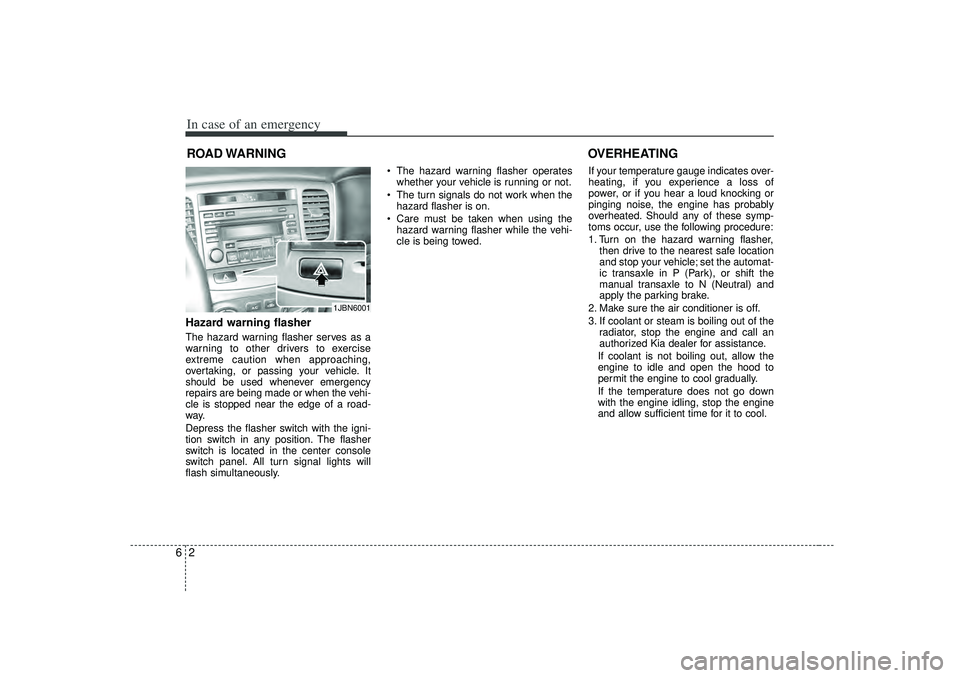
Depress the flasher switch with the igni-
tion switch in any position. The flasher
switch is located in the center console
switch panel. All turn signal lights will
flash simultaneously.• The hazard warning flasher operates
whether your vehicle is running or not.
The turn signals do not work when the hazard flasher is on.
Care must be taken when using the hazard warning flasher while the vehi-
cle is being towed. If your temperature gauge indicates over-
heating, if you experience a loss of
power, or if you hear a loud knocking or
pinging noise, the engine has probably
overheated. Should any of these symp-
toms occur, use the following procedure:
1. Turn on the hazard warning flasher,
then drive to the nearest safe location
and stop your vehicle; set the automat-
ic transaxle in P (Park), or shift the
manual transaxle to N (Neutral) and
apply the parking brake.
2. Make sure the air conditioner is off.
3. If coolant or steam is boiling out of the radiator, stop the engine and call an
authorized Kia dealer for assistance.
If coolant is not boiling out, allow the
engine to idle and open the hood to
permit the engine to cool gradually.
If the temperature does not go down
with the engine idling, stop the engine
and allow sufficient time for it to cool.
1JBN6001
OVERHEATING
Page 159 of 221
63
In case of an emergency
4. The coolant level should then bechecked. If the level in the reservoir is
low, look for leaks at the radiator hoses
and connections, heater hoses and
connections, radiator, and water
pump. If you find a major leak or anoth-
er problem that may have caused the
engine to overheat, do not operate the
engine until it has been corrected. Call
an authorized Kia dealer for assis-
tance. If you do not find a leak or other
problem, carefully add coolant to the
reservoir.If the engine frequently overheats, havethe cooling system checked and repairedby an authorized Kia dealer.
Jump starting Jump starting can be dangerous if done
incorrectly. Therefore, to avoid harm to
yourself or damage to your vehicle or
battery, follow the jump starting proce-
dures. If in doubt, we strongly recom-
mend that you have a competent techni-
cian or towing service jump start your
vehicle.✽ ✽ NOTICEUse only a 12-volt jumper system. You
can damage a 12-volt starting motor,
ignition system, and other electrical
parts beyond repair by use of a 24-volt
power supply (either two 12-volt batter-
ies in series or a 24-volt motor generator
set).
WARNING
- Removing
radiator cap
Do not remove the radiator cap
when the engine and radiator are
hot. Scalding hot coolant and steam
may blow out under pressure. This
could cause serious injury.
EMERGENCY STARTING
WARNING
- Battery
• Keep all flames or sparks away
from the battery. The battery pro-
duces hydrogen gas which may
explode if exposed to flame or
sparks.
Do not attempt to jump start the vehicle if the discharged battery
is frozen or if the electrolyte level
is low; the battery may rupture or
explode.
WARNING
- Battery
Never attempt to check the elec-
trolyte level of the battery as this
may cause the battery to rupture or
explode causing serious injury.
Page 161 of 221
65
In case of an emergency
Do not allow the jumper cables to con-
tact anything except the correct bat-
tery terminals or the correct ground.
Do not lean over the battery when
making connections.
6. Start the engine of the vehicle with the booster battery and let it run at 2,000
rpm, then start the engine of the vehi-
cle with the discharged battery.If the cause of your battery discharging isnot apparent, you should have your vehi- cle checked by an authorized Kia dealer.
Push-starting Your manual transaxle-equipped vehicle
should not be push-started because it
might damage the emission control sys-
tem.
Vehicles equipped with automatic
transaxle cannot be push-started.
Follow the directions in this section for
jump-starting.
CAUTION
Never tow a vehicle to start itbecause the sudden surge forwardwhen the engine starts could causea collision with the tow vehicle.
CAUTION -
Battery cables
Do not connect the jumper cable from the negative terminal of thebooster battery to the negative ter-minal of the discharged battery. This can cause the discharged bat-tery to overheat and crack, releas-ing battery acid.
Page 168 of 221
In case of an emergency12
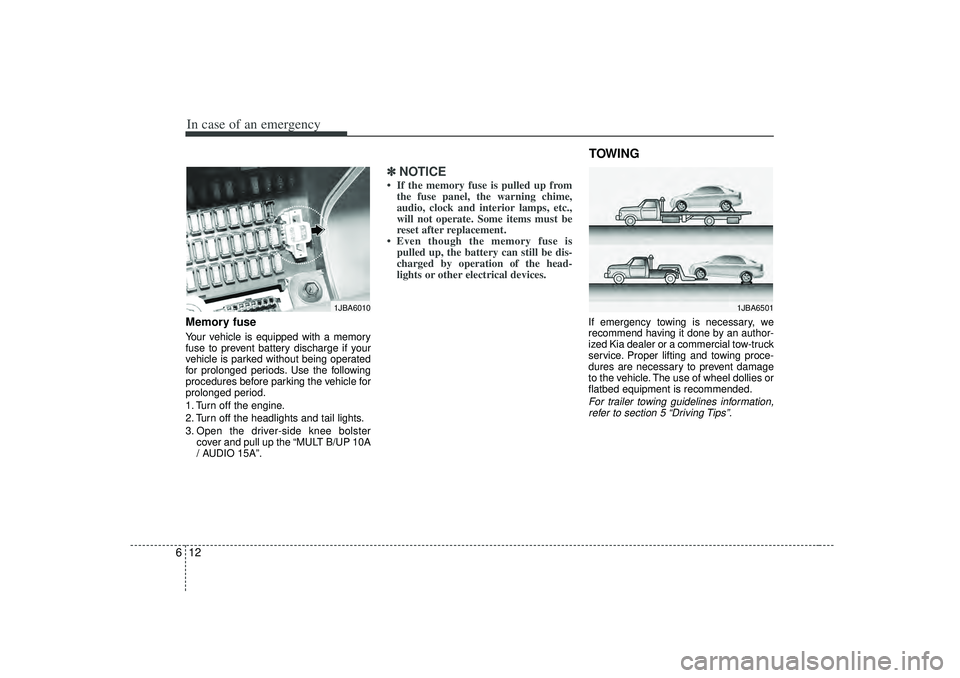
6Memory fuseYour vehicle is equipped with a memory
fuse to prevent battery discharge if your
vehicle is parked without being operated
for prolonged periods. Use the following
procedures before parking the vehicle for
prolonged period.
1. Turn off the engine.
2. Turn off the headlights and tail lights.
3. Open the driver-side knee bolster
cover and pull up the “MULT B/UP 10A
/ AUDIO 15A”.
✽ ✽NOTICE• If the memory fuse is pulled up from
the fuse panel, the warning chime,
audio, clock and interior lamps, etc.,
will not operate. Some items must be
reset after replacement.
• Even though the memory fuse is pulled up, the battery can still be dis-
charged by operation of the head-
lights or other electrical devices.
If emergency towing is necessary, we
recommend having it done by an author-
ized Kia dealer or a commercial tow-truck
service. Proper lifting and towing proce-
dures are necessary to prevent damage
to the vehicle. The use of wheel dollies or
flatbed equipment is recommended.For trailer towing guidelines information,
refer to section 5 “Driving Tips”.
1JBA6010
TOWING
1JBA6501
Page 169 of 221
613
In case of an emergency
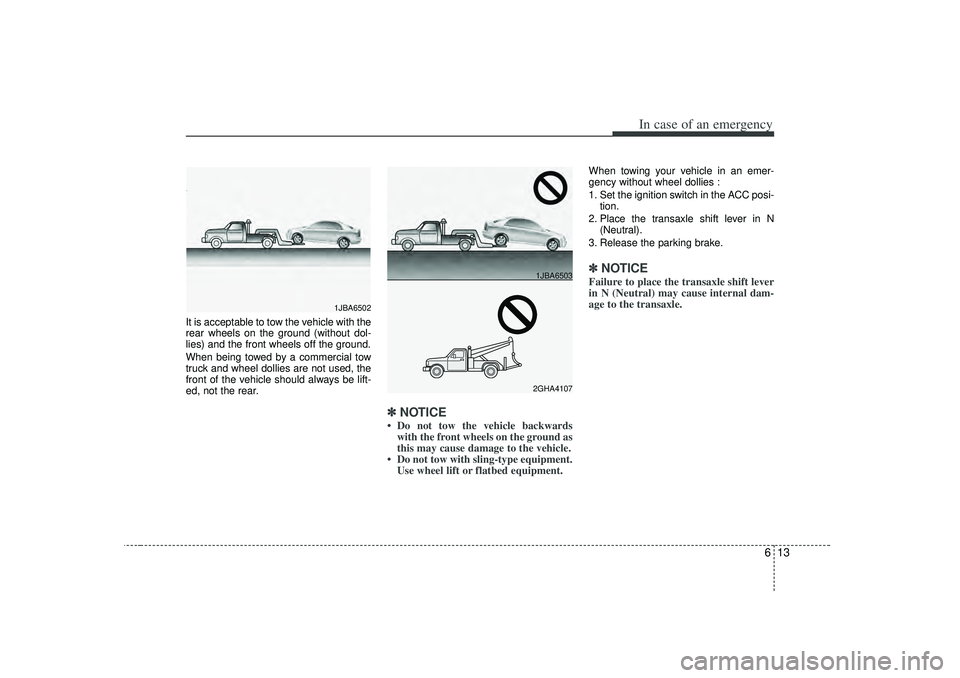
It is acceptable to tow the vehicle with the
rear wheels on the ground (without dol-
lies) and the front wheels off the ground.
When being towed by a commercial tow
truck and wheel dollies are not used, the
front of the vehicle should always be lift-
ed, not the rear.
✽ ✽NOTICE• Do not tow the vehicle backwards
with the front wheels on the ground as
this may cause damage to the vehicle.
• Do not tow with sling-type equipment. Use wheel lift or flatbed equipment.
When towing your vehicle in an emer-
gency without wheel dollies :
1. Set the ignition switch in the ACC posi-
tion.
2. Place the transaxle shift lever in N (Neutral).
3. Release the parking brake.✽ ✽ NOTICEFailure to place the transaxle shift lever
in N (Neutral) may cause internal dam-
age to the transaxle.
2GHA41071JBA6503
1JBA6502
Page 170 of 221
In case of an emergency14
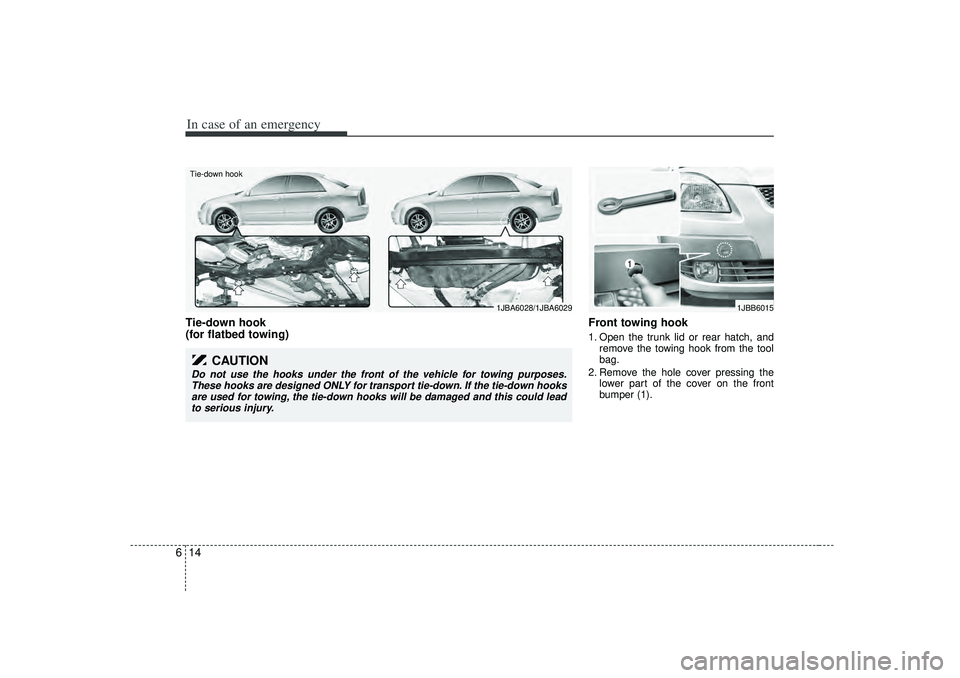
6Tie-down hook
(for flatbed towing) Front towing hook
1. Open the trunk lid or rear hatch, and
remove the towing hook from the tool
bag.
2. Remove the hole cover pressing the lower part of the cover on the front
bumper (1).
Tie-down hook
1JBA6028/1JBA6029
CAUTION
Do not use the hooks under the front of the vehicle for towing purposes.These hooks are designed ONLY for transport tie-down. If the tie-down hooks are used for towing, the tie-down hooks will be damaged and this could leadto serious injury.
1JBB6015
1
Page 171 of 221
615
In case of an emergency
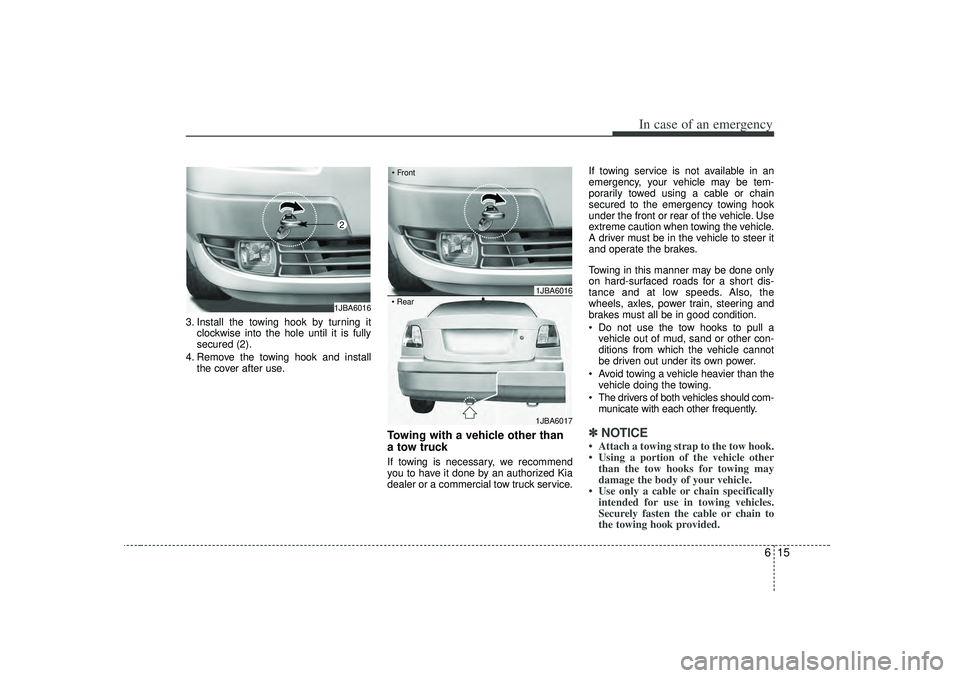
3. Install the towing hook by turning itclockwise into the hole until it is fully
secured (2).
4. Remove the towing hook and install the cover after use.
Towing with a vehicle other than
a tow truck If towing is necessary, we recommend
you to have it done by an authorized Kia
dealer or a commercial tow truck service. If towing service is not available in an
emergency, your vehicle may be tem-
porarily towed using a cable or chain
secured to the emergency towing hook
under the front or rear of the vehicle. Use
extreme caution when towing the vehicle.
A driver must be in the vehicle to steer it
and operate the brakes.
Towing in this manner may be done only
on hard-surfaced roads for a short dis-
tance and at low speeds. Also, the
wheels, axles, power train, steering and
brakes must all be in good condition.
Do not use the tow hooks to pull a
vehicle out of mud, sand or other con-
ditions from which the vehicle cannot
be driven out under its own power.
Avoid towing a vehicle heavier than the vehicle doing the towing.
The drivers of both vehicles should com- municate with each other frequently.
✽ ✽ NOTICE• Attach a towing strap to the tow hook.
• Using a portion of the vehicle other
than the tow hooks for towing may
damage the body of your vehicle.
• Use only a cable or chain specifically intended for use in towing vehicles.
Securely fasten the cable or chain to
the towing hook provided.
1JBA60162
1JBA6016
Front1JBA6017
Rear