tow KIA RIO HATCHBACK 2007 Owner's Guide
[x] Cancel search | Manufacturer: KIA, Model Year: 2007, Model line: RIO HATCHBACK, Model: KIA RIO HATCHBACK 2007Pages: 221, PDF Size: 2.65 MB
Page 172 of 221
In case of an emergency16
6 Before emergency towing, check that
the hook is not broken or damaged.
Fasten the towing cable or chain securely to the hook.
Do not jerk the hook. Apply steady and even force.
To avoid damaging the hook, do not pull from the side or at a vertical angle.
Always pull straight ahead.
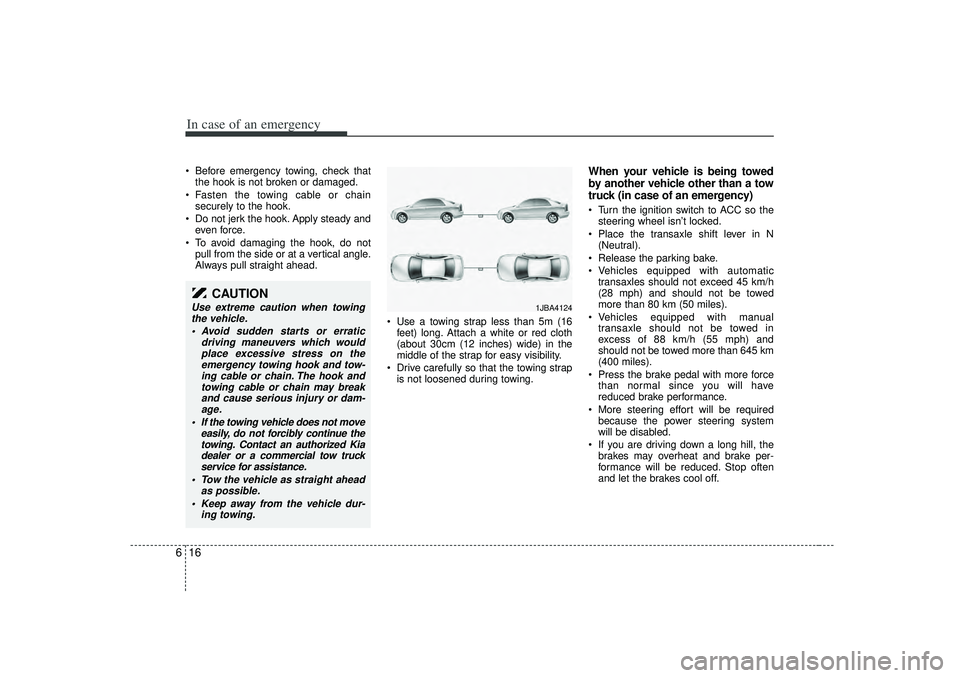
Use a towing strap less than 5m (16feet) long. Attach a white or red cloth
(about 30cm (12 inches) wide) in the
middle of the strap for easy visibility.
Drive carefully so that the towing strap is not loosened during towing.
When your vehicle is being towed
by another vehicle other than a tow
truck (in case of an emergency) Turn the ignition switch to ACC so thesteering wheel isn’t locked.
Place the transaxle shift lever in N (Neutral).
Release the parking bake.
Vehicles equipped with automatic transaxles should not exceed 45 km/h
(28 mph) and should not be towed
more than 80 km (50 miles).
Vehicles equipped with manual transaxle should not be towed in
excess of 88 km/h (55 mph) and
should not be towed more than 645 km
(400 miles).
Press the brake pedal with more force than normal since you will have
reduced brake performance.
More steering effort will be required because the power steering system
will be disabled.
If you are driving down a long hill, the brakes may overheat and brake per-
formance will be reduced. Stop often
and let the brakes cool off.
CAUTION
Use extreme caution when towingthe vehicle.
Avoid sudden starts or erratic driving maneuvers which wouldplace excessive stress on theemergency towing hook and tow- ing cable or chain. The hook andtowing cable or chain may breakand cause serious injury or dam- age.
If the towing vehicle does not move easily, do not forcibly continue thetowing. Contact an authorized Kiadealer or a commercial tow truckservice for assistance.
Tow the vehicle as straight ahead as possible.
Keep away from the vehicle dur- ing towing.
1JBA4124
Page 173 of 221
617
In case of an emergency
✽
✽NOTICETo prevent internal damage to the
transaxle, never tow your vehicle from
the rear (backwards) with all four tires
in contact with the surface. Tips for towing a stuck vehicleThe following methods are effective
when your vehicle is stuck in mud, sand
or similar substances that prevent the
vehicle from being driven out under its
own power.
Remove the soil and sand, etc. from
the front and the back of the tires.
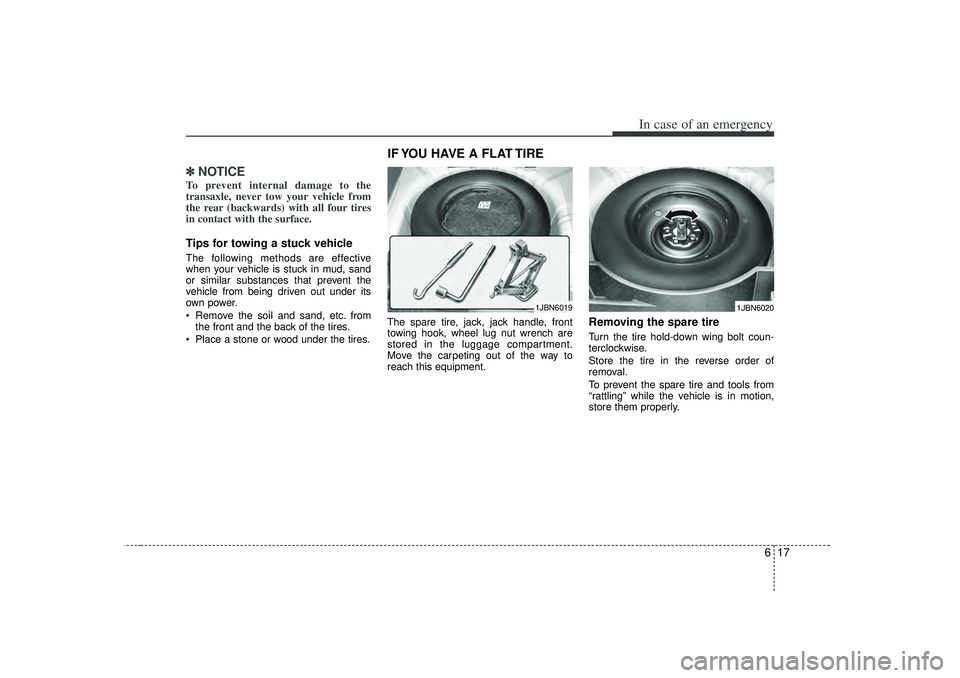
Place a stone or wood under the tires. The spare tire, jack, jack handle, front
towing hook, wheel lug nut wrench are
stored in the luggage compartment.
Move the carpeting out of the way to
reach this equipment.
Removing the spare tire Turn the tire hold-down wing bolt coun-
terclockwise.
Store the tire in the reverse order of
removal.
To prevent the spare tire and tools from
“rattling” while the vehicle is in motion,
store them properly.
IF YOU HAVE A FLAT TIRE
1JBN6019
1JBN6020
Page 175 of 221
619
In case of an emergency
Changing tires Jacking instructions The jack is provided for emergency tire
changing only.
Follow jacking instructions to reduce the
possibility of personal injury.
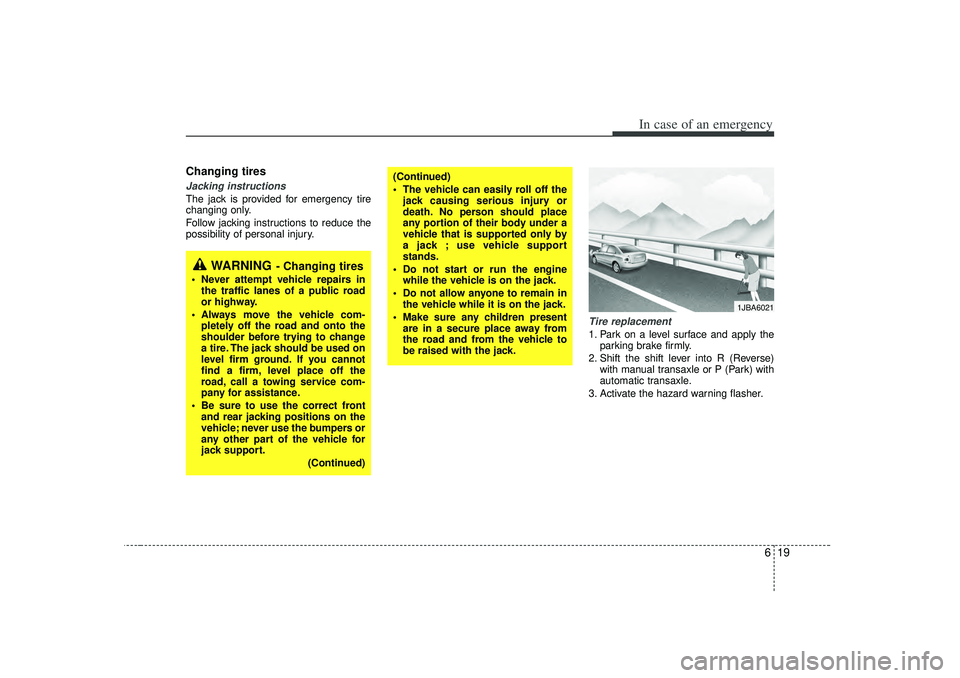
Tire replacement 1. Park on a level surface and apply theparking brake firmly.
2. Shift the shift lever into R (Reverse) with manual transaxle or P (Park) with
automatic transaxle.
3. Activate the hazard warning flasher.
WARNING
- Changing tires
Never attempt vehicle repairs in the traffic lanes of a public road
or highway.
Always move the vehicle com- pletely off the road and onto the
shoulder before trying to change
a tire. The jack should be used on
level firm ground. If you cannot
find a firm, level place off the
road, call a towing service com-
pany for assistance.
Be sure to use the correct front and rear jacking positions on the
vehicle; never use the bumpers or
any other part of the vehicle for
jack support.
(Continued)
(Continued)
The vehicle can easily roll off thejack causing serious injury or
death. No person should place
any portion of their body under a
vehicle that is supported only by
a jack ; use vehicle support
stands.
Do not start or run the engine while the vehicle is on the jack.
Do not allow anyone to remain in the vehicle while it is on the jack.
Make sure any children present are in a secure place away from
the road and from the vehicle to
be raised with the jack.
1JBA6021
Page 189 of 221
711
Maintenance
ENGINE COOLING SYSTEM The high-pressure cooling system has a
reservoir filled with year-round antifreeze
coolant. The reservoir is filled at the fac-
tory.
Check the antifreeze protection and
coolant level at least once a year, at the
beginning of the winter season, and
before traveling to a colder climate.Checking the coolant level
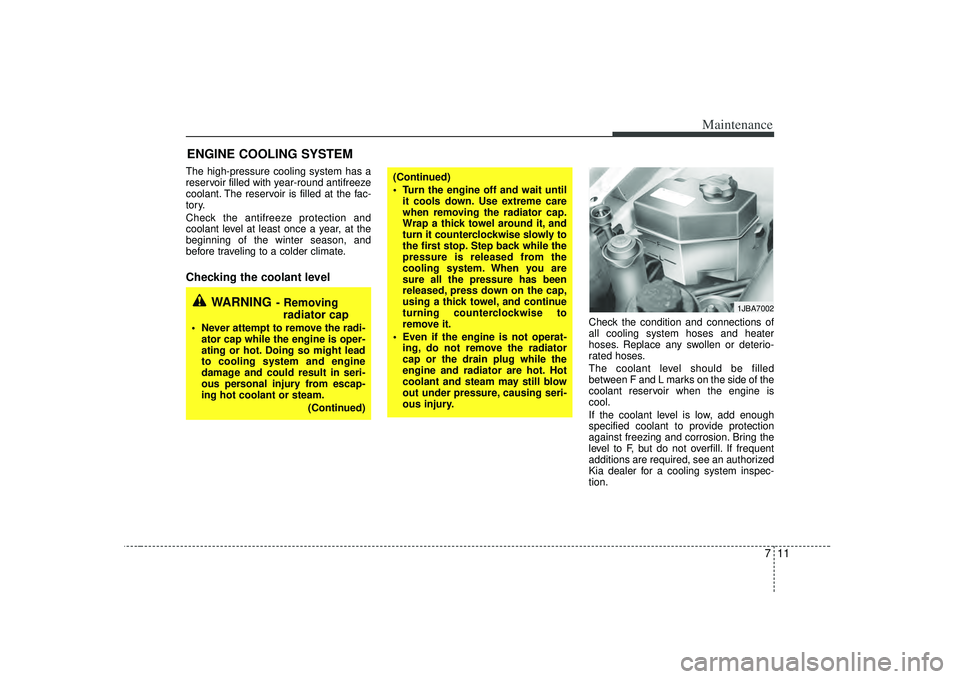
Check the condition and connections of
all cooling system hoses and heater
hoses. Replace any swollen or deterio-
rated hoses.
The coolant level should be filled
between F and L marks on the side of the
coolant reservoir when the engine is
cool.
If the coolant level is low, add enough
specified coolant to provide protection
against freezing and corrosion. Bring the
level to F, but do not overfill. If frequent
additions are required, see an authorized
Kia dealer for a cooling system inspec-
tion.
WARNING
- Removingradiator cap
Never attempt to remove the radi-
ator cap while the engine is oper-
ating or hot. Doing so might lead
to cooling system and engine
damage and could result in seri-
ous personal injury from escap-
ing hot coolant or steam.
(Continued)
(Continued)
Turn the engine off and wait untilit cools down. Use extreme care
when removing the radiator cap.
Wrap a thick towel around it, and
turn it counterclockwise slowly to
the first stop. Step back while the
pressure is released from the
cooling system. When you are
sure all the pressure has been
released, press down on the cap,
using a thick towel, and continue
turning counterclockwise to
remove it.
Even if the engine is not operat- ing, do not remove the radiator
cap or the drain plug while the
engine and radiator are hot. Hot
coolant and steam may still blow
out under pressure, causing seri-
ous injury.
1JBA7002
Page 221 of 221

93
Index
Keys ··················\
··················\
··················\
··················\
·········3-2
Label information ··················\
··················\
··················\
····5-10
Lighting··················\
··················\
··················\
··················\
··4-23
Lubricant specifications ··················\
··················\
·············7-32
Lubricants and fluids ··················\
··················\
·················7-16\
Luggage net ··················\
··················\
··················\
·············3-79
Maintenance schedule··················\
··················\
··················\
7-3
Maintenance services ··················\
··················\
··················\
·7-2
Manual transaxle··················\
··················\
··················\
········4-4
Mirrors ··················\
··················\
··················\
··················\
···3-68
Overheating··················\
··················\
··················\
················6-2
Overloading ··················\
··················\
··················\
···············5-9
Owner maintenance ··················\
··················\
··················\
···7-7
Power steering ··················\
··················\
··················\
·········7-14
Remote keyless entry ··················\
··················\
··················\
·3-3
Road warning ··················\
··················\
··················\
·············6-2Safety belts··················\
··················\
··················\
···············3-27
Seat··················\
··················\
··················\
··················\
·········3-17
Special driving conditions ··················\
··················\
···········5-6
Specifications ··················\
··················\
··················\
·············8-2
Starting the engine ··················\
··················\
··················\
·····4-3
Steering wheel···············\
··················\
··················\
·············4-14
Storage compartment ··················\
··················\
·················3-72\
Suggestions for economical operation··················\
···········5-5
Sunroof··················\
··················\
··················\
··················\
···3-77
Theft-alarm system ··················\
··················\
··················\
····3-5
Tires and wheels ··················\
··················\
··················\
······7-23
Towing ··················\
··················\
··················\
··················\
···6-12
Trailer towing ··················\
··················\
··················\
············5-9
Trunk ··················\
··················\
··················\
··················\
······3-62
Vehicle break-in process ··················\
··················\
··············1-2
Warnings and indicators ··················\
··················\
············4-19
Windows ··················\
··················\
··················\
··················\
3-14
Windshield defrosting and defogging··················\
··········4-37
Wiper blades ··················\
··················\
··················\
············7-19
Wipers and washers ··················\
··················\
··················\
·4-26KLMOPR
SWTV