warning KIA RIO HATCHBACK 2008 Owner's Guide
[x] Cancel search | Manufacturer: KIA, Model Year: 2008, Model line: RIO HATCHBACK, Model: KIA RIO HATCHBACK 2008Pages: 219, PDF Size: 5.17 MB
Page 55 of 219
Knowing your vehicle
46 3
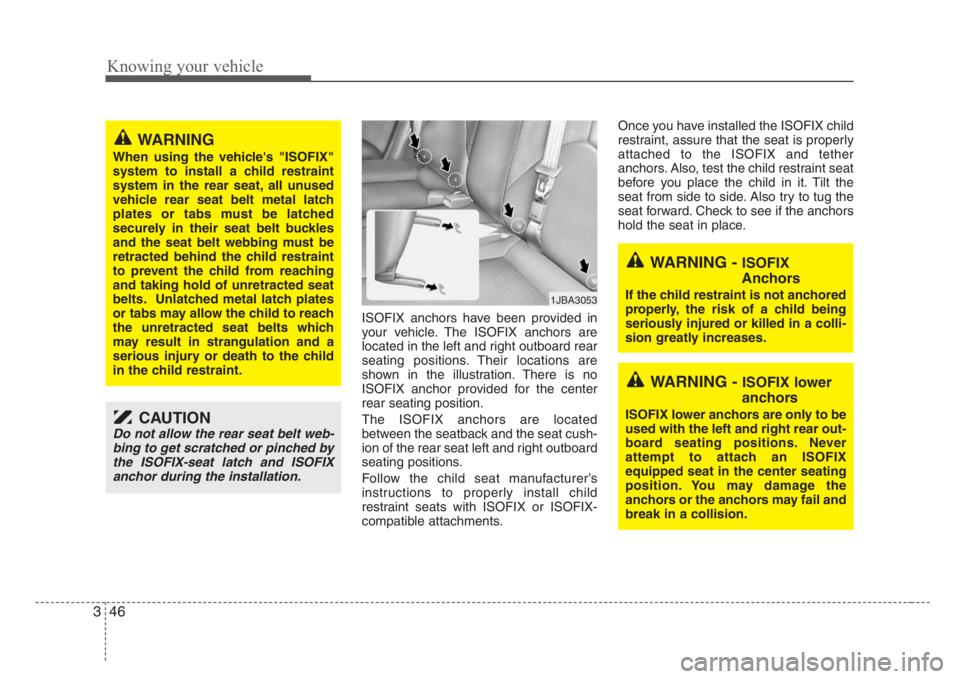
ISOFIX anchors have been provided in
your vehicle. The ISOFIX anchors are
located in the left and right outboard rear
seating positions. Their locations are
shown in the illustration. There is no
ISOFIX anchor provided for the center
rear seating position.
The ISOFIX anchors are located
between the seatback and the seat cush-
ion of the rear seat left and right outboard
seating positions.
Follow the child seat manufacturer’s
instructions to properly install child
restraint seats with ISOFIX or ISOFIX-
compatible attachments.Once you have installed the ISOFIX child
restraint, assure that the seat is properly
attached to the ISOFIX and tether
anchors. Also, test the child restraint seat
before you place the child in it. Tilt the
seat from side to side. Also try to tug the
seat forward. Check to see if the anchors
hold the seat in place.
WARNING - ISOFIX
Anchors
If the child restraint is not anchored
properly, the risk of a child being
seriously injured or killed in a colli-
sion greatly increases.
WARNING - ISOFIX lower
anchors
ISOFIX lower anchors are only to be
used with the left and right rear out-
board seating positions. Never
attempt to attach an ISOFIX
equipped seat in the center seating
position. You may damage the
anchors or the anchors may fail and
break in a collision.
WARNING
When using the vehicle's "ISOFIX"
system to install a child restraint
system in the rear seat, all unused
vehicle rear seat belt metal latch
plates or tabs must be latched
securely in their seat belt buckles
and the seat belt webbing must be
retracted behind the child restraint
to prevent the child from reaching
and taking hold of unretracted seat
belts. Unlatched metal latch plates
or tabs may allow the child to reach
the unretracted seat belts which
may result in strangulation and a
serious injury or death to the child
in the child restraint.
1JBA3053
CAUTION
Do not allow the rear seat belt web-
bing to get scratched or pinched by
the ISOFIX-seat latch and ISOFIX
anchor during the installation.
Page 57 of 219
Knowing your vehicle
48 3
What your air bag system does
Driver’s air bag and front passenger’s air
bag are designed to supplement the pro-
tection offered by the safety belt in cer-
tain frontal collisions. Likewise, side air
bag and curtain air bags are designed to
supplement the protection offered by the
safety belt in side collisions. Safety belts
are designed to reduce the injury of the
driver or passengers in case of light
impact or collision. No safety belt or air
bag system can completely eliminate
injuries that may cause in collisions or
impacts. To help reduce impact on driver
or passengers in any collision, safety
belts must be correctly worn.
What your air bag system does
not do
The air bag system is designed to sup-
plement the protection offered by the
safety belt system. IT IS NOT A SUBSTI-
TUTE FOR THE SAFETY BELT.
The importance of using
safety belts
There are four very important reasons to
use safety belts even with an air bag sup-
plemental restraint system. They:
• help keep you in the proper position
(away from the air bag) when it inflates.
• reduce the risk of harm in rollover, side
impact (vehicles not equipped with
side and curtain air bags) or rear
impact collisions, because an air bag is
not designed to inflate in such situa-
tions and even a side curtain air bag is
designed to inflate only in certain side
impact collisions.
• reduce the risk of harm in frontal or
side collisions which are not severe
enough to actuate the air bag supple-
mental restraint system.
• reduce the risk of being ejected from
your vehicle.Your vehicle’s Supplemental Restraint
System Control Module is equipped
with a recording device that may
record the use or status of the safety
belt restraint system by the driver and
front passenger in certain collisions.
WARNING- Air bags &
safety belts
• Even in vehicles with air bags,
you and your passengers must
always wear the safety belts pro-
vided in order to minimize the risk
and severity of injury in the event
of a collision or rollover.
•Always wear your safety belt. It
can help keep you away from the
air bags during heavy braking
just before a collision. It may also
reduce the risk of occupant ejec-
tion.
• If occupants are not wearing safe-
ty belts or correctly seated, they
cannot be fully protected, and
thus face a greater risk of serious
injury or death.
(Continued)
Page 58 of 219
349
Knowing your vehicle
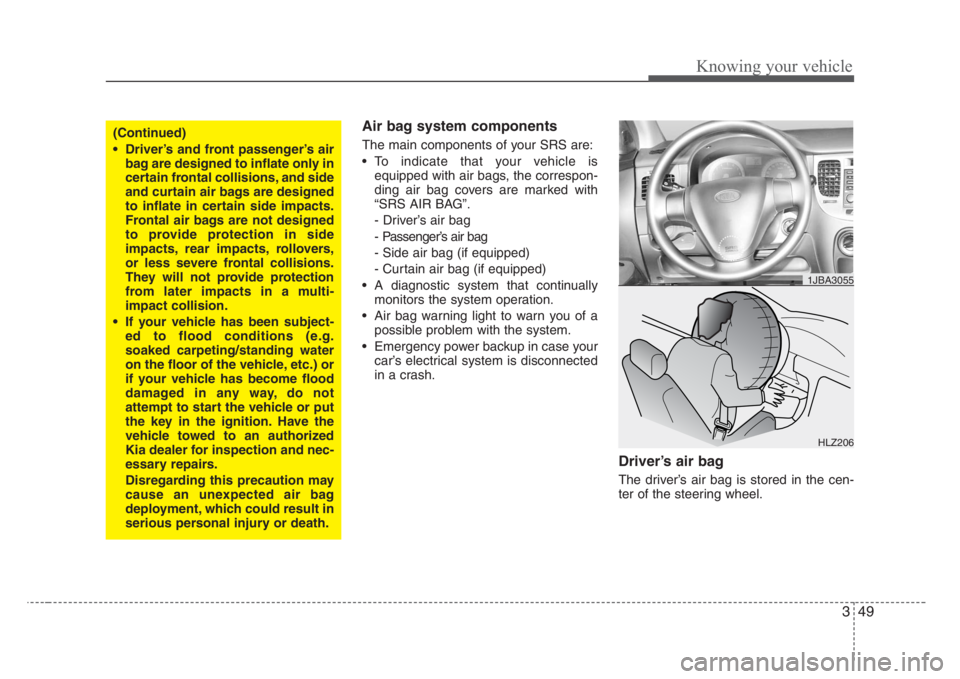
Air bag system components
The main components of your SRS are:
• To indicate that your vehicle is
equipped with air bags, the correspon-
ding air bag covers are marked with
“SRS AIR BAG”.
- Driver’s air bag
- Passenger’s air bag
- Side air bag (if equipped)
- Curtain air bag (if equipped)
• A diagnostic system that continually
monitors the system operation.
• Air bag warning light to warn you of a
possible problem with the system.
• Emergency power backup in case your
car’s electrical system is disconnected
in a crash.
Driver’s air bag
The driver’s air bag is stored in the cen-
ter of the steering wheel.
(Continued)
• Driver’s and front passenger’s air
bag are designed to inflate only in
certain frontal collisions, and side
and curtain air bags are designed
to inflate in certain side impacts.
Frontal air bags are not designed
to provide protection in side
impacts, rear impacts, rollovers,
or less severe frontal collisions.
They will not provide protection
from later impacts in a multi-
impact collision.
• If your vehicle has been subject-
ed to flood conditions (e.g.
soaked carpeting/standing water
on the floor of the vehicle, etc.) or
if your vehicle has become flood
damaged in any way, do not
attempt to start the vehicle or put
the key in the ignition. Have the
vehicle towed to an authorized
Kia dealer for inspection and nec-
essary repairs.
Disregarding this precaution may
cause an unexpected air bag
deployment, which could result in
serious personal injury or death.
HLZ206
1JBA3055
Page 59 of 219
Knowing your vehicle
50 3
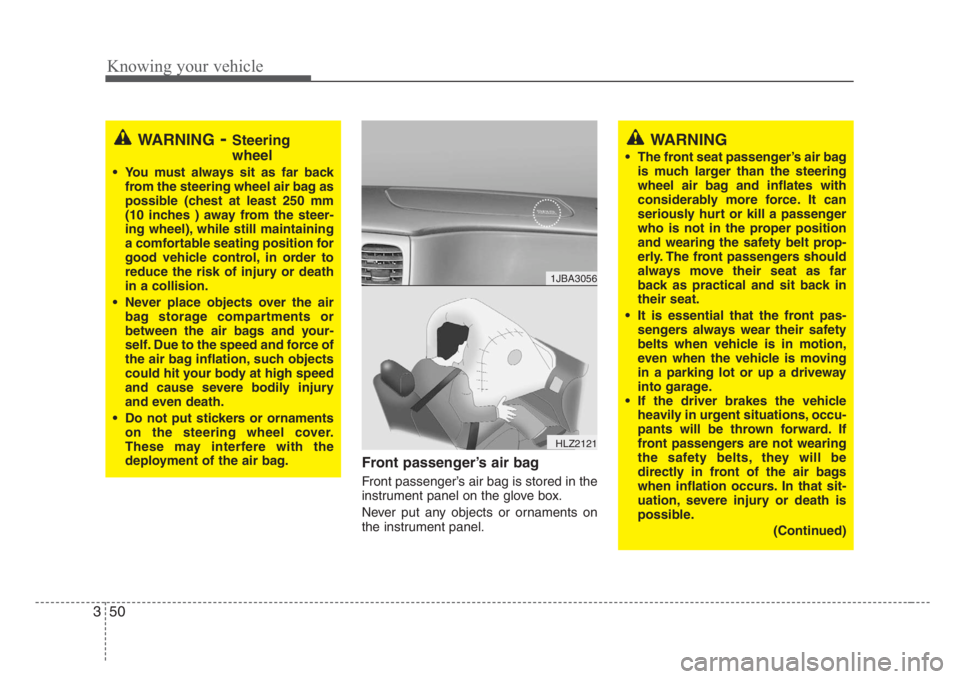
Front passenger’s air bag
Front passenger’s air bag is stored in the
instrument panel on the glove box.
Never put any objects or ornaments on
the instrument panel.
1JBA3056
HLZ2121
WARNING-Steering
wheel
• You must always sit as far back
from the steering wheel air bag as
possible (chest at least 250 mm
(10 inches ) away from the steer-
ing wheel), while still maintaining
a comfortable seating position for
good vehicle control, in order to
reduce the risk of injury or death
in a collision.
• Never place objects over the air
bag storage compartments or
between the air bags and your-
self. Due to the speed and force of
the air bag inflation,such objects
could hit your body at high speed
and cause severe bodily injury
and even death.
• Do not put stickers or ornaments
on the steering wheel cover.
These may interfere with the
deployment of the air bag.
WARNING
• The front seat passenger’s air bag
is much larger than the steering
wheel air bag and inflates with
considerably more force. It can
seriously hurt or kill a passenger
who is not in the proper position
and wearing the safety belt prop-
erly. The front passengers should
always move their seat as far
back as practical and sit back in
their seat.
• It is essential that the front pas-
sengers always wear their safety
belts when vehicle is in motion,
even when the vehicle is moving
in a parking lot or up a driveway
into garage.
• If the driver brakes the vehicle
heavily in urgent situations, occu-
pants will be thrown forward. If
front passengers are not wearing
the safety belts, they will be
directly in front of the air bags
when inflation occurs. In that sit-
uation,severe injury or death is
possible.
(Continued)
Page 60 of 219
351
Knowing your vehicle
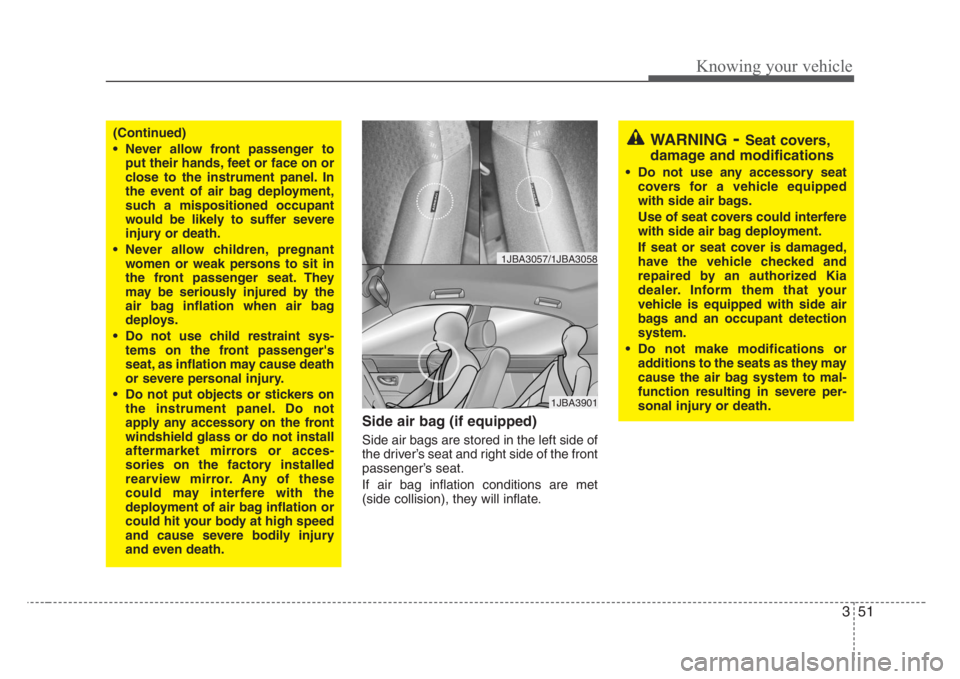
Side air bag (if equipped)
Side air bags are stored in the left side of
the driver’s seat and right side of the front
passenger’s seat.
If air bag inflation conditions are met
(side collision), they will inflate.
(Continued)
• Never allow front passenger to
put their hands, feet or face on or
close to the instrument panel. In
the event of air bag deployment,
such a mispositioned occupant
would be likely to suffer severe
injury or death.
• Never allow children, pregnant
women or weak persons to sit in
the front passenger seat. They
may be seriously injured by the
air bag inflation when air bag
deploys.
• Do not use child restraint sys-
tems on the front passenger's
seat, as inflation may cause death
or severe personal injury.
• Do not put objects or stickers on
the instrument panel. Do not
apply any accessory on the front
windshield glass or do not install
aftermarket mirrors or acces-
sories on the factory ins
talled
rearview mirror. Any of these
could may interfere with the
deployment of air bag inflation or
could hit your body at high speed
and cause severe bodily injury
and even death.
1JBA3901
1JBA3057/1JBA3058
WARNING-Seat covers,
damage and modifications
• Do not use any accessory seat
covers for a vehicle equipped
with side air bags.
Use of seat covers could interfere
with side air bag deployment.
If seat or seat cover is damaged,
have the vehicle checked and
repaired by an authorized Kia
dealer. Inform them that your
vehicle is equipped with side air
bags and an occupant detection
system.
• Do not make modifications or
additions to the seats as they may
cause the air bag system to mal-
function resulting in severe per-
sonal injury or death.
Page 61 of 219
Knowing your vehicle
52 3
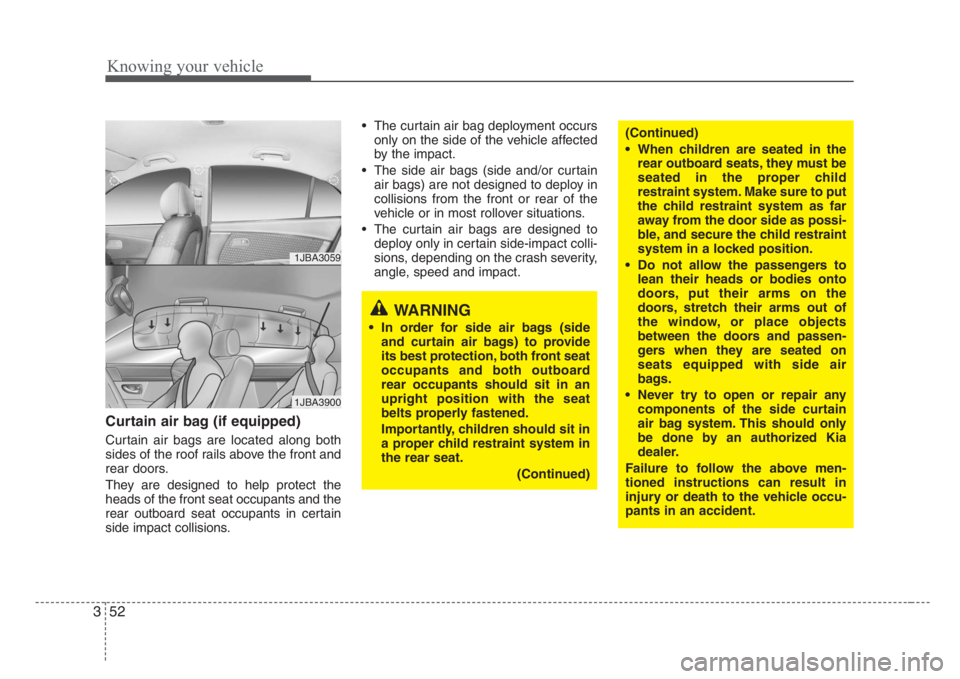
Curtain air bag (if equipped)
Curtain air bags are located along both
sides of the roof rails above the front and
rear doors.
They are designed to help protect the
heads of the front seat occupants and the
rear outboard seat occupants in certain
side impact collisions.• The curtain air bag deployment occurs
only on the side of the vehicle affected
by the impact.
• The side air bags (side and/or curtain
air bags) are not designed to deploy in
collisions from the front or rear of the
vehicle or in most rollover situations.
• The curtain air bags are designed to
deploy only in certain side-impact colli-
sions, depending on the crash severity,
angle, speed and impact.
1JBA3059
1JBA3900
WARNING
• In order for side air bags (side
and curtain air bags) to provide
its best protection, both front seat
occupants and both outboard
rear occupants should sit in an
upright position with the seat
belts properly fastened.
Importantly, children should sit in
a proper child restraint system in
the rear seat.
(Continued)
(Continued)
• When children are seated in the
rear outboard seats, they must be
seated in the proper child
restraint system. Make sure to put
the child restraint system as far
away from the door side as possi-
ble, and secure the child restraint
system in a locked position.
• Do not allow the passengers to
lean their heads or bodies onto
doors, put their arms on the
doors,stretch their arms out of
the window, or place objects
between the doors and passen-
gers when they are seated on
seats equipped with side air
bags.
• Never try to open or repair any
components of the side curtain
air bag sys
tem. This should only
be done by an authorized Kia
dealer.
Failure to follow the above men-
tioned instructions can result in
injury or death to the vehicle occu-
pants in an accident.
Page 63 of 219
Knowing your vehicle
54 3
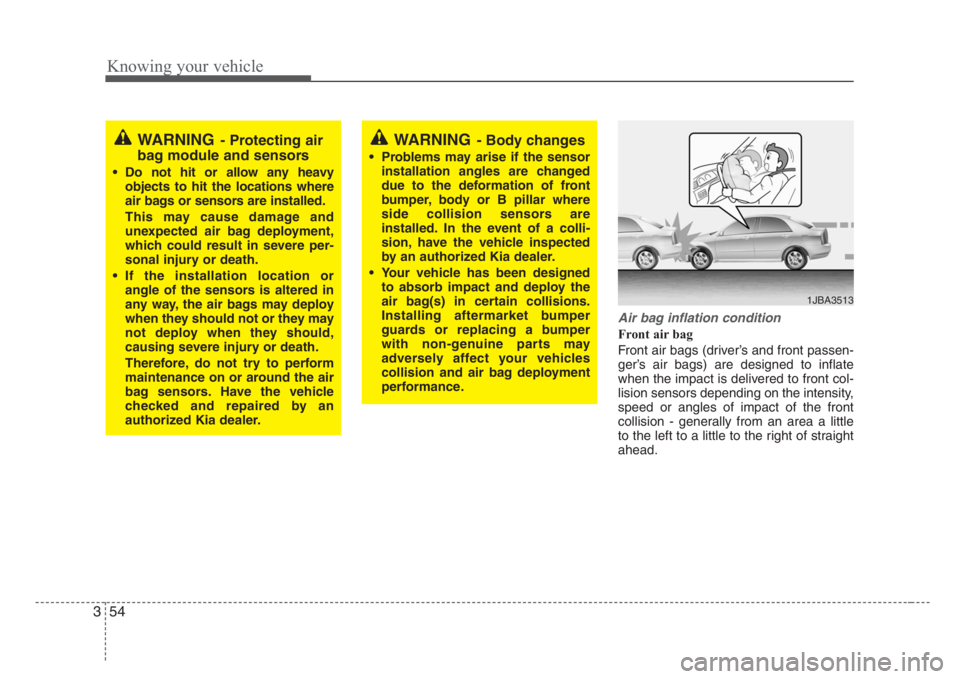
Air bag inflation condition
Front air bag
Front air bags (driver’s and front passen-
ger’s air bags) are designed to inflate
when the impact is delivered to front col-
lision sensors depending on the intensity,
speed or angles of impact of the front
collision - generally from an area a little
to the left to a little to the right of straight
ahead.
1JBA3513
WARNING- Protecting air
bag module and sensors
• Do not hit or allow any heavy
objects to hit the locations where
air bags or sensors are installed.
This may cause damage and
unexpected air bag deployment,
which could result in severe per-
sonal injury or death.
• If the installation location or
angle of the sensors is altered in
any way, the air bags may deploy
when they should not or they may
not deploy when they should,
causing severe injury or death.
Therefore, do not try to perform
maintenance on or around the air
bag sensors. Have the vehicle
checked and repaired by an
authorized Kia dealer.
WARNING- Body changes
• Problems may arise if the sensor
installation angles are changed
due to the deformation of front
bumper, body or B pillar where
side collision sensors are
installed. In the event of a colli-
sion, have the vehicle inspected
by an authorized Kia dealer.
• Your vehicle has been designed
to absorb impact and deploy the
air bag(s) in certain collisions.
Installing aftermarket bumper
guards or replacing a bumper
with non-genuine parts may
adversely affect your vehicles
collision and air bag deployment
performance.
Page 67 of 219
Knowing your vehicle
58 3
Air bag system operation
• Air bags only operate when the ignition
switch is turned to the ON or START
positions.
• Air bags inflate instantly in the event of
serious frontal or side collision (if
equipped with side air bag or curtain
air bag) in order to help protect the
occupants from serious physical injury.
• There is no single vehicle speed at
which the air bags will inflate.
• Air bag deployment depends on a
number of factors including vehicle
speed, angles of impact and the densi-
ty and stiffness of the vehicles or
objects which your vehicle hits in the
collision. However, factors are not limit-
ed to those mentioned above.
• The front air bags will completely
inflate and deflate in an instant.
It is virtually impossible for you to see
the air bags inflate during an accident.
It is much more likely that you will sim-
ply see the deflated air bags hanging
out of their storage compartments after
the collision.• In order to help provide protection in a
severe collision, the air bags must
inflate rapidly. The speed of air bag
inflation is a consequence of the
extremely short time in which a collision
occurs and the need to get the air bag
between the occupant and the vehicle
structures before the occupant impacts
those structures. This speed of inflation
reduces the risk of serious or life-
threatening injuries in a severe collision
and is thus a necessary part of air bag
design.
However, air bag inflation can also
cause injuries which normally can
include facial abrasions, bruises and
broken bones, and sometimes more
serious injuries because the inflation
speed also causes the air bags to
expand with a great deal of force.
• There are even circumstances
under which contact with the steer-
ing wheel air bag can cause fatal
injuries,especially if the occupant
is positioned excessively close to
the steering wheel.WARNING - Seated
positioning
• To avoid severe personal injury or
death caused by deploying air
bags in a collision, the driver
should sit as far back from the
steering wheel air bag as possible
(at least 250 mm (10 inches) away).
The front passenger should
always move their seat as far back
as possible and sit back in their
seat.
• Air bag inflates instantly in an
event of collision, passengers
may be injured by the air bag
expansion force if they are not in
proper position.
• Air bag inflation may cause
injuries which normally include
facial or bodily abrasions, injuries
by the broken glasses or burns by
the explosives.
Page 68 of 219
359
Knowing your vehicle
Noise and smoke
When the air bags inflate, they make a
loud noise and they leave smoke and
powder in the air inside of the vehicle.
This is normal. After the air bag inflates,
you may feel substantial discomfort in
breathing due to the contact of your
chest to both the safety belt and the air
bag, as well as from breathing the smoke
and powder.We strongly urge you to
open your doors and/or windows as
soon as possible after impact in order
to reduce discomfort and prevent pro-
longed exposure to the smoke and
powder.
Though the smoke and powder are non-
toxic, it may cause irritation to the skin
(eyes, nose and throat etc.). Wash and
rinse with cold water immediately and
consult a doctor if symptoms persist.
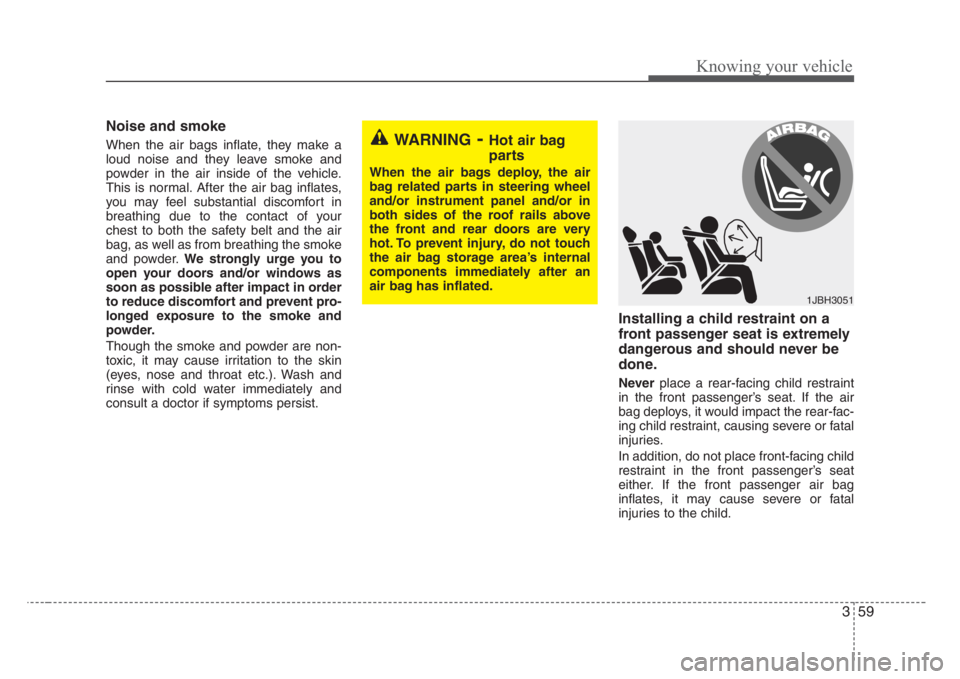
Installing a child restraint on a
front passenger seat is extremely
dangerous and should never be
done.
Neverplace a rear-facing child restraint
in the front passenger’s seat. If the air
bag deploys, it would impact the rear-fac-
ing child restraint, causing severe or fatal
injuries.
In addition, do not place front-facing child
restraint in the front passenger’s seat
either. If the front passenger air bag
inflates, it may cause severe or fatal
injuries to the child.
WARNING-Hot air bag
parts
When the air bags deploy, the air
bag related parts in steering wheel
and/or instrument panel and/or in
both sides of the roof rails above
the front and rear doors are very
hot. To prevent injury, do not touch
the air bag storage area’s internal
components immediately after an
air bag has inflated.
1JBH3051
Page 69 of 219
Knowing your vehicle
60 3
Air bag warning light
The purpose of air bag warning light in
your instrument panel is to alert you of a
potential problem with your air bag -
Supplemental Restraint System (SRS).
When the ignition switch is turned ON,
the indicator light should blink or illumi-
nate for approximately 6 seconds, then
go off.
Have the system checked if:
• The light does not turn on briefly when
you turn the ignition ON.
• The light stays on after the engine
starts.
• The light comes on while the vehicle is
in motion.
Air bag (Supplemental Restraint
System) service
Your Supplemental Restraint System is
virtually maintenance-free. There are no
parts which you can service.
You must have the system serviced
under the following circumstances:
• If an air bag ever inflates, the air bag
must be replaced. Do not try to remove
or discard the air bag by yourself. This
must be done by an authorized Kia
dealer.
• If the air bag warning indicator light
alerts you to a problem, have the air
bag system checked as soon as possi-
ble. Otherwise, your air bag system
may be ineffective.
WARNING
• Never put child restraint in the
front passenger seat. If the front
passenger air bag inflates, it may
cause severe or fatal injuries.
• When children are seated in the
rear outboard seats in which cur-
tain air bags are equipped, be
sure to put the child restraint sys-
tem as far away from the door
side as possible, and secure the
child restraint system to be
locked in position.
Inflation of side or curtain air bag
(if equipped) could cause severe
injury or death due to the expan-
sion impact.
AIR
BAG
CAUTION - No modification
Do not modify any part of the air bag
system. Modification could make
the air bag system ineffective or
could cause unnecessary deploy-
ment.