ignition KIA RIO HATCHBACK 2008 Workshop Manual
[x] Cancel search | Manufacturer: KIA, Model Year: 2008, Model line: RIO HATCHBACK, Model: KIA RIO HATCHBACK 2008Pages: 219, PDF Size: 5.17 MB
Page 165 of 219
611
In case of an emergency
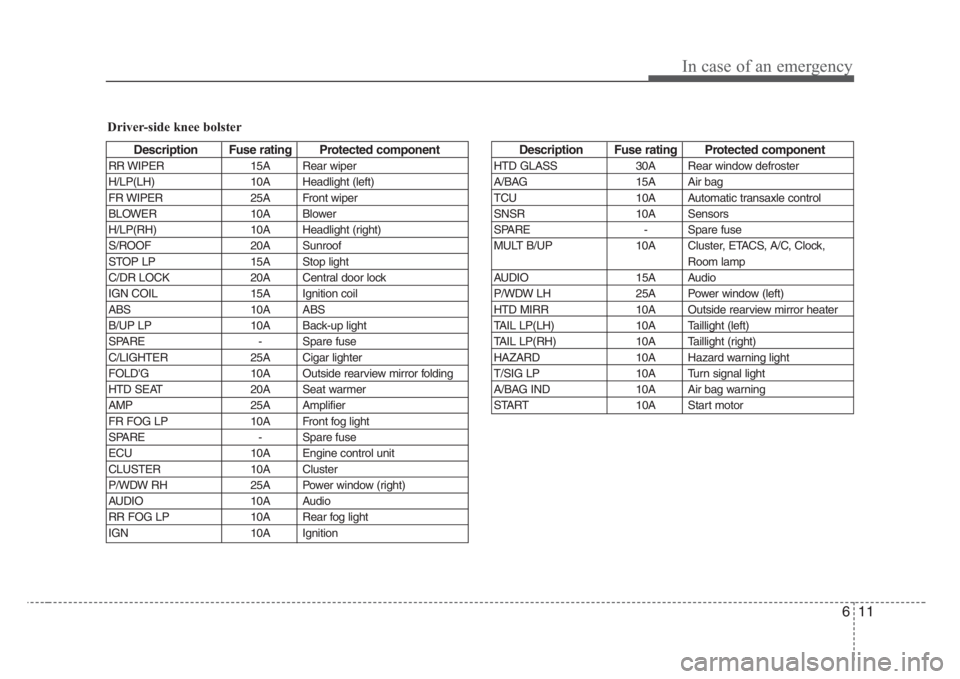
Driver-side knee bolster
Description Fuse rating Protected component
RR WIPER 15A Rear wiper
H/LP(LH) 10A Headlight (left)
FR WIPER 25A Front wiper
BLOWER 10A Blower
H/LP(RH) 10A Headlight (right)
S/ROOF 20A Sunroof
STOP LP 15A Stop light
C/DR LOCK 20A Central door lock
IGN COIL 15A Ignition coil
ABS 10A ABS
B/UP LP 10A Back-up light
SPARE - Spare fuse
C/LIGHTER 25A Cigar lighter
FOLD'G 10A Outside rearview mirror folding
HTD SEAT 20A Seat warmer
AMP 25A Amplifier
FR FOG LP 10A Front fog light
SPARE - Spare fuse
ECU 10A Engine control unit
CLUSTER 10A Cluster
P/WDW RH 25A Power window (right)
AUDIO 10A Audio
RR FOG LP 10A Rear fog light
IGN 10A Ignition
Description Fuse rating Protected component
HTD GLASS 30A Rear window defroster
A/BAG 15A Air bag
TCU 10A Automatic transaxle control
SNSR 10A Sensors
SPARE - Spare fuse
MULT B/UP 10A Cluster, ETACS, A/C, Clock,
Room lamp
AUDIO 15A Audio
P/WDW LH 25A Power window (left)
HTD MIRR 10A Outside rearview mirror heater
TAIL LP(LH) 10A Taillight (left)
TAIL LP(RH) 10A Taillight (right)
HAZARD 10A Hazard warning light
T/SIG LP 10A Turn signal light
A/BAG IND 10A Air bag warning
START 10A Start motor
Page 167 of 219
613
In case of an emergency
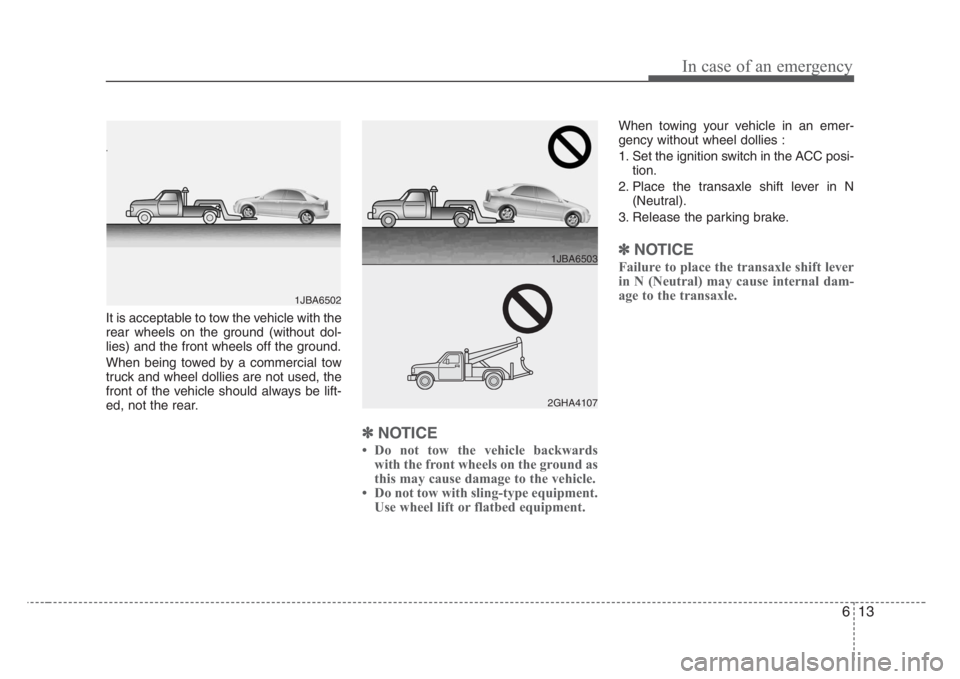
It is acceptable to tow the vehicle with the
rear wheels on the ground (without dol-
lies) and the front wheels off the ground.
When being towed by a commercial tow
truck and wheel dollies are not used, the
front of the vehicle should always be lift-
ed, not the rear.
✽
NOTICE
• Do not tow the vehicle backwards
with the front wheels on the ground as
this may cause damage to the vehicle.
• Do not tow with sling-type equipment.
Use wheel lift or flatbed equipment.
When towing your vehicle in an emer-
gency without wheel dollies :
1. Set the ignition switch in the ACC posi-
tion.
2. Place the transaxle shift lever in N
(Neutral).
3. Release the parking brake.
✽
NOTICE
Failure to place the transaxle shift lever
in N (Neutral) may cause internal dam-
age to the transaxle.
2GHA41071JBA6503
1JBA6502
Page 170 of 219
In case of an emergency
16 6
• Before emergency towing, check that
the hook is not broken or damaged.
• Fasten the towing cable or chain
securely to the hook.
• Do not jerk the hook. Apply steady and
even force.
• To avoid damaging the hook, do not
pull from the side or at a vertical angle.
Always pull straight ahead.
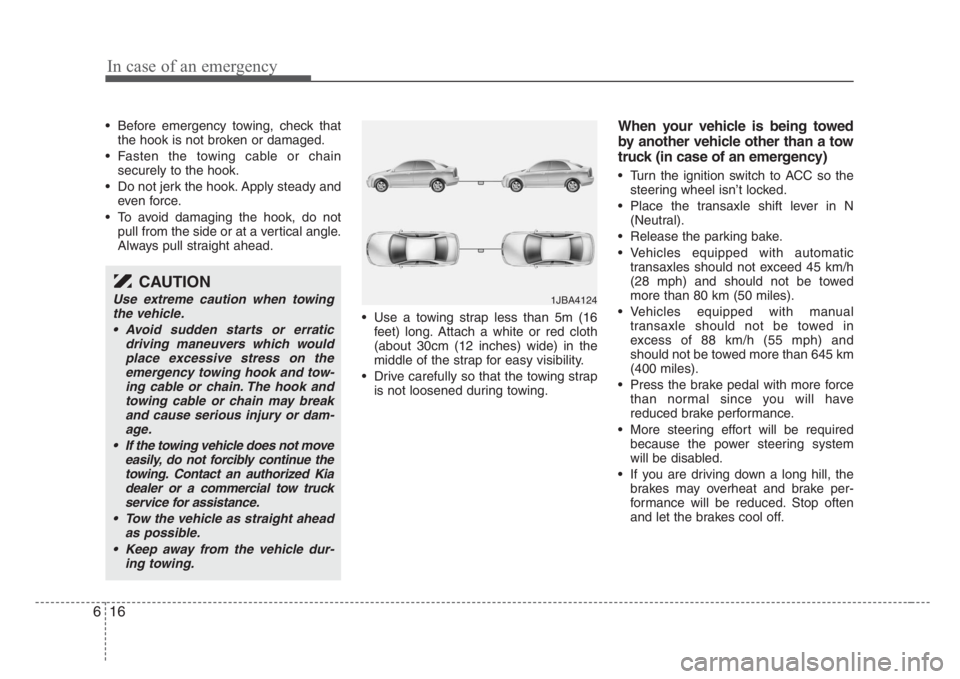
• Use a towing strap less than 5m (16
feet) long. Attach a white or red cloth
(about 30cm (12 inches) wide) in the
middle of the strap for easy visibility.
• Drive carefully so that the towing strap
is not loosened during towing.When your vehicle is being towed
by another vehicle other than a tow
truck (in case of an emergency)
• Turn the ignition switch to ACC so the
steering wheel isn’t locked.
• Place the transaxle shift lever in N
(Neutral).
• Release the parking bake.
• Vehicles equipped with automatic
transaxles should not exceed 45 km/h
(28 mph) and should not be towed
more than 80 km (50 miles).
• Vehicles equipped with manual
transaxle should not be towed in
excess of 88 km/h (55 mph) and
should not be towed more than 645 km
(400 miles).
• Press the brake pedal with more force
than normal since you will have
reduced brake performance.
• More steering effort will be required
because the power steering system
will be disabled.
• If you are driving down a long hill, the
brakes may overheat and brake per-
formance will be reduced. Stop often
and let the brakes cool off.
CAUTION
Use extreme caution when towing
the vehicle.
• Avoid sudden starts or erratic
driving maneuvers which would
place excessive stress on the
emergency towing hook and tow-
ing cable or chain. The hook and
towing cable or chain may break
and cause serious injury or dam-
age.
• If the towing vehicle does not move
easily, do not forcibly continue the
towing. Contact an authorized Kia
dealer or a commercial tow truck
service for assistance.
• Tow the vehicle as straight ahead
as possible.
• Keep away from the vehicle dur-
ing towing.1JBA4124
Page 179 of 219
73
Maintenance
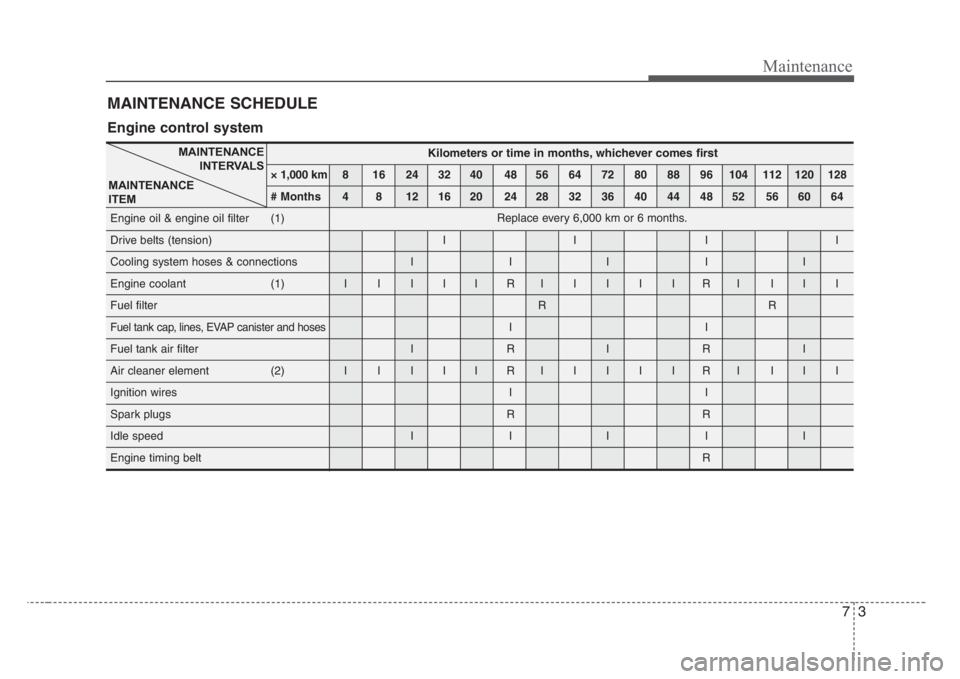
MAINTENANCE SCHEDULE
Engine control system
Kilometers or time in months, whichever comes first
× 1,000 km 8 16 24 32 40 48 56 64 72 80 88 96 104 112 120 128
# Months4 8 12 16 20 24 28 32 36 40 44 48 52 56 60 64
Engine oil & engine oil filter (1)
Drive belts (tension) I I I I
Cooling system hoses & connections I I I I I
Engine coolant (1) I I I I I RIIIIIRI III
Fuel filterRR
Fuel tank cap, lines, EVAP canister and hosesII
Fuel tank air filter I R I R I
Air cleaner element (2) I I I I I RIIIIIRI III
Ignition wires I I
Spark plugs R R
Idle speed I I I I I
Engine timing beltR
MAINTENANCE
INTERVALS
MAINTENANCE
ITEM
Replace every 6,000 km or 6 months.
Page 197 of 219
721
Maintenance
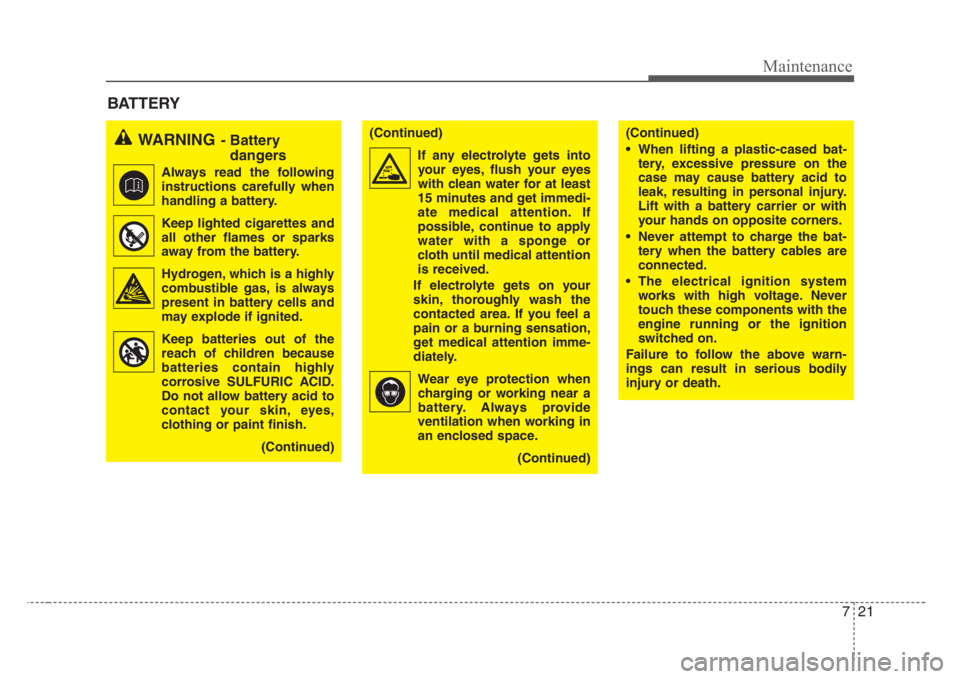
BATTERY
WARNING- Battery
dangers
Always read the following
instructions carefully when
handling a battery.
Keep lighted cigarettes and
all other flames or sparks
away from the battery.
Hydrogen, which is a highly
combustible gas,is always
present in battery cells and
may explode if ignited.
Keep batteries out of the
reach of children because
batteries contain highly
corrosive SULFURIC ACID.
Do not allow battery acid to
contact your skin, eyes,
clothing or paint finish.
(Continued)
(Continued)
If any electrolyte gets into
your eyes, flush your eyes
with clean water for at least
15 minutes and get immedi-
ate medical attention. If
possible, continue to apply
water with a sponge or
cloth until medical attention
is received.
If electrolyte gets on your
skin, thoroughly wash the
contacted area. If you feel a
pain or a burning sensation,
get medical attention imme-
diately.
Wear eye protection when
charging or working near a
battery. Always provide
ventilation when working in
an enclosed space.
(Continued)(Continued)
• When lifting a plastic-cased bat-
tery, excessive pressure on the
case may cause battery acid to
leak, resulting in personal injury.
Lift with a battery carrier or with
your hands on opposite corners.
• Never attempt to charge the bat-
tery when the battery cables are
connected.
• The electrical ignition system
works with high voltage. Never
touch these components with the
engine running or the ignition
switched on.
Failure to follow the above warn-
ings can result in serious bodily
injury or death.
Page 218 of 219
Index
2 9
Air bags-supplemental restraint system·························3-47
Air cleaner ·····································································7-17
Antenna ··········································································3-79
Audio system ·································································3-80
Automatic transaxle················································4-6, 7-15
Battery············································································7-21
Before driving ··································································5-4
Brake fluid ·····································································7-13
Brake system····································································4-9
Climate control air filter ················································7-18
Climate control system ··················································4-30
Defroster ········································································4-29
Door locks········································································3-9
Drive belts······································································7-14
Electrical circuit protection ·············································6-6
Emergency starting ··························································6-3
Emission control system ··················································5-2Engine compartment ················································2-4, 7-9
Engine cooling system ···················································7-11
Engine oil ·······································································7-10
Exterior care···································································7-33
Fuel filler lid ··································································3-65
Fuel requirements ····························································5-2
Gauges ···········································································4-17
Hazard warning flasher··················································4-29
Hood···············································································3-64
How to use this manual ···················································1-2
If you have a flat tire ·····················································6-17
Ignition switch ·································································4-2
Immobilizer system ·························································3-7
Instrument cluster ··························································4-16
Instrument panel overview ··············································2-3
Interior care····································································7-35
Interior features······························································3-73
Interior lights ·································································3-71
Interior overview ·····························································2-2
A
B
C
E
D
F
G
H
I