lock KIA RIO HATCHBACK 2008 Repair Manual
[x] Cancel search | Manufacturer: KIA, Model Year: 2008, Model line: RIO HATCHBACK, Model: KIA RIO HATCHBACK 2008Pages: 219, PDF Size: 5.17 MB
Page 174 of 219
In case of an emergency
20 6
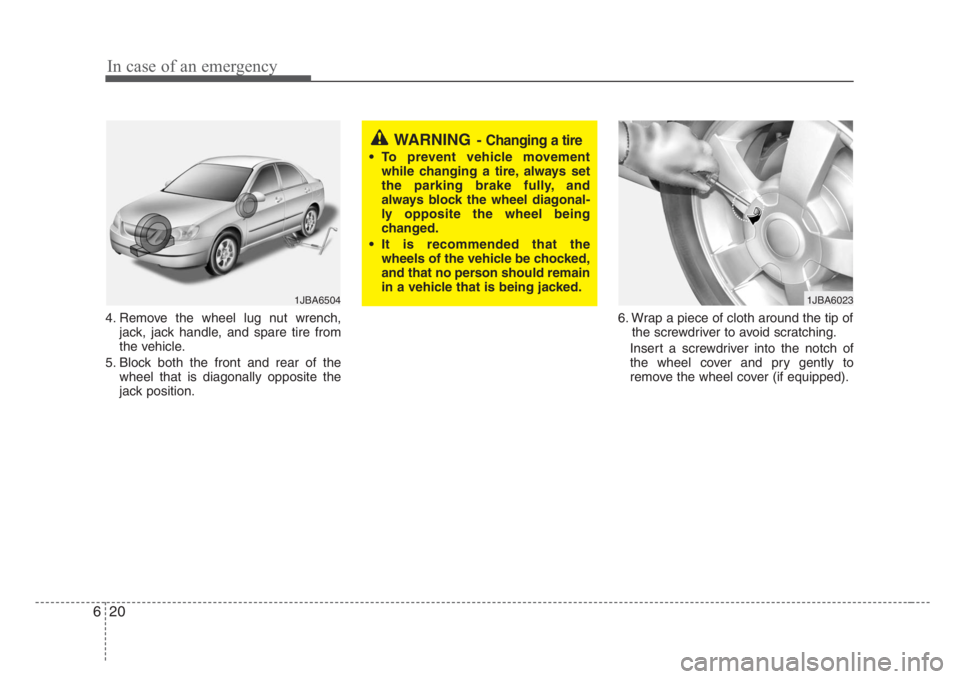
4. Remove the wheel lug nut wrench,
jack, jack handle, and spare tire from
the vehicle.
5. Block both the front and rear of the
wheel that is diagonally opposite the
jack position.6. Wrap a piece of cloth around the tip of
the screwdriver to avoid scratching.
Insert a screwdriver into the notch of
the wheel cover and pry gently to
remove the wheel cover (if equipped).
WARNING-Changing a tire
• To prevent vehicle movement
while changing a tire, always set
the parking brake fully, and
always block the wheel diagonal-
ly opposite the wheel being
changed.
• It is recommended that the
wheels of the vehicle be chocked,
and that no person should remain
in a vehicle that is being jacked.
1JBA65041JBA6023
Page 175 of 219
621
In case of an emergency
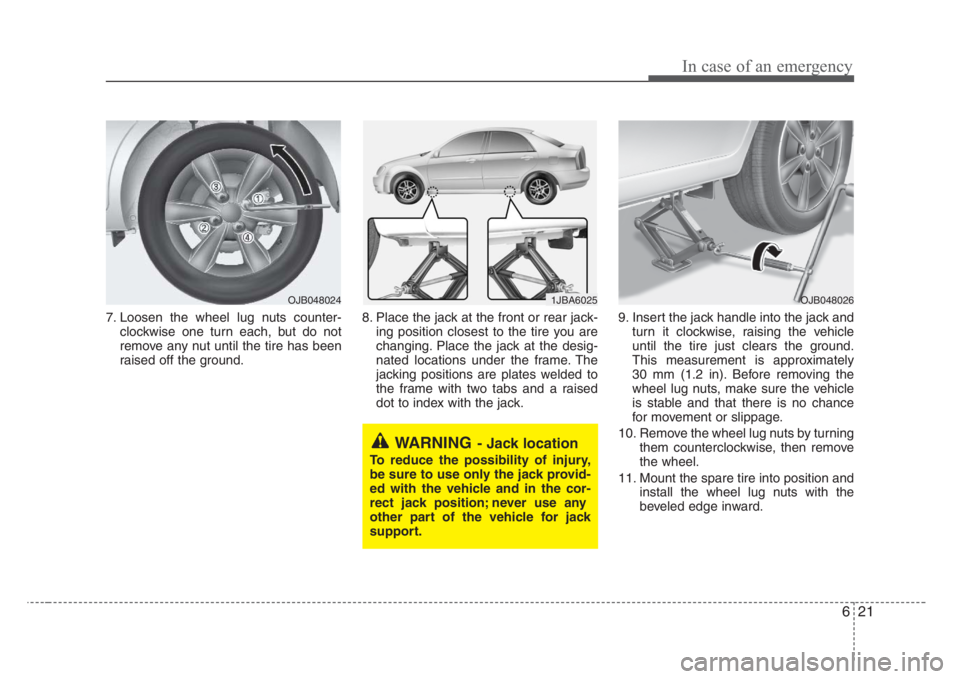
7. Loosen the wheel lug nuts counter-
clockwise one turn each, but do not
remove any nut until the tire has been
raised off the ground.8. Place the jack at the front or rear jack-
ing position closest to the tire you are
changing. Place the jack at the desig-
nated locations under the frame. The
jacking positions are plates welded to
the frame with two tabs and a raised
dot to index with the jack.9. Insert the jack handle into the jack and
turn it clockwise, raising the vehicle
until the tire just clears the ground.
This measurement is approximately
30 mm (1.2 in). Before removing the
wheel lug nuts, make sure the vehicle
is stable and that there is no chance
for movement or slippage.
10. Remove the wheel lug nuts by turning
them counterclockwise, then remove
the wheel.
11. Mount the spare tire into position and
install the wheel lug nuts with the
beveled edge inward.
1JBA6025
WARNING- Jack location
To reduce the possibility of injury,
be sure to use only the jack provid-
ed with the vehicle and in the cor-
rect jack position; never use any
other part of the vehicle for jack
support.
OJB048026OJB048024
Page 181 of 219
75
Maintenance
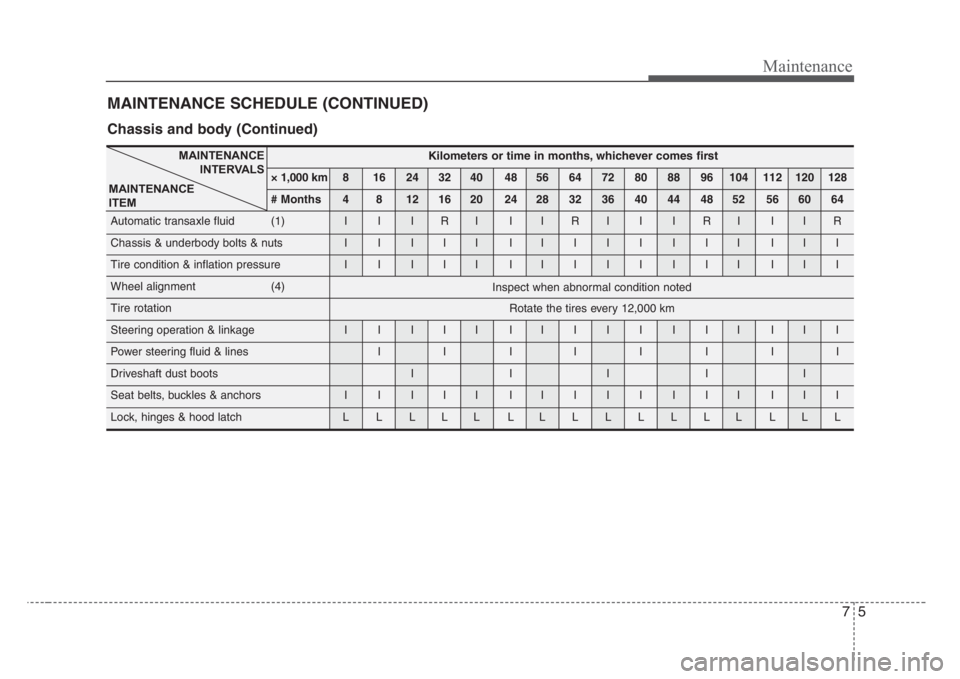
MAINTENANCE SCHEDULE (CONTINUED)
Chassis and body (Continued)
Kilometers or time in months, whichever comes first
× 1,000 km 8 16 24 32 40 48 56 64 72 80 88 96 104 112 120 128
# Months4 8 12 16 20 24 28 32 36 40 44 48 52 56 60 64
Automatic transaxle fluid (1) I I I R I I I R I I I R I I I R
Chassis & underbody bolts & nuts I I I I I IIIIIIII III
Tire condition & inflation pressure I I I I I IIIIIIII III
Wheel alignment (4)
Tire rotation
Steering operation & linkage I I I I I IIIIIIII III
Power steering fluid & lines I I IIIIII
Driveshaft dust boots I I I I I
Seat belts, buckles & anchors I I I I I IIIIIIII III
Lock, hinges & hood latch L L L L L LLLLLLLL LLL
MAINTENANCE
INTERVALS
MAINTENANCE
ITEM
Inspect when abnormal condition noted
Rotate the tires every 12,000 km
Page 184 of 219
Maintenance
8 7
At least once a year :
• Clean body and door drain holes.
• Lubricate door hinges and checks, and
hood hinges.
• Lubricate door and hood locks and
latches.
• Lubricate door rubber weatherstrips.
• Check the air conditioning system
before the warm weather season.
• Check the power steering fluid level.
• Inspect and lubricate automatic
transaxle linkage and controls.
• Clean battery and terminals.
• Check the brake fluid level.
Owner maintenance precautions
Improper or incomplete service may
result in problems. This section gives
instructions only for the maintenance
items that are easy to perform.
As explained earlier in this section, sev-
eral procedures can be done only by an
authorized Kia dealer with special tools.
Improper owner maintenance during
the warranty period may affect war-
ranty coverage. For details, read the
separate Kia Warranty & Consumer
Information Manual provided with the
vehicle. If you're unsure about any
servicing or maintenance procedure,
have it done by an Authorized Kia
Dealer.WARNING- Maintenance
work
• Performing maintenance work on
a vehicle can be dangerous.You
can be seriously injured while per-
forming some maintenance pro-
cedures. If you lack sufficient
knowledge and experience or the
proper tools and equipment to do
the work, have it done by an
Authorized Kia Dealer.
• Working under the hood with the
engine running is dangerous.It
becomes even more dangerous
when you wear jewelry or loose
clothing. These can become
entangled in moving parts and
result in injury. Always remove all
loose or hanging clothing and all
jewelry before working on the
engine.
Page 187 of 219
711
Maintenance
ENGINE COOLING SYSTEM
The high-pressure cooling system has a
reservoir filled with year-round antifreeze
coolant. The reservoir is filled at the fac-
tory.
Check the antifreeze protection and
coolant level at least once a year, at the
beginning of the winter season, and
before traveling to a colder climate.
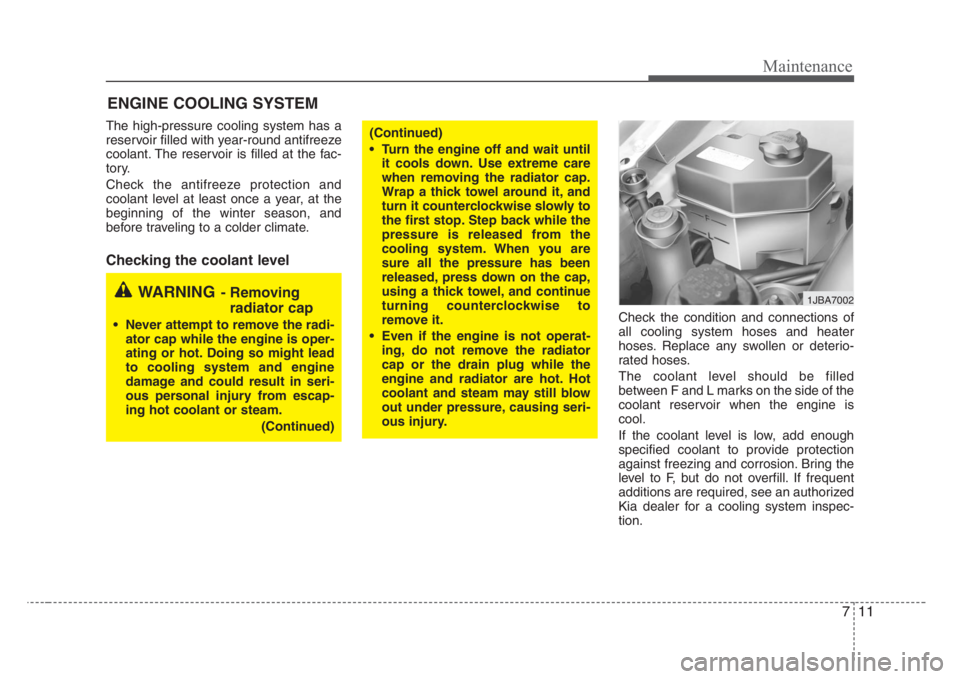
Checking the coolant level
Check the condition and connections of
all cooling system hoses and heater
hoses. Replace any swollen or deterio-
rated hoses.
The coolant level should be filled
between F and L marks on the side of the
coolant reservoir when the engine is
cool.
If the coolant level is low, add enough
specified coolant to provide protection
against freezing and corrosion. Bring the
level to F, but do not overfill. If frequent
additions are required, see an authorized
Kia dealer for a cooling system inspec-
tion.
WARNING- Removing
radiator cap
• Never attempt to remove the radi-
ator cap while the engine is oper-
ating or hot. Doing so might lead
to cooling system and engine
damage and could result in seri-
ous personal injury from escap-
ing hot coolant or steam.
(Continued)
(Continued)
• Turn the engine off and wait until
it cools down. Use extreme care
when removing the radiator cap.
Wrap a thick towel around it, and
turn it counterclockwise slowly to
the first stop. Step back while the
pressure is released from the
cooling system. When you are
sure all the pressure has been
released, press down on the cap,
using a thick towel, and continue
turning counterclockwise to
remove it.
• Even if the engine is not operat-
ing, do not remove the radiator
cap or the drain plug while the
engine and radiator are hot. Hot
coolant and steam may still blow
out under pressure, causing seri-
ous injury.
1JBA7002
Page 193 of 219
717
Maintenance
Body lubrication
All moving points of the body, such as
door hinges, hood hinges, and locks,
should be lubricated each time the
engine oil is changed. Use a non-freez-
ing lubricant on locks during cold weath-
er.
Make sure the engine hood secondary
latch keeps the hood from opening when
the primary latch is released.
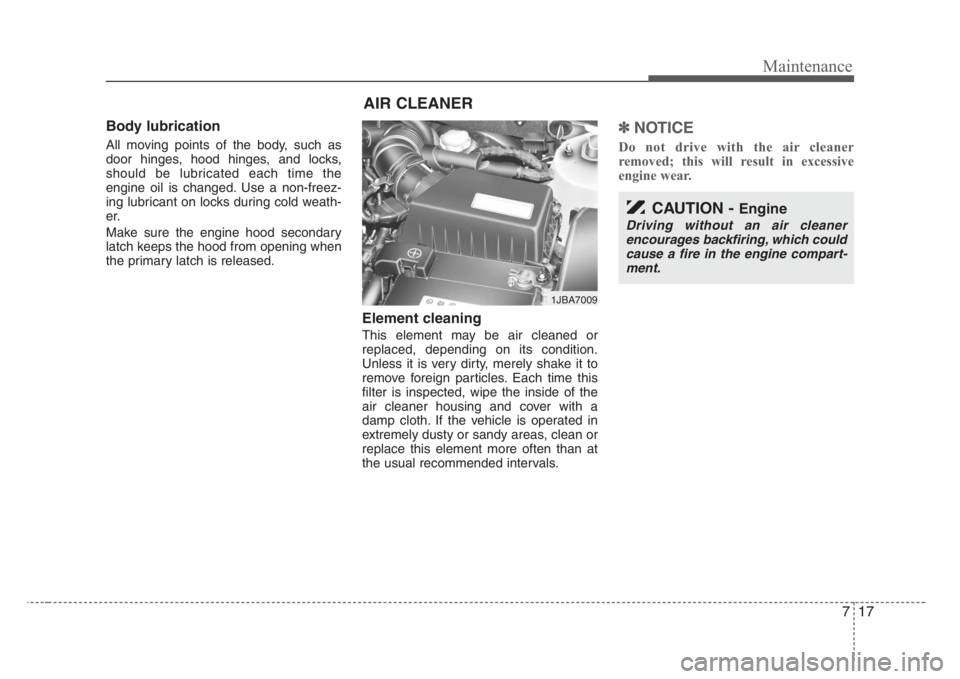
Element cleaning
This element may be air cleaned or
replaced, depending on its condition.
Unless it is very dirty, merely shake it to
remove foreign particles. Each time this
filter is inspected, wipe the inside of the
air cleaner housing and cover with a
damp cloth. If the vehicle is operated in
extremely dusty or sandy areas, clean or
replace this element more often than at
the usual recommended intervals.
✽
NOTICE
Do not drive with the air cleaner
removed; this will result in excessive
engine wear.
1JBA7009
CAUTION - Engine
Driving without an air cleaner
encourages backfiring, which could
cause a fire in the engine compart-
ment.
AIR CLEANER
Page 195 of 219
719
Maintenance
WIPER BLADES
Wiper blade maintenance
Commercial hot waxes applied by
automatic car washes have been
known to make the windshield diffi-
cult to clean.
Contamination of either the windshield or
the wiper blades with foreign matter can
reduce the effectiveness of the wind-
shield wipers. Common sources of con-
tamination are insects, tree sap, and hot
wax treatments used by some commer-
cial car washes. If the blades are not wip-
ing properly, clean both the window and
the blades with a good cleaner or mild
detergent, and rinse thoroughly with
clean water.
✽
NOTICE
To prevent damage to the wiper blades,
do not use gasoline, kerosene, paint
thinner, or other solvents on or near
them.
Windshield wiper blade replace-
ment
When the wipers no longer clean ade-
quately, the blades may be worn or
cracked, and require replacement.
✽
NOTICE
To prevent damage to the wiper arms or
other components, do not attempt to
move the wipers manually.
✽
NOTICE
The use of a non-specified wiper blade
could result in wiper malfunction and
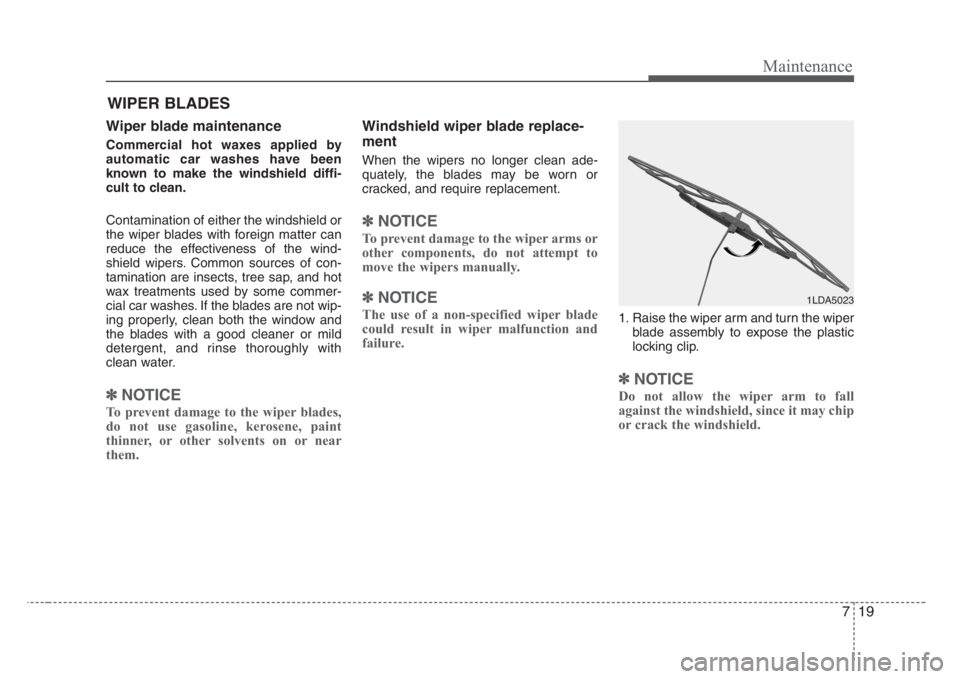
failure.1. Raise the wiper arm and turn the wiper
blade assembly to expose the plastic
locking clip.
✽
NOTICE
Do not allow the wiper arm to fall
against the windshield, since it may chip
or crack the windshield.
1LDA5023
Page 198 of 219
Maintenance
22 7
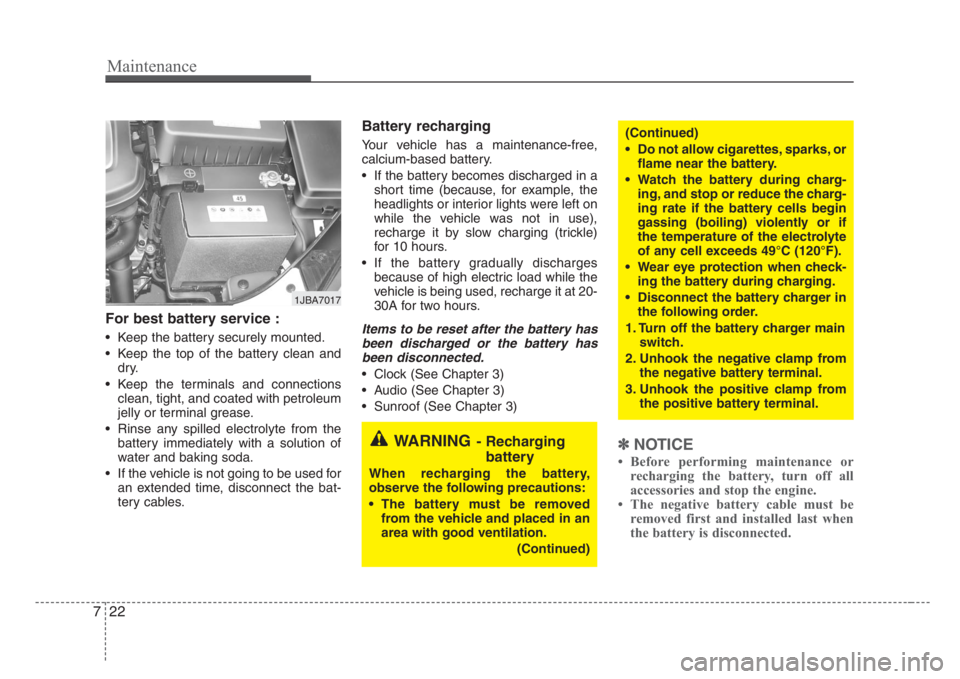
For best battery service :
• Keep the battery securely mounted.
• Keep the top of the battery clean and
dry.
• Keep the terminals and connections
clean, tight, and coated with petroleum
jelly or terminal grease.
• Rinse any spilled electrolyte from the
battery immediately with a solution of
water and baking soda.
• If the vehicle is not going to be used for
an extended time, disconnect the bat-
tery cables.
Battery recharging
Your vehicle has a maintenance-free,
calcium-based battery.
• If the battery becomes discharged in a
short time (because, for example, the
headlights or interior lights were left on
while the vehicle was not in use),
recharge it by slow charging (trickle)
for 10 hours.
• If the battery gradually discharges
because of high electric load while the
vehicle is being used, recharge it at 20-
30A for two hours.
Items to be reset after the battery has
been discharged or the battery has
been disconnected.
• Clock (See Chapter 3)
• Audio (See Chapter 3)
• Sunroof (See Chapter 3)
✽
NOTICE
• Before performing maintenance or
recharging the battery, turn off all
accessories and stop the engine.
• The negative battery cable must be
removed first and installed last when
the battery is disconnected.
1JBA7017
WARNING- Recharging
battery
When recharging the battery,
observe the following precautions:
• The battery must be removed
from the vehicle and placed in an
area with good ventilation.
(Continued)
(Continued)
• Do not allow cigarettes,sparks,or
flame near the battery.
• Watch the battery during charg-
ing, and stop or reduce the charg-
ing rate if the battery cells begin
gassing (boiling) violently or if
the temperature of the electrolyte
of any cell exceeds 49°C (120°F).
• Wear eye protection when check-
ing the battery during charging.
•Disconnect the battery charger in
the following order.
1. Turn off the battery charger main
switch.
2. Unhook the negative clamp from
the negative battery terminal.
3. Unhook the positive clamp from
the positive battery terminal.
Page 218 of 219
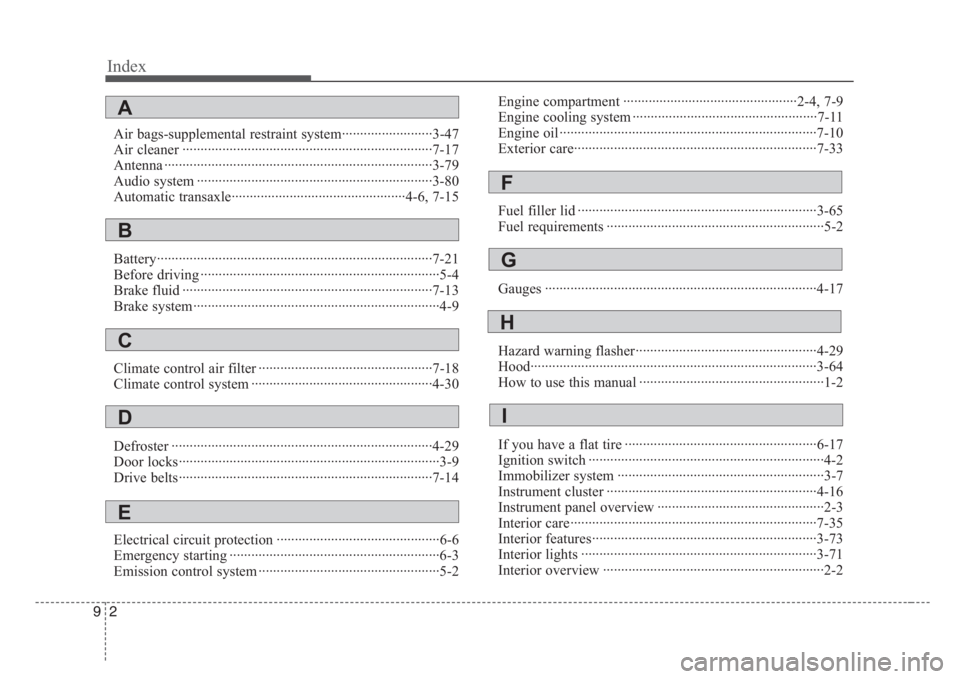
Index
2 9
Air bags-supplemental restraint system·························3-47
Air cleaner ·····································································7-17
Antenna ··········································································3-79
Audio system ·································································3-80
Automatic transaxle················································4-6, 7-15
Battery············································································7-21
Before driving ··································································5-4
Brake fluid ·····································································7-13
Brake system····································································4-9
Climate control air filter ················································7-18
Climate control system ··················································4-30
Defroster ········································································4-29
Door locks········································································3-9
Drive belts······································································7-14
Electrical circuit protection ·············································6-6
Emergency starting ··························································6-3
Emission control system ··················································5-2Engine compartment ················································2-4, 7-9
Engine cooling system ···················································7-11
Engine oil ·······································································7-10
Exterior care···································································7-33
Fuel filler lid ··································································3-65
Fuel requirements ····························································5-2
Gauges ···········································································4-17
Hazard warning flasher··················································4-29
Hood···············································································3-64
How to use this manual ···················································1-2
If you have a flat tire ·····················································6-17
Ignition switch ·································································4-2
Immobilizer system ·························································3-7
Instrument cluster ··························································4-16
Instrument panel overview ··············································2-3
Interior care····································································7-35
Interior features······························································3-73
Interior lights ·································································3-71
Interior overview ·····························································2-2
A
B
C
E
D
F
G
H
I