steering wheel KIA RIO HATCHBACK 2017 Service Manual
[x] Cancel search | Manufacturer: KIA, Model Year: 2017, Model line: RIO HATCHBACK, Model: KIA RIO HATCHBACK 2017Pages: 532, PDF Size: 12.04 MB
Page 399 of 532
What to do in an emergency
26
6
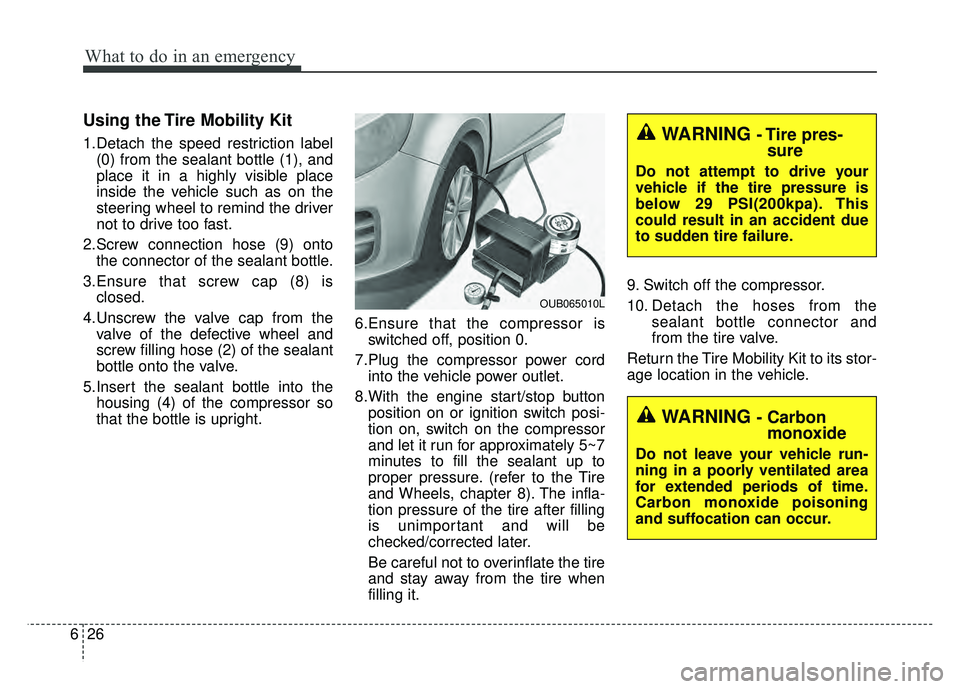
Using the Tire Mobility Kit
1.Detach the speed restriction label
(0) from the sealant bottle (1), and
place it in a highly visible place
inside the vehicle such as on the
steering wheel to remind the driver
not to drive too fast.
2.Screw connection hose (9) onto the connector of the sealant bottle.
3.Ensure that screw cap (8) is closed.
4.Unscrew the valve cap from the valve of the defective wheel and
screw filling hose (2) of the sealant
bottle onto the valve.
5.Insert the sealant bottle into the housing (4) of the compressor so
that the bottle is upright. 6.Ensure that the compressor is
switched off, position 0.
7.Plug the compressor power cord into the vehicle power outlet.
8.With the engine start/stop button position on or ignition switch posi-
tion on, switch on the compressor
and let it run for approximately 5~7
minutes to fill the sealant up to
proper pressure. (refer to the Tire
and Wheels, chapter 8). The infla-
tion pressure of the tire after filling
is unimportant and will be
checked/corrected later.
Be careful not to overinflate the tire
and stay away from the tire when
filling it. 9. Switch off the compressor.
10. Detach the hoses from the
sealant bottle connector and
from the tire valve.
Return the Tire Mobility Kit to its stor-
age location in the vehicle.
OUB065010L
WARNING - Carbon monoxide
Do not leave your vehicle run-
ning in a poorly ventilated area
for extended periods of time.
Carbon monoxide poisoning
and suffocation can occur.
WARNING - Tire pres-sure
Do not attempt to drive your
vehicle if the tire pressure is
below 29 PSI(200kpa). This
could result in an accident due
to sudden tire failure.
Page 404 of 532
631
What to do in an emergency
Emergency towing
If towing is necessary, we recom-
mend you have it done by an
authorized Kia dealer or a com-
mercial tow truck service.If towing service is not available in an
emergency, your vehicle may be
temporarily towed using a cable or
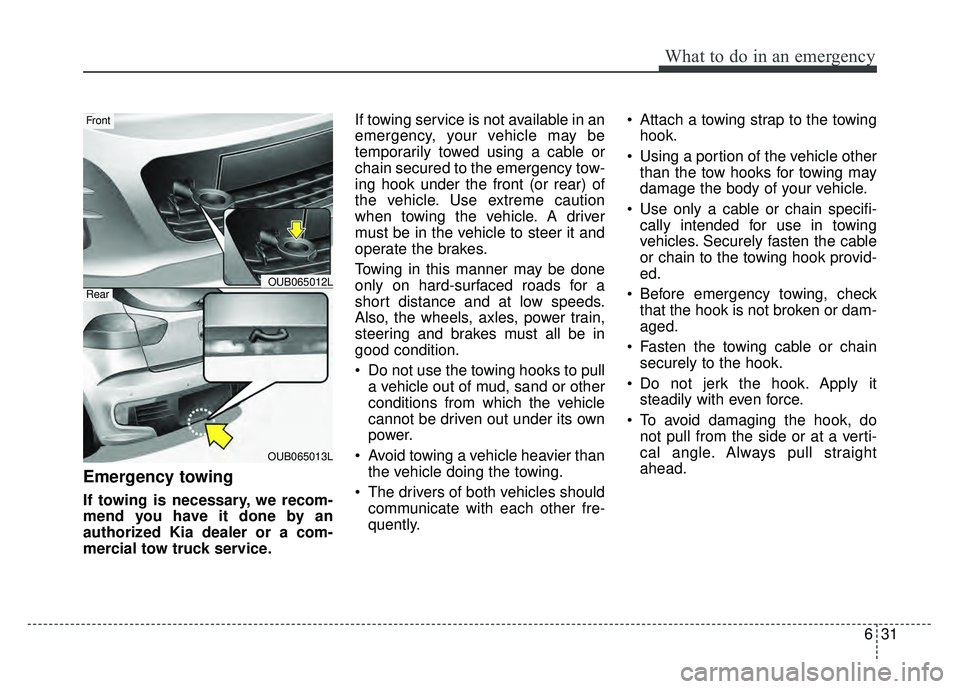
chain secured to the emergency tow-
ing hook under the front (or rear) of
the vehicle. Use extreme caution
when towing the vehicle. A driver
must be in the vehicle to steer it and
operate the brakes.
Towing in this manner may be done
only on hard-surfaced roads for a
short distance and at low speeds.
Also, the wheels, axles, power train,
steering and brakes must all be in
good condition.
Do not use the towing hooks to pull
a vehicle out of mud, sand or other
conditions from which the vehicle
cannot be driven out under its own
power.
Avoid towing a vehicle heavier than the vehicle doing the towing.
The drivers of both vehicles should communicate with each other fre-
quently. Attach a towing strap to the towing
hook.
Using a portion of the vehicle other than the tow hooks for towing may
damage the body of your vehicle.
Use only a cable or chain specifi- cally intended for use in towing
vehicles. Securely fasten the cable
or chain to the towing hook provid-
ed.
Before emergency towing, check that the hook is not broken or dam-
aged.
Fasten the towing cable or chain securely to the hook.
Do not jerk the hook. Apply it steadily with even force.
To avoid damaging the hook, do not pull from the side or at a verti-
cal angle. Always pull straight
ahead.
OUB065013L
Front
RearOUB065012L
Page 405 of 532
What to do in an emergency
32
6
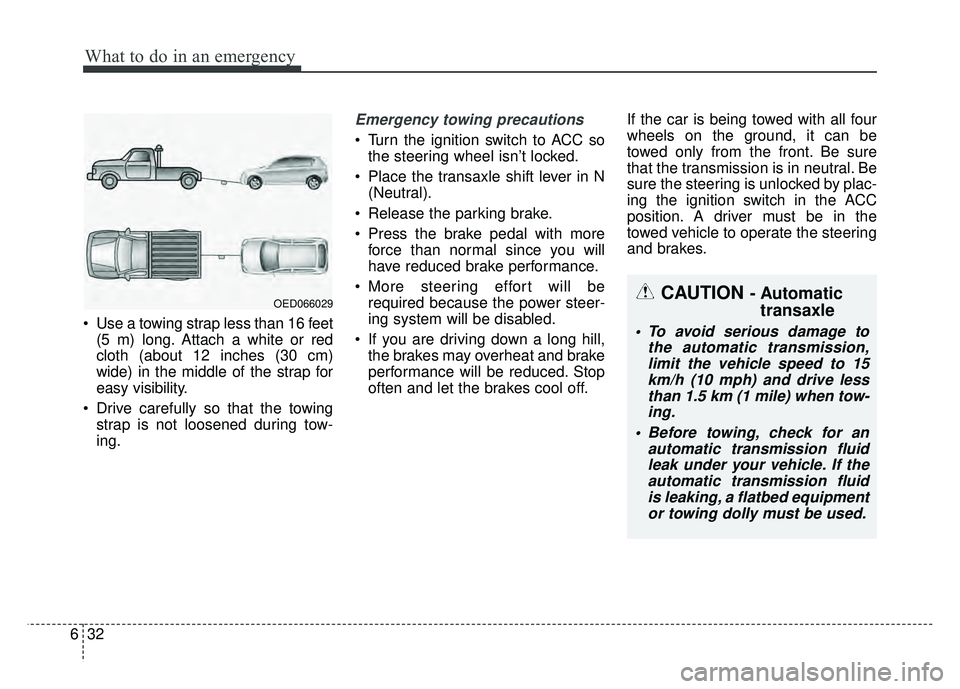
Use a towing strap less than 16 feet
(5 m) long. Attach a white or red
cloth (about 12 inches (30 cm)
wide) in the middle of the strap for
easy visibility.
Drive carefully so that the towing strap is not loosened during tow-
ing.
Emergency towing precautions
Turn the ignition switch to ACC sothe steering wheel isn’t locked.
Place the transaxle shift lever in N (Neutral).
Release the parking brake.
Press the brake pedal with more force than normal since you will
have reduced brake performance.
More steering effort will be required because the power steer-
ing system will be disabled.
If you are driving down a long hill, the brakes may overheat and brake
performance will be reduced. Stop
often and let the brakes cool off. If the car is being towed with all four
wheels on the ground, it can be
towed only from the front. Be sure
that the transmission is in neutral. Be
sure the steering is unlocked by plac-
ing the ignition switch in the ACC
position. A driver must be in the
towed vehicle to operate the steering
and brakes.
CAUTION - Automatic
transaxle
To avoid serious damage to
the automatic transmission,limit the vehicle speed to 15km/h (10 mph) and drive lessthan 1.5 km (1 mile) when tow-ing.
Before towing, check for an automatic transmission fluidleak under your vehicle. If theautomatic transmission fluidis leaking, a flatbed equipmentor towing dolly must be used.
OED066029
Page 411 of 532
Maintenance
67
OWNER MAINTENANCE
The following lists are vehicle checks
and inspections that should be per-
formed by the owner or an author-
ized Kia dealer at the frequencies
indicated to help ensure safe,
dependable operation of your vehi-
cle.
Any adverse conditions should be
brought to the attention of your deal-
er as soon as possible.
These Owner Maintenance Checks
are generally not covered by war-
ranties and you may be charged for
labor, parts and lubricants used.Owner maintenance schedule
When you stop for fuel:
Check the engine oil level.
Check the coolant level in coolantreservoir.
Check the windshield washer fluid level.
Look for low or under-inflated tires.
While operating your vehicle:
Note any changes in the sound of the exhaust or any smell of
exhaust fumes in the vehicle.
Check for vibrations in the steering wheel. Notice any increased steer-
ing effort or looseness in the steer-
ing wheel, or change in the
straight-ahead position.
Notice if your vehicle constantly turns slightly or “pulls” to one side
when traveling on smooth, level
road.
When stopping, listen and check for unusual sounds, pulling to one
side, increased brake pedal travel
or “hard-to-push” brake pedal.
If any slipping or changes in the operation of your transaxle occurs,
check the transaxle fluid level.
Check the automatic transaxle P (Park) function.
Check the parking brake.
Check for fluid leaks under your vehicle (water dripping from the air
conditioning system during or after
use is normal).
WARNING - Hot coolant
Be careful when checking your
engine coolant level when the
engine is hot. Scalding hot
coolant and steam may blow
out under pressure.
Page 412 of 532
77
Maintenance
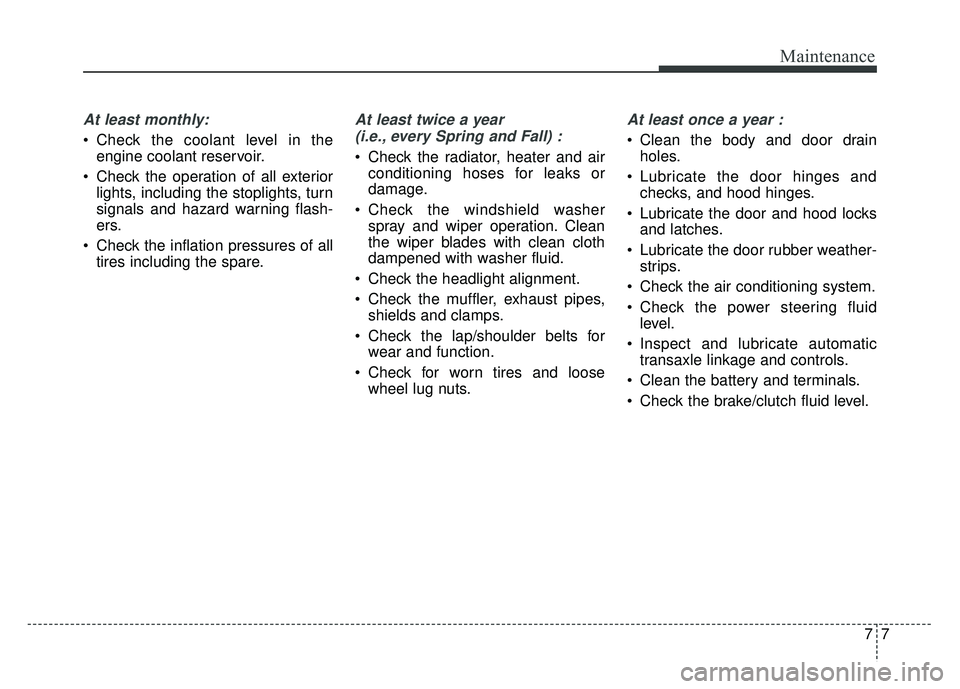
At least monthly:
Check the coolant level in theengine coolant reservoir.
Check the operation of all exterior lights, including the stoplights, turn
signals and hazard warning flash-
ers.
Check the inflation pressures of all tires including the spare.
At least twice a year
(i.e., every Spring and Fall) :
Check the radiator, heater and air conditioning hoses for leaks or
damage.
Check the windshield washer spray and wiper operation. Clean
the wiper blades with clean cloth
dampened with washer fluid.
Check the headlight alignment.
Check the muffler, exhaust pipes, shields and clamps.
Check the lap/shoulder belts for wear and function.
Check for worn tires and loose wheel lug nuts.
At least once a year :
Clean the body and door drainholes.
Lubricate the door hinges and checks, and hood hinges.
Lubricate the door and hood locks and latches.
Lubricate the door rubber weather- strips.
Check the air conditioning system.
Check the power steering fluid level.
Inspect and lubricate automatic transaxle linkage and controls.
Clean the battery and terminals.
Check the brake/clutch fluid level.
Page 439 of 532
Maintenance
34
7
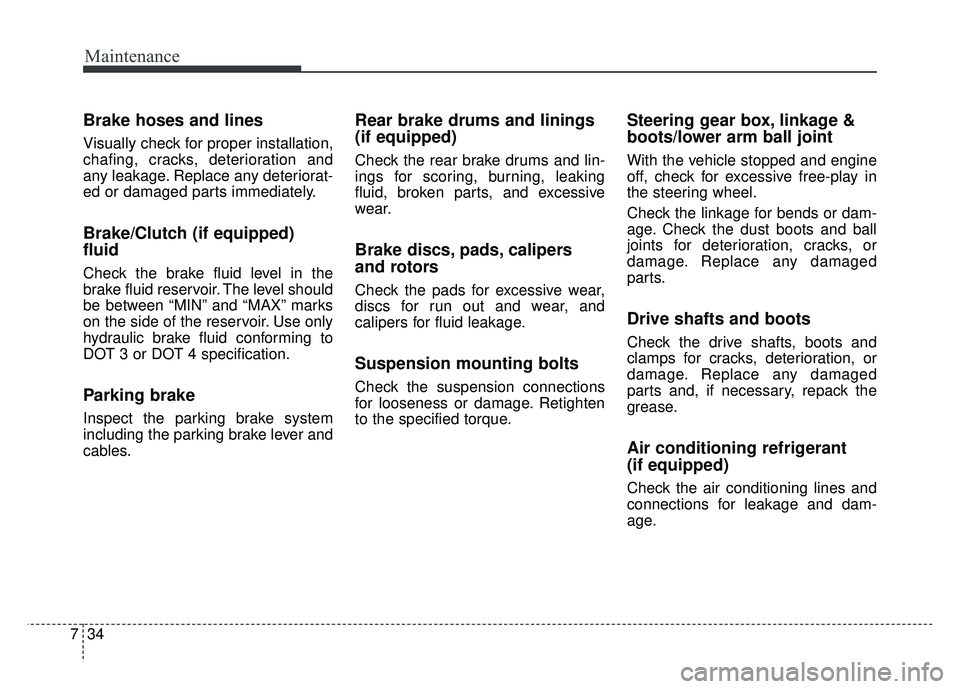
Brake hoses and lines
Visually check for proper installation,
chafing, cracks, deterioration and
any leakage. Replace any deteriorat-
ed or damaged parts immediately.
Brake/Clutch (if equipped)
fluid
Check the brake fluid level in the
brake fluid reservoir. The level should
be between “MIN” and “MAX” marks
on the side of the reservoir. Use only
hydraulic brake fluid conforming to
DOT 3 or DOT 4 specification.
Parking brake
Inspect the parking brake system
including the parking brake lever and
cables.
Rear brake drums and linings
(if equipped)
Check the rear brake drums and lin-
ings for scoring, burning, leaking
fluid, broken parts, and excessive
wear.
Brake discs, pads, calipers
and rotors
Check the pads for excessive wear,
discs for run out and wear, and
calipers for fluid leakage.
Suspension mounting bolts
Check the suspension connections
for looseness or damage. Retighten
to the specified torque.
Steering gear box, linkage &
boots/lower arm ball joint
With the vehicle stopped and engine
off, check for excessive free-play in
the steering wheel.
Check the linkage for bends or dam-
age. Check the dust boots and ball
joints for deterioration, cracks, or
damage. Replace any damaged
parts.
Drive shafts and boots
Check the drive shafts, boots and
clamps for cracks, deterioration, or
damage. Replace any damaged
parts and, if necessary, repack the
grease.
Air conditioning refrigerant
(if equipped)
Check the air conditioning lines and
connections for leakage and dam-
age.
Page 477 of 532

Maintenance
72
7
Instrument panel fuse panel
Fuse Name Fuse rating Circuit Protected
POWER OUTLET 15A Power Outlet
C/LIGHTER 20A Cigarette Lighter
ACC 10AFront Map Lamp, Power Outside Mirror Switch, BCM,
Low DC-DC Convertor, Smart Key Control Module, Audio,
A/V & Navigation Head Unit, Digital Clock
A/BAG IND 10A Instrument Cluster
A/BAG 10ASBR PAB Indicator, SRS Control Module
Passenger Weight Classification Sensor
MODULE 2 10A BCM
MDPS 10A EPS Control Module
WIPER RR 15A Multifunction Switch, Rear Wiper Relay, Rear Wiper Motor
HTD STRG 15A Steering Wheel Heater
FOG LAMP RR 10A -
FOG LAMP FRT 15A Front Fog Lamp Relay
MODULE 1 10A ATM Shift Lever Switch, Door Warning Switch
STOP LAMP 15AData Link Connector, Smart Key Control Module, Stop Lamp Switch
Stop Lamp Relay, PCB Fuse & Relay Box (HAC Relay)
CLUSTER 10AAudio, BCM, ATM Shift Lever ILL., Crash Pad Switch
Instrument Cluster, Tire Pressure Monitoring Module
IG1 1 10AMultipurpose Check Connector, Driver CCS Seat Warmer Module
Passenger Seat Warmer Module
With ISG : Crash Pad Switch, Low DC-DC Convertor
ABS 10ACrash Pad Switch, ESC Module
PCB Fuse & Relay Box (HAC Relay)
B/UP LAMP 10A Back-Up Lamp Switch
Page 502 of 532
797
Maintenance
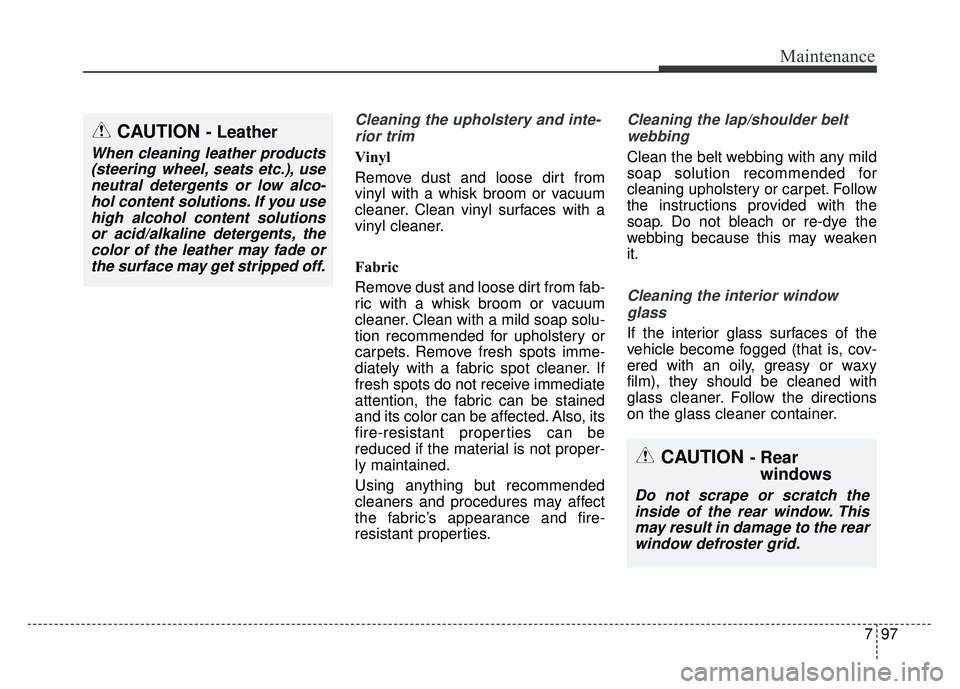
Cleaning the upholstery and inte-rior trim
Vinyl
Remove dust and loose dirt from
vinyl with a whisk broom or vacuum
cleaner. Clean vinyl surfaces with a
vinyl cleaner.
Fabric
Remove dust and loose dirt from fab-
ric with a whisk broom or vacuum
cleaner. Clean with a mild soap solu-
tion recommended for upholstery or
carpets. Remove fresh spots imme-
diately with a fabric spot cleaner. If
fresh spots do not receive immediate
attention, the fabric can be stained
and its color can be affected. Also, its
fire-resistant properties can be
reduced if the material is not proper-
ly maintained.
Using anything but recommended
cleaners and procedures may affect
the fabric’s appearance and fire-
resistant properties.
Cleaning the lap/shoulder beltwebbing
Clean the belt webbing with any mild
soap solution recommended for
cleaning upholstery or carpet. Follow
the instructions provided with the
soap. Do not bleach or re-dye the
webbing because this may weaken
it.
Cleaning the interior windowglass
If the interior glass surfaces of the
vehicle become fogged (that is, cov-
ered with an oily, greasy or waxy
film), they should be cleaned with
glass cleaner. Follow the directions
on the glass cleaner container.
CAUTION - Rear windows
Do not scrape or scratch the
inside of the rear window. Thismay result in damage to the rearwindow defroster grid.
CAUTION - Leather
When cleaning leather products(steering wheel, seats etc.), useneutral detergents or low alco-hol content solutions. If you usehigh alcohol content solutionsor acid/alkaline detergents, thecolor of the leather may fade orthe surface may get stripped off.
Page 523 of 532

Index
2I
Active Eco System ··················\
··················\
··················\
···5-45
Air bag warning label ··················\
··················\
················3-54
Air bag warning light··················\
··················\
·················3-34\
Air bag ··················\
··················\
··················\
··················\
···3-31Air bag warning label ··················\
··················\
··············3-54
Air bag warning light ··················\
··················\
··············3-34
Curtain air bag ··················\
··················\
··················\
·······3-46
Driver's and passenger's front air bag··········\
················3-42
Occupant detection system ··················\
··················\
······3-37
Side impact air bag ··················\
··················\
··················\
3-45
SRS components and functions ··················\
·················3-34\
Air cleaner ··················\
··················\
··················\
···············7-41
Air conditioning system··················\
··················\
···············8-6
Antenna ··················\
··················\
··················\
··················\
4-125
Anti-Lock Brake System (ABS) ··················\
··················\
5-26
Appearance care··················\
··················\
··················\
·······7-91 Exterior care ··················\
··················\
··················\
··········7-91
Interior care ··················\
··················\
··················\
···········7-96
Ashtray ··················\
··················\
··················\
··················\
·4-118
Audio system ··················\
··················\
··················\
·········4-125 Audio ··················\
··················\
··················\
········4-139, 4-181
Antenna··················\
··················\
··················\
················4-125
Steering wheel audio control ··················\
··················\
·4-126 Automatic climate control system ··················\
···············4-98
Air conditioning ··················\
··················\
··················\
··4-105
Climate control air filter ··················\
··················\
········4-107
Automatic transaxle ··················\
··················\
··················\
·5-16 Shift lock ··················\
··················\
··················\
···············5-20
Sports mode ··················\
··················\
··················\
···········5-18
Automatic transaxle fluid ··················\
··················\
··········7-40
AUX, USB and iPod ··················\
··················\
················4-127
Base curb weight ··················\
··················\
··················\
·····5-61
Battery··················\
··················\
··················\
··················\
····7-48
Battery saver function ··················\
··················\
················4-77
Before driving ··················\
··················\
··················\
············5-3
Bottle holders, see cup holders ··················\
··················\
4-119
Brake system··················\
··················\
··················\
············5-22 Anti-lock brake system (ABS) ··················\
··················\
5-26
Electronic stability program (ESC) ··················\
···········5-27
Hill-start assist control (HAC) ··················\
··················\
5-31
Parking brake ··················\
··················\
··················\
·········5-24
Power brakes··················\
··················\
··················\
··········5-22
Vehicle stability management (VSM) ··················\
·······5-31
Brakes/clutch fluid ··················\
··················\
··················\
···7-39
Bulb replacement ··················\
··················\
··················\
·····7-78
Bulb wattage ··················\
··················\
··················\
··············8-3
A
B
Page 529 of 532

Index
8I
Scheduled maintenance service ··················\
··················\
···7-8Maintenance under severe usage conditions ···············7-30
Normal maintenance schedule··················\
··················\
···7-9
Seat belt warning ··················\
··················\
··················\
·····3-14
Seat belts ··················\
··················\
··················\
··················\
3-13 3 Point rear center belt ··················\
··················\
············3-15
Hight adjustment ··················\
··················\
··················\
···3-16
Pre-tensioner seat belt ··················\
··················\
·············3-18
Seat belt - Driver's 3-point system ··················\
············3-15
Seat belt warning ··················\
··················\
··················\
···3-14
Seat belts - Front passenger and rear seat ··················\
·3-17
Seat Warmer ··················\
··················\
··················\
···············3-8
Seatback pocket ··················\
··················\
··················\
·········3-9
Seating capacity ··················\
··················\
··················\
·······5-57
Seats ··················\
··················\
··················\
··················\
·········3-2 Folding the rear seat ··················\
··················\
················3-10
Front seat adjustment·············\
··················\
··················\
····3-4
Headrest(front) ··················\
··················\
··················\
········3-5
Headrest(rear) ··················\
··················\
··················\
··········3-9
Rear seat ··················\
··················\
··················\
··················\
3-9
Seatback pocket ··················\
··················\
··················\
·······3-9
Warmer ··················\
··················\
··················\
··················\
··3-8
Shift Lock ··················\
··················\
··················\
················5-20
Shopping bag holder ··················\
··················\
················4-121 Side impact air bag ··················\
··················\
··················\
··3-45
Smart key ··················\
··················\
··················\
··················\
·4-6
Smooth cornering··················\
··················\
··················\
·····5-49
Snow tires ··················\
··················\
··················\
················5-52
Spare tire
Compact spare tire ··················\
··················\
··················\
·6-20
Compact spare tire replacement ··················\
················7-55
Removing and storing the spare tire···········\
·················6-15\
Special driving conditions ··················\
··················\
·········5-48 Driving at night ··················\
··················\
··················\
·····5-49
Driving in flooded areas ··················\
··················\
··········5-50
Driving in the rain ··················\
··················\
··················\
·5-50
Hazardous driving conditions ··················\
··················\
··5-48
Highway driving ··················\
··················\
··················\
····5-51
Rocking the vehicle ··················\
··················\
·················5-48\
Smooth cornering ··················\
··················\
··················\
··5-49
Speedometer··················\
··················\
··················\
·············4-47
Sports mode ··················\
··················\
··················\
·············5-18
SRS components and functions ··················\
··················\
·3-34
Starting difficulties, see engine will not start ··················\
6-4
Steering wheel ··················\
··················\
··················\
·········4-40 Electric power steering ··················\
··················\
············4-40
Horn ··················\
··················\
··················\
··················\
·····4-42
Tilt & Telescoping steering ··················\
··················\
·····4-41
Steering wheel audio control ··················\
··················\
···4-126
Steps For Determining Correct Load Limit ··················\
5-57
S