brake fluid KIA RIO HATCHBACK 2018 Owner's Manual
[x] Cancel search | Manufacturer: KIA, Model Year: 2018, Model line: RIO HATCHBACK, Model: KIA RIO HATCHBACK 2018Pages: 492, PDF Size: 10.36 MB
Page 373 of 492
823
Maintenance
Brake hoses and lines
Visually check for proper installation,
chafing, cracks, deterioration and
any leakage. Replace any deteriorat-
ed or damaged parts immediately.
✽ ✽NOTICE - NHTSA Safety
Corrosion Alert
NHTSA has warned all vehicle own-
ers of all brands that they must main-
tain their vehicles in a manner which
will prevent brake hose and brake line
failures due to corrosion when such
vehicles are exposed to winter road
salt and related chemicals. While seri-
ous corrosion conditions typically only
manifest themselves as safety issues
after 7 years of vehicle use, the corro-
sion process starts immediately and
thus underbody cleaning maintenance
must commence from your vehicle's
first exposure to road salts and chem-
icals. NHTSA urges vehicle owners to
take the following steps to prevent
corrosion:
(Continued)(Continued)
1. Wash the undercarriage of your
vehicle regularly throughout the
winter and do a thorough washing
in the spring to remove road salt
and other de-icing chemicals.
2. Monitor the brake system for signs of corrosion by having regu-
lar professional inspections and
watching for signs of problems,
including loss of brake fluid,
unusual leaks and soft or spongy
feel in the brake pedal.
3. Replace the entire brake pipe assembly if you find severe corro-
sion that causes scaling or flaking
of brake components.
CAUTION
Use only specified automatic
transaxle fluid. The use of a non-specified fluid could result in atransaxle malfunction and fail-ure. (Refer to "Recommendedlubricants and capacities" inchapter 9.)
Page 374 of 492
Maintenance
24
8
Brake/Clutch fluid
Check the brake/clutch fluid level in
the brake/clutch fluid reservoir. The
level should be between “MIN” and
“MAX” marks on the side of the
reservoir. Use only hydraulic
brake/clutch fluid conforming to DOT
3 or DOT 4 specification.
Parking brake
Inspect the parking brake system
including the parking brake pedal
and cables.
Brake discs, pads, calipers
and rotors
Check the pads for excessive wear,
discs for run out and wear, and
calipers for fluid leakage.
Exhaust pipe and muffler
Visually inspect the exhaust pipes,
muffler and hangers for cracks, dete-
rioration, or damage. Start the
engine and listen carefully for any
exhaust gas leakage. Tighten con-
nections or replace parts as neces-
sary.
Suspension mounting bolts
Check the suspension connections
for looseness or damage. Retighten
to the specified torque.
Steering gear box, linkage &
boots/lower arm ball joint
With the vehicle stopped and engine
off, check for excessive free-play in
the steering wheel.
Check the linkage for bends or dam-
age. Check the dust boots and ball
joints for deterioration, cracks, or
damage. Replace any damaged
parts.
Drive shafts and boots
Check the drive shafts, boots and
clamps for cracks, deterioration, or
damage. Replace any damaged
parts and, if necessary, repack the
grease.
Air conditioning refrigerant
Check the air conditioning lines and
connections for leakage and damage.
Page 375 of 492
825
Maintenance
CHECKING FLUID LEVELS
When checking engine oil, engine
coolant, brake fluid, and washer fluid,
always be sure to clean the area
around any filler plug, drain plug, or
dipstick before checking or draining
any lubricant or fluid. This is espe-
cially important in dusty or sandy
areas and when the vehicle is used
on unpaved roads. Cleaning the plug
and dipstick areas will prevent dirt
and grit from entering the engine and
other mechanisms that could be
damaged.
Page 381 of 492
831
Maintenance
BRAKE/CLUTCH FLUID (IF EQUIPPED)
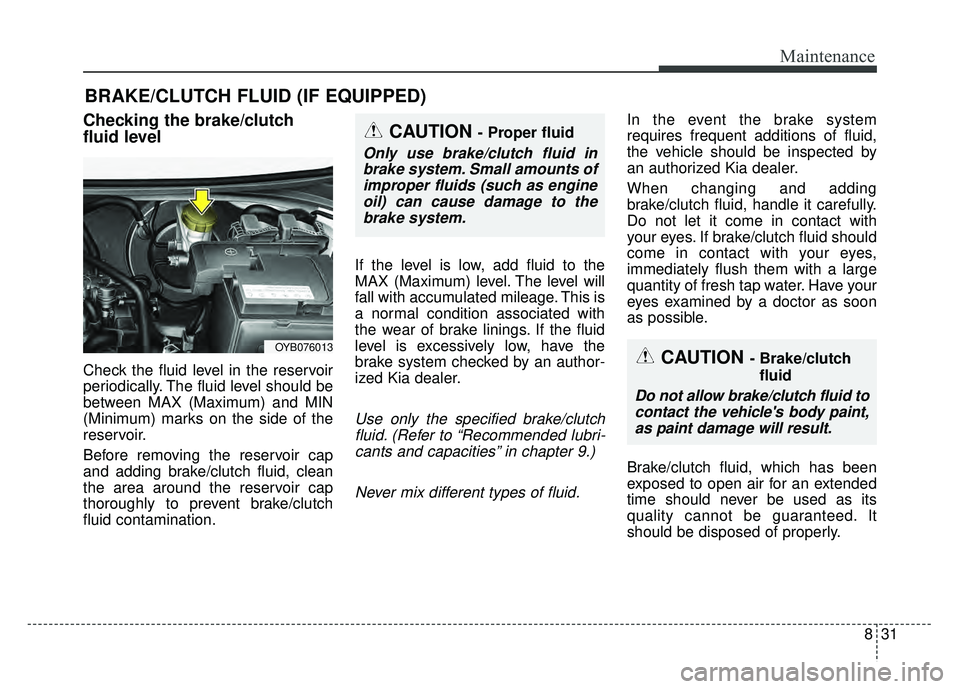
Checking the brake/clutch
fluid level
Check the fluid level in the reservoir
periodically. The fluid level should be
between MAX (Maximum) and MIN
(Minimum) marks on the side of the
reservoir.
Before removing the reservoir cap
and adding brake/clutch fluid, clean
the area around the reservoir cap
thoroughly to prevent brake/clutch
fluid contamination.If the level is low, add fluid to the
MAX (Maximum) level. The level will
fall with accumulated mileage. This is
a normal condition associated with
the wear of brake linings. If the fluid
level is excessively low, have the
brake system checked by an author-
ized Kia dealer.
Use only the specified brake/clutch
fluid. (Refer to “Recommended lubri-cants and capacities” in chapter 9.)
Never mix different types of fluid.
In the event the brake system
requires frequent additions of fluid,
the vehicle should be inspected by
an authorized Kia dealer.
When changing and adding
brake/clutch fluid, handle it carefully.
Do not let it come in contact with
your eyes. If brake/clutch fluid should
come in contact with your eyes,
immediately flush them with a large
quantity of fresh tap water. Have your
eyes examined by a doctor as soon
as possible.
Brake/clutch fluid, which has been
exposed to open air for an extended
time should never be used as its
quality cannot be guaranteed. It
should be disposed of properly.
OYB076013CAUTION - Brake/clutch fluid
Do not allow brake/clutch fluid tocontact the vehicle's body paint,as paint damage will result.
CAUTION - Proper fluid
Only use brake/clutch fluid inbrake system. Small amounts ofimproper fluids (such as engineoil) can cause damage to thebrake system.
Page 454 of 492
Maintenance
104
8
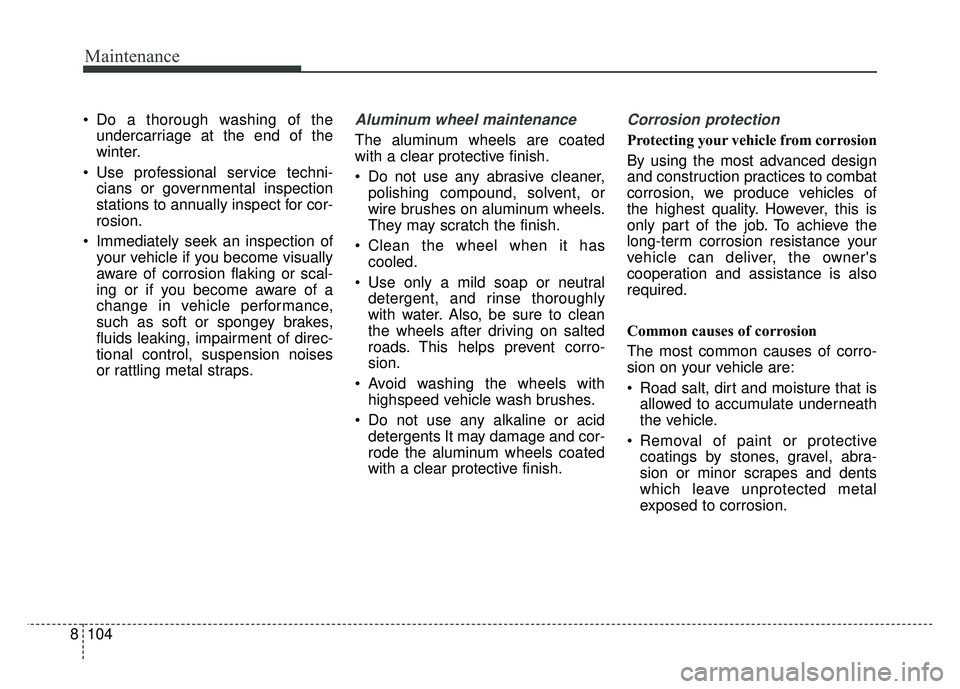
Do a thorough washing of the
undercarriage at the end of the
winter.
Use professional service techni- cians or governmental inspection
stations to annually inspect for cor-
rosion.
Immediately seek an inspection of your vehicle if you become visually
aware of corrosion flaking or scal-
ing or if you become aware of a
change in vehicle performance,
such as soft or spongey brakes,
fluids leaking, impairment of direc-
tional control, suspension noises
or rattling metal straps.Aluminum wheel maintenance
The aluminum wheels are coated
with a clear protective finish.
Do not use any abrasive cleaner,polishing compound, solvent, or
wire brushes on aluminum wheels.
They may scratch the finish.
Clean the wheel when it has cooled.
Use only a mild soap or neutral detergent, and rinse thoroughly
with water. Also, be sure to clean
the wheels after driving on salted
roads. This helps prevent corro-
sion.
Avoid washing the wheels with highspeed vehicle wash brushes.
Do not use any alkaline or acid detergents It may damage and cor-
rode the aluminum wheels coated
with a clear protective finish.
Corrosion protection
Protecting your vehicle from corrosion
By using the most advanced design
and construction practices to combat
corrosion, we produce vehicles of
the highest quality. However, this is
only part of the job. To achieve the
long-term corrosion resistance your
vehicle can deliver, the owner's
cooperation and assistance is also
required.
Common causes of corrosion
The most common causes of corro-
sion on your vehicle are:
Road salt, dirt and moisture that isallowed to accumulate underneath
the vehicle.
Removal of paint or protective coatings by stones, gravel, abra-
sion or minor scrapes and dents
which leave unprotected metal
exposed to corrosion.
Page 470 of 492
Specifications, Consumer information, Reporting safety defects
89
*1Refer to the recommended SAE viscosity numbers on the next page.
*2Engine oils labeled Energy Conserving Oil are now available. Along with other additional benefits, they contribute to fuel econ-
omy by reducing the amount of fuel necessary to overcome engine friction. Often, these improvements are difficult to measure
in everyday driving, but in a year’s time, they can offer significant cost and energy savings.
*
3If the API service SM engine oil is not available in your country, you are able to use API service SL.
*4If the ILSAC GF-4 engine oil is not available in your country, you are able to use ILSAC GF-4 or above grade; therefore, you can
use ILSAC GF-5 or above.
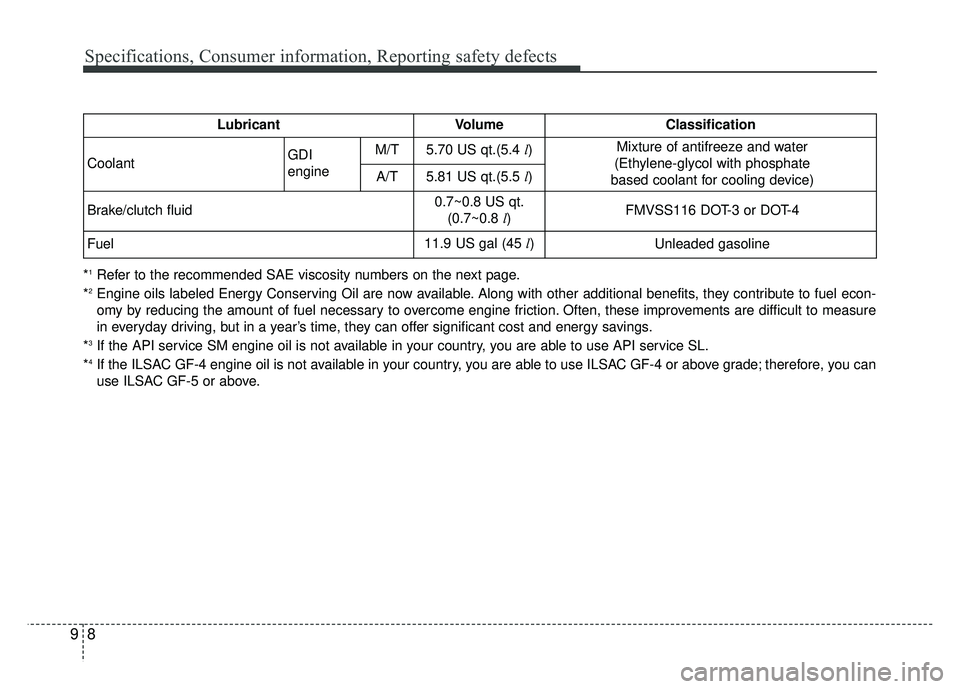
LubricantVolumeClassification
Coolant GDI
engineM/T5.70 US qt.(5.4 l)Mixture of antifreeze and water
(Ethylene-glycol with phosphate
based coolant for cooling device)
A/T5.81 US qt.(5.5 l)
Brake/clutch fluid0.7~0.8 US qt. (0.7~0.8 l)FMVSS116 DOT-3 or DOT-4
Fuel11.9 US gal (45 l)Unleaded gasoline
Page 481 of 492

I3
Index
Battery........................................................................\
....8-42For best battery service ..............................................8-42
Recharging the battery ................................................8-43
Reset items ..................................................................8-44
Battery saver function ....................................................4-87
Battery saver function ....................................................4-87
Before driving ..................................................................6-4
Bonnet see the hood ......................................................4-36
Brake system..................................................................6-23 Parking brake ..............................................................6-25
Anti-lock brake system (ABS)....................................6-27
Electronic stability control (ESC) ..............................6-29
Vehicle stability management (VSM) ........................6-34
Hill-start assist control (HAC) ....................................6-33
Brake/clutch fluid ..........................................................8-31 Checking the brake/clutch fluid level ........................8-31
Bulb replacement ..........................................................8-75
Bulb replacement precaution ........................................8-75
Bulb wattage ....................................................................9-3
California Perchlorate notice ......................................8-112
Camera (Rear view) ......................................................4-86
Capacities (Lubricants) ....................................................9-7
Care Care of seat belts ........................................................3-22
Tire care ......................................................................8-\
45 Exterior care ..............................................................8-101
Interior care ..............................................................8-106
Center console storage ................................................4-128
Central door lock switch................................................4-18
Checking fluid levels ....................................................8-25
Checking tire inflation pressure ....................................8-46
Child restraint system ....................................................3-23 Placing a passenger seat belt into the auto lock mode .. 3-25
Securing a child restraint seat with child seat lower anchor system ..........................................................3-28
Securing a child restraint seat with tether anchorage system ......................................................................3-\
27
Child-protector rear door lock ......................................4-20
Climate control air filter ................................................8-36 Filter inspection ..........................................................8-36
Clothes hanger ............................................................4-135
Combined instrument, see instrument cluster ..............4-52
Consumer assistance (U.S. ONLY) ..............................9-12
Coolant ........................................................................\
..8-28
Cooling fluid, see engine coolant ..................................8-28
Covering shelf ..............................................................4-137
Crankcase emission control system ............................8-109
Cruise control system ....................................................6-48 Cruise control switch ..................................................6-48
To set cruise control speed..........................................6-49
To increase cruise control set speed ..........................6-50
To decrease the cruising speed ..................................6-50
To temporarily accelerate with the cruise control on ..6-50
C
Page 483 of 492
I5
Index
Engine overheats ..............................................................7-6
Engine start/stop button ..................................................6-8Illuminated engine start/stop button ............................6-8
Engine start/stop button position ..................................6-8
Engine start/stop button illumination ..............................6-8
Engine start/stop button position ....................................6-8
Engine will not start ........................................................7-4
Evaporative emission control (including ORVR: Onboard Refueling Vapor Recovery) system ............8-109
Exhaust emission control system ................................8-110
Explanation of scheduled maintenance items ..............8-21 Engine oil and filter ....................................................8-21
Drive belts ..................................................................8-21
Fuel filter (for gasoline) ..............................................8-21
Fuel lines, fuel hoses and connections ......................8-21
Vapor hose and fuel filler cap ....................................8-21
Vacuum crankcase ventilation hoses ..........................8-22
Air cleaner filter ..........................................................8-22
Spark plugs ................................................................8-22
Valve clearance ..........................................................8-22
Cooling system ..........................................................8-22
Coolant ........................................................................\
8-22
Manual transaxle fluid ................................................8-22
Automatic transaxle fluid............................................8-2\
2
Brake hoses and lines..................................................8-23
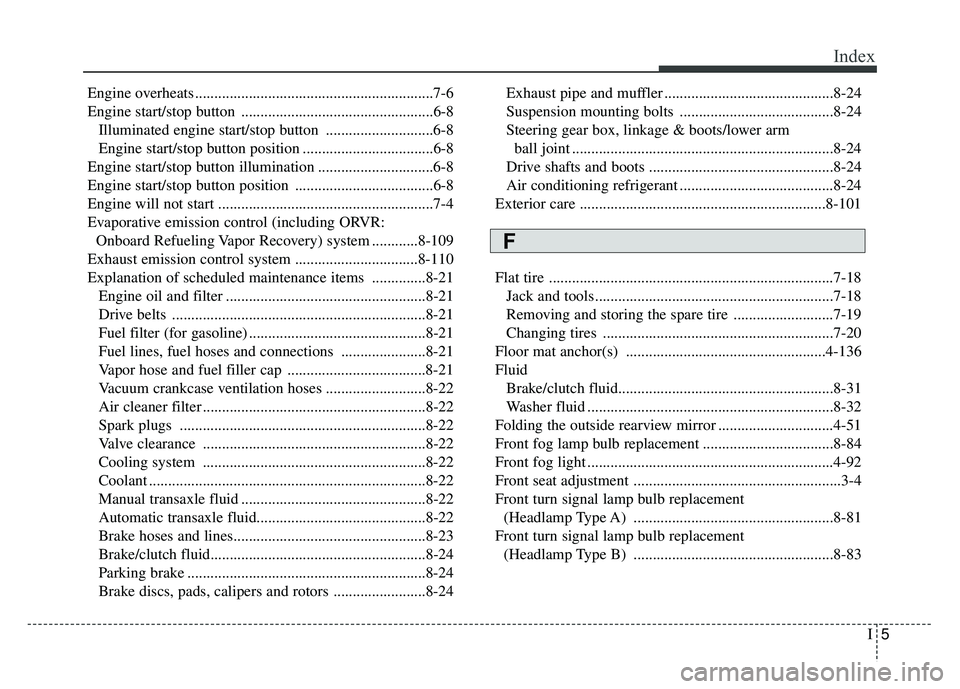
Brake/clutch fluid........................................................8-24
Parking brake ..............................................................8-24
Brake discs, pads, calipers and rotors ........................8-24 Exhaust pipe and muffler ............................................8-24
Suspension mounting bolts ........................................8-24
Steering gear box, linkage & boots/lower arm ball joint ....................................................................8-24\
Drive shafts and boots ................................................8-24
Air conditioning refrigerant ........................................8-24
Exterior care ................................................................8-101
Flat tire ........................................................................\
..7-18 Jack and tools ..............................................................7-18
Removing and storing the spare tire ..........................7-19
Changing tires ............................................................7-20
Floor mat anchor(s) ....................................................4-136
Fluid Brake/clutch fluid........................................................8-31
Washer fluid ................................................................8-32
Folding the outside rearview mirror ..............................4-51
Front fog lamp bulb replacement ..................................8-84
Front fog light ................................................................4-92
Front seat adjustment ......................................................3-4
Front turn signal lamp bulb replacement (Headlamp Type A) ....................................................8-81
Front turn signal lamp bulb replacement (Headlamp Type B) ....................................................8-83
F