tires KIA RIO HATCHBACK 2019 Owner's Manual
[x] Cancel search | Manufacturer: KIA, Model Year: 2019, Model line: RIO HATCHBACK, Model: KIA RIO HATCHBACK 2019Pages: 503, PDF Size: 10.42 MB
Page 348 of 503
715
What to do in an emergency
When you drive your vehicle from a
warm area to a cold area or from a cold
area to a warm area, or the outside
temperature is greatly higher or lower,
you should check the tire inflation pres-
sure and adjust the tires to the recom-
mended tire inflation pressure.TPMS (Tire PressureMonitoring System)malfunction indicator
The low tire pressure telltale will illu-
minate after it blinks for approximate-
ly one minute when there is a prob-
lem with the Tire Pressure
Monitoring System. If the system is
able to correctly detect an underinfla-
tion warning at the same time as sys-
tem failure then it will illuminate both
the TPMS malfunction and low tire
pressure position telltales e.g. if
Front Left sensor fails, the TPMS
malfunction indicator illuminates, but
if the Front Right, Rear Left, or Rear
Right tire is under-inflated, the low
tire pressure position telltales may
illuminate together with the TPMS
malfunction indicator.
Have the system checked by an
authorized Kia dealer as soon as
possible to determine the cause of
the problem. The TPMS malfunction indicator
may be illuminated if the vehicle is
moving around electric power sup-
ply cables or radios transmitters
such as at police stations, govern-
ment and public offices, broadcast-
ing stations, military installations,
airports, or transmitting towers,
etc. This can interfere with normal
operation of the Tire Pressure
Monitoring System (TPMS).
The TPMS malfunction indicator may be illuminated if snow chains
are used or some separate elec-
tronic devices such as notebook
computer, mobile charger, remote
starter or navigation etc., are used
in the vehicle. This can interfere
with normal operation of the Tire
Pressure Monitoring System
(TPMS).
WARNING- Low pressure
damage
Do not drive on low pressure
tires. Significantly low tire pres-
sure can cause the tires to over-
heat and fail making the vehicle
unstable resulting in increased
braking distances and a loss of
vehicle control.
CAUTION
When filling tires with more air, conditions to turn off the low tirepressure telltale may not be met.This is because a tire inflatorhas a margin of error in perform-ance. The low tire pressure tell-tale will be turned off if the tirepressure is above the recom-mended tire inflation pressure.
SC CAN (ENG) 7.qxp 7/18/2018 5:38 PM Page 15
Page 349 of 503
What to do in an emergency
16
7
Changing a tire with TPMS
If you have a flat tire, the Low Tire
Pressure telltale will come on. Have
the flat tire repaired by an authorized
Kia dealer as soon as possible or
replace the flat tire with the spare tire.
Each wheel is equipped with a tire
pressure sensor mounted inside the
tire behind the valve stem. You must
use TPMS specific wheels. It is rec-
ommended that you always have
your tires serviced by an authorized
Kia dealer. Even if you replace the low pressure
tire with the spare tire, the Low Tire
Pressure telltale will remain on until
the low pressure tire is repaired and
placed on the vehicle.
After you replace the low pressure
tire with the spare tire, the TPMS
malfunction indicator may illuminate
after a few minutes because the
TPMS sensor mounted on the spare
wheel is not initiated.
Once the low pressure tire is inflated
again to the recommended pressure
and installed on the vehicle or the
TPMS sensor mounted on the
replaced spare wheel is initiated by
an authorized Kia dealer, the TPMS
malfunction indicator and the low tire
pressure telltale will turn off within a
few minutes of driving.
If the indicator has not disappeared
after a few minutes of driving, please
visit an authorized Kia dealer.If an original mounted tire is replaced
with the spare tire, the TPMS sensor
on the replaced spare wheel should
be initiated and the TPMS sensor on
the original mounted wheel should be
deactivated. If the TPMS sensor on
the original mounted wheel located in
the spare tire carrier still activates,
the tire pressure monitoring system
may not operate properly. Have the
tire with TPMS serviced or replaced
by an authorized Kia dealer.
CAUTION- Repair Agents
Never use a puncture-repairing
agent not approved by Kia torepair and/or inflate a low pres-sure tire. The sealant notapproved by Kia may damagethe tire pressure sensor.
SC CAN (ENG) 7.qxp 7/18/2018 5:38 PM Page 16
Page 352 of 503

719
What to do in an emergency
It is possible that some tires, espe-
cially with larger punctures or dam-
age to the sidewall, cannot be sealed
completely.
Air pressure loss in the tire may
adversely affect tire performance.
For this reason, you should avoid
abrupt steering or other driving
maneuvers, especially if the vehicle
is heavily loaded or if a trailer is in
use.
The Tire Mobility Kit is not designed
or intended as a permanent tire
repair method and is to be used for
one tire only.
This instruction shows you step by
step procedure to temporarily seal
the puncture.
Read the section "Notes on the safe
use of the Tire Mobility Kit".Notes on the safe use of the
Tire Mobility Kit
Park your car at the side of theroad so that you can work with the
Tire Mobility Kit away from moving
traffic.
To be sure your vehicle will not move, even when you're on fairly
level ground, always set your park-
ing brake.
Only use the Tire Mobility Kit for sealing/inflation passenger car
tires. Only punctured areas located
within the tread region of the tire
can be sealed using the tire mobil-
ity kit.
Do not use on motorcycles, bicy- cles or any other type of tires.
When the tire and wheel are dam- aged, do not use Tire Mobility Kit
for your safety.
Use of the Tire Mobility Kit may not be effective for tire damage larger
than approximately 6 mm (0.24 in).
Please contact the nearest Kia
dealership if the tire cannot be
made roadworthy with the Tire
Mobility Kit. Do not use the Tire Mobility Kit if a
tire is severely damaged by driving
run flat or with insufficient air pres-
sure.
Do not remove any foreign objects such as nails or screws that have
penetrated the tire.
Provided the car is outdoors, leave the engine running. Otherwise
operating the compressor may
eventually drain the car battery.
Never leave the Tire Mobility Kit unattended while it is being used.
Do not leave the compressor run- ning for more than 10 min. at a time
or it may overheat.
Do not use the Tire Mobility Kit if the ambient temperature is below -
-30°C (22°F).
SC CAN (ENG) 7.qxp 7/18/2018 5:38 PM Page 19
Page 359 of 503

What to do in an emergency
26
7
IF YOU HAVE A FLAT TIRE (WITH SPARE TIRE, IF EQUIPPED)
Jack and tools
The spare tire, jack, jack handle and
wheel lug nut wrench are stored in
the luggage compartment. Remove the luggage under tray out
of the way to reach the equipment.
(1) Jack handle
(2) Jack
(3) Wheel lug nut wrench
Jacking instructions
The jack is provided for emergency
tire changing only.
To prevent the jack from “rattling”
while the vehicle is in motion, store it
properly.
Follow jacking instructions to reduce
the possibility of personal injury.
WARNING- Changing
tires
Never attempt vehicle repairs in
the traffic lanes of a public road
or highway.
OSC067007N
OYB066003
■ 4 door
■5 door
SC CAN (ENG) 7.qxp 7/18/2018 5:39 PM Page 26
Page 361 of 503
What to do in an emergency
28
7
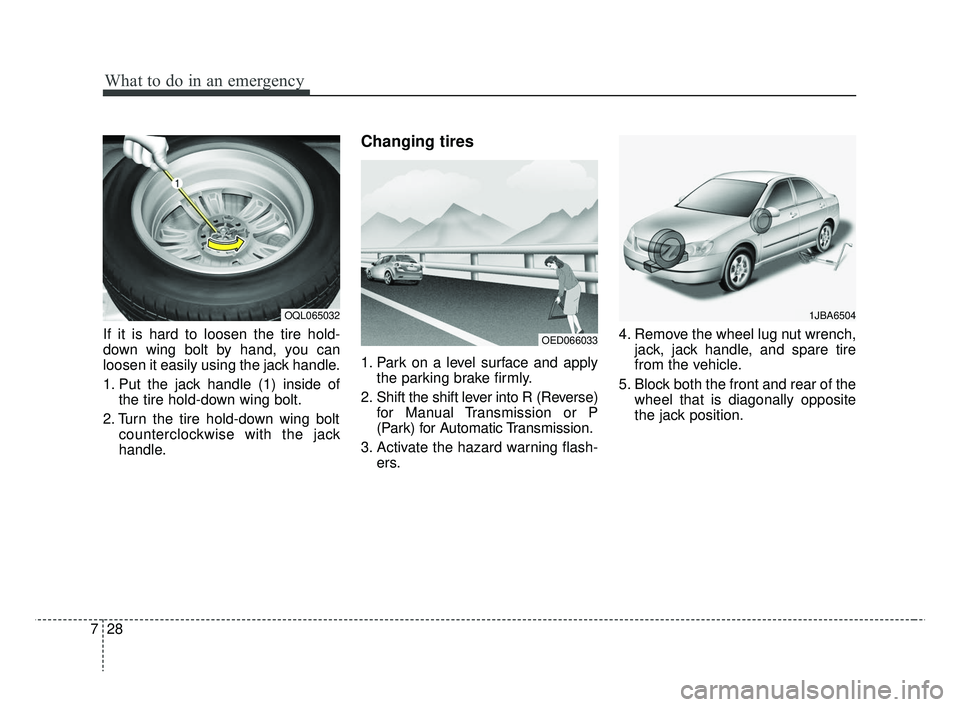
If it is hard to loosen the tire hold-
down wing bolt by hand, you can
loosen it easily using the jack handle.
1. Put the jack handle (1) inside of
the tire hold-down wing bolt.
2. Turn the tire hold-down wing bolt counterclockwise with the jack
handle.
Changing tires
1. Park on a level surface and applythe parking brake firmly.
2. Shift the shift lever into R (Reverse) for Manual Transmission or P
(Park) for Automatic Transmission.
3. Activate the hazard warning flash- ers. 4. Remove the wheel lug nut wrench,
jack, jack handle, and spare tire
from the vehicle.
5. Block both the front and rear of the wheel that is diagonally opposite
the jack position.
OED066033
1JBA6504OQL065032
SC CAN (ENG) 7.qxp 7/18/2018 5:39 PM Page 28
Page 364 of 503
731
What to do in an emergency
10. To install the wheel, hold it on thestuds, put the wheel nuts on the
studs and tighten them finger
tight. Jiggle the tire to be sure it is
completely seated, then tighten
the nuts as much as possible
with your fingers again.
11. Lower the vehicle to the ground by turning the wheel nut wrench
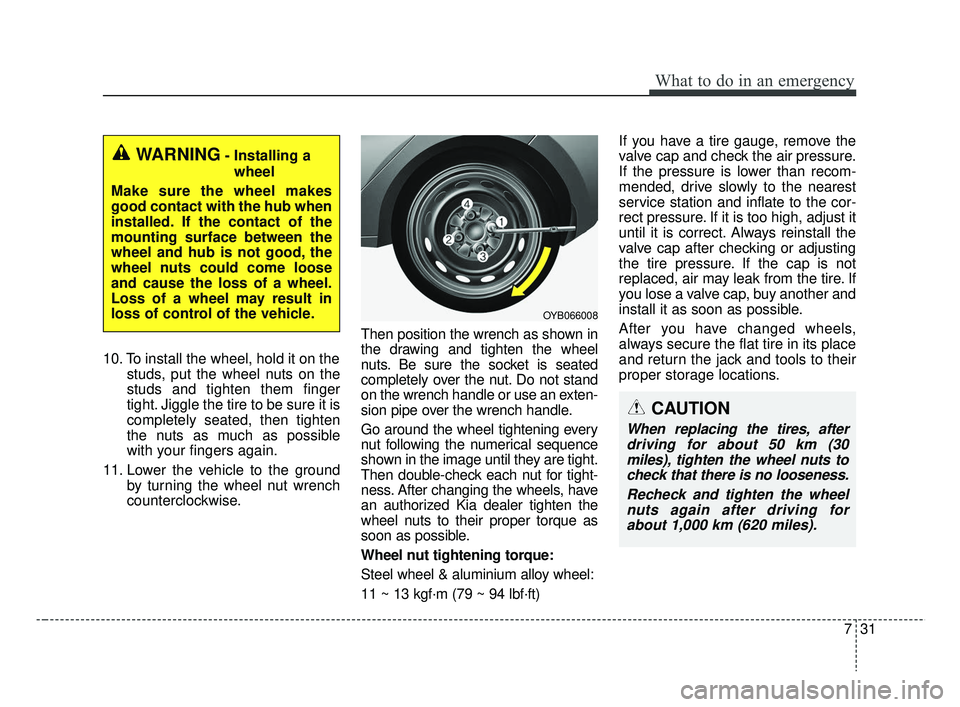
counterclockwise. Then position the wrench as shown in
the drawing and tighten the wheel
nuts. Be sure the socket is seated
completely over the nut. Do not stand
on the wrench handle or use an exten-
sion pipe over the wrench handle.
Go around the wheel tightening every
nut following the numerical sequence
shown in the image until they are tight.
Then double-check each nut for tight-
ness. After changing the wheels, have
an authorized Kia dealer tighten the
wheel nuts to their proper torque as
soon as possible.
Wheel nut tightening torque:
Steel wheel & aluminium alloy wheel:
11 ~ 13 kgf·m (79 ~ 94 lbf·ft) If you have a tire gauge, remove the
valve cap and check the air pressure.
If the pressure is lower than recom-
mended, drive slowly to the nearest
service station and inflate to the cor-
rect pressure. If it is too high, adjust it
until it is correct. Always reinstall the
valve cap after checking or adjusting
the tire pressure. If the cap is not
replaced, air may leak from the tire. If
you lose a valve cap, buy another and
install it as soon as possible.
After you have changed wheels,
always secure the flat tire in its place
and return the jack and tools to their
proper storage locations.
WARNING- Installing a
wheel
Make sure the wheel makes
good contact with the hub when
installed. If the contact of the
mounting surface between the
wheel and hub is not good, the
wheel nuts could come loose
and cause the loss of a wheel.
Loss of a wheel may result in
loss of control of the vehicle.
OYB066008
CAUTION
When replacing the tires, after driving for about 50 km (30miles), tighten the wheel nuts tocheck that there is no looseness.
Recheck and tighten the wheelnuts again after driving forabout 1,000 km (620 miles).
SC CAN (ENG) 7.qxp 7/18/2018 5:39 PM Page 31
Page 365 of 503
What to do in an emergency
32
7
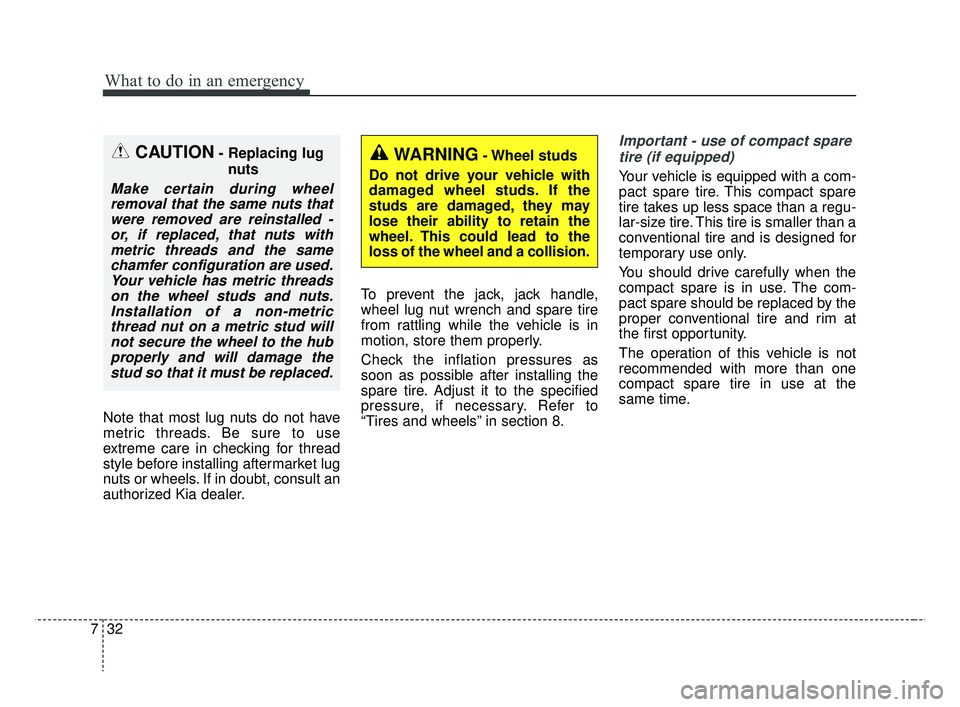
Note that most lug nuts do not have
metric threads. Be sure to use
extreme care in checking for thread
style before installing aftermarket lug
nuts or wheels. If in doubt, consult an
authorized Kia dealer. To prevent the jack, jack handle,
wheel lug nut wrench and spare tire
from rattling while the vehicle is in
motion, store them properly.
Check the inflation pressures as
soon as possible after installing the
spare tire. Adjust it to the specified
pressure, if necessary. Refer to
“Tires and wheels” in section 8.
Important - use of compact spare
tire (if equipped)
Your vehicle is equipped with a com-
pact spare tire. This compact spare
tire takes up less space than a regu-
lar-size tire. This tire is smaller than a
conventional tire and is designed for
temporary use only.
You should drive carefully when the
compact spare is in use. The com-
pact spare should be replaced by the
proper conventional tire and rim at
the first opportunity.
The operation of this vehicle is not
recommended with more than one
compact spare tire in use at the
same time.
CAUTION- Replacing lug nuts
Make certain during wheelremoval that the same nuts thatwere removed are reinstalled -or, if replaced, that nuts withmetric threads and the samechamfer configuration are used.Your vehicle has metric threadson the wheel studs and nuts.Installation of a non-metricthread nut on a metric stud willnot secure the wheel to the hubproperly and will damage thestud so that it must be replaced.
WARNING- Wheel studs
Do not drive your vehicle with
damaged wheel studs. If the
studs are damaged, they may
lose their ability to retain the
wheel. This could lead to the
loss of the wheel and a collision.
SC CAN (ENG) 7.qxp 7/18/2018 5:39 PM Page 32
Page 367 of 503
What to do in an emergency
34
7
Do not use the compact spare tire
on any other vehicle because this
tire has been designed especially
for your vehicle.
The compact spare tire’s tread life is shorter than a regular tire.
Inspect your compact spare tire
regularly and replace worn com-
pact spare tires with the same size
and design, mounted on the same
wheel.
The compact spare tire should not be used on any other wheels, nor
should standard tires, snow tires,
wheel covers or trim rings be used
with the compact spare wheel. If
such use is attempted, damage to
these items or other car compo-
nents may occur.
Do not use more than one compact spare tire at a time.
Do not tow a trailer while the com- pact spare tire is installed.
SC CAN (ENG) 7.qxp 7/18/2018 5:39 PM Page 34
Page 373 of 503
Maintenance
Engine compartment . . . . . . . . . . . . . . . . . . . . . . . . 8-4
Maintenance services . . . . . . . . . . . . . . . . . . . . . . . . 8-5
• Owner’s responsibility . . . . . . . . . . . . . . . . . . . . . . . . . 8-5
• Owner maintenance precautions . . . . . . . . . . . . . . . . . 8-6
Owner maintenance . . . . . . . . . . . . . . . . . . . . . . . . . 8-7
• Owner maintenance schedule. . . . . . . . . . . . . . . . . . . . 8-7
Scheduled maintenance service. . . . . . . . . . . . . . . 8-10
• Scheduled maintenance service precaution . . . . . . . 8-10
Explanation of scheduled maintenance items . . . 8-16
Checking fluid levels . . . . . . . . . . . . . . . . . . . . . . . 8-20
Engine oil. . . . . . . . . . . . . . . . . . . . . . . . . . . . . . . . . 8-21
• Checking the engine oil level . . . . . . . . . . . . . . . . . . . 8-21
• Changing the engine oil and filter . . . . . . . . . . . . . . . 8-22
Engine coolant . . . . . . . . . . . . . . . . . . . . . . . . . . . . 8-23
• Checking the coolant level . . . . . . . . . . . . . . . . . . . . . 8-23
• Changing the coolant . . . . . . . . . . . . . . . . . . . . . . . . . 8-25
Brake/clutch fluid . . . . . . . . . . . . . . . . . . . . . . . . . . 8-26
• Checking the brake/clutch fluid level . . . . . . . . . . . . 8-26
Washer fluid . . . . . . . . . . . . . . . . . . . . . . . . . . . . . . 8-27
• Checking the washer fluid level . . . . . . . . . . . . . . . . . 8-27
Parking brake . . . . . . . . . . . . . . . . . . . . . . . . . . . . . 8-28
• Checking the parking brake. . . . . . . . . . . . . . . . . . . . 8-28
Air cleaner. . . . . . . . . . . . . . . . . . . . . . . . . . . . . . . . 8-29
• Filter replacement . . . . . . . . . . . . . . . . . . . . . . . . . . . . 8-29
Climate control air filter . . . . . . . . . . . . . . . . . . . . 8-31
• Filter inspection . . . . . . . . . . . . . . . . . . . . . . . . . . . . . . 8-31
Wiper blades . . . . . . . . . . . . . . . . . . . . . . . . . . . . . . 8-33
• Blade inspection . . . . . . . . . . . . . . . . . . . . . . . . . . . . . . 8-33
• Blade replacement . . . . . . . . . . . . . . . . . . . . . . . . . . . . 8-33
Battery . . . . . . . . . . . . . . . . . . . . . . . . . . . . . . . . . . . 8-\
37
• For best battery service . . . . . . . . . . . . . . . . . . . . . . . 8-37
• Recharging the battery . . . . . . . . . . . . . . . . . . . . . . . . 8-38
• Reset items . . . . . . . . . . . . . . . . . . . . . . . . . . . . . . . . . . 8-39\
Tires and wheels . . . . . . . . . . . . . . . . . . . . . . . . . . . 8-40
• Tire care . . . . . . . . . . . . . . . . . . . . . . . . . . . . . . . . . . . . \
8-40
• Recommended cold tire inflation pressures . . . . . . . 8-40
• Tire pressure . . . . . . . . . . . . . . . . . . . . . . . . . . . . . . . . 8-41
• Checking tire inflation pressure. . . . . . . . . . . . . . . . . 8-41
• Tire rotation . . . . . . . . . . . . . . . . . . . . . . . . . . . . . . . . . 8-42
• Wheel alignment and tire balance . . . . . . . . . . . . . . . 8-43
• Tire replacement . . . . . . . . . . . . . . . . . . . . . . . . . . . . . 8-44
• Wheel replacement . . . . . . . . . . . . . . . . . . . . . . . . . . . 8-45
• Tire traction . . . . . . . . . . . . . . . . . . . . . . . . . . . . . . . . . 8-45
• Tire maintenance . . . . . . . . . . . . . . . . . . . . . . . . . . . . . 8-45
• Tire sidewall labeling . . . . . . . . . . . . . . . . . . . . . . . . . 8-45
• All season tires . . . . . . . . . . . . . . . . . . . . . . . . . . . . . . . 8-52
• Summer tires . . . . . . . . . . . . . . . . . . . . . . . . . . . . . . . . 8-52
• Snow tires . . . . . . . . . . . . . . . . . . . . . . . . . . . . . . . . . . . 8-\
53
8
SC CAN (ENG) 8.qxp 7/18/2018 5:32 PM Page 1
Page 374 of 503
• Radial-ply tires . . . . . . . . . . . . . . . . . . . . . . . . . . . . . . 8-53
• Low aspect ratio tire . . . . . . . . . . . . . . . . . . . . . . . . . . 8-54
Fuses . . . . . . . . . . . . . . . . . . . . . . . . . . . . . . . . . . . . \
8-55
• Inner panel fuse replacement . . . . . . . . . . . . . . . . . . . 8-57
• Memory fuse . . . . . . . . . . . . . . . . . . . . . . . . . . . . . . . . 8-58
• Engine compartment fuse replacement. . . . . . . . . . . 8-59
• Fuse/relay panel description. . . . . . . . . . . . . . . . . . . . 8-61
Light bulbs . . . . . . . . . . . . . . . . . . . . . . . . . . . . . . . 8-70
• Bulb replacement precaution . . . . . . . . . . . . . . . . . . 8-70
• Light bulb position (front) . . . . . . . . . . . . . . . . . . . . . 8-72
• Light bulb position (rear) (5 door) . . . . . . . . . . . . . . 8-73
• Light bulb position (rear) (4 door) . . . . . . . . . . . . . . 8-74
• Light bulb position (side) . . . . . . . . . . . . . . . . . . . . . . 8-75
• Headlamp (Low/High beam) (Bulb type) bulb replacement (Headlamp Type A) . . . . . . . . . . . . . . . 8-75
• Side marker (front) (Bulb type) bulb replacement (Headlamp Type A) . . . . . . . . . . . . . . . . . . . . . . . . . . 8-76
• Front turn signal lamp bulb replacement (Headlamp Type A) . . . . . . . . . . . . . . . . . . . . . . . . . . 8-77
• Headlamp (Low/High beam) (Bulb type) bulb replacement (Headlamp Type B) . . . . . . . . . . . . . . . 8-78
• Headlamp (Low/High beam) (LED type) bulb replacement (Headlamp Type B) . . . . . . . . . . . . . . . 8-79
• Front turn signal lamp bulb replacement (Headlamp Type B) . . . . . . . . . . . . . . . . . . . . . . . . . . 8-79 • Side marker (front) (LED type) bulb replacement
(Headlamp Type B) . . . . . . . . . . . . . . . . . . . . . . . . . . 8-80
• Front fog lamp bulb replacement . . . . . . . . . . . . . . . 8-80
• Position lamp + DRL (LED type) bulb r eplacement . 8-81
• Daytime running lamp (Bulb type) bulb replacement . . . . . . . . . . . . . . . . . . . . . . . . . . . . . . . . 8-81
• Side repeater lamp (LED type) bulb Replacement . 8-82
• Side repeater lamp (bulb type) bulb Replacement . 8-82
• Stop and tail lamp bulb replacement (for 5 door) . . 8-83
• Rear turn signal lamp bulb replacement (for 5 door) . . . . . . . . . . . . . . . . . . . . . . . . . . . . . . . . . 8-84
• Stop and tail lamp (LED type) bulb replacement (for 5 door) . . . . . . . . . . . . . . . . . . . . . . . . . . . . . . . . . 8-85
• Back-up lamp bulb replacement (for 5 door) . . . . . . 8-86
• Tail lamp (inside) bulb replacement (for 5 door) . . . 8-86
• Side marker (rear) (Bulb type) bulb replacement (Rear combination lamp Type A) (for 5 door) . . . . 8-87
• Side marker (rear) (LED type) bulb replacement (Rear combination lamp Type B) (for 5 door) . . . . 8-88
• High mounted stop lamp bulb replacement (for 5 door) . . . . . . . . . . . . . . . . . . . . . . . . . . . . . . . . . 8-89
• License plate lamp bulb replacement . . . . . . . . . . . . 8-89
• Rear turn signal lamp bulb replacement (for 4 door) . . . . . . . . . . . . . . . . . . . . . . . . . . . . . . . . . 8-90
• Stop and tail lamp / Side marker (Bulb type) replacement (for 4 door) . . . . . . . . . . . . . . . . . . . . . . 8-91
8
SC CAN (ENG) 8.qxp 7/18/2018 5:32 PM Page 2