Center KIA Rondo 2015 3.G User Guide
[x] Cancel search | Manufacturer: KIA, Model Year: 2015, Model line: Rondo, Model: KIA Rondo 2015 3.GPages: 564, PDF Size: 19.11 MB
Page 58 of 564
343
Safety features of your vehicle
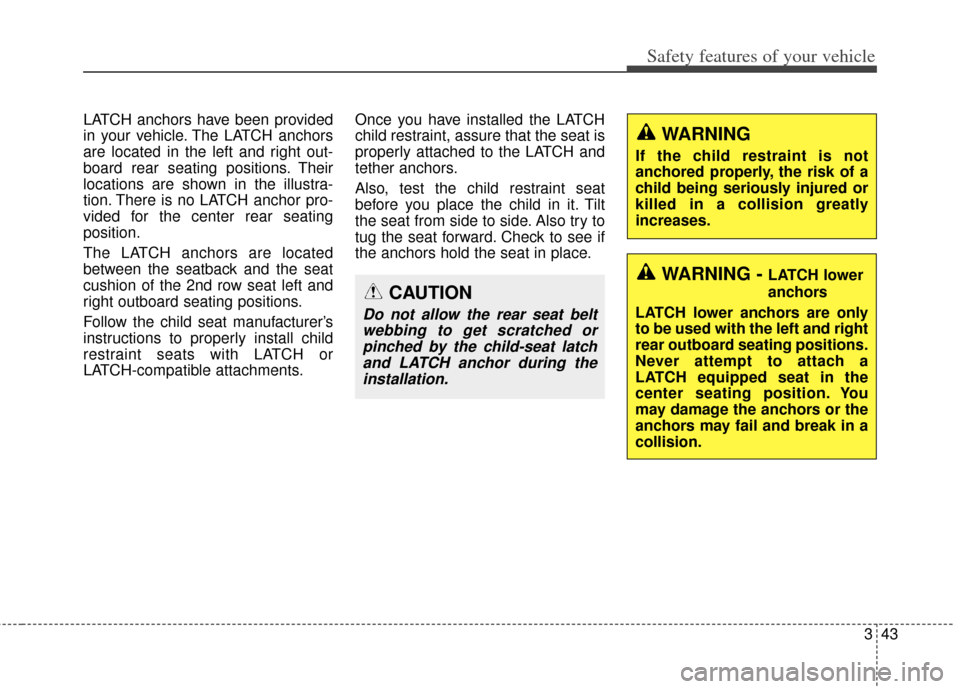
LATCH anchors have been provided
in your vehicle. The LATCH anchors
are located in the left and right out-
board rear seating positions. Their
locations are shown in the illustra-
tion. There is no LATCH anchor pro-
vided for the center rear seating
position.
The LATCH anchors are located
between the seatback and the seat
cushion of the 2nd row seat left and
right outboard seating positions.
Follow the child seat manufacturer’s
instructions to properly install child
restraint seats with LATCH or
LATCH-compatible attachments.Once you have installed the LATCH
child restraint, assure that the seat is
properly attached to the LATCH and
tether anchors.
Also, test the child restraint seat
before you place the child in it. Tilt
the seat from side to side. Also try to
tug the seat forward. Check to see if
the anchors hold the seat in place.
WARNING
If the child restraint is not
anchored properly, the risk of a
child being seriously injured or
killed in a collision greatly
increases.
WARNING - LATCH lower
anchors
LATCH lower anchors are only
to be used with the left and right
rear outboard seating positions.
Never attempt to attach a
LATCH equipped seat in the
center seating position. You
may damage the anchors or the
anchors may fail and break in a
collision.
CAUTION
Do not allow the rear seat belt webbing to get scratched orpinched by the child-seat latchand LATCH anchor during theinstallation.
Page 64 of 564
349
Safety features of your vehicle
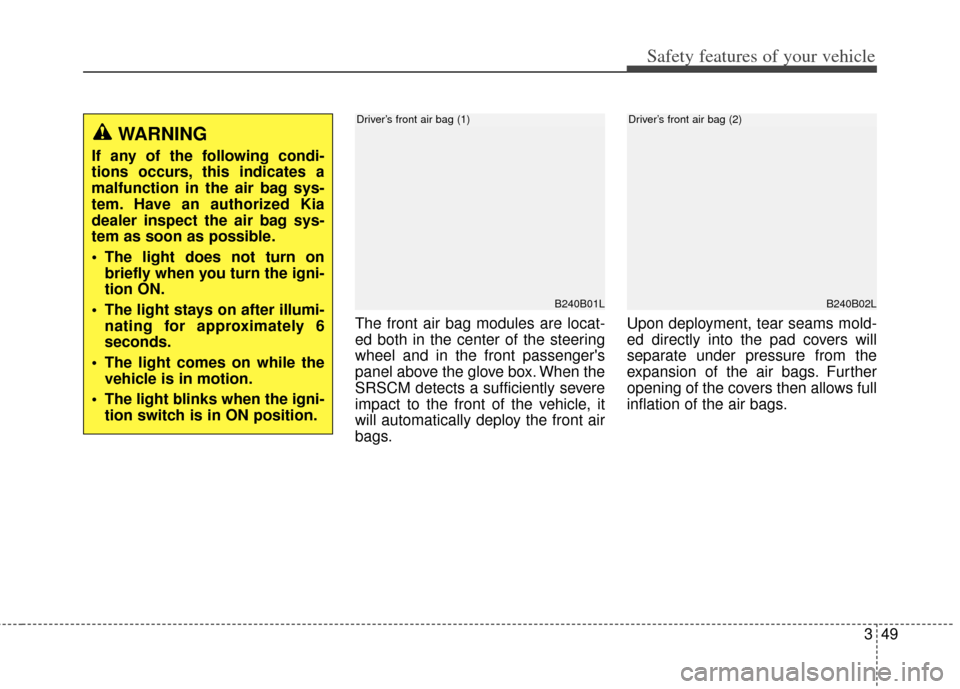
The front air bag modules are locat-
ed both in the center of the steering
wheel and in the front passenger's
panel above the glove box. When the
SRSCM detects a sufficiently severe
impact to the front of the vehicle, it
will automatically deploy the front air
bags.Upon deployment, tear seams mold-
ed directly into the pad covers will
separate under pressure from the
expansion of the air bags. Further
opening of the covers then allows full
inflation of the air bags.
B240B01L
Driver’s front air bag (1)
WARNING
If any of the following condi-
tions occurs, this indicates a
malfunction in the air bag sys-
tem. Have an authorized Kia
dealer inspect the air bag sys-
tem as soon as possible.
The light does not turn on
briefly when you turn the igni-
tion ON.
The light stays on after illumi- nating for approximately 6
seconds.
The light comes on while the vehicle is in motion.
The light blinks when the igni- tion switch is in ON position.
B240B02L
Driver’s front air bag (2)
Page 67 of 564
Safety features of your vehicle
52
3
Main components of the occu-
pant detection system
A detection device located within the front passenger seat cushion.
An electronic system which deter- mines whether the passenger air
bag systems should be activated
or deactivated.
A indicator light located on the instrument panel which illuminates
the words PASSENGER AIR BAG
“OFF” indicating the front passen-
ger air bag system is deactivated.
The instrument panel air bag warn- ing light is interconnected with the
occupant detection system. If the front passenger seat is occu-
pied by a person that the system
determines to be of appropriate size,
and he/she sits properly (sitting
upright with the seatback in an
upright position, centered on the
seat cushion with their seat belt on,
legs comfortably extended and their
feet on the floor), the PASSENGER
AIR BAG “OFF” indicator will turn off
and the front passenger's air bag will
be able to inflate, if necessary, in
frontal crashes.
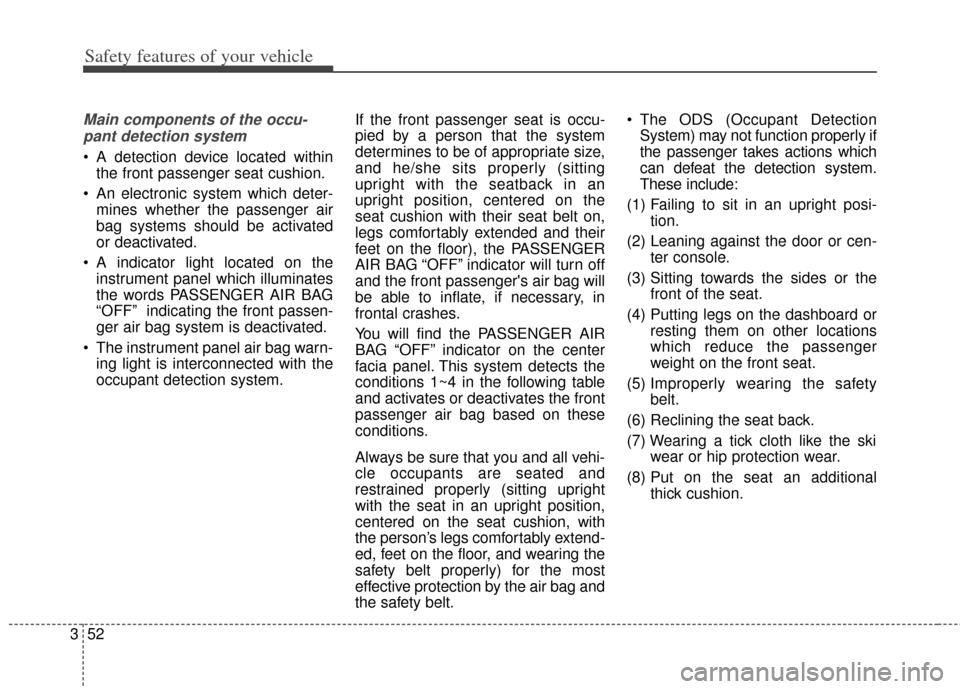
You will find the PASSENGER AIR
BAG “OFF” indicator on the center
facia panel. This system detects the
conditions 1~4 in the following table
and activates or deactivates the front
passenger air bag based on these
conditions.
Always be sure that you and all vehi-
cle occupants are seated and
restrained properly (sitting upright
with the seat in an upright position,
centered on the seat cushion, with
the person’s legs comfortably extend-
ed, feet on the floor, and wearing the
safety belt properly) for the most
effective protection by the air bag and
the safety belt. The ODS (Occupant Detection
System) may not function properly if
the passenger takes actions which
can defeat the detection system.
These include:
(1) Failing to sit in an upright posi- tion.
(2) Leaning against the door or cen- ter console.
(3) Sitting towards the sides or the front of the seat.
(4) Putting legs on the dashboard or resting them on other locations
which reduce the passenger
weight on the front seat.
(5) Improperly wearing the safety belt.
(6) Reclining the seat back.
(7) Wearing a tick cloth like the ski wear or hip protection wear.
(8) Put on the seat an additional thick cushion.
Page 70 of 564
355
Safety features of your vehicle
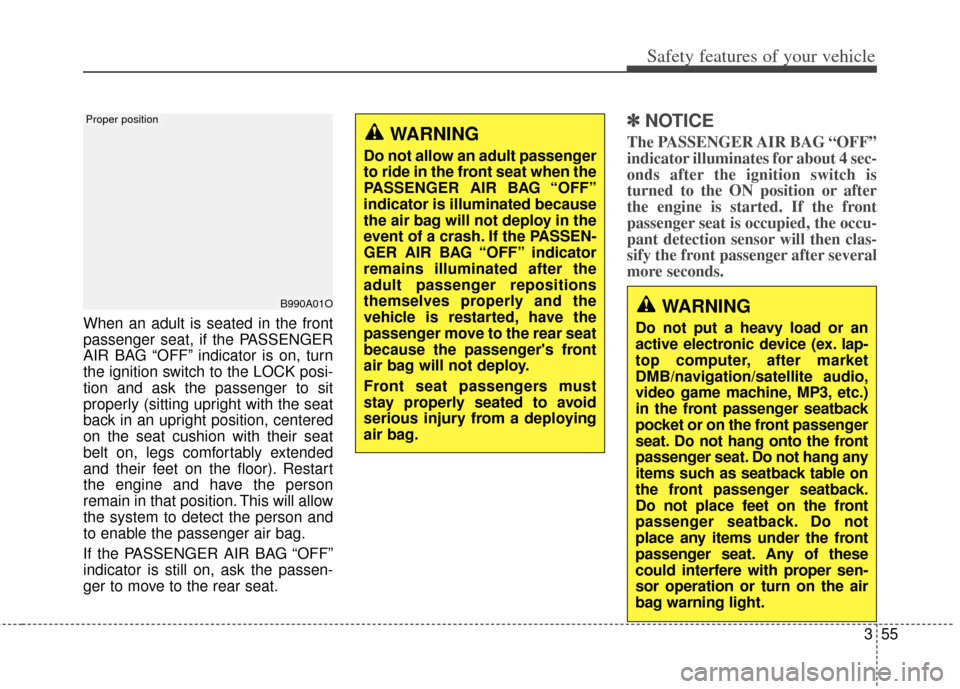
When an adult is seated in the front
passenger seat, if the PASSENGER
AIR BAG “OFF” indicator is on, turn
the ignition switch to the LOCK posi-
tion and ask the passenger to sit
properly (sitting upright with the seat
back in an upright position, centered
on the seat cushion with their seat
belt on, legs comfortably extended
and their feet on the floor). Restart
the engine and have the person
remain in that position. This will allow
the system to detect the person and
to enable the passenger air bag.
If the PASSENGER AIR BAG “OFF”
indicator is still on, ask the passen-
ger to move to the rear seat.
✽ ✽NOTICE
The PASSENGER AIR BAG “OFF”
indicator illuminates for about 4 sec-
onds after the ignition switch is
turned to the ON position or after
the engine is started. If the front
passenger seat is occupied, the occu-
pant detection sensor will then clas-
sify the front passenger after several
more seconds.
B990A01OWARNING
Do not put a heavy load or an
active electronic device (ex. lap-
top computer, after market
DMB/navigation/satellite audio,
video game machine, MP3, etc.)
in the front passenger seatback
pocket or on the front passenger
seat. Do not hang onto the front
passenger seat. Do not hang any
items such as seatback table on
the front passenger seatback.
Do not place feet on the front
passenger seatback. Do not
place any items under the front
passenger seat. Any of these
could interfere with proper sen-
sor operation or turn on the air
bag warning light.
Proper position
WARNING
Do not allow an adult passenger
to ride in the front seat when the
PASSENGER AIR BAG “OFF”
indicator is illuminated because
the air bag will not deploy in the
event of a crash. If the PASSEN-
GER AIR BAG “OFF” indicator
remains illuminated after the
adult passenger repositions
themselves properly and the
vehicle is restarted, have the
passenger move to the rear seat
because the passenger's front
air bag will not deploy.
Front seat passengers must
stay properly seated to avoid
serious injury from a deploying
air bag.
Page 71 of 564
Safety features of your vehicle
56
3
WARNING
Even though your vehicle is
equipped with the occupant
detection system, never install a
child restraint system in the
front passenger's seat. A
deploying air bag can forcefully
strike a child resulting in seri-
ous injuries or death. Any child
age 12 and under should ride in
the rear seat. Children too large
for child restraints should use
the available lap/shoulder belts.
No matter what type of crash,
children of all ages are safer
when restrained in the rear seat.
If the PASSENGER AIR BAG “OFF” indicator is illuminated
when the front passenger's seat
is occupied by an adult and
he/she sits properly (sitting
upright with the seatback in an
upright position, centered on
the seat cushion with their seat
belt on, legs comfortably
extended and their feet on the
floor), have that person sit in the
rear seat.
(Continued)
(Continued)
Accident statistics show thatchildren are safer if they are
restrained in the rear, as
opposed to the front seat. It is
recommended that child
restraints be secured in a rear
seat, including an infant riding
in a rear-facing infant seat, a
child riding in a forward-facing
child seat and an older child
riding in a booster seat.
Air bags can only be used once – have an authorized Kia
dealer replace the air bag
immediately after deployment.
The occupant detection sys- tem may not work properly if
water, coffee or any other liq-
uid including rain gets on the
seat. Keep the front seat dry
at all times.
(Continued)(Continued)
If the front passenger seat isoccupied by a child who is not
in a CRS, the PASSENGER
AIR BAG “OFF” indicator may
or may not be on and the pas-
senger air bag may or may not
deploy in a collision. Have the
child move to a rear seat to
increase their safety.
Do not modify or replace the front passenger seat. Don't
place anything on or attach
anything such as a blanket or
seat heater to the front pas-
senger seat. This can adverse-
ly affect the occupant detec-
tion system.
Do not place sharp objects on the front passenger seat.
These may damage the occu-
pant detection system, if they
puncture the seat cushion.
Do not use accessory seat covers on the front seats.
(Continued)
Page 73 of 564
Safety features of your vehicle
58
3
The indication of the system's pres-
ence are the letters "AIR BAG"
intagliated on the air bag pad cover
on the steering wheel and the pas-
senger's side front panel pad above
the glove box.
The SRS consists of air bags
installed under the pad covers in the
center of the steering wheel and the
passenger's side front panel above
the glove box.
The purpose of the SRS is to provide
the vehicle's driver and/or the front
passenger with additional protection
than that offered by the seat belt sys-
tem alone in case of a frontal impact
of sufficient severity. The SRS uses
sensors to gather information about
the driver's and front passenger's
seat belt usage and impact severity. The SRS offers the ability to control
the air bag inflation with two levels. A
first stage level is provided for mod-
erate-severity impacts. A second
stage level is provided for more
severe impacts.
The passenger’s front air bag is
designed to help reduce the injury of
children sitting close to the instru-
ment panel in low speed collisions.
However, children are safer if they
are restrained in the rear seat.
Additionally, your vehicle is equipped
with an occupant detection system in
the front passenger's seat. The occu-
pant detection system detects the
presence of a passenger in the front
passenger's seat and will turn off the
front passenger's air bag under cer-
tain conditions. For more detail, see
"Occupant detection system" in this
section.
WARNING
If the occupant detection sys-
tem is not working properly, the
SRS air bag warning light on
the instrument panel will illumi-
nate because the SRS air bag
warning light is connected with
the occupant detection system.
If the SRS air bag warning light
does not illuminate when the
ignition switch is turned to the
ON position, remains illuminat-
ed after approximately 6 sec-
onds when the ignition switch
is turned to the ON position, or
if it illuminates while the vehicle
is being driven, have an author-
ized Kia dealer inspect the SRS
air bag system as soon as pos-
sible.
Page 75 of 564
Safety features of your vehicle
60
3
✽
✽
NOTICE
Be sure to read information about
the SRS on the labels provided on
the sunvisor.(Continued)
Front and side air bags can
injure occupants improperly
positioned in the front seats.
Move your seat as far back as practical from the front air
bags, while still maintaining
control of the vehicle.
You and your passengers should never sit or lean
unnecessarily close to the air
bags. Improperly positioned
drivers and passengers can
be severely injured by inflat-
ing air bags.
Never lean against the door or center console – always sit in
an upright position.
Do not allow a passenger to ride in the front seat when the
PASSENGER AIR BAG “OFF”
indicator is illuminated,
because the air bag will not
deploy in the event of a mod-
erate or severe frontal crash.
(Continued)WARNING
Always use seat belts and child
restraints – every trip, every
time, everyone! Air bags inflate
with considerable force and in
the blink of an eye. Seat belts
help keep occupants in proper
position to obtain maximum
benefit from the air bag. Even
with advanced air bags, improp-
erly and unbelted occupants
can be severely injured when
the air bag inflates. Always fol-
low the precautions about seat
belts, air bags and occupant
safety contained in this manual.
To reduce the chance of serious
or fatal injuries and receive the
maximum safety benefit from
your restraint system:
Never place a child in anychild or booster seat in the
front seat.
ABC – Always Buckle Children in the 2nd Row seat.
It is the safest place for chil-
dren of any age to ride.
(Continued)
Page 77 of 564
Safety features of your vehicle
62
3
(Continued)
For maximum safety protection
in all types of crashes, all occu-
pants including the driver
should always wear their seat
belts whether or not an air bag
is also provided at their seating
position to minimize the risk of
severe injury or death in the
event of a crash. Do not sit or
lean unnecessarily close to the
air bag while the vehicle is in
motion.
Sitting improperly or out of position can result in serious
or fatal injury in a crash. All
occupants should sit upright
with the seat back in an upright
position, centered on the seat
cushion with their seat belt on,
legs comfortably extended and
their feet on the floor until the
vehicle is parked and the igni-
tion key is removed or the
engine is shut off.
(Continued)(Continued)
Even though your vehicle isequipped with the occupant
detection system, do not
install a child restraint system
in the front passenger seat
position. A child restraint sys-
tem must never be placed in
the front seat. The infant or
child could be severely
injured or killed by an air bag
deployment in case of an acci-
dent.
Children age 12 and under must always be properly
restrained in the rear seat.
Never allow children to ride in
the front passenger seat. If a
child over 12 must be seated
in the front seat, he or she
must be properly belted and
the seat should be moved as
far back as possible.
(Continued)
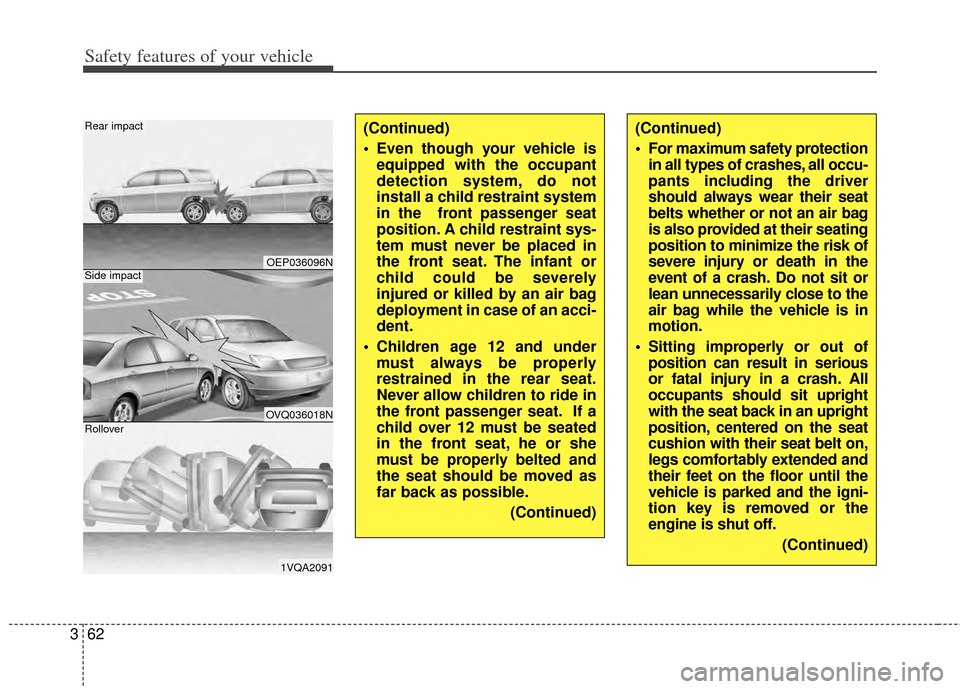
OEP036096N
OVQ036018N
1VQA2091
Rear impact
Side impact
Rollover
Page 87 of 564
Safety features of your vehicle
72
3
Additional safety precautions
Never let passengers ride in the
cargo area or on top of a folded-
down back seat. All occupants
should sit upright, fully back in their
seats with their seat belts on and
their feet on the floor.
Passengers should not move
out of or change seats while the
vehicle is moving. A passenger
who is not wearing a seat belt dur-
ing a crash or emergency stop can
be thrown against the inside of the
vehicle, against other occupants,
or out of the vehicle.
Each seat belt is designed to
restrain one occupant. If more
than one person uses the same
seat belt, they could be seriously
injured or killed in a collision.
Do not use any accessories on
seat belts. Devices claiming to
improve occupant comfort or repo-
sition the seat belt can reduce the
protection provided by the seat belt
and increase the chance of serious
injury in a crash.
Passengers should not place
hard or sharp objects between
themselves and the air bags.
Carrying hard or sharp objects on
your lap or in your mouth can result
in injuries if an air bag inflates.
Keep occupants away from the
air bag covers. All occupants
should sit upright, fully back in their
seats with their seat belts on and
their feet on the floor. If occupants
are too close to the air bag covers,
they could be injured if the air bags
inflate.
Do not attach or place objects
on or near the air bag covers.
Any object attached to or placed
on the front or side air bag covers
could interfere with the proper
operation of the air bags.
Do not modify the front seats.
Modification of the front seats
could interfere with the operation of
the supplemental restraint system
sensing components or side air
bags.
Do not place items under the
front seats. Placing items under
the front seats could interfere with
the operation of the supplemental
restraint system sensing compo-
nents and wiring harnesses.
Never hold an infant or child on
your lap. The infant or child could
be seriously injured or killed in the
event of a crash. All infants and chil-
dren should be properly restrained
in appropriate child safety seats or
seat belts in the rear seat.
WARNING
Sitting improperly or out of position can cause occupants
to be shifted too close to a
deploying air bag, strike the
interior structure or be thrown
from the vehicle resulting in
serious injury or death.
Always sit upright with the seatback in an upright posi-
tion, centered on the seat
cushion with your seat belt
on, legs comfortably extended
and your feet on the floor.
Page 120 of 564
Features of your vehicle
32
4
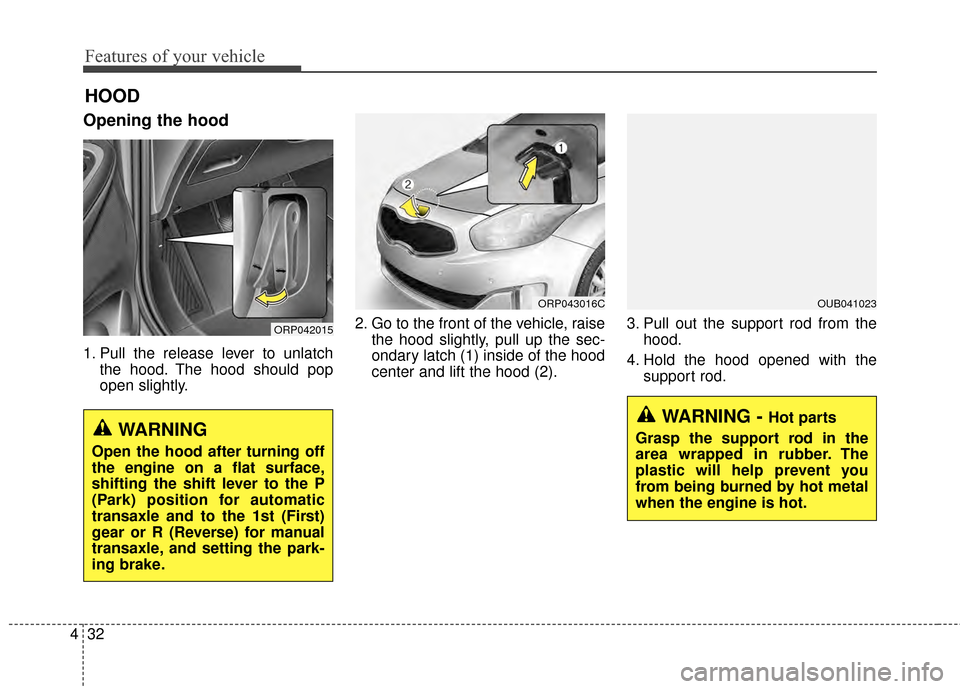
Opening the hood
1. Pull the release lever to unlatch
the hood. The hood should pop
open slightly. 2. Go to the front of the vehicle, raise
the hood slightly, pull up the sec-
ondary latch (1) inside of the hood
center and lift the hood (2). 3. Pull out the support rod from the
hood.
4. Hold the hood opened with the support rod.
HOOD
ORP042015
ORP043016C
WARNING
Open the hood after turning off
the engine on a flat surface,
shifting the shift lever to the P
(Park) position for automatic
transaxle and to the 1st (First)
gear or R (Reverse) for manual
transaxle, and setting the park-
ing brake.
WARNING - Hot parts
Grasp the support rod in the
area wrapped in rubber. The
plastic will help prevent you
from being burned by hot metal
when the engine is hot.
OUB041023