light KIA Rondo 2016 3.G Owner's Manual
[x] Cancel search | Manufacturer: KIA, Model Year: 2016, Model line: Rondo, Model: KIA Rondo 2016 3.GPages: 586, PDF Size: 22.03 MB
Page 537 of 586
757
Maintenance
Light truck(LT) tire:A tire designat-
ed by its manufacturer as primarily
intended for use on lightweight trucks
or multipurpose passenger vehicles.
Load Index: An assigned number
ranging from 1 to 279 that corre-
sponds to the load carrying capacity
of a tire.
Load ratings: The maximum load
that a tire is rated to carry for a given
inflation pressure.
Maximum Inflation Pressure: The
maximum air pressure to which a
cold tire may be inflated. The maxi-
mum air pressure is molded onto the
sidewall.
Maximum Load Rating: The load
rating for a tire at the maximum per-
missible inflation pressure for that tire.
Maximum Loaded Vehicle Weight:
The sum of curb weight; accessory
weight; vehicle capacity weight; and
production options weight.
Normal Occupant Weight: The
number of occupants a vehicle is
designed to seat multiplied by 68 kg
(150 pounds). Occupant Distribution:
Designated
seating positions.
Outward Facing Sidewall: The side
of a asymmetrical tire that has a par-
ticular side that faces outward when
mounted on a vehicle. The outward
facing sidewall bears white lettering
or bears manufacturer, brand, and/or
model name molding that is higher or
deeper than the same moldings on
the inner facing sidewall.
Ply: A layer of rubber-coated parallel
cords
Pneumatic tire: A mechanical
device made of rubber, chemicals,
fabric and steel or other materials,
that, when mounted on an automo-
tive wheel, provides the traction and
contains the gas or fluid that sustains
the load.
Production options weight: The
combined weight of installed regular
production options weighing over 5
lb.(2.3 kg) in excess of the standard
items which they replace, not previ-
ously considered in curb weight or
accessory weight, including heavy
duty brakes, ride levelers, roof rack,
heavy duty battery, and special trim. Passenger (P-Metric) Tire:
A tire
used on passenger cars and some
light duty trucks and multipurpose
vehicles.
Recommended Inflation Pressure:
Vehicle manufacturer's recommend-
ed tire inflation pressure and shown
on the tire placard.
Radial Ply Tire: A pneumatic tire in
which the ply cords that extend to the
beads are laid at 90 degrees to the
centerline of the tread.
Rim: A metal support for a tire and
upon which the tire beads are seat-
ed.
Sidewall: The portion of a tire
between the tread and the bead.
Page 540 of 586
Maintenance
60
7
Low aspect ratio tire
(if equipped)
Low aspect ratio tires, whose aspect
ratio is lower than 50, are provided
for sporty looks.
Because the low aspect ratio tires
are optimized for handling and brak-
ing, it may be more uncomfortable to
ride in and there is more noise com-
pare with normal tires.
CAUTION
Because the sidewall of the low
aspect ratio tire is shorter thanthe normal, the wheel and tire ofthe low aspect ratio tire is easi-er to be damaged. So, follow theinstructions below.
- When driving on a rough road or off road, drive cautiouslybecause tires and wheels maybe damaged. And after driv-ing, inspect tires and wheels.
- When passing over a pothole, speed bump, manhole, or curbstone, drive slowly so that thetires and wheels are not dam-aged.
- If the tire is impacted, we rec- ommend that you inspect thetire condition or contact anauthorized Kia dealer.
- To prevent damage to the tire, inspect the tire condition andpressure every 3,000km.
CAUTION
It is not easy to recognize the tire damage with your owneyes. But if there is the slight-est hint of tire damage, eventhough you cannot see the tiredamage with your own eyes,have the tire checked orreplaced because the tiredamage may cause air leak-age from the tire.
If the tire is damaged by driv- ing on a rough road, off road,pothole, manhole, or curbstone, it will not be covered bythe warranty.
You can find out the tire infor- mation on the tire sidewall.
Page 541 of 586
761
Maintenance
FUSES
A vehicle’s electrical system is pro-
tected from electrical overload dam-
age by fuses.
This vehicle has 3 (or 4) fuse panels,
one located in the driver’s side panel
bolster, others in the engine com-
partment near the battery.
If any of your vehicle’s lights, acces-
sories, or controls do not work, check
the appropriate circuit fuse. If a fuse
has blown, the element inside the
fuse will be melted.
If the electrical system does not
work, first check the driver’s side
fuse panel.
Always replace a blown fuse with
one of the same rating.
Before replacing a blown fuse, dis-
connect the negative battery cable.
If the replacement fuse blows, this
indicates an electrical problem. Avoid
using the system involved and imme-
diately consult an authorized Kia
dealer.
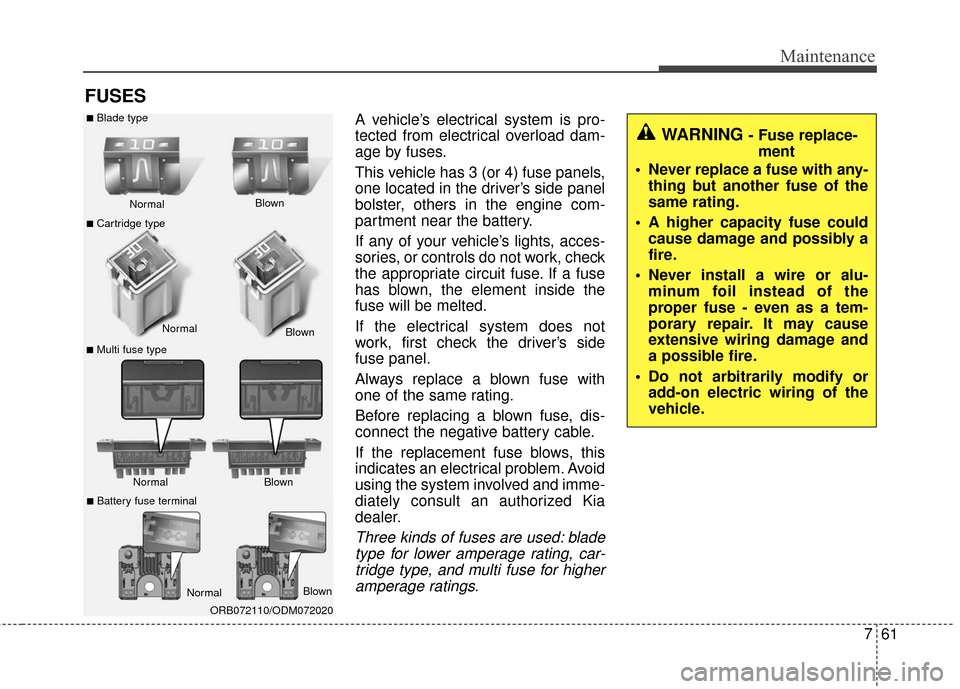
Three kinds of fuses are used: bladetype for lower amperage rating, car-tridge type, and multi fuse for higheramperage ratings.
WARNING - Fuse replace- ment
Never replace a fuse with any- thing but another fuse of the
same rating.
A higher capacity fuse could cause damage and possibly a
fire.
Never install a wire or alu- minum foil instead of the
proper fuse - even as a tem-
porary repair. It may cause
extensive wiring damage and
a possible fire.
Do not arbitrarily modify or add-on electric wiring of the
vehicle.
Normal
Normal
■Blade type
■Cartridge type
■Multi fuse type Blown
Blown
Normal Blown
ORB072110/ODM072020
Normal
Blown
■Battery fuse terminal
Page 543 of 586
763
Maintenance
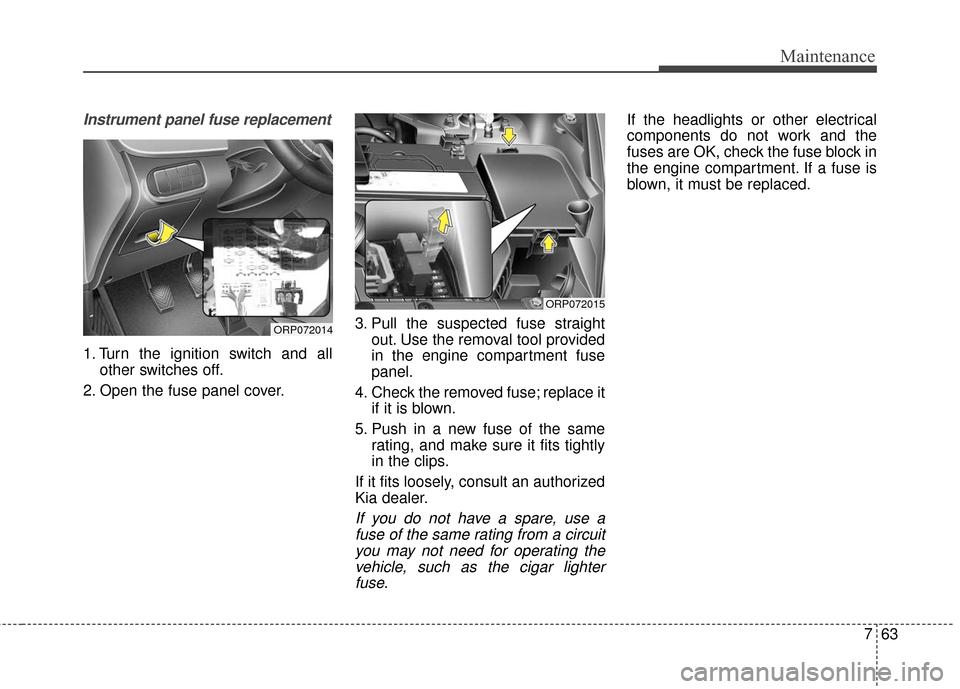
Instrument panel fuse replacement
1. Turn the ignition switch and allother switches off.
2. Open the fuse panel cover. 3. Pull the suspected fuse straight
out. Use the removal tool provided
in the engine compartment fuse
panel.
4. Check the removed fuse; replace it if it is blown.
5. Push in a new fuse of the same rating, and make sure it fits tightly
in the clips.
If it fits loosely, consult an authorized
Kia dealer.
If you do not have a spare, use a fuse of the same rating from a circuityou may not need for operating thevehicle, such as the cigar lighterfuse.
If the headlights or other electrical
components do not work and the
fuses are OK, check the fuse block in
the engine compartment. If a fuse is
blown, it must be replaced.
ORP072014
ORP072015
Page 549 of 586
769
Maintenance
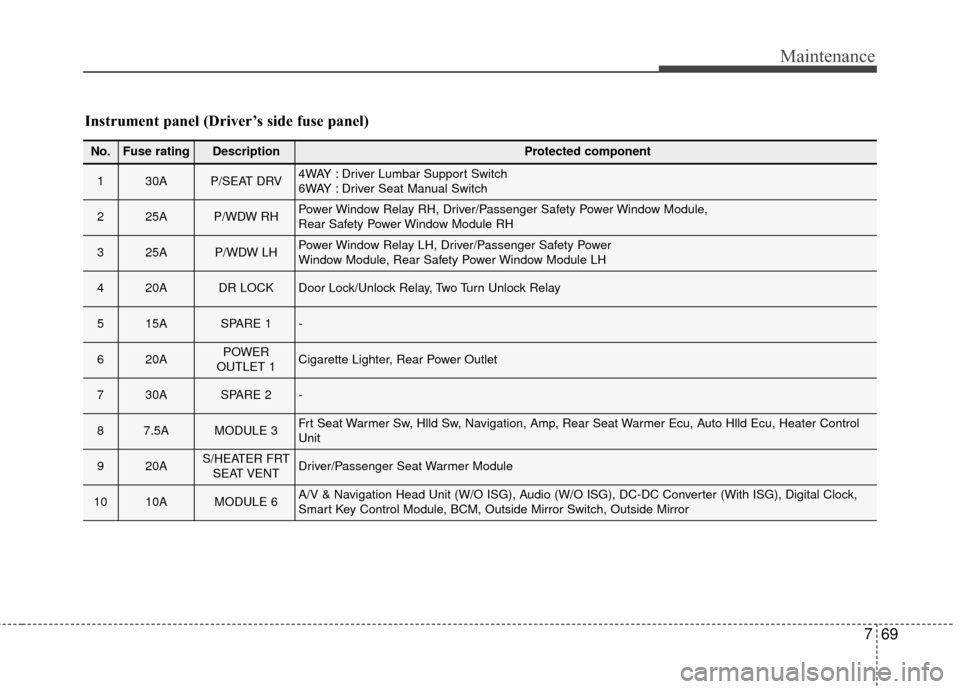
Instrument panel (Driver’s side fuse panel)
No.Fuse ratingDescriptionProtected component
130AP/SEAT DRV4WAY : Driver Lumbar Support Switch
6WAY : Driver Seat Manual Switch
225AP/WDW RHPower Window Relay RH, Driver/Passenger Safety Power Window Module,
Rear Safety Power Window Module RH
325AP/WDW LHPower Window Relay LH, Driver/Passenger Safety Power
Window Module, Rear Safety Power Window Module LH
420ADR LOCKDoor Lock/Unlock Relay, Two Turn Unlock Relay
515ASPARE 1-
620APOWER
OUTLET 1Cigarette Lighter, Rear Power Outlet
730ASPARE 2-
87.5AMODULE 3Frt Seat Warmer Sw, Hlld Sw, Navigation, Amp, Rear Seat Warmer Ecu, Auto Hlld Ecu, Heater Control
Unit
920AS/HEATER FRT SEAT VENTDriver/Passenger Seat Warmer Module
1010AMODULE 6A/V & Navigation Head Unit (W/O ISG), Audio (W/O ISG), DC-DC Converter (With ISG), Digital Clock,
Smart Key Control Module, BCM, Outside Mirror Switch, Outside Mirror
Page 556 of 586
Maintenance
76
7
APPEARANCE CARE
Exterior care
Exterior general caution
It is very important to follow the label
directions when using any chemical
cleaner or polish. Read all warning
and caution statements that appear
on the label.
Finish maintenance
Washing
To help protect your vehicle’s finish
from rust and deterioration, wash it
thoroughly and frequently at least
once a month with lukewarm or cold
water.
If you use your vehicle for off-road
driving, you should wash it after each
off-road trip. Pay special attention to
the removal of any accumulation of
salt, dirt, mud, and other foreign
materials. Make sure the drain holes
in the lower edges of the doors and
rocker panels are kept clear and
clean.
Insects, tar, tree sap, bird droppings,
industrial pollution and similar
deposits can damage your vehicle’s
finish if not removed immediately.
Even prompt washing with plain
water may not completely remove all
these deposits. A mild soap, safe for
use on painted surfaces, may be
used.
After washing, rinse the vehicle thor-
oughly with lukewarm or cold water.
Do not allow soap to dry on the fin-
ish. After washing the vehicle, test the
brakes while driving slowly to see if
they have been affected by water. If
braking performance is impaired, dry
the brakes by applying them lightly
while maintaining a slow forward
speed.
CAUTION
Do not use strong soap, chem-
ical detergents or hot water,and do not wash the vehicle indirect sunlight or when thebody of the vehicle is warm.
Be careful when washing the side windows of your vehicle.Especailly, with high-pressurewater. Water may leak throughthe windows and wet the inte-rior.
To prevent damage to the plastic parts and lamps, donot clean with chemical sol-vents or strong detergents.
Page 557 of 586

777
Maintenance
High-pressure washing
When using high-pressure wash-ers, make sure to maintain suffi-
cient distance from the vehicle.
Insufficient clearance or excessive
pressure can lead to component
damage or water penetration.
Do not spray the camera, sensors or its surrounding area directly with
a high pressure washer. Shock
applied from high pressure water
may cause the device to not oper-
ate normally.
Do not bring the nozzle tip close to boots (rubber or plastic covers) or
connectors as they may be dam-
aged if they come into contact with
high pressure water. Waxing
Wax the vehicle when water will no
longer bead on the paint.
Always wash and dry the vehicle
before waxing. Use a good quality
liquid or paste wax, and follow the
manufacturer’s instructions. Wax all
metal trim to protect it and to main-
tain its luster.
Removing oil, tar, and similar materi-
als with a spot remover will usually
strip the wax from the finish. Be sure to
re-wax these areas even if the rest of
the vehicle does not yet need waxing.
CAUTION
Water washing in the engine
compartment including highpressure water washing maycause the failure of electricalcircuits located in the enginecompartment.
Never allow water or other liq- uids to come in contact withelectrical/electronic compo-nents inside the vehicle asthis may damage them.
OJB037800
WARNING - Wet brakes
After washing the vehicle, test
the brakes while driving slowly
to see if they have been affected
by water. If braking performance
is impaired, dry the brakes by
applying them lightly while main-
taining a slow forward speed.
Page 558 of 586
Maintenance
78
7
Finish damage repair
Deep scratches or stone chips in the
painted surface must be repaired
promptly. Exposed metal will quickly
rust and may develop into a major
repair expense.
✽ ✽
NOTICE
If your vehicle is damaged and
requires any metal repair or
replacement, be sure the body shop
applies anti-corrosion materials to
the parts repaired or replaced.
Bright-metal maintenance
To remove road tar and insects,
use a tar remover, not a scraper or
other sharp object.
To protect the surfaces of bright- metal parts from corrosion, apply a
coating of wax or chrome preser-
vative and rub to a high luster.
During winter weather or in coastal areas, cover the bright metal parts
with a heavier coating of wax or
preservative. If necessary, coat the
parts with non-corrosive petroleum
jelly or other protective compound.CAUTION
Wiping dust or dirt off the body with a dry cloth willscratch the finish.
Do not use steel wool, abra- sive cleaners, or strong deter-gents containing highly alka-line or caustic agents onchrome-plated or anodizedaluminum parts. This mayresult in damage to the pro-tective coating and cause dis-coloration or paint deteriora-tion.
WARNING
After washing the vehicle, test
the brakes while driving slowly
to see if they have been affected
by water. If braking performance
is impaired, dry the brakes by
applying them lightly while
maintaining a slow forward
speed.
Page 569 of 586
83
Specifications & Consumer information
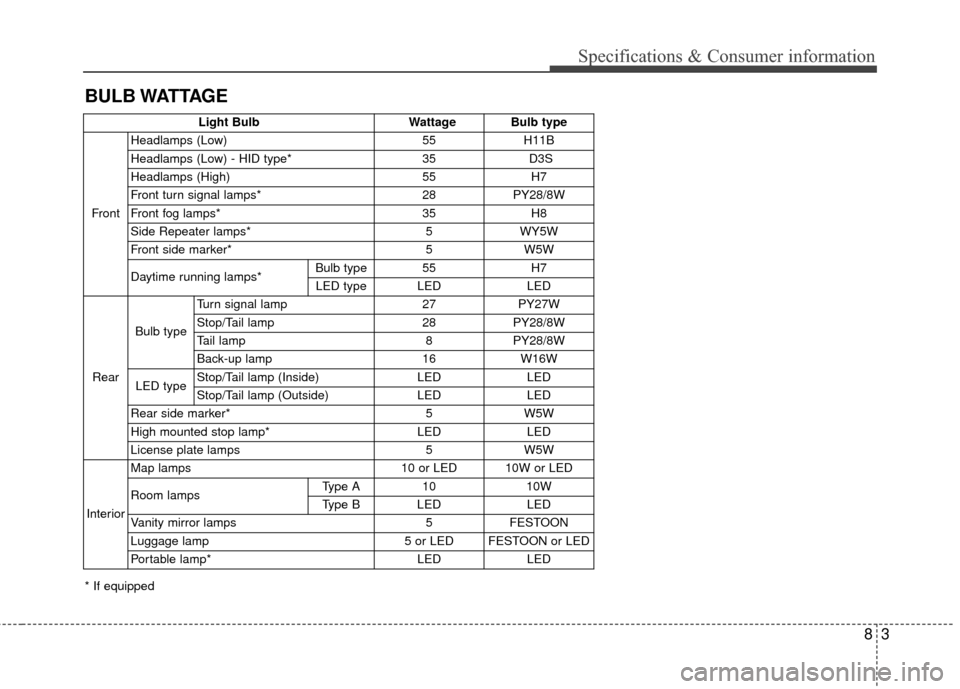
BULB WATTAGE
* If equippedLight Bulb Wattage Bulb type
Front Headlamps (Low) 55 H11B
Headlamps (Low) - HID type* 35 D3S
Headlamps (High) 55 H7
Front turn signal lamps* 28 PY28/8W
Front fog lamps* 35 H8
Side Repeater lamps* 5 WY5W
Front side marker* 5 W5W
Daytime running lamps*
Bulb type 55 H7
LED type LED LED
Rear Bulb type
Turn signal lamp 27 PY27W
Stop/Tail lamp 28 PY28/8W
Tail lamp 8 PY28/8W
Back-up lamp 16 W16W
LED type Stop/Tail lamp (Inside) LED LED
Stop/Tail lamp (Outside) LED LED
Rear side marker* 5 W5W
High mounted stop lamp* LED LED
License plate lamps 5 W5W
Interior Map lamps 10 or LED 10W or LED
Room lamps
Type A 10 10W
Type B LED LED
Vanity mirror lamps 5 FESTOON
Luggage lamp 5 or LED FESTOON or LED
Portable lamp* LED LED
Page 577 of 586

Index
2I
A/V Mode . . . . . . . . . . . . . . . . . . . . . . . . . . . . . . . . . . . 4-\
68
Active ECO . . . . . . . . . . . . . . . . . . . . . . . . . . . . . . . . . . 5-54\
Air bag warning label . . . . . . . . . . . . . . . . . . . . . . . . . . 3-80
Air bag warning light . . . . . . . . . . . . . . . . . . . . . . . . . . 3-52
Air bags. . . . . . . . . . . . . . . . . . . . . . . . . . . . . . . . . . . . \
. 3-49Air bag warning label. . . . . . . . . . . . . . . . . . . . . . . . 3-80
Air bag warning light . . . . . . . . . . . . . . . . . . . . . . . . 3-52
Curtain air bag . . . . . . . . . . . . . . . . . . . . . . . . . . . . . 3-71
Driver's and passenger's front air bag . . . . . . . . . . . 3-64
Inflation and non-inflation conditions . . . . . . . . . . . 3-73
Occupant Detection System . . . . . . . . . . . . . . . . . . . 3-56
Operation . . . . . . . . . . . . . . . . . . . . . . . . . . . . . . . . . 3-50
Side air bag. . . . . . . . . . . . . . . . . . . . . . . . . . . . . . . . 3-70
SRS components and functions . . . . . . . . . . . . . . . . 3-53
Air cleaner . . . . . . . . . . . . . . . . . . . . . . . . . . . . . . . . . . 7-38\
Air ventilation seat . . . . . . . . . . . . . . . . . . . . . . . . . . . 4-161
Airconditioning system Automatic climate control system . . . . . . . . . . . . . 4-134
Manual climate control system . . . . . . . . . . . . . . . 4-124
Alarm system . . . . . . . . . . . . . . . . . . . . . . . . . . . . . . . . 4-19
Antenna . . . . . . . . . . . . . . . . . . . . . . . . . . . . . . . . . . . . \
4-174
Anti-lock brake system (ABS) . . . . . . . . . . . . . . . . . . . 5-36
Appearance care . . . . . . . . . . . . . . . . . . . . . . . . . . . . . . 7-76 Exterior care . . . . . . . . . . . . . . . . . . . . . . . . . . . . . . . 7-76
Interior care . . . . . . . . . . . . . . . . . . . . . . . . . . . . . . . 7-81
Ashtray . . . . . . . . . . . . . . . . . . . . . . . . . . . . . . . . . . . . \
4-156 Audio system . . . . . . . . . . . . . . . . . . . . . . . . . . . . . . . 4-174
Antenna . . . . . . . . . . . . . . . . . . . . . . . . . . . . . . . . . 4-174
Steering wheel audio control . . . . . . . . . . . . . . . . . 4-175
Auto defogging system . . . . . . . . . . . . . . . . . . . . . . . . 4-149
Auto light position . . . . . . . . . . . . . . . . . . . . . . . . . . . 4-106
Automatic climate control system . . . . . . . . . . . . . . . 4-134
Automatic transaxle . . . . . . . . . . . . . . . . . . . . . . . . . . . 5-18 Paddle shifter . . . . . . . . . . . . . . . . . . . . . . . . . . . . . . 5-21
Shift lock system . . . . . . . . . . . . . . . . . . . . . . . . . . . 5-22
Sports mode . . . . . . . . . . . . . . . . . . . . . . . . . . . . . . . 5-20
Aux, USB and iPod . . . . . . . . . . . . . . . . . . . . . . . . . . 4-164
Battery. . . . . . . . . . . . . . . . . . . . . . . . . . . . . . . . . . . . \
. . 7-43
Battery replacement (folding key . . . . . . . . . . . . . . . . . . 4-7
Battery replacement (smart key). . . . . . . . . . . . . . . . . . 4-17
Battery saver function . . . . . . . . . . . . . . . . . . . . . . . . . 4-104
Before driving . . . . . . . . . . . . . . . . . . . . . . . . . . . . . . . . . 5-3
Bottle holder . . . . . . . . . . . . . . . . . . . . . . . . . . . . . . . . 4-158
Brake system. . . . . . . . . . . . . . . . . . . . . . . . . . . . . . . . . 5-26 Anti-lock brake system (ABS) . . . . . . . . . . . . . . . . . 5-36
Electric parking brake (EPB) . . . . . . . . . . . . . . . . . 5-30
Electronic stability control (ESC) . . . . . . . . . . . . . . 5-39
Hill-start assist control (HAC) . . . . . . . . . . . . . . . . . 5-44
Parking brake . . . . . . . . . . . . . . . . . . . . . . . . . . . . . 5-28
Power brakes . . . . . . . . . . . . . . . . . . . . . . . . . . . . . . 5-26
Vehicle stability management (VSM) . . . . . . . . . . . 5-43
A
B