weight KIA Rondo 2016 3.G Owner's Manual
[x] Cancel search | Manufacturer: KIA, Model Year: 2016, Model line: Rondo, Model: KIA Rondo 2016 3.GPages: 586, PDF Size: 22.03 MB
Page 8 of 586
15
Introduction
Gasoline containing MMT
Some gasoline contains harmful
manganese-based fuel additives
such as MMT (Methylcyclopentadi-
enyl Manganese Tricarbonyl).
Kia does not recommend the use of
gasoline containing MMT. This type
of fuel can reduce vehicle perform-
ance and affect your emission con-
trol system. The malfunction indica-
tor lamp on the cluster may come on.
Use of MTBE
Kia recommends avoiding fuels con-
taining MTBE (Methyl Tertiary Butyl
Ether) over 15.0% vol. (Oxygen
Content 2.7% weight) in your vehicle.
Fuel containing MTBE over 15.0%
vol. (Oxygen Content 2.7% weight)
may reduce vehicle performance and
produce vapor lock or hard starting.
Do not use methanol
Fuels containing methanol (wood
alcohol) should not be used in your
vehicle. This type of fuel can reduce
vehicle performance and damage
components of the fuel system,
engine control system and emission
control system.
Fuel Additives
Kia recommends that you use good
quality gasolines treated with deter-
gent additives such as TOP TIER
Detergent Gasoline, which helps
prevent deposit formation in the
engine. These gasolines will help the
engine run cleaner and enhance per-
formance of the Emission Control
System. For more information on
TOP TIER Detergent Gasoline,
please go to the website (www
.top-
tiergas.com).
For Customers who do not use TOP
TIER Detergent Gasoline regularly,
and have problems starting or the
engine does not run smoothly, addi-
tives that you can buy separately
may be added to the gasoline. If
TOP TIER Detergent Gasoline is not
available, one bottle of additive
added to the fuel tank at 12,000 km
or every engine oil change is recom-
mended. Additives are available from
your authorized Kia dealer along with
information on how to use them. Do
not mix other additives.
CAUTION
Your New Vehicle Limited Warranty may not cover dam-age to the fuel system and anyperformance problems that arecaused by the use of fuels con-taining methanol or fuels con-taining MTBE (Methyl TertiaryButyl Ether) over 15.0% vol.(Oxygen Content 2.7% weight.)
Page 53 of 586
337
Safety features of your vehicle
✽
✽NOTICE
Small children are best protected
from injury in an accident when
properly restrained in the rear seat
by a child restraint system that
meets the requirements of the safety
standards of your country. Before
buying any child restraint system,
make sure that it has a label certify-
ing that it meets safety standards of
your country. The restraint must be
appropriate for your child's height
and weight. Check the label on the
child restraint for this information.
Refer to “Child restraint system” in
this chapter.
Larger children
Children who are too large for child
restraint systems should always
occupy the rear seat and use the
available lap/shoulder belts. The lap
portion should be fastened and
snugged on the hips and as low as
possible. Check if the belt fits period-
ically. A child's squirming could put
the belt out of position. Children are
given the most safety in the event of
an accident when they are restrained
by a proper restraint system in the
rear seat. If a larger child (over age
12) must be seated in the front seat,
the child should be securely
restrained by the available lap/shoul-
der belt and the seat should be
placed in the rearmost position.
Children age 12 and under should be
restrained securely in the rear seat.
NEVER place a child age 12 and
under in the front seat. NEVER place
a rear facing child seat in the front
seat of a vehicle.WARNING
Every person in your vehicle
needs to be properly restrained
at all times, including infants
and children. Never hold a child
in your arms or lap when riding
in a vehicle. The violent forces
created during a crash will tear
the child from your arms and
throw the child against the inte-
rior. Always use a child restraint
appropriate for your child's
height and weight.
Page 58 of 586
Safety features of your vehicle
42
3
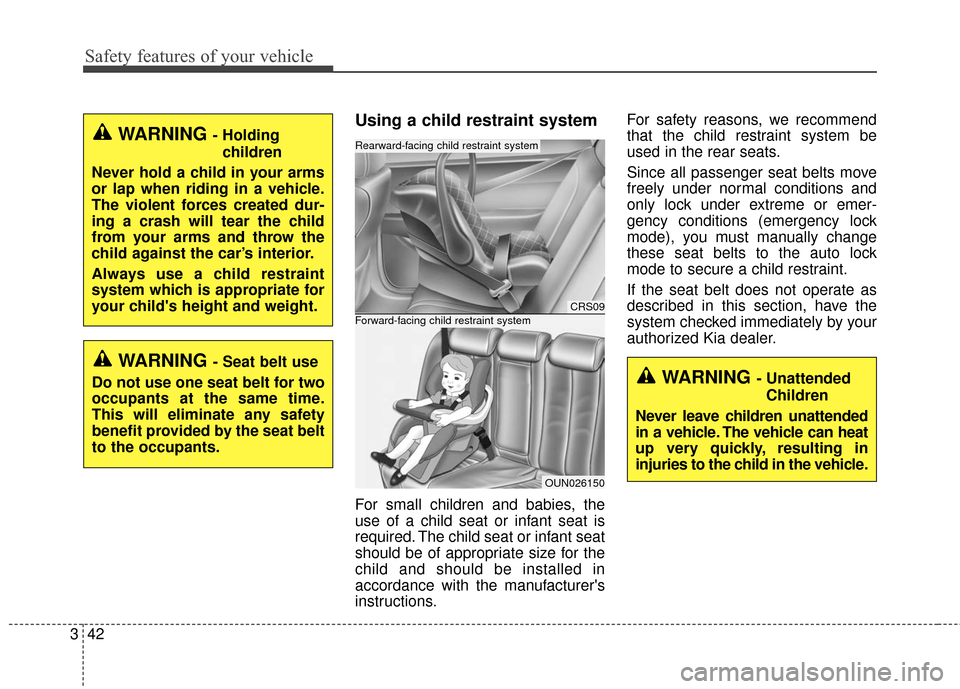
Using a child restraint system
For small children and babies, the
use of a child seat or infant seat is
required. The child seat or infant seat
should be of appropriate size for the
child and should be installed in
accordance with the manufacturer's
instructions. For safety reasons, we recommend
that the child restraint system be
used in the rear seats.
Since all passenger seat belts move
freely under normal conditions and
only lock under extreme or emer-
gency conditions (emergency lock
mode), you must manually change
these seat belts to the auto lock
mode to secure a child restraint.
If the seat belt does not operate as
described in this section, have the
system checked immediately by your
authorized Kia dealer.
CRS09
OUN026150
Forward-facing child restraint system
Rearward-facing child restraint systemWARNING - Holding
children
Never hold a child in your arms
or lap when riding in a vehicle.
The violent forces created dur-
ing a crash will tear the child
from your arms and throw the
child against the car’s interior.
Always use a child restraint
system which is appropriate for
your child's height and weight.
WARNING - Seat belt use
Do not use one seat belt for two
occupants at the same time.
This will eliminate any safety
benefit provided by the seat belt
to the occupants.
WARNING - Unattended Children
Never leave children unattended
in a vehicle. The vehicle can heat
up very quickly, resulting in
injuries to the child in the vehicle.
Page 74 of 586
Safety features of your vehicle
58
3
Always be sure that you and all vehi-
cle occupants are seated and
restrained properly (sitting upright
with the seat in an upright position,
centered on the seat cushion, with
the person’s legs comfortably
extended, feet on the floor, and wear-
ing the safety belt properly) for the
most effective protection by the air
bag and the safety belt.
The ODS (Occupant Detection
System) may not function properly if
the passenger takes actions which
can defeat the detection system.
These include: (1) Failing to sit in an upright posi-
tion.
(2) Leaning against the door or cen- ter console.
(3) Sitting towards the sides or the front of the seat.
(4) Putting legs on the dashboard or resting them on other locations
which reduce the passenger
weight on the front seat.
(5) Improperly wearing the safety
belt.
(6) Reclining the seat back.
(7) Wearing a tick cloth like the ski wear or hip protection wear.
(8) Put on the seat an additional thick cushion.
Page 75 of 586
359
Safety features of your vehicle
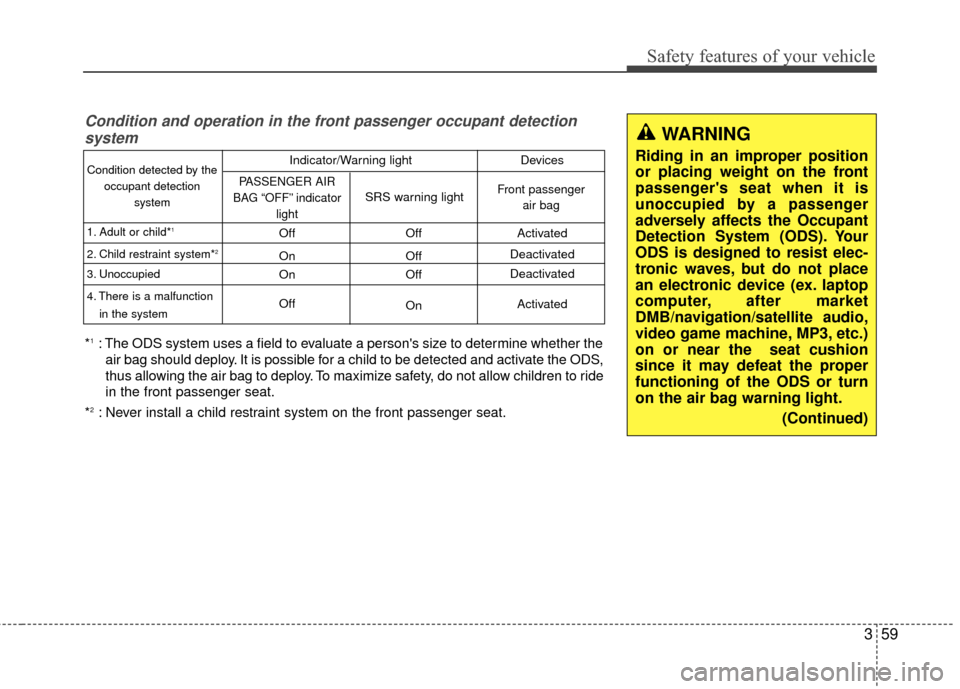
Condition and operation in the front passenger occupant detectionsystem
*1: The ODS system uses a field to evaluate a person's size to determine whether the
air bag should deploy. It is possible for a child to be detected and activate the ODS,
thus allowing the air bag to deploy. To maximize safety, do not allow children to ride
in the front passenger seat.
*
2: Never install a child restraint system on the front passenger seat.
WARNING
Riding in an improper position
or placing weight on the front
passenger's seat when it is
unoccupied by a passenger
adversely affects the Occupant
Detection System (ODS). Your
ODS is designed to resist elec-
tronic waves, but do not place
an electronic device (ex. laptop
computer, after market
DMB/navigation/satellite audio,
video game machine, MP3, etc.)
on or near the seat cushion
since it may defeat the proper
functioning of the ODS or turn
on the air bag warning light. (Continued)Condition detected by the
occupant detection system
1. Adult or child*
1
2. Child restraint system*2
3. Unoccupied
4. There is a malfunction in the system
Off
On
On
Off Off
Off
Off
On Activated
Deactivated
Deactivated
Activated
PASSENGER AIR
BAG “OFF” indicator light
SRS warning lightFront passenger air bag
Indicator/Warning light Devices
Page 265 of 586
4169
Features of your vehicle
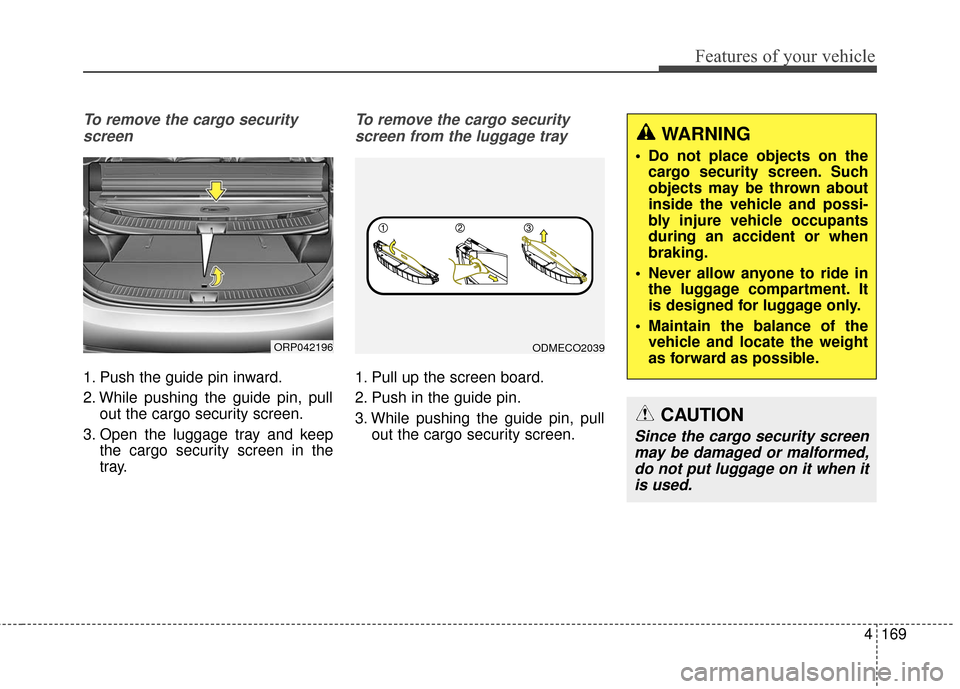
To remove the cargo securityscreen
1. Push the guide pin inward.
2. While pushing the guide pin, pull out the cargo security screen.
3. Open the luggage tray and keep the cargo security screen in the
tray.
To remove the cargo security
screen from the luggage tray
1. Pull up the screen board.
2. Push in the guide pin.
3. While pushing the guide pin, pull out the cargo security screen.
ORP042196
WARNING
Do not place objects on thecargo security screen. Such
objects may be thrown about
inside the vehicle and possi-
bly injure vehicle occupants
during an accident or when
braking.
Never allow anyone to ride in the luggage compartment. It
is designed for luggage only.
Maintain the balance of the vehicle and locate the weight
as forward as possible.
CAUTION
Since the cargo security screenmay be damaged or malformed,do not put luggage on it when itis used.
ODMECO2039
Page 269 of 586
4173
Features of your vehicle
WARNING
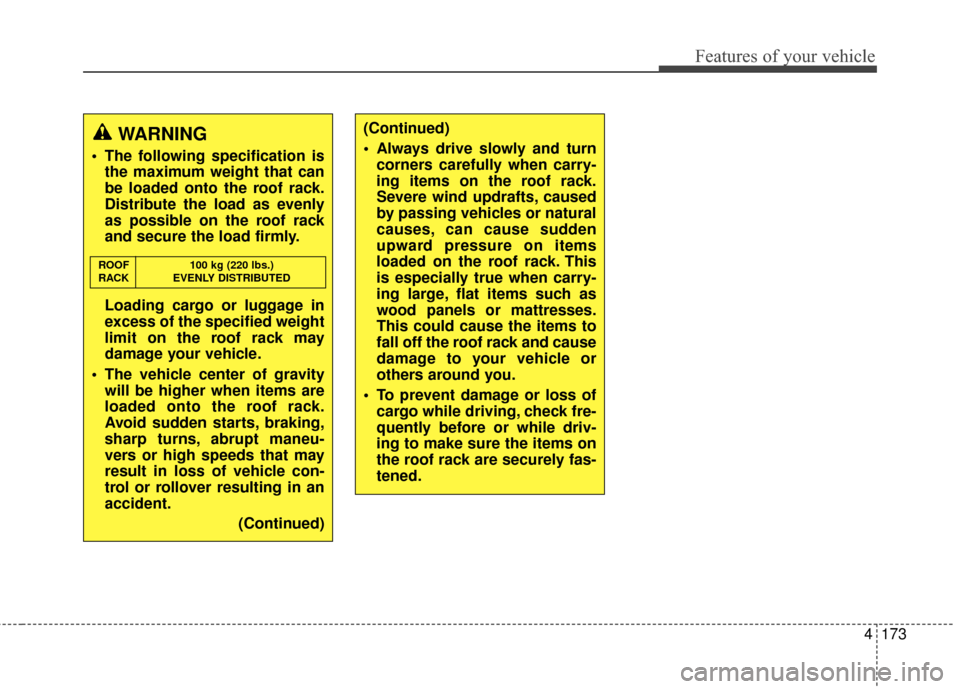
The following specification isthe maximum weight that can
be loaded onto the roof rack.
Distribute the load as evenly
as possible on the roof rack
and secure the load firmly.
Loading cargo or luggage in
excess of the specified weight
limit on the roof rack may
damage your vehicle.
The vehicle center of gravity will be higher when items are
loaded onto the roof rack.
Avoid sudden starts, braking,
sharp turns, abrupt maneu-
vers or high speeds that may
result in loss of vehicle con-
trol or rollover resulting in an
accident.
(Continued)
ROOF100 kg (220 lbs.)
RACK EVENLY DISTRIBUTED
(Continued)
Always drive slowly and turn corners carefully when carry-
ing items on the roof rack.
Severe wind updrafts, caused
by passing vehicles or natural
causes, can cause sudden
upward pressure on items
loaded on the roof rack. This
is especially true when carry-
ing large, flat items such as
wood panels or mattresses.
This could cause the items to
fall off the roof rack and cause
damage to your vehicle or
others around you.
To prevent damage or loss of cargo while driving, check fre-
quently before or while driv-
ing to make sure the items on
the roof rack are securely fas-
tened.
Page 373 of 586
Driving your vehicle
Before driving . . . . . . . . . . . . . . . . . . . . . . . . . . . . . . 5-3
Key positions . . . . . . . . . . . . . . . . . . . . . . . . . . . . . . . 5-5
Engine start/stop button . . . . . . . . . . . . . . . . . . . . . 5-8
Manual transaxle . . . . . . . . . . . . . . . . . . . . . . . . . . 5-13
• Manual transaxle operation . . . . . . . . . . . . . . . . . . . . 5-13
Automatic transaxle . . . . . . . . . . . . . . . . . . . . . . . . 5-18
. . . . . . . . . . . . . . . . . . 5-18
Brake system . . . . . . . . . . . . . . . . . . . . . . . . . . . . . . 5-26
. . . . . . . . . . . . . . . . . . . . . . . . . . . . . . . 5-26
. . . . . . . . . . . . . . . . . . . . 5-28
. . . . . . . . . . . . . . . . . . 5-30
. . . . . . . . . . . . . . . . . . 5-36
. . . . . . . . . . . . . . . 5-39
. . . . . . . . . . . . 5-43
. . . . . . . . . . . . . . . . . . 5-44
Cruise control system. . . . . . . . . . . . . . . . . . . . . . . 5-47
Active ECO system. . . . . . . . . . . . . . . . . . . . . . . . . 5-52
Economical operation . . . . . . . . . . . . . . . . . . . . . . 5-53Special driving conditions . . . . . . . . . . . . . . . . . . . 5-55
. . . . . . . . . . . . . . . . . . 5-55
. . . . . . . . . . . . . . . . . . . . . . . . . . . 5-55
. . . . . . . . . . . . . . . . . . . . . . . . . . . . 5-56
. . . . . . . . . . . . . . . . . . . . . . . . . . . . . . 5-57
. . . . . . . . . . . . . . . . . . . . . . . . . . . . 5-57
. . . . . . . . . . . . . . . . . . . . . . . 5-58
. . . . . . . . . . . . . . . . . . . . . . . . . . . . . . 5-58
. . . . . . . . . . . . . . . . . . . . . . . . . . . . . 5-58
Winter driving . . . . . . . . . . . . . . . . . . . . . . . . . . . . 5-60
Trailer towing . . . . . . . . . . . . . . . . . . . . . . . . . . . . . 5-63
Vehicle load limit . . . . . . . . . . . . . . . . . . . . . . . . . . 5-73
Vehicle weight . . . . . . . . . . . . . . . . . . . . . . . . . . . . . 5-79
. . . . . . . . . . . . . . . . . . . . . . . . . . . . . 5-79
. . . . . . . . . . . . . . . . . . . . . . . . . . . 5-79
. . . . . . . . . . . . . . . . . . . . . . . . . . . . . . . . 5-79
. . . . . . . . . . . . . . . . . . . . . . 5-79
. . . . . . . . . . . . . . . 5-79
. . . . . . . . . . . . . . . . . . . 5-79
. . . . . . . . . . . . 5-795
Page 386 of 586
Driving your vehicle
14
5
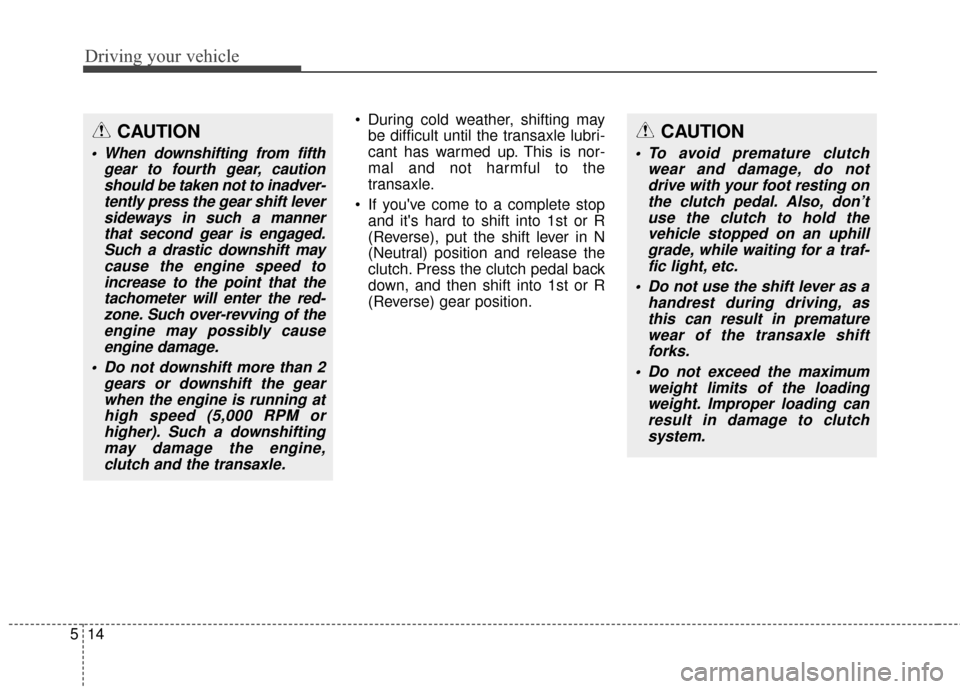
During cold weather, shifting may
be difficult until the transaxle lubri-
cant has warmed up. This is nor-
mal and not harmful to the
transaxle.
If you've come to a complete stop and it's hard to shift into 1st or R
(Reverse), put the shift lever in N
(Neutral) position and release the
clutch. Press the clutch pedal back
down, and then shift into 1st or R
(Reverse) gear position.CAUTION
When downshifting from fifth gear to fourth gear, cautionshould be taken not to inadver-tently press the gear shift leversideways in such a mannerthat second gear is engaged.Such a drastic downshift maycause the engine speed toincrease to the point that thetachometer will enter the red-zone. Such over-revving of theengine may possibly causeengine damage.
Do not downshift more than 2 gears or downshift the gearwhen the engine is running athigh speed (5,000 RPM orhigher). Such a downshiftingmay damage the engine,clutch and the transaxle.
CAUTION
To avoid premature clutch wear and damage, do notdrive with your foot resting onthe clutch pedal. Also, don’tuse the clutch to hold thevehicle stopped on an uphillgrade, while waiting for a traf-fic light, etc.
Do not use the shift lever as a handrest during driving, asthis can result in prematurewear of the transaxle shiftforks.
Do not exceed the maximum weight limits of the loadingweight. Improper loading canresult in damage to clutchsystem.
Page 397 of 586
525
Driving your vehicle
Moving up a steep grade from astanding start
To move up a steep grade from a
standing start, depress the brake
pedal, shift the shift lever to D
(Drive). Select the appropriate gear
depending on load weight and steep-
ness of the grade, and release the
parking brake. Depress the accelera-
tor gradually while releasing the
service brakes.
When accelerating from a stop on
a steep hill, the vehicle may have a
tendency to roll backwards.
Shifting the shift lever into 2
(Second Gear) will help prevent
the vehicle from rolling back-
wards.
WARNING
If your vehicle becomes stuck in
snow, mud, sand, etc., then you
may attempt to rock the vehicle
free by moving it forward and
backward. Do not attempt this
procedure if people or objects
are anywhere near the vehicle.
During the rocking operation
the vehicle may suddenly move
forward or backward as it
becomes unstuck, causing
injury or damage to nearby peo-
ple or objects.