light KIA Rondo 2017 3.G Owner's Manual
[x] Cancel search | Manufacturer: KIA, Model Year: 2017, Model line: Rondo, Model: KIA Rondo 2017 3.GPages: 625, PDF Size: 19.69 MB
Page 562 of 625
Maintenance
62
8
Maximum Loaded Vehicle Weight:
The sum of curb weight; accessory
weight; vehicle capacity weight; and
production options weight.
Normal Occupant Weight: The
number of occupants a vehicle is
designed to seat multiplied by 150
pounds (68 kg).
Occupant Distribution: Designated
seating positions.
Outward Facing Sidewall: The side
of a asymmetrical tire that has a par-
ticular side that faces outward when
mounted on a vehicle. The outward
facing sidewall bears white lettering
or bears manufacturer, brand, and/or
model name molding that is higher or
deeper than the same moldings on
the inner facing sidewall.
Passenger (P-Metric) Tire: A tire
used on passenger cars and some
light duty trucks and multipurpose
vehicles.
Ply: A layer of rubber-coated parallel
cords. Pneumatic tire:
A mechanical
device made of rubber, chemicals,
fabric and steel or other materials,
that, when mounted on an automo-
tive wheel, provides the traction and
contains the gas or fluid that sustains
the load.
Production options weight: The
combined weight of installed regular
production options weighing over 5
lb.(2.3 kg) in excess of the standard
items which they replace, not previ-
ously considered in curb weight or
accessory weight, including heavy
duty brakes, ride levelers, roof rack,
heavy duty battery, and special trim.
Recommended Inflation Pressure:
Vehicle manufacturer's recommend-
ed tire inflation pressure and shown
on the tire placard.
Radial Ply Tire: A pneumatic tire in
which the ply cords that extend to the
beads are laid at 90 degrees to the
centerline of the tread.
Rim: A metal support for a tire and
upon which the tire beads are seated. Sidewall:
The portion of a tire
between the tread and the bead.
Speed Rating: An alphanumeric
code assigned to a tire indicating the
maximum speed at which a tire can
operate.
Traction: The friction between the
tire and the road surface. The
amount of grip provided.
Tread: The portion of a tire that
comes into contact with the road.
Treadwear Indicators: Narrow
bands, sometimes called "wear bars,"
that show across the tread of a tire
when only 2/32 inch of tread remains.
UTQGS: Uniform Tire Quality
Grading Standards, a tire information
system that provides consumers with
ratings for a tire's traction, tempera-
ture and treadwear. Ratings are
determined by tire manufacturers
using government testing proce-
dures. The ratings are molded into
the sidewall of the tire.
Vehicle Capacity Weight: The num-
ber of designated seating positions
multiplied by 150 lbs. (68 kg) plus the
rated cargo and luggage load.
Page 565 of 625
865
Maintenance
CAUTION
Because the sidewall of the lowaspect ratio tire is shorter thanthe normal, the wheel and tire ofthe low aspect ratio tire is easi-er to be damaged. So, follow theinstructions below.
- When driving on a rough road or off road, drive cautiouslybecause tires and wheels maybe damaged. And after driv-ing, inspect tires and wheels.
- When passing over a pothole, speed bump, manhole, or curbstone, drive slowly so that thetires and wheels are not dam-aged.
- If the tire is impacted, we rec- ommend that you inspect thetire condition or contact anauthorized Kia dealer.
- To prevent damage to the tire, inspect the tire condition andpressure every 3,000km.
CAUTION
It is not easy to recognize the tire damage with your owneyes. But if there is the slight-est hint of tire damage, eventhough you cannot see the tiredamage with your own eyes,have the tire checked orreplaced because the tiredamage may cause air leak-age from the tire.
If the tire is damaged by driv- ing on a rough road, off road,pothole, manhole, or curbstone, it will not be covered bythe warranty.
You can find out the tire infor- mation on the tire sidewall.
Page 566 of 625
Maintenance
66
8
FUSES
A vehicle’s electrical system is pro-
tected from electrical overload dam-
age by fuses.
This vehicle has 3 (or 4) fuse panels,
one located in the driver’s side panel
bolster, others in the engine com-
partment near the battery.
If any of your vehicle’s lights, acces-
sories, or controls do not work, check
the appropriate circuit fuse. If a fuse
has blown, the element inside the
fuse will be melted.
If the electrical system does not
work, first check the driver’s side
fuse panel.
Always replace a blown fuse with
one of the same rating.
Before replacing a blown fuse, dis-
connect the negative battery cable.
If the replacement fuse blows, this
indicates an electrical problem. Avoid
using the system involved and imme-
diately consult an authorized Kia
dealer.
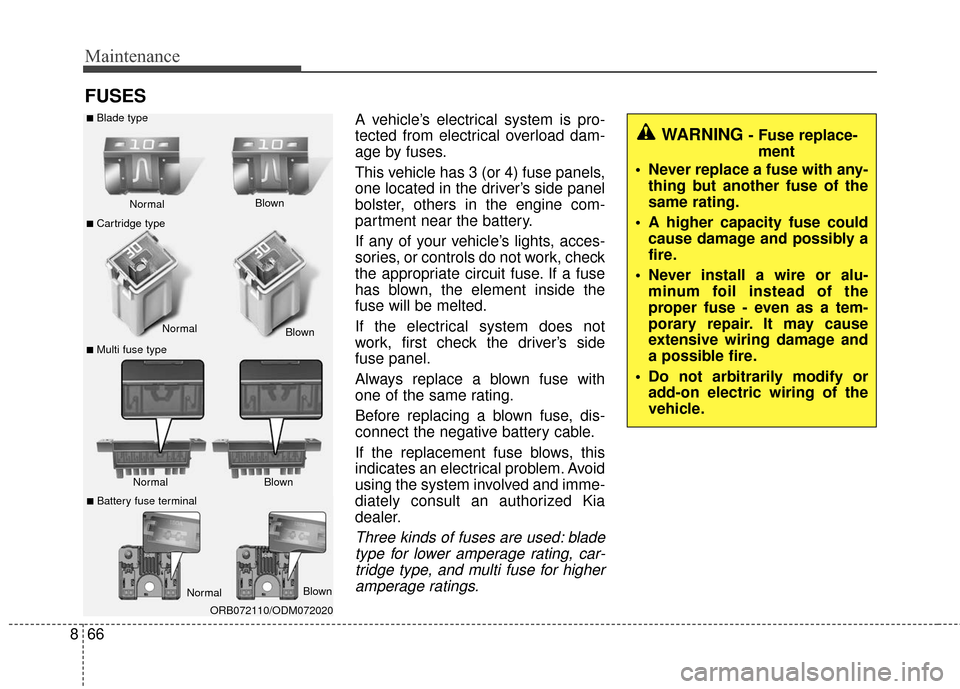
Three kinds of fuses are used: blade
type for lower amperage rating, car-tridge type, and multi fuse for higheramperage ratings.
WARNING - Fuse replace- ment
Never replace a fuse with any- thing but another fuse of the
same rating.
A higher capacity fuse could cause damage and possibly a
fire.
Never install a wire or alu- minum foil instead of the
proper fuse - even as a tem-
porary repair. It may cause
extensive wiring damage and
a possible fire.
Do not arbitrarily modify or add-on electric wiring of the
vehicle.
Normal
Normal
■Blade type
■Cartridge type
■Multi fuse type Blown
Blown
Normal Blown
ORB072110/ODM072020
Normal
Blown
■Battery fuse terminal
Page 568 of 625
Maintenance
68
8
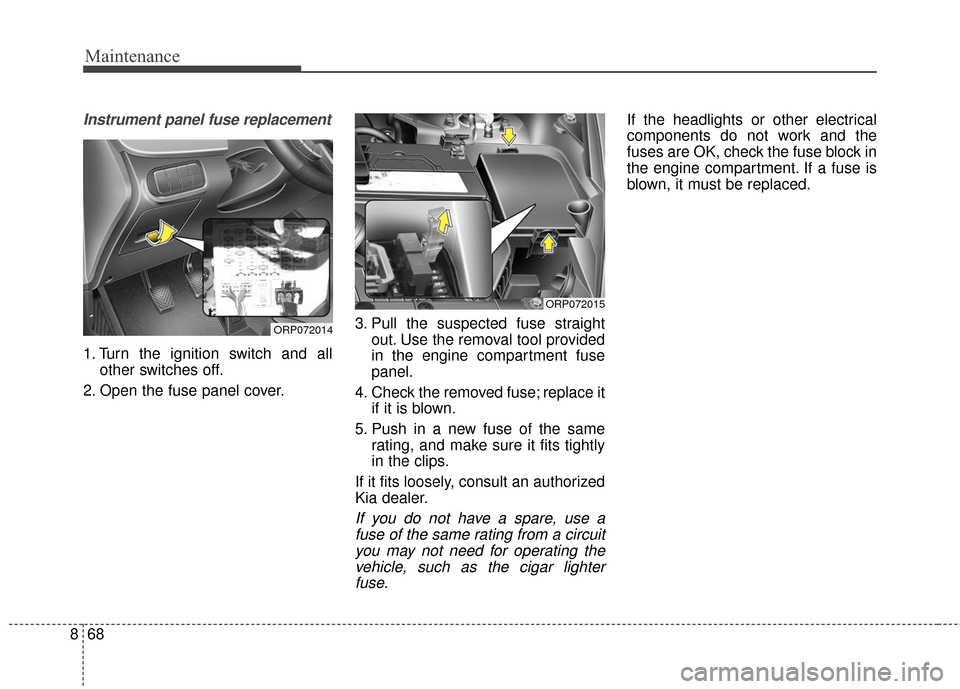
Instrument panel fuse replacement
1. Turn the ignition switch and all
other switches off.
2. Open the fuse panel cover. 3. Pull the suspected fuse straight
out. Use the removal tool provided
in the engine compartment fuse
panel.
4. Check the removed fuse; replace it if it is blown.
5. Push in a new fuse of the same rating, and make sure it fits tightly
in the clips.
If it fits loosely, consult an authorized
Kia dealer.
If you do not have a spare, use a fuse of the same rating from a circuityou may not need for operating thevehicle, such as the cigar lighterfuse.
If the headlights or other electrical
components do not work and the
fuses are OK, check the fuse block in
the engine compartment. If a fuse is
blown, it must be replaced.
ORP072014
ORP072015
Page 575 of 625
875
Maintenance
No.Fuse ratingDescriptionProtected component
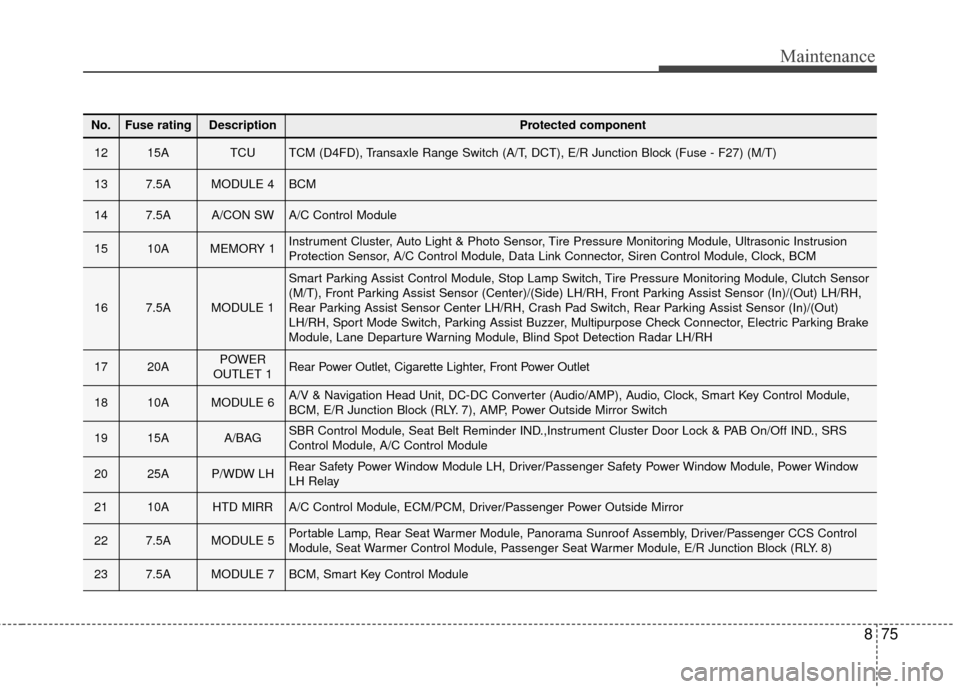
1215ATCUTCM (D4FD), Transaxle Range Switch (A/T, DCT), E/R Junction Block (Fuse - F27) (M/T)
137.5AMODULE 4BCM
147.5AA/CON SWA/C Control Module
1510AMEMORY 1Instrument Cluster, Auto Light & Photo Sensor, Tire Pressure Monitoring Module, Ultrasonic Instrusion
Protection Sensor, A/C Control Module, Data Link Connector, Siren Control Module, Clock, BCM
167.5AMODULE 1
Smart Parking Assist Control Module, Stop Lamp Switch, Tire Pressure Monitoring Module, Clutch Sensor
(M/T), Front Parking Assist Sensor (Center)/(Side) LH/RH, Front Parking Assist Sensor (In)/(Out) LH/RH,
Rear Parking Assist Sensor Center LH/RH, Crash Pad Switch, Rear Parking Assist Sensor (In)/(Out)
LH/RH, Sport Mode Switch, Parking Assist Buzzer, Multipurpose Check Connector, Electric Parking Brake
Module, Lane Departure Warning Module, Blind Spot Detection Radar LH/RH
1720APOWER
OUTLET 1Rear Power Outlet, Cigarette Lighter, Front Power Outlet
1810AMODULE 6A/V & Navigation Head Unit, DC-DC Converter (Audio/AMP), Audio, Clock, Smart Key Control Module,
BCM, E/R Junction Block (RLY. 7), AMP, Power Outside Mirror Switch
1915AA/BAGSBR Control Module, Seat Belt Reminder IND.,Instrument Cluster Door Lock & PAB On/Off IND., SRS
Control Module, A/C Control Module
2025AP/WDW LHRear Safety Power Window Module LH, Driver/Passenger Safety Power Window Module, Power Window
LH Relay
2110AHTD MIRRA/C Control Module, ECM/PCM, Driver/Passenger Power Outside Mirror
227.5AMODULE 5Portable Lamp, Rear Seat Warmer Module, Panorama Sunroof Assembly, Driver/Passenger CCS Control
Module, Seat Warmer Control Module, Passenger Seat Warmer Module, E/R Junction Block (RLY. 8)
237.5AMODULE 7BCM, Smart Key Control Module
Page 581 of 625
881
Maintenance
LIGHT BULBS
Use only the bulbs of the specifiedwattage.
✽ ✽ NOTICE
After driving in heavy rain or wash-
ing the vehicle, headlight and tail-
light lenses could appear foggy. This
condition is caused by the tempera-
ture difference between the lamp
inside and outside. This is similar to
the condensation on your windows
inside your vehicle during rain and
does not indicate a problem with
your vehicle. If the water leaks into
the lamp bulb circuitry, we recom-
mend that the system be checked by
an authorized Kia dealer.WARNING - Working on
the lights
Prior to working on the light,
firmly apply the parking brake,
ensure that the ignition switch
is turned to the “LOCK” position
(smart key: turn off the engine)
and turn off the lights to avoid
sudden movement of the vehi-
cle and burning your fingers or
getting an electric shock.
CAUTION
Be sure to replace the burned- out bulb with one of the samewattage rating. Otherwise, itmay cause damage to the fuseor electric wiring system.
CAUTION
If you do not have necessarytools, the correct bulbs and theexpertise, we recommend thatyou consult an authorized Kiadealer. In many cases, it is diffi-cult to replace vehicle lightbulbs because other parts of thevehicle must be removed beforeyou can get to the bulb. This isespecially true if you have toremove the headlight assemblyto get to the bulb(s).
Removing/installing the head-light assembly can result indamage to the vehicle.
Page 582 of 625
Maintenance
82
8
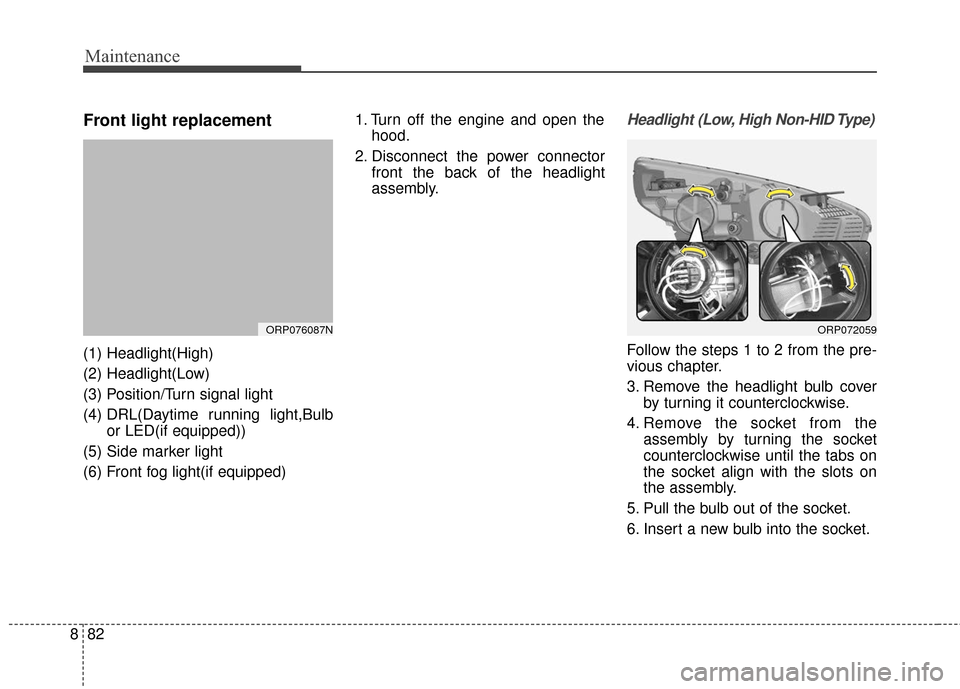
Front light replacement
(1) Headlight(High)
(2) Headlight(Low)
(3) Position/Turn signal light
(4) DRL(Daytime running light,Bulb
or LED(if equipped))
(5) Side marker light
(6) Front fog light(if equipped) 1. Turn off the engine and open the
hood.
2. Disconnect the power connector front the back of the headlight
assembly.
Headlight (Low, High Non-HID Type)
Follow the steps 1 to 2 from the pre-
vious chapter.
3. Remove the headlight bulb coverby turning it counterclockwise.
4. Remove the socket from the assembly by turning the socket
counterclockwise until the tabs on
the socket align with the slots on
the assembly.
5. Pull the bulb out of the socket.
6. Insert a new bulb into the socket.
ORP076087NORP072059
Page 583 of 625
883
Maintenance
7. Install the socket in the assemblyby aligning the tabs on the socket
with the slots in the assembly.
Push the socket into the assembly
and turn the socket clockwise.
8. Install the headlight bulb cover by turning it clockwise.
9. Connect the power connector to the back of the headlight assem-
bly.
✽ ✽NOTICE
If the headlight aiming adjustment
is necessary after the headlight
assembly is reinstalled, have the
vehicle checked by an authorized
Kia dealer.
Headlight (Low, HID type),
DRL (LED type)
If the DRL lamp (LED) does not
operate, have the vehicle checked by
an authorized Kia dealer.
LED lamps do not have replaceable
bulbs.
A skilled technician should check or
repair the Headlight low (HID) and
DRL lamp(LED), for it may damage
related parts of the vehicle.
✽ ✽ NOTICE
HID lamps have superior perform-
ance vs. halogen bulbs. HID lamps
are estimated by the manufacturer to
last twice as long or longer than halo-
gen bulbs depending on their fre-
quency of use. They will probably
require replacement at some point in
the life of the vehicle. Cycling the
headlamps on and off more than typ-
ical use will shorten HID lamps life.
HID lamps do not fail in the same
manner as halogen incandescent
lamps. If a headlamp goes out after a
period of operation but will immedi-
ately relight when the headlamp
switch is cycled it is likely the HID
lamp needs to be replaced. HID light-
ing components are more complex
than conventional halogen bulbs thus
have higher replacement cost.
WARNING - HID
Headlight low beam
(if equipped)
Do not attempt to replace or
inspect the low beam (XENON
bulb) due to electric shock dan-
ger. If the low beam (XENON
bulb) is not working, have the
vehicle checked by an author-
ized Kia dealer.
Page 584 of 625
Maintenance
84
8
Position/Turn signal light
Follow the steps 1 to 2 from the pre-
vious page.
3. Remove the socket from the
assembly by turning the socket
counterclockwise until the tabs on
the socket align with the slots on
the assembly.
4. Remove the bulb from the socket by pressing it in and rotating it
counterclockwise until the tabs on
the bulb align with the slots in the
socket. Pull the bulb out of the
socket.
OHD076046
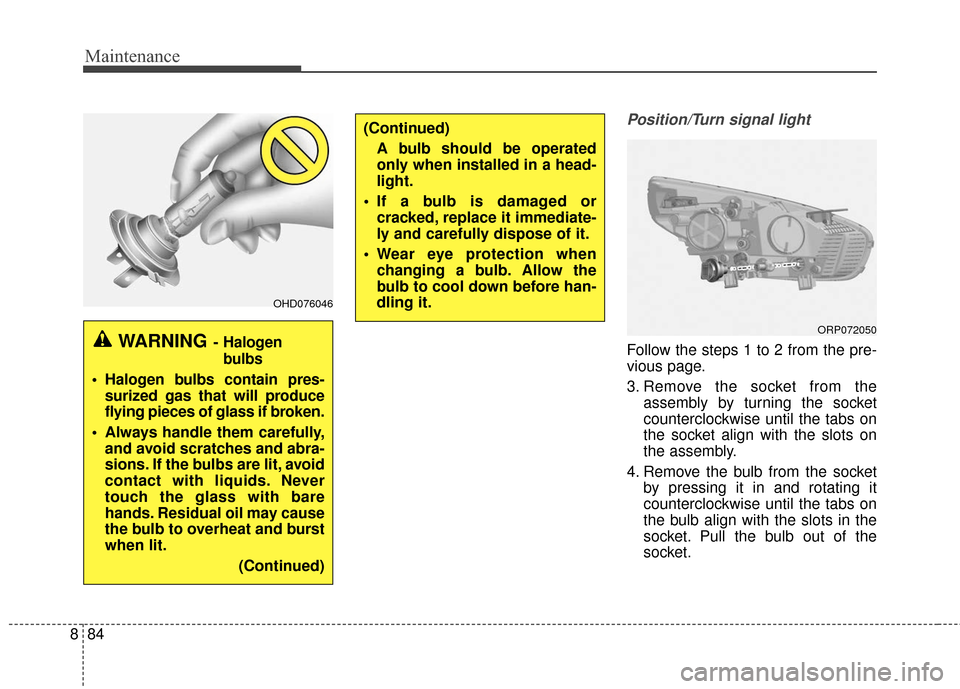
WARNING- Halogen
bulbs
Halogen bulbs contain pres-surized gas that will produce
flying pieces of glass if broken.
Always handle them carefully, and avoid scratches and abra-
sions. If the bulbs are lit, avoid
contact with liquids. Never
touch the glass with bare
hands. Residual oil may cause
the bulb to overheat and burst
when lit.
(Continued)
(Continued)A bulb should be operated
only when installed in a head-
light.
If a bulb is damaged or cracked, replace it immediate-
ly and carefully dispose of it.
Wear eye protection when changing a bulb. Allow the
bulb to cool down before han-
dling it.
ORP072050
Page 585 of 625
885
Maintenance
5. Insert a new bulb by inserting itinto the socket and rotating it until
it locks into place.
6. Install the socket in the assembly by aligning the tabs on the socket
with the slots in the assembly.
Push the socket into the assembly
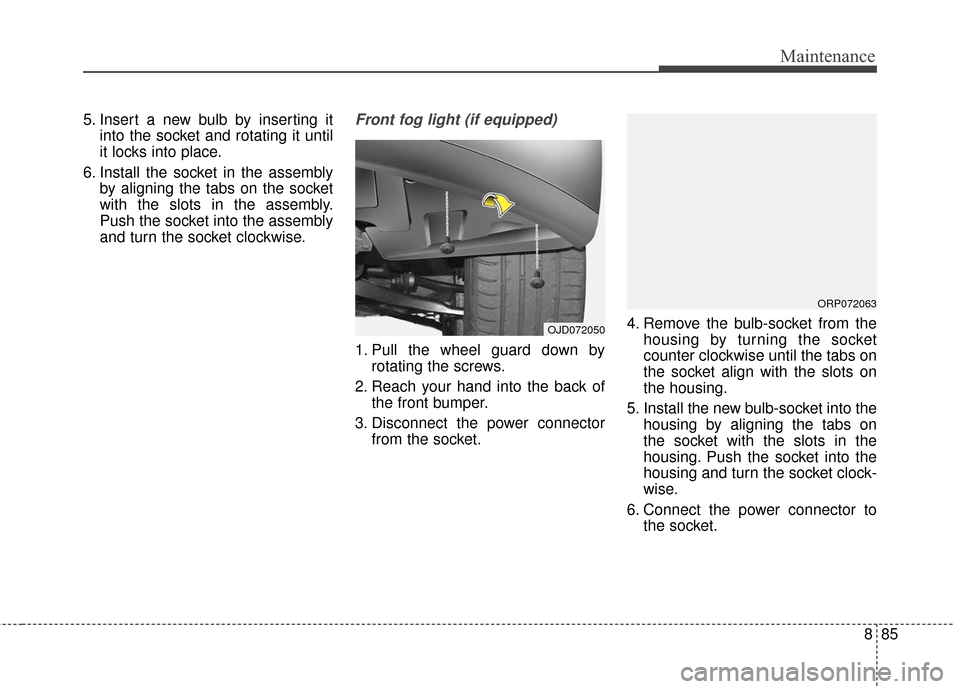
and turn the socket clockwise.Front fog light (if equipped)
1. Pull the wheel guard down byrotating the screws.
2. Reach your hand into the back of the front bumper.
3. Disconnect the power connector from the socket. 4. Remove the bulb-socket from the
housing by turning the socket
counter clockwise until the tabs on
the socket align with the slots on
the housing.
5. Install the new bulb-socket into the housing by aligning the tabs on
the socket with the slots in the
housing. Push the socket into the
housing and turn the socket clock-
wise.
6. Connect the power connector to the socket.
ORP072063
OJD072050