coolant KIA Rondo 2017 3.G Owner's Guide
[x] Cancel search | Manufacturer: KIA, Model Year: 2017, Model line: Rondo, Model: KIA Rondo 2017 3.GPages: 625, PDF Size: 19.69 MB
Page 533 of 625
833
Maintenance
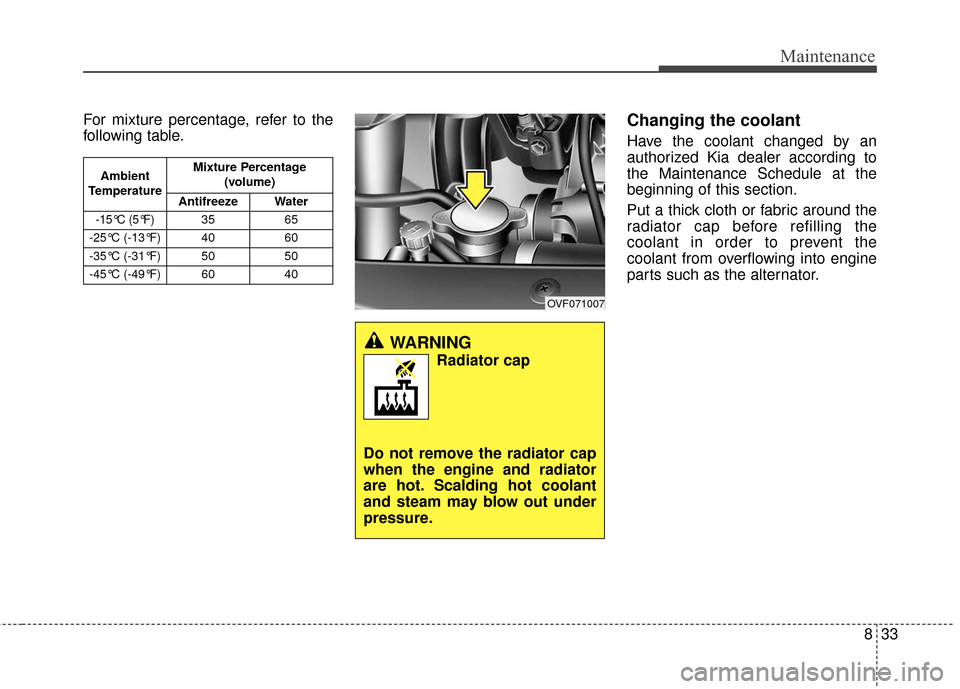
For mixture percentage, refer to the
following table.Changing the coolant
Have the coolant changed by an
authorized Kia dealer according to
the Maintenance Schedule at the
beginning of this section.
Put a thick cloth or fabric around the
radiator cap before refilling the
coolant in order to prevent the
coolant from overflowing into engine
parts such as the alternator.
WARNING
Radiator cap
Do not remove the radiator cap
when the engine and radiator
are hot. Scalding hot coolant
and steam may blow out under
pressure.
OVF071007
Ambient
Temperature Mixture Percentage
(volume)
Antifreeze Water
-15°C (5°F)35 65
-25°C (-13°F)4060
-35°C (-31°F)5050
-45°C (-49°F)6040
Page 534 of 625
Maintenance
34
8
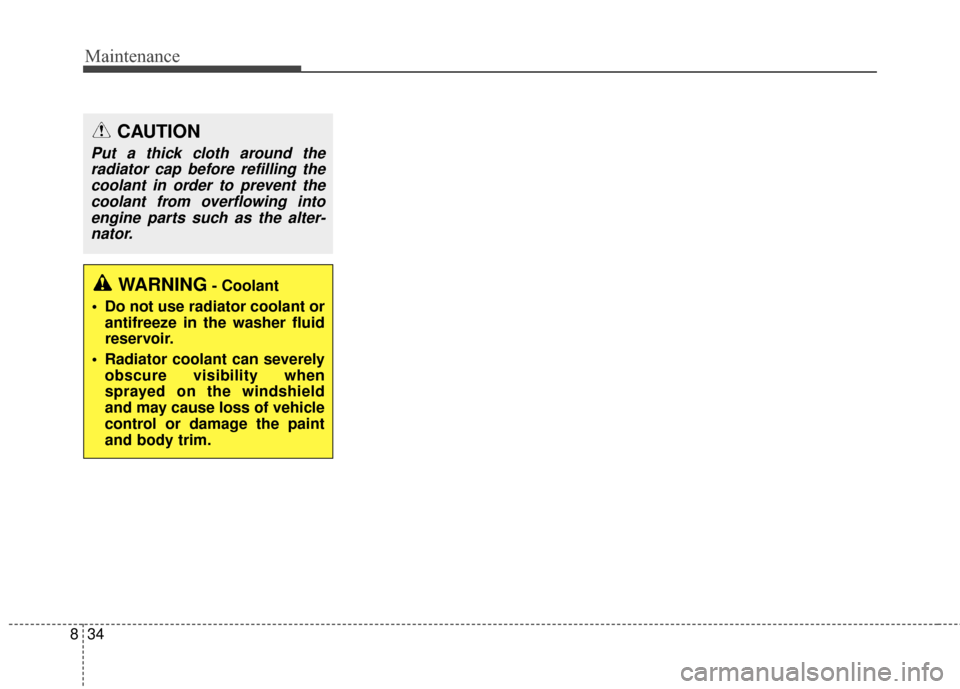
CAUTION
Put a thick cloth around the
radiator cap before refilling thecoolant in order to prevent thecoolant from overflowing intoengine parts such as the alter-nator.
WARNING- Coolant
Do not use radiator coolant or antifreeze in the washer fluid
reservoir.
Radiator coolant can severely obscure visibility when
sprayed on the windshield
and may cause loss of vehicle
control or damage the paint
and body trim.
Page 536 of 625
Maintenance
36
8
It is recommended that the automat-
ic transaxle fluid should be checked
by an authorized Kia dealer.
In severe conditions, the fluid should
be changed at an authorized Kia
dealer in accordance to the sched-
uled maintenance at the beginning of
this chapter.
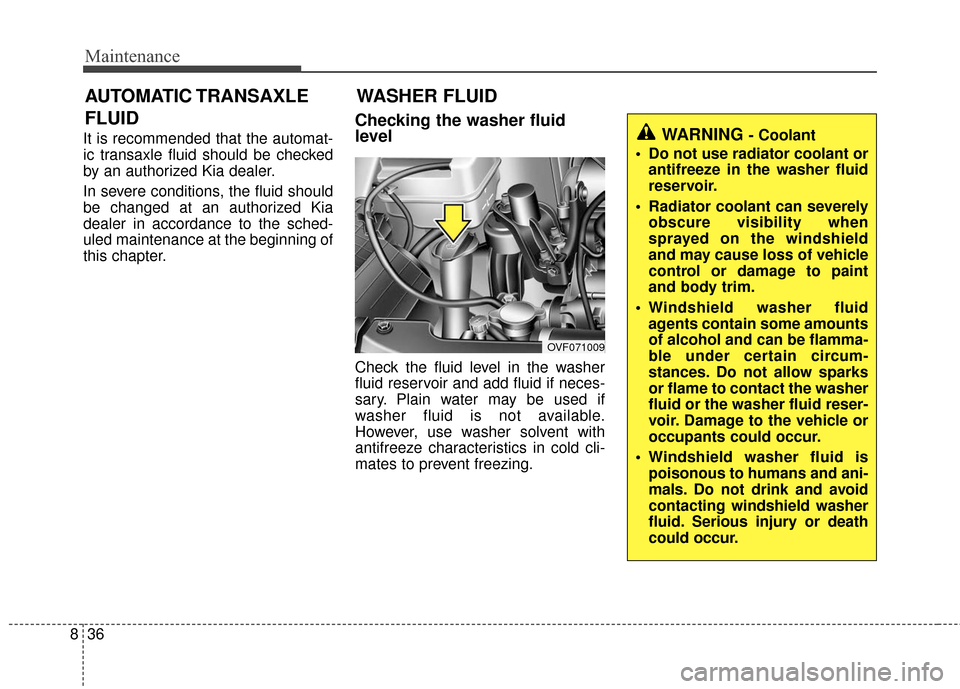
Checking the washer fluid
level
Check the fluid level in the washer
fluid reservoir and add fluid if neces-
sary. Plain water may be used if
washer fluid is not available.
However, use washer solvent with
antifreeze characteristics in cold cli-
mates to prevent freezing.
WASHER FLUID
AUTOMATIC TRANSAXLE
FLUID
OVF071009
WARNING - Coolant
Do not use radiator coolant or antifreeze in the washer fluid
reservoir.
Radiator coolant can severely obscure visibility when
sprayed on the windshield
and may cause loss of vehicle
control or damage to paint
and body trim.
Windshield washer fluid agents contain some amounts
of alcohol and can be flamma-
ble under certain circum-
stances. Do not allow sparks
or flame to contact the washer
fluid or the washer fluid reser-
voir. Damage to the vehicle or
occupants could occur.
Windshield washer fluid is poisonous to humans and ani-
mals. Do not drink and avoid
contacting windshield washer
fluid. Serious injury or death
could occur.
Page 561 of 625
861
Maintenance
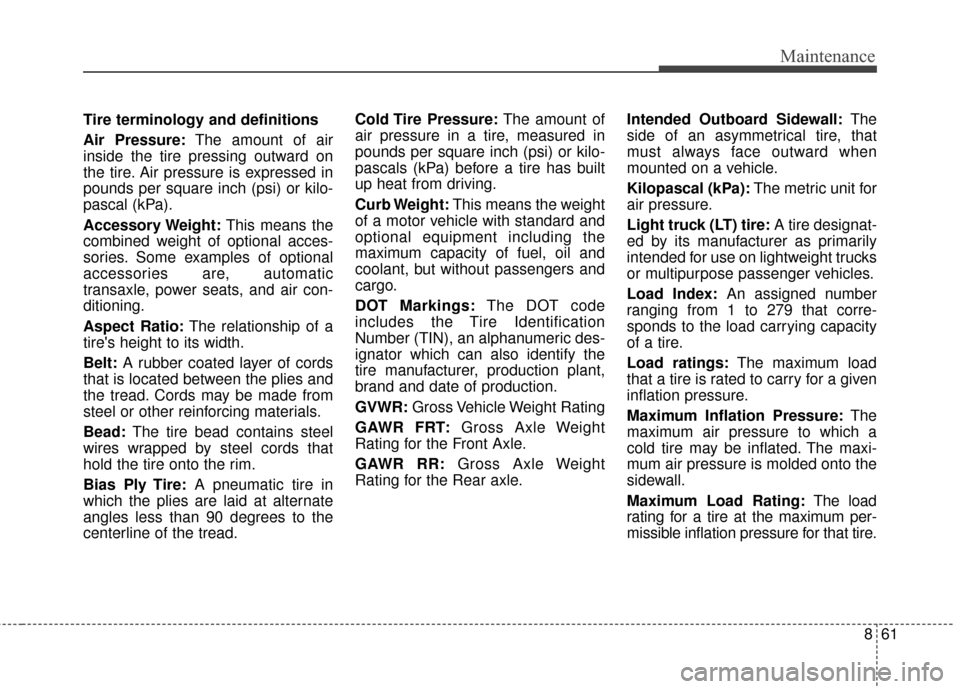
Tire terminology and definitions
Air Pressure:The amount of air
inside the tire pressing outward on
the tire. Air pressure is expressed in
pounds per square inch (psi) or kilo-
pascal (kPa).
Accessory Weight: This means the
combined weight of optional acces-
sories. Some examples of optional
accessories are, automatic
transaxle, power seats, and air con-
ditioning.
Aspect Ratio: The relationship of a
tire's height to its width.
Belt: A rubber coated layer of cords
that is located between the plies and
the tread. Cords may be made from
steel or other reinforcing materials.
Bead: The tire bead contains steel
wires wrapped by steel cords that
hold the tire onto the rim.
Bias Ply Tire: A pneumatic tire in
which the plies are laid at alternate
angles less than 90 degrees to the
centerline of the tread. Cold Tire Pressure:
The amount of
air pressure in a tire, measured in
pounds per square inch (psi) or kilo-
pascals (kPa) before a tire has built
up heat from driving.
Curb Weight: This means the weight
of a motor vehicle with standard and
optional equipment including the
maximum capacity of fuel, oil and
coolant, but without passengers and
cargo.
DOT Markings: The DOT code
includes the Tire Identification
Number (TIN), an alphanumeric des-
ignator which can also identify the
tire manufacturer, production plant,
brand and date of production.
GVWR: Gross Vehicle Weight Rating
GAWR FRT: Gross Axle Weight
Rating for the Front Axle.
GAWR RR: Gross Axle Weight
Rating for the Rear axle. Intended Outboard Sidewall:
The
side of an asymmetrical tire, that
must always face outward when
mounted on a vehicle.
Kilopascal (kPa): The metric unit for
air pressure.
Light truck (LT) tire: A tire designat-
ed by its manufacturer as primarily
intended for use on lightweight trucks
or multipurpose passenger vehicles.
Load Index: An assigned number
ranging from 1 to 279 that corre-
sponds to the load carrying capacity
of a tire.
Load ratings: The maximum load
that a tire is rated to carry for a given
inflation pressure.
Maximum Inflation Pressure: The
maximum air pressure to which a
cold tire may be inflated. The maxi-
mum air pressure is molded onto the
sidewall.
Maximum Load Rating: The load
rating for a tire at the maximum per-
missible inflation pressure for that tire.
Page 601 of 625
8101
Maintenance
Canister
Fuel vapors generated inside the fuel
tank are absorbed and stored in the
onboard canister. When the engine is
running, the fuel vapors absorbed in
the canister are drawn into the surge
tank through the purge control sole-
noid valve.
Purge Control Solenoid Valve(PCSV)
The purge control solenoid valve is
controlled by the Engine Control
Module (ECM); when the engine
coolant temperature is low during
idling, the PCSV closes so that evap-
orated fuel is not taken into the
engine. After the engine warms up
during ordinary driving, the PCSV
opens to introduce evaporated fuel to
the engine.
3. Exhaust emission control system
The Exhaust Emission Control
System is a highly effective system
which controls exhaust emissions
while maintaining good vehicle per-
formance.
Vehicle modifications
This vehicle should not be modified.
Modification of your vehicle could
affect its performance, safety or
durability and may even violate gov-
ernmental safety and emissions reg-
ulations.
In addition, damage or performance
problems resulting from any modifi-
cation may not be covered under
warranty.
If you use unauthorized electronic
devices, it may cause the vehicle to
operate abnormally, wire damage,
battery discharge and fire. For your
safety, do not use unauthorized
electronic devices.
Engine exhaust gas precautions(carbon monoxide)
Carbon monoxide can be present with other exhaust fumes.
Therefore, if you smell exhaust
fumes of any kind inside your vehi-
cle, have it inspected and repaired
immediately. If you ever suspect
exhaust fumes are coming into
your vehicle, drive it only with all
the windows fully open. Have your
vehicle checked and repaired
immediately.
WARNING- Exhaust
Engine exhaust gases contain
carbon monoxide (CO). Though
colorless and odorless, it is
dangerous and could be lethal if
inhaled. Follow the instructions
on this page to avoid CO poi-
soning.
Page 609 of 625
Specifications & Consumer information
69
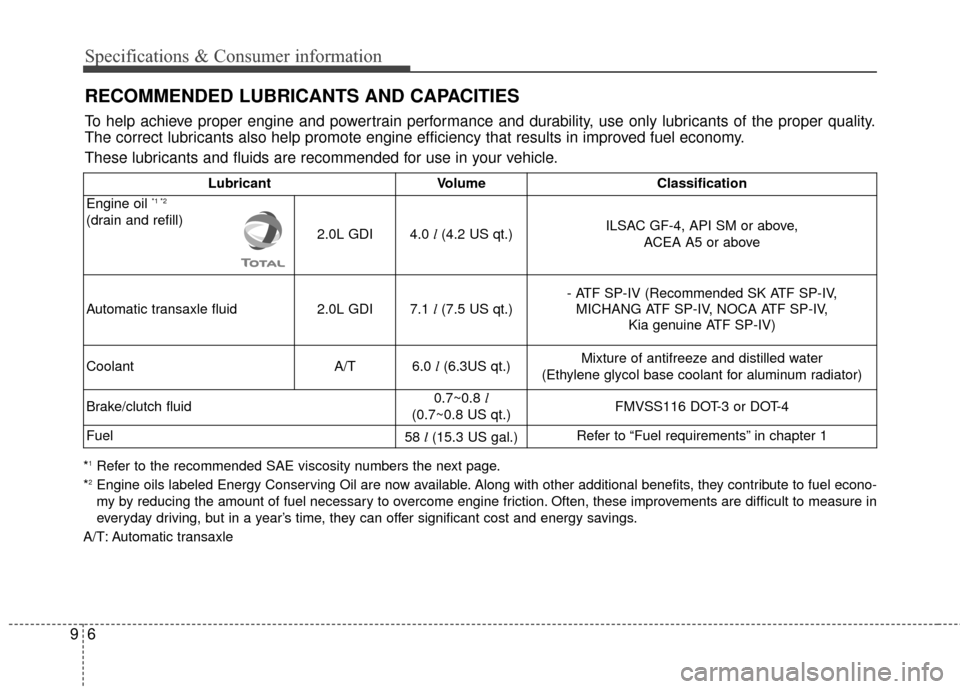
RECOMMENDED LUBRICANTS AND CAPACITIES
To help achieve proper engine and powertrain performance and durability, use only lubricants of the proper quality.
The correct lubricants also help promote engine efficiency that results in improved fuel economy.
These lubricants and fluids are recommended for use in your vehicle.
LubricantVolume Classification
Engine oil
*1 *2
(drain and refill) 2.0L GDI4.0
l(4.2 US qt.) ILSAC GF-4, API SM or above,
ACEA A5 or above
Automatic transaxle fluid 2.0L GDI7.1 l(7.5 US qt.)
- ATF SP-IV (Recommended SK ATF SP-IV,
MICHANG ATF SP-IV, NOCA ATF SP-IV, Kia genuine ATF SP-IV)
Coolant A/T6.0l(6.3US qt.)Mixture of antifreeze and distilled water
(Ethylene glycol base coolant for aluminum radiator)
Brake/clutch fluid 0.7~0.8
l
(0.7~0.8 US qt.) FMVSS116 DOT-3 or DOT-4
Fuel58
l (15.3 US gal.)Refer to “Fuel requirements” in chapter 1
*1Refer to the recommended SAE viscosity numbers the next page.
*2Engine oils labeled Energy Conserving Oil are now available. Along with other additional benefits, they contribute to fuel econo -
my by reducing the amount of fuel necessary to overcome engine friction. Often, these improvements are difficult to measure in
everyday driving, but in a year’s time, they can offer significant cost and energy savings.
A/T: Automatic transaxle
Page 615 of 625

I3
Index
Battery........................................................................\
....8-45For best battery service ..............................................8-45
Battery recharging ......................................................8-46
Reset items ..................................................................8-47
Battery replacement ........................................................4-7
Battery saver function..................................................4-104
Before driving ..................................................................6-4
Blind Spot Detection System(BSD) ..............................6-49 BSD (Blind Spot Detection) /LCA (Lane Change Assist) ......................................6-50
RCTA (Rear cross traffic alert) ..................................6-53
Driver's Attention ........................................................6-56
Bonnet see the hood ......................................................4-35
Brake fluid ....................................................................8-35\
Checking the brake fluid level ....................................8-35
Brake system..................................................................6-23 Power brakes ..............................................................6-23
Parking brake - Hand type ..........................................6-25
Electronic parking brake (EPB) ..................................6-27
Anti-lock brake system (ABS)....................................6-32
Electronic stability control (ESC) ..............................6-35
Vehicle stability management (VSM) ........................6-39
Hill-start assist control (HAC) ....................................6-40
Bulb wattage ....................................................................9-3 Camera (Rear view) ......................................................4-87
Capacities (Lubricants) ....................................................9-6
Care
Care of seat belts ........................................................3-40
SRS Care ....................................................................3-79\
Tire care ......................................................................8-\
48
Exterior care ................................................................8-92
Interior care ................................................................8-97
Cargo security screen ..................................................4-167
Center console storage ................................................4-152
Central door lock switch................................................4-23
Checking tire inflation pressure ....................................8-51
Child restraint system ....................................................3-42 Securing a child restraint withthe LATCHanchors system ..........................................................3-48
Securing a child restraint seatwith "Tether Anchor" system ......................................................................3-\
47
Placing a passenger seat beltinto the auto lock mode ...... 3-44
Child-protector rear door lock ......................................4-26
Clean air ......................................................................4-\
151
Climate control air filter ................................................8-40 Filter inspection ..........................................................8-40
Coat hook ....................................................................4-16\
4
Combined instrument, see instrument cluster ..............4-58
Coolant ........................................................................\
..8-31
Cooling fluid, see engine coolant ..................................8-31
BC
Page 617 of 625
I5
Index
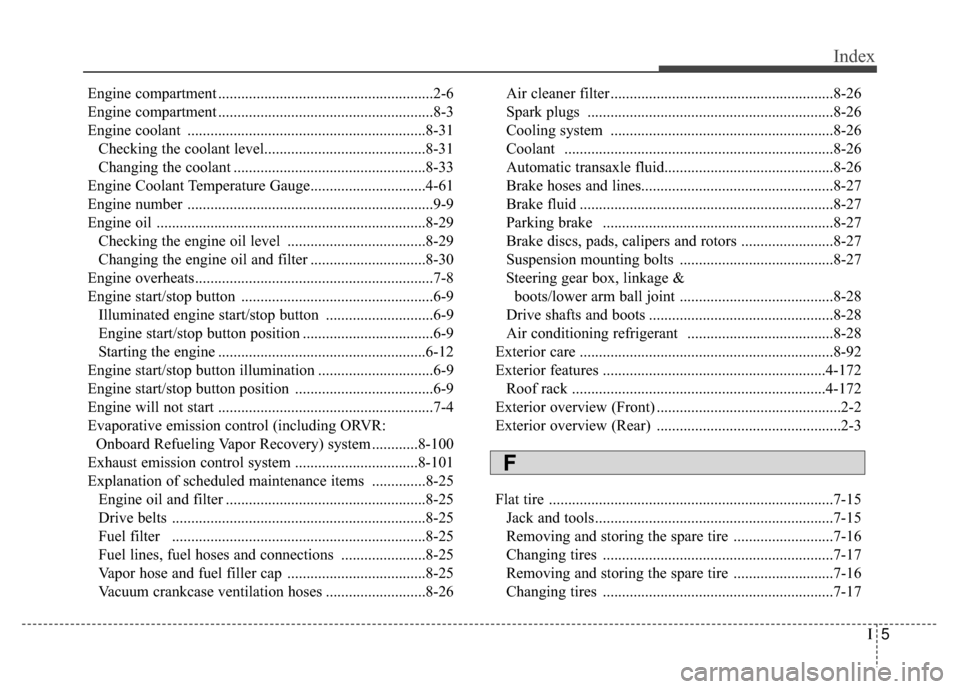
Engine compartment ........................................................2-6
Engine compartment ........................................................8-3
Engine coolant ..............................................................8-31Checking the coolant level..........................................8-31\
Changing the coolant ..................................................8-33
Engine Coolant Temperature Gauge..............................4-61
Engine number ................................................................9-9
Engine oil ......................................................................8-\
29 Checking the engine oil level ....................................8-29
Changing the engine oil and filter ..............................8-30
Engine overheats..............................................................7-8
Engine start/stop button ..................................................6-9 Illuminated engine start/stop button ............................6-9
Engine start/stop button position ..................................6-9
Starting the engine ......................................................6-12
Engine start/stop button illumination ..............................6-9
Engine start/stop button position ....................................6-9
Engine will not start ........................................................7-4
Evaporative emission control (including ORVR: Onboard Refueling Vapor Recovery) system ............8-100
Exhaust emission control system ................................8-101
Explanation of scheduled maintenance items ..............8-25 Engine oil and filter ....................................................8-25
Drive belts ..................................................................8-25
Fuel filter ..................................................................8-25
Fuel lines, fuel hoses and connections ......................8-25
Vapor hose and fuel filler cap ....................................8-25
Vacuum crankcase ventilation hoses ..........................8-26 Air cleaner filter ..........................................................8-26
Spark plugs ................................................................8-26
Cooling system ..........................................................8-26
Coolant ................................................................\
......8-26
Automatic transaxle fluid............................................8-2\
6
Brake hoses and lines..................................................8\
-27
Brake fluid ..................................................................8-27
Parking brake ............................................................8-27
Brake discs, pads, calipers and rotors ........................8-27
Suspension mounting bolts ........................................8-27
Steering gear box, linkage & boots/lower arm ball joint ........................................8-28
Drive shafts and boots ................................................8-28
Air conditioning refrigerant ......................................8-28
Exterior care ..................................................................8-92
Exterior features ..........................................................4-172 Roof rack ..................................................................4-172
Exterior overview (Front) ................................................2-2
Exterior overview (Rear) ................................................2-3
Flat tire ........................................................................\
..7-15 Jack and tools ..............................................................7-15
Removing and storing the spare tire ..........................7-16
Changing tires ............................................................7-17
Removing and storing the spare tire ..........................7-16
Changing tires ............................................................7-17
F