climate control KIA Sedona 2007 2.G Owner's Guide
[x] Cancel search | Manufacturer: KIA, Model Year: 2007, Model line: Sedona, Model: KIA Sedona 2007 2.GPages: 344, PDF Size: 3.76 MB
Page 291 of 344
6
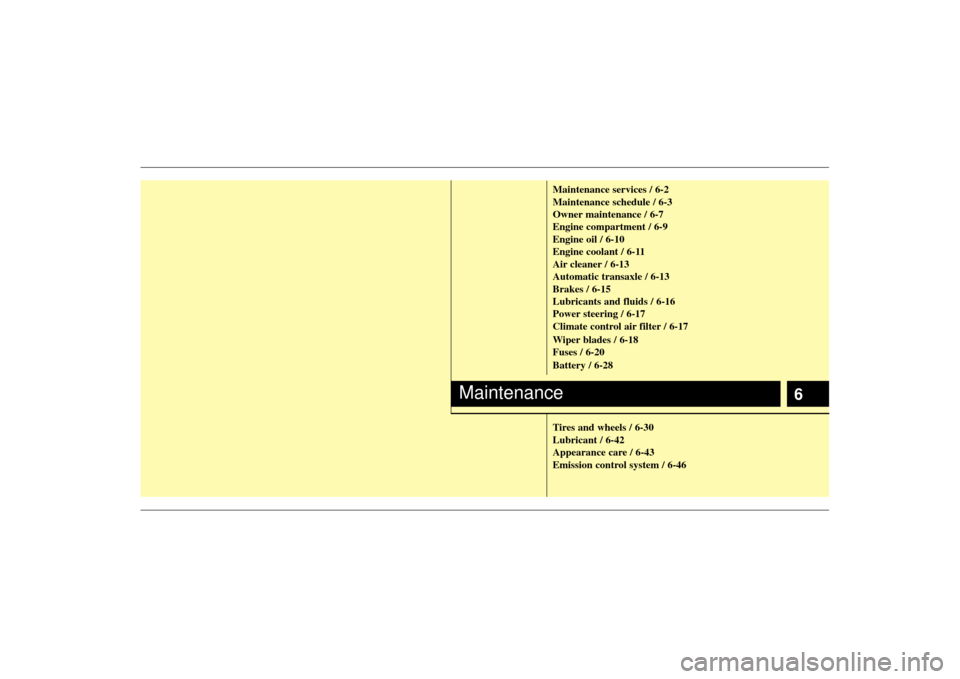
Maintenance services / 6-2
Maintenance schedule / 6-3
Owner maintenance / 6-7
Engine compartment / 6-9
Engine oil / 6-10
Engine coolant / 6-11
Air cleaner / 6-13
Automatic transaxle / 6-13
Brakes / 6-15
Lubricants and fluids / 6-16
Power steering / 6-17
Climate control air filter / 6-17
Wiper blades / 6-18
Fuses / 6-20
Battery / 6-28
Tires and wheels / 6-30
Lubricant / 6-42
Appearance care / 6-43
Emission control system / 6-46
Maintenance
Page 307 of 344

617
Maintenance
POWER STEERING Checking the power steering fluid
level With the vehicle on level ground, check
the fluid level in the power steering reser-
voir periodically. The fluid should be
between MAX and MIN marks on the
side of the reservoir at the normal tem-
perature.
Before adding power steering fluid, thor-
oughly clean the area around the reser-
voir cap to prevent power steering fluid
contamination.
If the level is low, add fluid to the MAX
level.
In the event the power steering system
requires frequent addition of fluid, the
vehicle should be inspected by an
Authorized Kia Dealer.
Use only the specified power steeringfluid. (Refer to "RecommendedLubricants" later in this section.)Power steering hosesCheck the connections for oil leaks,
severe damage and twists in the power
steering hose before driving. The climate control air filter installed
behind the glove box filters the dust or
other pollutants that come into the vehi-
cle from the outside through the heating
and air conditioning system. If dust or
other pollutants accumulate in the filter
over a period of time, the air flow from the
air vents may decrease, resulting in
moisture accumulation on the inside of
the windshield even when the outside
(fresh) air position is selected. If this hap-
pens, have the climate control air filter
replaced by an Authorized Kia Dealer.
CAUTION
To avoid damage to the power
steering pump, do not operate thevehicle for prolonged periodswith a low power steering fluid level.
Never start the engine when the reservoir tank is empty.
When adding fluid, be careful that dirt does not get into the tank.
Too little fluid can result in increased steering effort and/ornoise from the power steering sys- tem.
The use of the non-specified fluid could reduce the effectiveness ofthe power steering system and cause damage to it.
OVQ066012N
CLIMATE CONTROL AIR FILTER
1LDA5047
Outside air
Recirculatedair
Climate control
air filter Blower
Evaporator
coreHeater core
Page 308 of 344

Maintenance18
6The climate control air filter should be
replaced every 15,000 km (10,000
miles). If the vehicle is operated in the
severely air-polluted cities or on dusty
rough roads for a long period, it should
be inspected more frequently and
replaced earlier. When you try to replace
the climate control air filter by owner
maintenance, replace it performing the
following procedure, and in this case, be
careful to avoid damaging other compo-
nents.
Maintenance Commercial hot waxes applied by
automatic car washes have been
known to make the windshield diffi-
cult to clean.
Contamination of either the windshield or
the wiper blades with foreign matter can
reduce the effectiveness of the wind-
shield wipers. Common sources of con-
tamination are insects, tree sap, and hot
wax treatments used by some commer-
cial car washes. If the blades are not wip-
ing properly, clean both the window and
the blades with a good cleaner or mild
detergent, and rinse thoroughly with
clean water.
Replacement When the wipers no longer clean ade-
quately, the blades may be worn or
cracked, and require replacement.
WIPER BLADES
1VQA5022
CAUTION
To prevent damage to the wiper
blades, do not use gasoline,kerosene, paint thinner, or othersolvents on or near them.
CAUTION
To prevent damage to the wiperarms or other components, do not attempt to move the wipers manual-ly.
CAUTION
The use of a non-specified wiper blade could result in wiper malfunc-tion and failure.
Page 314 of 344

Maintenance24
6Driver's side fuse panel
Description Fuse rating Protected component
AUDIO15A Audio, Step lamp
MEMORY 7.5A Climate control module, Clock, Cluster, Trip computer, Front area module, Power sliding door module, Power
tailgate module, Driver's door module, Front passenger door module, Driver's power seat module,
Driver position memory system unit
VRS 10A Variable rack stroke system module, Variable rack stroke system control button
IG2-1 7.5A Air conditioner control module, Multi function switch, Inside relay box, ECM mirror, Rain sensor, Seat Warmer
IG2-2 7.5A Rear climate control button, Front area module, Power sliding door module, Power tailgate module, Driver's door
module, Front passenger door module, Driver's power seat module, Driver position memory system unit
OBD-II 7.5A OBD-II, Diagonosis connector
ROOM 7.5A Vanity mirror, Map lamp, Overhead console, Room lamp switch, Climate control module, Homelink
K/LOCK 7.5A Key interlock solenoid
ILLUMI 7.5A Instrument panel illumination
AMP 25A Amplifier
SEAT WARMER 20A Inside relay box(Seat warmer)
SUNROOF 25A Sunroof module
DDM 30A Driver's door module
TPMS 7.5A Tire pressure monitoring system
PEDAL 15A Power adjustable pedal relay(None-driver position memory system only)
P/OUTLET 1 15A Power outlet(Front)
ASS P/SEAT 20A Front passenger's power seat module
DRV P/SEAT 30A Driver's power seat module
ADM 30A Front passenger door module
ACC 7.5A Audio, Clock, Outside rearview mirror control and folding switch
P/OUTLET 2 15A Cigar lighter, Power outlet
START 7.5A Start relay
AIRBAG IND 7.5A Cluster
Page 320 of 344
Maintenance30
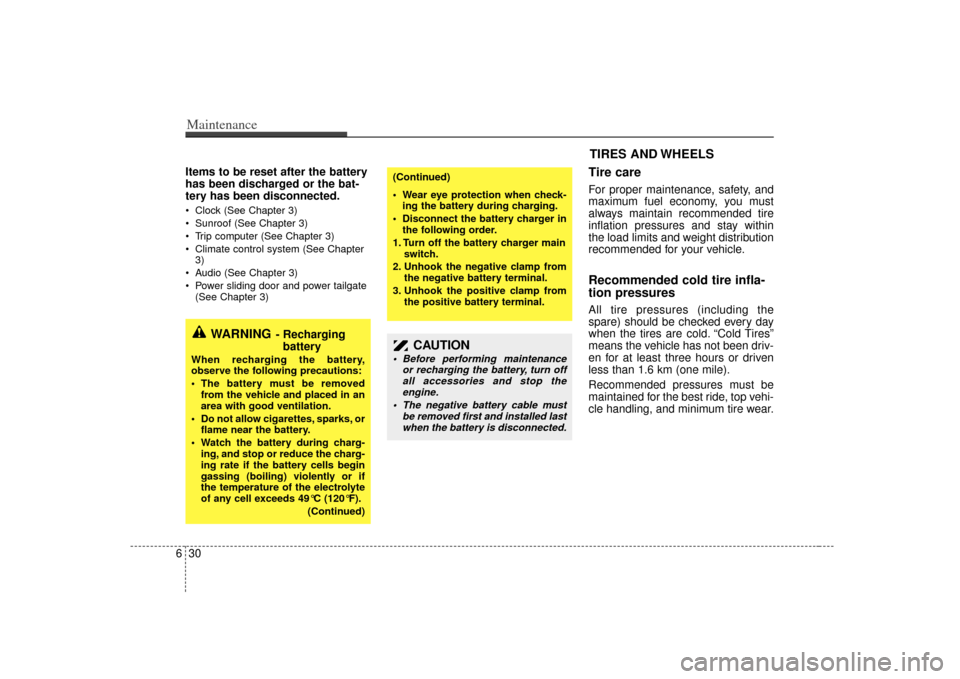
6Items to be reset after the battery
has been discharged or the bat-
tery has been disconnected. Clock (See Chapter 3)
Sunroof (See Chapter 3)
Trip computer (See Chapter 3)
Climate control system (See Chapter
3)
Audio (See Chapter 3)
Power sliding door and power tailgate (See Chapter 3)
Tire care For proper maintenance, safety, and
maximum fuel economy, you must
always maintain recommended tire
inflation pressures and stay within
the load limits and weight distribution
recommended for your vehicle.Recommended cold tire infla-
tion pressures All tire pressures (including the
spare) should be checked every day
when the tires are cold. “Cold Tires”
means the vehicle has not been driv-
en for at least three hours or driven
less than 1.6 km (one mile).
Recommended pressures must be
maintained for the best ride, top vehi-
cle handling, and minimum tire wear.
CAUTION
Before performing maintenance or recharging the battery, turn offall accessories and stop theengine.
The negative battery cable must be removed first and installed lastwhen the battery is disconnected.
WARNING
- Recharging battery
When recharging the battery,
observe the following precautions:
The battery must be removed
from the vehicle and placed in an
area with good ventilation.
Do not allow cigarettes, sparks, or flame near the battery.
Watch the battery during charg- ing, and stop or reduce the charg-
ing rate if the battery cells begin
gassing (boiling) violently or if
the temperature of the electrolyte
of any cell exceeds 49°C (120°F).
(Continued)
(Continued)
Wear eye protection when check-ing the battery during charging.
Disconnect the battery charger in the following order.
1. Turn off the battery charger main switch.
2. Unhook the negative clamp from the negative battery terminal.
3. Unhook the positive clamp from the positive battery terminal.
TIRES AND WHEELS
Page 328 of 344

Maintenance38
64. Tire ply composition and mate-
rialThe number of layers or plies of rub-
ber-coated fabric in the tire. Tire
manufacturers also must indicate the
materials in the tire, which include
steel, nylon, polyester, and others.
The letter "R" means radial ply con-
struction; the letter "D" means diago-
nal or bias ply construction; and the
letter "B" means belted-bias ply con-
struction.
5. Maximum permissible inflationpressureThis number is the greatest amount
of air pressure that should be put in
the tire. Do not exceed the maximum
permissible inflation pressure. Refer
to the Tire and Loading Information
label for recommended inflation
pressure.6. Maximum load ratingThis number indicates the maximum
load in kilograms and pounds that
can be carried by the tire. When
replacing the tires on the vehicle,
always use a tire that has the same
load rating as the factory installed
tire.7. Uniform tire quality grading The following information relates to
the tire grading system developed by
the Canadian Motor Vehicle Safety
Standard (CMVSS) for grading tires
by tread wear, traction and tempera-
ture performance. Tread wear
The tread wear grade is a compara-
tive rating based on the wear rate of
the tire when tested under controlled
conditions on a specified govern-
ment test course. For example, a tire
graded 150 would wear one-and-a-
half times as well on the government
course as a tire graded 100.
The relative performance of tires
depends upon the actual conditions
of their use. However, performance
may differ from the norm because of
variations in driving habits, service
practices and differences in road
characteristics and climate.
These grades are molded on the
side-walls of passenger vehicle tires.
The tires available as standard or
optional equipment on Kia vehicles
may vary with respect to grade.
WARNING -
Tire age
Tires degrade over time, even
when they are not being used.
Regardless of the remaining
tread, it is recommended that
tires generally be replaced after
six (6) years of normal service.
Heat caused by hot climates or
frequent high loading conditions
can accelerate the aging
process. Failure to follow this
warning can result in sudden tire
failure, which could lead to a
loss of control and an accident
involving serious injury or death.
Page 342 of 344

Index28Air bags-advanced restraint system ··················\
·············3-78
Air cleaner ··················\
··················\
··················\
···············6-13
Antenna ··················\
··················\
··················\
··················\
3-179
Appearance care··················\
··················\
··················\
·······6-43
Audio remote control ··················\
··················\
···············3-179
Audio system ··················\
··················\
··················\
·········3-180
Automatic climate control system ··················\
·············3-147
Automatic transaxle··················\
··················\
············4-5, 6-13
Battery··················\
··················\
··················\
··················\
····6-28
Before driving ··················\
··················\
··················\
············4-2
Brake system··················\
··················\
··················\
············4-14
Brakes ··················\
··················\
··················\
··················\
····6-15
Bulb wattage ··················\
··················\
··················\
··············7-2
Capacities ··················\
··················\
··················\
··················\
·7-3
Child restraint system ··················\
··················\
················3-71
Cruise control system ··················\
··················\
················4-11
Climate control air filter ··················\
··················\
············6-17
Defroster ··················\
··················\
··················\
················3-134
Dimensions ··················\
··················\
··················\
················7-2Door locks ··················\
··················\
··················\
················3-11
Driver position memory system ··················\
··················\
3-57
Economical operation ··················\
··················\
···············4-25
Electronic stability control··················\
··················\
·········4-19
Emergency starting ··················\
··················\
··················\
····5-2
Emission control system ··················\
··················\
············6-46
Engine compartment ··················\
··················\
··················\
··6-9
Engine coolant ··················\
··················\
··················\
·········6-11
Engine oil ··················\
··················\
··················\
·················6-10\
Fuel filler lid ··················\
··················\
··················\
············3-30
Fuel requirements ··················\
··················\
··················\
······1-2
Fuses ··················\
··················\
··················\
··················\
······6-20
Gauges ··················\
··················\
··················\
··················\
·3-109
Hazard warning flasher ··················\
··················\
···········3-135
Homelink® wireless control system··················\
··········3-165
Hood··················\
··················\
··················\
··················\
·······3-29
Horn ··················\
··················\
··················\
··················\
·····3-133
How to use this manual ··················\
··················\
···············1-2ABCD
EFGH
Page 343 of 344

83
Index
If the engine overheats ··················\
··················\
···············5-5
If you have a flat tire ··················\
··················\
··················\
·5-6
Immobilizer system ··················\
··················\
··················\
···3-9
Instrument cluster ··················\
··················\
··················\
··3-108
Instrument panel overview ··················\
··················\
··········2-3
Interior features··················\
··················\
··················\
······3-173
Interior lights ··················\
··················\
··················\
·········3-123
Interior overview ··················\
··················\
··················\
·······2-2
Key positions ··················\
··················\
··················\
·············4-3
Keys ··················\
··················\
··················\
··················\
·········3-3
Label information ··················\
··················\
··················\
····4-35
Lighting··················\
··················\
··················\
··················\
3-127
Lubricant ··················\
··················\
··················\
··················\
6-42
Lubricants and fluids ··················\
··················\
·················6-16\
Luggage net holder ··················\
··················\
··················\
3-163
Maintenance schedule··················\
··················\
··················\
6-3
Maintenance services ··················\
··················\
··················\
·6-2
Manual climate control system··················\
··················\
3-136
Mirrors ··················\
··················\
··················\
··················\
·3-103Overloading ··················\
··················\
··················\
·············4-34
Owner maintenance ··················\
··················\
··················\
···6-7
Power adjustable pedals··················\
··················\
·············3-58
Power sliding door and power tailgate ··················\
········3-17
Power steering ··················\
··················\
··················\
·········6-17
Rear parking assist system··················\
··················\
·········4-22
Rear seat entertainment system ··················\
·················3-21\
0
Remote keyless entry ··················\
··················\
··················\
·3-4
Road warning ··················\
··················\
··················\
·············5-2
Roof rack ··················\
··················\
··················\
···············3-164
Safety belts··················\
··················\
··················\
···············3-59
Seat··················\
··················\
··················\
··················\
·········3-37
Special driving conditions ··················\
··················\
·········4-26
Starting the engine ··················\
··················\
··················\
·····4-4
Steering wheel···············\
··················\
··················\
···········3-101
Storage compartment ··················\
··················\
···············3-169
Sunroof··················\
··················\
··················\
··················\
···3-33
Theft-alarm system ··················\
··················\
··················\
····3-7IKLM
OPRST